Why Australia Defence Spending Priorities Matter
24 April 2026 AIMN Editorial, By Denis Hay , https://theaimn.net/why-australia-defence-spending-priorities-matter/
Australia defence spending priorities reveal trade-offs between military budgets and essential public services.
Introduction
Australia defence spending priorities are increasingly raising concerns about whether public money is being directed toward national wellbeing or long-term military commitments. While governments argue that rising defence budgets are essential for security, many Australians are questioning why essential services face funding pressure while defence spending appears to expand with limited restraint.
If you value independent, fact-based analysis like this, consider supporting Social Justice Australia.
The Problem – Why Australians Feel Stuck
1. Structural cause: Alliance-driven defence policy
Australia growing military commitments through AUKUS are locking in long-term spending decisions that extend decades into the future. These agreements align Australia closely with the strategic interests of allies, particularly the United States and the United Kingdom.
Internal link: Australia’s alliance with the US
2. Consequences: Expanding costs with limited scrutiny
Defence spending is projected to reach hundreds of billions of dollars over coming decades, including submarine programs and advanced weapons systems.
AUKUS alone is estimated at around $368 billion over decades.
External evidence from Stockholm International Peace Research Institute shows that global military expenditure continues to rise, reflecting a broader trend toward increased defence investment.
For many Australians, this contrasts sharply with repeated claims that public services must run within tight financial limits.
The Impact – What Australians Are Experiencing
3. Everyday effects on cost of living and services
Australians are dealing with rising housing costs, pressure on healthcare, and job insecurity.
Internal link: Why it feels so hard to get ahead in Australia.
Public systems that directly affect daily life are under strain, often described as requiring reform, efficiency measures, or budget restraint.
4. Who benefits from Australia defence spending priorities
Large defence contractors and multinational corporations’ benefit from long-term public money commitments tied to military procurement.
These arrangements can generate significant profits, while the broader population sees fewer direct benefits in everyday life.
5. NDIS cuts and tightening eligibility criteria
The National Disability Insurance Scheme is increasingly being reshaped through funding constraints and stricter eligibility rules.
Recent changes include:
- Tighter access criteria for new applicants.
- More frequent reassessments for existing participants.
- Reduced or capped funding in some plans.
- Increased administrative requirements and documentation.
For many Australians already on the NDIS, this has created a system where they must continually prove their eligibility, navigating complex processes just to keep essential support.
According to Australian Institute of Health and Welfare, demand for disability services continues to grow due to ageing demographics and increased diagnosis rates.
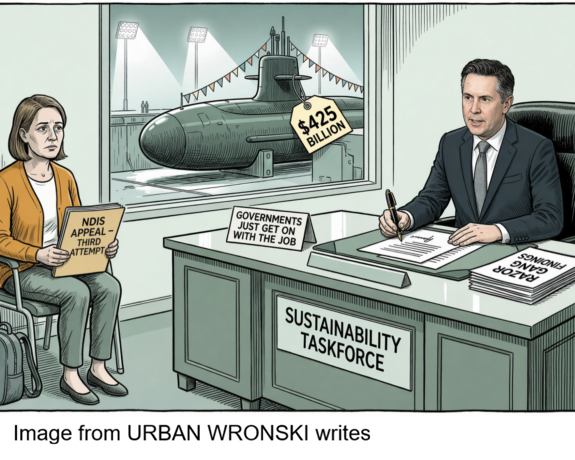
This highlights a clear contrast. Programs that directly support vulnerable Australians are being tightened, while large-scale defence commitments continue with far fewer visible constraints.
This kind of analysis is rarely covered in mainstream media.
If you want more content like this, reader support makes it possible.
While essential services tighten, spending elsewhere continues to expand.
The Solution – What Must Be Done
6. Monetary sovereignty and national priorities
Australia has full monetary sovereignty, meaning it can fund public priorities without being financially constrained in the way households are.
Modern Monetary Theory explains that governments can allocate public money toward areas that deliver the greatest social benefit, provided real resources are available.
This raises a fundamental question: why are some areas prioritised over others?
7. Practical policy reforms
- Increase transparency on defence contracts and long-term commitments.
- Introduce independent oversight of major defence projects.
- Rebalance spending toward healthcare, housing, and disability support.
- Invest in domestic industries that provide direct public benefit.
- Ensure programs like the NDIS are expanded to meet growing demand.
This article is part of a broader effort to inform and empower Australians.
Right now, the site is only partially funded.
If just a small number of readers contribute, this work continues
Final Thoughts
Australia defence spending priorities reveal a deeper issue about how national decisions are made. When large-scale commitments continue in one area while essential services face tightening conditions, it raises legitimate questions about whether current priorities reflect the needs of the Australian people.
Australia defence spending is projected to exceed 2.3% of GDP in coming years.
No comments yet.
1 This month.
20 September –National Day of Action in Melbourne on the International Day of Peace


Help Aunty Sue Protect Her Land and Sacred Sites From Destructive Rocket Testing.
.

Australians deserve the truth
about
AUKUS – https://aukuspublicinquiry.com/

PETITION – To: Prime Minister Anthony Albanese and the Australian Labor Government

of the week – Australians for War Powers Reform (AWPR)
To see nuclear-related stories in greater depth and intensity
 Antinuclear
Leave a comment