Ode to a Compassionate Warrior
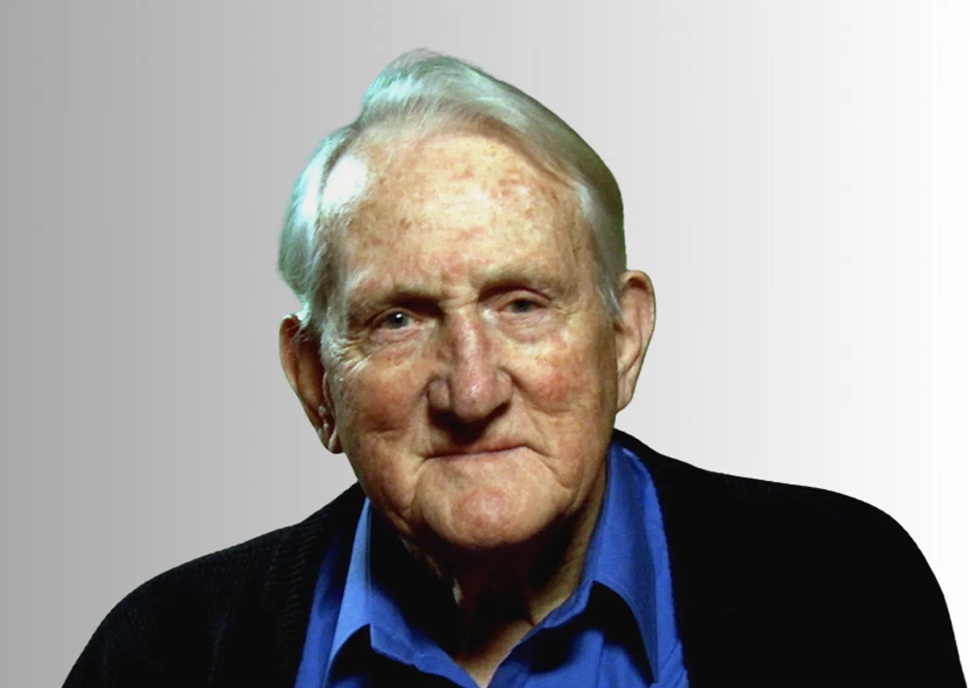
In his final year as a prisoner, when he was working underground in Japan as a coal miner, Tom gave some of the Japanese miners boxing lessons. He said some of the other Australian prisoners “didn’t like it”, but he saw the Japanese miners as being human like himself.
On Anzac Day, journalist Martin Flanagan reflects on Tom Uren’s life and legacy.
Nowadays, Tom Uren’s politics would be dismissed as “woke”. The idea behind that insult is that to be “woke” is to be weakly sentimental, to be hopelessly idealistic in a way that is at odds with reality. Only those who are hard and mean are “real”. We hear this daily. Usually from people in the media acting on behalf of the mega-wealthy, and the current political order.
I think Tom Uren knew a lot about what is real and what is not.
In 1941, at the age of twenty, he fought for the Australian heavyweight title. That year also, he joined the Army and, as a committed Christian, knelt beside his bed in the barracks each evening and said his prayers.
He was born in working class Balmain in 1921 and never forgot seeing his mother, to whom he was devoted, humiliated by a committee dispensing charity during the Depression of the 1930s.
But his political crucible was the Burma railway, where prisoners of different nations, including Australia, were worked as slaves by the Imperial Japanese Army. Over 100,000 perished.
Uren’s commanding officer was Weary Dunlop. In terms of post-war politics, Uren and Weary were generally on opposite sides, but, in Thailand in 1943 with death and disease on all sides, Uren recognised Weary as a true leader. The stories about Weary Dunlop and what he did on behalf of his men are legend. Young Tom Uren saw them happen like miracles before his eyes. He saw a morality in the prison camp experience which shaped his life. He expressed it thus: “The big man takes the heavy end of the log”. Tom was the big man. He told me he stood between a prisoner and a guard who was bashing him, taking the blows himself, adding with a twinkle in his eye, “Of course, being an old boxer, I knew how to roll with the punches”.
The only money coming into the camp was the officers’ pay. Tom was profoundly impressed by the fact that Dunlop taxed his officers. With the money, he bought food and medicine for his sick and dying men. Dunlop created what Tom called “a collective spirit”. At the Hintok camp, a British unit camped on the opposite side of the river to the Australians. Uren said the British officers took the best of the tents and equipment provided them, the sergeants the next best – the privates got what was left.
“They died like flies,” Tom would say. “We used to walk out past the dead bodies each morning going to the line”.
Tom talked about this in his maiden speech to the House of Representatives in 1958. “On one side of the river there was a collective spirit, on the other it was the law of the jungle”.
In his final year as a prisoner, when he was working underground in Japan as a coal miner, Tom gave some of the Japanese miners boxing lessons. He said some of the other Australian prisoners “didn’t like it”, but he saw the Japanese miners as being human like himself.
“I realised it wasn’t the Japanese I hated. It was militarism”.
It was while still a prisoner of the Imperial Japanese Army that Tom saw the discoloured sky that followed the dropping of the atomic bomb on Nagasaki.
In 1960, he returned to Japan and declared that the dropping of the atomic bombs on Hiroshima and Nagasaki were crimes against humanity.
Tom’s enemies called him a communist but, as I learned writing a book with him, the document he cited most often was Pope John XXIII’s 1963 encyclical Pacem in Terris (Peace on Earth). He would finish his long public life calling himself a “non-believer”, but at the same time appealing “to men and women of goodwill”.
Tom’s enemies belittled him as an old boxer, but he had a deep aesthetic sense. Among his friends were the painter Lloyd Rees and writer Patrick White.
One of the biggest inspirations of his life was hearing black American civil rights champion Paul Robeson sing to the workers on the steps of the Opera House in 1971.
Uren campaigned against the Vietnam war, conscription and nuclear armament. He was briefly jailed in 1971 for protesting against Queensland Premier Joh Bjelke-Petersen’s ban on street marches.
He feared no-one. He certainly wouldn’t have feared Donald Trump.
Tom told me the only thing that ever really scared him was the cholera virus in the prison camps.
He would’ve opposed AUKUS and resisted any Australian involvement in the current debacle in Iran initiated by Israel and the United States.
He would’ve spoken against the law of the jungle wherever he perceived it—Gaza, Lebanon, Bondi, Sudan….
He was a big man in every way, including his ego which could be child-like. He loved his government and parliamentary honours, he loved being recognised by members of the public on Sydney’s public transport system, which he considered a shining example of “collectivism”. He gloried traveling by ferry from Balmain to the centre of Sydney. Passing beneath the Sydney Harbour Bridge. The Opera House close by. The idea of that degree of beauty being available to the public thrilled him.
When I first met him and introduced myself as a journalist, he dismissed me. But the moment he heard my father was on the Burma Railway, it was like I became his son. And It continued that way for twenty-five years. (another to have a similar relationship with him was Anthony Albanese).
The first article I wrote about him, for the Good Weekend magazine, was butchered by the editors. When I rang Tom to say I was going to resign in protest, he thundered down the phone, “Don’t you resign! You stay in and maintain the struggle!”.
He fought for ex-POWs all his political life. Part of him never left the Burma railway. I believe the Burma Railway represented one of life’s ultimate realities since it asked an ultimate question: if I am to survive, what is my duty to my fellow human beings?
The great Gunditjmara warrior Reg Saunders once said to me, “People say my beliefs are soft, but I’ve measured them against every experience I’ve faced.” Tom did, too.
Tom died in 2015. I spoke at his funeral. I miss him. I miss his good advice. I have no doubt Tom Uren would be out on the street marching today.
Immediately after World War II, Tom worked a passage to England as a stoker. So that he could start his career as a professional fighter. But his body had been weakened by the recurrent bouts of malaria he suffered in the prison camps.
I read an account of his first fight. He kept getting knocked down. He kept getting up. The book I wrote with him in the final decade of his life was originally titled “Late In The Fight”. Tom never liked the title since it implied there was an end in sight. The book was published as “The Fight”.
The fight goes on, and I get strength from Tom Uren.
To quote from the song Paul Robeson sang on the Opera House step
I dreamed I saw Joe Hill last night,
Alive as you or me
Says I, “But Joe, you’re ten years dead,”
“I never died,” says he.
No comments yet.
1 This month
.

Australians deserve the truth
about
AUKUS – https://aukuspublicinquiry.com/

PETITION – To: Prime Minister Anthony Albanese and the Australian Labor Government

of the week – Australians for War Powers Reform (AWPR)
To see nuclear-related stories in greater depth and intensity


Leave a Reply