Australia’s Secret Embrace of U.S. Nuclear Planning
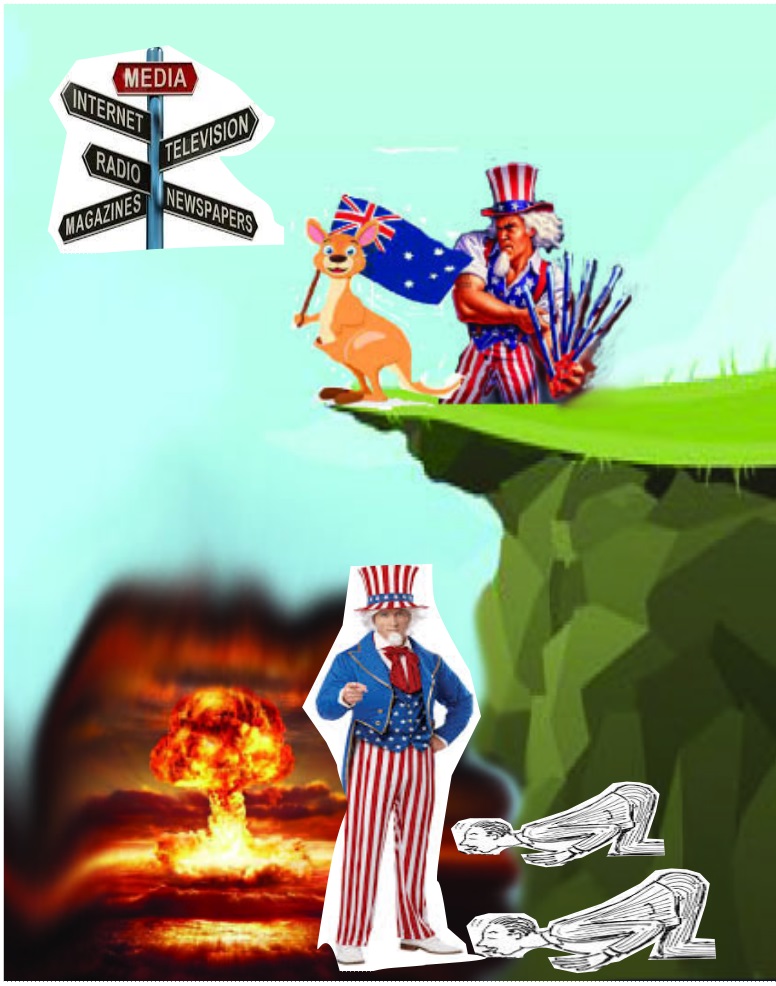
Australia’s subterfuge around its anti-nuclear commitments keeps Australians in the dark about American nuclear weapons on our territory.
DECLASSIFIED, By Jesse Boylan, ICAN Australia, Jun 12, 2026
n the morning of 15 February 2023, during a Senate Estimates hearing, Australia’s Foreign Minister Penny Wong and Defence Secretary Greg Moriarty were asked to respond to a simple but loaded question by the Greens Senator, Jordon Steele-John:
“I’m seeking on behalf of the community to get a firm commitment from the government that the [US] B-52s [long-range bombers] cycling through Australia will be solely conventionally capable, not nuclear capable.”
Senator Steele-John was trying to establish whether Australia would be hosting nuclear-capable bombers, which would undermine Australia’s nuclear-free status and increase its exposure to nuclear‑armed conflict. Adversaries, namely China, as Declassified Australia has exposed, would treat these aircraft as potentially nuclear‑armed, increasing the risk Australia could be targeted in a nuclear escalation.
Senator Wong consulted with Defence officials on the questions before providing an answer. After the mid-morning break, Secretary Moriarty addressed the question. In their report, Performing Fealty in a Nuclear Alliance, Vince Scappatura and Richard Tanter – experts on US military and intelligence facilities in Australia – describe Moriarty’s response as a “boilerplate formulation”:
[S]tationing of nuclear weapons in Australia is prohibited by the South Pacific Nuclear Free Zone Treaty, to which Australia is fully committed…Successive Australian governments have understood and respected the longstanding US policy of neither confirming nor denying the presence of nuclear weapons on particular platforms. Australia will continue to fully comply with our international obligations, and the United States understands and respects Australia’s international obligations with respect to nuclear weapons.
In other words, Australia has a nuclear weapons-free policy but would let the US circumvent it, which makes one wonder why the Foreign Minister felt she needed time to consult. Hansard documents prove that variations of this response have been used since at least 2006.
Liberals past ‘no nukes’ policy
Following the Soviet invasion of Afghanistan in 1979, in an attempt to counter Soviet regional expansion, Washington asked Australia if the US might fly B-52 bombers over the north of Australia for training purposes. Australian Liberal Prime Minister Malcom Fraser agreed.
A year later, Fraser agreed to a second American request for Indian Ocean maritime surveillance flights staging through Darwin. This time he required that the B-52s be “unarmed and carry no bombs” – meaning no nuclear weapons. Fraser went even further and forced the US to make this public, which was an unprecedented request by an ally and contrary to the US practice of neither confirming nor denying the presence of nuclear weapons on their aircraft or ships.
It’s clear Fraser held a deep distrust in America, says Tanter – who worked with Fraser on the second half of his 2014 book ‘Dangerous Allies’. This distrust had deepened after the Pentagon Papers revealed the US government had lied to the American and Australian public about the Vietnam War. Fraser also knew there could be situations where Australian and US interests would not align. US bombers flying operations from Australia raised questions of sovereignty.
While in opposition, Labor bitterly opposed and ridiculed Fraser’s protocol, but when Labor leader Bob Hawke took office in 1983, they kept it. By the end of the Cold War, in 1991, US B-52 missions wound down, and Fraser’s arrangements were essentially forgotten, rather than held onto as a model worth preserving. Every subsequent government has allowed the US military presence to expand without conditions placed on the carrying of nuclear weapons in Australian sovereign territory.
Australia’s nuclear posture has changed
Since the 1960s, secretive facilities at Northwest Cape, near Exmouth in Western Australia, and Pine Gap, near Alice Springs in the Northern Territory, have supported US early warning, communications and targeting operations – essential for nuclear war planning. These facilities on Australian soil, and our reliance on US extended nuclear deterrence, implicate us in US nuclear operations.
Under the Australia-US alliance, the US is preparing to deploy up to six B-52 bombers to RAAF Tindal airbase, near Katherine in the Northern Territory from this year. Will they be conventional-only bombers, nuclear-capable, or a mixture of both? And will the government be told?
Under AUKUS, the trilateral security partnership, US Virginia-class attack submarines will be regularly arriving at HMAS Stirling near Perth from 2027. Although this has not been specified, Vince Scappatura, a lecturer from the School of International Studies at Macquarie University, says it is possible that the submarines will be armed with nuclear weapons at some point. Although these and older attack submarines have been visiting Stirling for routine maintenance for a long time, they will become “de facto homeported at HMAS Stirling,” Scappatura says. In this way, it is conceivable that Australia might in the near future directly support nuclear combat missions from Australian soil.
Professor Gareth Evans, Labor’s Foreign Affairs Minister from 1988 to 1996, told me Australia has been “painting targets on our backs all over the place” on the assumption that the alliance is indispensable.
While upholding the Labor government policy on ‘neither confirm nor deny’ presence of nuclear weapons on visiting US aircraft, Evans was active on nuclear disarmament issues while in office, helping Prime Minister Paul Keating initiate the 1996 Canberra Commission on the Elimination of Nuclear Weapons. Since leaving office Evans has continued his work on disarmament issues and led the 2009 International Commission on Nuclear Non-proliferation and Disarmament report Eliminating Nuclear Threats: A Practical Agenda for Global Policymakers.
Performing strategic ambiguity
Later in the 2023 Senate Estimates exchange, Greens Senator David Shoebridge tried to clarify if our obligations under the South Pacific Nuclear Free Zone Treaty (SPNFZT) – also known as the Treaty of Rarotonga – restrain Australia from permitting nuclear armed B-52 bombers in Australia.
Wong quickly jumped in, asserting:
“No. You’re reading more into it. The statement says, ‘There is no impediment under this treaty or the nuclear non-proliferation treaty to the visit of foreign aircraft to Australian airfields or transit of Australia’s airspace’.”
The responses of Wong and Moriarty – who is now serving as Australia’s Ambassador to the United States – used “strategic ambiguity” as a shield to deflect Greens’ questions. It’s what Scappatura and Tanter describe as “public performance by political leaders”, which often involves obfuscation, displaced logic, and the denial of reality.
Under the Treaty of Rarotonga, ‘stationing’ of nuclear weapons in Australia is prohibited, but ‘transits’ and ‘visits’ are permitted. Dr Monique Cormier, an Associate Professor in the Faculty of Law at Monash University, told me that the line between ‘transiting’ and ‘stationing’ is “open to a lot of interpretation”. …………………………………………………………………………………………………………
Neither confirm nor deny: ‘love it or hate it’
Since 1948, Australia has accepted the US policy to neither confirm nor deny (NCND) if nuclear weapons are on visiting aircraft or ships……………………………………………………………………………………………………………………………………………………………………………………….
‘Full knowledge and concurrence‘
Where Australia allows the US to use its facilities for defence purposes, it is supposed to have “full knowledge and concurrence” of US activities on Australian soil. But this does not mean “Australia approves each individual activity or task undertaken”. Rather, Defence Minister Richard Marles said in 2023, it means that we “agree to the purpose of activities conducted in Australia, we are aware of the capabilities being used, and understand their expected outcomes.”
So, does Australia not know what the US does on its soil, or do we know, but look the other way?
Scappatura and Tanter believe Australia cannot have it both ways. It either does not know the nuclear status of visiting aircraft, ships and submarines – undermining its claims of sovereignty – or does know, but is unable (or unwilling) to share. (The Foreign Minister and Defence Minister did not respond to repeated requests for comment sent to them by Declassified Australia.) “To me,” says Scappatura, “that’s humiliating. It’s humiliating for Senator Wong; it’s humiliating for me as an Australian citizen.”
Extended Nuclear Deterrence
Associate Professor Tilman Ruff from the University of Melbourne is a co-founder and founding chair of the Nobel-prize winning organisation ICAN – the International Campaign to Abolish Nuclear Weapons. He understands the intergenerational trauma and legacy of war: his family were German immigrants in Palestine who lost many family members during both world wars. They were imprisoned as slave farm labour for the British and then interned in Australia till 1947.
Both of his grandmothers told him if war broke out again, “They wanted the first bomb to drop on their heads because they didn’t want to live through another one,” he says.
It wasn’t until after medical school, however, that Ruff learnt about the impacts of nuclear weapons and understood the responsibility on health professionals to campaign against their existence. Since then, he has dedicated his life to abolishing “the world’s worst weapons”………………………………………………………………….
Australia has formally stated it relies on the US for extended nuclear deterrence since the 1994 Defence White Paper “Defending Australia”. The expectation the US would use its nuclear weapons to protect Australia in case of attack, has never been formalised by Washington. This policy was only supposed to be an interim measure until a total ban on nuclear weapons could be achieved, says Evans, who was involved in drafting the white paper. “I don’t think anyone thought that nuclear weapons elimination was going to happen anytime soon,” he told me.
The UN Treaty on the Prohibition of Nuclear Weapons (TPNW) – also known as the nuclear weapons ban treaty – seeks to eliminate nuclear weapons entirely. It entered into force in 2021 with global support, but Australia is not yet a signatory. Instead, Australia still relies on extended nuclear deterrence, which is embedded in defence policy.
The text in Australia’s 2026 National Defence Strategy warns of a “new nuclear arms race”. It reaffirms that relying on the US for nuclear deterrence and other arms control is Australia’s best protection against increasing nuclear risk.
But in his Press Club speech, Minister Marles neglected to mention the US is a key driver of nuclear weapons proliferation, with 5402 warheads in its military stockpile: 1,770 deployed; 1,930 in reserve; and 1,342 awaiting dismantlement. A recent Congressional Budget Office report projected the US will spend up to US$1.5 trillion over the next thirty years (roughly US$95 billion a year) to modernise and expand its nuclear arsenal.
Evans firmly believes that we don’t need to rely on US extended nuclear deterrence for security, telling me:
“It’s very doubtful whether it would ever mean anything in practice. The US is highly unlikely to sacrifice San Francisco for Sydney or, or Miami for Melbourne. And so, it is pretty illusory. And to the extent that we are still relying on it, that is still a real issue to debate.” …………………………….
The path to nuclear abolition
There is no doubt nuclear weapons pose an existential threat. A modern nuclear weapon is five to ten times more powerful than those dropped on Hiroshima and Nagasaki. Their use – whether deliberate or accidental – would cause indiscriminate destruction, long-term environmental harm, and unimaginable loss of life. ………………………………………………………………………………………………….
If Palau can sign the nuclear weapons ban treaty, Australia should too, says Ruff:
“What an extraordinary lack of courage and conviction for Australia to doubt it could do the same. There couldn’t be a better time for the government to really step up and become the first nuclear complicit state to join this treaty.”
In practice, signing the nuclear weapons ban treaty would present an opportunity to renegotiate with the US to decommission or change functions of bases like Pine Gap and Northwest Cape that directly aid with the possible use of nuclear weapons. It would mean shutting down the Relay Ground Station at Pine Gap, which is essential for US nuclear war fighting, and it would mean ending our reliance on extended nuclear deterrence. https://declassifiedaus.org/2026/06/01/australias-secret-embrace-of-u-s-nuclear-planning/
Non-corporate nuclear-related news – week to 14 June

Some bits of good news – How To End A War: Lessons from Nobel Peace Prize Laureate Juan Manuel SantosMangrove forests stage a comeback. French Polynesia Protects Biodiverse Ocean Area Twice the Size of Arizona Teeming with Life
TOP STORIES. Reactor reboot at world’s largest nuclear plant highlights flaws in Japan’s radioactive waste plans.Is America ready for a nuclear explosion in space?
‘Burn for us’: The real message of US-EU ‘nuclear sharing’.
FIFA, Eurovision expelled Russia but Israel has Impunity.
Chas Freeman: The Greater Israel Project Is Collapsing Under the Weight of Endless War.
AI to double data centre power and water consumption by 2030, UN researchers say.
Climate. Record winter temperatures in Antarctic raise fears over speed of climate breakdown
AUSTRALIA.
- Technology unravels strategy and the weakness of AUKUS
- AUSTRALIA’S SECRET EMBRACE OF U.S. NUCLEAR PLANNING
- SUBMISSION: Radiation protection for workers and members of the public under AUKUS.
- Freedom Of Information to die? Albanese’s nuclear strike on transparency.
- From the archives – Freedom Of Information win as Information Commissioner rebukes Defence secrecy.
- Resisting radioactive racism in Australia.
- Nuclear test survivor’s daughter calls on First Nations communities to speak up on AUKUS
- Greens warn nuclear submarines deal risks war with China as Albanese says Aukus ‘full-steam ahead’ .
- Investigating the Foolish: The AUKUS Public Inquiry is Announced.
- More Australian news at https://antinuclear.net/2026/06/07/australian-nuclear-news-week-to-13-june/
NUCLEAR-RELATED ITEMS
| ATROCITIES. Visual data reveals extent of systematic Israeli white phosphorus attacks on south Lebanon: Report. More Palestinians killed by Israeli military and settlers across occupied West Bank in last 3 years since Gaza hostilities than previous 17 combined – Oxfam. Israel Has Engineered a Deadly Shortage of Medications and Health Care in Gaza. |
| CLIMATE. A nuclear war between India and Pakistan could destroy the ozone layer. |
| CIVIL LIBERTIES. Natasha Walter: Labour’s workaday repression of protest doesn’t alarm us – But it should. |
ECONOMICS.
- We economists have done the maths: ‘growth’ is a doomed strategy – there is a better way.
- Rolls-Royce strikes nuclear deal with Japan, likely to be tax-payer funded – ALSO AT https://nuclear-news.net/2026/06/14/6-b1-rolls-royce-strikes-nuclear-deal-with-japan-likely-to-be-tax-payer-funded/
- Campaigners demand answers over Sizewell C costs and completion date. Are the Sizewell C financing arrangements a model for other European countries? Sizewell C to move work offsite ‘as much as possible’ amid skills crisis. Department for Energy Security and Net Zero (DESNZ) defends Sizewell C funding which puts risk on taxpayer. – ALSO AT https://nuclear-news.net/2026/06/12/5-b1-department-for-energy-security-and-net-zero-desnz-defends-sizewell-c-funding-which-puts-risk-on-taxpayer/
- United Kingdom Atomic Energy Authority (UKAEA) commits £20M to UKI2S fund for fusion innovation .
- Screwed again: small investors to bail out billionaires from SpaceX, OpenAI, and Anthropic.
| EMPLOYMENT. Planned strikes suspended at nuclear site. Industrial dispute on Hinkley C site sees large police presence. |
| ENVIRONMENT. Hinkley Nuclear plant could be delayed again by demands to protect fish – ALSO AT https://nuclear-news.net/2026/06/14/6-b1-hinkley-nuclear-plant-could-be-delayed-again-by-demands-to-protect-fish/ |
| EVENTS. 25 June- THE PUKE ON NUKES. 26 June – Radiation Trainwreck at the NRC / Join the Protect Better Campaign . Protect Sazan Island from the Trump family!. Protest to be held at Calderbridge nuclear waste meeting. |
| HISTORY. How Israel Planned The Gaza Genocide Decades Ago. How The CIA Conjured Ukrainian Nationalism. Tortured US history with Iran goes back 73 years, not 47. |
MEDIA.
- Western Media Normalize Ethnic Cleansing of Lebanon by Viewing It Through Israel’s Eyes.
- Media’s Ceasefire Fiction Masks Continuing War.
- Revealed: USAID, National Endowment for Democracy & Open Society Quietly Bankroll Cuba’s “Independent” Media In Push for Regime Change.
- Honorable Mention to “HIBAKUSHA – WANDERING SOUL“
| OPPOSITION to NUCLEAR . Sizewell C: the Unanswered Questions. |
| PERSONAL STORIES. Stewart Lee: Quick – dangerous ideologies are storming the beaches – Has anyone reserved a sun-lounger? |
POLITICS.
ROSATOM report.
Trump’s Sedition Act for Israel.
Fusing the US Military and the Israeli Defense Force
POLITICS INTERNATIONAL and DIPLOMACY.
- The view from Moscow: The future of nuclear arms control exists, but the path is hard.
- IAEA board passes resolution demanding Iran report uranium stocks.
- Is the Ceasefire Dead? (w/ Alastair Crooke) -The Chris Hedges Report.
- The Gazafication of Lebanon: How Israel Exports Destruction and Washington Protects It.
- Trump news at a glance: president claims Iran ‘no longer want a nuclear weapon’ amid peace deal hopes.
- 𝐍𝐄𝐓𝐀𝐍𝐘𝐀𝐇𝐔’𝐒 𝐆𝐀𝐌𝐁𝐋𝐄 𝐖𝐈𝐓𝐇 𝐀𝐌𝐄𝐑𝐈𝐂𝐀𝐍 𝐈𝐍𝐓𝐄𝐑𝐄𝐒𝐓𝐒 𝐀𝐍𝐃 𝐒𝐎𝐋𝐃𝐈𝐄𝐑𝐒 𝐈𝐍 𝐓𝐇𝐄 𝐌𝐈𝐃𝐃𝐋𝐄 𝐄𝐀𝐒𝐓.
- ‘The Humiliation Just Compounds’: Trump Tells Netanyahu Not to Bomb Iran, Then Israel Strikes Anyway. Trump and Netanyahu: The odd couple.
- Why Europe Embraced Authoritarianism For Israel.
- International People’s Tribunal (IPT) invites representatives of the United States Government and the Government of the Republic of Korea to participate in Proceedings on Korean Victims of the Hiroshima and Nagasaki Atomic Bombings.
RADIATION. NUCLEAR HOTSEAT. Women, Children At Greatest Risk from Nuclear Radiation – UN Report by Mary Olson, Dr. Amanda M. Nichols
SAFETY.
- No electricity at Zaporizhia nuclear power plant after attack, IAEA says.
- Experts Warn Against Handing Impact Assessment of Nuclear Projects Over to Captured Regulator.
- Shipment of nuclear waste from Sellafield heads to Germany, raising safety concerns.
- UK to Extend Life of Sizewell B Nuclear Plant by 20 Years !
- The timeline for restoring operations at the Chornobyl nuclear waste storage facility following Russian shelling remains unknown – IAEA . Power returns to Zaporizhzhia nuclear plant after prolonged outage, IAEA says.
- Incidents. IAEA warning after drone hits used fuel facility near Chernobyl. Another deadly explosion casts shadow over Hanwha Aerospace’s cutting-edge image
| SPACE. EXPLORATION, WEAPONS. Space Force needs to prepare for an ‘in-person’ moon conflict with China, new report argues. United Nations Open-ended working group on the prevention of an arms race in outer space in all its aspects (“OEWG on PAROS”) |
| SPINBUSTER. The push to lift Ireland’s nuclear ban: Going nuclear or nowhere? Beyond the Propaganda: The French Uniqueness and the New Nuclear Dead End – Excerpts at https://nuclear-news.net/2026/06/14/6-b1-beyond-the-propaganda-the-french-uniqueness-and-the-new-nuclear-dead-end/ Hegseth Compares D-Day Troops to Europe’s Migrants. Israel Could Solve Its PR Problem By Simply Ceasing To Be Evil. |
| TECHNOLOGY. Can small nuclear reactors deliver for Europe? Nuclear-fusion firm says plant will deliver electricity to grid — but big questions remain. |
WAR and CONFLICT.
- US Begins Another Round of Attacks on Iran.
- War crime -US ‘precision strikes’ cut water access to 20,000 people in southern Iran.
- Putin Powerfully Rebuffed The Hawks Who Want Him To Attack NATO.
- Russian drone hits nuclear fuel site near Chernobyl – ALSO AT https://nuclear-news.net/2026/06/12/5-b1-russian-drone-hits-nuclear-fuel-site-near-chernobyl/
- Battle for Kiev 2022: The Battle That Never Was [i].
Nuclear weapons spending surges to record high of $119bn, report says .
Britain has become third-largest nuclear weapons spender – CND. UK overtakes Russia as Labour hike nuclear weapon spend by 17 per cent. UK Navy nuclear submarine fleet stuck in dock while awaiting maintenance.
North Korea will never give up its nuclear weapons, says Kim Jong-un’s sister. Kim Jong Un vows to build nuclear-armed navy with ‘secret underwater weapons‘ as he tours warship with his daughter.
| WOMEN. A Collective Call by the Women of the World. |
1 This month
17 October, Free Public Talk on Nuclear Issues in South Australia
David Noonan will speak on public interest concerns over the new Roxby Downs Indenture Act 2026 on BHP copper-uranium mining and ore processing in SA, and on how AUKUS may face SA with a High-Level nuclear waste agenda.
Dr Jim Green will discuss international developments in the field of nuclear power including ‘small modular reactors’ and Generation 4 ‘advanced’ nuclear reactor concepts.


Help Aunty Sue Protect Her Land and Sacred Sites From Destructive Rocket Testing.
.

Australians deserve the truth
about
AUKUS – https://aukuspublicinquiry.com/

PETITION – To: Prime Minister Anthony Albanese and the Australian Labor Government

of the week – Australians for War Powers Reform (AWPR)
To see nuclear-related stories in greater depth and intensity

