Submission to the AUKUS Public Inquiry – against Australia’s interest to be aligned with aggressor USA – Diane Atkinson
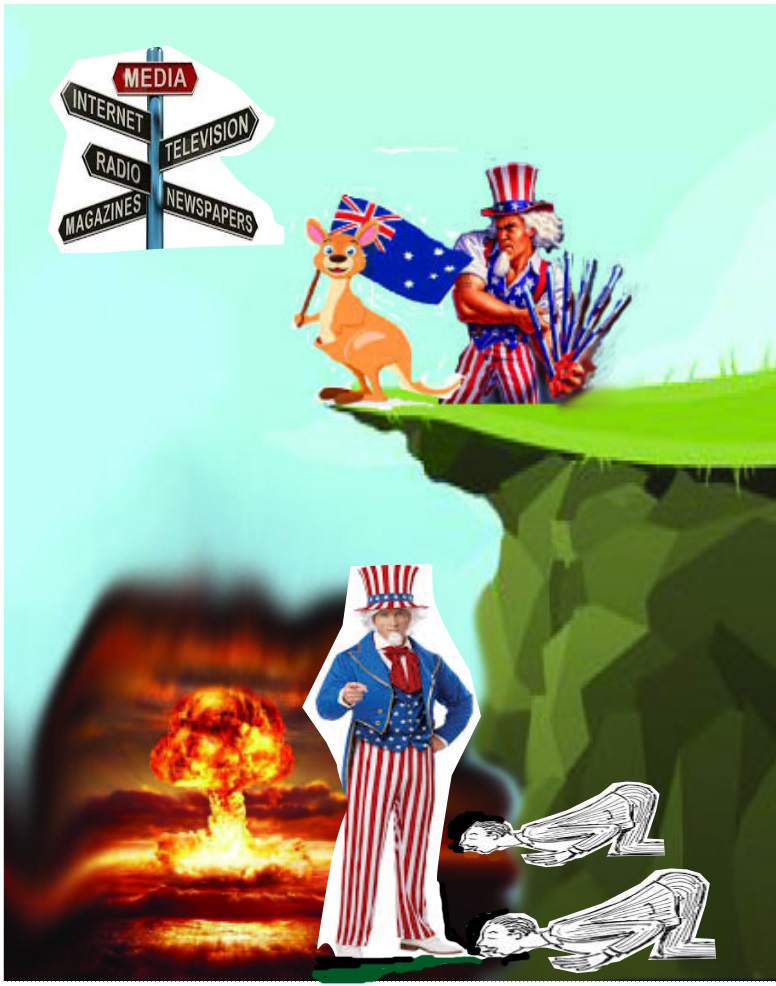
When they attacked Iran, the United States acted as a rogue state. They launched this attack in defiance of rules laid down in the United Nations’ charter, against wars of aggression. This war is already proving to be very much against Australia’s interests
Australia should be seeking to extricate ourselves from the alliance with the US, given the nature and direction of its wars of aggression, rather than tying ourselves more deeply to this alliance through AUKUS.
the danger that wars will be launched from Australian territory by the US, and that Australia will bear the brunt of retaliation against the US.
No 233.
AUKUS represents a very large investment by Australia: $368 billion over 30 years. This is a very
significant portion of our total budget, so we would want to ensure that we get good value, and that
it prepares Australia for the future. However, there is plenty of evidence that this commitment is
taking Australia in the wrong direction. Where we need to be contributing to a more stable and
cooperative world, so that we can solve collective challenges, we will instead be contributing to the
humanitarian and environmental damage that will be wrought by a declining empire, with no
tangible benefit to Australia.
We need to carefully weigh the security threats that are unfolding at this point in history, before we
commit to 30 years of spending. We know that climate change represents a major threat, which is
proving very difficult to confront. Building goodwill and cooperation would contribute to this task,
however the AUKUS alliance does the opposite. Australians have always resisted the nuclear
industry, but this deal forces us to accept the presence of nuclear-powered submarines, and the
waste that will require disposal on our soils. Having nuclear submarines present here is likely to
drive a regional arms race. At a time when resources need to be spent finding solutions to pressing
problems such as climate change, we will instead spend those resources on wasteful weapons of war.
The increased military spending will be perceived as a threat by other powers, and will undermine
the goodwill and global cooperation needed to produce binding agreements to reduce carbon
emissions. Instead, other countries will be obliged to also waste more resources on military
production.
When they attacked Iran, the United States acted as a rogue state. They launched this attack in
defiance of rules laid down in the United Nations’ charter, against wars of aggression. This war is
already proving to be very much against Australia’s interests. It threatens the availability of diesel
fuel and fertilizers, which are so important to Australia’s food security. At this time in history,
Australia should be seeking to extricate ourselves from the alliance with the US, given the nature and
direction of its wars of aggression, rather than tying ourselves more deeply to this alliance through
AUKUS.
Australia’s national security interests are not identical with those of our military ally, the United
States of America. The Global Financial Crisis of 2008 did not impact Australia in the severe way that
it impacted the USA or Europe. One of the reasons that Australia barely registered a recession
during this crisis, is the strength of our trade with China, which accounts for 25% of Australian trade,
based on 2025 figures from DFAT. It could be argued that we are too dependent on trade with China,
but when we think about our national interests, this current reality of China being our strongest
trading partner, needs to be factored in. Australia’s interests are not identical to those of the USA or
Europe, and this is a reflection of both geographical and economic differences. Our proximity with
Asia means that it makes sense for us to trade with Asia, including China. This also makes sense
because we have natural resources that these markets need, while we have lost or failed to develop
our manufacturing base, and our Asian neighbours can supply low-cost manufactured goods. We
made a decision to reduce tariffs and close down some of our industries. These decisions have
consequences for our security.
There is no identifiable threat to Australia’s security that currently emanates from our Asian
neighbours, including China. However, as a result of our free trade policies, we do now face an
economic threat, if our trade is interrupted. This could happen as a result of war, or of trade wars. Neither are in Australia’s interests, given our lack of self-reliance. Australia’s lack of self-reliance in
oil stands in contrast to the position of the United States. The problems in the Strait of Hormuz,
caused by US attacks on Iran, impact Australia more heavily than our military ally.
The United States has different defence priorities to Australia. The US seeks to suppress the rising
powers that have begun to challenge US hegemony. This has become obvious through their attacks
on Iran, which also have a negative impact on both Russia and China, since Iran is at the centre of key
trade corridors, and for that reason both countries have substantial investments in Iran. US leaders
make it very clear that they are hostile to China and Russia, along with a list of nations that are not
willing to accept US domination.
Since the US dollar is the world reserve currency, and this confers huge economic benefits on the US,
challenges such as the BRICS nations trading in their own currencies and using their own payment
systems, are likely to have negative consequences for the position that the US has enjoyed. The
power to shape institutions like the World Bank and trade rules such as the GATT arises from the
overwhelming economic power that the US has held, and this is ultimately backed by their military
power, which has been used to thwart countries that want to reduce the economic and political
dominance of the US over their internal governance. This was manifest in repeated military
interventions in Latin America last century, and in the Middle East more recently.
However, Australia is in a very different position. We are not an empire with hegemony to defend.
We are a smaller power, very reliant on trade, and therefore we have an interest in a stable world
order, and good relations with our Asian neighbours. We have already been adversely affected by
the war on Iran, and this could lead to a direct threat to our national security. One dimension of this
is food security. Diesel and fertilizers are essential inputs to our farming sector, and any resumption
of the war on Iran is likely to cause shortages of both.
The other threat to Australia’s security is the danger that wars will be launched from Australian
territory by the US, and that Australia will bear the brunt of retaliation against the US. We have seen
this happen in the Middle East. Iran retaliated against US military bases in the UAE, Kuwait, Iraq,
Bahrain, Qatar and most recently Jordan, since the US launched their attacks from those bases.
Military agreements such as the Force Posture Agreement and AUKUS prevent Australia from
controlling what the US does on our soil. We may not expect retaliation from Iran because US bases
in Australia in all likelihood provide intelligence for attacks on Iran, but we could well expect
retaliation if the US goes to war with China. Based on US threats, this scenario is currently the most
likely reason that any country might attack Australia.
Australia is currently allied with the very country that is launching wars of aggression. Even the
average person living in the US does not benefit from these wars. They have seen their standard of
living deteriorate over past decades. This deterioration is caused by a shift in the US economy,
whereby it is increasingly dominated by private monopolies, and the public sector increasingly serves
the interests of these rather than the general public interest. This tendency has reduced the
vibrancy of US industry. Even the arms industry, which receives so much public funding, produces
expensive equipment which is proving to be obsolete on the battlefield. Aircraft carriers and
battleships have repeatedly been withdrawn from the area of engagement in the Strait of Hormuz, as
they make easy targets for cheap drones and for missiles. The USA is not demonstrating that it can
use military force to great effect, and yet it relies on such force increasingly, suggesting once again
that it is an empire in decline.
In its attempts to shore up this loss of power, the US is leaning more heavily on its allies like Australia.
We are expected to subsidize the extravagant expenditure on arms that continued world domination
would require, at the expense of our own interests. AUKUS arose out of Australian attempts to
purchase non-nuclear submarines from France. We now find that the Australian prime minister who
undermined that process, and instead committed Australia to purchasing nuclear submarines from
the US and the UK, is now working for the US arms industry. It is obvious that as prime minister, he
was already promoting those interests. Instead of obtaining working submarines in a reasonable
timeframe at a reasonable cost, we now have a program that commits Australia to massive spending,
with no guarantees as to what Australia will get in return. Meanwhile AUKUS spending is driving a
war economy. Education spending by the South Australian government subsidises degrees for the
arms industry, instead of degrees for health care workers and teachers. In this way we are directly
subsidising US owned arms manufacturers, while under-investing in the sectors that ensure our
collective well-being. In the midst of a housing crisis, when many young Australians cannot afford to
buy a home, and many cannot even find let alone afford rent, we neglect to make the necessary
investments in social housing, and instead spend to subsidise the operations of foreign arms
companies. We train our young people to build arms instead of building houses.
The secrecy surrounding AUKUS shows that its proponents have no faith in their ability to convince
Australians that this appalling decision is in our interests. Any reasonable person can see that it is
not.
No comments yet.
1 This month
17 October, Free Public Talk on Nuclear Issues in South Australia
David Noonan will speak on public interest concerns over the new Roxby Downs Indenture Act 2026 on BHP copper-uranium mining and ore processing in SA, and on how AUKUS may face SA with a High-Level nuclear waste agenda.
Dr Jim Green will discuss international developments in the field of nuclear power including ‘small modular reactors’ and Generation 4 ‘advanced’ nuclear reactor concepts.


Help Aunty Sue Protect Her Land and Sacred Sites From Destructive Rocket Testing.
.

Australians deserve the truth
about
AUKUS – https://aukuspublicinquiry.com/

PETITION – To: Prime Minister Anthony Albanese and the Australian Labor Government

of the week – Australians for War Powers Reform (AWPR)
To see nuclear-related stories in greater depth and intensity


Leave a Reply