Australia’s “Antisemitism Envoy” Says The Pro-Palestine Left Are The Real Nazis
Caitlin Johnstone, Oct 30, 2026, https://www.caitlinjohnst.one/p/australias-antisemitism-envoy-says?utm_source=post-email-title&publication_id=82124&post_id=222727090&utm_campaign=email-post-title&isFreemail=true&r=1ise1&triedRedirect=true&utm_medium=email
Australia’s “antisemitism envoy” Jillian Segal has released a new report claiming that the primary threat to Jews in our country comes from left-wing pro-Palestine activists, which Segal hilariously labels “issue-motivated antisemitism”.
(Genocide. The “issue” is genocide.)
This, obviously, is an admission that Jillian Segal’s whole entire mission in Australia is to encourage government powers to stomp out pro-Palestine activism and protect the information interests of the apartheid state of Israel.
“Modern, progressive antisemitism is the most pervasive manifestation of antisemitism facing Australia today,” Segal’s report asserts. “It is often not a standalone hatred like the other sources. Rather, it serves to justify and legitimise antisemitism, providing it with intellectual and cultural credibility and, ultimately, making it fashionable. It does this by effectively laundering far-left antisemitism and Islamic extremism through a progressive lens, such as social justice and human rights, together with traditional antisemitic tropes, giving fundamentally extremist ideologies an apparently acceptable face.”
In a section titled “Far-left antisemitism or issue-motivated antisemitism,” Segal’s office complains that “Israel is portrayed as a colonial project that is inherently racist,” which she says “allows longstanding antisemitic motifs to be repackaged in the academic language of antiracism, decolonisation, human rights, social justice and intersectionality, often in service of a traditional Marxist revolutionary agenda.”
Here’s an excerpt:
“Over time, the language of human rights and its greatest crimes — apartheid, ethnic cleansing, genocide, etc. — has increasingly been appropriated to portray Israel (and, relevantly, members of the Jewish community who support it) as morally evil, often to the point of being equated to Nazis.
“In contemporary Australia, elements of Australia’s historically fringe radical left have sought to appeal to well-meaning mainstream progressive Australians who may perceive the Palestinian cause as a matter of social justice. This ‘gateway’ issue, of sorts, has been used by far-left activists to magnify their appeal and prominence and to attempt to introduce traditionally moderate Australians to radical and anti-Jewish propaganda that would previously have been of little interest.”
Segal repeatedly warns that antisemites are guilty of the “conflation” of Jewish people with the state of Israel while also repeatedly going out of her way to lump Jews in with support for the Israeli state, complaining of the view that “anyone who identifies as a Zionist is themselves fundamentally wicked, notably including the overwhelming majority of Jewish Australians who, as an inextricable part of their Jewish identity, hold a belief in the right of Israel to exist.”
In reality, Israel lobbyists like Segal are the ones who are guilty of conflating all Jews with the actions of Israel. That is what you are doing when you claim that opposition to a genocidal apartheid state is hateful toward Jews.
To help curb the actions of the “issue-motivated” antisemites, Segal recommends the implementation of exclusion zones for protesters, a ban on face coverings for demonstrators, extra review measures for people who are in this country on visas, and extra oversight of public broadcasters the ABC and SBS to ensure fair and balanced coverage of Israeli atrocities.
Segal’s office also recommends incorporating the authoritarian, pro-Israel IHRA working definition of antisemitism into every level of the law, calling for “Facilitation by law enforcement agencies, prosecutors and judicial education bodies of ongoing, appropriate and tailored education to their members regarding antisemitism, its contemporary expressions and the application of the IHRA definition.”
Segal also recommends forcing online platforms to adopt “the IHRA definition into community standards and policies for content moderation,” which would see people banned from social media for such self-evidently correct actions as comparing Israel to Nazi Germany or saying that Zionism is a racist endeavor.
As you might expect, the Australian press are dutifully regurgitating Segal’s left-punching propaganda with zero pushback. The Australian ran the story on the new report with the headline “‘Pervasive progressive hate’: antisemitism envoy’s new blueprint,” while The Age and The Sydney Morning Herald went with “New wave of Australian antisemitism comes from progressive social justice critics, says antisemitism envoy.”
I have said it before and I will say it again: anyone who talks about “left-wing antisemitism” like it’s a real problem which presents a real threat is a lying manipulator and should be treated as such. They are pretending to believe things that no one actually believes in order to promote the interests of a genocidal apartheid state.
At a recent Senate hearing, Jillian Segal was confronted by the leader of the Australian Greens, David Shoebridge, for her false Royal Commission testimony asserting that the Gaza death toll has been “grossly inflated” according to the United Nations. The spokesperson for the UN Secretary-General directly refuted this claim earlier this year, saying, “For us the Ministry of Health in Gaza is a source we, and many others, often cite. Independent validation of subsets of the data has found no significant discrepancies in their numbers.”
Jillian Segal is an immoral, manipulative white South African whose job is to deceive the public in order to facilitate genocide and apartheid. That is the light under which her recommendations should be viewed, and any government which espouses them should be viewed as supportive of the most extensively documented crimes against humanity in the history of the human species.
AUKUS and the dangerous illusion of national security
By David Higginbottom | 29 October 2026, https://independentaustralia.net/politics/politics-display/aukus-and-the-dangerous-illusion-of-national-security,21733
The Hormuz crisis shows why Australia cannot fight this century’s war with last century’s weapons, writes David Higginbottom.
ON 4 NOVEMBER at the National Press Club and broadcast live by the ABC, the independent AUKUS Public Inquiry will release its report.
This will not settle the question of Australia’s security policy. It is a civil society inquiry, not a parliamentary committee and its conclusions should be tested rigorously. However, so should the Government’s case for AUKUS. Australians have been asked to accept far-reaching claims about deterrence, sovereignty, jobs, cost and regional security.
Those claims still require a transparent, independent public test of the assumptions on which they rest and of the alternatives Australia has set aside.
That is why the Inquiry has already mattered. It has widened the debate from submarines alone to transparency and democratic accountability, arms expenditure and public priorities, Parliament’s role, relations with China and the wider security choices Australia faces.
The 2026 Hormuz crisis makes that wider discussion urgent. A country can prepare for high-end naval conflict while remaining exposed to the civilian systems through which modern war reaches people.
For most Australians, the first experience of a distant conflict is unlikely to be an enemy warship off the coast. It is more likely to be a higher fuel bill, a delayed shipment, disrupted travel, a shortage of a critical input, pressure on food prices, or an interest rate decision that asks households to absorb an imported shock. This is how security succeeds or fails in a trade-dependent country.
The International Energy Agency says that about one quarter of the world’s seaborne oil trade and almost one fifth of global LNG trade passed through the Strait of Hormuz in 2025. When the 2026 conflict disrupted that route and damaged energy infrastructure, the effects were not confined to the Gulf. Oil and gas flows tightened, refining capacity was lost, freight costs rose and the market for refined products, especially diesel, came under acute pressure.
The shock is still moving through the systems that move goods, people and basic necessities.
The UN Trade and Development assessment makes the chain clear. Higher energy prices bring higher freight, fuel and insurance costs. Fertiliser becomes more expensive, then food. The most vulnerable countries and households have the least capacity to absorb the shock. The International Maritime Organisation records the human dimension: seafarers, crews and port workers were caught in the danger and uncertainty of a trade route that could no longer be assumed safe.
Australia is in that chain. The Government and Industry Fertiliser Supply Working Group reported in June that the conflict had forced Australia and other countries to seek alternative urea supplies in a more competitive global market. The Government’s fuel and fertiliser facility helped secure shipments, but it also acknowledged that recovery would take time and disruption would persist.
The lesson is not that Australia must produce, or hold emergency stores of, every item it consumes. It is that security must include dealing with an emerging conflict before it becomes a wider crisis and before people in the conflict zone bear the immediate cost. It must also include practical preparations for the effects that will otherwise be passed on to Australian farms, freight operators and households.
The IEA’s October Oil Market Report describes how Middle East product disruption has coincided with lower Russian refinery output and exports after Ukrainian drone attacks. The result has been severe pressure on global diesel supplies. This should not reduce Russia’s war against Ukraine to a fuel price story, or diminish the suffering it has caused.
It demonstrates that the consequences of different wars now converge in the same supply chains. A disruption in one theatre erodes the buffers needed to manage a disruption in another.
The point is not that conventional naval power has become irrelevant, or that an adversary could not threaten Australia by sea. That is the strongest version of the AUKUS case and it should be stated fairly.
But the reciprocal point is equally important. A submarine cannot substitute for civilian resilience. It cannot:
- reopen a damaged airport;
- deliver medicines after a cyclone;
- restore insurer confidence in a threatened waterway;
- replace a fertiliser shipment;
- repair a power or water system; or
- prevent supply shock from becoming a cost-of-living crisis.
If national security is measured only by the capacity to fight, Australia may spend extraordinary sums on a capability that performs a narrow task while underinvesting in the systems that keep society functioning under pressure. It may also underinvest in diplomacy and regional cooperation that reduces the likelihood of a crisis developing in the first place.
The Government’s 2026 National Defence Strategy and Integrated Investment Program recognises national resilience and civil preparedness as part of defence. Parliament should now require an annual public account of fuel and critical input security, port and freight continuity, electricity and communications recovery, disaster readiness, cyber resilience and the protection of households from shocks they did nothing to cause. They are the conditions that determine whether a nation can withstand coercion without breaking.
The same annual account should apply a harder public test to AUKUS itself. What exact contingency is the capability designed to address? When will it be available? What must Australia rely on the United States and United Kingdom to provide? What can Australia decide, maintain, repair, adapt and decline to use? What are the costs, workforce and schedule risks?
The UK Parliament’s Defence Committee has identified continuing United States submarine production constraints as a foundational delivery risk — these are questions citizens are entitled to ask before a commitment becomes too large to reconsider.
The 4 November report should prompt a wider public test, not another contest between slogans.
Every major security investment should be judged by the danger it reduces, the time it takes to provide protection, the degree of Australian control, its effect on civilian continuity, its potential to increase or reduce escalation and the alternatives that address the same harm. A capability may pass one part of that test and fail another. That is precisely why Australia needs a portfolio, not a single prestige answer.
Hormuz has shown what that portfolio must protect: safe and lawful trade routes, the confidence of crews and shippers, fuel and fertiliser supplies, energy and communications systems, essential infrastructure, regional trust and the diplomatic capacity to stop crises spreading.
Australia needs the capacity to defend itself. It also needs the political maturity to understand that the purpose of defence is not merely to survive a damaged world. It is to prevent one.
1 This month
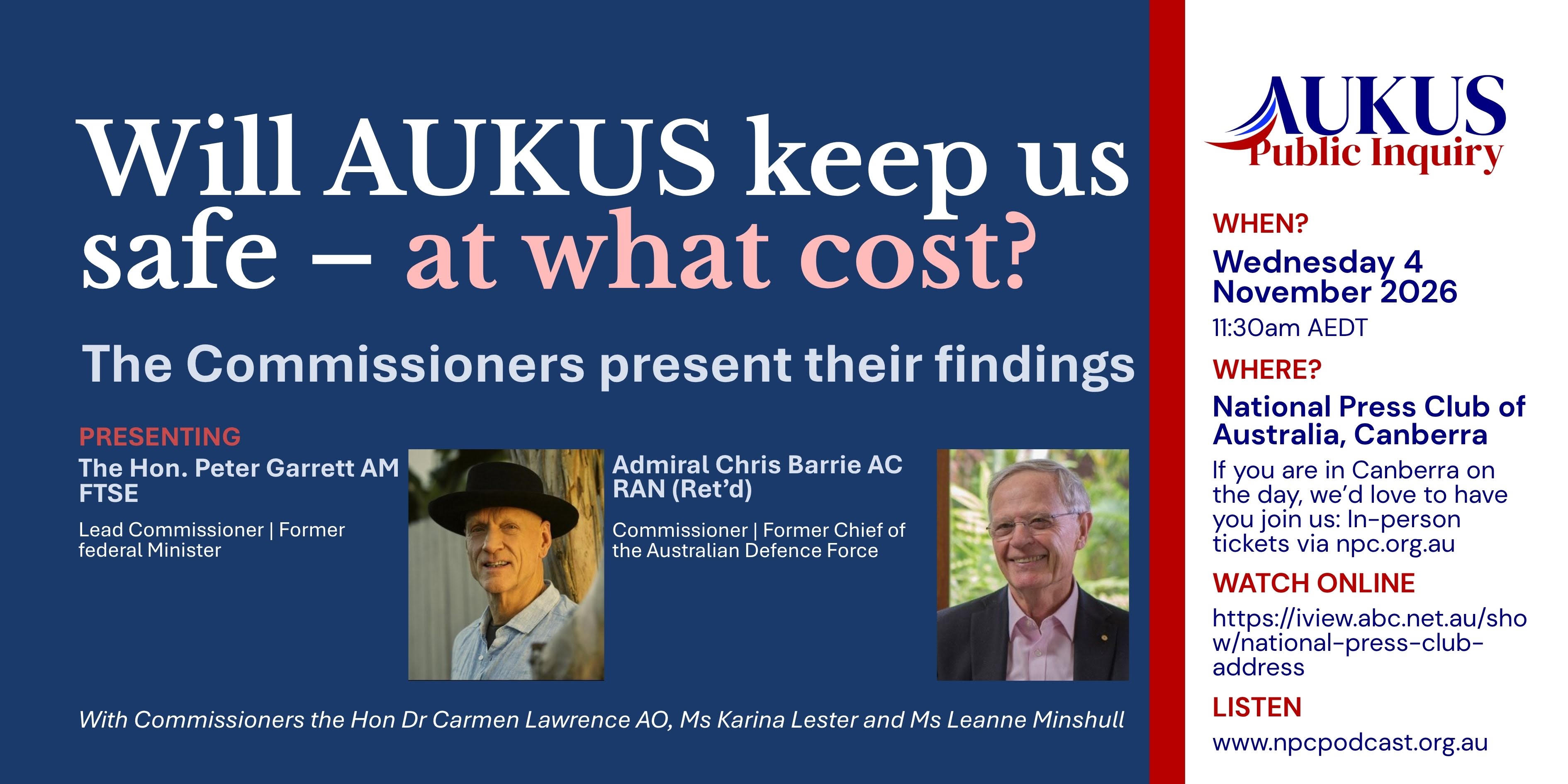
4 November – Will AUKUS keep us safe – at what cost?
the Commissioners of the AUKUS Public Inquiry present their findings at the National Press Club of Australia in Canberra. iview.abc.net.au/show/national-press-club-address
Australians deserve the truth
about
AUKUS – https://aukuspublicinquiry.com/

PETITION – To: Prime Minister Anthony Albanese and the Australian Labor Government

of the week – Australians for War Powers Reform (AWPR)
To see nuclear-related stories in greater depth and intensity

