Submission to AUKUS Public Inquiry – with a focus on Western Australia – STOP AUKUS

No 320 https://drive.google.com/file/d/1nkcNWsxkD82ipTDEguemqIQ0LNEk0DXn/view
Stop AUKUS WA is grateful for the opportunity to make a submission to the 2026 Public
Inquiry into AUKUS.
Although not specifically included in the TOR of the Inquiry, we will mainly focus on the
regional/local impacts of AUKUS and only briefly outline our perception of the broader
issues, noting that we concur with the substantial submissions to date by respected experts
including Tilman Ruff, Richard Tanter, Dave Sweeney, Joseph Camileri and John Lander.
National and International Issues
An appropriate defence asset?
The Virginia class submarines to be purchased under AUKUS Pillar 1 were originally
designed for the main purpose of deterring Chinese submarines from launching missiles
into mainland USA.
They are not suitable for defence of coastal Australia where a larger fleet of smallersubmarines would be more appropriate. By the time of delivery of Virginia class or SNN-AUKUS submarines they are likely to be obsolete due to improved underwater detection methods and development of underwater drones (ironically being developed under AUKUSPillar 2).
Financial implications
The huge cost of procuring nuclear-powered submarines under AUKUS, now estimated at
A$375 billion (albeit including a substantial contingency), inevitably detracts from
expenditure on other ADF options. This in turn exacerbates the defence budget creep which
consumes funds better spent on combating real existential threats of climate change and
nuclear war, and on social well-being programs. Furthermore, history has shown that initial
projected costs of large military or civilian projects (e.g. Snowy Hydro) inevitably blow out.
The risks of committing to such expenditure are huge – non-delivery of submarines, pending
obsolescence, the fallacious assumption China is our enemy etc.
Loss of sovereignty
The military interoperability and increased implementation of the Force Posture Agreement
(FPA) implicit in AUKUS will ensure further subservience to the USA, obliging Australia to
continue following the US into wars of its choosing. The assumption that subservience to the
US or having US bases on our soil will ensure Australia’s security and safety is false
particularly in light of the prevailing “America First” agenda. The recent attacks on US Bases
in West Asia are also testimony to this.
There are also serious doubts Australia would have the nuclear-ready workforce to operate
its own nuclear-powered submarines; equally that the US will meet the production level
requirements needed to provide Australia with the much touted 3 Virginia Class SSNs in
2032, ’35, ‘38 and that the US will simply perpetuate a quasi SRF-West co-crewed by US
and Australian crews but under the command of the US.
Abrogating treaties
AUKUS also threatens to undermine the Nuclear Non-Proliferation Treaty (NNPT) to which
Australia is a signatory: it would exploit the loophole in the Treaty which technically permits
visiting vessels (as opposed to ‘stationed’ vessels) being nuclear capable. This is especially
alarming given Australia’s “Don’t ask – Don’t tell’ attitude and the increasing likelihood that
the future models of Virginia Class submarines could be nuclear armed.
Further, the highly enriched uranium (HEU) used in Virginia Class submarines, and in the
Rolls Royce reactors for Australia’s SSN-AUKUS to be built at Osborne, can be used either
directly or with reprocessing, in the manufacture of nuclear weapons. Although the current
legislation prohibits Australia from enacting this, there is always the implied risk or possible
breach of security which could facilitate this.
Nuclear Waste Concerns (other than localised at HMAS Stirling)
AUKUS commits Australia to storing the high level nuclear waste from the 2nd hand Virginia
Class submarines to be procured in the 2030’s and Australia’s own SSN-AUKUS.
Decommissioning the reactors will generate potent waste remaining dangerously radioactive
for tens of thousands of years. This will require secure storage at an undisclosed
astronomical price and ‘defence site’ yet to be determined – no doubt to be again rightfully
challenged by First Nations peoples. AUKUS would be committing Australia to an inevitable
problem to which no solution is on the horizon, a damming legacy.
Diplomacy vs aggressive deterrence
China is Australia’s major trading partner as well as the intended US target adversary of
AUKUS which inevitably could have adverse repercussions on trade relations. Some harsh
trade restrictions imposed by China recently suggest that this is already happening. Further,
most Asian nations see AUKUS as an anglospheric reincarnation of European colonial
dominance – the antithesis of enhanced regional security.
Australia’s security could best be enhanced by rapidly expanding Australian diplomacy in the
region, combined with an independent foreign policy based on peace and justice.
Impacts of AUKUS on research, universities and foreign student intake
AUKUS imposes laborious and stringent restrictions on research partnerships and foreign
students from countries other than the USA and UK. This is reportedly leading to a brain drain back to China or to elsewhere. Recent data cited by Clarivate reveals Australia-
Chinese co-authored publications in the top 10% of those most cited globally over the pastfive years in computer science, materials science and engineering far outnumbers those co-
authored with US partners – 54% to 12%. Only 5% of China’s top publications involve an Australian author.
Confining Australia to research and development with its anglosaxon partners is a setback to
our scientific and technological development which risks Australia being left way behind in
the global arena. It is also having a negative impact on the foreign student intake which in
turn impacts universities’ income earning capacity.
WA Specific Issues
Loss of local jurisdiction
Currently, two bays in the north of Garden Island and beaches on the west of the island are
accessible to the public by boat during daylight hours for recreational purposes. There is
also a “closed naval waters” buffer zone to the east of the island in Cockburn Sound.
Although the Australian Navy, the Australian Submarine Agency (ASA) and the Australian
Naval Nuclear Power Submarine Agency (ANNPSA) all claim that public access to the island
will not be further impacted under Submarine Rotational Force West (SRF-West) as of 2027,
it is difficult to believe. The whole of the island is already a designated [nuclear] zone under
the ANNPS Act.
Also, a considerable area of Cockburn Sound adjacent to Garden Island, now accessible to
recreational boats, would likely become a restricted zone. With the increased traffic and
stationing of nuclear-powered submarines and the radioactive waste facility to be built in the
southern part of the island it is also highly likely that the current assurances that public
access to the Sound for fishing, boating, snorkelling and other water activities will not be
impacted, will ultimately prove untrue.
2. Environmental heritage effects………………………………….
3. Housing, employment and the local economy………………………………….
4. Henderson Defence Precinct – the AUKUS dry dock……………………………….
- Congestion in Cockburn Sound: commercial shipping, toxic industry and
recreational boating
6. Local Nuclear Issues – Waste and Radioactivity
The stationing of US and UK nuclear powered submarines at Stirling under SRF-West
necessitates in-water maintenance which in turn requires a Controlled Industrial Facility
(CIF) to manage and store the low level radioactive waste. ARPANSA granted the
construction licence to ASA in 2025 after a flawed public consultation – the public were
denied access to requested technical and detailed information regarding the intended
structure and radioactive materials to be handled and ultimate disposal procedures.
No information was given of the identity and amounts of the actual isotopes involved, other
than to claim that it would be “low level waste” of the type emanating from hospitals and
research labs such as gloves and protective clothing. It is essential to know the details of
hazardous substances before it can be worked out how best to handle and store them. The
radioactive waste was initially claimed to be of short half-life but later it was admitted that
some isotopes would have a half-life of about 300 years. The actual lifespan of the CIF (on
precarious geological island land, especially given climate change) was put at 40-50 years.
And all in the face of there still not being a permanent/long term storage site/plan or in fact
anywhere to take it to in case of emergency.
It is feared that the radiological waste from the temporary CIF storage facilities at Stirling and
Henderson will eventually be transported by road through, or in close proximity to, populated
areas. Authorities prefer not to discuss this and claim it is still in the planning stage.
At other bases for UK and US nuclear powered submarines there have been reports of
release of radioactive materials into the air and the harbour (e.g. Faslane, Scotland). In the
AUKUS proposals so far put out for consultation such possible emissions (including
evaporation of liquid waste) have been acknowledged but with no clear indication as to how
they would be monitored, minimized, remedied or reported to the public.
7. Accidents, safety and secrecy
…………………….Disturbingly, we have learned that the US is intending to relax its safety standards for
radiation exposure by a factor of five, against long accumulated medical advice. It remains
unknown as to what extent these relaxed standards would be applied in and around US
nuclear powered submarines, especially as the SRF West rotations will occur under the
2014 Force Posture Agreement (FPA) with the US and Stirling being listed as a special
facility and area under the FPA. Under Article IV.1, this gives the US “unimpeded access to
and use of Stirling” for related activities.
Article V.5 states “The Parties shall mutually develop procedures to address incident and
accident responses, including for the following matters: (a) first response; (b) the security of
incident or accident sites and human remains; (c) investigations; and (d) public statements
concerning accidents and incidents.”
Stop AUKUS has sought clarification of this issue via Questions posed at the various ASA
Information sessions held in 2025 and 2026 in Fremantle, Perth, Cockburn and Rockingham
and via repeated emails to the ASA – all to no avail.
The nuclear safety record for nuclear submarines is not good, and unlikely to be better for a
nation with no prior experience in nuclear submarines. At least nine nuclear-powered
submarines have sunk. Decommissioned nuclear-powered submarines are not dismantled
due to absence of permanent storage facilities for their reactor fuel, anywhere. Since 2006 a
total of 789 nuclear safety events were recorded at HM Naval Base Clyde at Faslane and
nearby Royal Naval Armaments Depot Coulport. The UK has ceased public reporting of
nuclear accidents since 2017.
With the standing up of the Australian Naval Nuclear Power Safety Agency (ANNPSA) on 1
November 2025 it has taken over naval nuclear safety and reporting from ARPANSA. It
reports to the Minister of Defence, who would no doubt be hesitant to disclose any mishaps
or misdeeds of their ministry – thus is an ineffective mechanism to gain and maintain social
licence of AUKUS, especially in the advent of any accidents.
It is usual practice that the military everywhere, and most civilian governments, are reluctant
to publicly report accidents, and especially those involving radiation, to prevent credibility
loss and loss of social licence. This tendency towards secrecy is readily apparent in the
ongoing local AUKUS public consultancy process (e.g. “information not available for security
reasons”) and ASA’s community information sessions in a belated attempt to gain some
semblance of social licence which is clearly lacking in the ill-conceived AUKUS plan.
Although visiting nuclear powered submarines fall under the OPSMAN visiting ships manual,
the new Regulator will play a role – seemingly yet to be defined even though the Regulator
has been in existence for 8 months. The WA Police are responsible for managing any
incident response under the HAZMAT Annex A – Radiation Escape From A Nuclear Powered
Warship (NPW) – State Hazard Plan. An update of the 2023 manual to factor in the ANNPSA
has been in the making for some time and still uncompleted or if it has been it is still not
publicly available.
We maintain none of the above bides well for social licence nor Australia’s nuclear readiness
in the eyes of its AUKUS partners.
8 Target
Our initial protests that establishing a base for US nuclear submarines in the vicinity of the
Perth metropolitan area would make us a prime target, rather than protect us, in any future
global-scale conflict were essentially dismissed. However, the recent US-Israel war on Iran
has illustrated how US bases do become prime, first-choice targets. The bombing of Pearl
Harbour by the Japanese in their opening of the war with the USA some 85 years ago
provides another example.
There are no contingency provisions for the public in the event of attacks on HMAS Stirling,
either conventional or nuclear. A successful conventional attack would in any case lead to
the uncontrolled release of radioactive contents from submarines and storage facilities.
9 China trade
A majority of the container ships visiting Fremantle, and eventually Westport, are involved in
the China trade. The existence of AUKUS discourages that trade with the general
understanding that the purpose of AUKUS is to join the US in militarily confronting, or as a
minimum, containing China. Understandably China is now seeking alternative trading
partners and would be reluctant to send their commercial shipping into hostile ports.
Conclusion
It is apparent that creation of AUKUS was primarily motivated by Australian political party
jostling for power, the US desire for a nuclear submarine base in the Indian Ocean/Australia
and the lingering nostalgia of the UK for a lost empire. The project as proposed is more likely
to antagonise Australia’s relations with its neighbours rather than enhance the security of the
country, and we would inevitably need to sacrifice further sovereignty to the USA. AUKUS
has so far not received the required parliamentary scrutiny for such a complex, costly and
future setting commitment.
Public consultancies held around various components of AUKUS such as the Australian
Submarine Agency’s licence applications for the siting and construction of a radioactive
waste storage facility at Stirling lacked sufficient information for thorough public scrutiny and
the outcome seemed preordained.
In WA, promises of increased employment and economic stimulation seem exaggerated,
especially when all of the disadvantages of proceeding are considered. It is clear that the
issue of nuclear waste has not been adequately thought through, especially the long-term
storage aspects designed to deal with nuclear reactor isotopes for millennia.
AUKUS poses a public health and safety, environmental, security and social cohesion risk to
the Cockburn Sound communities. It lacks social licence and a cost benefit analysis.
Australia’s submarine and defence policy needs an urgent rethink – as does the Australia-US
Alliance.
No comments yet.
1 This month
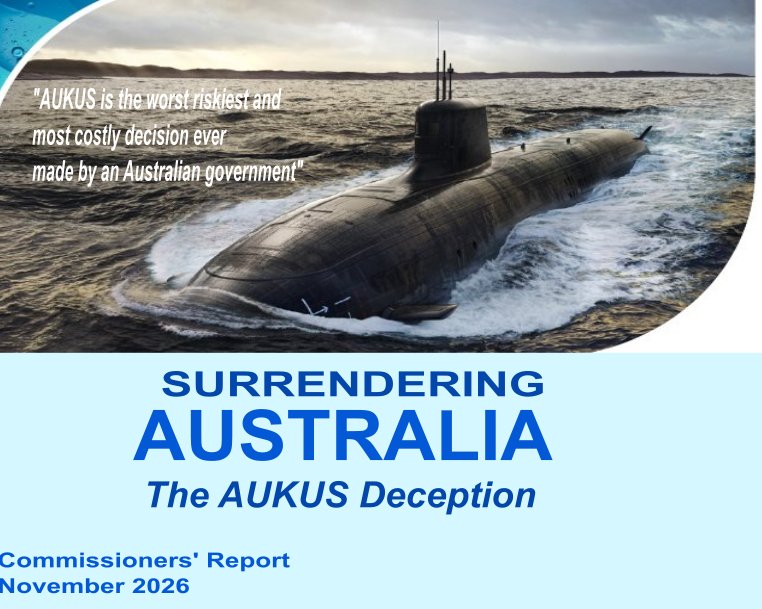
Read the Public Inquiry Report, the Commissioners’ report, Surrendering Australia: The AUKUS Deception is available to download for free at aukuspublicinquiry.com. Or just watch the replay of the National Press Club Luncheon.
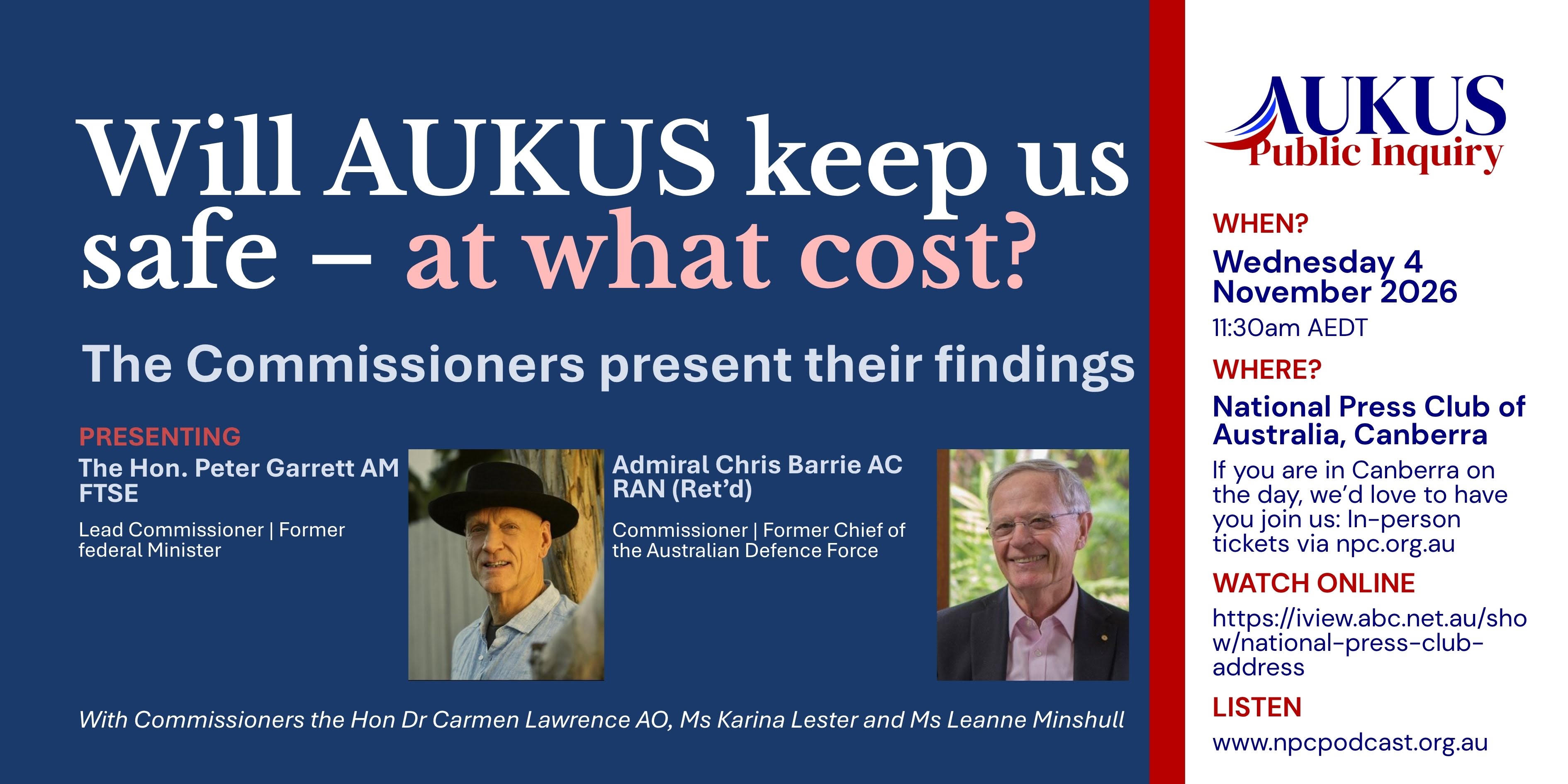
4 November – Will AUKUS keep us safe – at what cost?
the Commissioners of the AUKUS Public Inquiry present their findings at the National Press Club of Australia in Canberra. iview.abc.net.au/show/national-press-club-address
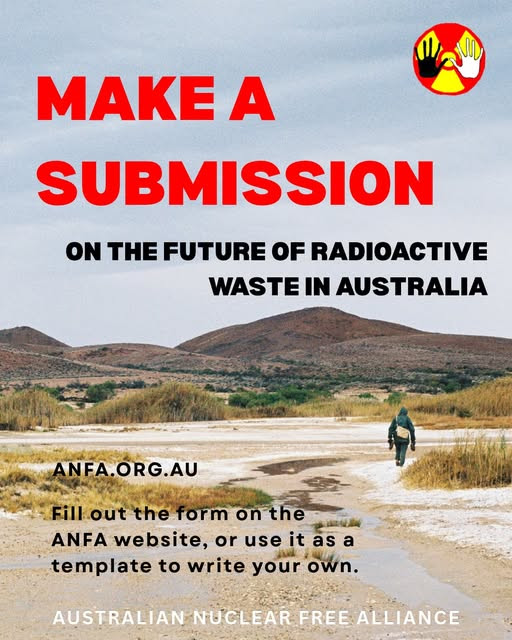
Submissions to the federal government’s new draft framework close on the 13th November 2026.
Australians deserve the truth
about
AUKUS – https://aukuspublicinquiry.com/

PETITION – To: Prime Minister Anthony Albanese and the Australian Labor Government

of the week – Australians for War Powers Reform (AWPR)
To see nuclear-related stories in greater depth and intensity


Leave a Reply