Submission to AUKUS Public Inquiry – with a focus on Western Australia – STOP AUKUS

No 320 https://drive.google.com/file/d/1nkcNWsxkD82ipTDEguemqIQ0LNEk0DXn/view
Stop AUKUS WA is grateful for the opportunity to make a submission to the 2026 Public
Inquiry into AUKUS.
Although not specifically included in the TOR of the Inquiry, we will mainly focus on the
regional/local impacts of AUKUS and only briefly outline our perception of the broader
issues, noting that we concur with the substantial submissions to date by respected experts
including Tilman Ruff, Richard Tanter, Dave Sweeney, Joseph Camileri and John Lander.
National and International Issues
An appropriate defence asset?
The Virginia class submarines to be purchased under AUKUS Pillar 1 were originally
designed for the main purpose of deterring Chinese submarines from launching missiles
into mainland USA.
They are not suitable for defence of coastal Australia where a larger fleet of smallersubmarines would be more appropriate. By the time of delivery of Virginia class or SNN-AUKUS submarines they are likely to be obsolete due to improved underwater detection methods and development of underwater drones (ironically being developed under AUKUSPillar 2).
Financial implications
The huge cost of procuring nuclear-powered submarines under AUKUS, now estimated at
A$375 billion (albeit including a substantial contingency), inevitably detracts from
expenditure on other ADF options. This in turn exacerbates the defence budget creep which
consumes funds better spent on combating real existential threats of climate change and
nuclear war, and on social well-being programs. Furthermore, history has shown that initial
projected costs of large military or civilian projects (e.g. Snowy Hydro) inevitably blow out.
The risks of committing to such expenditure are huge – non-delivery of submarines, pending
obsolescence, the fallacious assumption China is our enemy etc.
Loss of sovereignty
The military interoperability and increased implementation of the Force Posture Agreement
(FPA) implicit in AUKUS will ensure further subservience to the USA, obliging Australia to
continue following the US into wars of its choosing. The assumption that subservience to the
US or having US bases on our soil will ensure Australia’s security and safety is false
particularly in light of the prevailing “America First” agenda. The recent attacks on US Bases
in West Asia are also testimony to this.
There are also serious doubts Australia would have the nuclear-ready workforce to operate
its own nuclear-powered submarines; equally that the US will meet the production level
requirements needed to provide Australia with the much touted 3 Virginia Class SSNs in
2032, ’35, ‘38 and that the US will simply perpetuate a quasi SRF-West co-crewed by US
and Australian crews but under the command of the US.
Abrogating treaties
AUKUS also threatens to undermine the Nuclear Non-Proliferation Treaty (NNPT) to which
Australia is a signatory: it would exploit the loophole in the Treaty which technically permits
visiting vessels (as opposed to ‘stationed’ vessels) being nuclear capable. This is especially
alarming given Australia’s “Don’t ask – Don’t tell’ attitude and the increasing likelihood that
the future models of Virginia Class submarines could be nuclear armed.
Further, the highly enriched uranium (HEU) used in Virginia Class submarines, and in the
Rolls Royce reactors for Australia’s SSN-AUKUS to be built at Osborne, can be used either
directly or with reprocessing, in the manufacture of nuclear weapons. Although the current
legislation prohibits Australia from enacting this, there is always the implied risk or possible
breach of security which could facilitate this.
Nuclear Waste Concerns (other than localised at HMAS Stirling)
AUKUS commits Australia to storing the high level nuclear waste from the 2nd hand Virginia
Class submarines to be procured in the 2030’s and Australia’s own SSN-AUKUS.
Decommissioning the reactors will generate potent waste remaining dangerously radioactive
for tens of thousands of years. This will require secure storage at an undisclosed
astronomical price and ‘defence site’ yet to be determined – no doubt to be again rightfully
challenged by First Nations peoples. AUKUS would be committing Australia to an inevitable
problem to which no solution is on the horizon, a damming legacy.
Diplomacy vs aggressive deterrence
China is Australia’s major trading partner as well as the intended US target adversary of
AUKUS which inevitably could have adverse repercussions on trade relations. Some harsh
trade restrictions imposed by China recently suggest that this is already happening. Further,
most Asian nations see AUKUS as an anglospheric reincarnation of European colonial
dominance – the antithesis of enhanced regional security.
Australia’s security could best be enhanced by rapidly expanding Australian diplomacy in the
region, combined with an independent foreign policy based on peace and justice.
Impacts of AUKUS on research, universities and foreign student intake
AUKUS imposes laborious and stringent restrictions on research partnerships and foreign
students from countries other than the USA and UK. This is reportedly leading to a brain drain back to China or to elsewhere. Recent data cited by Clarivate reveals Australia-
Chinese co-authored publications in the top 10% of those most cited globally over the pastfive years in computer science, materials science and engineering far outnumbers those co-
authored with US partners – 54% to 12%. Only 5% of China’s top publications involve an Australian author.
Confining Australia to research and development with its anglosaxon partners is a setback to
our scientific and technological development which risks Australia being left way behind in
the global arena. It is also having a negative impact on the foreign student intake which in
turn impacts universities’ income earning capacity.
WA Specific Issues
Loss of local jurisdiction
Currently, two bays in the north of Garden Island and beaches on the west of the island are
accessible to the public by boat during daylight hours for recreational purposes. There is
also a “closed naval waters” buffer zone to the east of the island in Cockburn Sound.
Although the Australian Navy, the Australian Submarine Agency (ASA) and the Australian
Naval Nuclear Power Submarine Agency (ANNPSA) all claim that public access to the island
will not be further impacted under Submarine Rotational Force West (SRF-West) as of 2027,
it is difficult to believe. The whole of the island is already a designated [nuclear] zone under
the ANNPS Act.
Also, a considerable area of Cockburn Sound adjacent to Garden Island, now accessible to
recreational boats, would likely become a restricted zone. With the increased traffic and
stationing of nuclear-powered submarines and the radioactive waste facility to be built in the
southern part of the island it is also highly likely that the current assurances that public
access to the Sound for fishing, boating, snorkelling and other water activities will not be
impacted, will ultimately prove untrue.
2. Environmental heritage effects………………………………….
3. Housing, employment and the local economy………………………………….
4. Henderson Defence Precinct – the AUKUS dry dock……………………………….
- Congestion in Cockburn Sound: commercial shipping, toxic industry and
recreational boating
6. Local Nuclear Issues – Waste and Radioactivity
The stationing of US and UK nuclear powered submarines at Stirling under SRF-West
necessitates in-water maintenance which in turn requires a Controlled Industrial Facility
(CIF) to manage and store the low level radioactive waste. ARPANSA granted the
construction licence to ASA in 2025 after a flawed public consultation – the public were
denied access to requested technical and detailed information regarding the intended
structure and radioactive materials to be handled and ultimate disposal procedures.
No information was given of the identity and amounts of the actual isotopes involved, other
than to claim that it would be “low level waste” of the type emanating from hospitals and
research labs such as gloves and protective clothing. It is essential to know the details of
hazardous substances before it can be worked out how best to handle and store them. The
radioactive waste was initially claimed to be of short half-life but later it was admitted that
some isotopes would have a half-life of about 300 years. The actual lifespan of the CIF (on
precarious geological island land, especially given climate change) was put at 40-50 years.
And all in the face of there still not being a permanent/long term storage site/plan or in fact
anywhere to take it to in case of emergency.
It is feared that the radiological waste from the temporary CIF storage facilities at Stirling and
Henderson will eventually be transported by road through, or in close proximity to, populated
areas. Authorities prefer not to discuss this and claim it is still in the planning stage.
At other bases for UK and US nuclear powered submarines there have been reports of
release of radioactive materials into the air and the harbour (e.g. Faslane, Scotland). In the
AUKUS proposals so far put out for consultation such possible emissions (including
evaporation of liquid waste) have been acknowledged but with no clear indication as to how
they would be monitored, minimized, remedied or reported to the public.
7. Accidents, safety and secrecy
…………………….Disturbingly, we have learned that the US is intending to relax its safety standards for
radiation exposure by a factor of five, against long accumulated medical advice. It remains
unknown as to what extent these relaxed standards would be applied in and around US
nuclear powered submarines, especially as the SRF West rotations will occur under the
2014 Force Posture Agreement (FPA) with the US and Stirling being listed as a special
facility and area under the FPA. Under Article IV.1, this gives the US “unimpeded access to
and use of Stirling” for related activities.
Article V.5 states “The Parties shall mutually develop procedures to address incident and
accident responses, including for the following matters: (a) first response; (b) the security of
incident or accident sites and human remains; (c) investigations; and (d) public statements
concerning accidents and incidents.”
Stop AUKUS has sought clarification of this issue via Questions posed at the various ASA
Information sessions held in 2025 and 2026 in Fremantle, Perth, Cockburn and Rockingham
and via repeated emails to the ASA – all to no avail.
The nuclear safety record for nuclear submarines is not good, and unlikely to be better for a
nation with no prior experience in nuclear submarines. At least nine nuclear-powered
submarines have sunk. Decommissioned nuclear-powered submarines are not dismantled
due to absence of permanent storage facilities for their reactor fuel, anywhere. Since 2006 a
total of 789 nuclear safety events were recorded at HM Naval Base Clyde at Faslane and
nearby Royal Naval Armaments Depot Coulport. The UK has ceased public reporting of
nuclear accidents since 2017.
With the standing up of the Australian Naval Nuclear Power Safety Agency (ANNPSA) on 1
November 2025 it has taken over naval nuclear safety and reporting from ARPANSA. It
reports to the Minister of Defence, who would no doubt be hesitant to disclose any mishaps
or misdeeds of their ministry – thus is an ineffective mechanism to gain and maintain social
licence of AUKUS, especially in the advent of any accidents.
It is usual practice that the military everywhere, and most civilian governments, are reluctant
to publicly report accidents, and especially those involving radiation, to prevent credibility
loss and loss of social licence. This tendency towards secrecy is readily apparent in the
ongoing local AUKUS public consultancy process (e.g. “information not available for security
reasons”) and ASA’s community information sessions in a belated attempt to gain some
semblance of social licence which is clearly lacking in the ill-conceived AUKUS plan.
Although visiting nuclear powered submarines fall under the OPSMAN visiting ships manual,
the new Regulator will play a role – seemingly yet to be defined even though the Regulator
has been in existence for 8 months. The WA Police are responsible for managing any
incident response under the HAZMAT Annex A – Radiation Escape From A Nuclear Powered
Warship (NPW) – State Hazard Plan. An update of the 2023 manual to factor in the ANNPSA
has been in the making for some time and still uncompleted or if it has been it is still not
publicly available.
We maintain none of the above bides well for social licence nor Australia’s nuclear readiness
in the eyes of its AUKUS partners.
8 Target
Our initial protests that establishing a base for US nuclear submarines in the vicinity of the
Perth metropolitan area would make us a prime target, rather than protect us, in any future
global-scale conflict were essentially dismissed. However, the recent US-Israel war on Iran
has illustrated how US bases do become prime, first-choice targets. The bombing of Pearl
Harbour by the Japanese in their opening of the war with the USA some 85 years ago
provides another example.
There are no contingency provisions for the public in the event of attacks on HMAS Stirling,
either conventional or nuclear. A successful conventional attack would in any case lead to
the uncontrolled release of radioactive contents from submarines and storage facilities.
9 China trade
A majority of the container ships visiting Fremantle, and eventually Westport, are involved in
the China trade. The existence of AUKUS discourages that trade with the general
understanding that the purpose of AUKUS is to join the US in militarily confronting, or as a
minimum, containing China. Understandably China is now seeking alternative trading
partners and would be reluctant to send their commercial shipping into hostile ports.
Conclusion
It is apparent that creation of AUKUS was primarily motivated by Australian political party
jostling for power, the US desire for a nuclear submarine base in the Indian Ocean/Australia
and the lingering nostalgia of the UK for a lost empire. The project as proposed is more likely
to antagonise Australia’s relations with its neighbours rather than enhance the security of the
country, and we would inevitably need to sacrifice further sovereignty to the USA. AUKUS
has so far not received the required parliamentary scrutiny for such a complex, costly and
future setting commitment.
Public consultancies held around various components of AUKUS such as the Australian
Submarine Agency’s licence applications for the siting and construction of a radioactive
waste storage facility at Stirling lacked sufficient information for thorough public scrutiny and
the outcome seemed preordained.
In WA, promises of increased employment and economic stimulation seem exaggerated,
especially when all of the disadvantages of proceeding are considered. It is clear that the
issue of nuclear waste has not been adequately thought through, especially the long-term
storage aspects designed to deal with nuclear reactor isotopes for millennia.
AUKUS poses a public health and safety, environmental, security and social cohesion risk to
the Cockburn Sound communities. It lacks social licence and a cost benefit analysis.
Australia’s submarine and defence policy needs an urgent rethink – as does the Australia-US
Alliance.
Submission to AUKUS Public Inquiry – Scrap AUKUS – Teachers Federation
No 309
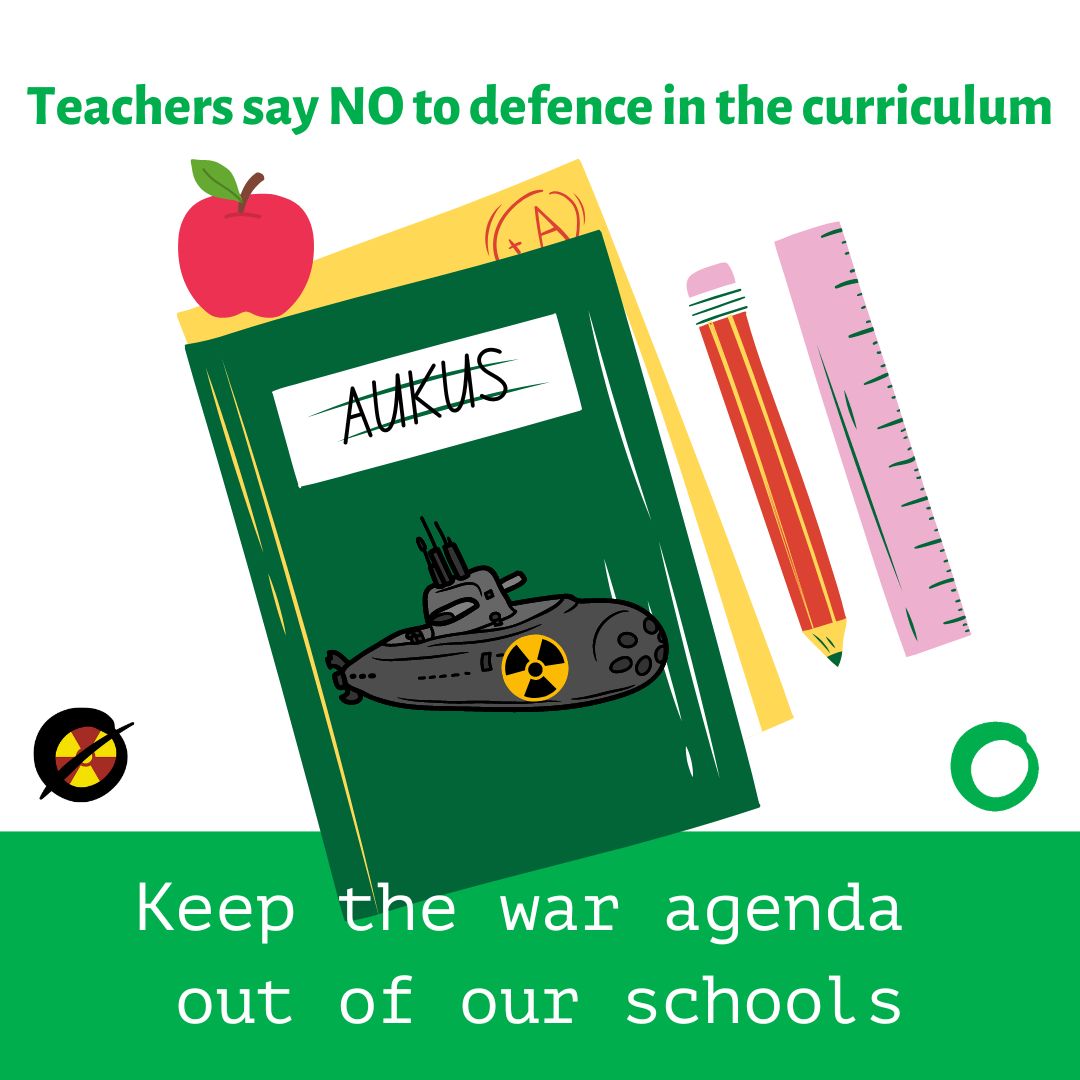
Maxine Sharkey, General Secretary, AEU NSW Teachers Federation
31 July 2026
Extracts – ” ……………………… The AUKUS announcement in September 2021, made clear that once again the peace movement, including Federation, would be required to mobilise against the warmongers who seek to line the pockets of the vested interests in the global weapons manufacturing industry, at the expense of government spending on education and other social services and investment in mitigations and solutions to the real threat – the climate emergency.
Costs
The massive $368 billion expenditure on nuclear-powered submarines that may or maynot be able to be delivered and may or may not utilise obsolete technology when they are, is unacceptable and will affect generations to come as those costs are inevitably diverted from vital public services…………………………………….
While the Albanese government asserts that there will be jobs created by the AUKUS
deal, there has not been any credible evidence presented that this is the case,
particularly when compared to the number of jobs that would be created without AUKUS, – in education, health, and manufacturing, for example, not to mention those jobs that would be lost if a nuclear submarine base is imposed on a functioning port and the industries that use it………………
Loss of independence
From the outset, Federation held concerns that the AUKUS pact would compromise
Australia’s ability to pursue an independent foreign policy, in particular, the prospect of hosting of US military forces on Australian territory. The risks that Australia will be dragged into future foreign conflicts and wars has only intensified under the current US administration.
It is not clear how AUKUS will allow Australia to engage in diplomacy in our region, and not merely follow our AUKUS “partners”, particularly the US, into their wars.
Secrecy
The lack of transparency about the details of the AUKUS deal is ongoing and highly
concerning for members of the community including teachers, as affected workers, as well as their students and families………………………………..
For example, the location of the proposed East Coast base for the submarines remains
secret. Port Kembla and Newcastle, both towns with significant population of Federation
members, have been mooted, with documents released by an order for the production
of documents in the NSW parliament indicating that Port Kembla was the preferred site
There has been no transparency from the Australian government around the question of
how high-level nuclear waste and the use of weapons-grade uranium will be managed.
Historically, the Australian government has repeatedly tried to set up nuclear waste
dumps on First Nations lands. The AUKUS deal will only intensify that pressure.
The Albanese government states that: “Australia will manage all radioactive waste
generated by its own Virginia Class and SSN-AUKUS submarines, including radioactive
waste generated through operations, maintenance and decommissioning.
All waste, including spent fuel, will be managed safely, informed by international best
practice and in accordance with Australia’s international and domestic legal obligations
and commitments.”6
But to date there has been no detail provided about how the above will be achieved.
Mobilisation against AUKUS
The AUKUS announcement has unquestionably seen an increase in peace activism
amongst the Federation membership.
In 2023 on May Day, Federation members joined thousands of fellow workers across
the Illawarra in Port Kembla for a march and rally in opposition to AUKUS, the nuclear
submarine deal and Port Kembla as a possible site for a nuclear base.
In July the same year unionists and community leaders from Port Kembla attended
Federation’s Annual Conference as guests to hear a special report “On Peace”,
including from this inquiry’s lead commissioner, Peter Garrett. Conference noted that it
appeared that the weapons industry had been emboldened by the AUKUS decision and
called for their attempts to push their way into public schools, TAFE and universities to
be rejected.
One example is the Nuclear Subs in Schools program7……………………………………………………………………………………………………
Recommendations
Federation strongly believes that AUKUS deal must be scrapped by the Australian
government.
Notwithstanding this position, there are immediate answers the Albanese government
must provide the Australian people with regards to AUKUS – and they must be treated
as essential transparency obligations with respect to safety and costs.
Until there is clarity on the safety for communities with hosting nuclear submarines in
Australia, building nuclear submarines here and disposing of the highly enriched
uranium they will be built with, Federation cannot support AUKUS, and we call on both
the NSW and Australian government to immediately and categorically rule out a nuclear
submarine base at either Port Kembla or Newcastle.
Of equal importance is that the Albanese government stop hiding behind claims of every
detail being “classified”, and immediately provide the public with transparency around
the costs and the “deliverables” under the AUKUS agreement. When public schools still
have not reached the School Resourcing Standard and will not do so for at least
another 10 years, capital spending on public school infrastructure is all but absent,
TAFE colleges are trying to skill the future with outdated equipment that doesn’t meet
industry standards, and governments do not yet recognise and fund programs for
affordable home ownership for teachers in the public system, the least the Albanese government can do is provide details on exactly what this agreement is, including what
options Australia has if deliverables are not met by one or both of our AUKUS partners.
.
Submission to AUKUS Public Inquiry -Australia should quit alliance with the UK and US – Dr Gideon Maxwell Polya.
No.258
“……………………My submission is in 3 parts and summarizes several detailed articles that set out why
Australia should quit alliance with the UK and US.
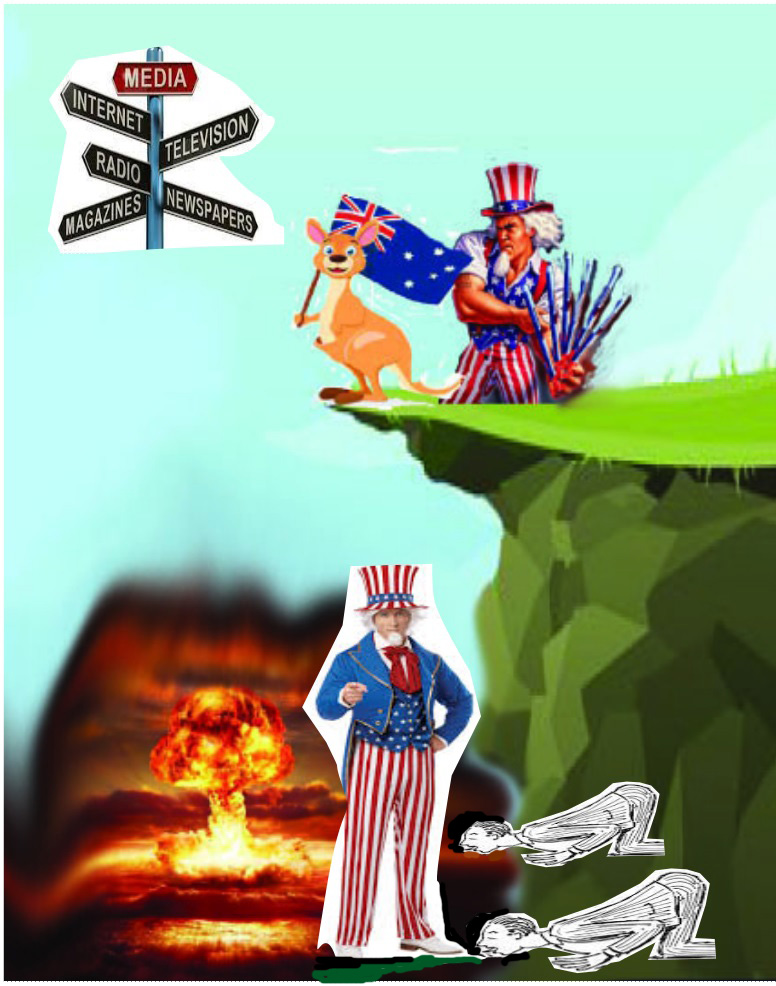
(A). As a UK lackey, US lackey or major climate criminal country Australia has
violated all circa 80 Indo-Pacific countries.
In 2021 Australia formed the anti-China AUKUS (Australia, UK and US) Alliance and
thence the Quad (Australia, India, US and Japan) Alliance to contain a supposedly
aggressive China. In reality as a nuclear terrorist, climate criminal, serial invader
and subversive entity Australia has violated all Indo-Pacific countries (see Gideon
Polya, “AUKUS & Quad In Context: Australia Violates All Indo-Pacific countries”,
Countercurrents, 9 December 2021: https://countercurrents.org/2021/12/aukus-qu
ad-in-context-australia-violates-all-indo-pacific-countries/ and for an exhaustively
referenced version see Gideon Polya, “Australia violates all Indo-Pacific countries”,
Stop state terrorism, 9 December 2021: https://sites.google.com/site/stopstateterr
orism/2021-12-09-australia-violates-all-indo-pacific-countries ).
………………………………………………………………………………………………………………………………………………………………………………………………………………….
………………………………………As a UK and thence US lackey, Australia in the last 80 years (i.e. WW2 onwards)
has had armed forces in many countries of the Indo-Pacific region, and has joined
the US in massive invasions and occupations. Australia has participated in all
post-1950 US Asian Wars (atrocities in which 40 million Asians have died from
violence and war-imposed deprivation). Anti-Arab anti-Semitic Australia has been
an enthusiastic participant in the US War on Terror (over 30 million Muslims have
died from violence and imposed deprivation in 20 countries invaded by the US
Alliance since the US Government-exploited 9/11 atrocity that killed 3,000 people).
The joint US-Australian telecommunications spying base at Pine Gap in Central
Australia targets war criminal US drone strikes on 7 Muslim countries.
As US lackeys Australians have been involved with the US in covert subversion of
many Indo-Pacific countries, and were successful in achieving regime change in 8
instances, namely Laos (1960), Indonesia (1965), Cambodia (1970), Chile (1973),
Australia (1975), Fiji (1987), Fiji (2000), and Australia (2010) (the latter 3 also
involving Apartheid Israel). Australia is second only to the US as a fervent
supporter of nuclear terrorist, genocidally racist, grossly human rights-abusing and
globally subversive Apartheid Israel, and hence of the utterly vile and intolerable
crime of Apartheid…………………………………………………………………………………………………
(B). Why Australia should quit military links with serial war criminal, genocidally
racist and egregiously mendacious America.
For a detailed and exhaustively referenced analysis see Gideon Polya, “Why
Australia Should Quit Military Links With Serial War Criminal America”,
Countercurrents, 28 January 2023: https://countercurrents.org/2023/01/why-austr
alia-should-quit-military-links-with-serial-war-criminal-america/ . Summarized
below are cogent arguments why Australia should quit its AUKUS alliance with
nuclear terrorist, genocidally racist and serial war criminal America and the UK.
(1). War typically violates International law, and is the penultimate in repugnant
racism, with genocide being the ultimate in racism…………………………………………..
(2). The US is a horrendous serial invader of other countries. Apart from inevitable
border spats, most countries in the world have not invaded other countries…………………………………………………
(3). War criminal active and passive mass murder by nuclear terrorist America and
the US Alliance. Iraq and Afghanistan were not the only countries murderously
violated by the US in the 21st century. It was estimated in 2015 that 32 million
Muslims had died from violence (5 million) and imposed deprivation (27 million) in
20 countries invaded by the US Alliance after the US Government-exploited 9/11
atrocity that killed 3,000 people, mostly innocent Americans…………………………………………………
(4) American lying ………………………… As cogently analysed by
Professors Edward Herman and Noam Chomsky in “Manufacturing Consent”,
mendacious US Mainstream media serve the interests of the US Establishment and
US governments.
(5). America violates, subverts, dirties and acutely threatens Australia.
(i). Australia was involved in all post-1950 US Asian wars.
(ii). AUKUS and Australian violation of all Indo-Pacific countries.
(iii). Australian involvement in 8 US-effected coups.
(iv). US lackey Australia’s deadly covert operations in neighbouring Indonesia.
(v). The US Murdoch media empire dominates Australia.
(vi). America spies on, subverts, deceives and betrays Australia.
(vii). UK- , US-, and Zionist-backed coups and other subversive interventions in
Australia.
(viii). Craven submission to American militarism makes Australia complicit in
nuclear terrorism and makes Australia a prime nuclear target.
(ix). Zionist subversion of IHRA member Australia is a product of blind Australian
fealty to Zionist-subverted America and soils Australia.
(x). Locked-in support for US militarism and militarist fiscal perversion inescapably
contributes to 100,000 preventable Australian deaths annually.
(xi). Australia is complicit in horrendous UK and US war crimes, notably in Iraq and
Afghanistan.
(xii). Blind support for the US has created a contemptible, reality-ignoring,
“look-the-other-way” Australian national culture.
(xiii). US lies and terror hysteria impacting Australian civil liberties.
(xiv). Genocidal US, US Alliance and Australia need de-Nazification.
(C). The AUKUS Alliance betrays, robs, soils, threatens and kills Australians.
………………………………… (i). AUKUS betrays Australians. The AUKUS deal supposedly protects Australian
sovereignty but the opposite is true. The nuclear submarines (if delivered) would
become Australia-crewed adjuncts to the naval strategy of a serial war-making US.
The deal locks an impotent Australia into US war-making strategy against our
biggest trading partner, China. Conversely, military strategy expert Albert Palazzo
(“The Big Fix”) argues that middle-power Australia should revert from a US-led
“strategic offensive” position to an efficient, effective and Australia-first “strategic
defensive” position. Our AUKUS partner, Zionist-perverted America, gets Australia
to hugely subsidize US war industry, makes Australia a prime nuclear target, and
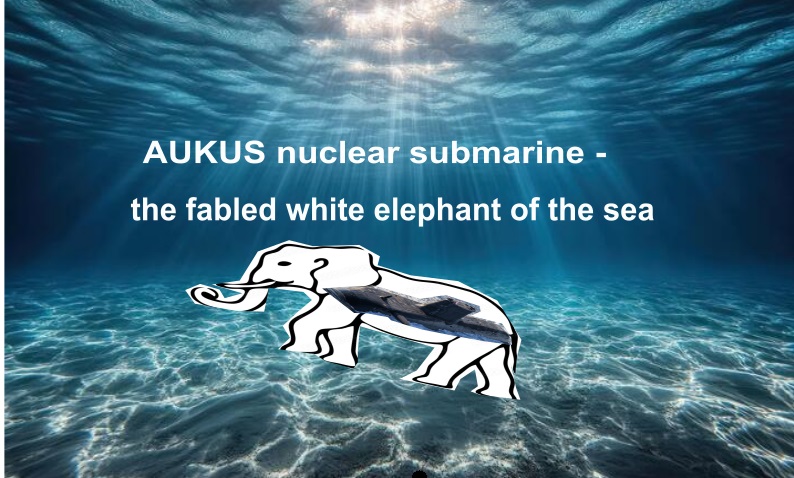
substitutes hugely expensive, submarine hunting , White Elephant “sitting ducks”
for an intelligent, multi-faceted and high technology defence system.
(ii). AUKUS robs Australians. The Australia Institute estimates that the cost could
be $500 billion for a few second-hand, US-controlled, US-assisting, single-purpose
submarines that may already be detectable and vulnerable to the latest
AI-assisted anti-submarine technology. The US war industry gets A$500 billion and
in return Australia becomes a prime nuclear target, and gets locked into an absurd
“strategic offensive” position for the benefit of the US instead of an expert-advised
“strategic defensive” position for the defence of Australia.
(iii). AUKUS soils Australia. Racism is vile because to whom we are born and by
whom we are raised is out of our control. War is the penultimate in racism and
genocide the ultimate. The UK has invaded 193 countries or nearly every country.
Only 3 countries have not had a US military presence. Before WW2 the British
committed genocide on all inhabited continents whereas the US (African slavery
and Pacific islands aside) largely confined itself to the American Indian genocide
and domination of Latin America. After WW2 the UK replaced colonialism with
deadly neo-colonialism but also participated in the (deaths from violence and
deprivation in brackets) Palestinian (3 million), Korean (5 million), Iraqi (5 million), Libyan (0.2 million) and Afghan (7 million) Genocides. The US invaded a swathe of
countries around the world after WW2…………………………………………………………………….
(iv). AUKUS threatens Australians. The Australia-US joint spying base at Pine Gap,
Central Australia, plays a key role US nuclear terrorism and in targeting US and
Israeli bombing. Australia is constructing a huge base for nuclear-armed US
submarines in Western Australia, is expanding the Tindal air base in the Northern
Territory to host potentially nuclear-armed B-52 bombers, and hosts a
3,000-personnel US Marine base near Darwin. AUKUS makes Australia a prime
nuclear target – in any escalating nuclear war key bases in Australia and Australian
cities would be bombed before bombing any US cities………………………………………………….
(v). AUKUS will kill Australians. AUKUS will remove $500 billion from Australia’s
capacity to keep Australians alive and healthy via its prosperous economy-based
world-leading universal health care system, the National Disability Insurance
Scheme (NDIS), the education system, and preventive medicine…………………………………………………………. https://drive.google.com/file/d/1s1_Y3ywvk8ywqTLFvhOt3RfBFZfYH25g/view
Data centres revive Coalition passion for nuclear power, but this time more expensive and even less realistic
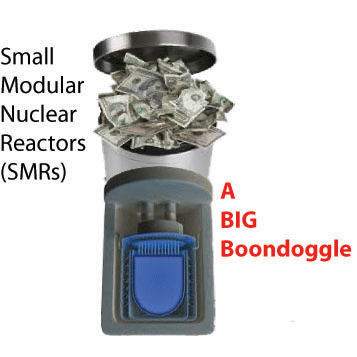
SMRs are “the most expensive form of energy you could possibly choose”
Peter Hannam, 12 November 2026, https://reneweconomy.com.au/data-centres-revive-coalition-passion-for-nuclear-power-but-this-time-more-expensive-and-even-less-realistic/amp/
The data centre-driven revival of the nuclear power debate in Australia is yet another political distraction from the urgent task of rapidly decarbonising the energy system, a new report has warned, only this time it’s focused on a technology that doesn’t technically exist: small modular reactors.
Small modular reactors (SMRs) aren’t operating commercially anywhere in the world despite decades of research and hype, won’t sate data centres’ energy hunger, and will dash federal Coalition hopes for an alternative to renewable energy, the report by the Australian Conservation Foundation (ACF) finds.
The Phantom Energy report, released on Thursday, details the lack of progress of SMRs globally.
“Nuclear power is too slow, too expensive, too unpopular, too dangerous and too thirsty to be a viable source of power for data centres in Australia,” the report says.
This has not stopped major technology firms such as Microsoft, Google, Amazon and Meta, from announcing nuclear energy partnerships to support growing data-centre demand, including inking more than a dozen agreements worth nearly 10 gigawatts (GW) of capacity.
“However, these commitments are largely non-binding agreements, power-purchase arrangements, or modest investments in SMR developers rather than direct funding for reactor construction,” report author Jim Green argues.
In particular, the US – home to those tech giants – has no SMRs or even large-scale reactors under construction. Plans to restart three shuttered reactors to power data centres “face obstacles and delays and only represent a tiny percent of electricity demand for data centres,” the report says.
Indeed, it cites a report by the Bulletin of the Atomic Scientists from July that found nuclear funding commitments from Amazon and Google to be fraction of 1% of their annual expenditures earmarked for building data centres.
The spending was “primarily meant as greenwashing, in order to divert attention from the negative environmental impacts of data centre operations,” including much larger fossil fuel investments, the bulletin found.
Debate over how to power Australia’s data centre boom has intensified, as communities wrestle with how another 225 planned or proposed centres can be accommodated by a grid already hosting about 165 of them.
On the one hand, Chris Bowen, the federal climate change and energy minister, is insisting they source and supply their own renewable energy, although Queensland and the Northern Territory are pushing for fossil-fuel carveouts.
The federal Coalition, however, is pushing for nuclear energy – reviving a stance that was widely rejected in the 2025 elections, costing them as many as 11 seats. Prohibitions would need to be overturned under federal law and in states, including Queensland, New South Wales and Victoria.
Matt Canavan, the Nationals leader even told ABC’s Insiders last weekend that he’d “welcome nuclear power here every day of the week”.
“I’d much prefer a nuclear power station next door to me than a 300-metre wind turbine,” he said.
Aside from the “theoretical” possibility of having SMRs – defined as having an electrical generating capacity of 300 megawatts or less – advocates have to explain how they would produce competitively priced power in the US, Australia, or elsewhere.
“Electricity from the Natrium and Xe-100 SMR designs would cost at least twice as much as electricity from large nuclear plants [in the US] and the cost of electricity from large nuclear plants is at least three times higher than from solar and wind,” the ACF report says.
No wonder, then, that a 2025 survey found 78% of US adults polled were somewhat or very concerned that new data centres would increase their power bills, it said. (The data centre issue also reportedly hurt Republicans – the US equivalent of the Coalition – in the recent mid-term elections.)
The annual GenCost report by CSIRO, meanwhile, has consistently underscored the high cost of nuclear energy – both large and small – as the ACF noted.
SMRs are “the most expensive form of energy you could possibly choose,” Mia Popper, a nuclear free campaigner at the Australian Conservation Foundation, told Renew Economy.
1 This month
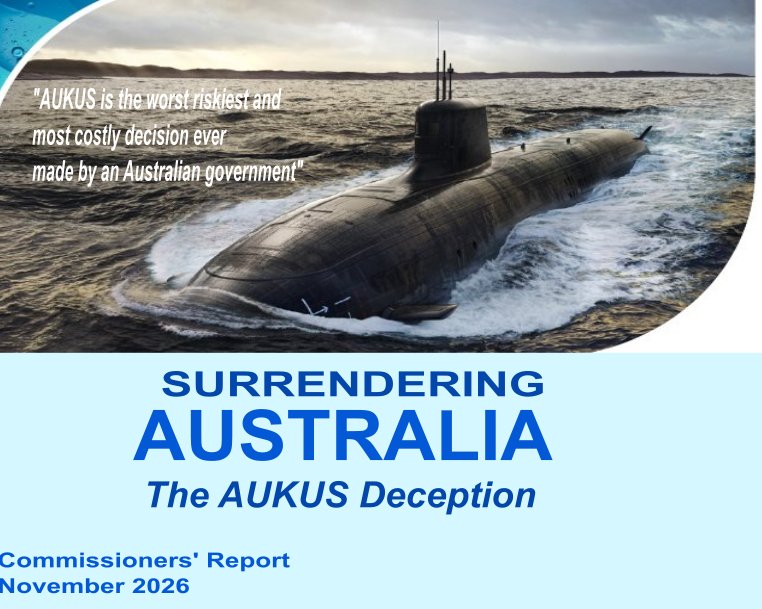
Read the Public Inquiry Report, the Commissioners’ report, Surrendering Australia: The AUKUS Deception is available to download for free at aukuspublicinquiry.com. Or just watch the replay of the National Press Club Luncheon.
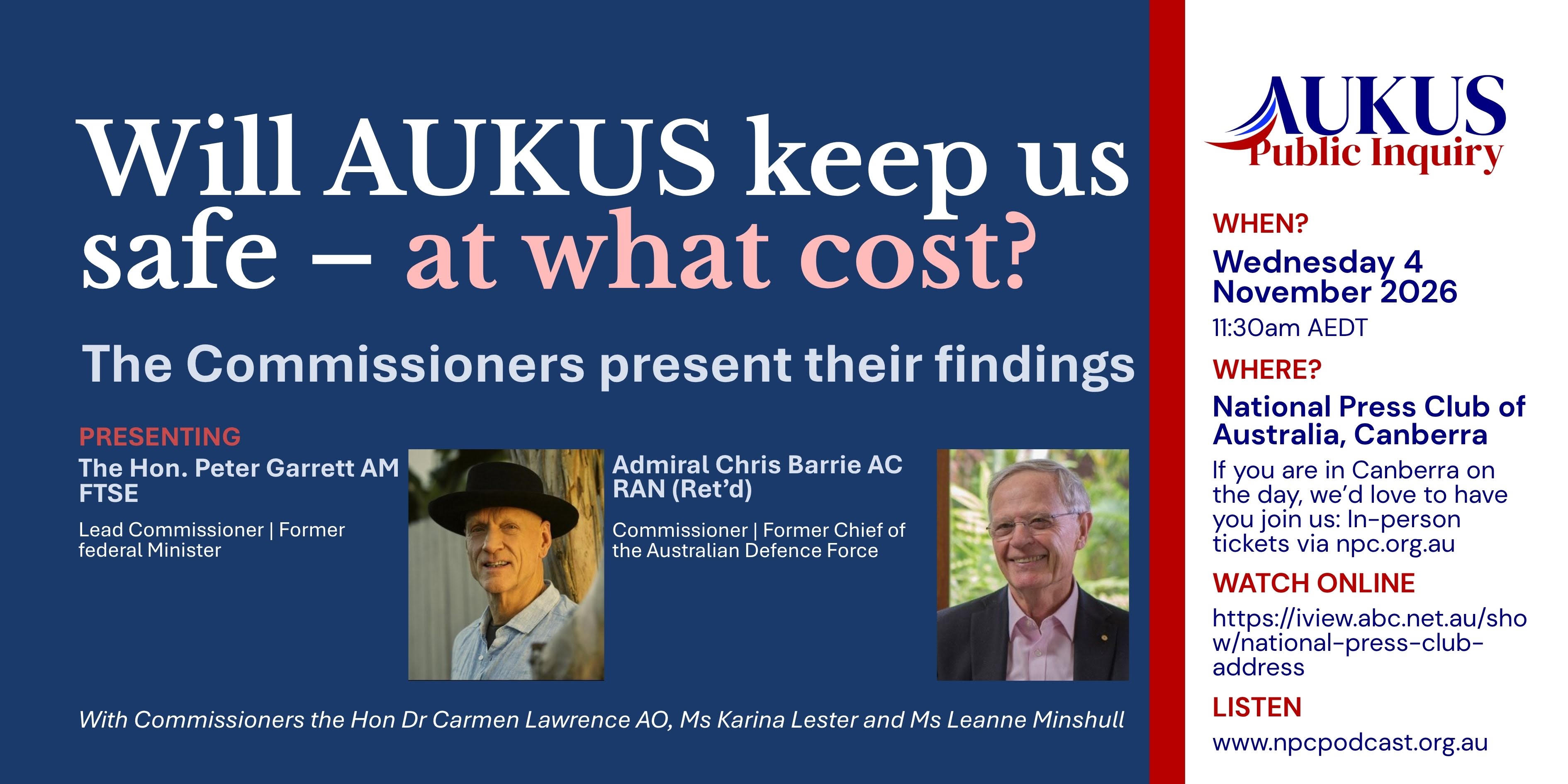
4 November – Will AUKUS keep us safe – at what cost?
the Commissioners of the AUKUS Public Inquiry present their findings at the National Press Club of Australia in Canberra. iview.abc.net.au/show/national-press-club-address
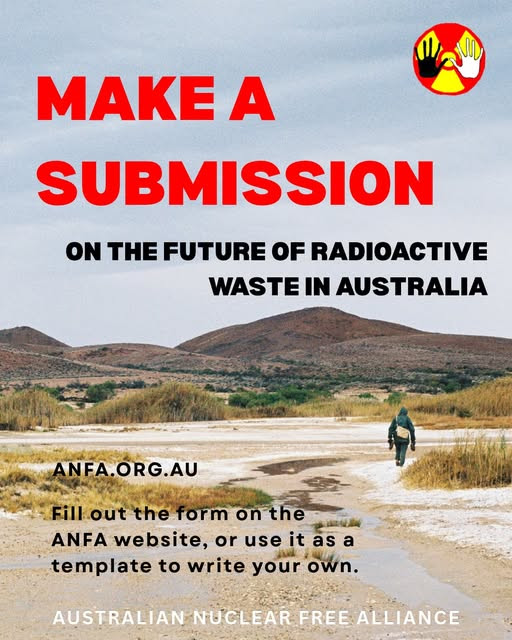
Submissions to the federal government’s new draft framework close on the 13th November 2026.
Australians deserve the truth
about
AUKUS – https://aukuspublicinquiry.com/

PETITION – To: Prime Minister Anthony Albanese and the Australian Labor Government

of the week – Australians for War Powers Reform (AWPR)
To see nuclear-related stories in greater depth and intensity

