Australian nuclear news headlines this week
Australian nuclear news this week
- Caps Off: How Mark Hammond’s Appointment Completes Labor’s Capture by Uncle Sam and the AUKUS Boondoggle.
- Richard “Deadwood” Marles: A Liberal Wearing a Red Rosette.
- The Apocalypse Salesman: How Richard Marles Sold Australia’s Future to the Permanent War Economy.
- The Biggest Peace Time Release in our Nation’s History. Who’s making money?
- The arsenal trade after Ukraine and Iran. Not Reporting a War (Part 2)
- Not reporting a war: How Australia’s media launders a crime (Part 1)How Israel is dragging America to war | The West Report.
- Australia Must Join The Trump Blockade!
The Apocalypse Salesman: How Richard Marles Sold Australia’s Future to the Permanent War Economy

The Manufactured Threat
Marles identified China as the primary threat to peace. He spoke of the need to project Australian military force “anywhere on the planet” to police global trade.
But China has no history of being an aggressor against Australia. It has never threatened Australia. It has never invaded Australian territory. It has never attacked Australian forces.
The only “threat” is that China might replace the United States as a trading partner by offering quality products at better prices and better trading conditions. This is not a military threat. It is an economic threat – to the profits of the defence contractors, to the hegemony of the United States, to the permanent war economy.
Former prime minister Paul Keating, no stranger to plain speaking, previously accused Marles of a “careless betrayal of the country’s policy agency and independence.”
Keating said:“A moment when an Australian Labor government intellectually ceded Australia to the United States as a platform for the US and, by implication, Australia, for military engagement against the Chinese state in response to a threat China is alleged to be making.”
“China has not threatened Australia militarily, nor indeed has it threatened the United States. And it has no intention of so threatening.”
17 April 2026 Dr Andrew Klein, PhD, https://theaimn.net/the-apocalypse-salesman-how-richard-marles-sold-australias-future-to-the-permanent-war-economy/
The Great Distraction
On April 16, 2026, Defence Minister Richard Marles stood before the National Press Club and announced the biggest military spending spree in Australian history. An extra $14 billion over four years. An additional $53 billion over the next decade. Defence spending to rise to 3% of GDP by 2033.
“Australia faces its most complex and threatening strategic circumstances since the end of World War II,” Marles declared. “International norms that once constrained the use of force and military coercion continue to erode.”
On the same day, the Prime Minister was flying to Brunei to beg for fertiliser and diesel.
The juxtaposition is obscene. While Marles was marketing the apocalypse, Anthony Albanese was scrambling to secure the basic necessities of Australian life – fuel for trucks, fertiliser for crops, the stuff that keeps the country running
The 100 million litres of diesel from Brunei and South Korea is not a solution. It is a distraction. The government is hoping that Australians will see the headline, breathe a sigh of relief, and stop asking the hard questions.
But the questions remain. And they are damning.
The Severity of the Crisis
The situation is far worse than the government has admitted.
As of April 11, 2026, Australia had 31 days’ worth of diesel, 28 days of jet fuel, and 38 days’ of petrol. These figures are dangerously close to the point where the government would be forced to implement nationwide fuel rationing.
In early April, Energy Minister Chris Bowen disclosed that 144 service stations across the country had completely run out of fuel, with a further 283 stations reporting no diesel supplies. The shortages have been most acute in rural and regional areas – precisely where farmers and truck drivers need fuel the most.
The Geelong refinery fire has compounded the problem. Viva Energy’s refinery is one of only two remaining refineries in Australia. The blaze shut down production at the worst possible moment.
As one Taiwanese media outlet starkly put it, Australia is living a “real-life Mad Max” scenario. The comparison is not hyperbolic. The film franchise depicted a world brought to its knees by fuel scarcity. Australia is now staring into that abyss.
The Root Cause: Structural Failure, Not Bad Luck
This crisis is not a bolt from the blue. It is the predictable consequence of decades of policy neglect.
Australia now imports over 90% of its refined fuel needs. In 2000, the country was almost entirely self-sufficient in petroleum products, meeting nearly 98% of its own demand. That figure has collapsed to just 5.6% for crude oil production.
The Just-in-Time model that has governed Australia’s fuel supply for decades is a house of cards. It prioritises efficiency and low costs over resilience and security. The Asian refineries that supply Australia are themselves dependent on crude oil shipped through the Strait of Hormuz, which has been effectively closed since late February.
The government has known about this vulnerability for years. In 2010, the NRMA warned that Australia was becoming dangerously dependent on fuel imports from “some of the most politically unstable corners of the globe.” Those warnings were ignored.
The same pattern applies to fertiliser. Australia imports 65% of its urea – the key ingredient in crop fertiliser – from the Middle East. The Strait of Hormuz closure has sent prices skyrocketing by 60%. Urea now costs more than $1,550 per tonne, up from $700 before the war.
Farmers are now on “boat watch”, anxiously tracking ships that may not arrive in time for winter planting. “Nothing grows without fertiliser and water,” said canegrower Dean Cayley. He is not exaggerating. Without urea, crop yields can drop by 40%.
The crisis is not a natural disaster. It is a policy choice.
The 100 Million Litre Announcement: Too Little, Too Late
The shipment secured by Prime Minister Albanese from Brunei and South Korea totals approximately 100 million litres.
Opposition sources have been quick to point out that this volume represents little more than a single day’s supply. Australia consumes roughly 90 million litres of fuel daily. The announcement is not a solution. It is a photo opportunity.
The government has also signed “no surprises” energy agreements with Malaysia, Singapore, and Brunei. These agreements are not legally binding supply guarantees. They are diplomatic assurances that Australia will be given advance notice if any of these nations consider restricting fuel exports.
Prime Minister Anwar Ibrahim of Malaysia was frank about the limitations of the arrangement. “The world looks very different to when you were here last year,” he said. “Global energy markets are under serious stress.” He did not promise that Malaysia would continue supplying Australia indefinitely. He promised that the two nations would talk.
Meanwhile, Australia has no national strategic fuel reserve. The International Energy Agency recommends that member countries hold reserves equivalent to 90 days of net imports. Australia holds approximately 30 days.
The Hidden Story: The Fuel Tax Credit Scheme
The most egregious aspect of this crisis is the one the mainstream media has almost entirely ignored.
Australia’s largest mining companies – BHP, Rio Tinto, Glencore, Fortescue, and Yancoal – continue to receive billions of dollars in fuel tax credits while ordinary Australians struggle to fill their tanks.
The Fuel Tax Credit Scheme is Australia’s largest taxpayer-funded fossil fuel subsidy, costing the budget $11 billion annually. In the 2025 financial year alone, the five largest mining companies were collectively refunded $1.94 billion:
- BHP: $622 million
- Rio Tinto: $423 million
- Glencore: $349 million
- Fortescue: $290 million
- South32: $140 million
Climate Energy Finance has calculated that 18 of the largest diesel consumers in Australia received $3.36 billion in fuel tax credits in the 2025 financial year alone.
The scheme refunds the full customs duty – currently 51.6 cents per litre – paid on imported diesel used off-road in industry. It is a direct transfer of wealth from Australian taxpayers to some of the largest corporations on the planet.
The government is simultaneously pleading with Australians to conserve fuel, subsidising the import of diesel from Asia, and handing billions of dollars to mining companies to continue burning the stuff.
Climate Energy Finance founder Tim Buckley has called for urgent reform, warning that without change, Australia will hand back almost $84 billion in fuel tax credits to major miners by 2030.
The silence from the government is deafening.
The Opportunity Cost: Defence vs. Everything Else
While Marles was marketing the apocalypse, the opportunity cost to Australia became staggering.
The government has announced an extra $14 billion in defence spending over the next four years, with a further $53 billion over the next decade. Total defence spending over the next decade will top out at $887 billion.
Meanwhile, the government has committed a paltry $386 million to Gavi, the Vaccine Alliance, for 2026–2030. Gavi has helped vaccinate more than 1.1 billion children globally, saving more than 18.8 million lives. It is one of the most cost‑effective health interventions in history.
The government has provided just $5 million to the Australian Partnership for Preparedness Research on Infectious Disease Emergencies (APPRISE).
The message is unmistakable: the government is prepared for war. It is not prepared for the next pandemic.
The Manufactured Threat
Marles identified China as the primary threat to peace. He spoke of the need to project Australian military force “anywhere on the planet” to police global trade.
But China has no history of being an aggressor against Australia. It has never threatened Australia. It has never invaded Australian territory. It has never attacked Australian forces.
The only “threat” is that China might replace the United States as a trading partner by offering quality products at better prices and better trading conditions. This is not a military threat. It is an economic threat – to the profits of the defence contractors, to the hegemony of the United States, to the permanent war economy.
Former prime minister Paul Keating, no stranger to plain speaking, previously accused Marles of a “careless betrayal of the country’s policy agency and independence.” Keating said:
“A moment when an Australian Labor government intellectually ceded Australia to the United States as a platform for the US and, by implication, Australia, for military engagement against the Chinese state in response to a threat China is alleged to be making.”
Keating noted the obvious:
“China has not threatened Australia militarily, nor indeed has it threatened the United States. And it has no intention of so threatening.”
The Revolving Door
The frequency with which political advisers revolve from the Albanese government into the private sector is striking. In March 2026, Defence Minister Richard Marles’s former policy adviser, Kieran Ingrey, left his position and immediately landed at the lobby shop GRACosway.
This is not an isolated incident. It is the revolving door – the mechanism by which public servants and political advisers convert their access into private-sector profit. The same mechanism that has been documented in the United States.
The Australian Financial Review notes that the practice “is starting to give the impression they’re using parliament as a halfway house.” The impression is correct. The halfway house is not a failure. It is a feature.
Ingrey’s new employer, GRACosway, is a lobbying and strategic communications firm. It represents corporate clients. It does not represent the Australian people. The revolving door ensures that the interests of the defence contractors are well represented – not only in the minister’s office, but in the minister’s mind.
The Silence of the Mainstream Media
The mainstream media has been complicit in downplaying the severity of the crisis. The government’s “no surprises” agreements have been reported as diplomatic victories. The 100 million litre purchase has been framed as a success. The underlying structural vulnerabilities have been glossed over.
The fuel tax credit scheme has received almost no coverage. The billions of dollars flowing to mining companies have been ignored. The fact that Australia has no strategic fuel reserve has been mentioned in passing, then forgotten.
The media is not neutral. It is captured.
A Final Word
Richard Marles did not deliver a defence strategy. He delivered a sales pitch.
The target is China. The enemy is abstract. The threat is manufactured.
The real purpose is the wealth transfer. The real beneficiaries are the defence contractors. The real losers are the Australian people, who will pay for this escalation with their taxes, their security, and their future.
The tickets to the Apocalypse Circus keep hitting the marketplace. The government is selling them. The media is promoting them. The opposition is cheering them on.
And the fuel crisis is not a natural disaster. It is a policy choice.
The Biggest Peace Time Release in our Nation’s History
16 April 2026 David Tyler, https://theaimn.net/the-biggest-peace-time-release-in-our-nations-history/
A Note from the Editor
Readers should be warned that this piece pays deliberate homage to Evelyn Waugh’s exquisitely appropriate fondness for long, winding sentences and his unrivalled capacity to report the facts with deadpan solemnity when our top brass parody themselves most enthusiastically. As Napoleon is said to have observed, one should never interrupt the enemy when he is making a mistake; here, the Defence Minister has been left entirely uninterrupted.
The Biggest Peacetime Increase in our Nation’s History
Being a faithful account of Australia’s National Defence Strategy, 2026, as delivered to the National Press Club, Canberra, on a Thursday, during a fuel crisis, while the Geelong refinery burned.
At ten o’clock on the morning of Thursday the sixteenth of April, in the year of our Lord two thousand and twenty-six, with one of Australia’s two remaining oil refineries still smouldering in Geelong, with the nation’s fuel reserves declining toward five weeks of supply, with the Prime Minister in Malaysia asking Petronas if they had any spare diesel, Defence Minister Richard Marles took to the podium at the National Press Club in Canberra and announced the biggest peacetime increase in defence spending in Australia’s history.
The assembled journalists wrote this down:
Mr Marles, his brow furrowed in the manner of a man who has just remembered an important but elusive appointment, said Australia faced its most complex and threatening strategic circumstances since the end of World War Two. He said international norms that once constrained the use of force and military coercion continued to erode. He said the government was pursuing every avenue of increasing defence capability quickly, mostly through bigger defence appropriations but also through accessing private capital. He said delivering the strategy was not only about investing more. It was about spending better.
The assembled journalists continued to write this down, their pens moving with the solemnity of altar boys recording the responses at High Mass.
An extra fourteen billion dollars, Mr Marles said, would be spent on defence over the next four years. An additional fifty-three billion would be set aside over the next decade. By 2033, Australia’s total defence spending would reach three percent of GDP.
A hand went up at the back. Michelle Grattan of The Conversation wished to note that the three percent figure was calculated using the NATO definition of defence spending, which could include certain tangential items not traditionally considered defence expenditure, and that in effect this made the defence spend appear larger than it was.
Mr Marles said it was not only about investing more. It was about spending better.
It should be noted, for the benefit of those unfamiliar with the history of Australian defence procurement, that the tradition of spending better has a distinguished pedigree in this country.
The Australian War Memorial in Canberra is a monument of considerable architectural grandeur, though its construction budget was exceeded by some margin and it was completed eleven years late. The Collins-class submarine program, conceived in the 1980s to provide Australia with a world-class underwater capability, delivered vessels that were described by their own crews as the finest submarines money could produce, provided that money was prepared to wait for parts, accept considerable noise levels, and develop a philosophical attitude toward the relationship between the planned number of operational submarines at any given moment and the actual number. The Joint Strike Fighter program, now in its third decade of development, has produced an aircraft whose software upgrade was described by the Pentagon’s own Director of Operational Test and Evaluation as “predominantly unusable” throughout the entirety of fiscal year 2025, requires pilots to perform the in-flight equivalent of pressing Ctrl+Alt+Delete to reboot its radar, and achieved precisely no new combat capabilities in the year Australia was asked to order more of them.
Australia currently has seventy-two F-35s on order.
Mr Marles said it was not only about investing more. It was about spending better.
The Iran War, which began on February 28 and which Mr Marles described as having “greatly complicated” the strategic landscape, has offered several observations about the future of air power that the defence establishment has received with the equanimity of institutions that have already ordered seventy-two aircraft.
The F-35 is a stealth aircraft. Its stealth characteristics are effective against radar. Heat-sensing surveillance, which Iranian forces employed with some enthusiasm in the early weeks of Operation Epic Fury, detects aircraft by their engine exhaust rather than their radar profile, a distinction the stealth coating does not address. Iranian air defences destroyed several F-35s in the opening weeks of the conflict. The United States Air Force confirmed a smaller number of these losses than Iran reported, and a larger number than CENTCOM’s initial press releases suggested, and the investigation into the precise figure is ongoing.
The drone, meanwhile, costs approximately twenty thousand dollars. It is not stealthy. It does not require a software upgrade. It does not need to reboot its radar. It has been used to considerable effect by every party to every recent conflict, and Mr Marles announced on Tuesday that billions of extra dollars would be allocated to drones and counter-drone measures over the next decade.
One notes that the drone allocation comes after the F-35 allocation. One notes further that the counter-drone allocation comes after the drone allocation. One observes that this sequence describes, with considerable precision, the nature of arms races, and that the fifty-three billion dollars earmarked over the next decade will, in the fullness of time, generate its own counter-counter-drone requirement, which will presumably feature in the 2030 National Defence Strategy, also to be delivered at the National Press Club, also while something is on fire somewhere.
Mr Marles said the strategy would put Australia on a path to strong defence self-reliance.
Self-reliance should not, he clarified, be confused with self-sufficiency. Alliances, especially with the United States, would always be fundamental to Australia’s defence.
The United States is currently conducting a naval blockade of the Strait of Hormuz, which it cannot safely enter, using destroyers that have already turned around once after being addressed firmly by an Iranian drone, in pursuit of a strategy that has been rejected by a forty-nation coalition including most of Australia’s other allies, and whose defence minister has just told the National Press Club that it is not only about investing more, it is about spending better.
Australia’s contribution to the alliance this week has been a Wedgetail surveillance aircraft based in the Gulf. The Wedgetail is doing, by all accounts, excellent work.
It is perhaps worth pausing here to consider the three armed services whose budgets Mr Marles was expanding. The Royal Australian Navy, the Australian Army, and the Royal Australian Air Force each maintain their own headquarters, their own command structures, their own procurement offices, their own traditions, their own ceremonial requirements, their own disputes with each other about which of them is more fundamental to national defence, and their own opinions about the optimal allocation of the fifty-three billion dollars.
The question of whether three separate armed services, each with its own administrative apparatus, its own officer class, its own retired generals available for corporate board placement and television commentary, represents the most efficient use of the defence budget in an era of joint operations, drone warfare, and a naval blockade being conducted by a single nation in a single strait for reasons that change daily, is a question that has not been asked at the National Press Club today.
Mr Marles said it was not only about investing more. It was about spending better.
The AUKUS submarine agreement, under which Australia will acquire conventionally armed, nuclear-powered submarines from the United States at a cost currently estimated at between two hundred and three hundred and sixty-eight billion dollars depending on which estimate one consults and on which day one consults it, was described in the announcement of Vice Admiral Mark Hammond’s appointment as Australia’s new ADF chief as a project toward which he would “continue to bring valuable insight.”
The first submarine is expected to arrive sometime in the 2040s. Mr Hammond will have retired by then. Mr Marles will have retired by then. The children currently in primary school in Australia will be in their thirties by then, at which point they will receive a nuclear-powered submarine and a defence budget representing three percent of GDP calculated using the NATO definition, which can include certain tangential items.
In the interim, Australia’s fuel reserves stand at less than five weeks. The Geelong refinery, which supplies ten percent of the nation’s fuel and fifty percent of Victoria’s, is still being assessed for damage after Wednesday night’s fire. The last tanker carrying pre-war jet fuel is scheduled to dock on Sunday.
The fifty-three billion dollars is allocated over ten years.
Opposition Leader Angus Taylor said that creative accounting did not defend a single Australian.
Mr Marles said it was not only about investing more. It was about spending better.
The assembled journalists packed up their notebooks.
Outside, on Canberra’s Capital Circle, a government vehicle filled up at the pump. The price per litre was a figure that would have seemed improbable eighteen months ago and now seems, given current trajectories, almost nostalgic.
The National Defence Strategy runs to one hundred and twelve pages. It does not mention the Liquid Fuel Emergency Act 1984, which is also a kind of strategy, and which is sitting in the drawer.
What secret report reveals about British nuclear weapons tests – veterans claimed they were harmed by the fallout
Christopher R. Hill, Professor of History, Faculty of Business and Creative Industries, University of South Wales, Jonathan Hogg, Senior Lecturer in Twentieth Century History, School of Histories, Languages and Cultures, University of Liverpoo, l April 15, 2026 https://theconversation.com/what-secret-report-reveals-about-british-nuclear-weapons-tests-veterans-claimed-they-were-harmed-by-the-fallout-280189
“The Ministry of Defence has always maintained that it never rained,” said Ken McGinley, founder of the British Nuclear Test Veterans Association (BNTVA). “I’m sorry, you’re liars … I was there!”
McGinley, who was a royal engineer, gave this interview in January 2024, shortly before his death, as part of our Oral History of British Nuclear Test Veterans project.
McGinley was present during the Grapple nuclear weapons test series, conducted by the UK on the central Pacific island of Kiritimati (also known as Christmas Island) in the late 1950s. At the time, this remote atoll was inhabited by 250 villagers as well as thousands of British servicemen.
For decades, many of those present during this and other above-ground British nuclear weapons tests have argued they were harmed by radioactive fallout. McGinley founded the BNTVA in 1983 to “gain recognition and restitution” for the veterans who took part in British and American nuclear tests and clean-ups between 1952 and 1965.
Rain became a key symbol in their argument as one of the only tangible signs of fallout taking place. The nuclear physicist Sir Joseph Rotblat described these alleged post-blast showers as “rainout”, a phenomenon whereby rain and mushroom clouds interact, leading to the contamination of rain droplets by harmful radionuclides.
In almost all cases, any link to subsequent health issues has been denied by the UK government because of lack of evidence of widespread radioactive contamination. However, a review of the evidence – written in 2014 by anonymous government scientists in response to freedom of information requests – was recently leaked by whistleblowers.
It reveals that post-blast radiation readings increased by a factor of up to seven on the island, compared with the normal background level. In our view, this would be more than enough to satisfy the “reasonable doubt” that tribunals require for veterans to receive a war pension due to illness or injury related to their service, as stated in the Naval, Military and Air Forces (Disablement and Death) Services Pension Order.
The top secret review, first revealed publicly by the Mirror newspaper on March 14 2026, also contains new evidence of radioactive contamination of fish in the island’s waters.
The repeated dismissal of veterans’ testimony in court cases and pension appeals caused stress and trauma for many. The majority died insisting they were not deceitful or forgetful – and that it did indeed rain while they were living on Kiritimati.
Factually inaccurate’
Kiritimati was monitored for fallout by the Ministry of Defence (MoD) after each detonation over the island – the largest of which, Grapple Y, was 200 times more powerful than the bomb dropped on Hiroshima.
In 1993, environmental monitoring data was collated into a report by a team at the MoD’s Atomic Weapons Establishment (AWE). Known as the Clare report, this informed the UK’s official position on fallout: namely, that none occurred over populated areas and that veterans would need to prove otherwise to secure redress.
However, the 2014 review of fallout data concluded the Clare report was “incomplete and, in some cases, factually inaccurate”.
Despite this review being passed on to the MoD, however, it was kept secret for more than a decade. Following its release, the legal implications could be gamechanging. According to the 2014 review: “The instrument readings could potentially be used to challenge the validity of statements made by MoD and UK government regarding … fallout on Christmas Island.”
In a recent House of Commons debate on the issue, the UK minister for veterans and people, Louise Sandher-Jones, confirmed her commitment “to the nuclear test veterans and their fight for transparency … They have had a very long fight, and I really recognise how difficult it has been for them, and I want them to understand that I am committed to them.”
What Merlin reveals
Behind the scenes, the release of newly declassified archival material in the publicly accessible Merlin database has added to calls for government accountability about the nuclear tests.
Compiled by the treasury solicitor during a class action against the MoD between 2009 and 2012, the database was stored at AWE until the journalist and author Susie Boniface discovered it held information about the medical monitoring of servicemen and Indigenous people. Her work led to its release in 2025.
Holding over 28,000 files, Merlin was commissioned by the MoD in response to the compensation claims made by almost 1,000 veterans from 2009. Its contents include official reports and communications, photographs, maps, safety guidelines and health monitoring information. Video footage includes the Grapple X test in November 1957.
A University of Liverpool team based in The Centre for People’s Justice and the Department of History is working with Boniface and campaign group Labrats International to catalogue and analyse the contents of Merlin – combining it with other sources, including personal testimony. Recently released files indicate nuclear fallout in the island’s ground sediment and rainwater, and heightened radioactivity in its clams.
Evidence has also emerged of radioactive waste being dropped from aeroplanes into the sea off Queensland in 1958 and 1959. Although dumping radioactive waste was surprisingly common during the cold war, this revelation raises questions about how risk and danger was understood and managed during Britain’s nuclear test programme.
The files also show workers without protective clothing around a plutonium pit at Maralinga in South Australia, site of seven British atmospheric nuclear tests in 1956-57.
The Merlin releases have galvanised claims that not so long ago may have been interpreted as conjecture. The recent releases suggest that servicemen and islanders were exposed to radioactive fallout – not just from rain showers, but from the fish they ate and the water they drank.
While a causal link with subsequent health conditions would be hard to prove, we believe it is time for the UK government to get behind a public inquiry into the full impact of Britain’s nuclear weapons testing programme.
Who’s making money? The arsenal trade after Ukraine and Iran
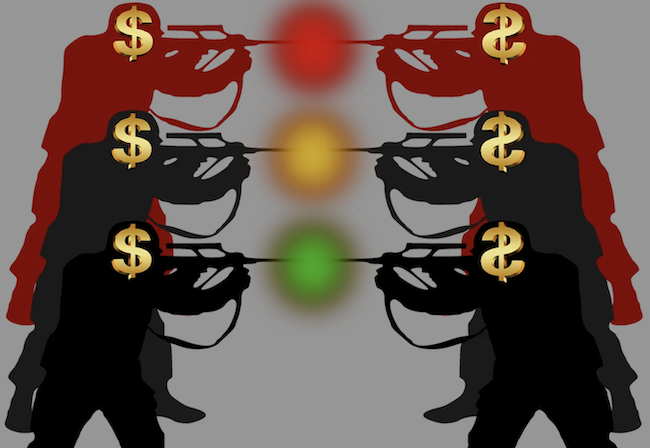
By Vince Hooper | 15 April 2026, https://independentaustralia.net/life/life-display/whos-making-money-the-arsenal-trade-after-ukraine-and-iran,20929
Defence is no longer a defensive trade, and nowhere is the question of who’s buying, who’s building, and who is being left behind more apparent than in Australia, writes Professor Vince Hooper.
Markets, missiles and the end of the peace dividend — and what it means for Australia
A South Korean missile-maker most Western investors could not have located on a map two years ago has just hit an all-time high. LIG Nex1, a precision-guided munitions and electronic warfare specialist headquartered in Yongin, has nearly quadrupled from its January 2025 base, touching 899,000 won on 6 March 2026 — days after American and Israeli aircraft struck Iranian nuclear and missile facilities.
The Korean defence sector as a whole has returned roughly 137 per cent over the past year. These are not the numbers of a sleepy industrial cyclical. They are the numbers of an asset class being repriced in real time.
Defence is no longer a defensive trade. It is the trade. And nowhere is the question of who is buying, who is building, and who is being left in the queue more pointed than in Australia.
Canberra in the queue
For Australia, the arsenal trade is not an abstract market story. It is a mirror.
AUKUS is now a procurement queue rather than a strategy and the cost of waiting for Virginia-class submarines while the Indo-Pacific darkens is becoming uncomfortable to discuss in polite company.
Canberra is, in effect, paying premium prices for late delivery, while Korean and Japanese yards offer shorter timelines at lower cost.
Hanwha’s confirmed 19.9 per cent strategic stake in Austal, cleared by both the Committee on Foreign Investment in the United States (CFIUS) and Canberra’s Foreign Investment Review Board (FIRB) by late 2025, the Henderson shipyards build-up (now known as the Australian Marine Complex), the AS9 Huntsman self-propelled howitzer program being built by Hanwha at Avalon, near Geelong are not coincidences. They are the early signs of an Australian defence industrial base quietly rotating away from Anglosphere dependence and towards Asian arsenals that can actually deliver.
The strain is visible in real time. As the Sydney Morning Herald reported last week, Canberra’s first crisis call during the Middle East escalation went to Beijing rather than Washington — a reflex inversion that would have been unthinkable a decade ago and that tells you more about the perceived reliability of the American guarantee than any AUKUS communiqué.
The ASX has noticed even if the cabinet has not: DroneShield, Electro Optic Systems, Codan and Austal have all attracted the kind of investor attention that only arrives when a market decides a sector’s tail risks have permanently thickened.
From cost centre to industrial darling
The Ukraine War did the structural work. It converted defence from a politically awkward line item into the most fashionable corner of industrial policy and it taught Western treasuries an uncomfortable lesson about how thin their magazines actually were. Three years of artillery duels in the Donbas drained stockpiles NATO had quietly assumed would last a generation.
The Middle East conflict is the second shock. Patriot interceptors, Terminal High Altitude Air Defense (THAAD) reloads, Iron Dome Tamirs, SM-3s, 155mm shells, loitering munitions — each salvo over the Gulf is, in accounting terms, a revenue recognition event somewhere in Arizona, Alabama, Haifa or Daejeon. Governments that spent the 2010s running down inventories on the assumption of a benign world are now writing cheques to rebuild them, and they are writing those cheques into the same handful of balance sheets.
Who, specifically, is making money
Four tiers are visible.
First, the American primes — Lockheed Martin, RTX, Northrop Grumman, General Dynamics, L3Harris. They capture the replenishment contracts, the integration work, and the multi-year framework agreements that Congress now waves through with rare bipartisan enthusiasm. Their backlogs are at record highs and, after two decades of monopsony complaints, their pricing power has quietly inverted.
Second, the European awakening — Rheinmetall, BAE Systems, Leonardo, Saab AB, Thales. Germany’s Zeitenwende turned out to be real, and Rheinmetall in particular has become the continent’s de facto shell foundry, trading less like an industrial stock and more like a leveraged proxy on NATO’s Article 5 itself.
Third, and most interesting from where Australia sits, the Asian arsenals — Hanwha Aerospace, Korea Aerospace Industries, Hanwha Systems and the LIG Nex1 of the opening paragraph, alongside Mitsubishi Heavy Industries and Kawasaki in Japan. South Korea has done what Europe spent 30 years failing to do: build a deep, exportable, price-competitive defence industrial base with delivery times measured in months rather than decades.
Warsaw noticed first. Riyadh, Canberra and Cairo are noticing now. Israel’s own Elbit, Rafael and IAI sit alongside them as the technological pace-setters, particularly in air defence and electronic warfare, where the Iran exchange has been a brutal but effective live-fire showcase.
Fourth, the invisible compounders — the propellant chemists, the rare-earth magnet refiners, the speciality steel mills, the gallium nitride foundries, the International Traffic in Arms Regulation (ITAR) cleared software shops, the maritime insurers writing war-risk cover on Hormuz transits at multiples of last year’s premium. This is where the quiet fortunes are being made. Lynas Rare Earths, sitting on one of the few non-Chinese heavy rare earth supply chains in existence, belongs in this tier, whether the market has fully priced it in or not.
The Gulf parallel
For the Gulf Cooperation Council (GCC), the calculation is different and more cynical than Australia’s, but the underlying logic is the same. Every Gulf capital is simultaneously a customer, a forward operating base, and a potential target. Sovereign wealth is rotating accordingly — not away from defence, but into it. Saudi Arabia, in particular, is building domestic primes such as the Synchronised Accessible Media Exchange (SAMI) — wholly owned by the Public Investment Fund and openly targeting a place in the global top 25 defence companies by 2030.
The export of security capacity has become a new instrument of influence and the capital flows track the doctrine more faithfully than any white paper. Australia, with its Henderson precinct ambitions and its Hanwha partnership, is on a milder version of the same curve.
The uncomfortable coda
None of this is a celebration. A rising LIG Nex1 share price is, in the end, a market-implied judgement that more young people in more places will be killed by better-engineered weapons. The honest analyst names that trade-off rather than hiding behind the chart.
But the honest analyst also tells the truth about incentives. The Ukraine War did not enrich defence contractors by accident and the Iran strikes will not either. Governments that spent a generation treating deterrence as a sunk cost are now paying the bill they should have been paying all along and the firms holding the order books are, predictably, getting rich.
CNN reported over the weekend that U.S. intelligence believes China is preparing to deliver shoulder-fired air defence missiles (MANPADS) to Iran during the current ceasefire — a claim Beijing has formally denied. If the reporting holds, that single fact reframes the arsenal trade as an explicit great-power contest rather than a Western replenishment cycle — and it makes every defence ministry from Canberra to Riyadh recalculate how long it can afford to wait in the AUKUS queue.
For Australia, the question is sharper than for most. Canberra can keep waiting for Virginia-class boats and hoping the phone in Washington still gets answered, or it can do what Warsaw and Riyadh have already done — back the arsenals that can actually deliver, and accept that strategic autonomy in 2026 looks less like an alliance white paper and more like a procurement contract with Daejeon, Tokyo, Henderson or Geelong.
The post-Cold War peace dividend has been spent. What replaces it is already listed, already trading and already on the front page. The only open question is whether Australia is reading the same page as the rest of the market.
Professor Vince Hooper is a proud Australian-British citizen and professor of finance and discipline head at SP Jain School of Global Management with campuses in London, Dubai, Mumbai, Singapore and Sydney.
Amid the Iran chaos, war over Taiwan just became less likely

by Marcus Reubenstein | Apr 15, 2026, https://michaelwest.com.au/amid-the-iran-chaos-war-over-taiwan-just-became-less-likely/
Last week’s meeting between Beijing and Taiwan’s main opposition leader is a bad sign for the China hawks and a sign of rapprochement. Marcus Reubenstein reports.
The combination of the US-Israel war on Iran and the anti-China media narrative in Australia has meant the visit of the leader of Taiwan’s main opposition party, Cheng Li-wun, to China has largely been ignored. Cheng chairs the Kuomintang (KMT) party, and she spent five days in mainland China from the 7th until the 12th of April.
Her public pronouncements indicate a belief that it is not in Taiwan’s interest to pin all of its hopes on an economic and military alliance with the US, and its future is better served with a pivot towards Beijing.
A significant proportion of Taiwan’s population does not want armed conflict with China. More importantly, Taiwan’s political leaders are acknowledging the fact that the US is becoming an increasingly unhinged and unreliable ally.
As reported by NBC News, Cheng points to Ukraine, saying,
“People do not want to see Taiwan become the next Ukraine.”
Add to that mix that Taiwan gets 70% of its oil from the Middle East, there is sentiment in Taiwan that the US bombing of Iran has been disastrously thought out and delivers Taiwan massive economic pain. Will Taiwan risk becoming the centrepiece of a future US military disaster?
In December, Cheng told the New York Times, “Could it be the United States is treating Taiwan as a chess piece, a pawn strategically opposing the Chinese Communist Party at opportune times?”
Taiwan’s ruling DPP (Democratic Progressive Party) had attempted to push a $US40B arms deal with the US through parliament in March, but that was sunk by Cheng’s KMT. The ruling DPP was eventually able to get a deal worth just $US11B through – around one third of an AUKUS submarine.
Cheng’s China visit
The visit to China by Taiwan’s opposition leader took in three very significant cities, Nanjing, Shanghai and Beijing. Shanghai and Beijing, as financial and political capitals, were logical, but Nanjing is of great historical significance.
She visited the Sun Yat‑sen Mausoleum in Nanjing with a large Taiwanese delegation, a site honouring the founding father of the Republic of China, revered in both Taiwan and mainland China. Nanjing is also the site of one of Japan’s greatest wartime atrocities, the so-called Rape of Nanjing.
A small number of hardline figures in Japan’s ruling LDP continue to deny Japanese participated in any wartime atrocities. The LDP’s newly elected prime minister, Sanae Takaichi, stating that Japan would send in its military to aid Taiwan in any conflict with China, has dramatically escalated tensions between Beijing and Tokyo.
Takaichi is one of Japan’s most pro-US leaders, and Cheng’s visit to Nanjing would not be lost on the US. By extension, Cheng’s point of visiting Nanjing could be seen as a backhanded message to Japan, which hosts 55,000 US troops, to stay out of Taiwan’s affairs.
Implications for Australia
Cheng’s trip to China has implications for Australia and our foreign policies towards both our biggest trading partner and most important strategic partner.
The Albanese government has gone all in on the US’s East Asia military push, and now the US is showing clear signs of stress. The US has redeployed Thaad missile systems from South Korea to fight its war with Iran, while supercarrier naval vessels based in Japan, and operating in the South China Sea, have also been sent to the Gulf. Despite being the greatest military power in global history, it’s obvious it doesn’t take much to wear US forces thin.
Neither Prime Minister Anthony Albanese, Foreign Minister Penny Wong, nor Defence Minister Richard Marles has deviated from Australia’s blind support for the US war on Iran.
The question is, will they follow the US into an inevitably disastrous war against China or, worse still, act as a proxy in a future war?
Australia’s tilt towards offensive military capability, also enthusiastically supported by the LNP opposition, and the billions committed to submarines which may never arrive, do not augur well.
If the US cannot defeat Iran, there is no path to victory against an equally determined China, far better equipped, with the world’s second largest economy, and that is not a pariah state.
1×1515
2:54 / 8:51
1×1515
0:16 / 8:51
Last week’s meeting between Beijing and Taiwan’s main opposition leader is a bad sign for the China hawks and a sign of rapprochement. Marcus Reubenstein reports.
The combination of the US-Israel war on Iran and the anti-China media narrative in Australia has meant the visit of the leader of Taiwan’s main opposition party, Cheng Li-wun, to China has largely been ignored. Cheng chairs the Kuomintang (KMT) party, and she spent five days in mainland China from the 7th until the 12th of April.
Her public pronouncements indicate a belief that it is not in Taiwan’s interest to pin all of its hopes on an economic and military alliance with the US, and its future is better served with a pivot towards Beijing.
A significant proportion of Taiwan’s population does not want armed conflict with China. More importantly, Taiwan’s political leaders are acknowledging the fact that the US is becoming an increasingly unhinged and unreliable ally.
As reported by NBC News, Cheng points to Ukraine, saying,
People do not want to see Taiwan become the next Ukraine.
Add to that mix that Taiwan gets 70% of its oil from the Middle East, there is sentiment in Taiwan that the US bombing of Iran has been disastrously thought out and delivers Taiwan massive economic pain. Will Taiwan risk becoming the centrepiece of a future US military disaster?
In December, Cheng told the New York Times, “Could it be the United States is treating Taiwan as a chess piece, a pawn strategically opposing the Chinese Communist Party at opportune times?”
Taiwan’s ruling DPP (Democratic Progressive Party) had attempted to push a $US40B arms deal with the US through parliament in March, but that was sunk by Cheng’s KMT. The ruling DPP was eventually able to get a deal worth just $US11B through – around one third of an AUKUS submarine.
Cheng’s China visit
The visit to China by Taiwan’s opposition leader took in three very significant cities, Nanjing, Shanghai and Beijing. Shanghai and Beijing, as financial and political capitals, were logical, but Nanjing is of great historical significance.
She visited the Sun Yat‑sen Mausoleum in Nanjing with a large Taiwanese delegation, a site honouring the founding father of the Republic of China, revered in both Taiwan and mainland China. Nanjing is also the site of one of Japan’s greatest wartime atrocities, the so-called Rape of Nanjing.
A small number of hardline figures in Japan’s ruling LDP continue to deny Japanese participated in any wartime atrocities. The LDP’s newly elected prime minister, Sanae Takaichi, stating that Japan would send in its military to aid Taiwan in any conflict with China, has dramatically escalated tensions between Beijing and Tokyo.
Takaichi is one of Japan’s most pro-US leaders, and Cheng’s visit to Nanjing would not be lost on the US. By extension, Cheng’s point of visiting Nanjing could be seen as a backhanded message to Japan, which hosts 55,000 US troops, to stay out of Taiwan’s affairs.
Implications for Australia
Cheng’s trip to China has implications for Australia and our foreign policies towards both our biggest trading partner and most important strategic partner.
The Albanese government has gone all in on the US’s East Asia military push, and now the US is showing clear signs of stress. The US has redeployed Thaad missile systems from South Korea to fight its war with Iran, while supercarrier naval vessels based in Japan, and operating in the South China Sea, have also been sent to the Gulf. Despite being the greatest military power in global history, it’s obvious it doesn’t take much to wear US forces thin.
Neither Prime Minister Anthony Albanese, Foreign Minister Penny Wong, nor Defence Minister Richard Marles has deviated from Australia’s blind support for the US war on Iran.
The question is, will they follow the US into an inevitably disastrous war against China or, worse still, act as a proxy in a future war?
Australia’s tilt towards offensive military capability, also enthusiastically supported by the LNP opposition, and the billions committed to submarines which may never arrive, do not augur well.
If the US cannot defeat Iran, there is no path to victory against an equally determined China, far better equipped, with the world’s second largest economy, and that is not a pariah state.
Respected US political scientist Professor John Mearsheimer says, US President Donald Trump’s war with Iran is “manna from heaven” for China. He argues the war on Iran has made the US an irresponsible stakeholder in the international system and that China looks like the “adults in the room.”
China’s carrot and stick
China’s approach to Taiwan, and more broadly to much of its global diplomacy, has been a mix of carrot and stick. Beijing is still dangling carrots in front of Taiwan. Reunification with Taiwan remains the endgame,
“but the overwhelming desire is that it should be achieved peacefully.”
Cheng was warmly received by Chinese President Xi Jinping, and following Cheng’s visit, the Chinese government announced a list of ten new policies to promote economic and travel initiatives to strengthen ties between Beijing and Taiwan.
In the background, a looming stick could be an easily achievable Chinese blockade of commercial shipping around Taiwan. As Iran’s blockade of the Strait of Hormuz demonstrates, it doesn’t take a great deal of military firepower to cripple an economy.
What would, or could, Australia do to intervene? Hypothetically, that is a question which may face Australia, but a reconciliation, indeed possible unification between Taiwan and China, would render moot Australia’s current strategic policy.
Taiwan’s future?
While opinions in Taiwan about Cheng are divided, she has a realistic chance of becoming Taiwan’s next president at the 2028 election. To win, she doesn’t only have to run on China policy; there are plenty of domestic issues facing voters. Also, there is no suggestion that a reunified Taiwan would be considered as a province of China. Instead, it would become a special administrative region, citizens would keep their Taiwanese passports, and the New Taiwan Dollar would remain the official currency.The line in the sand for Beijing would be separatist movements and their sympathisers speaking out publicly. Taiwan would also be prohibited from entering into any military alliances or agreements with other nations.
While this is the same set of conditions imposed on Hong Kong, Taiwan hardly has a tradition of democracy. For its first four decades as a territory, it was governed under martial law, and it wasn’t until 1996 that democratic presidential elections were held.
Current president, Lai Ching-te, is unpopular with his approval rating sinking to 33% in late 2025, having recovered to the low 40% mark in the most recent polls. Cheng’s approval rating is lower, reflecting the distrust Taiwanese people have for their political leaders.
In terms of specific issues, concerns over the economy rank first for Taiwanese voters.
The Chinese, that is to say those of Chinese ethnicity, are by and large very pragmatic. Cheng is betting on a belief that close ties with China represent the future and that the
“Taiwanese people will come to distrust Washington more than they distrust Beijing.”
Australia Must Join The Trump Blockade!
14 April 2026 Rossleigh, https://theaimn.net/australia-must-join-the-trump-blockade/
After Tony Abbott expressed a desire for to send military support for the USA in the Middle East, Jane Hume was on Sky News telling us that we have the capacity to send a warship to support Trump’s blockade of the Strait of Hormuz. This blockade is not the bad blockade that Iran imposed but a good blockade imposed by one of our allies, so we need to support it if we’ve been asked to because it would be terrible to let any oil to slip through from Iran when it’s pretty clear that the best way to stop the blocking of the Strait by Iran is to block it yourself.
Of course it makes sense that the Liberal Party would support a blockade because without it oil might get through and go to countries which aren’t supporting the US such as… well, pretty much every country in the world apart from that country that I can’t mention because it’d be anti-Semitic to do so because it might be interpreted as a criticism of that country and, as we all know, any criticism of that country is just a way of hiding one’s anti-Semitic views.
The terrible thing about oil getting through to places like China and Singapore would be that it’d enable them to sell the oil and that might stop the price going up which would be a bad thing because if the current situation remains then the USA pretty much has a monopoly and this is good for the world because what’s good for the USA is good for the world because the world ceases to exist outside its borders which is why it makes sense for Canada and Greenland to become a non-voting part of the country.
And of course it makes sense for the Liberals to support that because it means higher petrol prices in Australia and higher prices for everything and this would be something to blame Labor for.
After all, the Liberals can’t simply rely on Angus Taylor’s promise to introduce an Australian Values requirement as well as an ICE-style enforcement regime which seeks out those visa overstayers and drags them out and puts them behind bars where they belong until we can send them back to whatever country they came from whether it be China, India, England or even that place that Dan Tehan told us some kids are growing up unaware of, Africa. No, until we actually see people being dragged onto the streets and anyone trying to document it, taken into custody, then this might potentially sound like another one of those promises that are easy to make in opposition but quickly forgotten when one comes to government.
In case you’re wondering exactly what these values are, they’ve been spelled out and no, it’s not support for Phar Lap and drinking stubbies at the cricket. They are:
- Respect for the Individual: Freedom of speech, religion, and association.
- A “Fair Go”: Equality of opportunity for all, regardless of race, gender, age, or disability.
- Democracy and Law: A parliamentary democracy and a firm commitment to the rule of law.
- Equality: Treating all people with dignity and respect.
- Freedom: Respecting the rights of others to live as free citizens.
- Language: The English language is considered a key unifying element.
Yes, it’ll be great when all immigrants are required to abide by the above “Australian Values”. Perhaps they’ll even rub off on some of those native born Aussies who’ve been here long enough to proclaim bugger freedom of religion because we’re a white, Christian, British country and that’s what we’ve always been… which is completely true if you ignore most of our history.
As for the fair go for all regardless of race, gender, age or disability, I did notice several social media posts asking if the recent Head of the Army appointment had ever been in a combat zone or killed anybody. Strange, because I don’t remember anyone asking this about any male appointments. Still I understand that they weren’t being sexist. It was just that some of them wanted Ben Roberts-Smith as head because – according to them – he’d killed people.
BRS, unfortunately, has other Australian Values on his plate such as a firm commitment to the rule of law, but given that these Australian Values warriors aren’t being sexist because that would mean that they were un-Australian, so I’d just like to suggest that maybe we could make Erin Paterson the Army Head because she has all the qualities they asked for, including the capacity to coldly carry out a plan.
Mm, perhaps not.
We know nuclear numbers
R Wood, Valley View, 14 April 26, https://www.adelaidenow.com.au/letter-to-the-editor
Regarding nuclear power, correspondent Bill Fisher is incorrect saying we can’t know about its cost, waste, reliability or public acceptance until we remove the prohibition on nuclear power (“Policy over ideology”, Letters, 10/4)
The prohibition was bipartisan and surveys repeatedly show Australians are wary of nuclear power.
We can easily gather data from other similar countries to estimate the cost, reliability and information about the unsolved problem of what to do with high-level waste.
The CSIRO has done this and found that nuclear power is by far the most expensive way of making electricity.
Studies around the world agree.
How will removing the prohibition be of any influence? Do we have to build nuclear power before we can evaluate it? How does that make any sense?
Not Reporting a War (Part 2)
The question of how Australia became so deeply entangled in the US war machine has a simple answer: follow the money, and follow the men. The defence industry does not just sell weapons. It sells access, influence, and immunity from scrutiny. And in Australia, it has bought all three in spades.
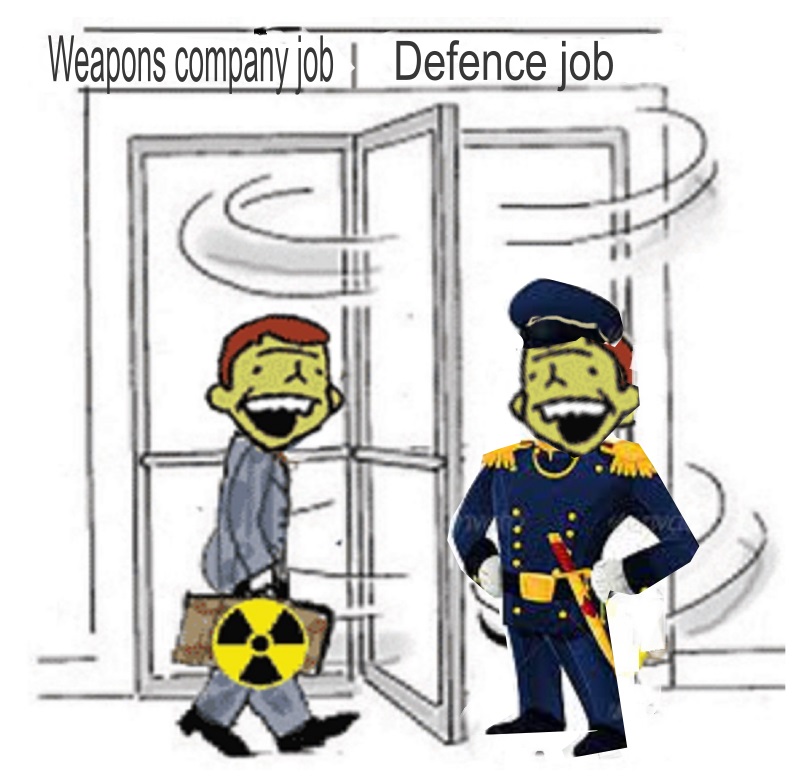
Real power, of course, lies not in the money itself, but in where it goes. The defence and arms lobby is the most egregious example. Elbit Systems of Australia hired Pyne and Partners, the lobbying firm of former Liberal Defence Minister Christopher Pyne, to secure government contracts. Pyne had begun talks about a defence-related corporate role while still in cabinet, and his firm continued to win tens of millions in contracts after he left politics. This is not an anomaly. It is the rule
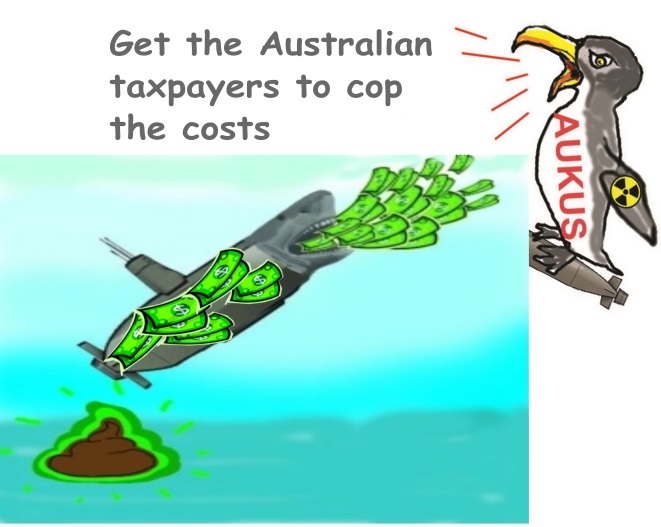
The AUKUS program, a $400 billion boondoggle, has become a gold rush for military contractors, and the revolving-door salesmen are their guides.
12 April 2026 David Tyler AIM Extra, https://theaimn.net/not-reporting-a-war-part-2/
The US and Israel are not only eager to illegally attack Iran, even to invade; they are at war with the rules of war itself. In a move largely ignored by our corporate media, they have dramatically extended the range of what they treat as legitimate targets.
Since Trump’s war began on February 28, 2026, American and Israeli troops have struck more than 13,000 targets across the country, dropping thousands of munitions in a campaign that has deliberately broadened to include soft civilian infrastructure off-limits under international norms.
Iran’s people, armed though their military may be with mine-laying speedboats, missiles and drones, have proved extremely vulnerable to these raids on universities, schools, hospitals, and cultural sites.
No longer is this tactic considered a criminal act in the Pentagon under Defense Secretary Pete Hegseth’s “anything goes” approach. But to understand what “anything goes” actually means in practice, you need to understand the man behind it.
Lethality, Lethality, Lethality

Pete Hegseth is the most consequential appointment Donald Trump has ever made, and the most dangerous. Not because he is powerful, though he is. Because he is incompetent, and the institution he has been handed contains enough destructive capacity to end several civilisations, which, as it happens, is precisely what he has been asked to do with it
Hegseth spent his career in television. He was a weekend host on Fox News, which is to say he was a man paid to be confident about things he did not understand, on a schedule that left his weekdays free. He has no command experience worth the name.
He has never managed a logistics chain, never been responsible for the rules of engagement in a contested theatre, never had to explain to a congressional committee why a targeting decision killed the wrong people. What he has is a theology, and in the current Pentagon, theology outranks competence.
His doctrine, such as it is, can be summarised in three words he repeats like a mantra at every opportunity: lethality, lethality, lethality. This is not a strategy. It is a temperament dressed up as a strategy, the kind of thing that sounds decisive in a greenroom and proves catastrophic in a targeting cell.
Lethality without restraint is not military effectiveness. It is the Peter Principle applied to the largest arsenal in human history: a man promoted precisely one level above the point where his limitations become catastrophic rather than merely embarrassing.
But underneath the incompetence is something more deliberate and more dangerous than simple unfitness for office. Hegseth’s Christianity is not the quiet, private faith of a man who attends church on Sundays.
It is a crusader’s theology, a conviction that the United States is engaged in a civilisational struggle between Christian order and Islamic chaos, and that the traditional constraints on military conduct, proportionality, distinction between combatants and civilians, the prohibition on targeting cultural and educational infrastructure, are not rules to be followed but obstacles to be cleared.
When you bomb a university, in Hegseth’s framework, you are not committing a war crime. You are prosecuting a holy war. The Geneva Conventions were written for conflicts between moral equals. In his theology, there are no moral equals on the other side.
This is the man who has purged the generals and admirals who might have told him why it matters that Sharif University of Technology was Iran’s MIT, that the Pasteur Institute served ninety million people, that destroying a civilisation’s capacity to educate its children is not a path to victory but a guarantee of generational enmity.
He did not want to hear it. The professionals who tried to say it are gone. What remains is an institution stripped of its institutional memory, run by a man whose primary qualification for the job was knowing which camera to look at, and whose secondary qualification was appearing on a television programme watched by the man who appointed him.
The result is not lethality. It is a military with enormous destructive power and no wisdom about when and how to use it, commanded by a man who has confused the absence of restraint with the presence of strength. The Pentagon under Hegseth does not have a strategy for Iran. It has a mood.
The Professors and the Bombs
That mood has consequences. Real ones, with names. On April 3, 2026, the Laser and Plasma Research Institute of Shahid Beheshti University in Tehran was reduced to rubble. The next day, Sharif University of Technology was struck, killing at least five professors and more than sixty students in their classrooms and laboratories.
These were not collateral damage. Iran’s Minister of Science, Hossein Simaei Sarraf, told Al Jazeera that the professors “did not die as a result of a single attack or bombing. The US and Israel deliberately targeted them and planned their killing.”
Since February 28, over thirty Iranian universities have been struck alongside hundreds of schools and medical facilities. This is Hegseth’s lethality doctrine in practice. Not in the Pentagon briefing room where it sounds like transformation. In a Tehran lecture hall, where it looks like a desk on fire and a student who will never finish her degree.
Yet in Australia, the murders of these scholars and their students have been met with silence. No front-page outrage. No prime-time specials. No editorials demanding justice. The ABC, the SMH, the Age, none have deemed it worthy of sustained attention. When Albanese finally ticked off Trump for his genocidal rhetoric, calling it “inappropriate,” it was too little, too late. The mouse had roared, but only after the lion had already feasted.
The Bases We Pretend Aren’t There
Australia is not just a bystander to this war. We are a host. Our bases are not ours alone. They are American outposts, and they have been for decades.
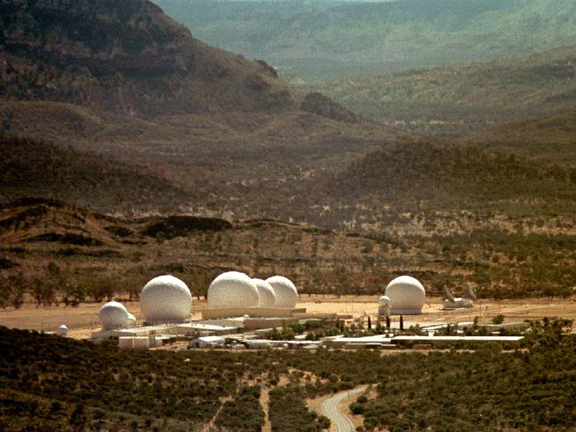
Pine Gap, the joint US-Australian facility near Alice Springs, is the most infamous. Its 45 radomes and Advanced Orion satellites do not just listen. They enable. Richard Tanter’s research confirms that Pine Gap provides real-time intelligence for US offensive operations in Iran. When American missiles strike Tehran, they are guided by data from the red centre of Australia.
HMAS Stirling is on Garden Island, Western Australia, is a different kettle of fish. Officially, it is a Royal Australian Navy base. In practice, it is a US submarine hub. The USS Minnesota’s routine visits are part of a pattern: Stirling is now a de facto US-UK Indian Ocean naval base, with American submarines coming and going as they please. The Australian government calls it “enhanced naval access.” The rest of us might call it a takeover.
Al Minhad Air Base in the UAE is Australia’s primary forward deployed headquarters in the Middle East. Under Operation Accordion, up to 80 Australian personnel are stationed there, alongside US forces. When Iran attacked Al Minhad on March 18, 2026, it was targeting a base that houses both Australian and American military infrastructure.
Our PM acknowledged that three ADF personnel were aboard the US submarine that sank the IRIS Dena. Yet we are told, with a straight face, that Australia is “not involved in offensive action.”
And let us not forget the North West Cape naval communication station in Exmouth, Western Australia, or the RAAF bases at Darwin and Tindal, where US Air Force B-52 bombers now have “enhanced access.” These are not Australian bases with American guests. They are American bases on Australian soil, used as the US sees fit.
The Jets, the Missiles, and the Money
Australia’s complicity is not just geographic, however. It is industrial. We are not just hosting the war. We are fuelling it. In January 2026, the US approved the sale of 450 AIM-260A Joint Advanced Tactical Missiles to Australia, a $3.16 billion deal that includes sustainment, training, and integration systems. These missiles are designed to extend the combat range of our F-35A Lightning II fighter jets, which are already part of the US-led global supply chain. Over 75 Australian companies contribute to the F-35 program, with more than 700 critical components manufactured in Victoria alone.
When these jets drop bombs on Iran, or on Gaza, Australian parts are in the payload.
Elbit Systems is also a key part of our war gaming. The Israeli defence giant, which has seen its share price surge 45 percent since January, is a key supplier to the Australian Defence Force. Our government has awarded millions in taxpayer-funded grants to Australian companies participating in the F-35 program, even as those same jets are used by Israel in its bombing campaigns. Michael West Media calls them “genocide grants.” The term is apt.
The Lobbyists, the Dark Money, and the Revolving Door
The question of how Australia became so deeply entangled in the US war machine has a simple answer: follow the money, and follow the men. The defence industry does not just sell weapons. It sells access, influence, and immunity from scrutiny. And in Australia, it has bought all three in spades.
Dark money floods our political system. Over $138 million in undisclosed donations poured into the major parties before the 2025 election alone, with Labor, the Liberals, the Greens, the Nationals, and One Nation all benefiting from funds whose origins remain a mystery. The rules are so lax that a lobby group can conceal half a million dollars by splitting it into 34 separate donations of $15,000 each, just under the disclosure threshold. The result? Tens of millions of dollars flow into the pockets of politicians with no oversight, no accountability.
Real power, of course, lies not in the money itself, but in where it goes. The defence and arms lobby is the most egregious example. Elbit Systems of Australia hired Pyne and Partners, the lobbying firm of former Liberal Defence Minister Christopher Pyne, to secure government contracts. Pyne had begun talks about a defence-related corporate role while still in cabinet, and his firm continued to win tens of millions in contracts after he left politics. This is not an anomaly. It is the rule.
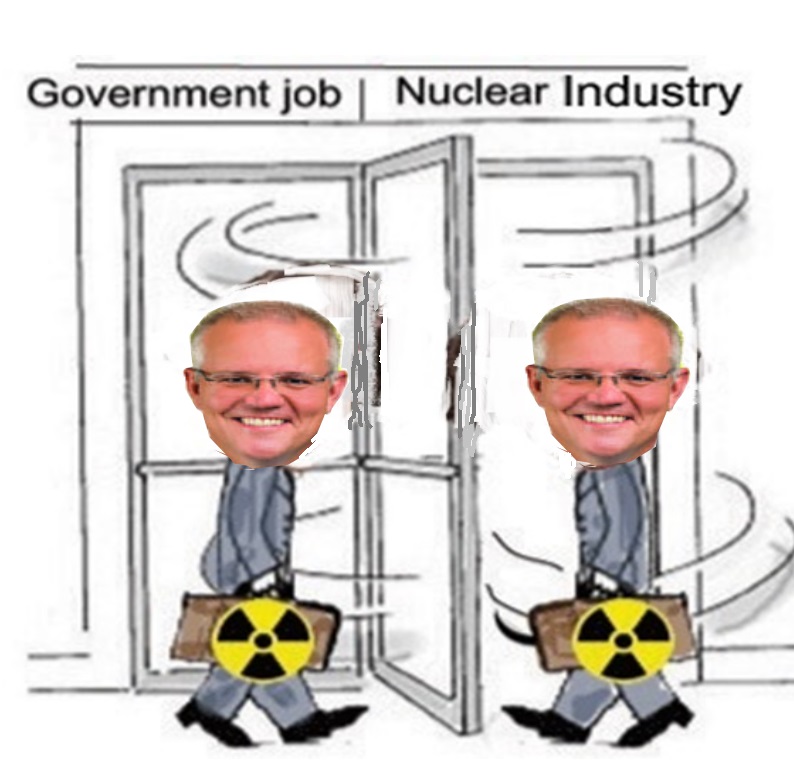
Former Prime Minister Scott Morrison now sits on the advisory board of DYME Maritime, an Australian-American capital fund investing in technologies for AUKUS, the very military alliance his government joined with the US and UK. Former Labor Defence Minister Joel Fitzgibbon is a registered lobbyist for Serco, the British multinational that profits from detention centres and defence logistics. And then there are the Howard government alumni: Alexander Downer, Nick Minchin, Mark Vaile, Michael Wooldridge, Helen Coonan, Richard Alston, Santo Santoro, Larry Anthony, and Peter Costello, all of whom walked straight from Parliament into lobbying roles, many for defence contractors.
.
This is the revolving door in action: a system where public service is a stepping stone to private profit, and where loyalty to the nation is secondary to loyalty to the highest bidder. The Centre for Public Integrity calls it a “well-established revolving door,” with one in four former ministers taking lucrative roles with special interest groups after leaving politics. The rules? A joke. Ministers are banned from lobbying for 18 months, but the ban is not enforced, and the definition of lobbying is so narrow that most simply ignore it. In Canberra, lobbyists now outnumber politicians three to one. And the defence industry is their most fertile hunting ground.
The AUKUS program, a $400 billion boondoggle, has become a gold rush for military contractors, and the revolving-door salesmen are their guides. When Michael West Media exposed that the federal government had awarded $78 million in taxpayer-funded grants to Australian companies supplying parts for the F-35s used by Israel in Gaza, the response was silence. The same jets that rain death on Palestinian civilians are partly made in Victoria, with over 700 critical components manufactured locally. And yet, no one in Canberra blinks.
This is how the war machine captures a democracy. It is not just about money. It is about culture. The defence establishment, with its powerful lobby groups, its dark money, and its utterly unaccountable ASIO, operates with sacred immunity. The Combatting Antisemitism, Hate and Extremism Bill 2026 is just the latest example of how national security is wielded as a cudgel to silence dissent. Under current laws, ASIO can detain individuals for questioning and compel them to answer, with the threat of five years imprisonment for those who refuse to speak, or even for those who disclose that they have been detained. The right to silence, once a cornerstone of our justice system, has been effectively erased for those caught in the national security dragnet.

And where is the watchdog? The press that should be holding this over-indulged monster to account is itself captured. Rupert Murdoch’s News Corp controls 59 percent of the metropolitan and national print media market by readership. Just three corporations, News Corp, Nine, and Seven, collect 80 percent of Australia’s free-to-air and subscription TV revenues. We have the least diverse media ownership in the democratic world, and it shows. When the government extends Murdoch’s press monopoly, it is not just a commercial decision. It is a political one, with consequences for the stories that are told, and the stories that are buried.
The Reckoning
There is a word for what has happened to Australian democracy, and it is not corruption, though corruption is part of it. The word is capture. The defence industry has not bribed its way into Australian politics. It has colonised it, so thoroughly and over such a long period that the distinction between the national interest and the arms industry’s interest has become genuinely difficult to locate. The revolving door spins. The dark money flows. The bases multiply. The grants go to the companies whose jets drop the bombs.
And in Canberra, nobody blinks, because blinking would require acknowledging what everyone already knows. We were once a country that helped build the United Nations. We sent Doc Evatt to New York to argue, with genuine conviction, that small nations had rights that great powers were obliged to respect. That idealism was not naivete. It was a considered foreign policy position: that a middle power’s best protection was a rules-based international order, because the alternative was a world run by the strongest, in which Australia would always be the client and never the principal.
We are that client now. We host the bases, supply the parts, process the targeting data, and call it a partnership. When the bombs fall on a university in Tehran, guided in part by signals from the red centre of Australia, we are told we are not involved in offensive action. The language is chosen carefully, by people who understand exactly what it conceals.
Hegseth has his theology. Albanese has his formulations. Neither is telling the truth about what Australia is doing in this war, and what is being done in our name.
A parliamentary inquiry into Pine Gap’s role in these strikes would be a start. Tighter revolving-door rules, enforced rather than merely announced. An immediate suspension of F-35-related grants pending independent review. These are not radical demands. They are the minimum that a functioning democracy owes its citizens when it takes them to war without asking.
But the deeper demand is simpler, and harder. It is that we stop pretending. Stop pretending that hosting American bases is not choosing sides. Stop pretending that processing targeting data is not participating in the targeting. Stop pretending that a democracy that cannot account for $138 million in undisclosed political donations is a democracy in any meaningful sense of the word.
The watchdogs are still barking. Crikey, The AIMN, Michael West Media: they are not just exposing the truth. They are keeping alive the idea that a free people has the right to know what is being done in its name, and the right to say no. That right exists. It is not being exercised. The question is not whether we still have it.
The question is whether we have the will to use it.
This article was originally published on URBAN WRONSKI WRITES
Hormuz Dateline
What Iran Actually Understands
Iran does not need to win a naval war in the classical sense. It only needs to make transit uncertain, costly, and politically radioactive. Mines, drones, missiles, fast boats, electronic piracy, and the psychology of fear are enough to turn a chokepoint into a garotte. That is the essence of asymmetry: a state under pressure parlays geography into power. Tehran does not need to dominate the sea. It needs only to make everyone else remember that the sea is not theirs.
The US-Israeli axis has long acted as if the region were a board and its opponents pieces. Hormuz shreds that assumption with the patience of geography.
Australia has a particular stake in this arithmetic that the Albanese government would prefer its citizens not examine too carefully. Australia sends approximately 80 percent of its LNG exports through or near the Gulf corridor. When Hormuz is threatened, Woodside’s share price moves. The war that Albanese insists Australia is not involved in is directly affecting the income of Australian energy companies and, through them, the superannuation balances of ordinary Australians. Pine Gap processes targeting data for the strikes. Australian-made F-35 components are in the payload. And Hormuz is where the bill arrives.
14 April 2026 David Tyler AIM Extra, https://theaimn.net/hormuz-dateline/
The war now has the smell of salt, oil, and old empires trying to defy the tide.
Thirty-three kilometres. That is the width of the Strait of Hormuz at its narrowest navigable point: two shipping lanes, each two miles wide, one in, one out, with a median strip of Iranian territorial water between them. Through those lanes passes approximately 21 million barrels of oil every single day. That is one barrel in every five consumed anywhere on earth. Add the liquefied natural gas, and you have roughly 20 percent of all the LNG traded on global markets squeezing through a corridor you could drive across in less than half an hour. A fifth of the world’s energy supply running through a gap that geography, not American naval doctrine, placed there.This is not a side theatre. This is the throat of the world economy, and in this war it has become the place where the old American order goes from swagger to strain. What was once sold as a system of irresistible reach; US power, Gulf oil, the dollar, the naval umbrella, the client-state arrangement, now looks clapped-out, ruinously costly, and exposed as it is caught, hoist by its own petard, dependent on a choke point that cannot be bullied out of geography.
No aircraft carrier in the world can widen the Strait of Hormuz by a single metre.
The Arithmetic of Vulnerability
The numbers matter because official language exists precisely to hide that fact.
When the Iran-Iraq war threatened these waters in the 1980s, oil prices doubled within months. When Houthi attacks on Red Sea shipping began in late 2023, global shipping insurance rates for Gulf-adjacent routes increased by up to 600 percent within weeks. Lloyd’s of London has now quietly tripled war risk premiums for vessels transiting the Gulf. That is not a diplomatic assessment or a Pentagon briefing. That is the financial system’s hard-nosed verdict on what is actually happening, stripped of all the official language about deterrence and security and the rules-based order.
While Trump posts to Truth Social about erasing civilisations and US admirals post to Facebook about historic firsts, the insurance market is pricing the reality that the propaganda is designed to conceal.
Australia has a particular stake in this arithmetic that the Albanese government would prefer its citizens not examine too carefully. Australia sends approximately 80 percent of its LNG exports through or near the Gulf corridor. When Hormuz is threatened, Woodside’s share price moves. The war that Albanese insists Australia is not involved in is directly affecting the income of Australian energy companies and, through them, the superannuation balances of ordinary Australians. Pine Gap processes targeting data for the strikes. Australian-made F-35 components are in the payload. And Hormuz is where the bill arrives.
What Iran Actually Understands
Iran does not need to win a naval war in the classical sense. It only needs to make transit uncertain, costly, and politically radioactive. Mines, drones, missiles, fast boats, electronic piracy, and the psychology of fear are enough to turn a chokepoint into a garotte. That is the essence of asymmetry: a state under pressure parlays geography into power. Tehran does not need to dominate the sea. It needs only to make everyone else remember that the sea is not theirs.
This is a strategic fact Washington cannot deny. Or lie about. The US-Israeli axis has long acted as if the region were a board and its opponents pieces. Hormuz shreds that assumption with the patience of geography. Israel can strike, assassinate, bomb, and escalate, but it cannot turn the Gulf into a risk-free zone. The US can threaten, sanction, and deploy, but it cannot guarantee the one thing the market demands most: confidence. That is the precise point at which imperial force runs into imperial limits. Empires can break things. Claim to rule the world. But it’s not so easy to rebuild trust once the world has called your bluff.
The ruling classes of all three powers; American, Israeli, Iranian are happy to gamble with systems they do not themselves live inside. They talk deterrence but they mean coercion. They may say security but they mean control. They may invoke peace but they build the conditions for the next war. It is the coastal fishermen, the dockworkers, “sea-gulls”, the tanker crews, and the families living with the knowledge that a misfire, a mine, or a drone can change the day in an instant who live inside the system these men are gambling with. That distinction matters. It is, in fact, the only distinction that matters.
The Petrodollar’s Exposed Seam
The petrodollar order was always more fragile than its keepers cared to admit. It rests on a Faustian bargain: Gulf oil will flow, the US will police the sea lanes, the dollar will stay as the world’s reserve currency, and regional rulers will play along so long as the deal suited them. Hormuz is where that bargain begins to fray.
The petrodollar system requires that oil be priced and settled in US dollars. That settlement runs through SWIFT, the global payments network, from which Iran has been excluded as an act of economic warfare. That exclusion has produced a direct, rational, and accelerating response: China, Russia, India, and an expanding coalition of the economically non-aligned are developing alternative settlement systems specifically designed to route around the dollar’s dominance.
This is not ideological posturing. It is financial self-defence against a system that has been openly weaponised. Hormuz is where that process becomes visible to everyone simultaneously.
The dollar’s centrality has depended on the belief that US power could secure the energy arteries while underwriting the financial order that prices global risk. But every threat to Hormuz chips at that belief. Every disruption reminds the world that this system is not floating on neutrality. It is anchored in force. And once force has to be constantly displayed, the myth of effortless supremacy begins to crack along every seam.
This is also why Hormuz looks, feels and even sounds like the end of an era. Not a stagey, Hollywood end of empire, but something slower and more repugnant: the fish rotting from the head, the end of imperial pretension publicly betrayed by the geography it claimed to master. The old style assumed that military reach could substitute for political legitimacy, that sanctions could replace diplomacy, that client regimes could be managed indefinitely, and that publics could be disciplined through spectacle and fear. Hormuz answers all of that with one simple fact: you can command the skies and the seas and still be strategically cornered. You can own the ocean narrative and still depend on a narrow strait you do not fully control.
The Scene Itself
Picture the actual scene, because power loves to use abstraction uses to hide from accountability.
Tankers move slow and dark under a white-hot sky. Naval escorts shadow them like anxious bodyguards. Insurance underwriters in distant offices recalculate exposure in real time. Traders watching screens flicker red. Refineries in South Korea, Japan, and India scramble to secure alternative supply. And in the waters themselves, and on the shores, and in the cities behind those shores, the people who have no choice but to live in the world that distant men are gambling with.That is Hormuz. Not a metaphor first, but a machine for making the abstract painfully concrete. It is thirty-three kilometres of water through which the pretensions of three nuclear-adjacent powers, and the complicities of a dozen client states including our own, are being tested against the oldest and most indifferent judge available: physical reality.
The old imperial language can still speak loudly, but it cannot hide the fact that the world runs through exposed conduits. It can still threaten, but it cannot guarantee outcome. It can still destroy, but it cannot stabilise what it has broken. That is the end-of-era feeling: not the end of power, but the end of the illusion that power can be made clean, automatic, and permanent.
The Narrowness of the Waterway, the Narrowness of Official Thinking
Hormuz is where the lie breaks down. It is where the empire finds the edge of its own reach. It is where the petrodollar shows its dependence, where military supremacy meets strategic vulnerability, and where thirty-three kilometres of salt water becomes a lesson in the catastrophic narrowness of the thinking that brought three powers to this point.
The old order still speaks in the voice of inevitability. Hormuz answers with a counter-argument that has been making the same point since the first trading dhow passed through it: no empire, no doctrine, no naval task force gets to abolish geography.
The market knows it. The insurance actuaries know it. The tanker captains threading those two-mile lanes know it. The fishermen on the Iranian shore know it.
The men ordering the strikes are the last to learn it. They always are.
This article was originally published on URBAN WRONSKI WRITES
Not reporting a war: How Australia’s media launders a crime (Part 1)
11 April 2026 David Tyler, https://theaimn.net/not-reporting-a-war-how-australias-media-launders-a-crime-part-1/
The Crime and the Cover-Up
How can you spot failure in your press gallery? Simple. You know your news media has failed when your government sends special forces to a war it denies waging. When Pine Gap feeds targeting coordinates to bombers killing schoolchildren. And when 170 girls aged seven to twelve are obliterated at their desks in Minab, yet your small target PM takes to the ABC to parrot the belligerents’ justifications without challenge. Australia’s mainstream press hasn’t just failed this test for six weeks. It has “Ajax-ed” the crime, scrubbing far more than just blood from the ledger of history.
The language is the first giveaway. The ABC, our public broadcaster, describes the Minab massacre as “more than 100 children dead in a strike on an Iranian girls’ school.” Not murdered. Not by our allies. Just dead, as if they expired of natural causes. As if no one pulled the trigger. As if the laws of physics and morality somehow suspended themselves over Minab.
The Sydney Morning Herald goes further, calling it “a military error” that “cast a shadow on the US operation.” A shadow. As though the deaths of 170 children are a minor inconvenience, a smudge on the ledger of war, a footnote to the main event. Military error is almost a misdemeanour.
The 13th-century Persian poet Saadi wrote, “The children of Adam are limbs of one body, each created from the same essence.” But in Minab, 170 of those limbs; girls aged seven to twelve – were not rendered invisible. They were erased.
One moment, they were reciting lessons, laughing, passing notes. The next, a Tomahawk missile turned their classroom into a slaughterhouse, their desks into splinters, their futures into ash. There was no warning. No evacuation. No chance. Just the sudden, unbidden destruction of innocence, reduced in our media to a passive clause: “more than 100 children dead in a strike.”
Saadi’s poetry speaks of unity. This war speaks of annihilation. And our press, in its careful language, speaks of nothing at all. But behind the conspiracy of silence is the both-sides fallacy and behind that is the propaganda cartoon of the evil regime: the theocratic bastards had it coming to them anyway.
The Man Who Made the Monster
Why does our media fail? The answer, in no small part, is a 95-year-old former Toorak toff, who long ago traded his Australian passport for American power. Rupert inherited not just his father Keith’s media holdings, but also his knack for blending journalism with political power.
“Rupert Murdoch spent the next half-century seeing what happens when one man controls enough newspapers, TV networks, and politicians’ private lines to bend a ruling class or two to his will.
Rupert Murdoch didn’t just endorse the Iran debacle. He lobbied for it. According to Bloomberg, Murdoch, alongside Israeli Prime Minister Benjamin Netanyahu, privately urged Donald Trump to attack Iran. This wasn’t Murdoch the commentator. This was Murdoch the puppet master, working a president he helped install, pushing for a war his outlets would then cover with the considered neutrality of a cheerleader at a blood sport.
When the bombs fell, his empire’s headlines told the story: “DEATH TO THE DEVIL” (on the killing of Ayatollah Khamenei), “DON GETS LAST LAUGH” (after the US sank an Iranian warship), and, most chillingly, “NO MERCY.”It is the vocabulary of a tabloid covering a football match, not a free press covering a war. But then, Murdoch’s papers have form. It was his British tabloid, The Sun, that screamed ‘GOTCHA!’ on its front page after the General Belgrano was torpedoed in 1982, killing 323 Argentine conscripts, most of them young men who had no more chosen that war than the children of Minab chose this one. Different masthead, different hemisphere. Same owner. Same instinct. Forty-three years and nothing learned.
In Australia, Murdoch’s outlets aren’t just reporting the war, they’re gaslighting the public. As petrol prices surge by 40 percent; a direct cost of the Hormuz closure, a direct consequence of the war they cheered on, his tabloids don’t blame the bombs or the blockades. They blame Chris Bowen. The energy minister. The man holding the hose at the bowser. Never mind that the pump’s price is set by a war Murdoch’s papers demanded, a war his editors framed as necessary, a war his headlines sold as righteous. The distraction isn’t a side effect. It’s the strategy. The war isn’t just a story for Murdoch’s media. It’s a business model. The chaos, the fear, the soaring prices – they’re not bugs in the system.
They are the system.
As the Prussian military theorist Carl von Clausewitz observed, “War is the continuation of politics by other means.” In Murdoch’s hands, it is also the maximising of profit by other means.
The Language of the Bloodless War
There is a craft to how Western media reports war, and it is the craft of the anaesthetist. The goal isn’t to inform. It’s to numb.
The vocabulary is so ingrained that journalists reach for it unthinkingly: strikes, not bombings; targets, not schools; assets destroyed, not people killed; collateral damage, not dead children. The military issues a statement. Coalition forces conduct operations. The situation remains fluid. A facility is neutralised. By the time a reader deciphers “a strike on a facility in the vicinity of a girls’ primary school in Minab, Hormozgan Province, in which a number of civilian casualties were reported,”they have been successfully shielded from the truth: that an American Tomahawk missile or two turned a classroom into a charnel house.
This isn’t accidental. It’s systemic. During the Vietnam War, the US military briefed journalists daily at what correspondents came to call the Five O’Clock Follies, where body counts and “pacified hamlets” sanitised industrial-scale slaughter. It worked until photographers like Nick Ut showed the world what the war actually looked like: a nine-year-old girl, Phan Thị Kim Phúc, running naked down a road, her back on fire with napalm. That single image did more to turn public opinion than a decade of Pentagon briefings. It worked because it refused the system. It showed the thing itself.
There is no equivalent image from Minab in the Australian mainstream press. There are only statistics, spokespeople, and “reports of” and “alleged incidents.” The AI-generated battle graphics on the nightly news are clean and precise, little animated arrows on digital maps, ordnance arcing in parabolas toward rendered targets. It looks just like a video game because the people who design these graphics have learned from video games: abstraction is comfort, and comfort keeps people watching in between lashings of shock and awe.
When US Defence Secretary Pete Hegseth vowed to show “no quarter, no mercy for our enemies,” a law professor and editor at Just Security told Axios this would constitute a war crime under the Pentagon’s own Law of War Manual. The Australian press reported Hegseth’s words. The legal assessment received considerably less coverage. The headline wrote itself. The follow-up did not.
The Questions Not Being Asked
The silences in Australian newsrooms are deafening.
Why, when 61 percent of Australians want no part in this war, is the Albanese government’s posture of covert co-belligerence treated as a footnote? When the Herald Sun reported that around 90 SAS members were deployed to Al Minhad Air Base in the UAE in mid-March, Communications Minister Anika Wells did not rule it out on ABC News Breakfast.
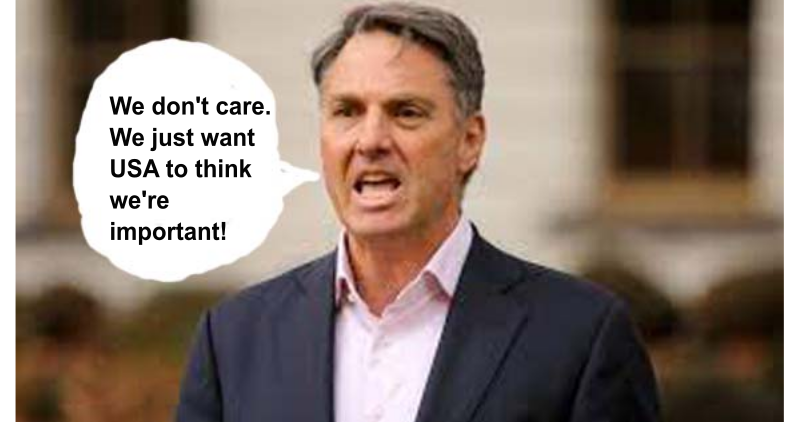
Defence Minister Richard Marles declined to answer directly, assuring listeners only that there were “no boots on the ground in Iran.” A geographic technicality. Moral abdication. Our soldiers aren’t in Iran. They’re in the UAE, feeding data to bombers. The distinction is meant to absolve us. It does not.
Then there’s Pine Gap. Richard Tanter, who has spent more years studying Australia’s joint intelligence facility at Alice Springs than most defence ministers have spent reading their briefings, confirms what Canberra will not: Pine Gap isn’t just listening. It’s providing real-time intelligence for US strikes. Offensive, not defensive. Its 45 radomes and Advanced Orion satellites give Washington total surveillance coverage of Iran. As veteran activist, physician, author, and anti-nuclear advocate Dr Helen Caldicott, warns,
Pine Gap is the “nidus point” for nuclear war fighting. We’re not bystanders. We’re accessories.
And the press? Mostly silent. While Australians pay 40 percent more at the pump, Murdoch’s outlets blame the energy minister, not the war his papers demanded. The distraction is the strategy.
Roman historian Tacitus noted, “The more corrupt the state, the more numerous the laws.” In this case, the more complicit the media, the more euphemistic the language.
Who Profits?
Wars are rarely fought for the reasons stated. The stated reasons here are the prevention of Iranian nuclear ambitions, the destabilisation of Iran’s regional proxies, and the protection of the “rules-based order”; an order whose rules, ironically, prohibit the very aggression used to “protect” it. The real reasons are worth examining.
On Wall Street, defence firms including Lockheed Martin, Northrop Grumman, and RTX see their shares jump by four to six percent on the first day of strikes. The three firms’ combined shareholder gain on that single day is 25 to 30 billion US dollars. In Israel, Elbit Systems briefly became the country’s most valuable listed company, its shares up 45 percent since January. Thirty billion dollars of shareholder value was created in one day, before a single declared objective had been achieved, before a single piece of Iranian military infrastructure was confirmed destroyed. The money did not wait for the outcome. It knew the outcome was irrelevant. The outcome was the war itself.
Non-Gulf energy producers everywhere; US LNG exporters, Norwegian oil fields, Australian gas giants, suddenly found themselves in a seller’s market. Every molecule of energy that did not have to travel through Hormuz became more valuable overnight. American LNG terminals ran at full capacity, shipping cargoes as fast as physically possible. LNG margins doubled. Brent crude surged past 120 dollars a barrel.
In Australia, shares in Woodside Energy and Santos posted record quarters as the war in Iran tightened global fuel supplies. Westpac expects a multi-billion-dollar windfall for the country over the next five years. When the Greens proposed a windfall tax on LNG profiteers, Shell and Chevron howled, calling it a “knee-jerk sugar hit” and “the exact opposite of what Australia needed.” The audacity is staggering, but it is entirely consistent: the companies that profit from wars always find a language for why the profits are deserved and the costs are someone else’s problem.
There is also a political dividend. Before the strikes began, the fallout from the Epstein files was reverberating globally, piling scrutiny on powerful figures with connections to the White House. On the first day of Operation Epic Fury, the Epstein files vanished from the front pages of every Murdoch outlet. They have not returned. The war is the story. Other stories are not the story.
The Persian poet Rumi wrote, “You are not a drop in the ocean. You are the entire ocean in a drop.” Yet amidst the cacophony of this distraction, the ocean of public concern is reduced to drops of outrage, carefully directed, carefully contained.
The Press That Is Actually Doing Its Job
While the mainstream looks away, the independent and student press are holding the line.
Honi Soit, the University of Sydney’s student paper, called out the ABC’s use of “dead” instead of “killed”, language that absolves responsibility, that marks human life as disposable. Michael West Media exposed how Murdoch’s outlets scapegoat Chris Bowen for fuel prices while ignoring the war’s role. Declassified Australia did the forensic work on Pine Gap that the national press refused to undertake. These outlets aren’t fringe. They’re what journalism looks like when it isn’t carrying out other functions.
Clinton Fernandes at UNSW has been unequivocal about Australian complicity through Pine Gap, a truth the Albanese government would rather not discuss. Trita Parsi at the Quincy Institute for Responsible Statecraft has produced the sharpest analysis of the diplomatic failures that led here. Antony Loewenstein’s body of work, documenting Australia’s integration into US and Israeli military operations, was available to every editor in Sydney and Melbourne before the first Tomahawk was launched. They chose not to assign the follow-up. The sources were never the problem.
What This Means (Part 1)
Australia is not a bystander to this war. We are a silent co-belligerent, hosting the intelligence infrastructure, providing the targeting capability, deploying special forces, accepting the fuel price as the cost of alliance, and generating a multi-billion-dollar windfall for corporations that have always owned more of this country’s politics than its voters.
Our press could report this. Instead, it hands the government a language system in which none of this is happening, or if it is, it’s not our fault, or if it is our fault, it’s Iran’s fault for being destabilising, or if it’s not Iran’s fault, it’s Chris Bowen’s fault for the price at the pump. The system is seamless. It has an answer for everything except the question it cannot answer: What happened to 170 girls in Minab? Who killed them? And what are we going to do about the fact that our satellite dishes helped guide the missile?
A democracy that cannot report its own wars is not a democracy. It is a client state, managing its own consent, with a Melbourne-born mogul in New York making the calls, a former prime minister in Sydney pushing for boots on the ground, and a current prime minister on the ABC, reading someone else’s script in his own voice.
Part 2 will expose the mechanics of Pine Gap’s role, the corporate lobbyists writing AUKUS’s blank cheques, and the journalists fighting to drag the truth into the light before the next strike.
This article was originally published on URBAN WRONSKI WRITES
At last, a hint of backbone in Australia’s foreign policy

9 April 2026 Michael Taylor, https://theaimn.net/at-last-a-hint-of-backbone-in-australias-foreign-policy/
For months, many of us have watched in frustration as our government responded to Gaza with caution, equivocation, and a reluctance to break from the familiar script of deference to powerful allies. It has felt, at times, like moral clarity was being carefully managed rather than clearly expressed.
Which is precisely why Anthony Albanese’s sudden intervention on Lebanon lands with such force.
By urging that Lebanon be included in any Middle East ceasefire, the Prime Minister has done something rare in modern Australian foreign policy: he has stepped, however briefly, out of line. Not dramatically. Not defiantly. But unmistakably.
This is not just a policy position – it is a signal.
A signal that Australia may be willing to acknowledge what much of the world can already see: that this is not a series of neatly contained conflicts, but a widening humanitarian crisis stretching from the ruins of Gaza Strip to the streets of Beirut. A signal that civilian suffering is not selective, and that our concern for it should not be either.
And yet, it is impossible to ignore the contrast.
Because while this newfound clarity extends to Lebanon, the same certainty has too often been absent when it comes to Gaza. The language has been softer, the urgency more muted, the moral line less clearly drawn. For many Australians, that inconsistency has not gone unnoticed – or unchallenged.
And perhaps most striking of all, it is a signal that the Prime Minister has finally “read the room.”
Because the room has changed. Public patience has thinned. Across Australia – including among Labor’s own supporters – there has been a growing unease with the language of balance when the images on people’s screens tell a far more unbalanced story. People are not asking for perfection, nor for reckless gestures. But they are asking for something that feels increasingly rare in public life: honesty, consistency, and the courage to apply our values evenly.
In that context, this moment feels different.
It feels like a government, or at least a Prime Minister, beginning to find his footing – beginning to speak not just as an ally, but as a representative of a public that expects more than quiet alignment and careful phrasing.
Whether this is the start of something more substantial, or merely a brief departure from the script, remains to be seen. Governments have a way of snapping back into old habits. The gravitational pull of alliance politics is strong, and Australia has rarely resisted it for long.
But for now, credit where it is due.
In choosing to speak up for Lebanon – and in doing so, gently but clearly diverging from the positions of allies such as the United States under Donald Trump – Anthony Albanese has shown a flicker of something Australians have been waiting to see.
Not a break with our allies. Not a dramatic realignment.
Just something quieter – and, perhaps, more important.
A willingness to stand, at least for a moment, on our own two feet.
Ignoring genocide. The bill for Australia’s silence has arrived
by Andrew Brown | Apr 7, 2026 , https://michaelwest.com.au/ignoring-genocide-the-bill-for-australias-silence-has-arrived/
There is a bitter truth that must be spoken before we can talk honestly about what is happening to us now. Andrew Brown on Australia’s quiet complicity in the illegal US-Israeli war on Iran, fourth in a series.
When the bombs fell on Gaza, Australia was quiet.
When the hospitals were destroyed, when the aid was blocked, when children were pulled from rubble in pieces, when the United Nations, the International Criminal Court, and humanitarian organisations with decades of credibility in conflict zones used words like genocide, ethnic cleansing and collective punishment, Australia was quiet.
Not uniformly. Not entirely. There were protests in every major city, sustained over months, of a size and seriousness this country has not seen since the Iraq War.
There were independent senators who stood in Parliament and said what needed to be said, in plain language, without diplomatic hedging. There were journalists, academics, former diplomats, and hundreds of thousands of ordinary Australians who signed petitions, marched in the streets, and wrote letters that went largely unanswered.
Palestinian-Australian, Muslim-Australian, Arab-Australian communities, and many others with no personal connection to the conflict beyond a functioning conscience, screamed into a political void and were told, in effect, to calm down.
Or apprehended for wearing a t-shirt.
The country, as a political entity, its government, its major institutions, its official voice to the world, was quiet.
The cost of silence
That silence had a cost. Not just a moral cost, though the moral cost is staggering and will take generations to fully reckon with. A strategic cost. The cost of allowing a logic of unchecked military impunity to establish itself as the operating principle of the US-Israeli alliance. A logic that, once normalised in Gaza, did not stay in Gaza.
It never does.
Over 72,000 people killed so far. Over 171,000 injured. An entire civilian population, in one of the most densely populated places on earth, was systematically starved, displaced, and destroyed.
Journalists were killed in numbers that constitute, by any honest accounting, a deliberate campaign to eliminate witnesses. Paramedics were bombed. UN peacekeepers were struck. Aid workers from Australia’s own partner organisations were killed in strikes so precise they could not have been accidental.
Australia expressed concern.
“Calibrated, diplomatically worded, operationally meaningless concern.”
And then, when the same alliance, emboldened by eighteen months of zero meaningful consequence, turned its weapons on a sovereign nation-state, on Iran, on February 28 of this year, Australia expressed support. Called it constructive. Offered the American justification back to its own people as sovereign Australian policy.
Warnings ignored
The people warning loudest about Gaza were not merely warning about Palestinians. They were warning about a system. A system in which American military power and Israeli strategic ambition, freed from the constraints of international law and serious allied pushback, would expand. Would find new targets. Would come, eventually, for the stability of every country caught in its orbit.
“They were right. And they were called antisemitic for saying so.“
Iran did not come from nowhere. The assault on Iran is the direct and logical extension of the impunity normalised in Gaza. If you can destroy a civilian population with no meaningful consequence, you can bomb a sovereign nation.
If the ICC arrest warrant for Netanyahu means nothing, then international law means nothing. And if international law means nothing, then the only operating principle is force. And the consequences of force are distributed not just to the combatants but to every country whose government chose alignment over principle.
Australia chose alignment over the people of Gaza. It chose it again over Iran. And now it is discovering, at the bowser and the checkout and the business bank account, exactly what that choice costs.
The war came home
Here is what makes this moment different from every protest march and every unanswered letter that came before.
The pain is no longer abstract.
When Gaza burned, the average Australian, cocooned by geographic distance, insulated by a media that kept the most confronting images off prime time, reassured by politicians who described it as heartbreaking while doing nothing, could maintain the fiction that this was someone else’s tragedy.
Terrible, certainly. Distant. Manageable. Something that happened over there, to people over there, in a conflict that had been going on forever and would presumably continue
“without any particular bearing on the school fees or the mortgage or the quarterly business figures.”
That fiction is now dead.
The fuel price spike is not over there. The supply chain disruption is not over there. The investment uncertainty showing up in superannuation statements, in business loans that just got harder to service, in the job that exists today and may not exist in three months. None of that is over there.
business loans that just got harder to service, in the job that exists today and may not exist in three months. None of that is over there.
The war came home. Not in body bags. Not in the specific grief of a military family. It came home in the way that imperial adventurism always eventually comes home to the countries that enable it. Through the economy. Through the slow, grinding, distributed punishment of a population that was never consulted, never warned, and never honestly told what their government’s choices would cost them.
Australia’s complicity
Australia was a participant in Gaza’s destruction. Not with weapons. Not with soldiers. With silence. With diplomatic cover. With the specific, material legitimacy that flows from a liberal democracy declining to formally object. And with the arms adjacent, intelligence and security cooperation that flows through Five Eyes and has never been seriously interrogated in the Australian public domain.
When you have the power to intervene, to sanction, to condemn, to withdraw diplomatic cover, and you choose not to, you are not a bystander. You are a participant. And participants, eventually, share in the consequences.
The Palestinian people could not make Australia listen with their suffering alone.
Not because Australians are cruel. They are not. But because the suffering was made distant. The media made it complex. The politicians made it delicate. The lobby groups made it professionally dangerous to say in plain language what was plainly happening.
“The whole architecture of managed consent did its job with brutal efficiency for eighteen months.”
But a forty percent fuel price increase cuts through managed consent, as does a wave of small business closures. And young Australians told to absorb the economic consequences of a war their government endorsed without their knowledge or consent. That cuts through everything.
The people who protested Gaza, who were dismissed and belittled and accused of antisemitism and told they were being naive about geopolitical complexity, understood something that the political class is only now beginning to grasp: That the world does not offer permanent non-involvement. That the wars you enable reach you. That the impunity you excuse comes back denominated in currencies you understand personally.
Fuel. Food. Jobs. Mortgages. Businesses. Futures.
This is that reckoning. The genocide in Gaza did not wake Australia up, the bill for enabling it will.And when Australia wakes, fully, clearly, with the focused fury of people who now understand exactly what was done to them, the politicians who called it constructive and the media that told them to blame the Energy Minister are going to find that managed consent has a shelf life.
That shelf life has expired.
1 This month
Chernobyl: The Lost Tapes – A good documentary on Chernobyl on SBS available On Demand for the next 3 weeks– https://www.sbs.com.au/ondemand/tv-program/chernobyl-the-lost-tapes/2352741955560
15 April – Zoom –Nuclear Power is Not the Solution
Apr 15, 2026 01:00 AM in Canberra, Melbourne, Sydney

Join the International Physicians for the Prevention of Nuclear War (IPPNW) on Tuesday, April 14th for a timely webinar exploring the risks associated with nuclear power and challenging the myth that it offers a simple, safe, carbon-free solution to the climate crisis

21 April Webinar: No Nuclear Weapons in Australia
Start: 2026-04-21 18:00:00 UTC Canberra, Melbourne, Sydney (GMT+10:00)
End: 2026-04-21 19:30:00 UTC Canberra, Melbourne, Sydney (GMT+10:00)
Event Type: Virtual
A virtual link will be communicated before the event.
Host Contact Info: australia@icanw.org

of the week – Australians for War Powers Reform (AWPR)
To see nuclear-related stories in greater depth and intensity
 Antinuclear