Tens of billions are ready for Australia’s renewable revolution: Can regulators and rule makers keep up? — RenewEconomy

The actions of Brookfield, Andrew Forrest, Mike Cannon-Brookes and Scott Farquhar show that shortage of capital is not a problem. The post Tens of billions are ready for Australia’s renewable revolution: Can regulators and rule makers keep up? appeared first on RenewEconomy.
Tens of billions are ready for Australia’s renewable revolution: Can regulators and rule makers keep up? — RenewEconomy
It can’t go on like this’: Power restored to Ukrainian nuclear plant but situation untenable, says IAEA

External power has been restored to Ukraine’s Zaporizhzhya Nuclear Power Plant (ZNPP) two days after it
experienced a complete blackout amid Russian shelling, the UN’s
International Atomic Energy Agency (IAEA) said on Saturday. Both of the
plant’s external power lines, a 750kV line and a 330kV back-up line, were
repaired on Friday, re-establishing power to the plant’s six reactors by
10pm.
The reactors have been shut down, although reactors 5 and 6 are in
semi-hot shutdown to provide steam to the site, and arrangements are being
made to further heat-up units 5 and 6 to achieve a “hot shutdown”
state. The other four units in Europe’s biggest nuclear plant remain in
cold shutdown. Ukrainian staff have operated the plant under Russian
occupation since March. The IAEA has had four experts embedded among the
Ukrainian staff since 5 September. It rotated a new team in on Thursday.
Last week, shelling damaged the last two high-voltage lines
connecting ZNPP to the country’s grid, putting it in full blackout mode and
necessitating the activation of all 20 of its diesel back-up generators.
The IAEA said the lines were damaged some 50-60 kilometres from the plant
in Ukrainian-controlled territory.
“The repeated power outages all too clearly demonstrate the extremely serious nuclear safety and security
situation this major nuclear power plant is facing,” said IAEA director
general Rafael Mariano Grossi. He continued: “So far, the brave staff of
the Zaporizhzhya Nuclear Power Plant have always managed to maintain the
safe operation of the six units. But it can’t go on like this. I have
repeatedly called for the urgent establishment of a nuclear safety and
security protection zone around the Zaporizhzhya Nuclear Power Plant to
prevent a nuclear accident. We can’t afford to lose any more time. We must
act before it is too late.”
Global Construction Review 7th Nov 2022
How the CIA Front group National Endowment for Democracy Laid Foundations for Ukraine War

In the hours following Russia’s invasion of Ukraine, NED hurried to remove any and all trace of its funding for organizations in Ukraine from its website.
A search of the NED grants database today for Ukraine returns “no results,” but a snapshot of the page captured February 25th reveals that since 2014, a total of 334 projects in the country have been awarded a staggering $22.4 million. By NED President Duane Wilson’s reckoning, Kiev is the organization’s fourth-largest funding recipient worldwide.
NED’s expurgation of records exposing its role in fomenting and precipitating the horror now unfolding in southeast Ukraine not only protects de facto CIA agents on the ground. It also reinforces and legitimizes the Biden administration’s fraudulent narrative, endlessly and uncritically reiterated in Western media, that Russia’s invasion was entirely unprovoked and groundless.
Substack, Kit Klarenberg, Jul 2, 22
Obvious examples of Central Intelligence Agency covert action abroad are difficult to identify today, save for occasional acknowledged calamities, such as the long-running $1 billion effort to overthrow the government of Syria, via funding, training and arming barbarous jihadist groups.
In part, this stems from many of the CIA’s traditional responsibilities and activities being farmed out to “overt” organizations, most significantly the National Endowment for Democracy (NED).
Founded in November 1983, then-CIA director William Casey was at the heart of NED’s creation. He sought to construct a public mechanism to support opposition groups, activist movements and media outlets overseas that would engage in propaganda and political activism to disrupt, destabilize, and ultimately displace ‘enemy’ regimes. Subterfuge with a human face, to coin a phrase.
Underlining the Endowment’s insidious true nature, in a 1991 Washington Post article boasting of its prowess in overthrowing Communism in Eastern Europe, senior NED official Allen Weinstein acknowledged, “a lot of what we do today was done covertly 25 years ago by the CIA.”
It Begins…
Fast forward to September 2013, and Carl Gershman, NED chief from its launch until summer 2021, authored an op-ed for The Washington Post, outlining how his organization was hard at work wresting countries in Russia’s near abroad – the constellation of former Soviet republics and Warsaw Pact states – away from Moscow’s orbit.
Along the way, he described Ukraine as “the biggest prize” in the region, suggesting Kiev joining Europe would “accelerate the demise” of Russian leader Vladimir Putin. Six months later, Ukraine’s elected President Viktor Yanukovych was ousted in a violent coup.
Writing in Consortium News not long before that fateful day, investigative legend Robert Parry recorded how, over the previous year, NED had funded 65 projects in Ukraine totaling over $20 million. This amounted to what the late journalist dubbed “a shadow political structure of media and activist groups that could be deployed to stir up unrest when the Ukrainian government didn’t act as desired.”
NED’s pivotal role in unseating Yanukovych can thus be considered beyond dispute, an unambiguous matter of record – yet not only is this never acknowledged in the mainstream press, but Western journalists aggressively rubbish the idea, viciously attacking those few who dare challenge the established orthodoxy of US innocence.
As if to assist in this deceit, NED has removed many entries from its website in the years since the coup, which amply underline its role in Yanukovych’s overthrow.
Read more: How the CIA Front group National Endowment for Democracy Laid Foundations for Ukraine WarFor example, on February 3rd 2014, less than three weeks before police withdrew from Kiev, effectively handing the city to armed protesters and prompting Yanukovych to flee the country, NED convened an event, Ukraine’s lessons learned: from the Orange Revolution to the Euromaidan.
It was led by Ukrainian journalist Sergii Leshchenko, who at the time was finishing up an NED-sponsored Reagan–Fascell Democracy Fellowship in Washington DC.
Alongside him was Nadia Diuk, NED’s then-senior adviser for Europe and Eurasia, and graduate of St. Antony’s College Oxford, a renowned recruiting pool for British intelligence founded by former spies. Just before her death in January 2019, she was bestowed the Order of Princess Olga, one of Kiev’s highest honors, a particularly palpable example of the intimate, enduring ties between NED and the Ukrainian government.
While the event’s online listing remains extant today, linked supporting documents – including Powerpoint slides that accompanied Leshchenko’s talk, and a summary of “event highlights” – have been deleted.
What prompted the purge isn’t clear, although it could well be significant that Leshchenko’s oratory offered a very clear blueprint for guaranteeing the failure of 2004’s Orange Revolution – another NED-orchestrated putsch – wasn’t repeated, and the country remained captured by Western financial, political and ideological interests post-Maidan. It was a roadmap NED subsequently followed to the letter.
Along the way, Leshchenko highlighted the importance of funding NGOs, exploiting the internet and social media as “alternative [sources] of information,” and the danger of “unreformed state television.”
So it was that on March 19th, representatives of the far-right Svoboda party – which has been linked to a false flag massacre of protesters on February 20th, an event that made the downfall of Yanukovych’s government a fait accompli – broke into the office of Oleksandr Panteleymonov, chief of Ukraine’s state broadcaster, and beat him over the head until he signed a resignation letter.
That shocking incident, motivated by the station broadcasting a Kremlin ceremony at which Vladimir Putin signed a bill formalizing Crimea as part of Russia, was one of many livestreamed by protesters that traveled far and wide online.
Panteleymonov’s savage defenestration notwithstanding, much of this livestreamed output served to present foreign audiences with a highly romantic narrative of the demonstrations, and their participants, which bore no relation to reality.
The Revolution Will Be Televised
Writing in NED’s quarterly academic publication Journal of Democracy in July that year, Leshchenko discussed in detail the media’s fundamental role in the Maidan coup’s success, drawing particular attention to the work of “online journalist” Mustafa Nayyem.
Nayyem personally kickstarted the protests the previous November, rallying hundreds of his Facebook followers to protest in Kiev’s Independence – now Maidan – Square, after Yanukovych scrapped the Ukrainian-European Association Agreement in favor of a more agreeable deal with Moscow.
Nayyem was no ordinary “online journalist”. He had by that point worked alongside Leshchenko for many years at Ukrainska Pravda, an opposition media outlet funded by NED, and also USAID, another CIA front, which likewise played a key role in the Maidan coup.
This may account for why, in October 2012, Nayyem was one of six Ukrainians whisked to Washington DC by Meridian International, a State Department-connected organization that identifies and grooms future overseas leaders, to “observe and experience” that year’s Presidential election………………………………………….
only 40 – 45 percent of Ukrainians were in favor of European integration, Yanukovych remained “the most popular political figure in the country,” and no poll conducted to date had ever indicated mass support for the uprising.
In fact, “quite large majorities” opposed “takeover of regional governments by the opposition,” and the population remained bitterly divided on the future of Ukraine, Darden and Way wrote. Such hostility stemmed from “anti-Russian rhetoric and the iconography of western Ukrainian nationalism,” rife among demonstrators, “not [playing] well among the Ukrainian majority.”
…….. “Anti-Russian forms of Ukrainian nationalism expressed on the Maidan are certainly not representative of the general view of Ukrainians. Electoral support for these views and for the political parties who espouse them has always been limited,” Darden and Way concluded. “Their presence and influence in the protest movement far outstrip their role in Ukrainian politics and their support barely extends geographically beyond a few Western provinces.”
‘Pro-Ukrainian Agenda’……………………………. an objective analysis of what actually happened and why, in which NED is completely central. Still, the organization didn’t need to rely purely on Leshchenko to keep the Minsk Accords moribund. Its extensive network of assets in the country, and Washington’s dark alliance with Ukraine’s far-right, was more than sufficient to ensure that Zelensky’s overwhelmingly popular mission of restoring relations with Russia would and could never be fulfilled.
‘In Solidarity’
In the hours following Russia’s invasion of Ukraine, NED hurried to remove any and all trace of its funding for organizations in Ukraine from its website.
A search of the NED grants database today for Ukraine returns “no results,” but a snapshot of the page captured February 25th reveals that since 2014, a total of 334 projects in the country have been awarded a staggering $22.4 million. By NED President Duane Wilson’s reckoning, Kiev is the organization’s fourth-largest funding recipient worldwide.
An archive of NED funding in Ukraine over 2021 – which has now been replaced with a statement “in solidarity” with Kiev – offers extensive detail on the precise projects backed by the CIA front over that fateful 12-month period.
It points to a preponderant focus on purported Russian misdeeds in eastern Ukraine. One grant, of $58,000, was provided to the NGO Truth Hounds to “monitor, document, and spotlight human rights violations” and “war crimes” in the Donetsk and Luhansk regions.
Another, of $48,000, was provided to Ukraine’s War Childhood Museum to “educate the Ukrainian public about the consequences of the war through a series of public events.” Yet another received by charity East-SOS aimed to “raise public awareness” of “Russia’s policies of persecution and colonization in the region, and document illustrative cases,” its findings circulated to the UN Human Rights Council, European Courts of Human Rights, and International Court of Justice.
There was no suggestion this wellspring would be used to document any abuses by Ukrainian government forces. UN research indicates 2018 – 2021, over 80 percent of civilian casualties were recorded on the Donbas side. Meanwhile, Organization for Security and Cooperation in Europe reports show that shelling of civilian areas in the breakaway regions intensified dramatically in the weeks leading up to February 24th, potentially the precursor of a full-blown military offensive.
As such, NED’s expurgation of records exposing its role in fomenting and precipitating the horror now unfolding in southeast Ukraine not only protects de facto CIA agents on the ground. It also reinforces and legitimizes the Biden administration’s fraudulent narrative, endlessly and uncritically reiterated in Western media, that Russia’s invasion was entirely unprovoked and groundless.
Ukrainians now live with the mephitic legacy of that reckless, unadmitted meddling in the most brutal manner imaginable. They may well do for many years to come. Meanwhile, the men and women who orchestrated it rest comfortably in Washington DC, insulated from any scrutiny or consequence whatsoever, every day cooking up fresh schemes to undermine and topple troublesome foreign leaders, hailed as champions of liberty by the mainstream press every step of the way. https://kitklarenberg.substack.com/p/anatomy-of-a-coup-how-cia-front-laid
How likely is progress on climate at Cop27?

Meeting the target of limiting heating to 1.5C: At Cop26 in Glasgow, countries agreed to limit global
heating to 1.5C above pre-industrial levels. The pledges on emissions cuts
they came forward with were not enough to meet this goal, however, so they
agreed to return this year with strengthened commitments.
Few have done so
– only 24 submitted new national plans on emissions to the UN in advance of
Cop27. Fulfilling promise of $100bn a year on climate finance: Since 2009,
poor countries have been promised $100bn (£87bn) a year from 2020 to help
them cut greenhouse gas emissions and adapt to the impacts of extreme
weather. This target has not been met, and will not be met before next
year.
Guardian 9th Nov 2022
https://www.theguardian.com/environment/2022/nov/09/how-likely-is-progress-on-climate-at-cop27
US warns Australia against joining treaty banning nuclear weapons

US embassy in Canberra says treaty ‘would not allow for US extended deterrence relationships’
Daniel Hurst, 9 Nov 22,
The US has warned Australia against joining a landmark treaty banning nuclear weapons, saying the agreement could hamper defence arrangements between the US and its allies.
But New Zealand said it was “pleased to observe a positive shift” in Australia’s position in a United Nations vote and “would, of course, welcome any new ratifications as an important step to achieving a nuclear weapon-free world”.
The comments follow the Albanese government shifting Australia’s voting position on the treaty on the prohibition of nuclear weapons to “abstain” after five years of blanket opposition by the Coalition government.
The relatively new treaty imposes a blanket ban on developing, testing, stockpiling, using or threatening to use nuclear weapons – or helping other countries to carry out such activities. But so far it has been shunned by all of the nuclear weapons states and many of their allies.
The US embassy in Canberra said the treaty “would not allow for US extended deterrence relationships, which are still necessary for international peace and security”.
That is a reference to Australia relying on American nuclear forces to deter any nuclear attack on Australia – the so-called “nuclear umbrella” – even though Australia does not have any of its own atomic weapons.
The embassy said the treaty also risked “reinforcing divisions” within the international community…………………………
The comments are a sign of the pushback Australia faces from its top security ally if it gets closer to signing and ratifying the treaty – although that still seems distant.
New Zealand said it welcomed “constructive developments in Australia’s approach” to the treaty, including the shift from opposing a NZ-backed resolution on the topic at the UN general assembly first committee last month.
New Zealand’s minister for disarmament and arms control, Phil Twyford, has met with Australian representatives.
A spokesperson for the Ministry o
f Foreign Affairs and Trade said New Zealand continued to urge all countries that were not yet a party to the treaty to sign and ratify it “at the earliest opportunity”, while acknowledging it was “for Australia to determine its position”.
The Australian prime minister, Anthony Albanese, has been involved in advocacy against nuclear weapons and has described them as “the most destructive, inhumane and indiscriminate weapons ever created”.
Albanese moved the motion at Labor’s 2018 national conference backing the TPNW, saying the task would not be easy or simple but it would be “just”.
The treaty now has 91 signatories, 68 of which have formally ratified it, and it entered into force last year.
Friends of the Earth urge all South Australian federal Labor politicians to push for the scrapping of Kimba nuclear waste plan.
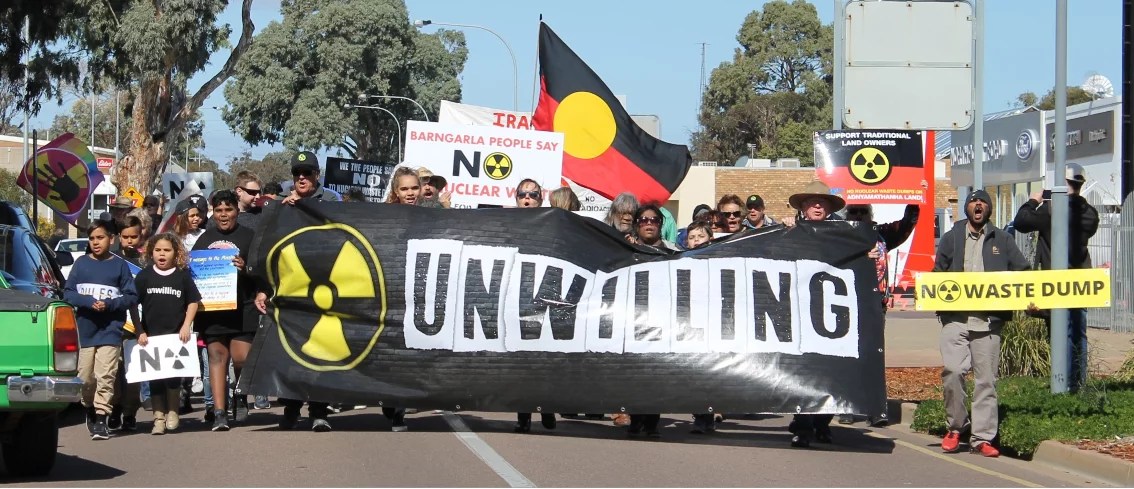
From Friends of the Earth – The letter below was sent today to all South Australian federal ALP politicians.
We are writing in regard to the proposed construction of a National Radioactive Waste Management Facility (nuclear waste dump) at Napandee, near Kimba in South Australia.
We wish to thank the SA Labor Caucus for its resolution at the recent South Australian ALP State Convention supporting “a veto right for the Barngarla community on this facility”. The resolution states, “Continuing with this project, including ancillary earthworks outside of current legal injunctions, despite the opposition of the Barngarla people, undermines efforts toward reconciliation.”
As a Labor Party politician elected to federal parliament to represent South Australia, we urge you to push for the implementation at the federal level of SA Labor’s position on this matter. We are concerned that the current Minister for Resources Madeleine King is following the lead of the bureaucracy in pursuing the former Coalition government’s policy on the nuclear waste dump.
Napandee was announced as the chosen site for the permanent disposal of low level radioactive waste (LLW) and temporary storage of intermediate level radioactive waste (ILW) in February 2020 by then federal resources minister Senator Matt Canavan. It was subsequently officially declared on 26 November 2021 by Senator Canavan’s successor Mr Keith Pitt MP. There is no reason why the current Labor government should allow itself to be bound by policies of the previous government promoted by National Party politicians Senator Canavan and Mr Pitt.
To pursue this project risks undermining the Labor government’s signature policy of enshrining in the Constitution a First Nations Voice to Parliament. A voice to parliament would enable Aboriginal and Torres Strait Islander people to provide advice to the parliament on policies and projects that impact their lives. The clear advice from the Barngarla people, the Traditional Owners of this area, is that they don’t want a nuclear waste dump on their land. The Barngarla people were excluded from a community ballot conducted by the Kimba District Council in November 2019, so they conducted their own independent poll. Not a single Traditional Owner voted in favour of the dump.
Besides the Barngarla people, significant other affected communities have not been consulted. A facility that would involve transportation of radioactive waste through South Australia should involve consultation with all communities along the transport route and with the wider public. No such consultation has occurred.
There are better alternatives to a centralised waste dump in regional South Australia. The overwhelming majority of the waste comes from the Australian Nuclear Science and Technology Organisation’s (ANSTO) Lucas Heights facility. The safest and most secure place to continue to manage and store the waste is at Lucas Heights, especially given that the proposed Napandee site would only provide temporary storage for intermediate level radioactive waste (ILW). A final disposal site for ILW would still have to be found. What is the point of double handling it?
We urge you to push for the federal government to promptly overturn the previous government’s declaration of the Napandee site and to cease all work at the site.
MASSIVE ANTI-RUSSIAN ‘BOT ARMY’ EXPOSED BY AUSTRALIAN RESEARCHERS

Reports on the new research have appeared in a few independent media sites, and in Russia’s RT, but not much else, so revealing the burial of stories that don’t fit the desired pro-Western narrative.
The Adelaide University researchers tried their best to be noncommittal in describing the activities of the fake Twitter accounts, although they had found the vast majority – over 90 percent – were anti-Russian messages.
many of the bot accounts behind the 5-million tweets studied are likely to be still up and running.
Over 3.5-million tweets, or 67 percent, were in the English language, with fewer that 2 percent in Russian and Ukrainian.
In May 2022, National Security Agency (NSA) Director and US Cyber Command chief, General Paul Nakasone, revealed that the Cyber Command had been conducting offensive Information Operations in support of Ukraine.
An Australian university has unearthed millions of Tweets by fake ‘bot’ accounts pushing disinformation on the Ukraine war.
https://declassifiedaus.org/2022/11/03/strongmassive-anti-russian-bot-army-exposed-by-australian-researchers-strong/ by Peter Cronau | 3 Nov, 2022 |
A team of researchers at the University of Adelaide have found that as many as 80 percent of tweets about the 2022 Russia-Ukraine invasion in its early weeks were part of a covert propaganda campaign originating from automated fake ‘bot’ accounts.
An anti-Russia propaganda campaign originating from a ‘bot army’ of fake automated Twitter accounts flooded the internet at the start of the war. The research shows of the more than 5-million tweets studied, 90.2 percent of all tweets (both bot and non-bot) came from accounts that were pro-Ukraine, with fewer than 7 percent of the accounts being classed as pro-Russian.
The university researchers also found these automated tweets had been purposely used to drive up fear amongst people targeted by them, boosting a high level of statistically measurable ‘angst’ in the online discourse.
The research team analysed a massively unprecedented 5,203,746 tweets, sent with key hashtags, in the first two weeks of the Russian invasion of Ukraine from 24 February this year. The researchers considered predominately English-language accounts, with a calculated 1.8-million unique Twitter accounts in the dataset posting at least one English-language tweet.
Reports on the new research have appeared in a few independent media sites, and in Russia’s RT, but not much else, so revealing the burial of stories that don’t fit the desired pro-Western narrative.
This ground-breaking study, exposing a massive anti-Russia social media disinformation campaign, has been effectively ignored by the mainstream Western establishment media. It’s become almost routine during the Russia-Ukraine war.
The disinformation blitz krieg
The Adelaide University researchers unearthed a massive organised pro-Ukraine influence operation underway from the early stages of the conflict. Overall the study found automated ‘bot’ accounts to be the source of between 60 to 80 percent of all tweets in the dataset.
The published data shows that in the first week of the Ukraine-Russia war there was a huge mass of pro-Ukrainian hashtag bot activity. Approximately 3.5 million tweets using the hashtag #IStandWithUkraine were sent by bots in that first week
In fact, it was like someone had flicked a switch, when at the start of the war on 24 February, pro-Ukraine bot activity suddenly burst into life. In that first day of the war the #IStandWithUkraine hashtag was used in as many as 38,000 tweets each hour, rising to 50,000 tweets an hour by day three of the war.
By comparison, the data shows that in the first week there was an almost total absence of pro-Russian bot activity using the key hashtags. During that first week of the invasion, pro-Russian bots were sending off tweets using the #IStandWithPutin or #IStandWithRussia hashtags at a rate of only several hundred per hour.
Read more: MASSIVE ANTI-RUSSIAN ‘BOT ARMY’ EXPOSED BY AUSTRALIAN RESEARCHERSGiven the apparent long-range planning for the invasion of Ukraine, cyber experts expressed surprise that Russian cyber and internet responses were so laggard. A researcher at the Centre for Security Studies in Switzerland, said: ‘The [pro-Russian] cyber operations we have seen do not show long preparation, and instead look rather haphazard.’
After being apparently left flatfooted, the #IStandWithPutin hashtag mainly from automated bots, eventually fired up a week after the start of the war. That hashtag commenced appearing in higher numbers on 2 March, day 7 of the war. It reached 10,000 tweets per hour just twice over the next two days, still way behind the pro-Ukraine tweeting activity.
The #IStandWithRussia hashtag use was even smaller, reaching only 4,000 tweets per hour. After just two days of operation, the pro-Russian hashtag activity had dropped away almost completely. The study’s researchers noted the automated bot accounts ‘likely used by Russian authorities’, were ‘removed likely by pro-Ukrainian authorities’.
The reaction against these pro-Russian accounts had been swift. On March 5, after the #IStandWithPutin hashtag had trended on Twitter, the company announced it had banned over 100 accounts using the hashtag for violating its ‘platform manipulation and spam policy’ and participating in ‘coordinated inauthentic behaviour’.
Later that month, the Ukraine Security Service (SBU) reportedly raided five ‘bot farms’ operating inside the country. The Russia-linked bot operators were reportedly operating through 100,000 fake social media accounts spreading disinformation that was ‘intended to inspire panic among Ukrainian masses’.
Unfiltered and independent research
The landmark Adelaide University research differs from these earlier revelations in another most unique and spectacular way.
While the Stanford-Graphika and Meta research was produced by researchers who have long-term deep ties to the US national security state, the Adelaide University researchers are remarkably independent. The academic team is from the university’s School of Mathematical Science. Using mathematical calculations, they set out to predict and model people’s psychological traits based on their digital footprint.
Unlike the datasets selected and provided for the Stanford/Graphika and the Meta research, the data the Adelaide University team accessed didn’t come from accounts after they’ve been detected for breaching guidelines and shut down by Meta or Twitter.
Joshua Watt is one of the lead researchers on the university team, and is a MPhil candidate in Applied Mathematics and Statistics from the university’s School of Mathematical Sciences.
He told Declassified Australia that the dataset of 5-million tweets was accessed directly by the team from Twitter accounts on the internet using an academic license giving access to the Twitter API. The ‘Application Programming Interface’ is a data communication software tool that allows researchers to directly retrieve and analyse Twitter data.
The fake tweets and automated bot accounts had not been detected and removed by Twitter before being analysed by the researchers, although some were possibly removed in the March sweep by Twitter. Watt told Declassified Australia that in fact many of the bot accounts behind the 5-million tweets studied are likely to be still up and running.
Declassified Australia contacted Twitter to ask what action they may have taken to remove the fake bot accounts identified in the University of Adelaide research. They had not responded by the time of going to press.
Critical tool in information warfare
This new research paper confirms mounting fears that social media has covertly become what the researchers call ‘a critical tool in information warfare playing a large role in the Russian invasion of Ukraine’.
The Adelaide University researchers tried their best to be noncommittal in describing the activities of the fake Twitter accounts, although they had found the vast majority – over 90 percent – were anti-Russian messages. They stated: ‘Both sides in the Ukrainian conflict use the online information environment to influence geopolitical dynamics and sway public opinion.’
They found the two main participating sides in the propaganda war have their own particular goals and style. ‘Russian social media pushes narratives around their motivation, and Ukrainian social media aims to foster and maintain external support from Western countries, as well as promote their military efforts while undermining the perception of the Russian military.’
While the research findings concentrated on automated Twitter bots, there were also findings on the use of hashtags by non-bot tweeters. They found significant information flows from non-bot pro-Russian accounts, but no significant flows from non-bot pro-Ukraine accounts.
As well as being far more active, the pro-Ukraine side was found to be far more advanced in its use of automated bots. The pro-Ukrainian side used more ‘astroturf bots’ than the pro-Russians. Astroturf bots are hyper-active political bots that continuously follow many other accounts to increase follower count of that account.
Social media role in boosting fear
Crucially, the University of Adelaide researchers also investigated the psychological influence the fake automated bot accounts had on the online conversation during those early weeks of the war.
These conversations in a target audience may develop over time into support or opposition towards governments and policies – but they may also have more instant effects influencing the target audiences’ immediate decisions.
The study found that it was the tweets from the fake ‘bot’ accounts that most drove ‘an increase in conversations surrounding angst’ amongst people targeted by them. They found these automated bot accounts increased ‘the use of words in the angst category which contains words related to fear and worry, such as “shame”, “terrorist”, “threat”, “panic”.’
By combining the ‘angst’ messaging with messages about ‘motion’ and geographical locations, the researchers found ‘the bot accounts are influencing more discussion surrounding moving/fleeing/going or staying’. The researchers believe this effect may well have been to influence Ukrainians even away from the conflict zones to flee from their homes.
The research shows that fake automated social media ‘bot’ accounts do manipulate public opinion by shaping the discourse, sometimes in very specific ways. The results provide a chilling indication of the very real malign effects that mass social media disinformation campaigns can have on an innocent civilian population.
Origins of the Twitter bot accounts
The researchers report that the overwhelming level of Twitter disinformation that was anti-Russian was from bots ‘likely [organised] by pro-Ukrainian authorities’.
The researchers asserted no further findings about the origin of the 5-million tweets, but did find that some bots ‘are pushing campaigns specific to certain countries [unnamed], and hence sharing content aligned with those timezones’. The data does show that the peak time for a selection of pro-Ukrainian bot activity corresponded with being between 6pm and 9pm across US timezones.
Some indication of the origin and the target of the messages, could be deduced from the specific languages used in the 5-million tweets. Over 3.5-million tweets, or 67 percent, were in the English language, with fewer that 2 percent in Russian and Ukrainian.
In May 2022, National Security Agency (NSA) Director and US Cyber Command chief, General Paul Nakasone, revealed that the Cyber Command had been conducting offensive Information Operations in support of Ukraine.
‘We’ve conducted a series of operations across the full spectrum: offensive, defensive, [and] information operations,” Nakasone said.
Nakasone said the US has been conducting operations aimed at dismantling Russian propaganda. He said the operations were lawful, conducted through policy determined by the US Defense Department and with civilian oversight. Nakasone said the US seeks to tell the truth when conducting an Information Operation, unlike Russia.
US Cyber Command had deployed to Ukraine a ‘hunt forward’ cyber team in December to help shore up Ukraine’s cyber defences and networks against active threats in anticipation of the invasion. A newly formed European Union cyber rapid response team consisting of 12 experts joined the Cyber Command team to look for active cyber threats inside Ukrainian networks and to strengthen the country’s cyber defences.
The US has invested $40 million since 2017 in helping Ukraine buttress its information technology sector. According to US Deputy Secretary of State Wendy Sherman, the investments have helped Ukrainians ‘keep their internet on and information flowing, even in the midst of a brutal Russian invasion’.
Wars and lies in our pockets
With the rise of the internet, war and armed conflict will never be the same again. Others have noted that the Russian invasion of Ukraine has ushered in ‘a new digital era of military, political and economic conflict’ being manipulated by ‘laptop generals and bot armies’.
‘In all dimensions of this conflict, digital technology plays a key role – as a tool for cyberattacks and digital protest, and as an accelerator for flows of information and disinformation,’ wrote one.
‘Propaganda has been a part of war since the beginning of history, but never before could it be so widely spread beyond an actual conflict area and targeted to so many different audiences.’
Joshua Watt, one of the lead researchers on the University of Adelaide team that conducted the landmark study, summed it up. ‘In the past, wars have been primarily fought physically, with armies, air force and navy operations being the primary forms of combat. However, social media has created a new environment where public opinion can be manipulated at a very large scale.’
‘CNN brought once-distant wars into our living rooms,’ another stated, ‘but TikTok and YouTube and Twitter have put them in our pockets.’
We are all carrying around with us a powerful source of information and news media – and also, most certainly, disinformation that’s coming relentlessly at us from influence operations run by ‘bad actors’ whose aim is to deceive.
Revealed: US and UK, Canada, Australia fall billions short of ‘fair share’ of climate funding for developing countries.

The US, UK, Canada and Australia have fallen billions of dollars short of
their “fair share” of climate funding for developing countries,
analysis shows. The assessment, by Carbon Brief, compares the share of
international climate finance provided by rich countries with their share
of carbon emissions to date, a measure of their responsibility for the
climate crisis.
Rich countries pledged to provide US$100bn a year by 2020,
although this target has been missed. The US share of this, based on its
past emissions, would be $40bn yet it provided only $7.6bn in 2020, the
latest year for which data is available.
Australia and Canada gave only about a third of the funding indicated by the analysis, while the UK
supplied three-quarters but still fell $1.4bn short.
The issue of climate finance will be critical to progress at the Cop27 summit, which began on
Sunday in Egypt. Developing countries did little to cause the climate
emergency, making funding from rich countries vital to create the trust
needed for combined global action.
The rich countries accept vulnerable
countries face a “life or death situation” and need far more than
$100bn but delivery of the money has been contentious and slow. The $100bn
was intended to support the cutting of carbon emissions and work to adapt
communities to the increasingly extreme weather being driven by global
heating. However, a series of reports last week have laid bare how close
the planet is to climate catastrophe, with “no credible pathway [of
carbon cuts] to 1.5C in place”, the internationally agreed temperature
limit to avoid the worst of the climate crisis.
Guardian 7th Nov 2022
Let’s Be Clear: If WW3 Happens It Will Be The Result Of Choices Made By The US Empire

https://caitlinjohnstone.substack.com/p/lets-be-clear-if-ww3-happens-it-will?publication_id=82124&isFreemail=true Caitlin Johnstone 8 Nov 22,
The commander of the US nuclear arsenal has stated unequivocally that the war in Ukraine is just a warmup exercise for a much larger conflict that’s already in the mail.
Antiwar’s Dave DeCamp reports:
The commander that oversees US nuclear forces delivered an ominous warning at a naval conference last week by calling the war in Ukraine a “warmup” for the “big one” that is to come.
“This Ukraine crisis that we’re in right now, this is just the warmup,” said Navy Adm. Charles Richard, the commander of US Strategic command. “The big one is coming. And it isn’t going to be very long before we’re going to get tested in ways that we haven’t been tested [in] a long time.”
Richard’s warning came after the US released its new Nuclear Posture Review (NPR), which reaffirms that the US doctrine allows for the first use of nuclear weapons. The review says that the purpose of the US nuclear arsenal is to “deter strategic attacks, assure allies and partners, and achieve US objectives if deterrence fails.”Not only does Richard appear to believe that a hot war between major world powers is a foregone conclusion, he has also previously stated that a nuclear war with Russia or China is now “a very real possibility.”
Again, this is not some armchair warrior opining from his desk at a corporate newspaper or DC think tank, this is the head of STRATCOM. Richard would be personally overseeing the very warfare he is talking about.
What I find most striking about remarks like these is how passive they always make it sound. Richard talks about “The Big One” like other people talk about California earthquakes, as though a hot war with China would be some kind of natural disaster that just happened out of nowhere.
This type of rhetoric is becoming more and more common. Describing an Atomic Age world war as something that would happen to the US empire, rather than the direct result of concrete A-or-B decisions made by the empire, is becoming its own genre of foreign policy punditry.
This passive, oopsy-poopsy narrative overlay that’s placed atop the US empire’s militarism is nothing new. Back in 2017 Fair.org’s Adam Johnson documented the way western media are always describing the United States as “stumbling” into wars and getting “sucked in” to military interventions, like a cheating spouse making up bad excuses after getting caught:
This framing serves to flatter two sensibilities: one right and one vaguely left. It satisfies the right-wing nationalist idea that America only goes to war because it’s compelled to by forces outside of its own control; the reluctant warrior, the gentle giant who will only attack when provoked to do so. But it also plays to a nominally liberal, hipster notion that the US military is actually incompetent and boobish, and is generally bad at war-making.
This is expressed most clearly in the idea that the US is “drawn into” war despite its otherwise unwarlike intentions. “Will US Be Drawn Further Into Syrian Civil War?” asked Fox News (4/7/17). “How America Could Stumble Into War With Iran,” disclosed The Atlantic (2/9/17), “What It Would Take to Pull the US Into a War in Asia,” speculated Quartz (4/29/17). “Trump could easily get us sucked into Afghanistan again,” Slate predicted (5/11/17). The US is “stumbling into a wider war” in Syria, the New York Times editorial board (5/2/15) warned. “A Flexing Contest in Syria May Trap the US in an Endless Conflict,” Vice News (6/19/17) added.
So let’s get real clear about this here and now: if there is a hot war between the US and a major power, it will not be because that war was “stumbled into”. It will not be like an earthquake or other natural disaster. It will not be something that happens to or is inflicted upon the US empire while it just passively stands there in Bambi-eyed innocence.
It will be the result of specific choices made by the managers of empire. It will be the result of the US choosing escalation over de-escalation, brinkmanship over detente — not just once but over and over again, while declining off-ramp after off-ramp. It will be the result of real material decisions made by real material people who live in real material houses while collecting real material paychecks to make the choices they are making.
Another thing that strikes me about comments like those made by Charles Richard is how freakish and insane it is that everyone doesn’t respond to them with, “Okay, well, then let’s change all of the things we are doing, because that’s the worst thing that can possibly happen.”
And make no mistake: that absolutely is an option. The option to turn away from the collision course with potentially the most horrific war of all time is available right now, and it will remain available for some time into the future. This isn’t 1939 when war is already upon us; if anything it’s more like the early 20th century precursors to World War I and all the stupid aggressions and entanglements which ultimately gave rise to both world wars.
One of the many ways our cultural fascination with World War II has made us stupid and crazy is that it has caused us to forget that it was the worst single event in human history. Even if a hot war with Russia and/or China didn’t go nuclear, it would still unleash unspeakable horrors upon this Earth which would reverberate throughout our collective consciousness for generations.
That horror should be turned away from. And the time to start turning is now.
The world is now deep into the climate crisis

The past eight years were the eight hottest ever recorded, a new UN report
has found, indicating the world is now deep into the climate crisis. The
internationally agreed 1.5C limit for global heating is now “barely
within reach”, it said.
The report, by the UN’s World Meteorological
Organization (WMO), sets out how record high greenhouse gases in the
atmosphere are driving sea level and ice melting to new highs and
supercharging extreme weather from Pakistan to Puerto Rico.
The stark assessment was published on the opening day of the UN’s Cop27 climate
summit in Egypt and as the UN secretary-general warned that “our planet
is on course to reach tipping points that will make climate chaos
irreversible”. The WMO estimates that the global average temperature in
2022 will be about 1.15C above the pre-industrial average (1850-1900),
meaning every year since 2016 has been one of the warmest on record.
Guardian 6th Nov 2022
Scientists now see the climate crisis as frightening

Why scientists are using the word scary over the climate crisis. The
former BBC environment analyst Roger Harrabin has spent his career talking
to scientists. Now they’re telling him they’re scared of what they’re
seeing.
Back in the 1980s, when climate research began to really take off,
scientists were desperate to retain their credibility as they unravelled
the potentially dire consequences of the “new” phenomenon of global
warming. Most journalists tiptoed round this topic because no one wanted to
lose their reputation by scaremongering. But as the science steadily became
overwhelming researchers pushed their conclusions in the face of
policymakers.
More and more scientists are now admitting publicly that they
are scared by the recent climate extremes, such as the floods in Pakistan
and west Africa, the droughts and heatwaves in Europe and east Africa, and
the rampant ice melt at the poles.
Guardian 7th Nov 2022
Australian energy software start-up lands $1.1 million in funding — RenewEconomy

Australian clean energy software provider exits stealth mode, with $1.1 million in funding to help expand its team and hit the market. The post Australian energy software start-up lands $1.1 million in funding appeared first on RenewEconomy.
Australian energy software start-up lands $1.1 million in funding — RenewEconomy
Construction begins on 400MW solar farm in central-west NSW, with battery to follow — RenewEconomy

ACEN Australia hits go on construction of Stubbo solar farm, with approvals for a big battery, after securing a connection to the grid. The post Construction begins on 400MW solar farm in central-west NSW, with battery to follow appeared first on RenewEconomy.
Construction begins on 400MW solar farm in central-west NSW, with battery to follow — RenewEconomy
Australia helping fund homegrown effort to commercialise green iron, steel industries — RenewEconomy

Calix will use government grant to study substituting hydrogen for gas to produce green steel and provide low carbon pathway to major export. The post Australia helping fund homegrown effort to commercialise green iron, steel industries appeared first on RenewEconomy.
Australia helping fund homegrown effort to commercialise green iron, steel industries — RenewEconomy
COP27 First Day: Climate backsliding and buyer’s remorse — RenewEconomy

COP27 is all about implementation. But where things will unravel is around compensating developing countries for loss and damage from climate change. The post COP27 First Day: Climate backsliding and buyer’s remorse appeared first on RenewEconomy.
COP27 First Day: Climate backsliding and buyer’s remorse — RenewEconomy
1 This month


Help Aunty Sue Protect Her Land and Sacred Sites From Destructive Rocket Testing.
.

Australians deserve the truth
about
AUKUS – https://aukuspublicinquiry.com/

PETITION – To: Prime Minister Anthony Albanese and the Australian Labor Government

of the week – Australians for War Powers Reform (AWPR)
To see nuclear-related stories in greater depth and intensity

