New files expose Australian govt’s betrayal of Julian Assange and detail his prison torment
The documents obtained by Tranter and provided to The Grayzone provide an unobstructed view of the Australian junior ally’s betrayal of one of its citizens to the imperial power that has hunted him for years. As Julian Assange’s rights were violated at every turn, Canberra appears to have been complicit.
New files expose Australian govt’s betrayal of Julian Assange and detail his prison torment https://thegrayzone.com/2021/11/17/files-australian-julian-assange-prison/ KIT KLARENBERG· NOVEMBER 17, 2021
Documents provided exclusively to The Grayzone detail Canberra’s abandonment of Julian Assange, an Australian citizen, and provide shocking details of his prison suffering
Was the government of Australia aware of the US Central Intelligence Agency plot to assassinate Julian Assange, an Australian citizen and journalist arrested and now imprisoned under unrelentingly bleak, harsh conditions in the UK?
Why have the country’s elected leaders refused to publicly advocate for one of its citizens, who has been held on dubious charges and subjected to torture by a foreign power, according to UN Special Rapporteur on Torture Nils Melzer? What does Canberra know about Julian’s fate and when did it know it?
The Grayzone has obtained documents revealing that the Australian government has since day one been well-aware of Julian’s cruel treatment inside London’s maximum security Belmarsh Prison, and has done little to nothing about it. It has, in fact, turned a cold shoulder to the jailed journalist despite hearing his testimony of conditions “so bad that his mind was shutting down.”
Not only has Canberra failed to effectively challenge the US and UK governments overseeing Assange’s imprisonment and prosecution; as these documents expose in stark detail, it appears to have colluded with them in the flagrant violation of an Australian citizen’s human rights, while doing its best to obscure the reality of his situation from the public.
Continue readingKimba, South Australia, as a nuclear ”sacrifice zone”

Below is an article from the Port Lincoln Times. Like most articles from the region, it appears to be written with breathless delight over the joys of Kimba, South Austraklis getting a ? temporsry nuclear waste dump.
It was the headline that got me.
What do they mean – ”SACRIFICE ZONE’? Does it simply refer to what everyone knows – that the dump will be a financial white elephant, trashing the area’s previous clean green agricultural reputation?
Or does it carry the more sinister meaning, of damage to health and environment, as Rusdsia’s Mayak site, and Fukushima, have been labelled as ”sacrifice zones”?
Grants recognise Kimba’s sacrifice Bianca Iovino, 17 Nov 21,
The Kimba region will benefit from another $2 million in grants, acting as a recognition of the strain the anticipated National Radioactive Waste Management Facility has had on the community.
Kimba Mayor Dean Johnson said the grants rewards community engagement in what’s been a long and difficult conversation about the facility.
“I think there’s a real air of excitement and expectation in the community at the moment, but the truth is not everyone agrees on this, there are people who strongly appose it and that hasn’t changed,” he said.
“But to have another $2 million to spend in our community is really exciting, and I can’t wait to see the projects that get put forward.”
Resources and Water minister Keith Pitt said the program recognises the significant amount of time, effort and disruption caused to the town following an over five years consultation process regarding the facility….. The official location of the site is yet to be confirmed, but a Notice of Intention to Declare has been lodged and and an announcement is imminent. https://www.portlincolntimes.com.au/story/7511178/grants-recognise-kimbas-sacrifice/?cs=1500&fbclid=IwAR3qWas_23kw_rcX6yKFSUePG8zM1WydYsVXgV8CN2Rz-KGaiz0AoJWnG5Q
Australian TV blatantly advertises weapons sales, in absurd claims about China invading Australia

Australian War Propaganda Goes Off the Rails https://consortiumnews.com/2021/11/17/australian-war-propaganda-goes-off-the-rails/ November 17, 2021 In a blatant advert for arms sales masquerading as news, 60 Minutes tries to tie Taiwan to the fantasy of China randomly invading a continent of white foreigners thousands of miles away, writes Caity Johnstone. By Caitlin Johnstone
CaitlinJohnstone.com
60 Minutes Australia has churned out yet another fear-mongering war propaganda piece on China, this one so ham-fisted in its call to beef up military spending that it goes so far as to run a brazen advertisement for an actual Australian weapons manufacturer disguised as news reporting.
This round of psychological conformity-making features Australian former major general Jim “The Butcher of Fallujah” Molan saying that in three to ten years a war will be fought against China over Taiwan and that Australians are going to have to fight in that war to prevent a future Chinese invasion of the land down under.
He argues Australia will need to greatly increase its military spending in order to accomplish this, because it can’t be certain the United States will protect it from Chinese aggression.
“Australia is monstrously vulnerable at the moment; we have this naive faith that American military power is infinite, and it’s not,” says Molan, who is a contributor to government/arms industry-funded think tanks Lowy Institute and Australian Strategic Policy Institute.
Decrying what he calls “panda huggers” (meaning people who aren’t China hawks), Molan claims that “the Chinese Communist Party’s aim is to be dominant in this region and perhaps dominant in the world.” Asked when war might break out, he claims “Given the power that they have in their military they could act any time from now on, and that’s what frightens me more than anything.”
“The next war is not going to be ten or twenty years away, it’s going to be in the next three to ten years,” Molan asserts.
“My estimate is that in a serious fight the Australian Defense Force only has enough missiles for days. This is not going to be resolved in days. And of course we’re not big enough. We should expand the defense force significantly… We should fund defense now based on our assessment of the national security strategy which is based on the war that we want to win.”
“In short do you think Australia needs to prepare for war tomorrow?” the interviewer asks Molan.
“Absolutely,” he replies.
Molan makes the ridiculous argument that if Australia does not to commit to defending Taiwan from the mainland then it won’t be long before they can expect a Chinese invasion at home, as though there’s any line that could be drawn between the resolution to a decades-old Chinese civil war and China deciding to invade a random continent full of white foreigners thousands of miles away.
Suppose we said okay Taiwan you’re on your own up there and the Chinese snapped it up, and the Chinese started looking around the world and they might snap up other liberal democracies like Australia,” Molan argues. “And we might then turn to America and say America well could you give us a bit of a hand here? And the Americans might say what we said to Taiwan. Where do you draw the line? This situation that is developing now is an existential threat to Australia as a liberal democracy.”
Incredibly, the 60 Minutes segment then plunges into several minutes of blatant advertising for Australian defense technology company Defendtex which manufactures weaponized drones designed to be used in clusters, saying such systems could handily be used to defeat China militarily in a cost-effective manner.
The segment also promotes bare-faced lies which have become commonplace in anti-China propaganda, repeating the false claim that Chinese fighter planes have been “breaching Taiwanese airspace” and repeating a mistranslation of comments by Xi Jinping which it used in a previous anti-China segment made to sound more aggressive than they actually were.
This segment follows a cartoonishly hysterical fear porn piece on China put out by the same program this past September which featured Australian Strategic Policy Institute ghouls insisting that Australians must be prepared to fight and die in defense of Taiwan and that a Chinese invasion of Australia is a very real threat. That 60 Minutes segment was preceded by an equally crazy one in May which branded New Zealand “New Xi-Land” for refusing to perfectly align with U.S. dictates on one small foreign policy issue.
To be perfectly clear, there is no evidence of any kind that China will ever have any interest in an unprovoked attack on Australia, much less an invasion, and attempts to tie that imaginary nonsense threat to Beijing’s interest in an island right off its coast which calls itself the Republic of China are absurd.
As we’ve discussed previously, anyone who’d support entering into a war against China over Taiwan is a crazy idiot. In the unfortunate event that tensions between Beijing and Taipei cannot be resolved peacefully in the future there is no justification whatsoever for the U.S. and its allies to enter into a world war between nuclear powers to determine who governs Taiwan.
The cost-to-benefit ratio in a conflict which would easily kill tens of millions and could lead to the deaths of billions if it goes nuclear makes such a war very, very, very far from being worth entering into, especially since there’s no actual evidence that Beijing has any interest in attacking nations it doesn’t see as Chinese territory.
There’s so much propaganda going toward generating China hysteria in westerners generally and Australians in particular, and it’s been depressingly successful toward that end.
Watching these mass-scale psyops take control of people’s minds one after another has been like watching a zombie outbreak in real time; people’s critical thinking faculties just fall out their ears and then all of a sudden they’re all about cranking up military spending and sending other people’s kids off to die defending U.S. interests in some island.
Please don’t become a zombie. Keep your brain. Stay conscious.
While the French government promises a nuclear revival, its supreme auditing body warns of serious obstacles to this.

The Court of Auditors (Cour des comptes) is the supreme body for auditing the use of public funds in France. It is independent from the Government and Parliament. It has financial jurisdiction and is in charge of auditing, issuing rulings and certifying the State and Social Security accounts, as well as contributing to the evaluation of public policies.
Nuclear revival: the Court of Auditors highlights many obstacles https://reporterre.net/Relance-du-nucleaire-la-Cour-des-comptes-pointe-de-nombreux-obstacles 19 Nov 21,
In a report published this Thursday, November 18, the Court of Auditors questions our “ability to build a new fleet of [nuclear] reactors on time and at reasonable costs”. This, while “maintaining a 50% nuclear share in electricity production (…) beyond 2050 would require ultimately not having seven EPR or EPR2, but 25 to 30 in the assumption that the current reactors would almost all be shut down by this time, ”the text specifies. And that the composition of the new mix must be decided between 2022 and 2027, believes the institution, given the delays in the construction of new plants.
The report from the Court of Auditors
In this document entitled “The choices of electricity production: anticipating and controlling technological, technical and financial risks”, the wise men of the rue Cambon recall the slippages of cost – 19 billion euros instead of the 3 billion planned – and of deadlines – at least eleven years late – of the Flamanville EPR site. “The gaps are similar for the Olkiluoto RPE in Finland,” they said. In July 2020, the Court of Auditors detailed these troubles at length in a report dedicated to the EPR sector.
Several points of real concern are mentioned.
One is the locations of these new reactors, “as climate change can make the installation of sites along rivers more complicated”.
Management of spent fuel and waste: the construction of new reactors planned to operate until 2100 would in fact involve “either renewing the fuel reprocessing plant at La Hague (…) and creating new sites for ‘warehousing and then disposal of nuclear waste, or to propose another mode of management of spent nuclear fuel and waste which would be, in such a hypothesis, much more voluminous ”, we read in the note.
Another imperative element for the implementation of this half-nuclear mix emphasized by the Court is “the start of the Cigeo radioactive waste disposal project” – a project that is also marred by many uncertainties.
The cost, finally. “EDF will not be able to finance the construction of new nuclear reactors on its own when it has to bear the cost of extending the current fleet and of the“ post Fukushima ”safety investments, face the future costs of dismantling and the uncertain evolution regulated access to historic nuclear power since its inception in 2011, and that it is already indebted to the tune of 42 billion euros, ”warns the Court of Auditors. The project to build six new EPRs had been estimated at 46 billion euros by EDF and could be half-financed by the state, as reported by Reporterre. The cost of the investment has since been reassessed from 52-56 billion euros to 64 billion euros, according to a working document released at the end of October by the media Context.
The implementation of a 100% renewable energy mix also represents many challenges, nevertheless warns the Court of Auditors. It would thus be necessary to define modalities for storing energy (batteries, etc.) at an affordable cost and to overcome implementation difficulties linked to geography, regulations and even social acceptability.
In any case, “the holding of an informed democratic debate would encourage choices made with full knowledge of the facts and then followed up with lasting effects”, recommends the institution. This debate could take place in 2023 during the preparation of the next multiannual energy program, the roadmap for France’s energy policy.

The publication of this report comes at a time when debates rage on the definition of the electricity mix of the future. On October 25, the electricity transmission manager unveiled its six electricity scenarios for 2050: three give pride of place to the atom. Less than three weeks later, Emmanuel Macron promised the construction of new nuclear reactors in France during a televised address.
Scientists Warn Experimental Nuclear Plant Backed by Bill Gates Is ‘Outright Dangerous’
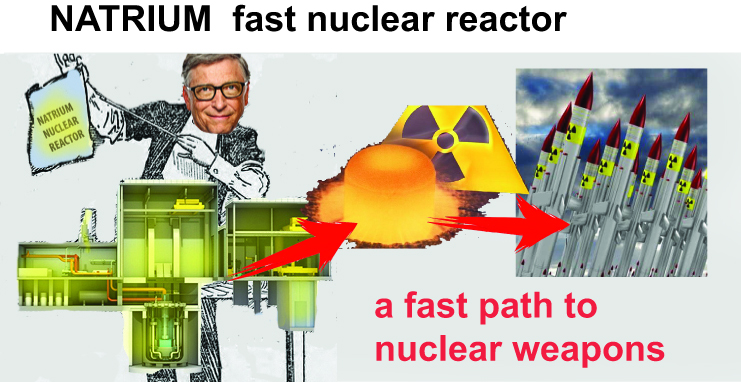
“fast breeder reactor” types “are proliferation nightmares.“
Continuing to support nuclear energy at the expense of faster and cheaper alternatives for cutting greenhouse gas emissions is a losing strategy.“
Scientists Warn Experimental Nuclear Plant Backed by Bill Gates Is ‘Outright Dangerous’ “Gates has continually downplayed the role of proven, safe renewable energy technology in decarbonizing our economy.” Common Dreams ANDREA GERMANOS, November 17, 2021 Officials announced Tuesday that the small city of Kemmerer, Wyoming would be the site of a new Bill Gates-backed nuclear power project—an initiative whose proponents say would provide climate-friendly and affordable energy but which some scientists warn is a dangerous diversion from true energy solutions.
The experimental Natrium nuclear power plant will be at the site of the coal-fired Naughton Power Plant, slated for retirement in 2025, though siting issues are not yet finalized. The company behind the project is TerraPower. Gates, who helped found TerraPower, is chairman of the board.
Mr. Gates,” nuclear expert Arnie Gundersen wrote in an open letter in August, Natrium “is following in the footsteps of a 70-year-long record of sodium-cooled nuclear technological failures. Your plan to recycle those failures and resurrect liquid sodium again will siphon valuable public funds and research from inexpensive and proven renewable energy alternatives.”………….
A feature of the future plant, TerraPower says, is “a molten salt-based energy storage system”—technology it claims represents “a significant advance over the light water reactor plants in use today.”
At a June press conference, Gates said Natrium was poised to “be a game-changer for the energy industry.” In a Tuesday tweet, Republican Sen. John Barrasso of Wyoming gave a similar message, saying “the Natrium reactor is the future of nuclear energy in America.”
While the company asserts the safety of Natrium’s sodium-cooled fast reactor, a report released in March by the Union of Concerned Scientists, entitled “Advanced” Isn’t Always Better, casts doubt on those claims.
UCS’s Elliott Negin highlighted the analysis in a June blog post, writing:
In fact, according to the UCS report, sodium-cooled fast reactors would likely be less uranium-efficient and would not reduce the amount of waste that requires long-term isolation. They also could experience safety problems that are not an issue for light-water reactors. Sodium coolant, for example, can burn when exposed to air or water, and the Natrium’s design could experience uncontrollable power increases that result in rapid core melting.
“When it comes to safety and security, sodium-cooled fast reactors and molten salt–fueled reactors are significantly worse than conventional light-water reactors,” says [report author Edwin] Lyman. “High-temperature gas-cooled reactors may have the potential to be safer, but that remains unproven, and problems have come up during recent fuel safety tests.”
Fast reactors have another major drawback. “Historically,” the report points out, “fast reactors have required plutonium or [highly enriched uranium]-based fuels, both of which could be readily used in nuclear weapons and therefore entail unacceptable risks of nuclear proliferation and nuclear terrorism.” Some fast reactors, including the Natrium, will initially use a lower-enriched uranium fuel, called high-assay low-enriched uranium, which poses a lower proliferation risk than highly enriched uranium, but it is more attractive to terrorists seeking nuclear weapons than the much lower-enriched fuel that current light-water reactors use.
Continue reading‘The graveyard of the Earth’: inside City 40, Russia’s deadly nuclear secret
The city’s residents know the truth, however: that their water is contaminated, their mushrooms and berries are poisoned, and their children may be sick. Ozersk and the surrounding region is one of the most contaminated places on the planet, referred to by some as the “graveyard of the Earth”.
City 40’s inhabitants were told they were “the nuclear shield and saviours of the world”
From the late 1940s, people here started to get sick and die: the victims of long-term exposure to radiation.
‘The graveyard of the Earth’: inside City 40, Russia’s deadly nuclear secret, https://www.theguardian.com/cities/2016/jul/20/graveyard-earth-inside-city-40-ozersk-russia-deadly-secret-nuclear Samira Goetschel, Wed 20 Jul 2016 Ozersk, codenamed City 40, was the birthplace of the Soviet nuclear weapons programme. Now it is one of the most contaminated places on the planet – so why do so many residents still view it as a fenced-in paradise?
“Those in paradise were given a choice: happiness without freedom, or freedom without happiness. There was no third alternative.” (From the dystopian novel We, by Yevgeny Zamyatin, 1924)
Deep in the vast forests of Russia’s Ural mountains lies the forbidden city of Ozersk. Behind guarded gates and barbed wire fences stands a beautiful enigma – a hypnotic place that seems to exist in a different dimension.
Codenamed City 40, Ozersk was the birthplace of the Soviet nuclear weapons programme after the second world war. For decades, this city of 100,000 people did not appear on any maps, and its inhabitants’ identities were erased from the Soviet census.
Today, with its beautiful lakes, perfumed flowers and picturesque tree-lined streets, Ozersk resembles a suburban 1950s American town – like one of those too-perfect places depicted in The Twilight Zone.
Continue readingScoMo Ingenious EV Plan: Australian Prime Minister Scott Morrison, leading climate action blocker, stretching the truth again? — One Finite Planet

“This is coal”: Scott Morrison’s ‘Coalaphobia’ speech. After a long history resisting action on climate change, the Australian government finally ‘committed’ to net zero by 2050, and then did an about face, and announced support for electric vehicles. Or did they? Background. Relevance: A Series On Political Influencers. The Australian Government And The Democracy Failure […]
ScoMo Ingenious EV Plan: Australian Prime Minister Scott Morrison, leading climate action blocker, stretching the truth again? — One Finite Planet
November 19 Energy News — geoharvey

Opinion: ¶ “New York Must Act On Clean Trucks” • The future of clean, zero-emission trucks is now in the hands of the New York Department of Environmental Conservation. The must decide whether to adopt the Advanced Clean Truck rule. We believe the answer is clear: It is imperative that the Department adopt the rule […]
November 19 Energy News — geoharvey
Victoria solar rebate delivers an extra 1GW of rooftop installations — RenewEconomy

Victorian government’s Solar Homes program notches up new milestone, with the rooftop solar capacity installed under the scheme passing 1 gigawatt. The post Victoria solar rebate delivers an extra 1GW of rooftop installations appeared first on RenewEconomy.
Victoria solar rebate delivers an extra 1GW of rooftop installations — RenewEconomy
Temperature of Fukushima Daiichi’s “frozen earth wall” rises again – TEPCO: “Function is being maintained — Fukushima 311 Watchdogs

Nov. 16As a measure to reduce the amount of contaminated water from the Fukushima Daiichi Nuclear Power Plant, the temperature in the ground has been rising in a part of the “frozen soil wall” that freezes the ground around the buildings to prevent the inflow of underground water.Tokyo Electric Power Company (TEPCO) has stated that […]
Temperature of Fukushima Daiichi’s “frozen earth wall” rises again – TEPCO: “Function is being maintained — Fukushima 311 Watchdogs
Why Morrison and Taylor won’t “meet and beat” their 2030 emissions target — RenewEconomy

New analysis finds no evidence Australia will achieve a “projected” 35 per cent cut in emissions by 2030, and even the official Paris targets are in doubt. The post Why Morrison and Taylor won’t “meet and beat” their 2030 emissions target appeared first on RenewEconomy.
Why Morrison and Taylor won’t “meet and beat” their 2030 emissions target — RenewEconomy
South Australia takes another big leap towards 100 per cent wind and solar — RenewEconomy

South Australia knocks down another barrier to 100 pct renewables as fossil fuel generation hits record low, and wind output a record high. The post South Australia takes another big leap towards 100 per cent wind and solar appeared first on RenewEconomy.
South Australia takes another big leap towards 100 per cent wind and solar — RenewEconomy
The growing unsolved problem of nuclear waste – becoming desperate in Sweden
Five Swedish nuclear reactors may need to close between 2024 and 2028, simply because a temporary site for storing spent fuel will soon be full.
And the Swedish government has yet to approve a final waste repository.
The timetable is that the Forsmark 4 reactor risks closure in 2024, followed in 2025 by Forsmark 3, Ringhals 3 and 4 and finally Forsmark 1 in 2028. Ringhals is owned by a consortium comprising Vattenfall and Uniper, while Forsmark is owned by the same two companies plus Fortum and Skelleftea Kraft.
A Swedish government decision on used nuclear fuel storage must by law be made no later than September 30 this year, so as to avoid exceeding the official permit at the interim storage site at Oskarshamn.
Precisely where nuclear waste is to be stored long-term remains a dilemma which effectively faces every single government that permits nuclear power. And the more such plants are built, the more the problem grows.
Electrical Review 18th Nov 2021
Safety risks of Bill Gates’ Natrium nuclear reactor
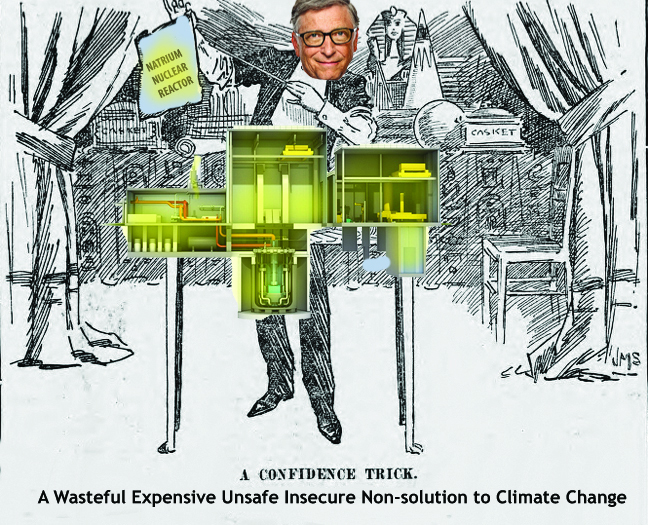
The use of liquid sodium has many problems. It’s a very volatile material that can catch fire if it’s exposed to air or water,” Edwin Lyman, director of nuclear power safety with the Union of Concerned Scientists science advocacy nonprofit, told Fortune on Tuesday.
“Honestly I don’t understand the motivation… There are some people who are just strong advocates for it and they’ve sort of won the day here by convincing Bill Gates that this is a good technology to pursue.”
Independent 17th Nov 2021
https://www.independent.co.uk/climate-change/news/bill-gates-nuclear-reactor-wyoming-b1959777.html
France has multiple nuclear problems – costs, wastes, safety and more …..

Cost, waste management and safety: eight questions raised by the announced
return of nuclear power in France. Emmanuel Macron said he wanted new
reactors, in the name of France’s energy independence and climate
preservation. But where is the sector and what does this choice imply?
Le Monde 18th Nov 2021
Electricity production choices: anticipate and control technological,
technical and financial risks.
Cour des Comptes 18th Nov 2021
Nuclear revival: the Court of Auditors highlights many obstacles.
Reporterre 18th Nov 2021
https://reporterre.net/Relance-du-nucleaire-la-Cour-des-comptes-pointe-de-nombreux-obstacles
1 This month
17 October, Free Public Talk on Nuclear Issues in South Australia
David Noonan will speak on public interest concerns over the new Roxby Downs Indenture Act 2026 on BHP copper-uranium mining and ore processing in SA, and on how AUKUS may face SA with a High-Level nuclear waste agenda.
Dr Jim Green will discuss international developments in the field of nuclear power including ‘small modular reactors’ and Generation 4 ‘advanced’ nuclear reactor concepts.


Help Aunty Sue Protect Her Land and Sacred Sites From Destructive Rocket Testing.
.

Australians deserve the truth
about
AUKUS – https://aukuspublicinquiry.com/

PETITION – To: Prime Minister Anthony Albanese and the Australian Labor Government

of the week – Australians for War Powers Reform (AWPR)
To see nuclear-related stories in greater depth and intensity

