Australia should stop selling uranium to nuclear weapon states and not sell uranium into unstable regions.


—
South Australian Upper House reaffirms the State’s law opposing nuclear waste dump

Mark Parnell MLC , It was a great day back in 2016 when we won the campaign to stop the ill-conceived proposal to turn South Australia into the World’s dumping ground for deadly high-level radioactive waste. However, domestic nuclear waste and other radioactive subjects are still on the agenda of State Parliament.
Proposed Kimba Nuclear Waste Dump
Whilst the Federal Liberal Government seeks to push this unnecessary and divisive project through the Senate, the South Australian Upper House has reaffirmed its commitment to State law by opposing a domestic nuclear waste dump at Kimba or anywhere else in South Australia. Dangerous long-lived radioactive waste currently stored under guard at Lucas Heights should stay there until a permanent solution is found, not shipped 1700kms to another temporary storage site in SA. If this project proceeds, the Greens will ensure that a South Australian Parliamentary inquiry is held that properly consults all stakeholders, including the Barngarla Traditional Owners who were shamefully excluded from the original community ballot.
Banning Nuclear weapons
State Parliament has recognised the 75th anniversary of the dropping of atomic bombs on Hiroshima and Nagasaki. This horror has inspired 47 countries to ratify a 2017 UN Treaty that would ban nuclear weapons forever. Only 3 more nations are needed for the Treaty to become International Law. So far, Australia is refusing to sign, for fear for offending our US allies. You can add your voice here: https://icanw.org.au/
STOP PRESS: We’ve just learnt that the 50th nation has ratified the Treaty, which will now come into effect in 90 days.
Radiation Regulation
The State Government has re-written South Australia’s radiation protection laws. Whilst most changes were administrative, there are still some fundamental problems, not least of which is that BHP’s Olympic Dam mine at Roxby Downs continues to be exempt from most State laws. Both Liberal and Labor joined forces to ensure that BHP’s special treatment continues with their “Indenture” overriding laws that all other mining companies must comply with.
On a more positive note, a number of Green amendments to increase accountability and transparency were accepted. We also secured an amendment that allows South Australia to set its own safety standards for radiation exposure and not be limited to outdated and weak standards applied elsewhere.
The Greens had a remarkable win in Australian Capital Territory elections
 The Green wave that swept the 2020 A.C.T. Election, Independent Australia, By Chris Mordd Richards | 26 October 2020, In a result almost none saw coming, the A.C.T. Greens have tripled their seat count in the A.C.T. Legislative Assembly following the Election on 17 October.
Going from two seats to six, stealing two seats each from A.C.T. Labor and the Canberra Liberals in the process……..
Clearly any party which manages to increase its representation by 300% in a single election has done an excellent job, appealing to the voters not only as a party but as credible individual candidates as well.
Newly elected MLA Johnathan Davis, who was in a very tight race for Brindabella but emerged the victor at the final count, had this to say on behalf of the Greens:
“The A.C.T. Greens are so grateful for the support we’ve received from Conder to Kippax, from Forde to Fraser. Every single Canberran is now represented by the Greens. We commit to working hard and honouring the support offered to us. Together, we’ll work every single day to build a better normal.”….
While Labor did reasonably well in retaining government, it was instead the Greens’ message which most struck a chord with a particular key segment of voters across the entire Territory this time. …….
The Australian Greens will certainly be examining in detail how the local party pulled it off to see how they might replicate this result in other parts of the country. For now, the A.C.T. is once more the greenest jurisdiction in Australia. https://independentaustralia.net/politics/politics-display/the-green-wave-that-swept-the-2020-act-election,14448
ICRC calls ban treaty entry into force “a victory for humanity” — IPPNW peace and health blog
In a statement following the 50th ratification of the Treaty on the Prohibition of Nuclear Weapons (TPNW), Peter Maurer, the president of the International Committee of the Red Cross, said the treaty “allows us to turn our gaze towards the future; to imagine a world freed from these inhumane weapons no longer as a distant […]
ICRC calls ban treaty entry into force “a victory for humanity” — IPPNW peace and health blog
Ocean acidification and the uncertain future of marine ecosystems

|
The uncertain future of the oceans, Science Daily October 26, 2020
The study, which has now been published in the journal Nature Climate Change, is one of the most comprehensive studies so far on the effects of ocean acidification on marine ecosystems. Scientists at the GEOMAR Helmholtz Centre for Ocean Research in Kiel have now been able to show for the first time that ocean acidification influences the carbon content of sinking organic material, and thus the biological pump. Surprisingly, the observed changes were highly variable. The carbon content of sinking particles increased or decreased significantly with increasing CO2, depending on the composition of species and the structure of the food web. Since the underlying data cover a wide range of ocean regions, this seems to be a global phenomenon. These findings allow a completely new assessment of the effects of ocean acidification……….https://www.sciencedaily.com/releases/2020/10/201026114214.htm |
|
Businesses and State governments lead the transition to renewable energy
 Guardian 26th Oct 2020, Future historians will no doubt remember 2020 as the year of Covid-19. But according to veteran climate campaigner Bill McKibben, they may also view it as a turning point, the year the world moved decisively towards “the transition everyone knew we needed to make”. McKibben told the recent Global Smart Energy Summit 2020 has been a year of “extraordinary convergence”, from the images of Australia’s bushfires, seen around the world on New Year’s Day – “like something out of Hieronymus Bosch” – to unprecedented developments such as China’s commitment to achieve net zero emissions by 2060, the EU’s pledge to make its Green Deal and Є100bn Just Transition Fund the centrepiece of post-Covid recovery, and the US $15tn divested from fossil fuels.
Closer to home, there’s extraordinary convergence between business and state governments on the need to speed up Australia’s energy transition.
Tim Reed, president of the Business Council of Australia, wants a “national, bipartisan commitment to net zero emissions by 2050”. Most states have already made this commitment, and South Australia is leading the pack. The state’s energy and mining minister, Dan van Holst Pellekaan, says SA will aim for 100% net renewable generation by 2030. Rapidly expanding wind, solar and battery storage capacity in SA’s Upper Spencer Gulf region will play a key role in achieving that aim.
But energy transitions are not just about panels, turbines and targets. They’re processes of social as well as technological change. Unless local people see jobs and other benefits for their communities, there’s a danger support will falter, and the legitimacy of Australia’s energy transition will be undermined.
South Australia’s global milestone -100 per cent of energy demand met by solar panels alone
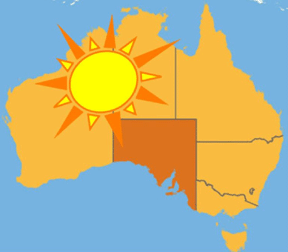 ABC 25th Oct 2020, South Australia’s renewable energy boom has achieved a global milestone. The state once known for not having enough power has become the first major ABC 25th Oct 2020, South Australia’s renewable energy boom has achieved a global milestone. The state once known for not having enough power has become the first majorjurisdiction in the world to be powered entirely by solar energy. For just over an hour on Sunday, October 11, 100 per cent of energy demand was met by solar panels alone. “This is truly a phenomenon in the global energy landscape,” Australian Energy Market Operator (AEMO) chief executive Audrey Zibelman said. https://www.abc.net.au/news/2020-10-25/all-sa-power-from-solar-for-first-time/12810366 |
|
|
The pandemic and the prospect of zero interest present a massive opportunity for clean energy development.
 The tantalising promise of ultra-cheap power South Wind, 27 October 2020 by admin The tantalising promise of ultra-cheap power South Wind, 27 October 2020 by admin
The pandemic and the prospect of zero interest present a massive opportunity for clean energy development. The story of 2020 has really been two stories, deeply interwoven, in which what happens in one keeps playing on the other and causing general mayhem. One is about the virus; the other the economy…….. Solar panels are getting steadily more efficient and cheaper to make, but Quiggin sees their greatest potential in the fact that they last three or more decades and cost virtually nothing to operate. The cost of a solar project today arises almost entirely from the need of investors to get a return on the capital they put into the project’s construction and grid connection. Solar’s low capital cost is stretching the “payback period” of projects – the time available for investors to be repaid in full – so far into the future that the power generated is virtually free. Quiggin calculates that over a module’s lifetime the cost could drop as low as 2c per kilowatt-hour. Yields from current Australian government bonds are lower than likely inflation. European countries are offering bonds maturing after 50 or 100 years, and the US government is selling similar bonds at negative interest rates. Given all this, Quiggin believes that governments should issue perpetual bonds yielding inflation-adjusted returns of zero. “In the world of zero real interest rates that now appears to be upon us… governments can, and should, invest in projects whenever the total benefits exceed the costs, regardless of how those benefits are spread over time.” If there is a powerful case for public investment in renewable energy, the case for doing the same for transmission, says Quiggin, is even stronger. “Electricity transmission lines have the same cost structure as renewables (low operational cost and long lives), if anything more so, meaning that the cost of transmission depends primarily on the need to secure a return to the capital invested.” This is where Quiggin’s interesting idea really starts to sing. A modern, smart, efficient electricity grid over a wide area like eastern Australia can make intermittent solar and wind power work well for us, rapidly switching demand to where the sun shines and the wind blows and minimising calls on alternative generators or energy stored in batteries or hydro schemes. Opposition leader Anthony Albanese proposes to spend $20 billion on transmission infrastructure to allow the national grid to fully integrate new renewable sources. The government could go one further by investing in both transmission and renewable generation. But it is still in pre-pandemic mode, offering just low cost finance for private transmission investment. The pandemic has disrupted everything we knew, killing the old economy and its ideological stereotypes. In these times of upheaval and flux, as John Quiggin says, there are huge opportunities for large-scale public investment in a new, cleaner economy. Our recovering economy will need a lot of public investment. All we ask of the Morrison government is the vision to see what’s possible and the courage to act. http://southwind.com.au/2020/10/27/the-tantalising-promise-of-ultra-cheap-power/ |
|
Community battery storage will help “dumb” networks catch up with energy transition — RenewEconomy

Community battery storage could make Australia’s networks smarter and cheaper, and bring their technology into the same century as the clean energy transition. The post Community battery storage will help “dumb” networks catch up with energy transition appeared first on RenewEconomy.
Community battery storage will help “dumb” networks catch up with energy transition — RenewEconomy
Australia’s biggest carbon customers plan their escape from fossil fuels, but Morrison isn’t listening — RenewEconomy

Japan joins China in announcing a net zero emissions target. This is a big deal for Australia, which depends on fossil fuel exports, but its political leaders are not listening. The post Australia’s biggest carbon customers plan their escape from fossil fuels, but Morrison isn’t listening appeared first on RenewEconomy.
Australia’s biggest carbon customers plan their escape from fossil fuels, but Morrison isn’t listening — RenewEconomy
October 26 Energy News — geoharvey

Opinion: ¶ “Tesla Bears Prove Easy Q3 Math Is Hard” • Congrats to Elon and the workers at Tesla for a record setting Q3, by almost every measure. I’ll cover some of the financial highlights, but first, a royal roasting of Tesla bears is in order. Many of them say that regulatory credits are the […]
October 26 Energy News — geoharvey
Japan puts off decision to release treated Fukushima water into sea — Fukushima 311 Watchdogs

is it actually possible they are actually listening ??? Japan has put off a decision to release treated radioactive water from the crippled Fukushima nuclear plant into the sea, government sources said Friday, after reports of a formal decision later this month triggered strong opposition from fishermen. Oct 23, 2020 Economy, Trade and Industry Minister […]
Japan puts off decision to release treated Fukushima water into sea — Fukushima 311 Watchdogs
Half of Japanese against releasing radioactive water from Fukushima plant; Seoul, Beijing also concerned — Fukushima 311 Watchdogs

October 20, 2020 A recent survey conducted by the Japanese daily Yomiuri Shimbun shows about 50 percent of citizens in Japan are against their government’s plan to discharge radioactive water from the tsunami-wrecked Fukushima nuclear plant into the sea.The survey was conducted on over one-thousand eligible voters from across Japan.Media reports say the fishing industry […]
Half of Japanese against releasing radioactive water from Fukushima plant; Seoul, Beijing also concerned — Fukushima 311 Watchdogs
Jeju Governor Vows to Take Legal Action against Japan’s Fukushima Water Release — Fukushima 311 Watchdogs
October 20, 2020 Jeju Province Governor Won Hee-ryong says he will launch both domestic and international lawsuits against Japan should it release radioactive water from its disabled Fukushima nuclear plant into the ocean. At a press conference on Tuesday, Won urged Tokyo to halt preparations for the release, be transparent in providing all relevant information […]
Jeju Governor Vows to Take Legal Action against Japan’s Fukushima Water Release — Fukushima 311 Watchdogs
S. Korean demonstrators ramp up protests against Japan’s plans to dump radioactive water into the ocean — Fukushima 311 Watchdogs

October 19, 2020 On Oct. 16, Japanese media outlets reported that the Japanese government will decide on whether or not to dump radioactive water from the Fukushima Daiichi Nuclear Power Plant into the Pacific Ocean. On Oct. 19, demonstrators organized in front of the former Japanese Embassy in Seoul to voice their vehement opposition to […]
S. Korean demonstrators ramp up protests against Japan’s plans to dump radioactive water into the ocean — Fukushima 311 Watchdogs
1 This month
.

Australians deserve the truth
about
AUKUS – https://aukuspublicinquiry.com/

PETITION – To: Prime Minister Anthony Albanese and the Australian Labor Government

of the week – Australians for War Powers Reform (AWPR)
To see nuclear-related stories in greater depth and intensity

