Australia and overseas, pandemic, climate, and focus on nuclear news

Covid-19 cases across the globe hit 40 million Monday with the United States leading the world with the highest numbers of infections and deaths. World round-up of coronavirus. cases and restrictions.
Climate change just keeps on – cycloone, floods and landslides.– Vietnam, India. It becomes important to devlop strategies to adapt to global heating.
Nuclear news items stress the need for international agreements on arms control.
But , on the ”peaceful nukes” scene, it is quite extraordinary that propaganda has ramped up enormously, even while the pandemic has actually slowed down nuclear building and other activities, as well as the demand for electricty.
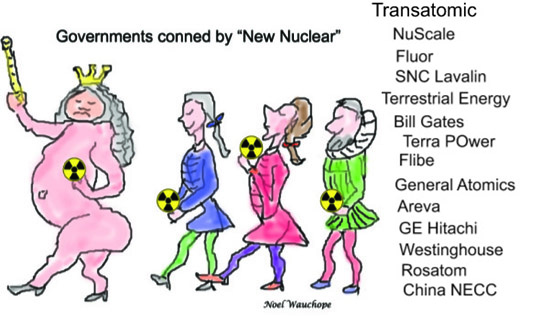
What we’re seeing is a frenzy of small nuclear reactor (SMR) propaganda handouts masquerading as real journalism. In English language news, it’s all about America selling these uneconomic and pretty useless gimmicks to their own population and to overseas countries. The most often praised model, NuScam’s reactor, is even now being touted as ”foreign development aid”. No doubt the global industry is doing the same confidence trick in Russian and Chinese. They need a global burst of tax-payer funded SMR building, to stave off the collapse of the industry.
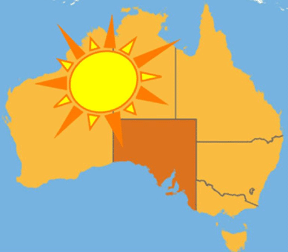
Some bits of good news –We’ve had so many wins’: why the green movement can overcome climate crisis. International Monetary Fund recommends a carbon price, for the economy as well as for the climate. Solar energy is here with a vengeance – look at South Australia.
AUSTRALIA
CLIMATE. USA election result, and Australia’s response– the world’s climate in the balance. Greens renew call for Green New Deal, describe Morrison’s climate policies as “criminal”.
Climate and clean energy leaders win big in New Zealand, ACT elections.
NUCLEAR. South Australia Upper House [Legislative Council] votes against any radioactive waste repository, upholds S.A.’s law opposing nuclear waste dumping.
Australia a leader in the worst sense – biodiversity loss and risk of ecosystem collapse. Morrison government’s devastating cuts to Environmental research and teaching.
U.S. Deputy Sheriff Australia taken for a ride on an obsolete $90 billion submarine.
Michelle Fahy blows open the disgraceful collusion between Australian politicians and weapons industries.
RENEWABLE ENERGY. Australian Energy Market Organisation (AEMO) takes lead role in global consortium seeking rapid energy transition.
INTERNATIONAL.
The attack on journalism – launched with the persecution of Julian Assange.
On climate: instead of denial or despair, there’s determined resolve. Carbon emissions are deeply embedded in our lifestyle – the challenge post-pandemic. Climate disasters – Earth is becoming uninhabitable for millions of humans.
Elimination of nuclear weapons is vital to the “survival of life on this planet”.
Nuclear waste – a danger for countless generations to come.
Resisting nuclear colonialism on Indigenous Peoples’ Day
Offshore Wind Energy, Not Nuclear, Is the Future. Study shows that renewable energy is clearly better that nuclear at cutting greenhouse emissions.
Book review: GAMBLING WITH ARMAGEDDON.
Thorium not likely to revive the nuclear energy industry.
U.S. Deputy Sheriff Australia taken for a ride on an obsolete $90 billion submarine


|
In for a penny, in for a pound: $90 billion for an obsolete submarine fleet, Michael West Media, by Brian Toohey | Oct 18, 2020 So much for sovereignty. Australia is locked out of repairing key US components of our submarines’ computer systems, and the government has committed our fleet to the extraordinarily dangerous role of helping the US conduct surveillance in the South China Sea. Brian Toohey reports.
It is hard to believe that a government genuinely committed to defending the nation would sign a contract to buy 12 ludicrously expensive submarines that would not be operational for at least 20 years, with the final submarine not ready for nearly 40 years. The fleet will be obsolete before its delivered. But this is what the Turnbull government did when it announced in September 2016 that the majority French government-owned Naval Group would build 12 large submarines in Adelaide. The first sub is unlikely to be operational until the late 2030s and the last one until well after 2050. It is even harder to understand why the government endorsed the extraordinarily dangerous role for Australian submarines of helping the US conduct surveillance and possible combat operations within the increasingly crowded waters of the South China Sea. And while the Morrison government repeatedly claims that Australia’s defence force has a “sovereign” capability, in reality we are locked in “all the way” with the USA.
Ominously, an earlier Coalition government gave Lockheed Martin the contract to integrate these systems into the Attack subs. This is the same company that wasted billions on a dud computerised system for the US made F-35 fighter planes.. Called the Attack class, the conventionally powered submarines to be built in Adelaide by Naval will rely on an unfinished design based partly on France’s Barracuda nuclear submarines. Their official cost has already blown out from an initial $50 billion to $90 billion. It was revealed earlier this week that Defence officials knew in 2015 that the cost of the fleet had already blown out by $30 billion to $80 billion, yet continued to state publicly that the price tag was $50 billion. Life-cycle costs are expected to be around $300 billion…….. Under US commandAustralian subs in the South China Sea will be integrated into US forces and will be relying on them for operational and intelligence data. In an escalating clash, accidental or otherwise, they will be expected to follow orders from US commanders. Again, so much for Australia’s sovereignty. There is no compelling strategic reason why Australian submarines should travel that onerous distance to support the US in the South China Sea. ………… Perhaps the best argument, however, for not wasting $90 billion on the Attack class is that cheap underwater drones will soon have an important military role particularly suited to use from bases in northern Australia. https://www.michaelwest.com.au/in-for-a-penny-in-for-a-pound-90-billion-for-an-obsolete-submarine-fleet/ |
|
Dismal future for nuclear power: small nuclear reactors a false hope
“Overall, in terms of the cost of power, new nuclear is clearly losing to wind and photovoltaics,”
More recently, the nuclear industry has been promising a technological renaissance through small modular reactors (SMRs). But “the industry is actually selling PowerPoint reactors, not detailed engineering,”
“if you look at nuclear power, it’s not only the most expensive, but it’s by far the slowest.” With even French nuclear giant EDF bidding against its own legacy technology to supply lower-cost solar projects, “do we really have to discuss what the future is or where this goes?”
|
WORLD NUCLEAR INDUSTRY LOSES GROUND TO CHEAP RENEWABLES AS CANADA CONSIDERS SMALL MODULAR REACTORS, The Energy Mix SEPTEMBER 27, 2020
MITCHELL BEER @MITCHELLBEER
The world nuclear industry “continues to be in stasis,” with power plants shutting down at a faster rate in western Europe and the United States, the number of operating reactor units at a 30-year low, and the few new construction projects running into “catastrophic cost overruns and schedule slippages,” according to the latest edition of the annual World Nuclear Industry Status Report (WNISR), released last week. Continue reading
|
In America, anti-science attacks Dr Fauci, about the pandemic, and Michael Mann, on climate change
America re-discovers anti-science in its midst, Environmental Health News,16 Oct 20
Fauci, Birx, Redfield & Co. are in the middle of a political food fight. They could learn a lot from environmental scientists.
Let’s start with the story of a scientist who beat back a powerful global denial movement without any help from social media or modern, sophisticated organizing campaigns.
It took Galileo 359 years to wrangle an apology out of the Vatican for his heretical belief that the Earth revolved around the sun.
I’m glad he didn’t take it personally. Science denial is neither new nor purely American—but we sure are finding ways to make it lethal and lasting.
Climate scientists have been dealing with anti-science, largely unnoticed by the general public, for 20 years. Doctors face a growing wave of anti-vaccination zealots. Now a pandemic with a seven-figure global death toll and a stranglehold on the world’s economy has opened the doors wide for some multi-front anti-science blowback.
Americans, many refusing to wear masks and ignoring social distancing guidelines, appear to be gathering at frat parties, raves, political rallies, nightclubs and more in defiance of what credentialed experts say are the most vital ways to restrict the spread of COVID-19.
Major sporting events, notably college football, are backing down from previously self-imposed restrictions.
And, lo and behold, positive test rates are going back up in a big way.
Past is deadly prologue
Here are a couple recent, high profile examples of anti-science fervor in the U.S.:………
But nothing in science can quite match the decades-long assault on climate science and climate scientists. On the high end, there are PR campaigns backed by fossil fuel money, well-heeled litigation, and unhinged attacks from national pols and pundits. Then, there are the confounding, face-palming antics of the Coal Rollers—pickup truck owners who modify their rides with “Prius Repellent”—thick sooty black smoke intended to make a bizarre anti-science, pro-climate denial statement. Yes, people do this.
Penn State’s Michael Mann is arguably the highest-profile climate scientist in the U.S. Let’s make a minor leap of faith and say Mann’s climate stature is the closest equivalent to Dr. Anthony Fauci’s standing on coronavirus.
Right now, Dr. Fauci’s main public tormentor is President Trump. Their conflicts are tame compared to the deniers’ gang-up on Mann, which has lasted more than a decade and may offer Fauci a few tips on being a scientist in the middle of a political peeing match…….
Make no mistake, Fauci’s a heroic public servant in an awful bind who, as far as I know, may not even be interested in the killer tell-all book that now resides in his head.
But after COVID-19 is finally conquered, Mike Mann and a thousand others will still be getting bashed, and the worst impacts of climate change will still be ahead of us.
Peter Dykstra is our weekend editor and columnist and can be reached at pdykstra@ehn.org or @pdykstra.
World solar energy, not just the future: it’s the present
 Forbes 17th Oct 2020, Anyone who follows developments in the energy sector will know that solar energy is no longer just the future but the present. According to thebInternational Energy Agency’s World Energy Outlook 2020, photovoltaic solar energy is already the cheapest source of electricity in history.
https://www.forbes.com/sites/enriquedans/2020/10/17/what-is-happening-with-solarenergy/amp
/
Queensland urged to switch public schools, libraries and hospitals to solar — RenewEconomy

Public schools and hospitals could be the key to boosting Queensland’s rooftop solar industry, slashing cost and emissions and delivering hundreds of jobs. The post Queensland urged to switch public schools, libraries and hospitals to solar appeared first on RenewEconomy.
Queensland urged to switch public schools, libraries and hospitals to solar — RenewEconomy
Climate and clean energy leaders win big in New Zealand, ACT elections — RenewEconomy

Voters endorse strong climate change and clean energy policies, as Jacinda Ardern returned in New Zealand and the Greens win big in the ACT. The post Climate and clean energy leaders win big in New Zealand, ACT elections appeared first on RenewEconomy.
Climate and clean energy leaders win big in New Zealand, ACT elections — RenewEconomy
S. Korea reiterates priority on citizens’ health in handling Fukushima water issue — Fukushima 311 Watchdogs

Where are all the other countries governments protesting against the radioactive contamination by Japan of our Pacific ocean? I can only hear South Korean government’s voice, where are all the others? Their absence of any protest is equivalent to consent!!! October 16, 2020 South Korea’s foreign ministry reiterated its “foremost priority” to protect its citizens’ […]
S. Korea reiterates priority on citizens’ health in handling Fukushima water issue — Fukushima 311 Watchdogs
Japan to release 1m tonnes of contaminated Fukushima water into the sea – reports — Fukushima 311 Watchdogs

Local media say release could begin in 2022 and would take decades to complete, but local fishermen say move will destroy their industry Reactor buildings and storage tanks for contaminated water at the Tokyo Electric Power company’s Fukushima Daiichi nuclear power plant October 16, 2020 Japan’s government has reportedly decided to release more than 1m […]
Japan to release 1m tonnes of contaminated Fukushima water into the sea – reports — Fukushima 311 Watchdogs
October 18 Energy News — geoharvey

Opinion: ¶ “My Personal History With Global Warming” • I served as a Peace Corps volunteer in Bolivia from 1964–1966. While I was there, I tested my skills at the highest ski resort in the world, on the impressive glacier at Mount Chacaltaya, five feet of fresh snow on top of ten feet of glacier. […]
October 18 Energy News — geoharvey
Mansion without a toilet: Towns in Japan seek to house, store nuclear waste out of necessity — Fukushima 311 Watchdogs

Oct 12, 2020 Two remote towns in northern Japan struggling with rapidly graying and shrinking populations signed up Friday to possibly host a high-level radioactive waste storage site as a means of economic survival. Japanese utilities have about 16,000 tons of highly radioactive spent fuel rods stored in cooling pools or other interim sites, and […]
Mansion without a toilet: Towns in Japan seek to house, store nuclear waste out of necessity — Fukushima 311 Watchdogs
Agency: Fukushima plant workers should be heard — Fukushima 311 Watchdogs

Oct. 11, 2020 A government agency overseeing the decommissioning of the crippled Fukushima Daiichi nuclear plant is urging the plant’s operator to take into account the views of workers in removing radioactive debris, set to start next year. Each year, the Nuclear Damage Compensation and Decommissioning Facilitation Corporation compiles its technical policy for the plant’s […]
Agency: Fukushima plant workers should be heard — Fukushima 311 Watchdogs
Nuclear waste dump: Will the Australian government compensate Kimba landowners for fall in their property values?

If the federal government’s proposed nuclear waste facility were built at the chosen site at Kimba and as a result property values in the region decreased as has been the case in other places around the world in not dissimilar circumstances what will the federal government do for the those who have suffered a diminution in their property values because of the facility
Based on past experience I suspect nothing
However if the government has promised huge economic benefits for the Kimba region – and it has certainly done so consistently for the past five years in order to win community support – and these promises proved to be incorrect then would the residents and even general community members who have suffered a loss have a right of action against the federal government for what is tantamount to misleading and deceptive conduct in the normal legal context
On the face of it they would but unfortunately the government as a Crown instrumentality is exempt from any legal responsibility and liability in that regard
However the District Council of Kimba has been fully complicit in misleading or misinforming the community and should be liable for any damages incurred as a result of the Council’s actions and conduct
Unlike the government the Council will not be treated as an instrumentality of the Crown and will therefore be fully liable with the liability extending personally to the individual councillors since there could be no limitation on their personal liability like in a normal corporate situation
What I would suggest – but please ensure that I am not mentioned and it is recognised that I am not offering any legal advice – is for several ratepayers to formally approach the mayor and councillors asking them to obtain a proper legal opinion for open publication for the Kimba community addressing these issues and the possible outcomes
Any resistance on the part of the councillors in acceding to this request will only worsen their situation as it could be argued very strongly that this is necessary in order to ensure the continued stability and solvency of the District Council and protect the financial position of the ratepayers
You may need the help of a lawyer but the District Council should pay all expenses in investigating what has been suggested and in obtaining any legal and if necessary financial advice so that the ratepayers and other community members can be protected
Best of luck!
USA election result, and Australia’s response- the world’s climate in the balance
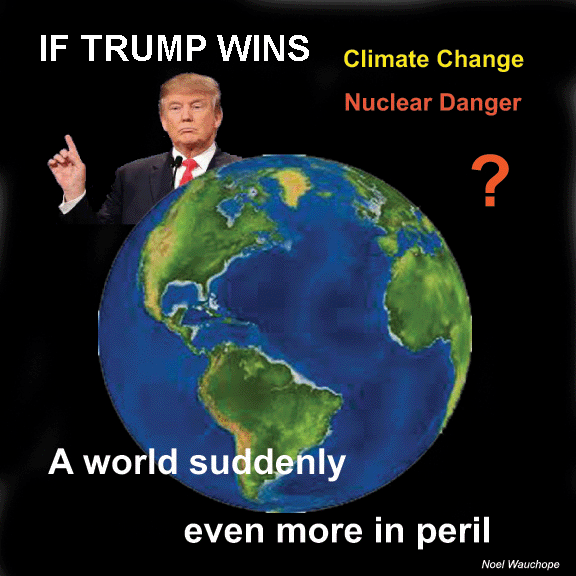
This is a cautionary tale for Australia. In both the US and Australia, conservative politicians seem more eager to bail out dirty polluters than protect the public
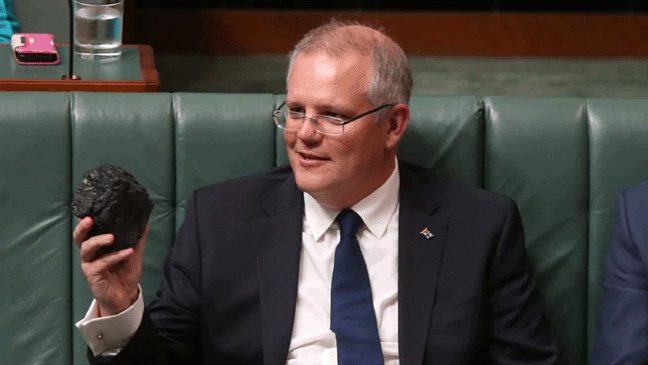
For Australia’s sake, I hope Trump’s climate science denialism loses. https://www.theguardian.com/commentisfree/2020/oct/17/for-australias-sake-i-hope-trumps-climate-science-denialism-loses, Michael Mann US policy has emboldened Scott Morrison to be less ambitious on climate, just when so much is at stake.
|
Anyone in Australia who witnessed the Black Summer bushfires (as I did), and anyone in the US who experienced the thick smoke from our western wildfires (as I have), knows how much damage climate change is already doing. The stark reality is that worldwide efforts to avert ever-more catastrophic climate change impacts lie in the balance in the 2020 US election. Donald Trump will go down in history bearing substantial responsibility for the deaths of over 200,000 Americans due to his rejection of the advice of public health experts and his refusal to endorse policies such as social distancing and mask-wearing that could have saved many thousands of lives. But his rejection of the science of climate change sets the stage for a far greater toll. Far more human lives will be lost from the impacts of climate change if we fail to act. Whether or not Trump gets re-elected – and how other countries like Australia respond to the outcome of the US election – could determine the fate of our planet. Indeed, I’ve stated that a second Trump term might well be “game over for the climate” if it leads to the collapse of international efforts to act. The damage caused by Trump’s climate denial is painfully visible within the US as we endure climate change-fuelled extreme weather events, including unprecedented wildfires in the west and unprecedented hurricanes in the east. But the damage can be felt around the world. Trump has proudly, and shamelessly, trumpeted his climate denialism on the global stage, joining with petrostates such as Russia, Saudi Arabia and Brazil in opposing international climate efforts. Indeed, Trump’s actions have emboldened Australia to be less ambitious on climate too, prime minister Scott Morrison following Trump’s lead in promoting climate denial, coddling fossil fuel interests and blocking efforts to support a clean, renewable energy transition. By pulling the US out of the Paris agreement (one of the first and only campaign promises he kept) Trump ceded America’s leadership on the defining challenge of our time. Thus far, other countries have fortunately filled the leadership void, at least temporarily. The EU and China, with its new net-zero pledge, have stepped up to the plate, recognising that they will benefit from the opportunities of a clean energy economy and better protect their citizens from dangerous climate change impacts. But nobody stands to benefit more from climate action, or lose more if we fail to act, than Australia. Having spent a sabbatical leave down under earlier this year, aimed at collaborating with scientists in Australia to study the impact of climate change on extreme weather events, I instead witnessed those impacts first-hand. I saw the muted beauty of the Blue Mountains when shrouded in wildfire smoke. If Trump is re-elected, and we collectively continue down a path of insufficient climate action, it may not be long before those fires rage year-round, and the Blue Mountains are lost in a perpetual grey and dismal haze. It’s the same with the vibrant sea life of the Great Barrier Reef, which I was fortunate enough to witness with my family during my time in Australia. The delicate ecosystems of the GBR are already on the ropes, with fossil fuels pushing up temperatures in the ocean to the point where bleachings occur with such frequency and ferocity that corals simply cannot recover. Research released this week found that the reef has lost half its coral, largely due to warming oceans caused by climate change. Add the impact of ocean acidification from increasing carbon emissions, and we could sadly, within a decade or two, be reading the GBR’s obituary for real. It doesn’t have to be like that. For one thing, renewable energy costs are plummeting while the technology just keeps getting more efficient and better, so dirty energy no longer makes economic sense. For example, on one recent Sunday, all the electricity demand for the entire state of South Australia was met by solar power alone, and every state and territory in Australia has committed to go carbon neutral by 2050. Here in the US, we’ve seen a record number of cities and states stepping up on climate goals too, knowing clean energy is good for their communities’ health, resilience and prosperity. Policymakers must accelerate the shift to clean energy that is already under way. As we’ve learned in the Trump-era, some fossil fuels are too far gone for even the most determined polluter-in-chief to save. Though another term would give Trump time to defend his environmental rollbacks in court and solidify his dirty energy policies, he has already failed to save coal from market forces, and another four years isn’t going to reverse the long-term decline of the industry. This is a cautionary tale for Australia. In both the US and Australia, conservative politicians seem more eager to bail out dirty polluters than protect the public, denying politically inconvenient science in order to offer lavish payouts to help unprofitable fossil fuel companies. If we are to avert catastrophic warming, we must do just the opposite, providing financial incentives for renewables and disincentives for fossil fuels. That will level the playing field, and accelerate the clean energy transition. We must take the earliest exit possible off the fossil fuel highway. By trying to squeeze out the last drop of fossil fuel industry profits, the Morrison government could well be on its way to bleaching the life from Australia’s coral reefs and blighting the blue of its mountains. There is some good news, however. Regardless of whom Americans vote for – and for the sake of the planet, I hope it’s Joe Biden and the Democrats – Australians can still work together for structural change at home. You can’t solve it alone, but we also can’t solve it without you. Australia has seen that the sun can power an entire state’s electricity for a day. Now it’s time to make that happen every day. Australia must distance itself from the handful of bad petrostate actors who have sabotaged global climate action and rejoin the coalition of the willing, when it comes to the battle to save our planet. • Michael E. Mann is distinguished professor of atmospheric science at Pennsylvania State University. He is author of the upcoming book The New Climate War: The Fight to Take Back Our Planet, due out in January (Public Affairs Books) |
|
Persecuting Assange Is a Real Blow to Reporting and Human Rights Advocacy’
Persecuting Assange Is a Real Blow to Reporting and Human Rights Advocacy’
CounterSpin interview with Chip Gibbons on Assange extradition Fair, 15 Oct 20,
Assange’s case, the unprecedented use of the Espionage Act to go after a journalist, has dire implications for all reporters. But this country’s elite press corps have evidently decided they can simply whistle past it, perhaps hoping that if and when the state comes after them, they’ll make a more sympathetic victim.
Joining us now to discuss the case is Chip Gibbons. He’s policy director at Defending Rights & Dissent. He joins us now by phone from Washington, DC………..
CG: Sure. So the US has indicted Julian Assange with 17 counts under the Espionage Act, as well as a count under the Computer Fraud and Abuse Act.
Assange is not a US person; he’s an Australian national. He was inside the Ecuadorian embassy for a number of years, as Ecuador had granted him asylum, and the UK had refused to basically recognize that and let him leave the country, so he was de facto imprisoned inside the embassy. And after the indictment the US issued, the new government of Ecuador—which is much less sympathetic to Assange than the previous Correa government—let the US come in the embassy and seize him.
And the US is seeking Assange’s extradition to the US from the UK. I guess it’s, probably, technically a hearing, but Kevin’s point was that it’s more like what we would think of as a trial, in that there’s different witnesses, there’s expert testimony, there’s different legal arguments at stake.
The defense, the witness portion of it, has closed; it ended last week. And there’s going to be closing arguments submitted in writing, and then the judge will render a decision, and that decision will be appealable by either side. So regardless of the outcome, we can expect appeals. So it does very closely mirror what we would think of more like a trial than a hearing in the US court context.
It’s important to really understand what’s at stake with Assange’s extradition. He is the first person ever indicted by the US government under the Espionage Act for publishing truthful information.
The US government has considered indicting journalists before: They considered indicting Seymour Hersh, a very famous investigative reporter. They considered indicting James Bamford, because he had the audacity to try to write a book on the National Security Agency. But they’ve never done that.
And Obama’s administration looked at the idea of indicting Assange and said, “No, this would violate the First Amendment, and it would open the door to all kinds of other bad things.” But the Trump administration clearly doesn’t have those qualms……..
It is very interesting to see how this plays out in a US court in the current environment. If whoever—Trump or Biden, whoever is president, when this finally comes to the US—actually pursues this, and they actually are allowing the persecution of journalists, that’s going to be a really dark, dark assault on free expression rights.
And it’s worth remembering—and Julian Assange is clearly very reviled in the corporate media and the political establishment right now—but the information he leaked came from Chelsea Manning, it dealt with US war crimes; and he worked with the New York Times, the Guardian, Der Spiegel, Le Monde, Al Jazeera, to publish this information. So if he can go to jail for publishing this, why can’t the New York Times? And is that a door anyone wants to open? There is a big press freedom angle here.
I also want to talk about the facts, though: What did Julian Assange publish, and why did it matter? ………..
Julian Assange is accused of publishing information about war crimes, about human rights abuses and about abuses of power, that have been tremendously important, not just for the public’s right to know, but also have made a real difference in advocacy around those issues. People were able to go and get justice for victims of rendition, or able to go and get court rulings in other countries about US drone strikes, because of this information being in the public domain. So attacking Assange, persecuting Assange, disappearing him into a supermax prison, this is a real blow to reporting and human rights advocacy. ………
JJ: Right. And, finally, the journalists who are holding their nose right now on covering it aren’t offering to give back the awards that they won based on reporting relying on WikiLeaks revelations. And James Risen had an op-ed in the New York Times a while back, in which he was talking about Glenn Greenwald, but also about Julian Assange, and he said that he thought that governments—he was talking about Bolsonaro in Brazil, as well as Donald Trump—that they’re trying out these anti-press measures and, he said, they “seem to have decided to experiment with such draconian anti- press tactics by trying them out first on aggressive and disagreeable figures.”………. https://fair.org/home/persecuting-assange-is-a-real-blow-to-reporting-and-human-rights-advocacy/
1 This month
.

Australians deserve the truth
about
AUKUS – https://aukuspublicinquiry.com/

PETITION – To: Prime Minister Anthony Albanese and the Australian Labor Government

of the week – Australians for War Powers Reform (AWPR)
To see nuclear-related stories in greater depth and intensity

