Murdoch media monopoly – an ‘arrogant cancer on our democracy’
 Australia’s high concentration of media ownership is eroding its democracy, getting in the way of critical action on issues like climate change and limiting what stories get told, media experts have warned. Australia’s high concentration of media ownership is eroding its democracy, getting in the way of critical action on issues like climate change and limiting what stories get told, media experts have warned.
The warning comes as former prime minister Kevin Rudd called for a royal commission into media concentration on Saturday, launching a petition to Parliament that amassed thousands of signatures within hours of going live. Australia’s media landscape is dominated by two players – Nine Entertainment, which owns the The Age and The Sydney Morning Herald mastheads among others, and News Corp, owned by former Australian Rupert Murdoch, which controls between 60 and 70 per cent of the metropolitan market. Mr Rudd decried the sheer concentration of the Murdoch empire, and pointed to News Corp mastheads’ support for the Liberal Party in the past 18 elections. Murdoch has become a cancer, an arrogant cancer, on our democracy,” Mr Rudd said. “I’m calling on the Parliament to establish a royal commission into the abuse of media monopoly in Australia, and particularly by the Murdoch media, to make recommendations to maximise media diversity ownership for the future lifeblood of our democratic system.” Mr Rudd has had a long-running feud with News Corp, which used its mastheads to hound him during his tenure as prime minister. A petition to Parliament is essentially a request for action, but it does not mean the sitting government has to implement its requests…….. Mr Murdoch’s influential newspapers and television stations have been widely criticised for spreading misinformation about climate change during Australia’s out-of-control bushfires. The Australian has repeatedly argued that this year’s fires are no worse than those of the past – a claim that scientists have dismissed as untrue…….. “We see story after story in the Murdoch papers saying there is no such thing as climate change, then that arsonists were responsible. “There’s never any apology or correcting the record.” News Corp has also been pursuing Victorian Premier Daniel Andrews over the issue of the state’s coronavirus lockdowns, she said. “Every story in The Australian is about ‘Dictator Dan’, it would be like the NZ publications going after ‘General Jacinda’, but there the coverage has been more considered,” Dr Price said. Her dream royal commission on media ownership would also focus on tabloid commentators and the ways in which they target and bully individuals they dislike. “I want a royal commission into the stream of columnists who should have to make amends for their fact-less columns,” Dr Price said………. Dr Muller said the Murdoch influence was not just apparent in Australia. “If you look at the two democracies in the most trouble, the UK and the US, in both the Murdoch empire is dominant and has been an active player in preferring right-wing governments,” he said. “When you have power like that which is not accountable you impair your democracy.”…….. https://thenewdaily.com.au/news/politics/2020/10/11/kevin-rudd-murdoch-royal-commission/ |
|
Climate change, nuclear weapons, global health – the American election MATTERS
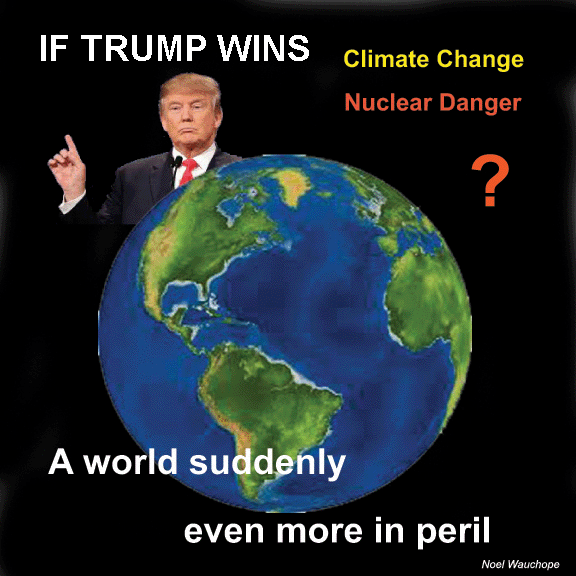 Can the world survive four more years of Donald Trump? From climate change to nuclear weapons to global health — this election isn’t just about you, America
By POLITICO 10/8/20 This article is part of a special report, The Global Election.
A second term could set Trumpism in concrete
In the middle of a devastating pandemic, recurring nationwide protests and a bitter presidential election — not to mention the president’s own COVID-19 diagnosis — Americans can be forgiven for losing track of what Donald Trump’s presidency has meant beyond their borders. But the list of changes he has wrought abroad is not short.
A world order designed to function through slow consensus and underwhelming compromise, on a good day, has had virtually no coping mechanism for the American president’s disruption. In the name of putting America first, Trump has pulled out of one global deal after another, unpredictably reversing course on some of America’s biggest global priorities and moral commitments. He has snubbed democratic leaders and longtime allies while cozying up to Vladimir Putin and other autocrats. While the most important Western institutions — NATO, the European Union, the United Nations, the World Trade Organization, the World Health Organization — are still standing, it’s an open question whether they will be able to survive another four years of pummeling and disinvestment by the world’s superpower.
So, what really happens if the world gets a second Trump term? ……….
Here’s what the world should expect if Trump remains commander in chief.
- By Ryan Heath………. Some of the outlook is unsettling: Trump is already undertaking a nuclear buildup and seems set on dismantling the one remaining treaty between the world’s two main nuclear powers. And there is a real fear that a second Trump term would embolden the authoritarians around the world who have lined up to support him. ……..
Emissions come back, and America bows out
The climate crisis is a slow-moving disaster that hinges on single pivotal moments. Right now, the global community is planning around the year 2050, when experts say humans need to all but eliminate greenhouse-gas emissions to avoid the worst effects of global warming. But the biggest dates on the immediate calendar are November 3 and 4.
Reelecting Donald Trump on November 3 would put America, and possibly other countries, on a new and hard-to-reverse course away from that emissions goal……
his abandonment of the Paris deal is still not official.
That pullout will be final on November 4, the day after the election.
A second Trump term would likely have a far bigger impact than the first, both domestically and abroad. The president would have more time to defend his deregulatory agenda in court, which could lock in rules that allow more pollution from power plants, leaking oil and gas wells, cars and refrigerants
……… If the United States pulls out entirely, the Paris deal could start to fall apart, much as the earlier Kyoto Protocol climate treaty did without U.S. involvement. Saudi Arabia, whose economy depends on petroleum, has long played a role in trying to unpick the U.N. process from within. Some diplomats worry the Saudis would see the U.S. departure as the moment to walk out entirely. What will President Jair Bolsonaro do with Brazil? An exodus of such major players would leave the deal increasingly toothless. …………
Joe Biden is largely promising a reversal of the Trump approach. His platform calls for a $2 trillion investment to clean up the power grid, electrify the transportation sector, and aid minority and low-income communities disproportionately impacted by pollution. And he has pledged to rejoin the Paris accord and put the United States on track toward net-zero emissions by 2050 — though the details of how that will work, in an American economy still reeling from the pandemic, are far from clear.
- By Catherine Boudreau and Karl Mathiesen
US becomes an ever more unreliable ally
……………The far more likely threat is that Trump would remain as NATO’s most influential leader, sowing uncertainty and chaos from within. “It is likely he would persist in disrupting, both politically and militarily,” said retired Lieutenant General Douglas Lute, who was U.S. ambassador to NATO from 2013 to 2017, and is now chief executive of Cambridge Global, a strategic consulting firm. ……
For military commanders, it’s Trump’s sheer unpredictability that is most unnerving. The worst possibility is unilateral military action, which Trump has shown a willingness to take with no warning to allies, as when he withdrew U.S. forces from northeastern Syria. …… — By David M. Herszenhorn
Nuclear weapons. A direct strike on the treaty system
On an existential global threat that often feels like a back-burner issue in U.S. politics, Donald Trump has quietly moved America into much riskier territory — and faces a decision point before February that has nuclear experts of both parties worried…….
If he stays this course in a second term, Trump will have made permanent the biggest nuclear buildup since the Cold War — while simultaneously unraveling the treaties that have steadily reduced the nuclear threat since the end of the Cold War.
A Biden presidency likely would pivot the United States back to its earlier approach, quickly. Biden and his advisers have pledged to extend New START without preconditions before it expires, and to scramble to rebuild some of the previous deals that Trump walked away from. Biden has also expressed support for declaring a “no first use” policy when it comes to nuclear weapons — replacing, for the first time, the purposely vague U.S. position on when it might actually resort to their use. Also, his advisers support proposals to pursue an agreement with Russia to take both nations’ nuclear weapons off “alert” status, a step that arms control advocates believe would do more than anything else to reduce the danger of an accidental nuclear exchange. ………… https://www.politico.eu/article/us-election-2020-implications-for-the-world-trump-biden/?fbclid=IwAR2JOtx6HJgGl8PEAVCfydecyMA4Z_oiCXXjNrl2bN5xwCJ8PkThzHR6Jg8
Queensland election – all about climate, coal, and minority parties
 ‘Queensland paradox’ pushes coal and climate to centre stage of election campaign, Guardian, Ben Smee @BenSmee, Sat 10 Oct 2020
 As Labor and the LNP try to woo regional and metro voters with at-times contradictory messages, minor parties thrive
On Sunday in Clermont – in the dusty heart of Queensland – the coal fanatic Liberal National party senator Matt Canavan and the mining magnate Clive Palmer will hold a rally, mocking the convoy of climate protesters who made a somewhat unwelcome voyage north last year.
Three days earlier, almost 1,000km away in Brisbane’s trendy western suburbs, the Greens announced state election plans to provide free school meals, funded by a $55bn increase to mining royalties.
Somewhere in between lies what the University of Queensland political scientist Glenn Kefford calls “the Queensland paradox” – the challenge for major parties to woo voters in both Toowong and Townsville with different, sometimes contradictory, messages.
“The state might appear a certain way to outsiders but it’s really interesting and diverse,” Kefford says.
As Labor and the LNP attempt to “walk both sides of the street”, divisive issues including coalmining and climate change have again been pushed to the forefront of the campaign………
Avoiding the third rail
Of course, it’s impossible to talk about Queensland, coal, climate and the election without mentioning the third rail of that debate: Adani.
On the eve of the election, Labor sought to neutralise a potential campaign problem by signing a long-delayed royalties deal for Adani’s under-construction Carmichael coalmine.
Polling released this week shows Labor extending its dominance over the LNP in greater Brisbane. The party also hopes to pick up seats on the Gold Coast and the southern Sunshine Coast.
Of most concern to Labor strategists are the party’s regional seats, including the working-class regional cities of Townsville, Mackay, Rockhampton and Gladstone, where voters swung fiercely towards the Coalition at the 2019 federal election.
The premier, Annastacia Palaszczuk, began her hi-vis “jobs, jobs and more jobs” campaign by hopping across north Queensland, pushing a pro-mining message.
Kefford said Labor appeared to be attempting to address failures from last year’s federal election campaign in north and central Queensland by running messaging tailored to suit local campaigns in regional areas……….
‘Frankenstein majority’
Queensland politics has become known for its embrace of minor parties,………
“There’s a good chance of [a hung parliament], there’s no doubt,” Kefford said. “The major parties, they have to rationalise what they’re doing and be strategic about their messaging. They can’t be everything to everyone.” https://www.theguardian.com/australia-news/2020/oct/10/queensland-paradox-pushes-coal-and-climate-to-centre-stage-of-election-campaign
Net zero emissions target for Australia could launch $63bn investment boom
|
Net zero emissions target for Australia could launch $63bn investment boom, Guardian, Lisa Cox, 12 Oct 20,
Modelling shows moving towards a net zero emissions economy would unlock financial prospects in sectors including renewables and manufacturing Australia could unlock an investment boom of $63bn over the next five years if it aligns its climate policies with a target of net zero emissions by 2050, according to new economic modelling. The analysis, by the Investor Group on Climate Change (IGCC), finds the investment opportunity created by an orderly transition to a net zero emissions economy would reach hundreds of billions of dollars by 2050 across sectors including renewable energy, manufacturing, carbon sequestration and transport. However, if the country keeps to its current targets and climate policies, investment worth $43bn would be lost over the next five years, growing to $250bn by 2050. The Investor Group on Climate Change represents investors in Australia and New Zealand who are focused on the effect of the climate crisis on the financial value of investments. Among its membership are institutional investors with funds under management worth more than $2 trillion. The organisation commissioned the consultancy Energetics to examine the domestic investment opportunities that would arise from an orderly transition to net zero emissions by 2050. The report finds a net zero scenario would unlock $63bn in investment over the next five years, including $15bn in manufacturing, $6bn in transport infrastructure such as charging stations, and $3bn in domestic green hydrogen production, as companies and governments moved towards the stronger emissions goal. ………. “What it shows is that the investment opportunities extend well beyond just the renewables industry,” said Erwin Jackson, the IGCC’s director of policy. “Renewables are the backbone of the transition but there are massive opportunities in other sectors such as manufacturing, restoring the land, and electrification of transport.” The report, which targets governments, companies, investors and financial regulators, says its estimates are conservative because they do not factor in the export potential of industries such as clean hydrogen. It argues that if governments set stable policy, and companies and investors collaborate to align their decisions with the goals of the Paris agreement, then billions of dollars over the short and long term could support the jobs and wealth of millions of Australians, particularly in regional areas. The Morrison government has refused to commit Australia to a net zero emissions target and has focused its climate policy on a new technology roadmap covering hydrogen, energy storage, “low carbon” steel and aluminium, carbon capture and storage, and soil carbon……… John Connor, the chief executive of the Carbon Market Institute, said the reality Australia faced was its economy was running “below capacity and it needs a new direction”. He said clean technologies like renewable energy and transport represented significant opportunities for Australia in a post-carbon world and the country’s vast land mass, with landscapes in need of regeneration, gave it a competitive advantage in carbon sequestration. “We can either coast off the cliff into the hothouse of economic and climate disaster, or we can turn a corner towards an orderly transition and the opportunities that are there,” Connor said. https://www.theguardian.com/australia-news/2020/oct/12/net-zero-emissions-target-for-australia-could-launch-63bn-investment-boom |
|
Ice melt projections may underestimate Antarctic contribution to sea level rise
|
Ice melt projections may underestimate Antarctic contribution to sea level rise, EurekAlert, 9 Oct 20, PENN STATE Fluctuations in the weather can have a significant impact on melting Antarctic ice, and models that do not include this factor can underestimate the global impact of sea level rise, according to Penn State scientists.“We know ice sheets are melting as global temperatures increase, but uncertainties remain about how much and how fast that will happen,” said Chris Forest, professor of climate dynamics at Penn State. “Our findings shed new light on one area of uncertainty, suggesting climate variability has a significant impact on melting ice sheets and sea level rise.” While it is understood that continued warming may cause rapid ice loss, models that predict how Antarctica will respond to climate change have not included the potential impacts of internal climate variability, like yearly and decadal fluctuations in the climate, the team of scientists said. Accounting for climate variability caused models to predict an additional 2.7 to 4.3 inches — 7 to 11 centimeters — of sea level rise by 2100, the scientists recently reported in the journal Climate Dynamics. The models projected roughly 10.6 to 14.9 inches — 27 to 38 centimeters — of sea level rise during that same period without climate variability. “That increase alone is comparable to the amount of sea level rise we have seen over the last few decades,” said Forest, who has appointments in the departments of meteorology and atmospheric science and geosciences. “Every bit adds on to the storm surge, which we expect to see during hurricanes and other severe weather events, and the results can be devastating.” The Antarctic ice sheet is a complex system, and modeling how it will evolve under future climate conditions requires thousands of simulations and large amounts of computing power. Because of this, modelers test how the ice will respond using a mean temperature found by averaging the results of climate models. However, that process smooths out peaks caused by climate variability and reduces the average number of days above temperature thresholds that can impact the ice sheet melt, creating a bias in the results, the scientists said…….. https://www.eurekalert.org/pub_releases/2020-10/ps-imp100920.php |
|
Solar meets 100 per cent of South Australia demand for first time — RenewEconomy

Solar power met 100 per cent of South Australia’s demand on Sunday for the first time. It won’t be the last. The post Solar meets 100 per cent of South Australia demand for first time appeared first on RenewEconomy.
Solar meets 100 per cent of South Australia demand for first time — RenewEconomy
Australia could lose $265bn in green investment without zero emissions target — RenewEconomy

Investor group says size of Australia’s green investment opportunity could total $1 trillion by 2050, if governments embrace a net zero by 2050 target. The post Australia could lose $265bn in green investment without zero emissions target appeared first on RenewEconomy.
Australia could lose $265bn in green investment without zero emissions target — RenewEconomy
October 11 Energy News — geoharvey

Opinion: ¶ “New York Pathways To Bus And Truck Electrification” • To achieve New York’s ambitious climate and clean energy goals outlined in the Climate Leadership and Community Protection Act, New York needs to aggressively reduce greenhouse gas emissions in the transportation sector, the largest source of emissions in the state. [CleanTechnica] ¶ “Robert Redford: […]
October 11 Energy News — geoharvey
October 10 Energy News — geoharvey

Opinion: ¶ “A Nine-Point Plan For The UK To Achieve Net Zero Carbon Emissions” • The last six months have seen a growing realization that decarbonizing our societies is technically possible, relatively cheap, and potentially of major benefit to society, and especially to less prosperous sectors. Here is a sensible portfolio of nine actions for […]
October 10 Energy News — geoharvey
Australian government’s controversial Nuclear Waste Bill delayed – not yet debated in Senate
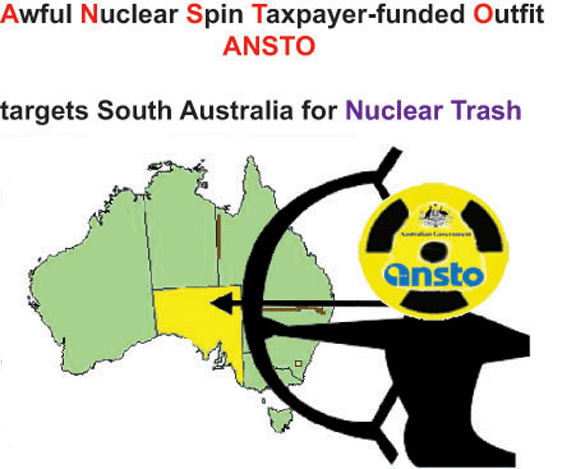 10 Oct 20, The dump legislation didn’t make it on to the Senate floor for debate and voting …
I think the government just ran out of time, they didn’t withdraw the Bill
So over the next week Non Government Organisations, and farmers and Traditional Owner s will be discussing how best to use the next month
Clean-up for Ranger uranium mine. Rum Jungle mine still a polluted mess
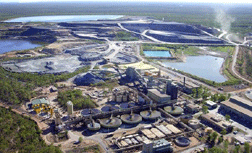 It’s costing a fortune but the Ranger uranium mine is gradually being cleaned up, Canberra Times, Chris McLennan 6 Oct 20 It’s costing a fortune but the Ranger uranium mine is gradually being cleaned up, Canberra Times, Chris McLennan 6 Oct 20
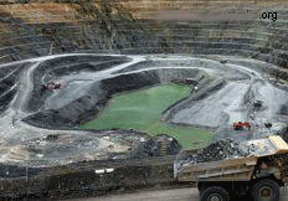
Over the years many people questioned the decision to allow uranium to be mined inside one of Australia’s most famous and largest national parks – Kakadu. But in 1980 that’s exactly what happened, an open-cut mine surrounded by a park famed for its natural beauty made even more famous by the hugely popular Paul Hogan movie, Crocodile Dundee. Now the uranium is gone, dug out and sent off to nuclear power stations around the world and Australia’s longest continually operated uranium mine is almost done.
Nuclear power is making way for renewable energy. Uranium has been mined at Ranger for more than three decades, producing in excess of 130,000 tonnes of uranium oxide. The mine is being closed, Jabiru – the town built to service to the mine workers, is in the process of being handed over to Traditional Owners and the mining company is being closely watched as it delivers on its promise to clean up the site. Cleaning up uranium mines is not something the Northern Territory does well – there is still a huge environmental mess at Rum Jungle closer to Darwin.
That uranium mine is a legacy of the Cold War. Australia’s first large scale uranium mine was dug at Rum Jungle on behalf of our “Allies” in the UK and USA to fuel their nuclear weapon programs in the 1950s. Now water fills that vast open cut, a lake as locals call it, and another attempt is going to have to be made to cap the radioactive tailings left behind, the first attempt, supposed to last a century, failed after 20 years. Energy Resources Australia, a subsidiary of Rio Tinto, says it has spent more than $642 million in the past eight years on rehabilitation of the mountains of tailings complicated by a lake created from a vast flooded pit………. This story It’s costing a fortune but the NT’s uranium mine is being cleaned up, gradually first appeared on Katherine Times. https://www.canberratimes.com.au/story/6955634/its-costing-a-fortune-but-the-nts-uranium-mine-is-being-cleaned-up-gradually/?cs=14231 |
|
Adnyamathanha Traditional Lands Association gets $millions from uranium mining: need for Royal Commission into Native Title
 South Australia’s premier will be formally asked to launch a royal commission into native title, Transcontinental, Greg Mayfield, 10 Oct 20, South Australia’s premier will be formally asked to launch a royal commission into native title, Transcontinental, Greg Mayfield, 10 Oct 20,
Indigenous leaders will make a last-ditch formal attempt to persuade the South Australian government to order a royal commission into Native Title and Aboriginal corporations. Premier Steven Marshall has agreed to see the group, led by Mark Koolmatrie, in Adelaide on Friday, October 16, to hear their case as outlined by a Senior Counsel. Sources say Mr Marshall may agree to the plea, but the verdict is unknown at this stage.
The submission comes after the Canberra-based Office of the Registrar of Indigenous Corporations put two Port Augusta-based Aboriginal corporations into special administration this year. It also follows demands by an action group for access to financial records of the Adnyamathanha Traditional Lands Association, based at Port Augusta and which is one of the groups under administration.
The association receives millions of dollars in royalties from the Beverley uranium mine in the outback. Indigenous leaders say problems with Native Title corporations exist around the nation. They have called also for a federal royal commission. …… “The message is that there are concerns at the way things are happening. “There is a better way of doing business. We want to find out about what ’empowerment’ really means. “We want to see the financial records of the Adnyamathanha association.”…….. Aboriginal Reform Group of South Australia and Adnyamathanha elder Charlie Jackson, of Port Augusta, said some members were appointed as directors of corporations without knowing their rights and responsibilities. “If you don’t know your role as a board member, that is going to cause conflict for you and for the organisation,” he said. “We want the government to instigate a royal commission into Native Title and Aboriginal corporations throughout SA. “There are major problems in these organisations.” The newspaper is seeking comment from the Premier’s office. https://www.transcontinental.com.au/story/6962338/sa-premier-to-look-at-indigenous-inquiry-plea/ |
|
Biden’s ambitious climate policy (d’ya think Scott Morrison has noticed this?)
|
The 2020 presidential election will decide the fate of the climate As we approach planetary tipping points, it’s vital to understand the two candidates’ plans—or lack thereof (Trump doesn’t have one)—for combatting climate change. Fast Company, 9 Oct 20, BY ADELE PETERS Whether the world succeeds in avoiding the worst impacts of climate change is likely to hinge in part on the results of the upcoming U.S. election. Climate scientist Michael Mann has said that a second Trump term would be “game over” for the climate, making it virtually impossible to limit global warming to 1.5 degrees Celsius. Biden, by contrast, is proposing the most ambitious climate policy of any major party nominee in U.S. history. Here’s a closer look at the differences. TRUMP: “IT WILL START GETTING COOLER”
The first major difference: Trump doesn’t accept the science of climate change or even necessarily seem to understand what “climate change” means. On a September visit to California, where heat and drought driven by climate change have helped fuel record-breaking fires, Trump said, “It will start getting cooler.” (He has previously called climate change a “con,” “hoax,” and claimed that it was invented by China.) At the first presidential debate, when asked about climate change, Trump started talking about clean air and water, and then claimed “we have now the lowest carbon.” (In fact, carbon dioxide levels in the atmosphere are now the highest that they have been in 15 million years.)
Through his first term, Trump has actively moved the country in the wrong direction on climate. “Across the board, the Trump administration has rolled or attempted to roll back all of the significant steps that the previous administration took under the Clean Air Act and other laws to reduce the carbon pollution and the other pollutants that are driving dangerous climate change,” says David Doniger, a senior advisor to the NRDC Action Fund, a political affiliate organization of the Natural Resources Defense Council. The administration weakened fuel economy standards, eliminated the Clean Power Plan, and weakened standards for emissions from the oil and gas industry. ……..
Trump’s campaign website says nothing about a plan for climate change. The Republican platform, recycled from 2016, says that climate change is “the triumph of extremism over common sense,” even though military experts have identified climate change as a national security threat and thousands of scientists have warned that we’re facing a climate emergency. To actually tackle climate change, the federal government would need to do far more, and a second Trump term would delay that action as the window of opportunity is closing………..
BIDEN: THE MOST AMBITIOUS CLIMATE POLICY OF ANY MAJOR PARTY NOMINEE
Biden, by contrast, has proposed investing $2 trillion to set us “on an irreversible course to meet the ambitious climate progress that science demands,” with a target of net-zero emissions by 2050. By 2035, he wants to decarbonize the electric grid. “This is more ambitious than the most ambitious states in the country,” says Stokes. (California and Hawaii are aiming for 100% clean electricity by 2045; New York is aiming for 2040.) The work on the electric grid would create millions of jobs. Retrofitting buildings to improve energy efficiency would create another million jobs. Ramping up the electric vehicle industry, and infrastructure like charging stations, would create a million more jobs. The plan also calls for “high-quality, zero-emissions” public transit for every large city, “climate-smart” agriculture, cleaning up pollution from the oil and gas industry, and the construction of 1.5 million sustainable homes and housing units. All of this would be done through the lens of environmental justice, ensuring that communities that have been hardest hit by pollution in the past see the benefits.
Though Biden has said that his plan is different from the Green New Deal, a resolution sponsored by Alexandria Ocasio-Cortez, the core principle is the same—creating jobs and fostering equity while reducing emissions. …..
The scope of the plan has to be massive because the country has waited so long to act; the changes could have been much more gradual if we had started 25 years ago. “We’re in a tough spot now,” Doniger says. “If Biden is elected, there’s a need for very deep reductions very fast.” Still, the vast scope of work means creating millions of jobs at a moment when the country also needs to invest in economic recovery.
If Biden wins—and, crucially, if Democrats also control Congress—it’s possible that the world could still avoid the worst impacts of climate change while addressing the recovery. “We’re going to need a very big recovery package, probably a lot bigger than the one from 2009,” Doniger says. “There’s a huge opportunity to build into that infrastructure spending for the transition to clean energy and low emissions that we need, and to do it in a way that invests in communities that have been underserved and beset by pollution.” https://www.fastcompany.com/90560969/the-2020-presidential-election-will-decide-the-fate-of-the-climate
|
|
China’s dramatic plan for switch to renewables – a warning to Australia’s fossil-fuel economy
 China just stunned the world with its step-up on climate action – and the implications for Australia may be huge, The Conversation, October 8, 2020, Hao Tan, Associate professor, University of Newcastle, Elizabeth Thurbon, Scientia Fellow and Associate Professor in International Relations / International Political Economy, UNSW, John Mathews, Professor Emeritus, Macquarie Business School, Macquarie University, Sung-Young Kim, Senior Lecturer in International Relations, Discipline of Politics & International Relations, Macquarie School of Social Sciences, Macquarie University China just stunned the world with its step-up on climate action – and the implications for Australia may be huge, The Conversation, October 8, 2020, Hao Tan, Associate professor, University of Newcastle, Elizabeth Thurbon, Scientia Fellow and Associate Professor in International Relations / International Political Economy, UNSW, John Mathews, Professor Emeritus, Macquarie Business School, Macquarie University, Sung-Young Kim, Senior Lecturer in International Relations, Discipline of Politics & International Relations, Macquarie School of Social Sciences, Macquarie University
|
|
Climate misinformation advertisements on Facebook, seen by millions

The ads included calling climate change a hoax and were paid for by conservative US groups, Guardian, Damian Carrington 9 Oct 20, Adverts on Facebook denying the reality of the climate crisis or the need for action were viewed at least 8 million times in the US in the first half of 2020, a thinktank has found.The 51 climate disinformation ads identified included ones stating that climate change is a hoax and that fossil fuels are not an existential threat. The ads were paid for by conservative groups whose sources of funding are opaque, according to a report by InfluenceMap.
Last month Facebook said it was “committed to tackling climate misinformation” as it announced a climate science information centre. It said: “Climate change is real. The science is unambiguous and the need to act grows more urgent by the day.”Facebook uses factcheckers and bans false advertising but also says this process “is not meant to interfere with individual expression, opinions and debate”. Some of the ads were still running on 1 October. The ads cost just $42,000 to run and appear to be highly targeted, with men over the age of 55 in rural US states most likely to see them.
Warren and other senators wrote to Facebook in July calling on it to close the loopholes.
1 This month


Help Aunty Sue Protect Her Land and Sacred Sites From Destructive Rocket Testing.
.

Australians deserve the truth
about
AUKUS – https://aukuspublicinquiry.com/

PETITION – To: Prime Minister Anthony Albanese and the Australian Labor Government

of the week – Australians for War Powers Reform (AWPR)
To see nuclear-related stories in greater depth and intensity

