Book: The Carbon Club -Tony Abbott and the ‘people’s revolt’ against Gillard’s climate policy
 Tony Abbott and the ‘people’s revolt’ against Gillard’s climate policy
In her new book ‘The Carbon Club’ Marian Wilkinson exposes the truth behind Australia’s inaction on climate change. Crikey, MARGOT SAVILLE, AUG 28, 2020
For several years, award-winning journalist Marian Wilkinson has been investigating the relationship between climate-sceptic politicians, business leaders and their allies. For her latest book The Carbon Club, she has conducted scores of interviews with players on both sides in order to expose the truth behind Australia’s inaction on climate change.
Bernardi teamed up with young libertarian Tim Andrews, who had trained with the Koch Brothers’ internship in the US.
“The two helped create the ‘people’s revolt’ against the climate policy, using the power of social media and the tactics of the Tea Party movement that was gaining ground in the US Republican party.
“One of the driving ideas behind the campaign was to exploit the anger and disaffection among ordinary voters towards politicians,” Wilkinson writes. …..
The “people’s revolt” against Gillard and the emissions trading scheme passed by Kevin Rudd would fundamentally fracture conservative politics in Australia, fostering splinter parties and deepening divisions in the Liberals, Wilkinson writes.
“It would destroy any chance of uniting the major political parties to face the enormous challenge of climate change.”………
Marian Wilkinson will discuss her new book at a Crikey Talks event for Inside Access members next month. Visit our Inside Access page to upgrade https://www.crikey.com.au/2020/08/28/book-review-carbon-club/
Cut through the propaganda. Population growth is NOT good for Australia
So, KPMG and its big-business clients hope that the masses will be lulled into supporting a return to higher immigration. Well, let’s hope a bit of counter-propaganda will prevent that.
Even on KPMG’s figures, this hit to the Australian economy and therefore living standards of Australians is suspect.
KPMG’s says GDP would be $117 billion lower each year by 2029-30 if we do not have these 1.1 million extra people, and that would leave every one of the 28 million Australians by then $2850 worse off each year – that is a total of $79.8 billion, let’s say $80 billion.
Bear with me with the figures.
Population growth propaganda
There was more fear-mongering, self-serving, and flawed guestimates over population this week – this time from the quintessential accountant and consultant to big business and government, KPMG.
Shock, horror, Australia’s population would be 1.1 million less by 2029-30 because of the reduction in immigration caused by Covid. That would be a “$117 billion” hit to the economy over the decade by dragging down economic growth, KPMG calculates. That would leave every Australian $2850 worse off each year, KPMG says.
So, KPMG and its big-business clients hope that the masses will be lulled into supporting a return to higher immigration. Well, let’s hope a bit of counter-propaganda will prevent that.
Even on KPMG’s figures, this hit to the Australian economy and therefore living standards of Australians is suspect.
KPMG’s says GDP would be $117 billion lower each year by 2029-30 if we do not have these 1.1 million extra people, and that would leave every one of the 28 million Australians by then $2850 worse off each year – that is a total of $79.8 billion, let’s say $80 billion.
Bear with me with the figures.
But if instead we have the extra immigrants, that $80 billion will not be “lost” because of the extra $117 billion in GDP the immigrants would provide. Take that $80 billion for the existing population away from KPMG’s $117 billion, it leaves $37 billion a year for the 1.1 million immigrants themselves, which comes to just $33,636 each immigrant per year, well below the Australian average income. So they are dragging their heels. They are a cost to the Australian community not an asset.
There is clearly something wrong with these “plucked-from-the-air” figures.
KPMG’s study looks at what would happen if there was no vaccine – and therefore no immigration – after one year and after two years. ……
But the 5.5% drop is not down to no immigration. Rather, it is down to all the other economically horrible things caused by a no-vaccine environment: closed businesses, closed borders, lack of confidence etc etc. But KPMG, to suit its own purposes, puts all of the lower GDP ($117 billion) down to no immigration and says the absence of immigration will cost every Australian $2850…..
Covid aside, there are good grounds for concluding that the John Howard-inspired high-immigration policies since the late 1990s have cost Australians dearly, not just in economic terms but also in environmental and lifestyle costs.
It is all very well bringing in immigrants with their immediate incomes which add to overall GDP in the short-term. But GDP per head in the long term is cruelled by that. Schools, hospitals and transport infrastructure have to be built to accommodate them. That might be good for KPMG’s big-business clients just as their immediate consumption needs might similarly benefit them.
But it is not so good for existing residents. Increased congestion and agricultural and wilderness land being consumed by housing are just some of the costs.
High immigration has become a self-perpetuating myth. It was a great thing for Australia from 1945 to about 1970, but thereafter it should have been questioned, but was not……..
The KPMG report is just one more bit of a continuous stream of pro-population propaganda. Couched in statistics and the “science” of economics, it goes unchallenged especially by media that should do better: the ABC, SBS, The Sydney Morning Herald and The Age. They rarely if ever challenge high immigration because of a misguided fear of being branded racist or anti-multicultural.
You don’t have to agree with high immigration to prove you are not a racist or anti-mulitculturalism. You can do that by merely supporting Australia’s laudable non-race-based refugee intake…….
The fact is, existing multicultural communities have the most to lose from high immigration because it puts extra pressure on the very services they need most: public transport, translation services, schools, health services and so on.
Covid, of course, poses a real threat to the present pro-population Ponzi scheme. If Australia experiences a couple of years’ relief from the high-immigration, high-population mantra, ordinary people might like the result. There would be less pressure on schools, hospitals, public transport, housing costs and so on.
Suddenly, people might revolt against high immigration and high population growth which enriches the few at the expense of the many and at the expense of the natural environment and its non-human inhabitants.
Small wonder KPMG and others like them are serving up the scare-mongering manipulated figures they did this week – continuing to serve their big-business clients against the interests of the vast bulk of Australian residents.
Among the many things that Australians should question and change as a consequence of Covid, high immigration should be near the top of the list….. http://www.crispinhull.com.au/2020/08/28/more-pro-population-growth-propaganda/?utm_source=mailpoet&utm_medium=email&utm_campaign=crispin-hull-column-16-nov-2019_99
Adani quietly rebranding Abbot Point terminal as company hit with $107m damages bill
 Adani quietly rebranding Abbot Point terminal as company hit with $107m damages bill
Exclusive: Queensland supreme court says company engaged in ‘unconscionable conduct’, Guardian Ben Smee @BenSmee, Fri 28 Aug 2020 Adani has quietly begun planning to rebrand its Abbot Point coal terminal – removing all reference to Adani in its company name and branding – as financiers continue to abandon the business and a Queensland court orders it to pay $106.8m in damages.
The Queensland supreme court this week ordered Adani to pay four terminal users damages for “unconscionable conduct” in a judgement that was scathing of Adani’s actions to advantage its own financial interests over other coal companies.
In the 93-page decision, the supreme court justice Jean Dalton said Adani’s ports business “attempted to disguise its behaviour in complex transactions”, engaged in conduct outside the boundaries of normal commercial behaviour, and “pleaded matters which were false”.
Name change planned as more investors pull out
Guardian Australia can reveal that Adani reserved two new company names with the Australian Securities and Investments Commission on 18 August – eight days before the court judgement. The Asic documents flag its intention to rebrand Adani Abbot Point Terminal and its holding company as the “North Queensland Export Terminal”.
In July, an Adani employee registered the web domain www.nqxt.com.au on behalf of Adani Abbot Point Operations, a separate company that manages the operations of the export terminal.
Climate campaigners say the move appears to be Adani “changing what has obviously become a toxic brand” amid its ongoing difficulties refinancing the port’s debts.
The Guardian can also reveal two additional Korean investors have, under pressure from climate activists, said they will dump their investments in Adani’s port, which has total debts of $1.5bn.
In recent days, Korean Investment Securities and Industrial Bank of Korea have written to activist groups confirming they will not offer further finance to the port, which would export coal from Adani’s controversial Carmichael coalmine………. https://www.theguardian.com/environment/2020/aug/28/adani-quietly-rebranding-abbot-point-terminal-as-company-hit-with-107m-damages-bill
Construction begins at Australia’s largest community-owned solar farm — RenewEconomy

Construction starts at SolarShare’s 1MW Majura solar farm, set to be one of Australia’s largest community owned solar projects. The post Construction begins at Australia’s largest community-owned solar farm appeared first on RenewEconomy.
Construction begins at Australia’s largest community-owned solar farm — RenewEconomy
Big business, energy and unions call on Morrison to wake up to climate risks — RenewEconomy

Australian Climate Roundtable calls on federal government to support a zero emissions target by 2050, citing looming risks to business. The post Big business, energy and unions call on Morrison to wake up to climate risks appeared first on RenewEconomy.
Big business, energy and unions call on Morrison to wake up to climate risks — RenewEconomy
August 28 Energy News — geoharvey

Opinion: ¶ “685,000 Americans Evacuated This Week. Could Climate Change Be Responsible?” • 685,000 Americans are subject to mandatory evacuation orders this week – 385,000 in Texas, 200,000 in Louisiana, and 100,000 in California according to Forbes. Is it possible that a warming planet had anything to do with either situation? [CleanTechnica] Science and Technology: […]
August 28 Energy News — geoharvey
“Chaos and confusion” as regulators fast-track rules to switch off solar PV — RenewEconomy

Solar industry warns of “chaos and confusion” as regulators struggle to finalise new standards and rules for new inverters and large scale “shedding” of rooftop PV. The post “Chaos and confusion” as regulators fast-track rules to switch off solar PV appeared first on RenewEconomy.
“Chaos and confusion” as regulators fast-track rules to switch off solar PV — RenewEconomy
Renewable alternatives set to slash industrial gas use – sooner rather than later — RenewEconomy

University of South Australia team says its own R&D – and that of many others – on renewable heat-to-power technology will slash industrial gas use by up to 80%. The post Renewable alternatives set to slash industrial gas use – sooner rather than later appeared first on RenewEconomy.
Renewable alternatives set to slash industrial gas use – sooner rather than later — RenewEconomy
Rapid fall to parity predicted for Australian renewable hydrogen costs — RenewEconomy

ANU study says cheaper solar and wind, combined with falling costs for electrolysers, will mean green hydrogen will soon beat fossil fuel alternatives. The post Rapid fall to parity predicted for Australian renewable hydrogen costs appeared first on RenewEconomy.
Rapid fall to parity predicted for Australian renewable hydrogen costs — RenewEconomy
Australia entangled in the military-industrial-intelligence-security complex

|
The military-industrial-intelligence-security complex https://johnmenadue.com/alison-broinowski-the-three-slash-complex/ By ALISON BROINOWSKI | On 25 August 2020 In 1961 President Eisenhower warned that a vast and permanent ‘military-industrial complex’ could produce ‘the disastrous rise of misplaced power’. Earlier, US Senators Robert La Follette and J. William Fulbright also foresaw the dangers of militarisation. Now we have a military/industrial/security/intelligence complex, and it is dangerous. Let’s start with ‘security’, which sounds harmless and desirable. Who welcomes insecurity? Our ‘safety and security’, various authorities assure us (never explaining the difference) are their prime concern, particularly after some egregious security failure on their part. Security abroad used to mean the First World remaining in control of opportunities, in its own interests. Security now additionally means controlling people euphemistically called ‘those who would do us harm’. Since 2001, national security has become an exponential, unassailable, growth area. Proliferating Australian laws criminalise knowing, revealing, or even asking anything about it. Despite some academics arguing that it includes food, health, social, economic, and environmental security, ‘hard-headed’ national security is the dominant growth area in universities and government. From there to intelligence. We lavishly fund the ‘community’ of ten security agencies which demand ever more power and resources. Several heads of ASIO, ASIS, ASD, and DFAT have followed each other in revolving door fashion. Some emerge occasionally to warn us of the new, dire, and continuing dangers we face. They can’t give details, of course, before WikiLeaks or the American media do, or until a tip-off to a Five Eyes partner inspires an ‘open source’ report. But they assure us of their best efforts – with a lot more staff – to keep us safe and secure. Their colleague from the American community, Mike Green, former Asia Director of the National Security Agency (the equivalent of ASIO), used to joke that the NSA’s job was to keep people frightened ‘so they’ll go on funding us’. From the community came the intelligence that government misused, or didn’t use, before the Bali bombing and the Lindt Café siege in Sydney. They provided intelligence that government used, or misused, to justify Australian forces’ illegal invasions of Iraq and Syria, to benefit Woodside Petroleum and disadvantage East Timor. Government is currently making an example of David McBride, a military lawyer who said what he saw Australian troops doing in Afghanistan, of Witness K, a former ASIS officer who said what he did in Dili, and of his former solicitor Bernard Collaery, who’s not allowed to say much, but who was raided in 2013 under anti-terrorism laws. The Attorney-General wants charges and court proceedings against them in the ACT to be secret, as in the Kafkaesque case of another, Witness J. The same applies in Britain, a common-law country, where a judge is likely in September to allow the extradition of Julian Assange to the US, whose CIA paid to have him spied on. Rule of law? The Australian government and opposition say nothing. To industry then. Canberra airport has become a hall of mirrors for American, British, and French arms producers. So has the Kerry Stokes-chaired Australian War Memorial, whose expansion is to cost $500 million. Less than a decade after the ‘Australia in the Asian Century’ report, Asian languages and the arts languish, and the National Library closes its Asian collection. Defence expenditure is exempt from the efficiency dividend, and much cannot be accounted for. Yet a government that criticised its predecessors for running up ‘debt and deficit’ tries to please the Americans by exceeding 2 percent of GDP, even for aircraft that are not delivered and are denied the technologies the US allows Israel, and for submarines that will lack crew and be obsolete and over budget before they hit the water. Diversification of suppliers is commendable, and local manufacture too, but value for money? Japan would have undercut the French price and delivery date for the submarines, and might not have dangled the option of nuclear power. By 1967 the US was ‘the greatest purveyor of violence in the world today’, said Martin Luther King. Now the war industry (let’s call it by its name) has proliferated in Australia, as in the US and UK. Its promises of local employment ̶ often more jobs than are delivered ̶ attract votes, particularly in South Australia. The merchants of death are to be joined by Australia as the tenth largest arms exporter. And we won’t ban nuclear weapons. So why bother searching for a vaccine to stop millions dying in the pandemic? Fourth, military. In most democracies, elected civilians debate where the armed forces should go, what they should do, what they need to do it, and when they should return. Some constitutions even require reports on progress, and independent inquiries afterwards. That worked before the undeclared, endless war. Now potential conflicts are planned years in advance, the security state identifies the priorities, the war industry gears up, and inter-operable allied forces that are not already embedded get their American orders on a given date. So the Australian military tail in effect wags the government dog. Moreover, inviting US military bases to proliferate in northern Australia, and expanding our war-games, not only makes Australia a bigger target but inevitably America’s endless wars become Australia’s. The putative enemies China, Russia, and Iran need not be Australia’s enemies. The risk grows of Australia being used as an example by China of what it could do to the US, to its real enemy. If Australia is not to be dragged into war against China or Iran by the US, our Ministers while in quarantine might reflect on the invertebrate performance they gave at the AUSMin talks in July. Bipartisan Sinophobia was recently demonstrated against NSW parliamentarian Shaoquett Moselmane. Australian security would benefit if the opposition didn’t try to outdo the government’s ‘Communist China’ McCarthyism. Trump aimed to drain the Washington swamp by filling top White House positions with ex-military people. Most have departed, but this proto-fascist tendency continues in Australia where the governor-general, governors, politicians, and even academics with military backgrounds are conspicuous. Of these former fighters, only a few have the courage, as retired General Peter Leahy did in 2016, to deplore Australia’s lack of independent military strategy and the way we go to war. If the ADF is called out to enforce the law in Australia, fascism will be next. Dr Alison Broinowski AM is a former diplomat, academic, and author, and is Vice-President of Australians for War Powers Reform. |
|
‘Nuclear will never happen in the Latrobe Valley’
 Nuclear discussion is a hot topic in the Latrobe Valley, Latrobe Valley Express, Michelle Slater, 26 Aug 20, “……..
‘Nuclear will never happen in the Latrobe Valley’
The call to lift the state’s prohibition on nuclear is not being backed by all unions, as some community groups come out swinging against any nuclear proposal in the Latrobe Valley.
Many concerns surrounded the region’s geographical instability, the use of water, dangerous waste and the need to forge ahead with large-scale renewables.
The Victorian branch of the Electrical Trades Union doubled down on its opposition in its submission into the Inquiry into Nuclear Prohibition.
It instead called for large scale renewables such as the Star of the South offshore wind farm off the Gippsland coast to provide a just transition for workers and communities.
“Renewable energy is affordable, low risk, clean, and popular. Nuclear is simply not,” the ETU submission said.
“Our shared energy future is renewable, not radioactive and our government must plan for and support a fair and just transition for energy workers, their communities and the Australian people.”
Voices of the Valley convenor Wendy Farmer backed the ETU stance, rejecting claims from the CFMMEU that nuclear would provide a “just transition” for the Valley.
Ms Farmer also rigorously argued that there was no social licence from within the local community to go ahead with nuclear.
She said any nuclear plant in the Valley, particularly if it was built on the former Hazelwood site, would be too close to homes in a seismically unstable location.
“Nuclear will never happen in the
Latrobe Valley, it’s too expensive and will take too long to build. Do we just care about jobs and not a healthy community? This would impact all of Gippsland,” Ms Farmer said.
“Yes, we need a proper transition and secure energy, but nuclear is not the way to go when we need the federal government’s will to build more renewables.”
Community over Mining spokesperson Tracey Anton has voiced her concerns about using water to rehabilitate the Latrobe Valley’s coal mines.
The community advocate said nuclear was unsuitable for the region due to the volume of water it would require, creating a burden on downstream agriculture and environmental needs.
“We’ve already over-allocated our ground and surface water, how do you fit in another industry that needs more water when we don’t have enough as it is,” Ms Anton said.
“The (state) government can’t even figure out how to rehabilitate the existing coal pits, or even how to transport asbestos safely, never mind nuclear.”
Friends of the Earth’s Yes2Renewables campaigner Patrick Simons has been working with the local proponents for the proposed Delburn wind farm, helping campaign for renewables in Gippsland.
Mr Simons said the conversations around nuclear were a “distraction” from discussing rolling out renewables in a decentralised grid.
“There is surplus grid capacity in Gippsland,” he said.
“Renewable energy built in the region will complement wind power operating in western Victoria, where the grid is constrained, making the energy system overall more resilient.”……..
nuclear power remains unlawful in Australia under federal legislation.
The Victorian government has no plans for a nuclear power industry, which has been banned since 1983 and is instead focusing on “cheaper, safer and more sustainable alternatives in the form of renewable energy and storage”.
A state government spokeswoman pointed to Victoria’s ambitious 50 per cent renewables targets by 2030, creating more than 24,000 jobs, “particularly in regional areas”…….. https://www.latrobevalleyexpress.com.au/story/6896995/nuclear-discussion-is-a-hot-topic/
Two U.S.cities cut their losses, pullout of dodgy NuScam “small” nuclear reactor project
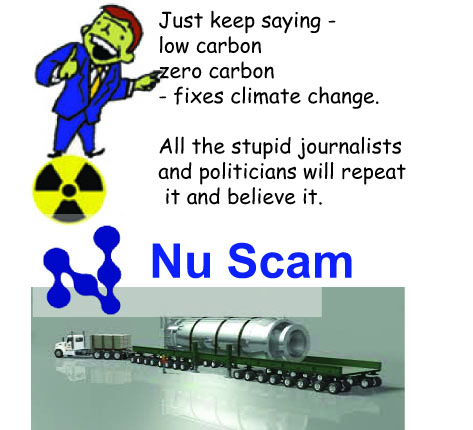 Lehi, Logan Back Out Of First-Of-Its-Kind Nuclear Power Plant Project Citing Financial Risk InKuer, By KATE GROETZINGER • 27 Aug 20, Two Utah cities have pulled out of a nuclear power plant investment — saying the financial risks are just too high. But 28 other towns and service districts in the state are still involved in the project, which is organized by a utility cooperative called Utah Associated Municipal Power Systems, or UAMPS. Lehi, Logan Back Out Of First-Of-Its-Kind Nuclear Power Plant Project Citing Financial Risk InKuer, By KATE GROETZINGER • 27 Aug 20, Two Utah cities have pulled out of a nuclear power plant investment — saying the financial risks are just too high. But 28 other towns and service districts in the state are still involved in the project, which is organized by a utility cooperative called Utah Associated Municipal Power Systems, or UAMPS.The Carbon Free Power Project involves a first-of-its-kind technology called “small modular nuclear reactors”, which would produce around 720 megawatts of nuclear energy. UAMPS and the U.S. Department of Energy have invested $3 million in the project since it began in 2017. But the reactors are still in development, and it’s unclear how much the project — and the power — will ultimately cost. That’s one reason the city of Logan cited in its decision to leave the project ahead of a Sept. 30 deadline to invest in its next phase, which is expected to cost $130 million. Logan was planning to use seven megawatts of power from the plant and has put around $250,000 into the project based on that amount so far. The city would have had to put in another $654,000 over the next three years to remain invested in the project. The cost could continue to grow, according to Mark Montgomery, director of light and power for Logan. He told the city council that Logan could end up having to pay millions into the project during the second phase of its licensing period, from 2023 to 2025……. Montgomery also cited concerns that it’s still up in the air whether the Department of Energy will invest in the project. The department pledged to fully fund the first reactor in 2018, but it went back on that deal. Now, it plans to invest $1.4 billion in the project — about a quarter of its total $6 billion price tag. That agreement is not yet final and the appropriation would need to be approved by Congress. The city of Lehi also voted to leave the project during a city council meeting this week. So far, Lehi has invested $455,000 in the project for a 21 megawatt subscription. Power Director Joel Eves said the project has struggled to find new investors, while its budget almost doubled to $6 billion from $3.4 billion since 2017. “A big piece of this is project subscription, and that does make us nervous,” Eves said. “It seems like we’re going at this alone as UAMPS members.” ……. https://www.kuer.org/post/lehi-logan-back-out-first-its-kind-nuclear-power-plant-project-citing-financial-risk#stream/0 |
|
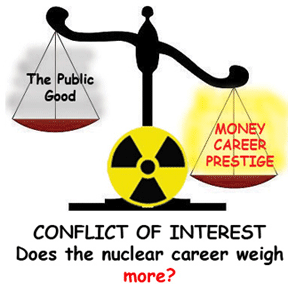
Not all scientists are objective, especially nuclear scientists
With a denier of science in The White House—whether it has to do with the climate crisis or Covid-19 and so on—there is a major push, including by Democratic officials, for making science the basis for governmental decision-making.
That’s completely understandable.
But what about the push by some scientists to politically further areas of science and technology which they favor? Science might be objective—but that doesn’t mean all scientists are.
Take Congressman Bill Foster.
Major holes in ozone hole treaty must be addressed to avert stronger climate change
 Experts reveal major holes in international ozone treaty https://www.eurekalert.org/pub_releases/2020-08/uos-erm082520.php
– 26-AUG-2020
Major holes in ozone hole treaty must be addressed to avert stronger climate change and serious risks to human health, experts warn
A new paper, co-authored by a University of Sussex scientist, has revealed major holes in an international treaty designed to help repair the ozone layer, putting human health at risk and increasing the speed of climate change.
Evidence amassed by scientists in the 1970s and 1980s showed that the depletion of the ozone layer in the stratosphere was one of the first truly global threats to humanity.
Chemicals produced through economic activity were slowly drifting to the upper atmosphere where they were destroying the ozone layer, which plays an indispensable role in protecting humanity and ecosystems by absorbing harmful ultraviolet radiation from the sun.
In 1987, countries signed up to a treaty to take reparative action, known as the ‘Montreal Protocol on Substances that Deplete the Ozone Layer, which was eventually ratified by all 197 UN member states.’
But in a paper published today in Nature Communications, experts have flagged major gaps in the treaty which must be addressed if the ozone layer is to be repaired and avert the risks posed to human health and the climate.
Professor Joseph Alcamo, Director of the Sussex Sustainability Research Programme and former Chief Scientist at UNEP, said: “The Montreal Protocol and its amendments have no doubt been an effective worldwide effort to control the toughest substances depleting the ozone. But our paper shows that the treaty has developed too many gaps to fully repair the ozone layer. It’s time to plug the holes in the ozone hole treaty.”
Professor Alcamo, along with lead author Professor Susan Solomon of Massachusetts Institute of Technology (MIT) and co-author Professor A. R. Ravishankara of Colorado State University, have identified several ‘gaps’ which consist of ozone depleting substances not covered in the treaty.
These include:
- Unaccounted for new sources of CFC and HFC emissions recently detected in the atmosphere.
- Leakages of ozone depleting substances from old air conditioners, refrigerators and insulating foams.
- Inadvertent releases of ozone-depleting gases from some manufacturing processes.
- Emissions of the ozone-depleting gas, nitrous oxide, stemming mostly from agricultural activities.
The authors have called for a range of solutions to plug the gaps including:
- A toughening of compliance with the treaty by using provisions that are already part of the Montreal Protocol.
- Boosting the effectiveness of the treaty by adding in regular environmental monitoring of ozone-depleting substances.
- Controlling the emissions of substances that have slipped through the treaty up to now, including nitrous oxide emissions from agriculture, and ozone-depleting substances leaking from old refrigerators and other equipment.
- In addition, because ozone-depleting substances and their substitutes contribute significantly to global warming, the authors urge a faster phasing out of all of these substances as a way of combatting climate change.
The ozone layer absorbs harmful ultraviolet radiation from the sun but this protective layer is slowly destroyed by industrial gases that slowly drift up from the earth’s surface including CFCs (chlorofluorocarbons) contained in refrigerants, foaming agents and, earlier, propellants in aerosol sprays.
Discovery of the ‘ozone hole’ above high latitudes in the 1980s provided final evidence of the importance of ozone depletion.
By 1985, countries had signed the Vienna Convention, which pledged to reduce CFCs and other ozone-depleting substances. Two years later, they signed the Montreal Protocol that laid out a plan of action.
During his time as the first Chief Scientist of UNEP, which hosts the Secretariat of the Montreal Protocol, Professor Alcamo coordinated groups of scientists in producing policy-oriented reports that addressed emerging ozone depletion issues.
UNEP reports that 98% of the chemicals targeted for removal in the Montreal Protocol had been phased out by 2009, avoiding hundreds of millions of cases of skin cancer and tens of millions of cases of cataracts. However, this new paper shows that some important sources were not targeted by the Protocol – and urgently need to be now.
Professor Alcamo said: “Since most ozone-depleting gases and their current substitutes are also potent greenhouse gases, it’s time to use the Montreal Protocol to draw down these gases even faster to help avoid dangerous global warming.
“We won’t be able to reach the global Sustainable Development Goals by 2030 without closing the gaps in the ozone treaty. It’s hard to imagine, for example, how the global health and climate goals could be reached without drastically drawing down all ozone-depleting gases and their substitutes. If we fail, humanity will have to face a higher risk of skin cancers and more rapid climate change.”
Journalists have been let down by ABC management
There has been a great deal of public debate recently about funding for the ABC — the cuts to its budget and the redundancies that have resulted from those. But what of the organisation’s willingness to push back not only against funding cuts, but against political interference?
The recent departure of journalist Emma Alberici from the ABC has typified the management weaknesses that have seen the organisation too beholden to government mood and not willing enough to back its journalists, writes Denis Muller. He says Australian governments have a long history of trying to influence the way the ABC does its work, particularly when the Coalition has been in power, beginning under John Howard and going right up until the unvarnished hostility of the Abbott-Turnbull-Morrison years.
In the meantime, he says journalists have been let down. Management has one task: to provide support for its journalists to do independent work, regardless of corporate, economic or political influence. But there is no sign the ABC journalists have had that protection, least of all from the board. Instead, writes Muller, “they are at the mercy of a vindictive government, urged on by its mates in News Corporation, which has a vested interest in weakening the ABC and shamelessly campaigns for exactly that”.
1 This month
.

Australians deserve the truth
about
AUKUS – https://aukuspublicinquiry.com/

PETITION – To: Prime Minister Anthony Albanese and the Australian Labor Government

of the week – Australians for War Powers Reform (AWPR)
To see nuclear-related stories in greater depth and intensity

