Port Kembla no place for a nuclear subs base, say local campaigners
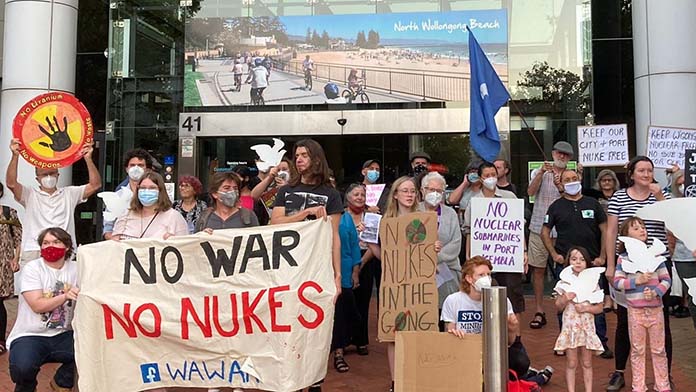
Activists in Wollongong are organising against plans for nearby Port Kembla to host the East Coast base for the AUKUS nuclear submarines. Solidarity spoke to Alexander Brown from Wollongong Against War and Nukes about local opposition and how unions have dedicated this year’s May Day march to opposing the plan
The cost is around $10 billion for an East Coast submarine base. The Treasurer says they can’t afford the $24 billion required to increase Centrelink payments above poverty levels and yet they can afford to spend $10 billion on a war base. And that’s a small part of the overall $368 billion dollars for AUKUS. It’s a gross waste of money.
The strategic justification for it doesn’t make any sense. That’s being picked apart even within the Labor Party by people like Paul Keating and Bob Carr. We’re now seeing current sitting MPs start to express criticism. The submarines may arrive in between ten to 30 years, when their supporters in ASPI and the Sydney Morning Herald say we’re about to have war with China in the next three years. If so the subs are not going to be much use.
More importantly, it’s a ridiculous approach to peace making in the region to say we will arm ourselves to the teeth and that will deter China. China and its regime have many problems but they’re not a military threat to Australia now and they’re unlikely to be in the future. And if these subs are supposed to be to defend shipping, we are shipping most of our exports to China anyway, so who are we defending it against?
We need to build people-to-people solidarity with ordinary people in China to ensure peace and democracy in the whole region—not get drawn into a US provocation and starting a regional arms race.
What kind of actions have you taken to build opposition?
When Scott Morrison suggested that Port Kembla could be a site for an East Coast submarine base there was a protest called by the Student Association at Wollongong University, and different groups and individuals including unions and local councillors came to that.
We started organising a dedicated campaign group called Wollongong Against War and Nukes (WAWAN) and held a successful rally about a year ago to support the local council renewing the declaration of Wollongong as a nuclear free zone, which goes back to 1980.
We held a public meeting with former Greens Senator Scott Ludlam and the South Coast Secretary of the Maritime Union.
We had a rally here two weeks ago, because some local business interests held a defence industry conference and want to build a war industry down here.
This year when the Labor government so fully endorsed continuing AUKUS, after I think many people hoped they might back away, it created shock.
Then there was also a report in the ABC that Port Kembla was firming up as the most likely location for the submarine base. So the campaign has really picked up in the last two months.
The local South Coast Labor Council endorsed a motion to oppose having a nuclear base here.
Unions like the maritime union have put a lot of work into trying to plan for a renewable energy industry here to survive the big shocks that are coming in terms of the decline of coal and steel. They’re interested in expanding offshore wind and potentially green steel through hydrogen.
WAWAN has a community meeting in Port Kembla on 29 April, and we are calling for everyone who can get there to come and support the South Coast May Day march on Saturday 6 May, which will include opposition to the nuclear base alongside the slogan of “Peace, Jobs and Justice”.
Wollongong and Port Kembla steel works have been hotbeds of militancy since the beginning of last century and that tradition continues. The Dalfram dispute in the 1930s saw waterside workers refuse to load pig iron bound for Japan, because they knew that it would be used to make bombs and bullets for the Japanese invasion of China. Pig iron exports to Japan more or less stopped after that struggle.
In the Vietnam War there was a strong movement here and in the 1980s the anti-nuclear movement was really big in Wollongong and the unions were a major part of that. A lot of people in Wollongong have seized the opportunity to say that fighting unionism needs to look beyond the workplace at the environment that workers are going to be living in and creating.
We are wasting money and resources on the defence industry when we could be spending that money on addressing climate change and jobs through a Green New Deal.
Unions back renewable energy jobs over nuclear subs
The South Coast Labour Council, which represents unions in and around Wollongong, is opposing the submarine base as a threat to alternative jobs in the area.
Port Kembla has been assessed as an ideal spot for offshore wind developments, due to wind conditions, grid connections and the working harbour. The area is one of the NSW government’s priority Renewable Energy Zones, with at least two companies already carrying out scoping work for multi-billion dollar offshore wind projects.
Even NSW Ports and the Port Kembla Chamber of Commerce have warned that the Outer Harbour site is needed for wind turbine assembly as well as a new container port, and should not be taken by defence. This is also the likely site for the submarine base. Even the two offshore wind projects already proposed would create thousands of jobs in construction as well as over 500 ongoing jobs.
March against the nuclear base in Port Kembla
12pm Saturday 6 May, Wentworth St, Port Kembla, more details here
Sign up for travel from Sydney here
Opposition grows to nuclear submarines in Port Kembla
by Owen Marsden-Readford https://redflag.org.au/article/opposition-grows-nuclear-submarines-port-kembla, Wednesday, 19 April 2023

Last year, as part of the AUKUS pact, Liberal Prime Minister Scott Morrison announced plans for a new submarine base on Australia’s east coast. The Labor government that succeeded Morrison’s has said it will stick with this plan.
There is increasing speculation that the site for the base will be Port Kembla, a southern suburb of Wollongong in the Illawarra region of the NSW south coast. While Labor insiders have claimed a final decision won’t be made until after the next federal election, the ABC recently reported that, according to “defence, government and industry figures”, Port Kembla “is now the strongly favoured option” for its deep port and proximity to other military bases and Australia’s lone nuclear reactor at Lucas Heights.
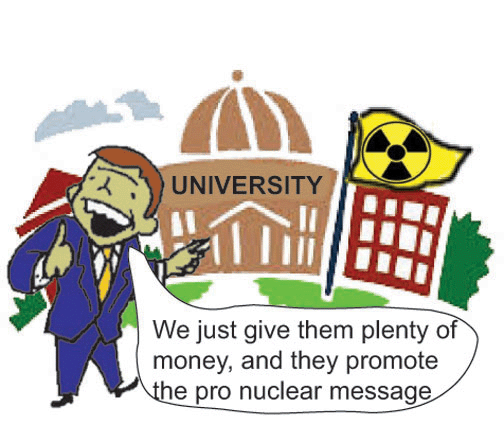
The plan has received support from some local business figures, and the University of Wollongong is deepening its already extensive ties with the military-industrial complex in anticipation. Among the wider community, however, opposition is growing.
Several unions have already come out against the proposed base. The New South Wales Teachers Federation passed a motion at its March council meeting:
“Continuing reports that Port Kembla is being considered as the site for a nuclear submarine base is of deep concern for our public education communities. While governments appear ever ready to commit huge amounts of public revenue on military expenditure there remains a serious underfunding of public pre-schools, public schools, TAFE and higher education, and other areas of the public sector.”
The Kiama council also passed a motion opposing a submarine base at Port Kembla. Even the Dapto and Port Kembla branches of the Labor Party have passed oppositional motions. Socialist students in the Wollongong Undergraduate Students’ Association have passed motions opposing the nuclear submarines, the AUKUS pact and the Australian government’s war drive.
Importantly, the South Coast Labour Council has called for this year’s May Day rally to be held in Port Kembla on Saturday, 6 May, to oppose the planned base. Council secretary Arthur Rorris told the Sydney Morning Herald, “If they want to turn our harbour into a nuclear parking lot, we will fight them tooth and nail”. There will even be a solidarity action held in San Francisco outside the Australian consulate.
Wollongong Against War and Nukes (WAWAN)—a campaign group formed last year—has held a series of protests against AUKUS. The most recent, on 4 April, drew more than 80 people in opposition to the Illawarra Defence Industry Conference—a gathering of war hawks and military profiteers.
Socialist and WAWAN activist Luke Hocking said in a speech at the protest, “If we are all committed to building this movement … then we can make something that can physically get in the way of their plans. And the more of us there are, the better we will be able to do that”. WAWAN will be holding a community forum in Port Kembla on Saturday, 29 April, and is planning further protests.
The Illawarra has a proud history of working-class anti-imperialism. We should look to these traditions as we set out to build resistance to the planned submarine base, the AUKUS pact and the militarism of the Australian ruling class and its US and British allies.
May Day March planned – against AUKUS

The Age (print version) , David Crowe, Matthew Knott,23 Mar 23,
Laboutr organisers will escalate their concerns about the AUKUS defence pact by movingan annual workers’ march to the NSW city of Port Kembla to oppose its use as a base for a future submarine fleet.
The organisers agreed on Tuesday night to relocate the MayDay March from Wollongong out of growing c oncern at the prospect that nearby Port Kembla could become the eas-coast home for eight nuclear-powered vessels.
“the battle for Port Kembla has begun” said Arthur Rorris, the secretary of the South Coast Labour Council, a longstanding Labor member and one of the organisers of the annual march.
The move cam after former Labor cabinet minister Kim Carr added hi svoice to concerns about AUKUS in the wake of criticism from former prime minister Paul Keating………………..
The location of the fleet is a major obstacle because the AUKUS plan includes$10 billion for an east coast base to house the submarines, with Brisbane and Newcastle named as options, but the idustrial city of Port Kembla seen as the government’s most likely choivce.
The protest will focus attention on AUKUS befoe Albanese heads to the G-7 summit in Japan on May 19 and United States President Joe Biden visits Sydney for the Quad summit in the same months, with expectatins that tehpresident will address federal parliament.
Rorris said the groups concerns about AUKUS were about the national interest and nota “not-in-my-backyard” protest.
The name is Port Kembla not Fort Kembla” he said.
“We will not cop lectures about the national interest from spooks and arms dealers”, he said……….
NSW Ports boss backs offshore wind farm plant ahead of nuclear base
ABC Illawarra / By Jessica Clifford, Melinda James, and Tim Fernandez 22 Feb 23
NSW Ports chief executive Marika Calfas has called for the state’s trade needs to be prioritised ahead of a nuclear base, while unveiling plans for an offshore wind farm facility at Port Kembla.
Key points:
- The facility at Port Kembla would support windfarms on the NSW coast
- Port Kembla is adjacent to the federal government’s proposed Illawarra offshore wind development zone
- The project would need significant government investment to proceed.
……………………………. The ABC understands Port Kembla has been identified as the Department of Defence’s preferred site for a nuclear submarine base.
Ms Calfas said she was not aware of the deparment’s plans but said the state’s trade needs should come first.
“We would like to think everyone recognises the importance of ports,” she said.
“Particularly over the last three years with the issues which have occurred globally in terms of supply chains and how important it is that our ports can support the needs of our island nation moving forward.
The Defence Strategic Review was delivered to the government earlier this month with a report expected to be published in March.
Labor Member for Cunningham, Alison Byrnes, recently returned from a tour of a US Submarine base in Connecticut and said the location of the base will not be revealed until after community consultation.
“This process was started by the former government, so they put the three proposed sites on the table,” Ms Byrnes said.
“I have said to our Defence Minister that there needs to be, shortly after the release of the defence strategic review, a community leaders’ consultation to start talking about the way forward … to choose a site for the submarine location.”
Billion-dollar boost to economy
Offshore wind farms have been proposed for parts of the NSW coastline, including the Central Coast, Illawarra and South Coast, but do not yet have final approval.
BlueFloat is among the companies interested in establishing a wind farm off the coast of the Illawarra.
Technical project director David Delamore said the company was looking at establishing two farms about 14 kilometres offshore.
“The project we are looking at is over 100 turbines, this is a huge project it is a billion-dollar project and it needs a large work force as well,” he said.
“We need trained personnel, so we definitely need to be tapping into the local business communities and looking to establish training facilities to address any skills gaps.”
The federal government will begin consultations over the proposed offshore wind farm zones later this year.
Ms Calfas said the lack of certainty for the region makes it difficult for businesses to plan for the future.
“I think the need for clarity and the need for certainty is really important,” she said.
“The sooner we can get that, the sooner everyone can progress with their planning, the sooner everyone can progress with their investment plans and the sooner we can all start delivering on those benefits of jobs and investments.” https://www.abc.net.au/news/2023-02-22/windfarm-future-demands-port-kembla-facilities-planned/102003542
Firefighters called to Newcastle golf club after stolen car set alight
Firefighters were called to a popular golf course after a stolen car was set on fire, sparking concern over a potential radiation leak.
Aisling Brennan news.com.au 8 Feb 23,
Firefighters have successfully prevented a radiation leak coming from a stolen car set on fire in the middle of a Newcastle golf course.
Specialist hazardous materials firefighters from Fire and Rescue NSW were called to Merewether Golf Club in Adamstown, following reports of a possible radiation leak about 9.45am on Wednesday.
The car, which was allegedly stolen, had been driven onto the green in the early hours of the morning, where the driver reportedly did several burnouts on the golf club greens.
The car was then set on fire and abandoned about 2am.
Crews were called when the owner of the stolen vehicle notified authorities there was a moisture gauge on board which has a radiation source attached and could be damaged because of the blaze.
“Firefighters, wearing protective clothing and carrying radiation detectors, then entered the scene and conducted an initial assessment,” FRNSW said in a statement.
“The equipment was located and was emitting low levels of radiation.
“Additional specialist radiation detection equipment and radiation experts responded to conduct a comprehensive assessment.”…………………………………………….. https://www.news.com.au/national/nsw-act/crime/firefighters-called-to-newcastle-golf-club-after-stolen-car-set-alight/news-story/7098926a530ba2cb7ea146192966f8d0
Newcastle radiation risk: Police call in EPA to help remove radioactive device from burnt out vehicle at Merewether
By Madeline Link, February 8 2023, POLICE have called in the Environment Protection Authority (EPA) to help remove a radioactive device from a burnt out vehicle found at Merewether Golf Course…………… (Subscribers only) https://www.newcastleherald.com.au/story/8077712/radiation-risk-police-call-in-epa-to-help-remove-radioactive-device-from-burnt-out-car/
Military join rescue effort as floods ravage outback
The military has been brought into South Australia to help with emergency
evacuations amid official forecasts that thousands of properties are
threatened by the state’s worst flooding in almost 70 years. Officials have
described the crisis as a slow-moving disaster, brought on by heavy
rainfall over the eastern Australian states of Queensland, New South Wales
and Victoria.
Times 1st Jan 2022
Dangerous radiation mishaps surge across NSW hospitals and medical centres
SMH Carrie Fellner, December 12, 2022 ,
Radiation accidents have surged across NSW hospitals and medical diagnostic imaging centres as the state records a dangerous upswing in rates of equipment malfunctions and human errors.
In one incident, which has been referred to the healthcare watchdog, a cancer patient’s radiation treatment was bungled, resulting in their healthy tissue being dosed with radiation four times instead of their tumour.
In the past financial year, there were 263 accidents across the state, or an average of five a week, according to the annual report of the NSW EPA’s Radiation Advisory Council.
“This total represents a 26 per cent increase on the total accidents reported in the previous year (209) and reaffirms the strong year-on-year upward trend in reporting,” said the report, published without fanfare last week.
“Human error is the primary cause of reported accidents, with the majority due to failure to follow procedures and protocols or incorrect interpretation of patient information,” it said.
Equipment failures had also “increased substantially” on previous years, the report noted.
The council requested “a further breakdown of equipment failures to establish if the same brand of equipment has the same errors across different sites”.
The council also recommended the EPA raise the increase in preventable accidents with health authorities in NSW and emphasise the appropriate ordering of medical imaging procedures.
In response to questions on Sunday, an EPA spokeswoman attributed the rise in accidents to increased reporting……………………..
“The EPA is investigating reports of equipment and software malfunctions, and is contacting manufacturers.”
Of the total number of incidents, 172 involved exposure to more than one millisievert of radiation.
The average person in Australia is exposed to about 1.7 millisieverts of radiation a year from natural sources, according to the Australian Radiation Protection and Nuclear Safety Agency……….
The accidents fell into three categories: medical imaging procedures such as X-rays and CT scans, radiation treatments in hospital oncology wards and nuclear medicine procedures such as PET scans.
There was a steep rise in the number of accidents reported involving radiation oncology, which jumped from three in 2017-18 to 57 logged last financial year.
Equipment failures accounted for 30 per cent of all accidents last financial year, up from 20 per cent in the previous financial year.
The second most common cause was a patient’s paperwork not being interpreted or read correctly by staff, with 49 people affected.
……………. “These incidents are rare in the context of the number of procedures performed in public and private facilities, but it is important that any incident is reviewed through appropriate channels, including the Radiation Advisory Council,” the spokesperson said.
A spokeswoman for Environment Minister James Griffin said he was pleased to see increased reports to the regulator by radiation oncology workers….. https://www.smh.com.au/national/nsw/dangerous-radiation-mishaps-surge-across-nsw-hospitals-and-medical-centres-20221211-p5c5eo.html
The Liberal National Coalition’s flirtation with nuclear energy will not be well received by the electorate, especially in Gilmore on the NSW South Coast.
Nuclear option might trigger an electoral meltdown, The Echidna, John Hanscombe, Tuesday June 7, 2022,
The Coalition is flirting with nuclear energy. The public musings started when David Littleproud won the Nationals leadership last week. He said nuclear power was a clean energy option that ought to be discussed. Outgoing Barnaby Joyce echoed the sentiment. Peter Dutton did the same yesterday.
There’s been a chain reaction of sorts in the conservative camp, which is a major turnaround, given it was only last September when Scott Morrison ruled out nuclear energy. His proscription came just after he announced the landmark AUKUS deal with the United Kingdom and the United States to acquire a fleet of nuclear powered submarines………..
As the next election approaches, such talk is likely to become muted or disappear altogether because it will indeed lead to a scare campaign, especially in the ultra marginal seat of Gilmore on the NSW South Coast. Jervis Bay sits in the middle of the electorate and in the 1960s was slated as the site of a nuclear reactor. There was even talk of producing weapons grade plutonium there – of Australia arming itself with nukes. The idea was shelved after Australia signed the Non-Proliferation of Nuclear Weapons Treaty in 1973. A reminder of how close the plans came to fruition can be found at Murrays Beach, where concrete footings for the reactor are still visible under the water. Every time nuclear energy is mentioned by either party, people who love Jervis Bay for its natural beauty go into meltdown. The very idea is toxic.
Talk is cheap when you’re newly in opposition – and likely to remain there for the next six years – but the electorate’s reluctance to embrace nuclear energy will quickly lay the Coalition’s newfound enthusiasm for it to rest…………………………….. for all the buzz around small modular reactors, which are touted as lessening the likelihood of accidents, that technology is still in development. Not even the International Atomic Energy Agency is prepared to say whether it will be cost effective………….. https://view.mc.austcommunitymedia.com.au/?qs=2bef209076d2e92cad0ffbe50cfe6117f6de9b563c7f216a55f25b25a465ef4053920d84e8c319c1ee827faf2abd014eaf6af926304d34acbc4913de77c01ab76b3971c3c352c700fbcb032e2a19e72e
Sydney University radiation case shows the need for stronger environmental laws, with wider scope
The fallout of the University’s radiation case, To see real environmental progress, it is not enough to rely on corporate responsibility; we need a body of enforceable restrictions on corporate and institutional consumption. Honi Soit by Bella Gerardi, May 2, 2022,
Last week, the University of Sydney was fined $61,000 for failing to properly dispose of a radioactive source belonging to a decommissioned medical imaging machine. For an institution that claims to have a strong commitment to the environment, conviction of a criminal environmental offence appears at odds with its sustainability strategy.
The source, which contained a sealed radioactive isotope, was found when a truck delivering scrap metals to a recycling yard set off alarms during a routine radiation check.
Identified as belonging to a PET scanner owned by the University, the Environmental Protection Agency (EPA) charged the University with four individual breaches of the Radiation Control Act. The case didn’t go to court as the University pled guilty, and in exchange the EPA dropped two of the four charges.
………. Last week, the University of Sydney was fined $61,000 for failing to properly dispose of a radioactive source belonging to a decommissioned medical imaging machine. For an institution that claims to have a strong commitment to the environment, conviction of a criminal environmental offence appears at odds with its sustainability strategy.
The source, which contained a sealed radioactive isotope, was found when a truck delivering scrap metals to a recycling yard set off alarms during a routine radiation check.
Identified as belonging to a PET scanner owned by the University, the Environmental Protection Agency (EPA) charged the University with four individual breaches of the Radiation Control Act. The case didn’t go to court as the University pled guilty, and in exchange the EPA dropped two of the four charges.
…………… It is disappointing, but not surprising, that it took a criminal conviction to reach the safeguards imposed today. Unfortunately, the University’s prior lack of clear procedure is indicative of the broader attitude institutions and corporations hold toward environmental crimes. Environmental crimes are often entangled with accidents, negligence, or oversight, and are often not viewed as holding the same gravity as other offences.
Corporations and institutions are responsible for the majority of environmental harm, yet complex corporate hierarchies make it uncommon for individuals to face repercussions for offences, which in turn promotes a lax attitude toward environmental damage.
Is anything changing?
The NSW Government passed the Environment Legislation Amendment Act 2022 (NSW) last month, which broadened the personal liability that executives face if their corporation breaches environmental legislation. If directors financially benefit from a breach of environmental law, they can be criminally prosecuted for that offence, regardless of whether they were personally aware of or involved in the breach.
In bringing a greater threat of personal liability, the new laws will hopefully incentivise directors to take greater care in ensuring company policies uphold environmental laws.
Despite all this, the scope of environmental law as it stands is limited, as most environmental offences relate to waste management or water and air pollution. ………. https://honisoit.com/2022/05/the-fallout-of-the-universitys-radiation-case/
Sydney University fined for carelessness with a radioactive device
The fallout of the University’s radiation case, by Bella Gerardi, May 2, 2022,
Last week, the University of Sydney was fined $61,000 for failing to properly dispose of a radioactive source belonging to a decommissioned medical imaging machine. For an institution that claims to have a strong commitment to the environment, conviction of a criminal environmental offence appears at odds with its sustainability strategy.
The source, which contained a sealed radioactive isotope, was found when a truck delivering scrap metals to a recycling yard set off alarms during a routine radiation check.
Identified as belonging to a PET scanner owned by the University, the Environmental Protection Agency (EPA) charged the University with four individual breaches of the Radiation Control Act. The case didn’t go to court as the University pled guilty, and in exchange the EPA dropped two of the four charges.
So, how did this happen?
By accident, the court ruled.
…………… the court noted that if the source had not been detected before entry to the second metal recycling yard, environmental contamination would have been “very likely”. In this scenario, the source would have gone on to be reprocessed, a procedure that would involve breaking the seal of the source and dispersing the material into usable metal. It would have ultimately ended up in consumer material, which the court noted has occurred overseas.
………… It is disappointing, but not surprising, that it took a criminal conviction to reach the safeguards imposed today. Unfortunately, the University’s prior lack of clear procedure is indicative of the broader attitude institutions and corporations hold toward environmental crimes. Environmental crimes are often entangled with accidents, negligence, or oversight, and are often not viewed as holding the same gravity as other offences.
Corporations and institutions are responsible for the majority of environmental harm, yet complex corporate hierarchies make it uncommon for individuals to face repercussions for offences, which in turn promotes a lax attitude toward environmental damage. ………………………………….. more https://honisoit.com/2022/05/the-fallout-of-the-universitys-radiation-case/
Various groups oppose plan for nuclear submarine base – ”a military target” at Port Kembla, New South Wales
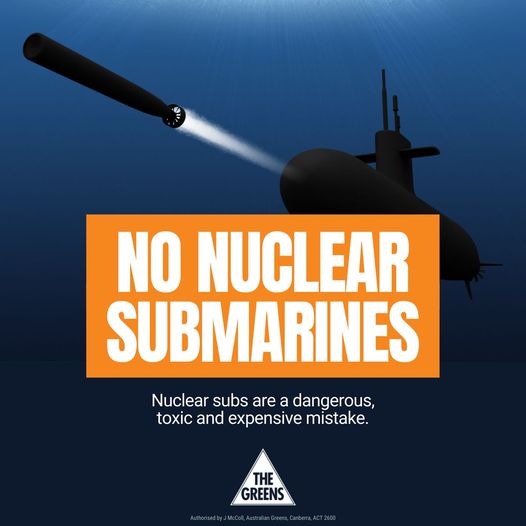
Planes, trains, automobiles … and nuclear subs: the local issues at play in the federal election
Guardian Stephanie Tran and Khaled Al Khawaldeh, Mon 2 May 2022
………….Submarine base in Port Kembla
Max, 26, works for a non-profit and lives in the electorate of Cunningham, held by retiring Labor MP Sharon Bird. He is worried about the prospect of a base being built in Port Kembla to house the future nuclear-powered submarines to be built under the Aukus agreement.
“This announcement was made with no consultation with the community, no proposal for consultation moving forward and a potential for my home to have a giant target on its back,” he said.
The Wollongong suburb, 100km south of Sydney, was flagged by the Coalition as the potential home of its new nuclear-powered submarine base. However, experts have raised concerns that the base could endanger the community by making it a military target, and some in the community are wary over the safety of the submarines’ nuclear reactors.
Alison Byrnes, the Labor candidate for Cunningham, said that if elected she would ensure that the community was consulted on the decision.
“I will make it a priority to seek a detailed briefing from the minister for defence on this plan, as well as Defence’s proposed assessment process,” she said.
The Liberal party emphasised the economic benefits of the project, but did not address the community concerns……..
Greens candidate Dylan Green said he did not want to see his community “getting caught up in a nuclear arms race”.
“Our government should be strengthening diplomatic ties with neighbouring states, not inviting conflict by investing in warships with primarily offensive capabilities,” he said.
Alexis Garnaut-Miller, from the Australian Citizens party, was “absolutely and resolutely opposed to this nonsensical proposal of building nuclear submarines or any development of nuclear submarine presence in Port Kembla”…… https://www.theguardian.com/australia-news/2022/may/02/planes-trains-automobiles-and-nuclear-subs-the-local-issues-at-play-in-the-federal-election
Students, Maritime Union, strongly oppose proposal for nuclear submarine base at Port Kembla
Nuclear submarine naval base at Port Kembla proposal opposed https://www.illawarramercury.com.au/story/7655576/wollongong-protest-demands-end-to-nuclear-submarine-naval-base-plan/ Ashleigh Tullis 13 Mar 33
Dozens of people gathered in Wollongong to protest the “proliferation of nuclear weapons” following the federal government’s proposal to build a nuclear submarine naval base at Port Kembla.
Port Kembla has been touted as the preferred location for a future base for Australia and visiting nuclear-powered submarine fleets, under a federal government plan.
Rally organiser, Wollongong Undergraduate Students’ Association Education Officer Sean McLachlan said the protest at Wollongong mall on Saturday demanded an end to the AUKUS pact where the US and the UK will help Australia to acquire highly-sophisticated nuclear-powered submarines.
“We see this proposal as a significant act of aggression and exaggeration towards potential war in the future,” he said.
“This latest proposal of having the naval base in Brisbane, Newcastle or Port Kembla, in our backyard, is quite shocking.
“It will be met with strident opposition.”
Mr McLachlan said Wollongong had a strong history of “standing up against all forms of militarism”.
“We are saying no to the naval base, no to AUKUS and no to war,” he said.
“We oppose the proliferation of nuclear weapons. Nuclear power in any form requires uranium, mining and a massive investment into infrastructure which can be used for the proliferation of nuclear weapons.”
Mr McLachlan said ordinary people had no interest in the government investing in the military but would rather see money spent on expanding social welfare, public and social housing, disaster funding and climate change.
“This is what money should be funnelled into from the government – things that ordinary people could benefit from, not weapons,” he said.
“Instead of building a naval base that will only increase the threat of devastating conflict in the region, the $10 billion slated for this base should be spent on building new schools and hospitals.
“They claim there isn’t enough money for us, but there’s somehow always money for death and destruction.”
Maritime Union of Australia southern NSW branch secretary Mick Cross reiterated the union’s opposition to nuclear proliferation.
“The MUA has always stood for peace, internationalism and justice, and so condemns in any shape or form the proliferation of nuclear capability in any country, especially our own. This includes the development or proliferation of nuclear-powered defence vessels,” he said.
During the rally, Mr Cross said if the base was built, fishing would no longer be permitted, nor families using the foreshore due to security concerns.
“Shame on the LNP government and shame on those who think there is any positive aspect of this nuclear base being built in Port Kembla,” he said.
Mr Cross said he was worried about Port Kembla becoming a “target” once submarines were based there.
He added the port was now entering a “progressive” phase with a focus on jobs in renewable energy industry into the long term, and that was better than than short-term jobs that would be needed to build the base.
Mr Cross said the announcement was a “distraction” ahead of the federal election.
Members of Wollongong Undergraduate Students’ Association, Wollongong Socialists, Illawarra Greens, refugee campaigners, South Coast Labour Council and Southern NSW Maritime Union of Australia branch hoped Saturday’s rally would be the start of an opposition campaign against the proposal.
Liberal Senator Concetta Fierravanti-Wells wants Port Kembla as nuclear submarine base – Dr Helen Caldicott and Wollongong Council disagree
Port Kembla the ‘obvious choice’ for nuclear submarine base, Liberal Senator says
ABC Illawarra / By Tim Fernandez 8 Mar 2022 Port Kembla could become the home of the first major military base to be built in Australia in more than 20 years, but the prospect of nuclear activity in the region has split the community.
Key points:
- Concetta Fierravanti-Wells says Port Kembla is the “obvious choice” for the base
- Nobel Prize-winning anti-nuclear activist Helen Caldicott says the base will turn Wollongong into a military target
- Wollongong has been a nuclear-free city since 1980
Prime Minister Scott Morrison confirmed yesterday that a submarine base would be built on Australia’s east coast as part of the AUKUS partnership with the US and the UK.
Port Kembla, Newcastle and Brisbane have been floated as possible locations for the base, but the ABC understands Wollongong is the Defence Department’s preferred site.
………………… Liberal Senator Concetta Fierravanti-Wells has been advocating for the Garden Island Naval Base in Sydney to be moved to Port Kembla since 2015.
‘Vote-buying gimmick’
The South Coast has a long history of community opposition to nuclear projects and the identification of Port Kembla as a possible destination for nuclear assets has reignited the debate.
One of the pioneers of the Australian anti-nuclear movement, Helen Caldicott, has spent decades raising awareness of the nuclear threat and won the 1985 Nobel Peace Prize for her work.
The Berry resident believed the base would pose an unmanageable risk to the area.
“Huge amounts of money being spent, nuclear activity at Port Kembla, which is always dangerous, and making it a target in the event of war, like Pine Gap,” Dr Caldicott said.
“It is just a vote-buying gimmick, obviously, when the Prime Minister should be spending that sort of money on the people in Lismore, many of whom have lost their houses.
“I think it should be treated with cynicism, and for Port Kembla to understand the dangers — both with dealing with nuclear activities and making it a possible target.”
The Labor Party supports the AUKUS partnership, but its candidate in the Wollongong-based seat of Cunningham, Alison Byrnes, has criticised the government’s secrecy around the plan.
“It has been really disrespectful for our community — they deserve to have all the details,” she said.
“The Prime Minister is using national security for his own job security, which suits his political timeline and not national security priorities.”
Nuclear-free zone
Wollongong council has been a nuclear-free zone since 1980 and in 2019 the council adopted the United Nations Treaty on the Prohibition of Nuclear Weapons…………………. https://www.abc.net.au/news/2022-03-08/port-kembla-submarine-base-proposal-reignites-nuclear-debate/100889814
A nuclear bomb on Sydney would mean umimaginable carnage
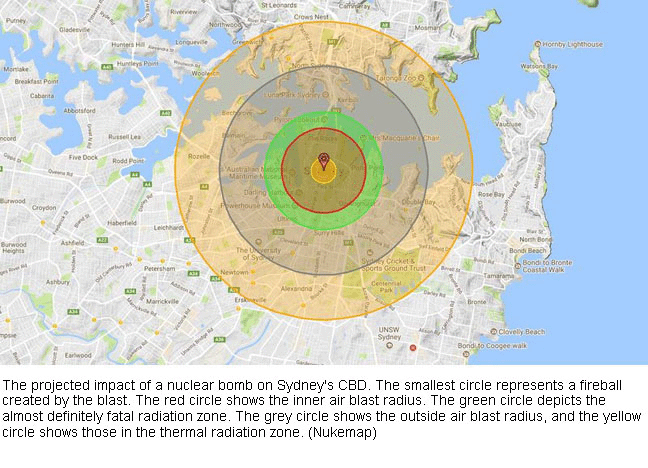
Frightening graphic reveals the horrific carnage a nuclear bomb would cause in Australia’s biggest cities – as Vladimir Putin’s nuclear sabre-rattling sparks global fears, By KEVIN AIRS FOR DAILY MAIL AUSTRALIA, 3 Mar 22, ”……………………But if the attack was to target Sydney or Melbourne, the carnage would be almost unimaginable.
Almost a million would die instantly in a 5km fireball which would engulf Sydney city centre, turning the inner-west, CBD and Eastern Suburbs to ash.
Buildings would be crushed to dust from Homebush to Collaroy to Cronulla.
If the airburst happened over Parramatta, the devastation would be even greater. The entire greater Sydney area from Penrith to Richmond to Palm Beach to Camden and the Royal National Park would be ablaze.
Anyone in the city left alive after the nuclear fireball and initial blast would be suffering third degree radiation burns all over their body, with many losing limbs.
The only saving grace might be that all their nerve-endings would probably be burnt away and they’d feel little to no pain.
Further out and windows in the Illawarra and Central Coast would be blown out by the blast, inflicting maiming injuries on locals, many of whom would be standing by a window to watch the distant explosion.
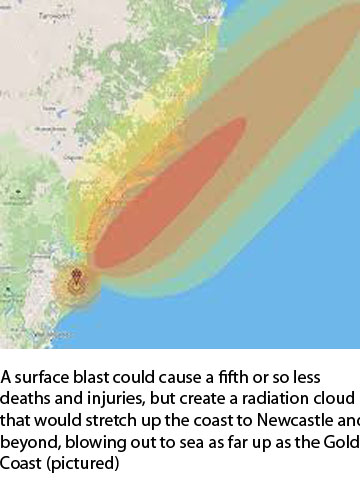
A surface blast could cause a fifth or so fewer deaths and injuries, but create a radiation cloud that would stretch up the coast to Newcastle and beyond, blowing out to sea as far up as the Gold Coast.
‘There’s no doubt that any large-scale nuclear weapons use would be quite catastrophic,’ Australian National University Professor Stephan Fruehling told the I’ve Got News For You podcast.
If you have a nuclear weapon that’s exploded on the ground, you’re looking at a very significant fallout plume and local contamination, which is essentially dangerous because of the radiotoxicity and contaminating water supplies and food chains.’

In Melbourne, a similar airburst explosion would instantly destroy everywhere around the CBD including Docklands, South and East Melbourne and Carlton in a deadly fireball.
More than 900,000 would die in a blink of an eye with another 1.3 million injured.
Everything from Sunshine West to Box Hill and north to Broadmeadows would be flattened in a 30km-wide blast range.
Everyone from Orangefields to Boronia to Whalan would be burnt to a crisp, with windows blown out and property damaged 85km from the epicentre, stretching from Frankston to Bacchus Marsh to Wallan.
A surface explosion would reduce the death total by a couple of hundred thousand, but the radiation cloud would stretch across Victoria, over Albany and Canberra and reach Sydney and Newcastle…………… https://www.dailymail.co.uk/news/article-10562917/Russia-Ukraine-war-happen-nuclear-bomb-dropped-Australia.html
1 This month

of the week – Australians for War Powers Reform (AWPR)
To see nuclear-related stories in greater depth and intensity
 Antinuclear