Reality bats last-Small Nuclear Reactors just not economic for Australia (or anywhere else)

 Small modular reactor rhetoric hits a hurdle https://reneweconomy.com.au/small-modular-reactor-rhetoric-hits-a-hurdle-62196/ Jim Green, 23 June 2020, The promotion of ‘small modular reactors’ (SMRs) in Australia has been disrupted by the Commonwealth Scientific and Industrial Research Organisation (CSIRO) and the Australian Energy Market Operator (AEMO).
The latest GenCost report produced by the two agencies estimates a hopelessly uneconomic construction cost of A$16,304 per kilowatt (kW) for SMRs. Continue reading
South Australia targeted: easy to later bring international waste in to nuclear dump
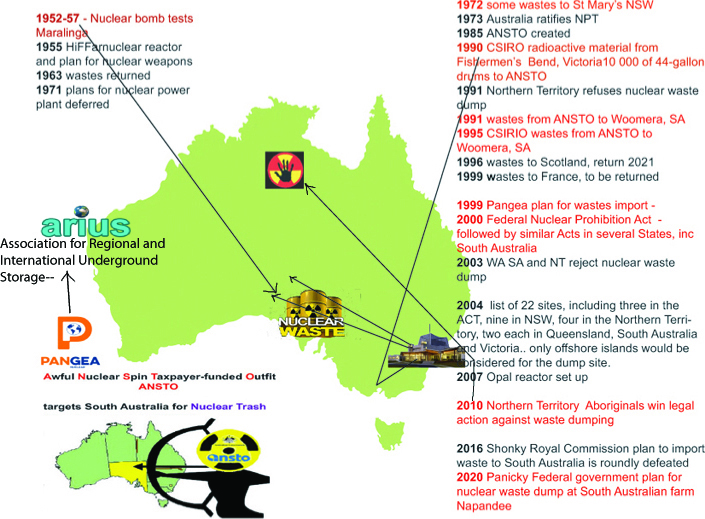
Name withheld. to Senate Committee on National Radioactive Waste Management Amendment (Site Specification, Community Fund and Other Measures) Bill 2020 [Provisions] Submission 39 Excerpt
The amendment to the Bill put forward by the now Minister of Resources Keith Bill should be rescinded and here are the reasons why.
First and foremost there was NO Broad Community Support achieved.
[The writer now gives an account of the requirement for community support for the nuclear waste facility: Support “would need to be in the vicinity of 65%, and that submissions and ‘neighbouring views’ would also be taken into consideration.” – and that this support was not achieved]
So why was Kimba announced as the dump site if this stipulation was not fulfilled? To understand it, first you must understand the history behind the dump proposal.
HISTORY
This whole dump proposal has been flawed from the very start. It is the exact same proposal put forward in Parliament in the 1980’s and hasn’t changed. The recurrent statement of “we only have a small amount of Intermediate Level Waste so that can “tag-a-long” or “co-locate” with the Low Level Waste” was used back then and continues to be used right now 40 years later!
If you consider that, back in the 1980’s the proposed dump concept was to be only operating for 50 years, as they also stated that by that time the Intermediate Level Waste would be dealt with before its closure. Think about it – that means the preparation should ALREADY be in place RIGHT NOW according to their statements – ready for 2030!
And yet NOTHING has been done in that regard!! We still have the Woomera Waste still sitting in Woomera, when it was stated by the Federal Government at that time (1994), that it would only be “temporary” for 2 – 3 years maximum! Moving on 25 years plus – and it still remains in Woomera. Past behaviour is a good predictor of future behaviour.
It should be noted that the waste in Woomera – the CSIRO waste from Melbourne Fishermans Bend and the St. Mary’s waste from St. Mary’s Defence Base NSW – were placed in Woomera AS A RESULT of a NSW Environmental Court Case brought onto ANSTO Lucas Heights by the Sutherland Shire Council.The CSIRO waste was from the cleanup of Fishermans Bend in Victoria – where in fact only 200 of these drums contained radioactive waste according to the then Transport code of a minimum exceeding 70,000 Becquerels per kilogram to be considered a radioactive substance! But due to the media coverage and the concern by the public, all 9726 x 205L of the drums were classified as radioactive and then taken by consignment to ANSTO Lucas Heights NSW for storage. They werenstored on site for 4 years at ANSTO Lucas Heights (1990 -1994).
It was only when Lucas Heights agreed to take the waste from St Mary’s Defence Base NSW (1991) that Sutherland Shire Council brought a court case up against ANSTO Lucas Heights from taking waste from other entities.The Case was won by Sutherland Council, and although ANSTO was swift to change the Federal Act thereafter so that such jurisdictional action would never happen again. The Federal Government sought a suitable Commonwealth site to place the Fishermans Bend and St Marys Bend waste at short notice – which was Woomera in SA. At the time, the Feds were in negotiation with Northern Territory with regards to a dump site in NT, which fell through. The waste remains separately stored in Woomera – although ANSTO was commissioned to condition the St Mary’s Defence waste before it was transported to Woomera.
https://www.aph.gov.au/About_Parliament/Parliamentary_Departments/Parliamentary_Library/Pu blications_Archive/online/RadioactiveWaste
Almost every state in Australia has been the target of this dump in the past. This is the second time SA has been targeted.And each and every time the establishment of the dump has failed.Why is this? Because it is a flawed proposal. Trotting out the exact same proposal since 1980’s shows that. The only change this time round is for nomination by land owners to nominate their land for the dump this time! 28 sites all around Australia were nominated in the nomination period 2nd March 2015 to 5th May 2015. It was the 13th November 2015 when the then resources minister Josh Frydenberg announce 6 sites around Australia which the Federal Government had deemed suitable.
https://www.aph.gov.au/DocumentStore.ashx?id=a80c7b35-3fdc-4502-8febd8381b03dae3& subId=565152 “Submission
“Submission to the Senate Inquiry into the Site Selection Process for a National Radioactive Waste Management Facility Radioactive Waste Management Taskforce April 2018” Annexure 6 – Chronology of site selection process.
Coincidentally, the South Australian Royal Commission into the Nuclear Fuel Cycle was established on 19th March 2015. The final report of this Royal Commission was presented to the SA premier Jay Weatherill on 9th May 2016. From October 2016 to November 2016, with final result obtained and given to the Premier of SA on 6th November 2016 a citizen’s jury decided a NO MEANS NO to SA becoming an International Dump site. https://www.abc.net.au/news/2016-11-06/sa-citizens-juryvote- against-storing-nuclear-waste/7999262 The then opposition leader Stephen Marshall reaffirmed this stance 5 days later 11th November 2016
https://www.abc.net.au/news/2016-11-11/opposition-says-it-will-vote-against-sa-nuclear-wastedump/ 8016818?fbclid=IwAR1CiCk6Y1je4l1ZUtpvlJqYT4rHeKcqreHAXtVJ1xZxpKNfHZ6xfToZxVA
Why is this important? Because of the timeline! There is NO WAY ON EARTH that South Australia was NOT BEING TARGETED!
And even today, there are South Australians who believe that the International AND National Nuclear Dump targeting in South Australia had been put to bed back in November 2016! That this was ONE FIGHT instead of TWO
However, it has to be noted, that when Mike Rann fought to stop the Federal Government putting a dump into South Australia in the early 2000’s, there was a push by an international group called PANGEA with a leaked media video, which is intent on establishing an International Nuclear Dump in Australia. The group is now called itself ARIUS, since 2012, and is alive and kicking as witnessed in the Royal Commission into the Nuclear Fuel Cycle 2016.
TECHNICAL SUITABILITY
So why is the Federal Government so hell bent on putting this nuclear waste onto South Australia? Surely World’s Best Practise would dictate that the best site would be closer to the main site of generation and not over 1700kms across the country and into another state! Less transport and less handling required meaning less human error and mistakes. Which is a perfect time to reiterate ARPANSA’s definition of nuclear waste – “Radioactive waste is material that has no foreseeable use and contains radioactive materials with activities or activity concentrations at levels high enough that regulatory oversight is needed to ensure safety.” https://www.arpansa.gov.au/understandingradiation/ radiation-sources/more-radiation-sources/radioactive-waste-safety/frequently-askedquestions
Why was Sallys Flat NSW which was ONE of the SIX sites deemed suitable by the Federal Government not hounded like the South Australian sites were? Sallys Flat is only 260 kms from Lucas Heights. Even Oman Ama QLD which is another of the SIX sites deemed suitable by the Federal Government is closer at 780kms! The site at Kimba is over 1700kms away!Over 90% of all Australia’s nuclear waste (non-mining) is generated on site at Lucas Heights NSW for the production of nuclear medical isotopes predominately. And these isotopes are predominately used for diagnostic imaging, and to a much, much smaller extent for treatment.
How much nuclear waste does South Australia actually have itself? Back in 2003 Mike Rann was reported as stating thatSouth Australia itself had only enough nuclear waste to fill one 44 gallon drum! And today it isn’t much more than that! https://www.abc.net.au/news/2003-06-03/rannrejects-waste-dump-threats/1864470“States and territories are responsible for managing a range of radioactive waste holdings, accounting for about one per cent of total radioactive waste holdings in Australia.”…according to the DIIS – “Australian Radioactive Waste Management Framework April 2018” page 7 https://www.industry.gov.au/sites/default/files/2019- 04/australian_radioactive_waste_management_framework.pdf……
Lucas Heights was built with ample space so that they could take care of all of the waste they generated on site. It was only with the build of the OPAL reactor which replaced the aging HIFAR reactor that it was thought that the waste could go elsewhere, to pacify the nearby population as a compromise of the build of the new reactor. But the premise still remains, and Lucas Heights has enough space to deal with their own was for up to 100 years.
Since Lucas Heights was built in 1958 there is still plenty of space and time for this research reactor to find a proper solution to this nuclear waste once and for all. Not to bury it somewhere out of sight and out of mind , so it is essentially abandoned. If push comes to shove with Government funding, do you think the proposed nuclear dump will be a priority? This dump simply gives Lucas Heights licence to continue and indeed even increase nuclear waste production.
And then consider the criteria for acceptance of nuclear waste at the proposed dump. These can easily be changed with a stroke of a pen. No liquid now, but that can be changed. No mining waste now, but that can be changed. No High Level Nuclear Waste now, but that can be changed. Just as the management and ownership of the dump can change, should the financing prove too much for the Federal Government. They have off loaded other Government owned entities before, no different with nuclear waste. And there in comes International Nuclear Waste through the backdoor.
The sorry Kimba nuclear waste saga- Michele Madigan spells it out (and it’s not over)
Canavan’s decision was a natural follow on from his December 13th announcement that with just 47 per cent of voters in favour, the Flinders Ranges site of Wallerberdina was no longer under consideration. As such, the Kimba decision was predictable. However it still came as a jolt to most of the farmers and others rightly fearful of the plan to host nuclear waste which even the government now admits will remain toxic for an unimaginable 10,000 years.
The early November Kimba vote of 61.17 per cent in favour on the proposed project followed the four year divisive government campaign. On December 5th, Kimba region farmer Terry Schmucker explained the vote’s long history: ‘We have already been through this once already where everyone was on equal terms. The minister at the time had already ruled there was not broad community support. However the landholder that nominated his land the first time then renominated a different part of his farm and his friends and family within the Kimba council moved for a vote of only the council area. The community funding has now been restricted to the Kimba council area only because of this — people are looking at the large inducement, not the radioactive waste issues.’ He concluded that ‘if the 50 km radius was applied at Kimba like it is at Hawker the vote would fail at these waste sites.’
After their 20 year struggle to successfully obtain their native title rights, which included the Kimba region, the Barngarla people were astonished at their own exclusion from the vote. As Jeanne Miller movingly explains in Kim Mavromatis’ four minute film, as Aboriginal people with no voting power they are put back 50 years, ‘again classed as flora and fauna.’ The Barngarla case against the Kimba Council will return to the Federal Court on February 21st. After the Kimba region announcement, most predictable was the delight of the man due to profit the most from the arrangement in monetary terms. Jeff Baldock of Napandee is to be paid four fold for the 160 hectares of his land that the federal government plans to acquire.
Not much doubt, however, that Baldock and his family over future generations may get much more in repercussions than bargained for. At our privileged gathering on 5th February in Adelaide’s CBD, every time a guest referred to ‘intermediate long lived nuclear waste’, Dr Helen Caldicott, an internationally known anti-nuclear campaigner, insistently corrected the term to ‘high level’ nuclear waste. Somewhat surprisingly, on February 6, ANSTO (Australian Nuclear Science and Technology Organisation) senior nuclear officer Hef Griffths voiced the same opinion. Speaking to the ABC’s Paul Culliver, Griffiths admitted France classifies waste from reprocessed spent nuclear fuel as high level nuclear waste — and when the waste gets shipped back to Australia it is reclassified as intermediate.
Unsurprisingly, there has been more media coverage of this issue in the Murdoch owned Adelaide Advertiser since Senator Canavan’s anouncement. One opinion piece to one (extreme) side, more facts than usual have been reported. Unswerving however has been the insistence by many correspondents of the repetition of the government mantra that the project is all about medical nuclear waste. The reality is that over 90 per cent of the waste, measured by radioactivity, is intermediate long-lived waste including the nuclear spent fuel rods and also the parts of the previous nuclear reactor. And no, X-rays and radiotherapy aren’t nuclear medicine.
After their 20 year struggle to successfully obtain their native title rights, which included the Kimba region, the Barngarla people were astonished at their own exclusion from the vote. As Jeanne Miller movingly explains in Kim Mavromatis’ four minute film, as Aboriginal people with no voting power they are put back 50 years, “again classed as flora and fauna”‘. To avoid any unnecessary repetition of details regarding the medical waste argument I suggest that any interested reader would do well to read the respondents’ questions and information to my last published article. In addition, there is always the valuable Friends of the Earth scientific information source.
The hosts of the Kimba Rally for Sunday February 2nd, expecting 100, were overwhelmed and delighted with the crowd, a physical count revealing five times that number. Mrs Waniwa Lester, widow of the late Yami Lester blinded by the 1953 British nuclear tests at Emu Junction, travelled the 467 kilometres from Adelaide with me to attend. Weeks in the planning, it turned out the rally took place two days after the Minister’s actual announcement of the nuclear site. MC Peter Woodfold, President of No Radioactive Waste on Agricultural Land in Kimba or SA, summarised the local divisive campaign in his speech, saying ‘if you want to know what intimidation is, you stand between people and money.’ Perhaps most moving of all the excellent speeches were those from other farmers, James Shepherdson and Tom Harris. As reported in the Stock Journal, Shepherdson said the community had not initially been told that the facility would be used to temporarily store intermediate-level radioactive waste, in addition to the storage and disposal of low-level waste. He said funding injections, such as a $20 million government community fund, did not outweigh potential problems with grain quality. ‘Farmers are under scrutiny and at the beck and call of buyers and brokers, and to risk what is an $80m income for this district every 12 months, for a one-off $20m payment, that’s absurd,’ he said. Kimba farming land is an important part of South Australia’s just 4.5 per cent agricultural cropping land. Tom Harris revealed with some distress the current doubt by insurance agents regarding his insurance viability because of its proximity of his farm to the nuclear storage site; this may jeopardise his sons’ succession. Reflecting the determination of local No campaigners, ACF ‘s Dave Sweeney warns that the fight is far from over. Various hurdles along the way in which opponents can be involved include the required Environmental Impact Statement and then the assessment the regulator ARPANSA (The Australian Radiation Protection and Nuclear Safety Agency) must make. The inclusion of other opponents is more likely when transport routes are finally revealed. Coming from a long established Eyre Peninsula family, P Boylan is clear: all of SA’s West Coast will be affected and must have a say. Peter Woolford goes further, in view of the extraordinary ramifications of this decision for the whole state, a referendum is needed. No, it’s not over yet. Nor will it be. On an issue that will have implications for every generation to come, just 452 local residents cannot be allowed to speak for 1.7 million South Australians. |
|
|
History of Australia’s govt move towards importing nuclear waste
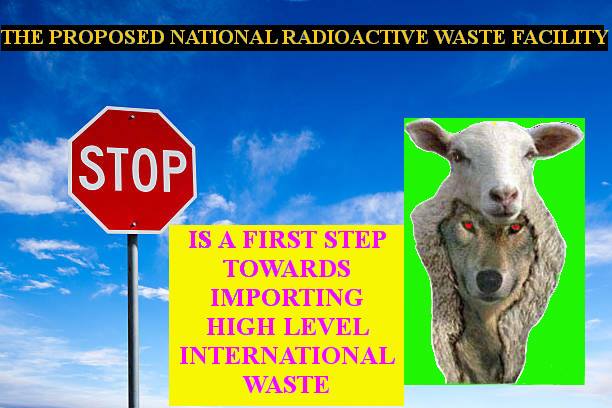 If the “low level” storage facility goes ahead in Kimba, it would only be a matter of time before it became a facility storing medium and high level waste creating untold risks for human life, Indigenous culture and heritage, flora and fauna, and agriculture. It must be stopped.
TERRA NUCLEAR https://www.cpa.org.au/guardian/2020/1902/05-nuclear.html?fbclid=IwAR0oOmAw7IIbs9dERT6aUM6gKTG4eIIco6iEycpzr58GHwyPomOVyGh2jak Anna Pha,16 Feb 2, Last week, the then Resources Minister Matt Canavan announced the site for an international nuclear waste dump on farmland in South Australia. The decision comes after two decades or more of wrangling over where to locate the facility.
The land is at Napandee in Kimba, on the Eyre Peninsula and is owned by a farmer who offered it to the government. He is set to receive compensation well above market value.
“The facility has broad community support in Kimba, but I acknowledge there remains opposition, particularly amongst the Barngarla People and their representative group,” Canavan said in a press release.
He omits to mention that the Barngarla People were excluded from a local vote on the question.
In addition, the opposition is not confined to the Barngarla People who fear the pollution of their land and waters, as well as the damage to their culture and sacred sites. Environmental and other groups as well as many individuals have not given up. They are determined to fight it to the end.
Denial of Danger
Just as the government refuses to acknowledge the dangers of inaction over climate change, Canavan plays down the deadly risks associated with radiation; “I am satisfied a facility at Napandee will safely and securely manage radioactive waste and that the local community has shown broad community support for the project and economic benefits it will bring.”
This is a hollow claim, which he cannot back with practice. How can anyone claim such a facility would be safely and securely managed for thousands or possibly hundreds of thousands of years that it would take for the radioactive material to breakdown?
The minister cannot make any guarantees. In particular, as the plan is to hand the facility over to the private sector to manage, the risks and cover-ups become far more likely and serious Continue reading
“Ecomodernists” – Ben Heard, Oscar Archer, Barry Brook, Geoff Russell, – Australia’s pro-nuclear fake environmentalists
|
Aboriginal First Nations and Australia’s ‘pro-nuclear environmentalists’ Jim Green – Nuclear Monitor | 10th July 2018 Australia’s Aboriginal people have long been mistreated by governments and industry in the pursuit of nuclear projects. The attitudes of ‘pro-nuclear environmentalists’ or ‘ecomodernists’ towards Aboriginal people is as disrespectful as those of governments and industry, argues JIM GREEN.The plan to turn South Australia (SA) into the world’s nuclear waste dump has lost momentum since 2016 though it continues to be promoted by some politicians, the Business SA lobby group, and an assortment of individuals and lobbyists including self-styled ‘pro-nuclear environmentalists’ or ‘ecomodernists‘. In its 2016 report, the SA Nuclear Fuel Cycle Royal Commission established by the state government promoted a plan to import 138,000 tonnes of high-level nuclear waste (about one-third of the world’s total) and 390,000 cubic metres of intermediate-level waste. The state Labor government then spent millions on a state-wide promotional campaign under the guide of consultation. …….. The Royal Commission Royal Commissioner Kevin Scarce ‒ a retired Navy officer ‒ didn’t appoint a single Aboriginal person to the staff of the Royal Commission or to his Expert Advisory Committee. Aboriginal people repeatedly expressed frustration with the Royal Commission process…… No analysis but favourable conclusions Despite its acknowledgement that it had not systematically analysed the matter, the Royal Commission nevertheless arrived at unequivocal, favourable conclusions, asserting that there “are frameworks for securing long-term agreements with rights holders in South Australia, including Aboriginal communities” and these “provide a sophisticated foundation for securing agreements with rights holders and host communities regarding the siting and establishment of facilities for the management of used fuel.” Such statements were conspicuously absent in submissions from Aboriginal people and organisations. There is in fact an abundance of evidence that land rights and heritage protection frameworks in SA are anything but “sophisticated.”……. Enter the ecomodernists
Ben Heard from the ‘Bright New World’ pro-nuclear lobby group said the Royal Commission’s findings were “robust”. Seriously? Failing to conduct an analysis and ignoring an abundance of contradictory evidence but nevertheless concluding that a “sophisticated foundation” exists for securing agreements with Aboriginal rights-holders … that’s “robust”?
In a November 2016 article about the nuclear waste import plan, Ben Heard and Oscar Archer wrote: “We also note and respect the clear message from nearly all traditional owner groups in South Australia that there is no consent to proceed on their lands. We have been active from the beginning to shine a light on pathways that make no such imposition on remote lands.” In Heard’s imagination, the imported spent nuclear fuel would not be dumped on the land of unwilling Aboriginal communities, it would be processed for use as fuel in non-existent Generation IV ‘integral fast reactors‘. Even the stridently pro-nuclear Royal Commission gave short shrift to Heard’s proposal, stating in its final report: “[A]dvanced fast reactors and other innovative reactor designs are unlikely to be feasible or viable in the foreseeable future. The development of such a first-of-a-kind project in South Australia would have high commercial and technical risk.” Heard claims his imaginary Generation IV reactor scenario “circumvents the substantial challenge of social consent for deep geological repositories, facilities that are likely to be best located, on a technical basis, on lands of importance to Aboriginal Australians”. But even in Heard’s scenario, only a tiny fraction of the imported spent fuel would be converted to fuel for imaginary Generation IV reactors (in one of his configurations, 60,000 tonnes would be imported but only 4,000 tonnes converted to fuel). Most of it would be stored indefinitely, or dumped on the land of unwilling Aboriginal communities. Honoured in the breach Heard says he “respects” the opposition of Traditional Owners to the waste import plan, but that respect appears to be honoured in the breach. Despite his acknowledgement that there was “no consent” to proceed from “nearly all traditional owner groups in South Australia”, Heard nevertheless wrote an ‘open letter‘ promoting the waste import plan which was endorsed by ‘prominent’ South Australians, i.e. rich, non-Aboriginal people. One of the reasons to pursue the waste import plan cited in Heard’s open letter is that it would provide an “opportunity to engage meaningfully and partner with Aboriginal communities in project planning and delivery”. There is no acknowledgement of the opposition of Aboriginal people to the waste import plan ‒ evidently Heard believes that their opposition should be ignored and overridden but Aboriginal people might be given a say in project planning and delivery. A second version of Heard’s open letter did not include the above wording but it cited the “successful community consultation program” with Aboriginal communities. However the report arising from the SA government’s community consultation program (successful or otherwise) stated: “There was a significant lack of support for the government to continue pursuing any form of nuclear storage and disposal facilities. Some Aboriginal people indicated that they are interested in learning more and continuing the conversation, but these were few in number.” Beyond offensive Geoff Russell, another self-styled pro-nuclear environmentalist, wrote in a November 2016 article in New Matilda: “Have Aboriginals given any reasons for opposing a waste repository that are other than religious? If so, then they belong with other objections. If not, then they deserve the same treatment as any other religious objections. Listen politely and move on. “Calling them spiritual rather than religious makes no difference. To give such objections standing in the debate over a repository is a fundamental violation of the separation of church and state, or as I prefer to put it, the separation of mumbo-jumbo and evidence based reasoning. “Aboriginals have native title over various parts of Australia and their right to determine what happens on that land is and should be quite different from rights with regard to other land. This isn’t about their rights on that land. “Suppose somebody wants to build a large intensive piggery. Should we consult Aboriginals in some other part of the country? Should those in the Kimberley perhaps be consulted? No. “They may object to it in the same way I would, but they have no special rights in the matter. They have no right to spiritual veto.” Where to begin? Russell’s description of Aboriginal spiritual beliefs as “mumbo-jumbo” is beyond offensive. His claim that Traditional Owners are speaking for other people’s country is a fabrication. Federal native title legislation provides limited rights and protections for some Traditional Owners ‒ and no rights and protections for many others (when the federal Coalition government was trying to impose a national nuclear waste dump on Aboriginal land in SA in 2003, it abolished all native title rights and interests over the site). National nuclear waste dump The attitudes of the ecomodernists also extend to the debate over the siting of a proposed national nuclear waste dump. Silence from the ecomodernists when the federal government was passing laws allowing the imposition of a national nuclear waste dump in the Northern Territory without consent from Traditional Owners. Echoing comments from the Liberal Party, Brook and Heard said the site in the Northern Territory was in the “middle of nowhere”. From their perspective, perhaps, but for Muckaty Traditional Owners the site is in the middle of their homelands. Heard claims that one of the current proposed dump sites, in SA’s Flinders Ranges, is “excellent” in many respects and it “was volunteered by the landowner”. In fact, it was volunteered by absentee landlord and former Liberal Party politician Grant Chapman, who didn’t bother to consult Adnyamathanha Traditional Owners living on the neighbouring Indigenous Protected Area. The site is opposed by most Adnyamathanha Traditional Owners and by their representative body, the Adnyamathanha Traditional Lands Association (ATLA). Indigenous Protected Area Heard claims there are “no known cultural heritage issues” affecting the Flinders Ranges site. Try telling that to the Adnyamathanha Traditional Owners who live on Yappala Station, in the Indigenous Protected Area adjacent to the proposed dump site. The area has many archaeological and culturally-significant sites that Traditional Owners have registered with the SA government over the past decade. So where did Heard get this idea that there are “no known cultural heritage issues on the site”? Not from visiting the site, or speaking to Traditional Owners. He’s just repeating the federal government’s propaganda. Silence from the ecomodernists about the National Radioactive Waste Management Act (NRWMA), which dispossesses and disempowers Traditional Owners in every way imaginable:
Uranium mining Silence from the ecomodernists about the Olympic Dam mine’s exemptions from provisions of the SA Aboriginal Heritage Act. Silence from the ecomodernists about sub-section 40(6) of the Commonwealth’s Aboriginal Land Rights Act, which exempts the Ranger uranium mine in the Northern Territory from the Act and thus removed the right of veto that Mirarr Traditional Owners would otherwise have enjoyed. Silence from the ecomodernists about the divide-and-rule tactics used by General Atomics’ subsidiary Heathgate Resources against Adnyamathanha Traditional Owners in relation to the Beverley and Four Mile uranium mines in SA. Adnyamathanha Traditional Owner Dr Jillian Marsh, who in 2010 completed a PhD thesis on the strongly contested approval of the Beverley mine, puts the nuclear debates in a broader context: “The First Nations people of Australia have been bullied and pushed around, forcibly removed from their families and their country, denied access and the right to care for their own land for over 200 years. Our health and wellbeing compares with third world countries, our people crowd the jails. “Nobody wants toxic waste in their back yard, this is true the world over. We stand in solidarity with people across this country and across the globe who want sustainable futures for communities, we will not be moved.” Now, Traditional Owners have to fight industry, government, and the ecomodernists as well. Silence from the ecomodernists about the divide-and-rule tactics used by General Atomics’ subsidiary Heathgate Resources against Adnyamathanha Traditional Owners in relation to the Beverley and Four Mile uranium mines in SA. Adnyamathanha Traditional Owner Dr Jillian Marsh, who in 2010 completed a PhD thesis on the strongly contested approval of the Beverley mine, puts the nuclear debates in a broader context: “The First Nations people of Australia have been bullied and pushed around, forcibly removed from their families and their country, denied access and the right to care for their own land for over 200 years. Our health and wellbeing compares with third world countries, our people crowd the jails. “Nobody wants toxic waste in their back yard, this is true the world over. We stand in solidarity with people across this country and across the globe who want sustainable futures for communities, we will not be moved.” Now, Traditional Owners have to fight industry, government, and the ecomodernists as well. |
|

Curiouser and curiouser – the dishonest acrobatics of the Australian Nuclear Science and Technology Organisation (ANSTO)

it does not matter what are the capabilities of the expert eventually selected by the tender offer as this will not overcame either the inherently unsuitable nature of Napandee for the government’s facility or the gross lack of regulatory compliance by the government of the internationally prescribed safety codes and regulatory requirements for the Napandee facility
the disgraceful and insincere performance by the ANSTO management
28 Dec 20, It is amazing how much information you are given by various sources once you have begun to expose situations of improper or unfair conduct at a public level
I have just found out that ANSTO has approached two overseas experts in the field of nuclear waste to submit tenders in response to the tender offer published on 11 December 2021
In both instances the experts were told that their prime tasks would be the corporatisation of the nuclear medicine facility at Lucas Heights as a separate entity to ANSTO and to establish the nuclear waste management facility at Napandee as planned by the federal government
It was suggested that the route to corporatise the nuclear medicine facility is now quite clear due to recent management changes at ANSTO
This probably relates to the resignation in rather unusual circumstances of Adrian Paterson as the chief executive officer of ANSTO since he was apparently against the corporate plans for the production of nuclear medicine
It was explained to the experts as to the other task that the Napandee facility has to reach operational status as quickly as possible and at the same time to discredit or prohibit the Azark Project underground repository at Leonora as this was proving a major embarrassment to the government
The words apparently used with regard to Azark were to “torpedo it” or “sink it”
It was suggested that the Leonora facility would cut across the efforts of the government to find a suitable location for the final disposal of the intermediate level waste which can only be stored at Napandee on a temporary basis
As neither of these experts has any presence in Australia which is a requirement of the tender ANSTO actually mentioned a couple of local groups who would be prepared to collaborate with those experts
While I am presently unable to verify this fact it seems that one of the overseas experts is linked with another expert group which is already a consultant for the Azark Project and it was also suggested that this consultancy be terminated as part of the tender process
If this can be established surely it is an attempt to lessen completion which becomes misleading and unconscionable conduct in trade or commerce under the Australian Consumer Law or is ANSTO exempt from any liability by Crown privilege?
However it does not matter what are the capabilities of the expert eventually selected by the tender offer as this will not overcame either the inherently unsuitable nature of Napandee for the government’s facility or the gross lack of regulatory compliance by the government of the internationally prescribed safety codes and regulatory requirements for the Napandee facility
You only need to watch the disgraceful and insincere performance by the ANSTO management at the Senate estimates committee hearing on 29 October 2020 including the inability to answer various questions which stemmed mainly from information I had given to the committee members
ANSTO has over 1,000 employees yet still suffers from gross errors in its operations and planning with seemingly little overview of its activities – moreover it remains a mystery what all these employees do because little realistic research and development has come from ANSTO.
Australia’s lying Minister for Resources gets an “F” in assessment of govt ministers

Peter Remta 26 Dec 20, How long can Keith Pitt remain with ministerial responsibility for such nationally important portfolios as water and mining and effectively the nuclear industry
He continues to make statements that are in many instances plainly wrong and show his ignorance and in some cases his complete disingenuity without attracting any parliamentary sanctions or chastising
His comments seem to be aimed purely at gaining public credibility and attempting to sway the senators opposing his ill advised proposals
He cannot rely on his advisers and ministerial staff for his comments as the ultimate authority and control lies solely with him as the responsible minister
No wonder The West Australian newspaper and its allied media sources gave Pitt an F for his ministerial efforts with the highest grading of course being A +
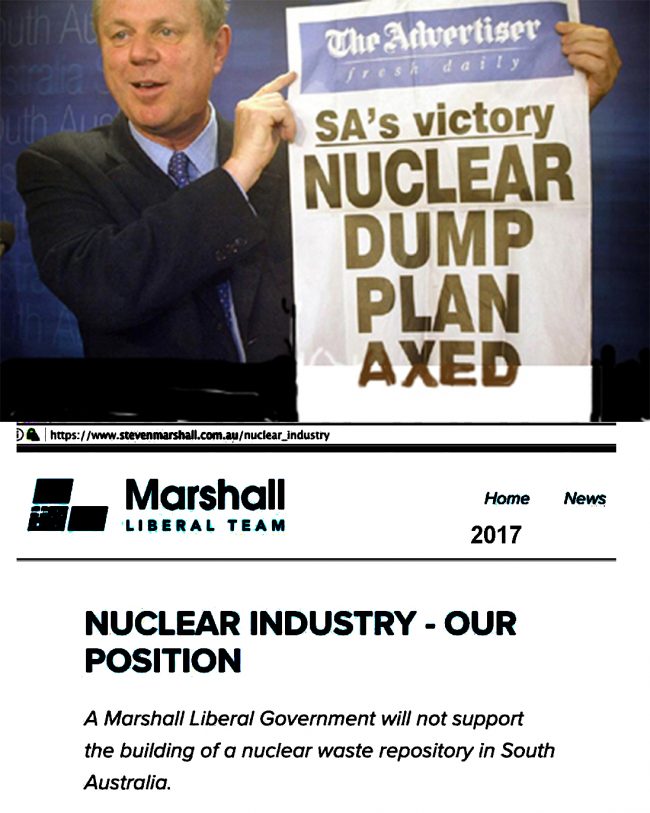
Silent Steven Marshall – cowardly silence from South Australia’s Premier on nuclear waste dump plan
|
SILENT STEVEN
Last week I posted about Minister Dan van Holst Pellekaan threatening me with legal costs in response to a Freedom of information (FOI) request for all correspondence between the Federal and SA State Government on the National Radioactive Waste Management Facility since Steven Marshall had become Premier of SA.
********
In 2016, when in opposition, Marshall stated he would not support the facility. After the SA ‘Citizens Jury’ handed down their verdict on a waste facility to Premier Weatherill, Marshall proclaimed, “Jay Weatherill’s dream of turning South Australia into a nuclear waste dump is now dead”.
********
What I got back under FOI was heavily redacted but shows Marshall, like a good lapdog to the Prime Minister, has remained silent on the issue.
********
It’s the same with keeping Submarine Full Cycle Docking work in SA, as the PM considers sending that work to WA – silence. Its the same with the Federal Government’s appointment of a irrigation supporting former NSW National to the position of Inspector-General of (Murray-Darling) Water Compliance – silence.
********
The Premier is free to determine his political position on these issues which affect South Australia’s interests. But he is obliged as Premier to share his position with South Australians and he should be prepared to defend whatever his view is. That’s what leaders do. Instead, on so many important issues, he’s just Silent Steven.
|
|
A reminder of the danger of ionising radiation, after theft of a nuclear device
|
The machine, a Troxler 3430P plus enhanced nuclear moisture density gauge, went missing from a building site at Eastwood over the weekend. Police said anyone attempting to dismantle the gauge “could expose themselves to radioactive material”. On its website, equipment company Troxler said the devices are commonly used by “contractors, engineers, and highway departments”. They are used to measure the density of substances and “for compaction control of soil aggregate, concrete and full-depth asphalt”. he instruments, which emit neutrons, can contain radioactive elements californium as well as americium, which is commonly found in smoke detectors in much smaller doses but can be more radioactive than plutonium. Police have urged anyone with information about the robbery to contact Crime Stoppers on 1800 333 000. Radiation expert Kent Gregory, from Radiation SA, said while the devices were “reasonably intrinsically safe”, they could be potentially lethal if dismantled, and were much more radioactive than household smoke detectors. “By the order of 1,000 times or even more,” Dr Gregory said.
“There have been occasions these things have ended up going through recycling facilities and turned into doorknobs and metal toilet roll holders incorporating the radioactive material.” Dr Gregory said the density gauges were commonly used by road builders to effectively x-ray the ground, and check whether “the right level of compaction has occurred, and the right level of moisture is in the ground before asphalt is applied”. “When I worked for the EPA (Environment Protection Authority) for 10 years, I think two or three got stolen in that time,” he said. “You’ve got to be very, very careful about making sure these [radiation] sources remain sealed.” |
|

Senator Rex Patrick calls on South Australian govt to come clean about nuclear waste dumping
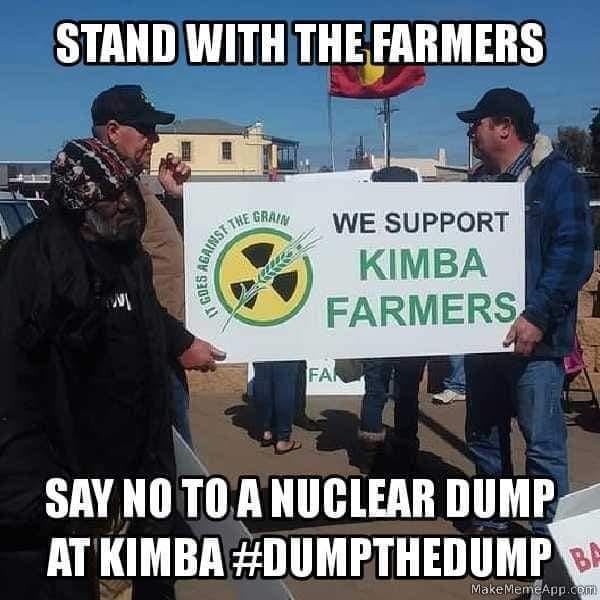 Patrick has Kimba nuclear question, https://www.whyallanewsonline.com.au/story/7058277/patrick-has-kimba-nuclear-question/?fbclid=IwAR3o2cKC_SU9yV-Q-d_xa470gmY0xG5CXkYRiA-LOJuXRDV76e8ls0v1n04, Luca Cetta, 17 Dec 20, The state government has remained silent on its stance relating to the planned Kimba nuclear waste site and South Australian Independent Senator Rex Patrick has called on the government to make known its position on the proposal.
The federal government has talked with the Kimba community about creating the site near the town with a majority of residents favouring the facility.
Senator Patrick said he had lodged a freedom-of-information (FOI) request seeking access to correspondence from the time of the last state election in 2018 to today and was “surprised” there had been only a few pieces of correspondence between Minister for Energy and Mining Dan van Holst Pellekaan and the federal government.
“I was very interested as there was a lot taking place between the federal government and the community in Kimba, and I was interested in what the state government has been doing through the process,” he said.
“The state has a role to play … and I was surprised there was only one letter to the Premier and a letter from former federal Resources Minister Matt Canavan and response. That is all we have seen. That is the only part the state government has had to play.”
While acknowledging it was a federal facility and issue, Senator Patrick said the state government should be involved by way of communication with federal leaders and community engagement.
“While I respect it is a national facility, there is no question the state government has skin in the game and I question why there is silence publicly,” he said.
“They should come out and support or oppose it so their position is known.
“They do need to be engaging the community as well to make sure all state-related issues that will flow from the facility are addressed.”
He said parts of the correspondence included redactions relating to the proposed site.
In a letter from Mr van Holst Pellekaan to Senator Patrick, which has been obtained by the Whyalla News, Mr van Holst Pellekaan said “the FOI Act provides that an agency may refuse access to a document if it is an exempt document” and that there was cause to provide “partial access” to three documents.
The letter outlines why parts should be redacted, including that a document can be exempt if “it contains information from an intergovernmental communication to the Government of South Australia”, while he also pointed to how the Act notes a document could be exempt if it “would, or could reasonably be expected to, cause damage to relations between the Commonwealth and a State”.
Senator Patrick said Mr van Holst Pellekaan made a “fundamental error” in thinking the correspondence was exempt under federal law as he was “not entitled to make that decision”.
He said he would take the matter to the South Australian Civil and Administrative Tribunal (SACAT) to “uncover what is underneath this”.
“There should be transparency about what has been communicated between the government of South Australia and the federal government,” he said.
“The Minister has made a decision. He relies on the fact he thinks it would be exempt under federal law and he is not entitled to make that decision. You can’t say ‘I think it is exempt’, you have to say ‘I think it is exempt because it would harm release in a particular way…’.”
Mr Patrick said the state FOI Act granted people and parliamentarians a positive right to documents and was only subject to restrictions consistent with the public interest and preservation of personal privacy.
He said the Act burdened the agency with establishing their case if they wanted to restrict access.
Both Commonwealth and state constitutions establish a democracy underpinned by a responsible system of government. Democracy and responsible government both require participation by people and, just because this is communication between the state and federal government, it doesn’t mean it automatically gets to be confidential. The Minister does not meet his burden by simply stating that the communications are confidential,” he said.
“This is now a fight between myself and Mr van Holst Pellekaan. This is Senator against Minister in SACAT. The Minister needs to be transparent with me, but more important with the people of SA.
“Governments work for the people, everything they do is paid for by the people. The people have a right to know what it is they are up to and how they are going about what they are up to.”
Mr van Holst Pellekaan did not respond to questions for this article.
Australia’s Industry Department is bluffing in employing staff for non existent nuclear waste project

|
Kazzi Jai, Fight to stop nuclear waste in South Australia, 19 Dec 20,
Have I missed something? Or two things actually?
Unless Minister Pitt has DECLARED the Napandee site right now as per current legislation….NOPE…or Senate passed the Amendments at last sitting ….NOPE….then is this a case of DIIS bluffing it yet again? If you ain’t got it bluff it?
And AWRA has employed ANSTO – who by the way is the MAIN CUSTOMER OF THIS DUMP – to tender for it for them! In their own words…
“ANSTO has been engaged by ARWA to provide a broad range of services to develop the NRWMF engineering design, and associated safety, security and operational framework. This tender is for the appointment of a lead engineering consultant (Consultant) to support ANSTO in progressing the project from the current concept design through to preliminary design”
BIZARRE!
Oh…and by the way Ms Chard –
THERE WAS NO BROAD COMMUNITY SUPPORT ACHIEVED!
Just because you say it and want it …. doesn’t actually make it so!
The FACTS speak for themselve
New engineering partner to assist with design on radioactive waste facility https://www.industry.gov.au/news/new-engineering-partner-to-assist-with-design-on-radioactive-waste-facility?fbclid=IwAR0RnDaKhcv6r07tmyQvhBRzRNDuyn4VfpLhf6KLyWb9bE7T8IFJ09EeCWI |
|
Minister Dan van Holst Pellekaan resorts to threas when asked to be transparent
Federal govt accepted Queensland’s “NO” to nuclear dump. Why not South Australia’s?
 Kazzi Jair No nuclear waste dump anywhere in South Australia, 19 Dec 20, https://www.facebook.com/groups/1314655315214929
Senator Rex Patrick contests Freedom of Information refusal about nuclear waste plan

Rex Patrick to ask SA Civil and Administrative Tribunal to reverse nuclear FoI refusal
An SA Senator will ask a court to decide whether his call for information on a nuclear waste facility should have been granted. Advertiser –Matt Smith, December 16, 2020 –
South Australian senator Rex Patrick will tackle State Government lawyers after a Freedom of Information request concerning a nuclear waste facility was refused.
He will fight to overturn the decision in the SA Civil and Administrative Tribunal over what he describes as “a lack of transparency”.
Senator Patrick, pictured, said his FOI request was met with a “highly unusual” reminder from the Crown Solicitor’s office that if he were to fight the decision and lose he would be liable for costs.
He had asked for correspondence between Energy and Mining Minister Dan van Holst Pellekaan and the Federal Government concerning the establishment of a National Radioactive Waste Management Facility in SA.
“FOI in SA is a farce. Late responses, cavalier exemption claims, delayed review processes and now threats if you push a request beyond the control of the very government department seeking to hide information,” he said.
A government spokesman said: “While it would not be appropriate to comment on matters currently before SACAT, it’s worth noting that the tribunal and only the tribunal makes a determination on whether costs are awarded, and can do so if satisfied that there are statutory grounds to do so.
No decision has been made in this matter and, as such, no application for costs has been, or can be, made at this time.”
It was revealed this week that reviews of FOI requests are taking more than six months to
complete. SA Senator Rex Patrick takes nuclear FOI ‘farce’ to court | The Advertiser (adelaidenow.com.au)
See Senator Rex Patrick’s Face Book page post:
https://www.facebook.com/193047494589008/posts/836162363610848/
MINISTER DAN van HOLST PELLEKAAN RESORTS TO THREATS WHEN ASKED TO BE TRANSPARENT
In response to a request for transparency, Minister Dan van Holst Pellekaan has outrageously instructed the Crown Solicitor to threaten me with costs.
Everything the SA Government does it does for public purpose and using SA taxpayer’s money. As such, South Australians are entitled to see all that the State Government does, admittedly with some exceptions.
I asked Minister van Holst Pellekaan’s office to provide me with correspondance between the State and Federal Government on the proposed National Radioactive Waste Management Facility at Kimba, using SA Freedom of information laws. At first he failed to respond to the request in the timeframe required by the law, then he made a decision that hid (presumably embarrassing) information from me.
I have asked SACAT, the State’s independent umpire, to review the Minister’s decision. Minister van Holst Pellekaan has now threatened me with “costs” if I proceed. That prompts two questions: 1) what’s he trying to hide and 2) if he’s prepared to threaten a senator seeking transparency, how would he treat a regular South Australian that reasonably requested information from him?
Ranger Danger: Rio Tinto Faces Its Nuclear Test in Kakadu Uranium
|
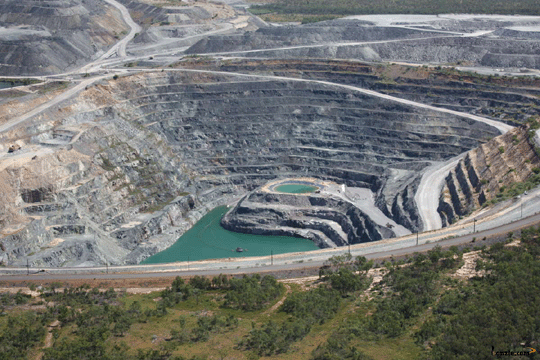
Ranger Danger: Rio Tinto Faces Its Nuclear Test in Kakadu Uranium Mine, https://sei.sydney.edu.au/opinion/ranger-danger-rio-tinto-faces-its-nuclear-test-in-kakadu-uranium-mine/ Rebecca Lawrence and Dave Sweeney report on growing concerns over the potential failures of the rehabilitation plan for the Ranger mine in Kakadu National Park. By Rebecca Lawrence, Senior Research Fellow, Sydney Environment Institute and Dave Sweeney, Australian Conservation Foundation, 16 December 2020 In the 1950’s uranium mining began in the Alligator Rivers and Kakadu regions in the Top End of the Northern Territory. Since then, the Kakadu uranium story has generated heartache and headlines but it is set to soon come to an end with the closure of the Ranger uranium mine in early January 2021. The story is now moving from one of contest over the impacts of mining to one of concern around the adequacy of rehabilitation. Australia has a notorious record when it comes to mine rehabilitation. Many mines are simply abandoned, and those that are rehabilitated often fail, which means complex and on-going monitoring and management is usually required. In many cases, mining companies and their shareholders are long-gone and it is usually Indigenous communities who are forced to live with toxic legacies and left to fight for governments to finance the clean-up with tax-payer money.
Yet, there are alarming signs we may be headed that way. Significant and crucial knowledge gaps remain around the closure and rehabilitation of the Ranger mine. Despite the looming closure date, mine operator Energy Resources Australia (ERA) is still unable to answer many key questions. For example, ERA has still not completed modelling of the pathways and volumes Another key omission in the mine closure plan is the absence of any substantive social impact research. There is no attention paid to how Aboriginal people have been impacted by uranium mining in Kakadu, or any assessment of how they may be impacted the mine closure. This omission constitutes a profound social injustice and is demonstrably inconsistent with both international best practise and contemporary community expectation. ERA is part of the global Rio Tinto group. Rio, who own 86% of ERA, has been called out for its destruction of ancient Aboriginal heritage and sites at Juukan Gorge in the Pilbara region of West Australia. As the main shareholder in ERA at Ranger, there is a real risk that Rio will also fail at Ranger if they don’t get the rehabilitation right and put in place secure financing for perpetual care and maintenance of the Ranger site post-closure. There is a requirement that the company must isolate large volumes of radioactive mining tailings for 10,000 years, but how can that be done without any funds earmarked for monitoring or post-closure management? The Commonwealth government was the key driver behind opening the Ranger Uranium mine in the early 1980s and yet as closure approaches, they are virtually absent. There is no clear regulatory process for how rehabilitation and post-closure monitoring will be financed or enforced. A successful rehabilitation is dependent upon the Commonwealth Government keeping ERA and Rio Tinto accountable and honest. Despite reassuring rhetoric no mining company will do that on their own – for too many the triple bottom line remains measured in pounds, dollars and euros. The Commonwealth Government needs to step up and ensure that the Kakadu environment and its people are protected and that a dual World heritage listed region is given the attention and focus it deserves and needs. A further key constraint on the likely success of the clean up and closure of Ranger is the unrealistic timeframe that has been mandated for rehabilitation. Ranger is the longest running uranium mine in Australia. It was imposed against the explicit opposition of the region’s Mirarr Traditional Owners and for forty years has conducted deeply contested operations in a monsoonal tropical environment. And not just any tropical environment – the mine is an industrial zone surrounded by Australia’s largest national park – Kakadu. Kakadu National Park is a dual World heritage listed area that is recognised for both its cultural and natural values and properties. The Ranger site is required to be rehabilitated to a standard where it could be incorporated into this unique environment. This is a very high bar to clear and Rio Tinto currently have a very short run-up. The rehabilitation period extends only from January 2021 to January 2026. Five years is simply not enough time to make meaningful and lasting repair to a heavily impacted landscape. As a result, the rehabilitation approach is being increasingly driven by short-cuts and bad decisions, rather than taking the time needed to get it right. The Mirarr people and an increasing number of civil society and wider stakeholders and commentators are urging both the Commonwealth and the company to extend this set period of works to better reflect the complexity of the rehabilitation challenge and to increase the likelihood of a successful result. The closure and clean up of Ranger is a critical test of the commitment, competence and credibility of Rio Tinto and the Commonwealth. Both parties have a responsibility to address decades of environmental damage and community disruption. Without more clarity, funding, time and transparency the future of Kakadu cannot be assured. And this is too high a price to pay. There are many eyes from across Australia and around the world that are focussed on the Ranger rehabilitation and near enough is not good enough. The challenge is clear and considerable – and now it needs to be met. Rebecca Lawrence and Dave Sweeney are part of an expert group who have authored the report, Closing Ranger, protecting Kakadu, released by the Sydney Environment Institute, the Australian Conservation Foundation, the Mineral Policy Institute and the Environment Centre NT. Access the report here. |
|
1 This month
17 October, Free Public Talk on Nuclear Issues in South Australia
David Noonan will speak on public interest concerns over the new Roxby Downs Indenture Act 2026 on BHP copper-uranium mining and ore processing in SA, and on how AUKUS may face SA with a High-Level nuclear waste agenda.
Dr Jim Green will discuss international developments in the field of nuclear power including ‘small modular reactors’ and Generation 4 ‘advanced’ nuclear reactor concepts.


Help Aunty Sue Protect Her Land and Sacred Sites From Destructive Rocket Testing.
.

Australians deserve the truth
about
AUKUS – https://aukuspublicinquiry.com/

PETITION – To: Prime Minister Anthony Albanese and the Australian Labor Government

of the week – Australians for War Powers Reform (AWPR)
To see nuclear-related stories in greater depth and intensity

