As Julian Assange faces extradition to USA, global press freedom is endangered
|
Assange Faces Extradition for Exposing US War Crimes, BY Marjorie Cohn, Truthout, October 11, 2020 Three weeks of testimony in Julian Assange’s extradition hearing in London underscored WikiLeaks’s extraordinary revelation of U.S. war crimes in Iraq, Afghanistan and Guantánamo Bay. But the Trump administration is seeking to extradite Assange to the United States to stand trial for charges under the Espionage Act that could cause him to spend 175 years in prison.
Assange founded WikiLeaks during the Bush administration’s “war on terror,” which was used as a pretext to start two illegal wars and carry out a widespread program of torture and abuse of prisoners at Guantánamo and the CIA black sites. On October 8, 2011, Assange told a Stop the War Coalition rally in London’s Trafalgar Square, “If wars can be started by lies, peace can be started by truth.” In 2010 and 2011, WikiLeaks published classified material that Army intelligence analyst Chelsea Manning had provided to the organization. Manning was prosecuted, convicted and sentenced to 35 years in prison for leaking the documents. As he left office, Barack Obama commuted her sentence to the seven years she had already served. That commutation provoked “tremendous anger” in the Trump administration and drew Trump’s attention to Assange, Eric Lewis testified. Lewis, chairman of the board of Reprieve U.S. and lawyer for Guantánamo and Afghan detainees, called this “a politically motivated prosecution.” The files that WikiLeaks published contained 90,000 reports about the war in Afghanistan, including the Afghan War Logs, which documented a greater number of civilian casualties by coalition forces than the U.S. military had reported. In addition, WikiLeaks published nearly 400,000 field reports about the Iraq War, more than 15,000 unreported deaths of Iraqi civilians, and the systematic murder, torture and rape by the Iraqi army and authorities that were ignored by U.S. forces. WikiLeaks also published the Guantánamo Files, 779 secret reports constituting evidence of the U.S. government’s abuse of approximately 800 men and boys, ages 14 to 89. That abuse violated the Geneva Conventions and the Convention Against Torture and Other Cruel, Inhuman or Degrading Treatment or Punishment. Perhaps the most notorious release by WikiLeaks was the 2007 “Collateral Murder” video, which depicts a U.S. Army Apache helicopter target and fire on unarmed civilians in Baghdad. At least 18 civilians were killed, including two Reuters reporters and a man who came to rescue the wounded. Two children were injured. A U.S. Army tank drove over one of the bodies, cutting it in half. The video contained evidence of three separate war crimes prohibited by the Geneva Conventions and the U.S. Army Field Manual. As they are firing on the civilians, U.S. gunmen can be heard saying, “Look at those dead bastards.” In his written testimony, investigative journalist Nicky Hager drew a parallel between the Collateral Murder video and the television image of George Floyd screaming “I can’t breathe.” Assange Cannot Be Extradited for a Political OffenseThe 2003 U.S.-U.K. Extradition Treaty forbids extradition for a political offense. Although the treaty doesn’t define “political offense,” it generally includes espionage, treason, sedition and crimes against state power. Trump is asking the U.K. to extradite Assange for exposing war crimes. This is a classic political offense. Assange is charged under the Espionage Act and espionage constitutes a political offense as well……….. Assange’s Prosecution Violates Freedom of PressWhile the Obama administration declined to file criminal charges against Assange for fear of setting a dangerous precedent, Team Trump demonstrated no such forbearance. By charging Assange under the Espionage Act, Trump is making him a poster boy for its full court press against the media, which he calls “the enemy of the people.” Assange’s prosecution would send an ominous message to all journalists: report the unvarnished truth at your peril. No media outlet or journalist has ever been prosecuted under the Espionage Act for publishing truthful information, which is protected First Amendment activity. Journalists are permitted to publish material that was illegally obtained by a third person and is a matter of public concern. The U.S. government has never prosecuted a journalist or newspaper for publishing classified information, an essential tool of journalism. Information-gathering, reporting and disclosure fit the classic definition of activity protected by the First Amendment’s guarantee of freedom of the press. There is no distinction between what WikiLeaks did and what The New York Times, Der Spiegel, Le Monde, El País and The Guardian did as well. They all published articles based on documents WikiLeaks released. This is the reason Obama administration — which prosecuted an enormous number of whistleblowers — considered, but refrained from, indicting Assange. ……… WikiLeaks Didn’t Endanger Informants and Saved LivesAlthough the U.S. government claims that Assange endangered informants named in the published documents, John Goetz, an investigative reporter who worked for Germany’s Der Spiegel, testified that Assange took pains to ensure that the names of U.S. informants in Iraq and Afghanistan were redacted to protect their identities. …….. Moreover, WikiLeaks’s revelations actually saved lives. After WikiLeaks published evidence of Iraqi torture centers the U.S. had established, the Iraqi government refused Obama’s request to extend immunity to U.S. soldiers who commit criminal and civil offenses there. As a result, Obama had to withdraw U.S. troops from Iraq. WikiLeaks also revealed evidence of wrongdoing by other countries besides the United States. The organization uncovered Russian surveillance, published exposés of Bashar al-Assad in Syria, and some say WikiLeaks’s exposure of corruption in Tunisia and torture in Egypt helped catalyze the Arab Spring………… Assange’s Prosecution Will Chill JournalismOstensibly to get around allegations that it is prosecuting Assange for conducting journalism, the Trump administration is trying to paint him as a hacker by accusing him of conspiring with Manning to break into a government computer to steal government documents, in violation of the Computer Fraud and Abuse Act. But, as Patrick Eller, a digital forensic expert, testified, the attempted cracking of the password hash was not technologically possible in 2010, when the conversation between Assange and Manning occurred. Even if it were feasible, the purpose would not have been to conceal Manning’s identity and it would not have given Manning any increased access to government databases. The prosecution of Assange would set a disturbing example for journalists and media outlets that publish information critical of the government. Team Trump singled out Assange to deter journalists from publishing material that criticizes U.S. policy. If Assange is extradited to the United States and convicted of the charges against him, it would chill journalists from reporting the facts for fear they could be indicted under the Espionage Act………. When she set the November 16 date for the defense to submit closing arguments, Judge Vanessa Baraitser asked the defense how the U.S. presidential election would affect its case and declared that her decision on extradition would come after that election, stating, “That’s one of the factors going into my decision.” Kristinn Hrafnsson, editor-in-chief of WikiLeaks, said that the judge “acknowledged what has been clear since even before the first indictment against Julian Assange was unsealed — that this is a politically motivated prosecution.” Baraitser, who has granted extradition in 96 percent of the cases that have come before her, plans to issue her ruling on January 4. If she grants extradition, there will be several levels of appeals, including to the European Court of Human Rights. The stakes could not be higher. https://truthout.org/articles/assange-faces-extradition-for-exposing-us-war-crimes/?eType=EmailBlastContent&eId=614ce999-9844-4d61-a600-169db0c99052 |
Murdoch media monopoly – an ‘arrogant cancer on our democracy’
 Australia’s high concentration of media ownership is eroding its democracy, getting in the way of critical action on issues like climate change and limiting what stories get told, media experts have warned. Australia’s high concentration of media ownership is eroding its democracy, getting in the way of critical action on issues like climate change and limiting what stories get told, media experts have warned.
The warning comes as former prime minister Kevin Rudd called for a royal commission into media concentration on Saturday, launching a petition to Parliament that amassed thousands of signatures within hours of going live. Australia’s media landscape is dominated by two players – Nine Entertainment, which owns the The Age and The Sydney Morning Herald mastheads among others, and News Corp, owned by former Australian Rupert Murdoch, which controls between 60 and 70 per cent of the metropolitan market. Mr Rudd decried the sheer concentration of the Murdoch empire, and pointed to News Corp mastheads’ support for the Liberal Party in the past 18 elections. Murdoch has become a cancer, an arrogant cancer, on our democracy,” Mr Rudd said. “I’m calling on the Parliament to establish a royal commission into the abuse of media monopoly in Australia, and particularly by the Murdoch media, to make recommendations to maximise media diversity ownership for the future lifeblood of our democratic system.” Mr Rudd has had a long-running feud with News Corp, which used its mastheads to hound him during his tenure as prime minister. A petition to Parliament is essentially a request for action, but it does not mean the sitting government has to implement its requests…….. Mr Murdoch’s influential newspapers and television stations have been widely criticised for spreading misinformation about climate change during Australia’s out-of-control bushfires. The Australian has repeatedly argued that this year’s fires are no worse than those of the past – a claim that scientists have dismissed as untrue…….. “We see story after story in the Murdoch papers saying there is no such thing as climate change, then that arsonists were responsible. “There’s never any apology or correcting the record.” News Corp has also been pursuing Victorian Premier Daniel Andrews over the issue of the state’s coronavirus lockdowns, she said. “Every story in The Australian is about ‘Dictator Dan’, it would be like the NZ publications going after ‘General Jacinda’, but there the coverage has been more considered,” Dr Price said. Her dream royal commission on media ownership would also focus on tabloid commentators and the ways in which they target and bully individuals they dislike. “I want a royal commission into the stream of columnists who should have to make amends for their fact-less columns,” Dr Price said………. Dr Muller said the Murdoch influence was not just apparent in Australia. “If you look at the two democracies in the most trouble, the UK and the US, in both the Murdoch empire is dominant and has been an active player in preferring right-wing governments,” he said. “When you have power like that which is not accountable you impair your democracy.”…….. https://thenewdaily.com.au/news/politics/2020/10/11/kevin-rudd-murdoch-royal-commission/ |
|
Queensland election – all about climate, coal, and minority parties
 ‘Queensland paradox’ pushes coal and climate to centre stage of election campaign, Guardian, Ben Smee @BenSmee, Sat 10 Oct 2020
 As Labor and the LNP try to woo regional and metro voters with at-times contradictory messages, minor parties thrive
On Sunday in Clermont – in the dusty heart of Queensland – the coal fanatic Liberal National party senator Matt Canavan and the mining magnate Clive Palmer will hold a rally, mocking the convoy of climate protesters who made a somewhat unwelcome voyage north last year.
Three days earlier, almost 1,000km away in Brisbane’s trendy western suburbs, the Greens announced state election plans to provide free school meals, funded by a $55bn increase to mining royalties.
Somewhere in between lies what the University of Queensland political scientist Glenn Kefford calls “the Queensland paradox” – the challenge for major parties to woo voters in both Toowong and Townsville with different, sometimes contradictory, messages.
“The state might appear a certain way to outsiders but it’s really interesting and diverse,” Kefford says.
As Labor and the LNP attempt to “walk both sides of the street”, divisive issues including coalmining and climate change have again been pushed to the forefront of the campaign………
Avoiding the third rail
Of course, it’s impossible to talk about Queensland, coal, climate and the election without mentioning the third rail of that debate: Adani.
On the eve of the election, Labor sought to neutralise a potential campaign problem by signing a long-delayed royalties deal for Adani’s under-construction Carmichael coalmine.
Polling released this week shows Labor extending its dominance over the LNP in greater Brisbane. The party also hopes to pick up seats on the Gold Coast and the southern Sunshine Coast.
Of most concern to Labor strategists are the party’s regional seats, including the working-class regional cities of Townsville, Mackay, Rockhampton and Gladstone, where voters swung fiercely towards the Coalition at the 2019 federal election.
The premier, Annastacia Palaszczuk, began her hi-vis “jobs, jobs and more jobs” campaign by hopping across north Queensland, pushing a pro-mining message.
Kefford said Labor appeared to be attempting to address failures from last year’s federal election campaign in north and central Queensland by running messaging tailored to suit local campaigns in regional areas……….
‘Frankenstein majority’
Queensland politics has become known for its embrace of minor parties,………
“There’s a good chance of [a hung parliament], there’s no doubt,” Kefford said. “The major parties, they have to rationalise what they’re doing and be strategic about their messaging. They can’t be everything to everyone.” https://www.theguardian.com/australia-news/2020/oct/10/queensland-paradox-pushes-coal-and-climate-to-centre-stage-of-election-campaign
Net zero emissions target for Australia could launch $63bn investment boom
|
Net zero emissions target for Australia could launch $63bn investment boom, Guardian, Lisa Cox, 12 Oct 20,
Modelling shows moving towards a net zero emissions economy would unlock financial prospects in sectors including renewables and manufacturing Australia could unlock an investment boom of $63bn over the next five years if it aligns its climate policies with a target of net zero emissions by 2050, according to new economic modelling. The analysis, by the Investor Group on Climate Change (IGCC), finds the investment opportunity created by an orderly transition to a net zero emissions economy would reach hundreds of billions of dollars by 2050 across sectors including renewable energy, manufacturing, carbon sequestration and transport. However, if the country keeps to its current targets and climate policies, investment worth $43bn would be lost over the next five years, growing to $250bn by 2050. The Investor Group on Climate Change represents investors in Australia and New Zealand who are focused on the effect of the climate crisis on the financial value of investments. Among its membership are institutional investors with funds under management worth more than $2 trillion. The organisation commissioned the consultancy Energetics to examine the domestic investment opportunities that would arise from an orderly transition to net zero emissions by 2050. The report finds a net zero scenario would unlock $63bn in investment over the next five years, including $15bn in manufacturing, $6bn in transport infrastructure such as charging stations, and $3bn in domestic green hydrogen production, as companies and governments moved towards the stronger emissions goal. ………. “What it shows is that the investment opportunities extend well beyond just the renewables industry,” said Erwin Jackson, the IGCC’s director of policy. “Renewables are the backbone of the transition but there are massive opportunities in other sectors such as manufacturing, restoring the land, and electrification of transport.” The report, which targets governments, companies, investors and financial regulators, says its estimates are conservative because they do not factor in the export potential of industries such as clean hydrogen. It argues that if governments set stable policy, and companies and investors collaborate to align their decisions with the goals of the Paris agreement, then billions of dollars over the short and long term could support the jobs and wealth of millions of Australians, particularly in regional areas. The Morrison government has refused to commit Australia to a net zero emissions target and has focused its climate policy on a new technology roadmap covering hydrogen, energy storage, “low carbon” steel and aluminium, carbon capture and storage, and soil carbon……… John Connor, the chief executive of the Carbon Market Institute, said the reality Australia faced was its economy was running “below capacity and it needs a new direction”. He said clean technologies like renewable energy and transport represented significant opportunities for Australia in a post-carbon world and the country’s vast land mass, with landscapes in need of regeneration, gave it a competitive advantage in carbon sequestration. “We can either coast off the cliff into the hothouse of economic and climate disaster, or we can turn a corner towards an orderly transition and the opportunities that are there,” Connor said. https://www.theguardian.com/australia-news/2020/oct/12/net-zero-emissions-target-for-australia-could-launch-63bn-investment-boom |
|
Australian government’s controversial Nuclear Waste Bill delayed – not yet debated in Senate
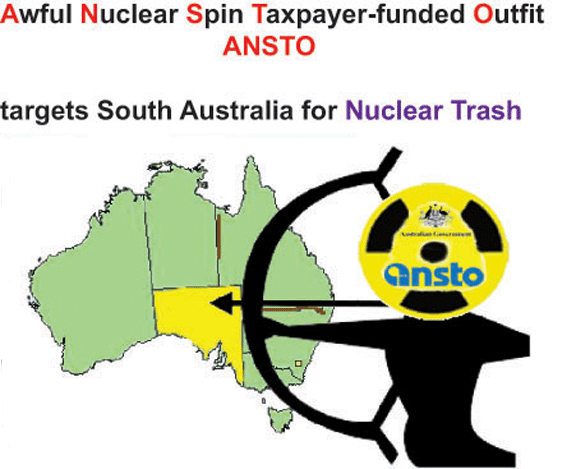 10 Oct 20, The dump legislation didn’t make it on to the Senate floor for debate and voting …
I think the government just ran out of time, they didn’t withdraw the Bill
So over the next week Non Government Organisations, and farmers and Traditional Owner s will be discussing how best to use the next month
Clean-up for Ranger uranium mine. Rum Jungle mine still a polluted mess
 It’s costing a fortune but the Ranger uranium mine is gradually being cleaned up, Canberra Times, Chris McLennan 6 Oct 20 It’s costing a fortune but the Ranger uranium mine is gradually being cleaned up, Canberra Times, Chris McLennan 6 Oct 20
Over the years many people questioned the decision to allow uranium to be mined inside one of Australia’s most famous and largest national parks – Kakadu. But in 1980 that’s exactly what happened, an open-cut mine surrounded by a park famed for its natural beauty made even more famous by the hugely popular Paul Hogan movie, Crocodile Dundee. Now the uranium is gone, dug out and sent off to nuclear power stations around the world and Australia’s longest continually operated uranium mine is almost done.
Nuclear power is making way for renewable energy. Uranium has been mined at Ranger for more than three decades, producing in excess of 130,000 tonnes of uranium oxide. The mine is being closed, Jabiru – the town built to service to the mine workers, is in the process of being handed over to Traditional Owners and the mining company is being closely watched as it delivers on its promise to clean up the site. Cleaning up uranium mines is not something the Northern Territory does well – there is still a huge environmental mess at Rum Jungle closer to Darwin.
That uranium mine is a legacy of the Cold War. Australia’s first large scale uranium mine was dug at Rum Jungle on behalf of our “Allies” in the UK and USA to fuel their nuclear weapon programs in the 1950s. Now water fills that vast open cut, a lake as locals call it, and another attempt is going to have to be made to cap the radioactive tailings left behind, the first attempt, supposed to last a century, failed after 20 years. Energy Resources Australia, a subsidiary of Rio Tinto, says it has spent more than $642 million in the past eight years on rehabilitation of the mountains of tailings complicated by a lake created from a vast flooded pit………. This story It’s costing a fortune but the NT’s uranium mine is being cleaned up, gradually first appeared on Katherine Times. https://www.canberratimes.com.au/story/6955634/its-costing-a-fortune-but-the-nts-uranium-mine-is-being-cleaned-up-gradually/?cs=14231 |
|
Adnyamathanha Traditional Lands Association gets $millions from uranium mining: need for Royal Commission into Native Title
 South Australia’s premier will be formally asked to launch a royal commission into native title, Transcontinental, Greg Mayfield, 10 Oct 20, South Australia’s premier will be formally asked to launch a royal commission into native title, Transcontinental, Greg Mayfield, 10 Oct 20,
Indigenous leaders will make a last-ditch formal attempt to persuade the South Australian government to order a royal commission into Native Title and Aboriginal corporations. Premier Steven Marshall has agreed to see the group, led by Mark Koolmatrie, in Adelaide on Friday, October 16, to hear their case as outlined by a Senior Counsel. Sources say Mr Marshall may agree to the plea, but the verdict is unknown at this stage.
The submission comes after the Canberra-based Office of the Registrar of Indigenous Corporations put two Port Augusta-based Aboriginal corporations into special administration this year. It also follows demands by an action group for access to financial records of the Adnyamathanha Traditional Lands Association, based at Port Augusta and which is one of the groups under administration.
The association receives millions of dollars in royalties from the Beverley uranium mine in the outback. Indigenous leaders say problems with Native Title corporations exist around the nation. They have called also for a federal royal commission. …… “The message is that there are concerns at the way things are happening. “There is a better way of doing business. We want to find out about what ’empowerment’ really means. “We want to see the financial records of the Adnyamathanha association.”…….. Aboriginal Reform Group of South Australia and Adnyamathanha elder Charlie Jackson, of Port Augusta, said some members were appointed as directors of corporations without knowing their rights and responsibilities. “If you don’t know your role as a board member, that is going to cause conflict for you and for the organisation,” he said. “We want the government to instigate a royal commission into Native Title and Aboriginal corporations throughout SA. “There are major problems in these organisations.” The newspaper is seeking comment from the Premier’s office. https://www.transcontinental.com.au/story/6962338/sa-premier-to-look-at-indigenous-inquiry-plea/ |
|
China’s dramatic plan for switch to renewables – a warning to Australia’s fossil-fuel economy
 China just stunned the world with its step-up on climate action – and the implications for Australia may be huge, The Conversation, October 8, 2020, Hao Tan, Associate professor, University of Newcastle, Elizabeth Thurbon, Scientia Fellow and Associate Professor in International Relations / International Political Economy, UNSW, John Mathews, Professor Emeritus, Macquarie Business School, Macquarie University, Sung-Young Kim, Senior Lecturer in International Relations, Discipline of Politics & International Relations, Macquarie School of Social Sciences, Macquarie University China just stunned the world with its step-up on climate action – and the implications for Australia may be huge, The Conversation, October 8, 2020, Hao Tan, Associate professor, University of Newcastle, Elizabeth Thurbon, Scientia Fellow and Associate Professor in International Relations / International Political Economy, UNSW, John Mathews, Professor Emeritus, Macquarie Business School, Macquarie University, Sung-Young Kim, Senior Lecturer in International Relations, Discipline of Politics & International Relations, Macquarie School of Social Sciences, Macquarie University
|
|
Australia needs a permanent war crimes investigation unit
At the conclusion of Justice Paul Brereton’s Afghanistan inquiry we know there will be more referrals to the Australian Federal Police for criminal investigation of war crimes allegations.
We know so far that Brereton’s inquiry has investigated more than 55 incidents of alleged unlawful killings and cruel treatment of Afghan civilians and captured combatants. We know that the AFP is investigating at least three incidents, and it has been put on notice to prepare for more.
Our legal centre was established to push Australia to undertake more investigations and prosecutions into international crimes and to contribute to the global effort to end the impunity enjoyed by perpetrators of these crimes. It has been saying for some time that the AFP needs specialist training, skills, and resources to undertake such investigations. Experience shows that authorities often find the challenges involved in investigating and prosecuting crimes committed extraterritorially daunting, and consequently choose not to prioritise these cases………….
Rawan Arraf is principal lawyer and director of the Australian Centre for International Justice, a legal centre that has been working with survivor and victims’ communities on criminal complaints to the Australian Federal Police. https://www.theage.com.au/politics/federal/australia-needs-a-permanent-war-crimes-investigation-unit-20201005-p562a2.html
Australia now the worst OECD country for climate change action
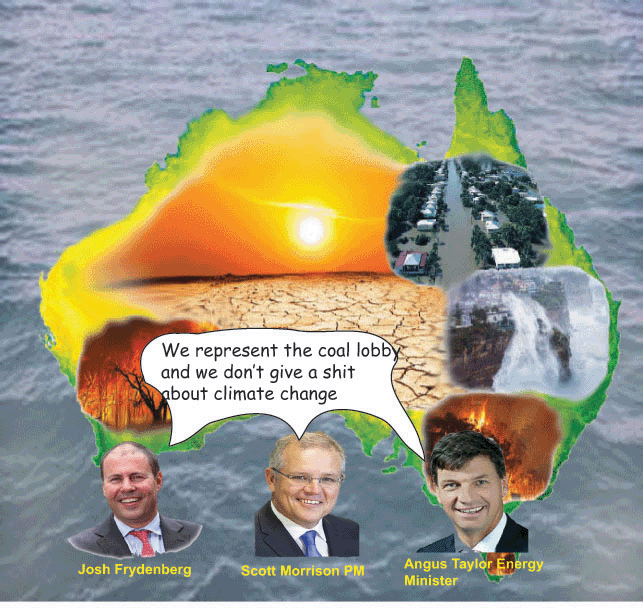 Back of the pack: Australia now the worst OECD country for climate change action, The New Daily, Cait Kelly, 7 Oct 20, Australia has become the worst-performing of all OECD countries when it comes to climate change, and will soon become a global pariah unless federal policies change fast, experts warn.It comes as UK Prime Minister Boris Johnson became the first democratic leader to outline a green-centred plan for rebuilding the country and creating jobs when the coronavirus crisis ends.
One of Australia’s leading experts in climate change, Professor Will Steffen said the UK’s announcement has left Australia in the dust.
“The UK is the first country to put forward a concrete plan but other OECD counties, particularly the Nordic ones – Denmark, Norway and Sweden – already have advanced plans,” he told The New Daily.
“We and the United States are stumbling around while most European countries are trying to get it done.”
He said depending on how the US election plays out, Australia could soon become an outlier.
We’re pretty much alone now and who knows how the US is going to go,” Professor Steffen said. If the election changes the government, you’ll see much more action on climate change. They’ve got great wind resources. They’ve got enormous tech capability. If they get the politics right, they could change fast.
We have enormous renewable sources, but we’re being held back by politics.”
The stark warning we have fallen behind the pack comes as new analysis from WWF reveals that in terms of committing to stimulus spending on renewables, Australia lags even further behind.
We are currently spending five times less than the conservative UK government and 10 times less than South Korea – a major trading partner……….
The government has focused Australia’s economic recovery from COVID-19 on fossil fuels, namely gas. ……. https://thenewdaily.com.au/news/national/2020/10/07/australia-climate-change-oecd/
Morrison government again fails on climate ation, snubs renewable energy
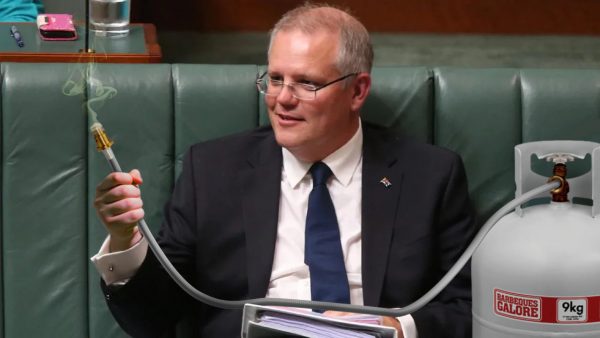
But investment in renewable energy was largely shunned. Notably, the government allocated just A$5 million for electric vehicles. It confirmed funding for the Australian Renewable Energy Agency (ARENA) for another decade, but the money is far less than what’s needed.
The COVID-19 pandemic has seen the Morrison government abandon long-held dogma on debt and deficits. However, the federal budget shows when it comes to climate and energy, the government is singing from the same old songbook.
A techno-fix
The budget doubled down on the Morrison government’s rhetoric of “technology, not taxes”, by choosing preferred technologies for investment.
This “picking winners” approach would have some chance of addressing climate change if it were based on a comprehensive analysis of the best path to zero emissions. But instead, the government has largely made offerings at the altars of technologies worshipped by the conservative side of politics.
The government will spend an as-yet undisclosed sum, possibly A$11 million, to refurbish the Vales Point coal-fired power station. The commitment to this coal infrastructure, co-owned by prominent Liberal party donor Trevor St Baker, is a disgraceful misuse of public money. It will also do little to halt the steady decline of coal-fired power generation.
As previously announced, the government will spend A$52.9 million to support the gas industry, which Frydenberg says will lower prices and support more manufacturing jobs. It includes money for gas infrastructure planning and to open up five gas basins, starting with Beetaloo Basin in the Northern Territory.
The budget confirms A$50 million for carbon capture and storage (CCS) to fund projects to cut emissions from industry. But proving the viability of large-scale CCS projects is extremely difficult, as experience in the United States and Canada has shown. In this context, allocating just A$50 million to get the technology off the ground is simply laughable.
History suggests the spending offers little return on investment. Research by the Australia Institute in 2017 revealed federal governments have spent A$1.3 billion in taxpayers’ money on CCS projects, with very little to show for it.
Renewables snubbed
Meanwhile, last night’s budget largely shunned investment in renewable energy.
The budget confirmed A$1.4 billion in ARENA funding for a further ten years, including a pretty paltry A$223.9 million over the next four years. Separately, the government will also seek to pass legislation to change ARENA’s investment mandate, enabling it to fund gas and carbon capture projects.
The government has allocated a tiny A$5 million towards electric vehicle development, including money towards a manufacturing facility in South Australia. It’s good to see electric vehicles on the government’s radar. But the commitment is dwarfed by investment overseas, including a reported US$300 billion set aside by global car makers over the next decade to bring electric vehicles to mass production.
The measly spending on clean energy technology does not make economic sense. The renewable energy sector is standing by to slash emissions and deliver lower energy prices – if only the right policy environment existed.
The budget was also an opportunity for the government to ditch its irrational opposition to carbon pricing. Recent research has comprehensively shown carbon pricing slows growth in greenhouse gas emissions.
Vehement carbon pricing critics, such as conservatives Tony Abbott, Craig Kelly and Barnaby Joyce, are now either discredited or out of parliament altogether. And scores of countries around the world have implemented some form of price on carbon.
A global outlier
Most obviously, the budget was an opportunity to commit to net-zero emissions by 2050, as many developed countries have done.
The Morrison government has already used dodgy accounting tricks to meet Australia’s Paris Agreement commitment – reducing emissions by 26% on 2005 levels. The absence of a net-zero target suggests the government intends to allow emissions to grow indefinitely after 2030.
This approach is out of step with many of Australia’s international peers. Democratic presidential candidate Joe Biden, now the clear favourite to win the US election in November, is campaigning on what has been described as “the most aggressive climate platform” ever put forward by a presidential nominee.
Labor likely to amend the Nuclear Waste Bill, removing certainty about the Napandee dump happening
 Labor’s position on nuclear waste bill means uncertainty remains over South Australian site, Guardian, Paul Karp @Paul_Karp 5 Oct 20, Labor will try to amend a government bill so that the federal resources minister has to nominate the site for a nuclear waste dump, despite concerns within the ALP caucus the change could pave the way for the decision to be challenged in court.On Monday, the Labor caucus agreed it would try to amend the bill by removing a schedule which states the dump should be located at Napandee some 20km north-west of Kimba in South Australia. The caucus resolved to oppose the bill if the change was not supported. Labor’s position on nuclear waste bill means uncertainty remains over South Australian site, Guardian, Paul Karp @Paul_Karp 5 Oct 20, Labor will try to amend a government bill so that the federal resources minister has to nominate the site for a nuclear waste dump, despite concerns within the ALP caucus the change could pave the way for the decision to be challenged in court.On Monday, the Labor caucus agreed it would try to amend the bill by removing a schedule which states the dump should be located at Napandee some 20km north-west of Kimba in South Australia. The caucus resolved to oppose the bill if the change was not supported.
The caucus resolution follows a recommendation by the shadow science minister, Brendan O’Connor, and despite vigorous opposition from senators Alex Gallacher and Kim Carr. They argued that making the minister select the site could leave the decision vulnerable to challenge. The government’s bill, as it stands, nominates Napandee as the location for the dump and provides a compensation package – a formulation that prevents judicial review of the site selection…… https://www.theguardian.com/environment/2020/oct/05/labors-position-on-nuclear-waste-bill-means-uncertainty-remains-over-south-australian-site |
|
Nuclear waste dump – a Federal abuse of a small rural town
 Regina McKenzie Fight To Stop a Nuclear Waste Dump in South Australia, 6 Oct 20
Federal government hiding its toxic nuclear waste Act under the cover of budget fuss
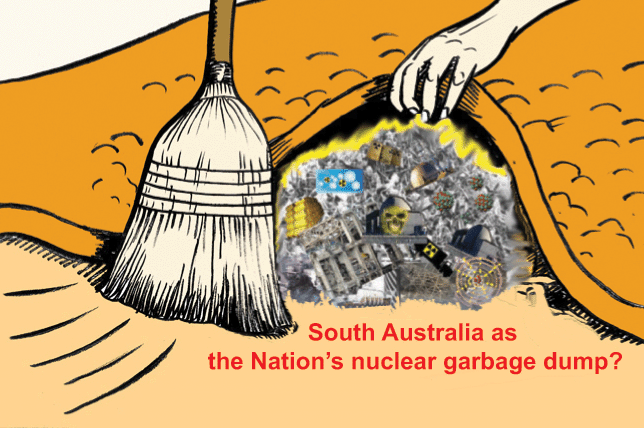 From A letter from Dr Margaret Beavis,
Divisions in Labor, over nuclear waste dump plan
Federal Labor divided over plans to block SA’s nuclear waste dump facility, The Age, By Rob Harris, October 5, 2020 — A 40-year effort to establish a nuclear waste dump in remote South Australia faces a rocky passage through Federal Parliament after Labor signalled it is prepared to block the Morrison government’s attempts to resolve the long-running debate.
The decision, rubber-stamped by the federal caucus in lengthy debate on Monday, has sparked further divisions within the opposition, with veteran senators Alex Gallacher and Kim Carr expressing fierce criticism of their party’s position.
There are also concerns within federal Labor that its stance could unwittingly hand Prime Minister Scott Morrison a double-dissolution trigger should the crossbench sink the laws.
The government intends to introduce legislation to finally establish a low- and medium-level nuclear waste facility at Napandee, a farm on South Australia’s Eyre Peninsula, having spent seven years and more than $60 million finding a suitable home……..
Labor will seek to amend the laws so that the minister responsible, Resources Minister Keith Pitt, can use existing powers to nominate any site under the current legislation. Labor says the changes would still give the local community access to a significant community fund on offer and would ensure the decision be subject to a judicial review.
Seven Labor MPs spoke up in the debate over the legislation, which lasted for more than an hour………
Opposition science spokesman Brendan O’Connor said federal Labor supported the need for a national facility to store radioactive waste.
This government has had existing powers under the current legislation for the past seven years to determine a site, but under the guise of compensation has sought to remove proper scrutiny, through this proposed legislation,” he said.
“This is a contentious issue and should be subject to the highest levels of scrutiny to ensure that the principles of procedural fairness and natural justice have been applied given the national significance of this matter.”……..
A Senate committee last month recommended the legislation be supported but three members – the Greens’ Sarah Hanson-Young, Independent senator Rex Patrick and Labor senator Jenny McAllister – issued dissenting reports.
Senator McAllister said the proposed facility had not received the support of the relevant traditional owners in South Australia. https://www.theage.com.au/politics/federal/federal-labor-divided-over-plans-to-block-sa-s-nuclear-waste-dump-facility-20201005-p5628p.html
1 This month
17 October, Free Public Talk on Nuclear Issues in South Australia
David Noonan will speak on public interest concerns over the new Roxby Downs Indenture Act 2026 on BHP copper-uranium mining and ore processing in SA, and on how AUKUS may face SA with a High-Level nuclear waste agenda.
Dr Jim Green will discuss international developments in the field of nuclear power including ‘small modular reactors’ and Generation 4 ‘advanced’ nuclear reactor concepts.


Help Aunty Sue Protect Her Land and Sacred Sites From Destructive Rocket Testing.
.

Australians deserve the truth
about
AUKUS – https://aukuspublicinquiry.com/

PETITION – To: Prime Minister Anthony Albanese and the Australian Labor Government

of the week – Australians for War Powers Reform (AWPR)
To see nuclear-related stories in greater depth and intensity

