Pretty despicable -tax breaks for company exporting weapons to Saudi Arabia, UAE.
Tax break for weapons exports to Mid-East countries accused of war crimes, Michael West Media, by Michelle Fahy | Oct 6, 2020 Australian weapons manufacturer Electro Optic Systems, with financial support from the federal and ACT governments, is capitalising on the ‘growth market’ of the Middle East, one of the world’s most volatile regions. Michelle Fahy reports.
As has been reported repeatedly, remote weapons systems manufactured by EOS are being exported to the United Arab Emirates and Saudi Arabia despite both countries being accused of war crimes. Numerous UN reports have detailed shocking human rights violations over the six years of the Yemen war.
After a shutdown due to Covid-19, EOS announced last month that it is exporting again.
EOS and the federal government have been asked repeatedly for proof that its weapons are not being used in Yemen. “Trust us,” is the standard response.
Assurances from a company chasing millions in profit and a government intent on catapulting Australia into the global top 10 of weapons exporters seem to be the best the public can expect in terms of accountability.
There is zero transparency when it comes to Australian weapons exports………..
Government support for EOS
EOS has received extensive government support, including an exemption from paying state payroll tax. Under questioning last November by the ACT Greens, Chief Minister Andrew Barr said the ACT Government provided support to EOS (PDF p44), “principally for its space industry related activity”. While EOS separates its space industry work from its weapons side, both companies operate in the same group under the same board……..
EOS has so far supplied the UAE and Saudi with its remote weapons systems. The systems are mounted on armoured vehicles and can incorporate a light cannon, machine gun, grenade launcher or anti-tank missile, which EOS does not manufacture. The system enables the weapon to be operated from inside the vehicle, which makes the soldier safer. It can identify targets and automatically aim the weapon, making the firing of the weapon faster and more accurate. In military parlance, the system enhances lethality. See it in action here.
The claim that it was not a weapons manufacturer may have been technically correct when asserted by EOS and Barr, but that is no longer the case.
Last month EOS announced it had moved into production with a new range of directed energy (laser) weapons. The weapons are being marketed by EOS as ‘drone kill’ technology (counter unmanned aircraft system or CUAS). EOS says “CUAS are entirely defensive systems”. The potential market is large. EOS has named its new range of weapons Mopoke, after the small native Australian owl.
EOS has not disclosed its list of interested customers for Mopoke, but industry insiders – such as AuManufacturing – have noted that its first customers are likely to come from the Middle East, given drone attacks on infrastructure there……….
EOS is now unequivocally a weapons manufacturer, and likely to soon start exporting its weapons to the Middle East.
Supplying weapons to war crimes accused
Melissa Parke, a lawyer, former federal Labor MP, and human rights expert, is one of three UN-appointed Eminent Experts on Yemen. Parke told SBS Dateline last year:
“No country can claim not to be aware of the violations being perpetrated in Yemen. To continue to provide weapons in the knowledge of such violations is both morally and legally hazardous.”
A former secretary of the Defence Department, Paul Barratt, has also stated his position on these weapon sales:
“Regardless of whether Australian-made weapons [are] crossing the border into Yemen, Australia now has a national policy which seeks and facilitates weapons sales with countries that stand accused of gross violations of human rights and likely war crimes. When did this particular trade in arms become official Australian policy? As a country that routinely asks other countries to abide by the rules-based international order, it would seem hypocritical, at best, that Australia is now willing to … make a profit from weapons sales to nations that are openly flouting this international order.”……….
In addition to ministerial lobbying, EOS Defence Systems has received federal financial support, including:
- $3.7 million from Defence between 2013 and 2016
- $41.5 million performance bond from Export Finance Australia (EFIC) (PDF p66)
The company has also gained from influential appointments to its board. Former Chief of Army, Peter Leahy, joined the EOS board in May 2009, just 10 months after retiring as army chief. In April 2016 Leahy was joined by former Chief of Air Force, Geoff Brown, less than 10 months after he had retired from the air force…… https://www.michaelwest.com.au/eos-weapons-export-transparen
Australian State laws have weak environmental standards
 Major gaps’: no state meets national environment standards, The Age, Mike Foley, October 4, 2020 — State and territory governments should make major reforms to their environmental laws and increase compliance regimes to meet the national standards, new research has found.
The findings are revealed in a report from the “Places You Love” alliance of conservation groups, released on Monday, which found “not only does no state or territory law meet national standards, but in some jurisdictions, the environmental protections in state and territory laws have actually been weakened”.
This week the Senate is set to debate the federal government’s bill to hand approval powers for major projects to state governments, in a bid to remove bureaucratic duplication and speed-up project development to boost the economy.
Environment Minister Sussan Ley has pledged that any changes to The Environment Protection and Biodiversity Conservation Act will not reduce current level of environmental regulation…….
Ms Ley has been criticised by environment groups for rushing her bill through Parliament. It passed the lower house in August and could be enacted as soon as next week – ahead of a major review of the laws by former competition watchdog boss Professor Graeme Samuel, which is due by the end of October.
Professor Samuel said Australia’s “current environmental trajectory is unsustainable”. National laws were “not fit to address current or future environmental challenges”, he said, while for industry they are “ineffective and inefficient”…….
The EPBC Act was enacted in 1999 and created a list of “matters of national environmental significance”, including World Heritage areas, internationally listed wetlands and threatened species. While state laws do include some protections for these matters, federal government has wielded the most powerful protections for the past two decades.
The report found no state or territory legislation met the necessary suite of “national environmental standards required to protect matters of national environmental significance”.
Grossly inadequate Senate report on National Radioactive Waste Management Amendment Bill

The report released on 14 September 2020 by the majority of the Senate committee inquiring into the National Radioactive Waste Management Amendment Site Specification,Community Fund and Other Measures) Bill is both grossly deficient and biased and does no credit to the members of the committee.
While I do not intend to comment on all of the report in detail I will refer to some aspects of the introduction being chapter 1 including the conduct of the inquiry but more extensively to the second part of the report dealing with support for the legislative changes and the evidence of the witnesses who appeared before the committee.
**************************************
Pine Gap could play role in accidental US-China nuclear fight
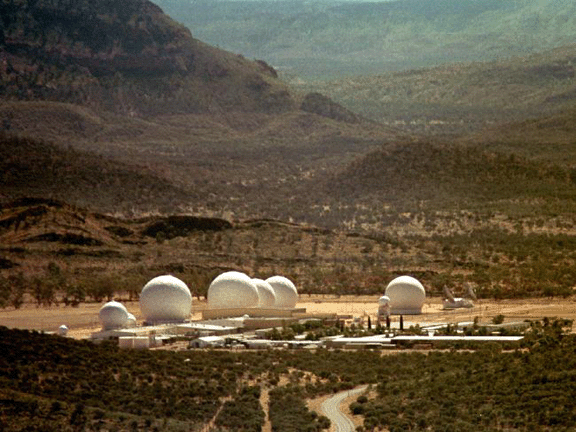
Pine Gap could play role in accidental US-China nuclear fight NT News, 30 Sept 20
Heightened US-China tensions have increased the risk of an accidental nuclear exchange between the two superpowers — and whether or not the Northern Territory’s Pine Gap surveillance base is playing a role in hyping this up needs to be looked at ……. (subscribers only)
Julian Assange could face life in America’s most dreaded ‘Supermax’ prison
  Julian Assange ‘faces fate worse than death’ in US: WikiLeaks founder could serve life in isolation at dreaded ‘Supermax’ prison that’s home to America’s most violent terrorists and drug lords if extradited, court hears Daily Mail, 30 Sept 20, Julian Assange ‘faces fate worse than death’ in US: WikiLeaks founder could serve life in isolation at dreaded ‘Supermax’ prison that’s home to America’s most violent terrorists and drug lords if extradited, court hears Daily Mail, 30 Sept 20,
Julian Assange ‘faces a fate worse than death’ in a lifetime of isolation at the ‘Supermax’ prison currently home to America’s most violent terrorists and drug lords if he is extradited, a court has heard. The Wikileaks founder, 49, could live out his years alone at maximum security ADX Colorado jail where he would spend 23 hours in a cell if he is convicted of espionage offences in the US. Assange is wanted in the US for allegedly conspiring with army intelligence analyst Chelsea Manning to expose military secrets between January and May 2010 Prison expert Joel Sickler said the US government had ‘raised the possibility of sending Mr Assange to ADX’. ……… I believe, based on my understanding of the case, that this is a not unlikely proposition.’ He said Supermax was the only prison criticised as inhumane by its own staff, adding: ‘Robert Hood, the Warden says, “this is not built for humanity. I think that being there day by day, it’s worse than death”.’…….. The WikiLeaks founder could be placed on a prison regime called Special Administrative Measures (SAMS). This means he could be deprived of meals, phone calls, visits or interaction with other inmates. Mr Sickler, who advises federal prison defence attorneys, said: ‘Based on decades of experience, over a dozen of my clients committed suicide, it can be done. ‘I think he is only going to go there if he is a SAMS inmate. There is an outside chance he will go there on other grounds. ‘SAMS will seal his fate. If he is given a life sentence he must start at a United State Penitentiary. ‘He is someone our government alleges has knowledge of certain highly qualified information.’……… ‘Officially known as Administrative Maximum-Security United States Penitentiary (“ADX”); it is most known by its shorthand name, “Supermax”,’ Mr Sickler added. ‘This is a facility is the most feared by inmates and is where the most violent offenders in the nation are sent. ‘And this is where the Government, according to its own affidavit, sees as a potential prison placement for Mr Assange. He said it was the solitary nature of the ADX that made it so difficult for its inmates to bear. ‘Should Mr Assange be sent to ADX he will almost certainly spend all his time in ADX in solitary,’ he added……….. https://www.dailymail.co.uk/news/article-8781275/Julian-Assange-faces-fate-worse-death-WikiLeaks-founder-serve-life-isolation.html?fbclid=IwAR21x4PeHIIn2pjMDgqjBSqfqA2pK5YPTZ9Q4q4SOG066tGN_aKkZj91ROE |
|
Legacy of Maralinga bomb tests -a reminder of need for safety in matters nuclear
 Sixty years on, the Maralinga bomb tests remind us not to put security over safety, The Conversation Liz Tynan, Senior Lecturer and Co-ordinator Research Student Academic Support, James Cook University September 26, 2016 It is September 27, 1956. At a dusty site called One Tree, in the northern reaches of the 3,200-square-kilometre Maralinga atomic weapons test range in outback South Australia, the winds have finally died down and the countdown begins……….
The count reaches its finale – three… two… one… FLASH! – and all present turn their backs. When given the order to turn back again, they see an awesome, rising fireball. Then Maralinga’s first mushroom cloud begins to bloom over the plain – by October the following year, there will have been six more.
RAF and RAAF aircraft prepare to fly through the billowing cloud to gather samples. The cloud rises much higher than predicted and, despite the delay, the winds are still unsuitable for atmospheric nuclear testing. The radioactive cloud heads due east, towards populated areas on Australia’s east coast.
Power struggle
While Australia was preparing to sign the Maralinga agreement, the supply minister, Howard Beale, wrote in a top-secret 1954 cabinet document:
The British carried out two clean-up operations – Operation Hercules in 1964 and Operation Brumby in 1967 – both of which made the contamination problems worse.
Legacy of damage
The damage done to Indigenous people in the vicinity of all three test sites is immeasurable and included displacement, injury and death. Service personnel from several countries, but particularly Britain and Australia, also suffered – not least because of their continuing fight for the slightest recognition of the dangers they faced. Many of the injuries and deaths allegedly caused by the British tests have not been formally linked to the operation, a source of ongoing distress for those involved.
Decades later, we still don’t know the full extent of the effects suffered by service personnel and local communities. Despite years of legal wrangling, those communities’ suffering has never been properly recognised or compensated.
Why did Australia allow it to happen? The answer is that Britain asserted its nuclear colonialism just as an anglophile prime minister took power in Australia, and after the United States made nuclear weapons research collaboration with other nations illegal, barring further joint weapons development with the UK. …..Six decades later, those atomic weapons tests still cast their shadow across Australia’s landscape. They stand as testament to the dangers of government decisions made without close scrutiny, and as a reminder – at a time when leaders are once again preoccupied with international security – not to let it happen again. https://theconversation.com/sixty-years-on-the-maralinga-bomb-tests-remind-us-not-to-put-security-over-safety-62441?fbclid=IwAR3-AXJA_-RZTlr1AW6qxgcFRPuOX5IIi163L75vLWXFyIOcZGKxbet5DDE
China’s zero emissions target is contrasted with Australia’s inaction on global heating
China’s escalation is also set to have implications for Australia’s diplomatic position in the Pacific, where it has been attempting to manage China’s rising influence among some of its closest neighbours.
“From both sides of Parliament Australian politicians aren’t understanding it, they approach climate change like it’s just another issue for our Pacific counterparts. What Australian politicians 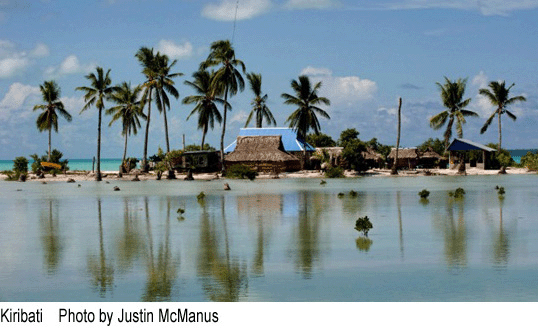 do often miss is this issue is personal,” said Professor Bamsey.
“It concerns Pacific politicians when they get out of bed, they can see the changes to the future of their country when they look out the window.”
China’s zero emissions target puts Australia on notice, The Age, By Eryk Bagshaw and Mike Foley, September 30, 2020 — Australia’s former top climate diplomat has warned China’s net-zero emissions target will leave Australia behind, threatening future trade deals and its influence in the Pacific as the Morrison government becomes wedged between the US and China on climate action.
Howard Bamsey, who was Australia’s special envoy on climate change during the Rudd government, said the announcement from President Xi Jinping last week had turned the politics of emissions reduction into a sharp economic and diplomatic issue.
Professor Bamsey, who was also Australia’s ambassador for the environment under the Howard government, said the new policy “pulls the rug out from under the argument” that Australia’s domestic climate goals do not need to accelerate because China was yet to increase its ambitions.
“It’s clear now China is accepting a leadership role,” he said. “Xi made the announcement. That carries all the weight of the state and party.”
The coronavirus has forced this year’s United Nations Glasgow Climate Change Conference to be rescheduled to November 2021, turning Australia’s international emissions obligations into a major election flashpoint. The earliest month a federal election can be held is August 2021 and voters are expected to go to the polls by the end of next year.
China, which is simultaneously the world’s largest polluter and biggest producer of renewable energy, pledged to go carbon neutral by 2060 at the UN General Assembly last week………… Continue reading
Morrison government refuses to sign leaders’ pledge on biodiversity
|
Scott Morrison declined as 10-point plan calls for commitments considered inconsistent with government policy, Guardian Lisa Cox 28 Sept 20, The Morrison government has said it refused to sign a global pledge endorsed by 64 countries committing them to reverse biodiversity loss because it was inconsistent with Australia’s policies. Emmanuel Macron, Angela Merkel, Justin Trudeau, Jacinda Ardern and Boris Johnson are among world leaders who signed the Leaders’ pledge for nature which was launched on Monday ahead of a major UN summit on biodiversity being hosted virtually from New York. The summit is working towards a Paris-style global agreement on nature. The federal government was invited to sign but refused because the 10-point plan calls for commitments that are inconsistent with Australian policy – including a greater ambition to reduce greenhouse gas pollution and reach net zero emissions by 2050…….. Apart from Australia, other countries that didn’t sign the pledge include the United States, Brazil, China, Russia and India. The pledge warns humanity is in a state of “planetary emergency” due to the intertwined crises of biodiversity loss, ecosystem degradation and climate change. It states that the decline of the natural world is accelerating at an unprecedented rate. “Nature fundamentally underpins human health, wellbeing and prosperity,” the pledge states. “We need to appropriately value nature and the services it provides as we make decisions and recognise that the business case for biodiversity is compelling.” Australia was recently singled out for mammal extinction in a UN report that found the world had failed to meet a single target to slow the loss of the natural world and preserve land and marine ecosystems. The pledge promises a stronger global effort to reduce deforestation, halt unsustainable fishing practices, eliminate environmentally harmful subsidies and begin the transition to sustainable food production systems and a circular economy during the next decade. Leaders promised to ensure “biodiversity, climate and the environment as a whole” were at the heart of responses to the economic crisis brought on by the Covid-19 pandemic. “Against the backdrop of Covid-19, which has crippled the world’s economies and pressured governments everywhere to begin the process of rebuilding and renewing, decisions made now will have ramifications for all of us and for generations to come,” the pledge states. Labor’s environment spokeswoman, Terri Butler, said the prime minister, Scott Morrison, should explain why Australia would not commit to a stronger effort to protect wildlife. “Australia is in the midst of an extinction crisis, 3 billion animals have died or were displaced by last summer’s bushfires and 12m hectares of land burnt . But the Morrison government doesn’t think we have a problem,” Butler said. The Greens environment spokeswoman, senator Sarah Hanson-Young, said a global target on extinction, similar to the Paris target, was necessary to stem the rapid loss of biodiversity. She said Australia was “squandering an opportunity” to take a leading role after the bushfire crisis, which accelerated the loss of habitat and wildlife and has forced the government to consider new threatened listings for iconic species, including the koala. “Our biodiversity is under significant threat and with it our tourism industry and local economy,” Hanson-Young said. “Australia’s lack of commitment at this summit is shameful and ultimately will be bad for our economy, as well as our environment.”…….. https://www.theguardian.com/environment/2020/sep/29/australia-joins-us-china-and-russia-in-refusing-to-sign-leaders-pledge-on-biodiversity |
|

Dr Helen Caldicott and Independent Australia bust the media spin on ‘small nuclear reactors’
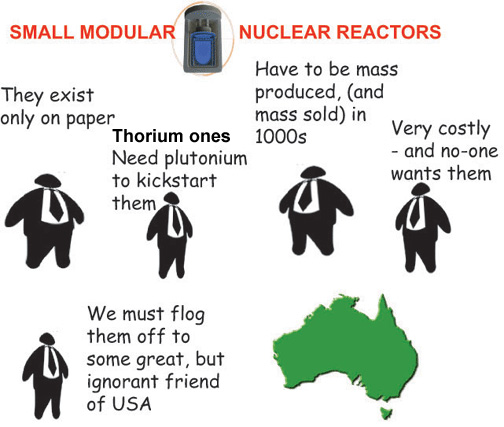
The so-called “nuclear renaissance” died following the Fukushima catastrophe when one-sixth of the world’s nuclear reactors closed. However, global nuclear corporations – Toshiba, NuScale, Babcock & Wilcox, GE Hitachi, General Atomics and the Tennessee Valley Authority – did not accept defeat.
Their new strategy has been to develop small modular nuclear reactors without the dangers inherent in large reactors — safety, cost, proliferation risks and radioactive waste. But these claims are fallacious for the reasons outlined below.
Basically, there are three types of SMRs which generate less than 300 megawatts of electricity compared with current day 1000 megawatt reactors.
Light water reactors designs
These will be smaller versions of present-day pressurized water reactors using water as the moderator and coolant, but with the same attendant problems as Fukushima and Three Mile Island. Built underground, they will be difficult to access in the event of an accident or malfunction.
Mass-produced (turnkey production) large numbers must be sold yearly to make a profit. This is an unlikely prospect because major markets – China and India – will not buy U.S. reactors when they can make their own.
If safety problems arise – as in General Motors cars – they all must be shut down which will interfere substantially with electricity supply.
SMRs will be expensive because the cost per unit capacity increases with a decrease in reactor size. Billions of dollars of government subsidies will be required because Wall Street is allergic to nuclear power. To alleviate costs, it is suggested that safety rules be relaxed, including reducing security requirements and a reduction in the 10-mile emergency planning zone to 1,000 feet.
Non-light water designs
These are high-temperature gas-cooled reactors (HTGR) or pebble bed reactors. Five billion tiny fuel kernels consisting of high-enriched uranium or plutonium will be encased in tennis-ball-sized graphite spheres which must be made without cracks or imperfections — or they could lead to an accident. A total of 450,000 such spheres will slowly and continuously be released from a fuel silo – passing through the reactor core – and then be re-circulated ten times. These reactors will be cooled by helium gas operating at very high temperatures (900 degrees Celsius).
A reactor complex consisting of four HTGR modules will be located underground, to be run by just two operators in a central control room. Claims are that HTGRs will be so safe that a containment building will be unnecessary and operators can even leave the site – “walk away safe” reactors.
However, should temperatures unexpectedly exceed 1,600 degrees Celsius, the carbon coating will release dangerous radioactive isotopes into the helium gas and at 2,000 degrees Celsius the carbon would ignite creating a fierce graphite Chernobyl-type fire.
If a crack develops in the piping or building, radioactive helium would escape and air would rush in, also igniting the graphite.
Although HTGRs produce small amounts of low-level waste they create larger volumes of high-level waste than conventional reactors.
Despite these obvious safety problems and despite the fact that South Africa has abandoned plans for HTGRs, the U.S. Department of Energy has unwisely chosen the HTGR as the “Next Generation Nuclear Plant”.
Liquid metal fast reactors (PRISM)
It is claimed by proponents that fast reactors will be safe, economically competitive, proliferation-resistant and sustainable.
They will be fueled by plutonium or highly enriched uranium and cooled by either liquid sodium or a lead-bismuth molten coolant. Liquid sodium burns or explodes when exposed to air or water and lead-bismuth is extremely corrosive producing very volatile radioactive elements when irradiated.
Should a crack occur in the reactor complex, liquid sodium would escape, burning or exploding. Without coolant, the plutonium fuel could reach critical mass, triggering a massive nuclear explosion scattering plutonium to the four winds. One-millionth of a gram of plutonium induces cancer and it lasts for 500,000 years. Extraordinarily, claims are made that fast reactors will be so safe they will require no emergency sirens and emergency planning zones can be decreased from ten miles to 1,300 feet.
There are two types of fast reactors: a simple plutonium fueled reactor and a “breeder” in which the plutonium reactor core is surrounded by a blanket of uranium 238 which captures neutrons and converts to plutonium.
The plutonium fuel, obtained from spent reactor fuel will be fissioned and converted to shorter-lived isotopes — caesium and strontium which last 600 years instead of 500,000. Called “transmutation”, the industry claims that this is an excellent way to get rid of plutonium waste. But this is fallacious because only ten per cent fissions, leaving 90 per cent of the plutonium for bomb-making etc.
Three small plutonium fast reactors will be grouped together to form a module and three of these modules will be buried underground. All nine reactors will then be connected to a fully automated central control room operated by only three operators. Potentially then, one operator could simultaneously face a catastrophic situation triggered by the loss of off-site power to one unit at full power, in another shut down for refuelling and in one in start-up mode. There are to be no emergency core cooling systems.
Fast reactors require a massive infrastructure including a reprocessing plant to dissolve radioactive waste fuel rods in nitric acid, chemically removing the plutonium and a fuel fabrication facility to create new fuel rods. A total of 10,160 kilos of plutonium is required to operate a fuel cycle at a fast reactor and just 2.5 kilos is fuel for a nuclear weapon.
Thus fast reactors and breeders will provide extraordinary long-term medical dangers and the perfect situation for nuclear weapons proliferation. Despite this, the industry is clearly trying to market them to many countries including, it seems, Australia.
You can follow Dr Caldicott on Twitter @DrHCaldicott. Click here for Dr Caldicott’s complete curriculum vitae.
Kimba mayor Dean Johnson shows his ignorance on nuclear wastes
 Kazzi Jai Fight to Stop ma Nuclear Waste Dump in South Australia
The Federal Government had NOTHING to do with either of them!
And….BOTH produce waste ON SITE – which is NOT SENT SUBSEQUENTLY INTERSTATE!
We take care of our own waste produced in our own state – not try and SHAFT it onto another state so that it becomes THAT RECEIVING state’s problem and responsibility AS THE CURRENT PROPOSAL FOR KIMBA STANDS!
Kapeesh!
Australians recorded frog calls on their smartphones after the bushfires – and the results are remarkable
Jodi Rowley, Australian Museum and Will Cornwell,
Frogs are one of the most threatened groups of animals on Earth. At least four of Australia’s 240 known frog species are extinct and 36 are nationally threatened. After last summer’s bushfires, we needed rapid information to determine which frogs required our help.
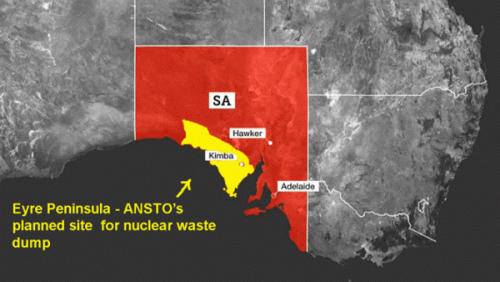
Kimba nuclear waste dump: The government failed to show overwhelming support and the proposal to site the facility in Kimba can’t proceed.

22 November 2019
Mr Dean Johnson
Mayor
District Council of Kimba
Dear Mayor Johnson
I refer to the recent ballot at Kimba to determine the level of support
for the siting of the radioactive waste facility.
The results of the Kimba ballot were:
Voting papers issued 824
Formal votes accepted 735
Yes vote 452
Did not vote ~ 283
The government are saying that the result is the percentage of yes votes of the formal votes accepted and they say this is 61.50/0.
This not a vote between two political opponents who are both free to campaign and present alternatives political views for consideration.
This is a simple yes / no vote on a proposal to establish a radioactive waste facility in a wheat field.
It is the government who are the proponent. It is they who have to get people to vote yes. They have to get 413 vote to get a simple majority.
For an overwhelming show of support they need at least a 2/3 yes vote.
You have to remember that this poll was not a genuine contest of ideas. There was only one view put and paid for by the government. There was not a no vote argument presented to voters. This places an unfair bias in any result obtained.
As if this were not bad enough the government offered a $31 million cash handout to the voters and 45 permanent jobs, manned a permanent office in the town of Kimba advocating a yes vote.
The way in which this ballot has to be interpreted is this: How many people voted yes as against how many people did not vote yes.
As a famous South Australian Mick Young the former Special Minister of State in the Hawke Government correctly put it if they don’t say yes they mean no.”
The government has been dishonest in that their figure of 61.49% as it neglects the people who didn’t vote.
The correct methodology is the ratio of people who wanted the facility (voted yes) as against those who didn’t vote yes. This is the ratio of yes votes to the people who didn’t vote yes.
The actual number supporting the facility is then 54.850/0. To achieve an overwhelming result the Yes vote would have to be 536 votes.
The government failed to show overwhelming support and the proposal to site the facility in Kimba can’t proceed.
This view is based on my experience as a federal government minister and also in local government where I am currently the Mayor of the City of Melville in Western Australia.
Yours sincerely
George Gear
Kimba nuclear waste dump – not just a local issue, but only locals were consulted
 This article includes an opinion poll at the end –
Last week, a Senate Inquiry report was released advising federal parliament to pass legislation on the establishment of the site, including the location at Napandee, 30 kilometres from Kimba.
There were three dissenters from the Senate Economics Committee – The Greens’ Sarah Hanson-Young, independent SA senator Rex Patrick and NSW Labor’s Jenny McAllister.
In the same week, SA Labor MPs Eddie Hughes – in whose Giles electorate the site sits – and Opposition spokesperson for the environment Susan Close issued a joint call for the federal government to halt the process, saying not enough was done to include the views of the Barngarla people.
Late last year, the results of a ballot of Kimba District Council was released, showing 61.58 per cent of residents were in support of the site.
There were three dissenters from the Senate Economics Committee – The Greens’ Sarah Hanson-Young, independent SA senator Rex Patrick and NSW Labor’s Jenny McAllister.
In the same week, SA Labor MPs Eddie Hughes – in whose Giles electorate the site sits – and Opposition spokesperson for the environment Susan Close issued a joint call for the federal government to halt the process, saying not enough was done to include the views of the Barngarla people.
Late last year, the results of a ballot of Kimba District Council was released, showing 61.58 per cent of residents were in support of the site.
“Instead of rushing this quick fix by dumping in SA, the federal government should do the work on a long-term plan for the management of nuclear waste in Australia,” Mr Hughes said.
“We clearly have an obligation to manage our domestic nuclear waste in a responsible way for the long-term. This proposal falls far short of meeting that obligation.”
The same week, a survey from the Australia Institute showed 60pc of its respondents believed consultation should include all of SA and not just Kimba residents, while 50pc opposed the transport of nuclear waste on SA roads and ports.
Australia Institute SA director Noah Schultz-Byard said the survey was initiated to gauge the public’s feelings about a site in SA. He said the 510 respondents were made up of a proportional representation of urban and regional residents.
Kimba District Council mayor Dean Johnson says consultation on the proposal had been ongoing for the past five years.
“It’s been completely open and well-publicised and anyone in SA could have come along,” he said………
He said the notion of statewide consultation proposed by some was not a solution.
“Kimba residents are really well-informed on this topic,” he said. “The idea that everyone is the state should get a vote is ridiculous. Does Kimba get a vote on the smelter at Port Pirie or a mine at Leigh Creek?
“This is locals making a decision on the town and the community’s future.”
No Radioactive Waste Facility for Kimba District group secretary Toni Scott said the group had long held the position the entire state should vote on this issue.
She said the release of the Senate Inquiry had again raised the opportunity for the public to share their thoughts about the site and its future.
Ms Scott said there were many parts to the legislation that needed to be approved, not just the location, and she was hopeful dissenters in parliament would continue to push for amendments.
Australia’s media disgrace – the deliberate neglect of the Julian Assange extradition hearing
 ”Fair” castigates the international media for ignoring the Assange case – the “Media Trial of the Century”. But hey ! What about the Australian media? Julian Assange is an
 Australian. When our citizens overseas commit murders and drug trafficking, it is all over our media, about their plight in the overseas justice system – pages and pages, TV and radio broadcasts. Then the benevolent Australian government bends over backwards to save their bacon. But when it comes to Julian Assange – only courageous mentions by the soon to be demolished ABC .
Our whole media – News Corpse and the ABC ran a big campaign on “Press Freedom” – Assange didn’t get a mention. Why should I expect them to? Decades ago they pillories Wilfred Burchett for reporting on Hiroshima bombing victims. Kowtowing to USA is the system here.
The media ignores Julian Assange and the Media ‘Trial of Century’
The United Nations has condemned his persecution, with Amnesty International describing the case as a “full-scale assault on the right to freedom of expression.” Virtually every story of national significance includes secret or leaked material; they could all be in jeopardy under this new prosecutorial theory.
President Donald Trump has continually fanned the flames, demonizing the media as the “enemy of the people.” Already 26% of the country (including 43% of Republicans) believe the president should have the power to shut down outlets engaging in “bad behavior.” A successful Assange prosecution could be the legal spark for future anti-journalistic actions.
Yet the case has been met with indifference from the corporate press. Even as their house is burning down, media are insisting it is just the Northern Lights.
 Julian Assange: Press Shows Little Interest in Media ‘Trial of Century’ https://fair.org/home/julian-assange-press-shows-little-interest-in-media-trial-of-century/, ALAN MACLEOD 25 Sept 20,
Labeled the media “trial of the century,” WikiLeaks founder Julian Assange’s extradition hearing is currently taking place in London—although you might not have heard if you’re relying solely on corporate media for news. If extradited, Assange faces 175 years in a Colorado supermax prison, often described as a “black site” on US soil.
The United States government is asking Britain to send the Australian publisher to the US to face charges under the 1917 Espionage Act. He is accused of aiding and encouraging Chelsea Manning to hack a US government computer in order to publish hundreds of thousands of documents detailing American war crimes, particularly in Afghanistan and Iraq. The extradition, widely viewed as politically motivated, has profound consequences for journalists worldwide, as the ruling could effectively criminalize the possession of leaked documents, which are an indispensable part of investigative reporting.
WikiLeaks has entered into partnership with five high-profile outlets around the world: the New York Times, Guardian (UK), Le Monde (France), Der Spiegel (Germany) and El País (Spain). Yet those publications have provided relatively little coverage of the hearing.
Since the hearing began on September 7, the Times, for instance, has published only two bland news articles (9/7/20, 9/16/20)—one of them purely about the technical difficulties in the courtroom—along with a short rehosted AP video (9/7/20). There have been no editorials and no commentary on what the case means for journalism. The Times also appears to be distancing itself from Assange, with neither article noting that it was one of WikiLeaks’ five major partners in leaking information that became known as the CableGate scandal.
The Guardian, whose headquarters are less than two miles from the Old Bailey courthouse where Assange’s hearing is being held, fared slightly better in terms of quantity, publishing eight articles since September 7. Continue reading
1 This month
17 October, Free Public Talk on Nuclear Issues in South Australia
David Noonan will speak on public interest concerns over the new Roxby Downs Indenture Act 2026 on BHP copper-uranium mining and ore processing in SA, and on how AUKUS may face SA with a High-Level nuclear waste agenda.
Dr Jim Green will discuss international developments in the field of nuclear power including ‘small modular reactors’ and Generation 4 ‘advanced’ nuclear reactor concepts.


Help Aunty Sue Protect Her Land and Sacred Sites From Destructive Rocket Testing.
.

Australians deserve the truth
about
AUKUS – https://aukuspublicinquiry.com/

PETITION – To: Prime Minister Anthony Albanese and the Australian Labor Government

of the week – Australians for War Powers Reform (AWPR)
To see nuclear-related stories in greater depth and intensity

