South Australian Labor calls on the Federal Government to halt its plans to dump nuclear waste at Kimba.
 SUSAN CLOSE MP Shadow Minister for Environment and Water EDDIE HUGHES MP Member for Giles 15 Sept 20,
Kimba site selection process flawed, waste dump plans must be scrapped
South Australian Labor is calling on the Federal Government to halt its plans to dump nuclear waste at Kimba. The The decision follows the release of the Senate Economics Legislation Committee report on the National Radioactive Waste Management Amendment (Site Specification Community Fund and Other Measures) Bill 2020.
The report found there was a deliberate attempt to remove judicial review rights from the Barngarla people and the farming community of the Kimba area.
In June this year, the Federal Opposition voted against this legislation in the House of Representatives.
SA Labor has consistently expressed its concerns about the site selection process and the lack of consultation with native title holders. Quotes attributable to Shadow Minister for Environment Susan Close
This was a dreadful process from start to finish, resulting in fractures within the local community over the dump.
The SA ALP has committed to traditional owners having a right of veto over any nuclear waste sites, yet the federal government has shown no respect to the local Aboriginal people.
Quotes attributable to Member for Giles Eddie Hughes
This report clearly reflects that any mediation undertaken with the Barngarla people did not have any legal or political weight.
This has been a very divisive process from the beginning due to individual land owners nominating the sites.
Instead of rushing this quick fix by dumping in SA, the federal government should do the work on a long-term plan for the management of nuclear waste in Australia.
We clearly have an obligation to manage our domestic nuclear waste in a responsible way for the long term. This proposal falls far short of meeting that obligation.
Observations on the Senate Radioactive Waste Inquiry Report
 Key messages:
- Report has failed to provide a compelling case for the need for the proposed changes and the legal override
- The fact that there are multiple responses and findings highlights there is no broad political consensus – this mirrors that there is no broad community support
- This report does not provide certainty for the project – it remains unproven, unwelcome and this unfinished business will remain the focus of active contest.
The majority report – Coalition (and I presume but am not certain, some Labor members) predictably recommend the legislation be advanced.
Jenny McAllister – (Labor) has an individual dissenting report that changing the process ‘should not proceed at this time’
Rex Patrick – Independent – has a dissenting report stating the process has been flawed and improper and the waste should go to Woomera
The Greens – have a dissenting report that the legislation should not be advanced and that an inquiry into alternative management options and a consultation with transport corridor communities take place.
The majority reports recommends that the legislation be advanced – with the sop that the department and Barngarla ‘discuss issues and find a pathway for on-going consultation’, including through an independent mediator. These folks are graduates in the school that no doesn’t mean no – it means not yet.
Not welcome, not needed: Community alliance united in response to divided Senate report on Kimba radioactive waste plan
 September 15, 2020 ‒ www.nodumpalliance.org.au/senate_nuclear_waste_report Federal government plans to transport, dump and store radioactive waste in South Australia are not needed, not welcome and will be actively contested says the South Australian community based No Dump Alliance.
This statement comes in response to a new Senate report into plans to change the federal radioactive waste laws by removing the community’s right of legal review.
The government controlled Senate Committee report had multiple conflicting findings which highlights the lack of political consensus. The report does not present a compelling case for the proposed changes including the legal override. In the three minority reports Committee members have raised serious concerns and opposition including over the heavy handed legal exclusion, the denial of Aboriginal and wider community rights and protections and the lack of proven need for the planned national facility.
“In the 21st Century it is unacceptable to try and airbrush away Aboriginal peoples concern over nuclear risks”, said NDA spokesperson Karina Lester. “The Barngarla Native Title holders were excluded from the Kimba community ballot about the waste plan and now the federal government is trying to deny them the right to contest the plan in court. This is not only unfair to the Barngarla people but a clear insult to the concerns expressed by Aboriginal people from right across South Australia to any dumping and storage of radioactive waste on our traditional lands from outside the state”.
The federal plan has attracted many critics as the government has failed to demonstrate that moving waste to Kimba is either necessary or responsible.
“This plan is a clear example of government overreach,” said NDA spokesperson and state secretary of the Maritime Union Jamie Newlyn. “South Australian communities have not had any say in the controversial plan but would face increased radioactive transport risks. The plan is deeply deficient and the process is fatally flawed”.
NDA member groups have committed to escalate their efforts around the Kimba waste push and will work against the federal government’s move to reduce community and environment protections in the Senate.
“We have a long, proud and united history of overturning radioactive waste plans in SA,” said Karina Lester. “From the senior desert law women the Kupa Piti Kungka Tjuta challenging Federal waste dump plans in the late 90’s and early 2000’s to the Scarce Royal Commission (2015-2017) our community has taken action to protect and stand up for our state. The federal government – and the Marshall government – should be under no illusions – this will be opposed”.
Critical mass in Canberra puts nuclear dump in doubt
 Kimba radioactive waste plans faces challenge in parliament following release of Senate inquiry report Kimba radioactive waste plans faces challenge in parliament following release of Senate inquiry reportPlans for a nuclear waste dump in the South Australian outback could still be derailed as opposition against laws clearing its path run into opposition from multiple political players. Michelle Etheridge, Regional Editor, The Advertiser, September 14, 2020 https://www.adelaidenow.com.au/business/kimba-radioactive-waste-plans-faces-challenge-in-parliament-following-release-of-senate-inquiry-report/news-story/5f0c57845cb063a6eed2003673350f78 The Federal Government faces a challenge to pass its radioactive waste bill through Parliament, amid dissent from a Labor Senator, the Greens and Independent Senator Rex Patrick. *****************************
A Senate committee probe into the draft legislation paving way for a radioactive waste site at Napandee farm, near Kimba, has recommended it be passed. However, dissenting reports from Labor’s Jenny McAllister, Greens Senator Sarah-Hanson Young and Mr Patrick have raised a raft of concerns, including it preventing the community from seeking a judicial review of the site selection process.
*****************************
Under the plans, the Government will store low-level waste at Napandee permanently, and intermediate level waste for several decades.
*****************************
Senator McAllister said the traditional landowners, the Barngarla people, were worried the new legislation specifying the site would override their right to a judicial review that would normally apply if Resources Minister Keith Pitt declared the location. She said the Government had given “no compelling reason” for the change.
*****************************
Senator Patrick said the bill emerged because “the Government botched its own site selection process to such a degree that it would almost certainly have seen a site selected through a ministerial decision overturned on judicial review”. The Government wanted the Senate to “fix up its mistake”, he said, but it could not do that “without serving up the majority of the stakeholders … with a plate of Government-cooked injustice”.
*****************************
A Kimba Council-run ballot found 62 per cent of respondents supported the waste facility in their region. The Barngarla people lost a court battle to be included, later holding their own vote, which rejected the plans.
*****************************
Resources Minister Keith Pitt says the nuclear proposal will bring more than 40 jobs to the Kimba area. While many in the community have welcomed nuclear storage as a new industry, providing more than 40 jobs and a $31 million community funding package, others are staunchly opposed. They have cited worries including the impact on agricultural land, and double-handling of intermediate level waste.
*****************************
Senator Hanson-Young’s report said most of the 105 submissions the committee received opposed the bill and the broader SA community deserved a say in the project.
Mr Pitt said the committee’s report put the Government “one step closer” to a storage site for nuclear waste – “a process which has been ongoing for four decades”. “The individual dissenting report by Senator McAllister aside, I would like to acknowledge the largely bipartisan approach to the location and construction of this facility,” he said.
*****************************
Conservation SA chief executive Craig Wilkins and Australian Conservation Foundation campaigner Dave Sweeney said the Senate split over the issue reflected broader community division. “This is completely at odds with Federal Government rhetoric of only proceeding with facility if there is clear majority community support,” Mr Wilkins said.
*****************************
Senator Hanson-Young said the Senate inquiry showed the draft legislation was “a highly flawed bill”. “There are deep concerns that this bill blatantly seeks to prevent any right to judicial review of this process and sets in stone Kimba as the dump site against strong community opposition,” she said.
|
|
Senate inquiry recommends passing nuclear waste site at Napandee, South Australia
 Senate inquiry recommends passing nuclear waste site at Napandee, South Australia, ABC North and West SA, By Gary-Jon Lysaght and Gabriella Marchant
Dissent in the ranks
While the committee as a whole recommended the amendments be passed, there were three MPs who opposed the decision — the Greens’ Sarah Hanson-Young, independent senator Rex Patrick and Labor senator Jenny McAllister.
“The proposed facility has not received the support of the relevant traditional owners, or of many other First Nations representatives in South Australia,” Ms McAllister wrote in the report.
“In particular, the process undertaken to assess community attitudes to the facility has been criticised as inadequate by the Barngarla Determination Aboriginal Corporation on the grounds that its members were excluded from participating in the community ballot commissioned to assess sentiment.”
But South Australian Labor senator Alex Gallacher, who is also on the committee, said Ms McAllister’s views did not represent the entire party.
“There’s a variety of views in the Labor party,” he said………
Mr Patrick said the Woomera Prohibited Area (WPA), a large defence testing arena in outback SA, should still be considered as a potential site.
“Defence creates an argument that says there is nowhere within the Woomera Prohibited Area you can put a National Radioactive Waste Management Facility,” he said.
“My report goes to all the areas within the WPA that have never been subject to any testing.”
Traditional owners ‘excluded from vote’
A community ballot was held at Kimba in 2019, which showed more than 60 per cent of the Kimba community supported the facility.
But the traditional owners of the region, the Barngarla, were not included in the vote, because it was limited to those living in the Kimba Council area.
Barngarla Determination Aboriginal Corporation chairman Jason Bilney said the Senate should vote the bill down.
“If the Government would only include traditional owners as a whole from the start and let Barngarla be a part of the process,” he said.
“We were excluded from the vote.”
Mr Bilney said he was concerned the proposed legislation effectively removed citizens’ ability to challenge the Government’s selection of the site in the courts.
“They’ve announced the site, why can’t they just give a reason why they picked the site, and we all have the right to question why they picked it?” he said.
“What have they got to hide, now they want to go and take away the judicial review?” https://www.abc.net.au/news/2020-09-15/senate-committee-recommends-nuclear-waste-facility-at-napandee/12658266
Dissent and anger: Senate divided over nuke dump push
14 Sept 20 Four separate reports released today by the Senate committee investigating the Federal Government Bill to create a nuclear waste facility at Kimba shows deep divisions over whether the waste dump should proceed on agricultural land in South Australia’s Eyre Peninsula.
“Not one, but three, separate dissenting reports shows a very divided Senate Committee,” said Craig Wilkins, Chief Executive of Conservation SA.
“This is on top of a contested community ballot, and fierce opposition from the Barngarla Traditional Owners.
“The community is split, and so is the Senate.
“This is completely at odds with Federal Government rhetoric of only proceeding with facility if there is clear majority community support.
The Inquiry into the National Radioactive Waste Management Amendment (Site Specification, Community Fund and Other Measures) Bill 2020 has spawned four reports: the Government majority report which predictably backs the facility and three dissenting reports which all strongly oppose – Senators Jenny McAllister (Labor), Sarah Hanson-Young (Greens) and Rex Patrick (Independent).
“The Federal Government process has been flawed from day one.
“There is clear and continuing opposition from Barngarla Traditional Owners, which the majority report acknowledges. Yet, they still recommend the naming of Kimba as the waste facility site despite this opposition.
“There is also clear evidence from the Senate Inquiry that this Bill was created for the express purpose of wiping out the right of community members to legally challenge the process of locating the facility at Kimba.
“If the Federal Government is confident they have the decision right, they don’t need this Bill to start building the dump.
“But clearly they fear that a court will find their process has been shoddy, so they need this Bill to override that right.
“That’s appalling, and it’s good that it’s been called out by three of the four Senate reports.
“This Senate Inquiry does not provide certainty for the project – it remains unproven, unwelcome and this unfinished business will continue to be opposed until a more respectful and credible process is advanced,” he said.
For further comment: Craig Wilkins 0417 879 439
Australian politics: Deep disagreement on federal radioactive waste plan

The growing uncertainty and contest over Federal Government plans to advance a national radioactive waste facility at Kimba on South Australia’s Eyre Peninsula has been highlighted today in a new Senate report.
The Senate report reflects growing divisions about how to manage radioactive waste in Australia, with government members supporting the plan while Labor, Green and independent Senators raised serious concerns and reservations or actively opposed the plan.
The report was set up to examine controversial changes to national radioactive waste laws in order to the secure the Kimba site and then remove this decision from judicial review.
“This is a deeply deficient plan based on a flawed and constrained process,” said Australian Conservation Foundation campaigner Dave Sweeney. “That one Committee inquiry has generated four separate responses from Senators shows there is no consensus on the plan”.
“The government dominated majority report predictably supports the waste plan, while the three other responses are critical of the approach”.
“The government’s plan would lead to sub-optimal radioactive waste management outcomes and is actively contested by many in the wider region, including the Barngarla Traditional Owners who have been consistently excluded from the consultation process.”
The federal waste plan has drawn criticism and opposition from a range of civil society and community groups and South Australia’s Labor opposition. Federal Labor voted against the plan in the House of Representatives in June. Key concerns with the plan include:
- There is no pressing need for a centralised national waste storage site. The federal nuclear regulator ARPANSA says there is no urgency to move the most problematic waste from where it is stored at the Australian Nuclear Science and Technology Organisations (ANSTO) reactor site at Lucas Heights.
- The unnecessary double-handling and transport of intermediate level waste from an above-ground extended interim storage facility at ANSTO to an above-ground extended interim storage facility in a less resourced regional area is inconsistent with best practice.
- The bill would disproportionately and adversely affect Barngarla Traditional Owners.
- There has been no consultation outside the immediate region. Communities on the wider Eyre Peninsula and along the extensive transport corridors have not been consulted.
“This is not a credible plan,” said Dave Sweeney, “it is a politicised and fragile promise.”
“Australians deserve better than an approach which lacks credibility, is inconsistent with international standards and shirks hard question about what to do with the worst waste.”
For context or comment contact Dave Sweeney on 0408 317 812
Read ACF’s 3-page background brief on the federal radioactive waste plans
Australia’s environmental law: the danger in moving powers to the States
 ‘We are relying on a pinky promise’: The problem with the Government moving its environmental powers to states, ABC , By national science, technology and environment reporter Michael Slezak, 13 Sept, 20
Just over a month ago — perhaps an eternity in the political news cycle — Environment Minister Sussan Ley welcomed a landmark review into our national environment laws by reaching across the aisle…….
After years of partisanship on what to do with the laws, Professor Graeme Samuel’s recommendations laid out a middle path. It delivered the deregulation sought by the Morrison Government, while protecting the environment with fundamental safeguards.
With that middle path laid out, Labor also came to the table, dropping their long-held opposition to deregulation.
Fast-forward just five weeks and the Government introduced amendments which, to a large degree, rehashed Abbott-era deregulation amendments, without yet introducing the fundamental protections recommended by Professor Samuel.
And partisanship is back at full throttle.
The Government rushed the amendment through the upper house, quashing debate. The crossbench and Labor called foul, and now conservationists have written to the United Nations calling for it to “express alarm” about the changes. And now the crossbenchers in the Senate appear set to block the bill.
How did we get here and where is all this going? And what could all this mean for the environment?
An old policy by a new name
For years, the Coalition has had one overriding reform planned for Australia’s environmental laws: devolving federal assessment and approval powers to the states.
When a proposed project — think a mine, farm or building — has the potential to damage matters of national environmental significance, it requires environmental approval from both state and federal governments.
Under Abbott, the devolution of federal approval powers to states was called a “one stop shop”. It’s been relabelled “single touch approval” under Morrison but it’s the same thing.
Graeme Samuel’s review recommended that devolution of powers to states proceed with some key safeguards to ensure the environment is protected.
Samuel called for an “independent cop on the beat” — a regulator that would function at arm’s length from the minister. That was immediately rejected.
But crucially, Samuel said the deregulation must be built on what he called “national standards” that would ensure state processes protected the environment. He described these as the “foundation for effective regulation”.
Minister Ley immediately accepted that recommendation.
But last week she introduced a bill to Parliament that devolved approval powers to states, without any reference to national standards.
Rather than allow a parliamentary debate of the matter, the Government rushed it through the House of Representatives, blocking debate, stopping crossbenchers from moving amendments to the bill and sent it straight to the Senate — although too late for it to be considered there this month.
Labor, the Greens and crossbenchers were furious, claiming that democracy was under threat. That anger seemed to jump to the Senate, with crossbenchers now looking to vote the bill down.
The missing national standards
The Minister still insists there will be national standards; that they will be legally enforceable; and they will be “Commonwealth led”. So why weren’t they in that bill?
In an interview with the ABC last week, Minister Ley said the Government already had a bill “ready” that would set up the framework for national standards and would introduce it soon………….
Does it matter?
Dr Megan Evans, an environmental policy expert from UNSW, says the law passed by the lower house gives the minister too much latitude to set the standards.
“It provides the Commonwealth with total discretion over the terms if entering into a bilateral agreement,” Dr Evans said. “This means we are relying on a pinky promise from the Government.”
Dr Peter Burnett from the ANU College of Law said “the mode of setting the Standards does make a difference”. According to him, it’s a matter of who will be able to enforce those standards.
“If they form part of a bilateral agreement between two governments, then it is likely that only the Commonwealth could take action against a state that did not comply with the standards, as only the parties to an agreement can enforce it,” Dr Burnett said.
If the standards were in federal legislation, then it is likely that third parties — like environmental groups — could challenge non-compliance by states in court.
And who’s enforcing the laws could make all the difference.
Of all the threatened species habitat cleared since the laws were first put in place, only seven per cent of it was even assessed under the act.
And according to the Auditor General, among projects that were assessed and approved by the Federal Government, 80 per cent were non-compliant or contained errors.
But how the Government will get these standards agreed to by states — without money on the table to help apply them — is still up in the air.
And this week in NSW, we saw just how fraught state environmental laws can be.https://www.abc.net.au/news/2020-09-13/environmenal-law-deregulation-states/12656318
Does Australia really need nuclear submarines, and the whole nuclear shebang
|
The strange submarine saga: nuclear-powered poser, The Strategist
14 Sep 2020, |Graeme Dobell Submarines are so vital to Australia that two of our past prime ministers have publicly pointed to the nuclear-powered option.
Shifting from the conventional power of the existing Collins class and the planned Attack class to nuclear propulsion would take the subs saga to a whole new depth. Before reading the nuclear-powered musings of Tony Abbott and Malcolm Turnbull (a rare meeting of minds), turn to the other part of the proposition: subs are vital. A couple of episodes into this five–part series, I got a note from one of the smartest men I know—an economist with a long history in the Canberra policy jungle and an equally deep understanding of East Asia. He is a master at posing the simple Delphic question that forces lots of devilish detail through its paces. And so my master posed this question:
A fine reminder of an enduring truth: the Canberra defence consensus isn’t always what the rest of Oz understands or believes. Whenever military types berate me for the ignorance of journalists about defence, I respond they should be grateful to us: we’re merely showing them how much the rest of the population lives in a different place with a sky of a different colour. On why subs are vital, turn to two politicians responsible for explaining defence to the voters…………..
With France, Australia is building Attack-class submarines that are cousin to the French Barracuda nuclear-powered boats. And that nuclear capability is one element in Australia’s decision to partner with France rather than Germany or Japan, as Turnbull states: ‘It wasn’t the reason for the choice, but accepting the French submarine bid, as opposed to the Japanese or German bids, at least gives us a potential option to move to a nuclear design in the years ahead.’ Reaching for that option would confront many dimensions of Australia’s nuclear taboo. The Labor and Liberal parties would have to agree. The people would have to be persuaded. There’s the small matter of building the nuclear industry. And we’d have to do a lot of talking and explaining to the neighbours—especially Indonesia. All that could only happen in a darkening strategic environment. It’d be ‘a post-Covid world that is poorer, that is more dangerous, and that is more disorderly’. The quotation marks around that poorer, dangerous, disorderly quote are because that’s what Prime Minister Scott Morrison described in launching the 2020 strategic update. Tough times will put more twists into Australia’s strange submarine saga. https://www.aspistrategist.org.au/the-strange-submarine-saga-nuclear-powered-poser/ |
|
Following the UK court hearing on the extradition of Julian Assange
 Your Man in the Public Gallery – Assange Hearing Day 8, Craig Murray September 10, 2020 The great question after yesterday’s hearing was whether prosecution counsel James Lewis QC would continue to charge at defence witnesses like a deranged berserker (spoiler – he would), and more importantly, why?
QC’s representing governments usually seek to radiate calm control, and treat defence arguments as almost beneath their notice, certainly as no conceivable threat to the majestic thinking of the state. Lewis instead resembled a starving terrier kept away from a prime sausage by a steel fence whose manufacture and appearance was far beyond his comprehension.
Perhaps he has toothache.
PROFESSOR PAUL ROGERS
The first defence witness this morning was Professor Paul Rogers, Emeritus Professor of Peace Studies at the University of Bradford. He has written 9 books on the War on Terror, and has been for 15 years responsible for MOD contracts on training of armed forces in law and ethics of conflict. Rogers appeared by videolink from Bradford.
Prof Rogers’ full witness statement is here.
Edward Fitzgerald QC asked Prof Rogers whether Julian Assange’s views are political (this goes to article 4 in the UK/US extradition treaty against political extradition). Prof Rogers replied that “Assange is very clearly a person of strong political opinions.”
Fitzgerald then asked Prof Rogers to expound on the significance of the revelations from Chelsea Manning on Afghanistan. Prof Rogers responded that in 2001 there had been a very strong commitment in the United States to going to war in Afghanistan and Iraq. Easy initial military victories led to a feeling the nation had “got back on track”. George W Bush’s first state of the union address had the atmosphere of a victory rally. But Wikileaks’ revelations in the leaked war logs reinforced the view of some analysts that this was not a true picture, that the war in Afghanistan had gone wrong from the start. It contradicted the government line that Afghanistan was a success. Similarly the Wikileaks evidence published in 2011 had confirmed very strongly that the Iraq War had gone badly wrong, when the US official narrative had been one of success.
Wikileaks had for example proven from the war logs that there were a minimum of 15,000 more civilian deaths than had been reckoned by Iraq Body Count. These Wikileaks exposures of the failures of these wars had contributed in large part to a much greater subsequent reluctance of western powers to go to war at an early stage.
Fitzgerald said that para 8 of Rogers’ report suggests that Assange was motivated by his political views and referenced his speech to the United Nations. Was his intention to influence political actions by the USA?
Rogers replied yes. Assange had stated that he was not against the USA and there were good people in the USA who held differing views. He plainly hoped to influence US policy. Rogers also referenced the statement by Mairead Maguire in nominating Julian for the Nobel Peace Prize:
Julian Assange and his colleagues in Wikileaks have shown on numerous occasions that they are one of the last outlets of true democracy and their work for our freedom and speech. Their work for true peace by making public our governments’ actions at home and abroad has enlightened us to their atrocities carried out in the name of so-called democracy around the world.
Rogers stated that Assange had a clear and coherent political philosophy. He had set it out in particular in the campaign of the Wikileaks Party for a Senate seat in Australia. It was based on human rights and a belief in transparency and accountability of organisations. It was essentially libertarian in nature. It embraced not just government transparency, but also transparency in corporations, trade unions and NGOs. It amounted to a very clear political philosophy. Assange adopted a clear political stance that did not align with conventional party politics but incorporated coherent beliefs that had attracted growing support in recent years.
Fitzgerald asked how this related to the Trump administration. Rogers said that Trump was a threat to Wikileaks because he comes from a position of quite extreme hostility to transparency and accountability in his administration. Fitzgerald suggested the incoming Trump administration had demonstrated this hostility to Assange and desire to prosecute. Rogers replied that yes, the hostility had been evidenced in a series of statements right across the senior members of the Trump administration. It was motivated by Trump’s characterisation of any adverse information as “fake news”.
Fitzgerald asked whether the motivation for the current prosecution was criminal or political? Rogers replied “the latter”. This was a part of the atypical behaviour of the Trump administration; it prosecutes on political motivation. They see openness as a particular threat to this administration. This also related to Trump’s obsessive dislike of his predecessor. His administration would prosecute Assange precisely because Obama did not prosecute Assange. Also the incoming Trump administration had been extremely annoyed by the commutation of Chelsea Manning’s sentence, a decision they had no power to revoke. For that the prosecution of Assange could be vicarious revenge.
Several senior administration members had advocated extremely long jail sentences for Assange and some had even mooted the death penalty, although Rogers realised that was technically impossible through this process.
Fitzgerald asked whether Assange’s political opinions were of a type protected by the Refugee Convention. Rogers replied yes. Persecution for political opinion is a solid reason to ask for refugee status. Assange’s actions are motivated by his political stance. Finally Fitzgerald then asked whether Rogers saw political significance in the fact that Assange was not prosecuted under Obama. Rogers replied yes, he did. This case is plainly affected by fundamental political motivation emanating from Trump himself.
James Lewis QC then rose to cross-examine for the prosecution. His first question was “what is a political opinion?” Rogers replied that a political opinion takes a particular stance on the political process and does so openly. It relates to the governance of communities, from nations down to smaller units………. https://www.craigmurray.org.uk/?fbclid=IwAR1SSVvRVbh8_y-5pargeR-U2E6JHQDcGUq_752VyejbktpjIbMY-g-MdnA
A legal win for Adani, against climate activist Ben Pennings
 Adani granted injunction to stop activist Ben Pennings using ‘confidential material’ABC 11 Sept 20, Mining giant Adani has been granted an injunction ordering an activist to stop using “confidential material” it claims is frustrating the development of its mine and rail network in the Galilee Basin.
Key points:
- The legal action is against Brisbane activist Ben Pennings
- Mr Pennings is accused of demanding contractors to cease working with Adani
- Justice Martin found the “Stop Adani” movement had caused at least three contractors to withdraw
Adani launched legal action in the Supreme Court in Brisbane against activist Ben Pennings, claiming he had continually demanded contractors who had agreements with the mining company to terminate or withdraw from negotiations.
Adani also argued Mr Pennings would encourage others to provide confidential information to an ongoing campaign —The Galilee Blockade — concerning plans and operations at the site.
Today’s order comes after Adani twice failed to secure a search order to seize evidence from Mr Penning’s home.
Activist accused of ‘intimidation and conspiracy’
Outside court, Mr Pennings said he would respect the court’s injunction but was “very concerned” about ongoing civil action in which Adani accused Mr Pennings of a “breach of confidence, inducing breach of contract, intimidation and conspiracy”.
“I have a family at home, kids, a kid with a disability,” Mr Pennings said.
“If Adani is successful with their civil action, I’ll have to sell my house, and that’s really difficult for my family, but Adani seem determined to hurt me.
“I don’t believe I should have to sell my suburban family home in Aspley to make an Indian multi-billionaire even richer.
“The ‘Stop Adani’ movement is massive. I’m just one passionate person. They really can’t sue all of us.”………. https://www.abc.net.au/news/2020-09-11/adani-granted-court-injunction-ben-pennings-galilee-basin/12654486
Farmers, Traditional Owners fight radioactive waste dump
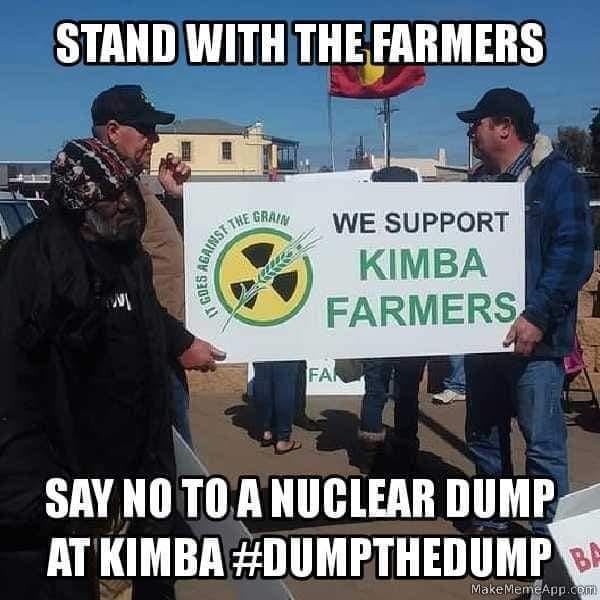
Farmers, Traditional Owners fight radioactive waste dump https://www.greenleft.org.au/content/farmers-traditional-owners-fight-radioactive-waste-dump, Renfrey Clarke, Adelaide, September 8, 2020
A 160-hectare tract of farmland has been purchased near the small town of Kimba and, as inducement to deliver support for the plan, local residents have been promised a $31 million “community development package.” A non-binding ballot conducted last November among residents of the Kimba District Council area recorded 62% in favour of the scheme.
But opponents of the dump remain active and vocal. As well as farmers and townsfolk concerned for their safety and for the “clean and green” reputation of the district’s produce, those against the plan include the Barngarla First Nations people, who hold native title over the area.
Critics argue that last year’s ballot sought the views of only a narrow section of the people affected. In particular, members of the Barngarla people, who do not live locally, are angry at being excluded.
The federal Coalition government, however, has not been deterred. In June, the House of Representatives passed a set of amendments to the legislation governing the scheme. These changes would strip opponents of the dump — including the Barngarla — of the right to mount legal challenges.
The amendments still have to pass through the Senate. But, confident of victory, in July the government set up the Australian Radioactive Waste Agency as part of the Department of Industry, Science, Energy and Resources. With its base in Adelaide, and a satellite office in Kimba, the agency is to “lead the process to deliver” the waste dump.
Low and intermediate-level wastes
In volume terms, the great bulk of the radioactive waste currently produced in Australia results from nuclear medicine, and is considered low-level. These materials do not require shielding in handling or storage, but must be kept secure until the radioactivity has decayed to the point where they can safely go to landfill. At present, these wastes are stored at more than 100 sites around the country, mostly in hospitals or universities.
The amount of low-level waste created here each year is about 40 cubic metres, roughly three truckloads, suggesting that the need to collect these materials into a centralised store is questionable.
More than likely, the risks of shifting these wastes exceed those of keeping them where they are for the decades needed until their radioactivity falls to natural background levels.
There are also intermediate-level wastes. These accumulate at a rate of about five cubic metres a year, and are in a very different category. Highly dangerous, they require shielding, and must be kept secure for as long as 10,000 years. They consist almost entirely of spent nuclear fuel from the research reactor at Lucas Heights, near Sydney, returned after reprocessing in Europe and currently stored on the reactor premises.
The waste dump planned for the farm property Napandee, near Kimba, is meant to provide a permanent home for Australia’s low-level wastes — but not for the intermediate-level materials. The latter are to be held in above-ground canisters at the facility until permanent storage provisions have been made.
Will this “interim” storage turn out to be permanent?
Kimba is remote enough that the temptation will be great for governments to leave these dangerous, long-lasting materials there indefinitely.
Meanwhile, if the Napandee dump is to hold the intermediate-level wastes for only a few decades, where is the need to move these materials there at all? The store at Lucas Heights has room to hold the wastes for many years to come, while permanent disposal methods are being devised and tested. Simply keeping the materials on site would avoid the risks of multiple handling and long-distance transport.
Community rifts
In Kimba, the social rifts from years-long disagreements over the dump remain painful. Many local people look to the facility to sustain a town that is steadily declining as farmers are compelled to “get big or get out”, and as the regional population shrinks.
Farmer Heather Baldock, who supports the dump, lamented to a Senate committee hearing in August: “We lose students, youth, neighbours, friends, sporting club members, emergency service volunteers … We gain more empty houses and property for sale.”
The federal government has suggested that a total of 45 jobs will be created by the facility — a big boost for a town of barely 600 people. Many of these jobs, however, will likely be part–time, or will be performed on a fly-in-fly-out basis.
The $31 million community package will create excellent town amenities, but not a long–term basis for the local economy. It will not solve the worst problem confronting regions like northern Eyre Peninsula: global warming, which raises temperatures, reduces already sparse rainfall and sends farmers into crippling debt.Opponents of the dump, meanwhile, speak bitterly of the deceits by a government determined to impose its scheme regardless of local objections.
Farmer Peter Woolford, who heads the group No Radioactive Waste on Agricultural Land in Kimba or SA, told the Senate hearing: “The path that the federal government has taken … has been a long road of propaganda, manipulation and promises without justification.”
The flow of information to the community, Woolford noted, has been tightly controlled and almost entirely narrated by the department. “No assistance, practical or financial, has been given to provide independent advice. Every speaker who has visited Kimba at the expense of the government has been a supporter of the proposal.”
Ballot manipulation
Opponents of the scheme are especially angry at the way the terms of last year’s ballot were manipulated. Rejecting a call for voting to be open to all residents within a 50-kilometre radius — a far more meaningful measure of the people for whom Kimba is the local hub — the government and the Kimba District Council insisted on the smaller area within the council boundaries. If the 50-kilometre boundary had applied, critics argue, the vote would have failed.
Particularly impressive has been the resolve of the Barngarla people to have their say in deciding the outcome. In 2018, the Barngarla fought and lost a court case against the district council, demanding to be included in the prospective ballot.
Excluded from the official vote, the Barngarla Determination Aboriginal Corporation organised its own independently-run ballot. This recorded a total of 83 members against the dump and zero in favour. A recent letter from the Barngarla to the federal resources minister stated: “The systematic racist behaviour by your government is a stain on the collective consciousness of this country.”
In any case, opponents of the dump ask why “community support” for the dump should be measured only by the views of a few hundred people. Why should the decision not be one for the whole population of South Australia — where indications are that the idea of hosting a radioactive waste dump is highly unpopular?
As Woolford pointed out, of 2789 submissions received in a public consultation 94.5% oppose the facility.
Professor Paul Rogers – a witness explaining how Julian Assange is to be extradited for POLITICAL REASONS
 Julian Assange clearly political, says extradition trial witness, https://www.theaustralian.com.au/world/julian-assange-clearly-political-says-extradition-trial-witness/news-story/735ef7d40551d52f4f7f12d9d6c318d7 JACQUELIN MAGNAY, FOREIGN CORRESPONDENT@jacquelinmagnay, THE TIMES, SEPTEMBER 10, 2020
Julian Assange’s nomination for the Senate during the 2013 federal election campaign and the establishment of the WikiLeaks political party the year before “clearly shows’’ the WikiLeaks founder has a political view and a libertarian standpoint, a witness has told the Old Bailey.
Professor Paul Rogers, the emeritus professor of peace studies at Bradford University, was called as a witness by Assange’s team to persuade the judge that Assange is being targeted for political means, and thus an extradition to the US should not be permitted under the Anglo-US extradition treaty.
In day three of the court hearing where Assange, 49, is objecting to extradition to the US, Professor Rogers said in written testimony that Assange’s expressed views, opinions and activities demonstrate very clearly “political opinions”. He cited how Assange had formed the political party to contest the Australian general election and “central of this is his view to put far greater attention to human rights’’.
He added: “The clash of those opinions with those of successive US administrations, but in particular the present administration which has moved to prosecute him for publications made almost a decade ago, suggest that he is regarded primarily as a political opponent who must experience the full wrath of government, even with suggestions of punishment by death made by senior officials including the current President.’’
But US prosecutor James Lewis QC said: “Assistant US Attorney Gordon D. Kromberg explicitly refutes that this is a political prosecution but rather an evidence-based prosecution.’’
In documents to the court, the prosecution says the investigation into Assange had been ongoing before the Trump administration came into office.
“Assange’s arguments are contradicted by judicial findings, made in the US District Court of the District of Columbia, that the investigation into the unauthorised disclosure of classified information on the WikiLeaks website remained ongoing when the present administration came into office,” the prosecution says.
Mr Lewis added: “If this was a political prosecution, wouldn’t you expect him to be prosecuted for publishing the collateral murder video?’’https://www.theaustralian.com.au/world/julian-assange-clearly-political-says-extradition-trial-witness/news-story/735ef7d40551d52f4f7f12d9d6c318d7
He said Assange was being extradited to face charges relating to complicity in illegal acts to obtain or receive voluminous databases of classified information, his agreement and attempt to obtain classified information through computer hacking; and publishing certain classified documents that contained the unredacted names of innocent people who risked their safety and freedom to provide information to the United States and its allies, including local Afghans and Iraqis, journalists, religious leaders, human rights advocates, and political dissidents from repressive regimes.
Professor Rogers told the court the motivation of Assange and WikiLeaks was to achieve greater transparency and was political. The trial continues.
Julian Assange’s extradition hearing in London. What can we expect?
 What’s at stake at Julian Assange’s long-awaited extradition hearing?, ABC 8 Sept 20, Julian Assange is fighting an attempt by the United States to extradite him to face charges on what it says was “one of the largest compromises of classified information in the history of the United States”.
It marks the culmination of a nearly decade-long pursuit by US authorities of the Australian-born WikiLeaks founder over the publication of secret documents and files in 2010 and 2011.
Assange’s extradition hearing had initially begun in February but was delayed for several months, and the coronavirus pandemic added additional delays, meaning Assange has been kept on remand in Belmarsh prison in south-east London since last September.
As reported by Background Briefing, Assange’s defence team will attempt to persuade the court he is unfit to travel to the US to face trial, and that the attempt to send him there is essentially an abuse of process.
How did he get to this point?
WikiLeaks made international headlines in April 2010 when it published a classified US military video showing an Apache attack helicopter gunning down 11 civilians, including two Reuters journalists, on a street in Baghdad in 2007.
Later that year, WikiLeaks released hundreds of thousands of US military messages and cables, a leak that saw former US Army intelligence analyst Chelsea Manning jailed……..
Assange, 49, has always denied the allegations, saying they were part of a US plot to discredit him and eventually extradite him to the US, and the investigation was eventually dropped in 2017.
He remained holed up in the embassy for seven years until April 2019, when the Ecuadorian government withdrew his asylum and Metropolitan Police officers arrested him for failing to surrender to the court over an arrest warrant issued in 2012……..
In May 2019, Assange was sentenced to 50 weeks in jail for breaching bail conditions, and during that time the US Justice Department brought 18 charges against him.
What is Assange accused of?
Assange is facing 17 charges relating to obtaining and disclosing classified information, and one charge concerning an alleged conspiracy to crack passwords on government servers.
The US alleges he conspired with Chelsea Manning to hack into US military computers to acquire the classified information published by WikiLeaks.
What can we expect from this hearing?
The court must examine a series of factors before any extradition can be granted, such as if the alleged crimes have equivalent offences in the UK and could lead to trial.
“It’s what’s called double criminality, in other words, whether the offences for which Assange is being sought in under US law are broadly being recognised under UK law,” Professor Don Rothwell, from the Australian National University, told Background Briefing.
Prosecutors have argued there is no doubt his actions would amount to offences under the UK’s Official Secrets Act.
If the court agrees, it must then consider how extradition would affect Assange’s health.
Previous court appearances this year have been delayed due to health issues, and his lawyers say his efforts to protect himself from US extradition and being stuck inside the Ecuadorian embassy for seven years had taken its toll.
If the court accepted it would be detrimental to his health, it could open up the possibility of protecting Assange in the UK under European human rights law.
The magistrate may also take issue with how the prosecutors are seeking to impose American law on what Mr Assange is alleged to have done outside of US territory.
“In this matter, US law is seeking to extend all the way, not only from the United States, but into the United Kingdom and into parts of Europe and basically impact upon the activities that Assange has undertaken associated with WikiLeaks over 10 years ago,” Professor Rothwell said…….
Assange’s legal team contends the US is seeking to prosecute Assange for political offences and that he is thereby exempt from extradition under the terms of the UK-US extradition treaty…….
What happens next?
The hearing is expected to last between three and four weeks, with any decision made likely to be appealed and go to a higher court, meaning the legal battle would likely drag into next year and possibly beyond that.
If Assange is eventually extradited to the United States and found guilty, he faces a maximum 175 years imprisonment for the 18 offences listed in the indictment. https://www.abc.net.au/news/2020-09-09/julian-assange-what-does-extradition-hearing-mean/12642972
The nuclear stigma – some Kimba residents selling their assets before the nuclear dump sets sail?
1 This month
17 October, Free Public Talk on Nuclear Issues in South Australia
David Noonan will speak on public interest concerns over the new Roxby Downs Indenture Act 2026 on BHP copper-uranium mining and ore processing in SA, and on how AUKUS may face SA with a High-Level nuclear waste agenda.
Dr Jim Green will discuss international developments in the field of nuclear power including ‘small modular reactors’ and Generation 4 ‘advanced’ nuclear reactor concepts.


Help Aunty Sue Protect Her Land and Sacred Sites From Destructive Rocket Testing.
.

Australians deserve the truth
about
AUKUS – https://aukuspublicinquiry.com/

PETITION – To: Prime Minister Anthony Albanese and the Australian Labor Government

of the week – Australians for War Powers Reform (AWPR)
To see nuclear-related stories in greater depth and intensity

