BHP betrays international safety efforts
|
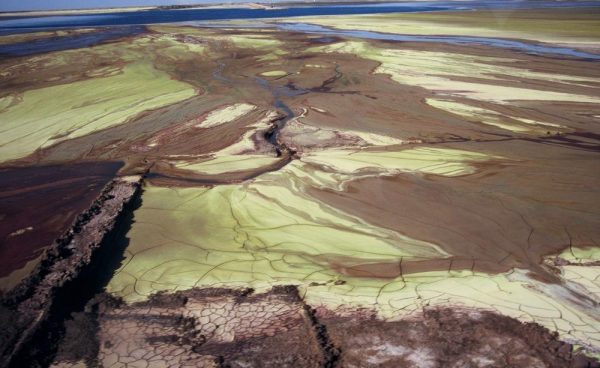
BHP betrays international safety efforts https://theecologist.org/2020/sep/15/bhp-betrays-international-safety-efforts, Dr Jim Green, David Noonan 15th September 2020, Mining giant BHP was complicit in the Samarco mining disaster in Brazil but the company has not learned from the experience. The world’s largest mining company BHP has betrayed international efforts to reform the mining sectors’ ongoing potential to cause catastrophic impacts though the failure of tailings dams. Operations at the Olympic Dam copper-uranium mine in South Australia show BHP has failed to learn key lesson’s regarding transparency, accountability and corporate responsibility following its complicity in the November 2015 disaster at the BHP and Vale joint venture Samarco iron ore mine in Brazil. Samarco was a corporate mining disaster which caused the loss of 19 lives and catastrophic environmental impacts with permanent pollution of native people’s land and rivers. Brazilian prosecutors say the company failed to take actions that could have prevented the disaster. Mine BHP now faces a $6.3 billion (US dollars) law-suit in the UK on behalf of 200,000 Brazilian people. The case alleges the Anglo-Australian mining giant BHP was “woefully negligent” in the run-up to the 2015 dam failure that led to Brazil’s worst environmental disaster. Mayors of two towns wiped out by the Samarco disaster assert that BHP has been using delaying tactics to avoid paying compensation to thousands of people affected by the flood of tailings waste. There have long been calls from environmentalists and others for Australian mining companies to be required to apply Australian standards to their overseas mining operations. The logic is sound given the often inadequate practices of Australian mining companies overseas. But the logic is also a little shaky given that mining standards in Australia leave much room for improvement. Olympic Dam is a case in point. BHP orchestrated approval in 2019 for a massive new tailings dam at Olympic Dam ‒ Tailings Storage Facility 6 (TSF6). This tailings dam is to be built in the same risky ‘upstream’ design that featured in both the Samarco disaster and the January 2019 Vale Brumadinho tailings dam disaster that killed over 250 people – mainly mine workers ‒ in Brazil. Community An internal 2016 report reveals that TSF6 has the potential to cause the death of 100 or more BHP employees and to cause “irrecoverable” environmental impacts from release of tailings waste. Yet, contrary to the recommendations of NGOs in Australia, Federal Environment Minister Sussan Ley granted approval for TSF6 without a comprehensive safety impact assessment and without setting any conditions on BHP to protect workers and the environment. TSF6 is to cover an area of nearly three sq km in tailings waste up to a height of 30 metres at the centre of the tailings pile, equivalent to the height of a nine-story building. BHP will leave this toxic mine waste there forever. Australian Prime Minister Scott Morrison has announced a “fast track” taskforce to further prioritise and accelerate approvals to BHP mining interests in a major Olympic Dam mine expansion process. BHP has clearly failed to learn the lessons of the disasters in Brazil. TSF6 represents an untenable risk to the lives of BHP employees and is unfit for community safety expectations in the 2020’s. Such approaches are clearly inconsistent with modern environmental practice and community expectations. Secret Radioactive tailings waste at Olympic Dam poses a significant long-term risk to the environment and must be isolated for over 10,000 years ‒ effectively forever. Continue reading |
Why NuScam and other ”small” nuclear proposals just don’t make any sense
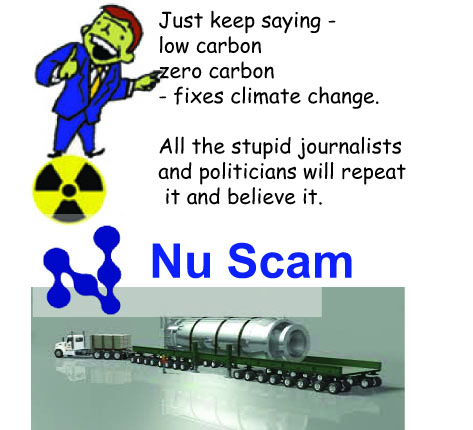 New nuclear projects, like this NuScale proposal, make no sense, Deseret, By Robert Davies, Contributor Sep 18, 2020, The debate over nuclear power has ramped up recently in Utah, with a number of the state’s municipal power agencies wrestling with continued participation in an experimental nuclear project in Idaho, the Utah Associated Municipal Power Systems/NuScale project.
Much has already been written about the project itself. Though proponents tout benefits of cost and reliability, two municipalities so far, Logan and Lehi, have recently opted out of further participation, citing mainly financial concerns over an experimental design with delays and cost overruns mounting rapidly. Still, this extremely expensive energy might be worth it ― if the environmental benefits, particularly for climate change, were significant.
Climate change is regarded within the full scientific community as a bona fide civilizational emergency ― that is, a situation requiring immediate, meaningful response to avoid catastrophic outcomes. For the climate emergency, meaningful response means cutting global carbon emissions at least in half in the next decade, and eliminating them entirely in the next two to three decades.
Electricity generation, as roughly a third of the current carbon emissions, is a large piece of the equation ― and it is on this point that nuclear power has been worth considering. Indeed, the project’s developers, having christened the endeavor the “Carbon Free Power Project,” are emphasizing the climate angle. And if the question were about building new nuclear generation versus new fossil (coal or natural gas) generation, they would have a point; the clear winner with respect to climate would be nuclear.
But this isn’t the question. In rapidly decarbonizing the electrical grid, the name of the game is replacing existing high-carbon (coal and gas) with new low-carbon, as quickly as possible.
……..proposed new nuclear makes no sense ― because it isn’t competing with fossils. Instead, new nuclear is competing with low-carbon renewables, chiefly solar and wind. And it simply can’t compete.
Investing in new nuclear projects to combat climate change is akin to the crew of the Titanic devoting time to building a whole new ocean liner instead of putting all their effort into loading the lifeboats; it steals time and resources from a much better alternative. Any money spent on new nuclear could buy us four to six times more wind and solar energy, available in months instead of a decade. And, remember, the next 10 years are critical.
Faced with this reality, UAMPS/NuScale proponents have said they want a mostly renewable grid, but supplemented by just a bit of nuclear for “baseload” ― and that this is necessary.
The refrain of 20th century-era power managers is that renewables like wind and solar aren’t reliable (“The wind doesn’t always blow, the sun doesn’t always shine … ”) and so constantly humming “baseload” is necessary for reliability. It sounds reasonable, but like most bumper-sticker wisdom, doesn’t hold up. In fact, it is objectively, demonstrably wrong.
The technologies of energy storage (utility-scale battery systems, for example) and demand management (when the energy is used) have transformed the landscape. Traditional “baseload” is no longer a necessary grid attribute. Anyone who says it is simply isn’t keeping up.
In Australia, for example, a 100-megawatt utility-scale battery system (about 1.5 times bigger than one of NuScale’s nuclear modules) is already proving more reliable and 90% cheaper than the “baseload” natural gas system it’s replacing. ………
new nuclear makes no sense whatsoever ― financially, or far more importantly, for addressing climate change.
The UAMPS/NuScale project is a poor choice for the planet, for our nation and for Utah’s independent municipal power companies. A bright future is possible if we’re smart and focused; the nuclear power trap is a distraction we can’t afford.
Robert Davies is an associate professor of professional practice in Utah State University’s department of physics. His work focuses on global change, human sustainability and critical science communication.https://www.deseret.com/opinion/2020/9/18/21400144/guest-opinion-nuscale-uamps-nuclear-project-power-utah-idaho-makes-no-sense
Julian Assange was offered a pardon, if he would name a source
Trump ‘associates’ offered Assange pardon in return for emails source, court hears
WikiLeaks founder was asked to reveal source of leak damaging to Hillary Clinton, hearing told, Guardian, Peter Beaumont in London, Sat 19 Sep 2020 Two political figures claiming to represent Donald Trump offered Julian Assange a “win-win” deal to avoid extradition to the US and indictment, a London court has heard.
Under the proposed deal, outlined by Assange’s barrister Jennifer Robinson, the WikiLeaks founder would be offered a pardon if he disclosed who leaked Democratic party emails to his site, in order to help clear up allegations they had been supplied by Russian hackers to help Trump’s election in 2016.
According to a statement from Robinson read out to the court, the offer was made by the then Republican congressman Dana Rohrabacher and Trump associate Charles Johnson at a meeting on 15 August 2017 at the Ecuadorian embassy in London where Assange was then sheltering. At the time he was under secret investigation by a US grand jury.
Robinson added: “The proposal put forward by Congressman Rohrabacher was that Mr Assange identify the source for the 2016 election publications in return for some kind of pardon, assurance or agreement which would both benefit President Trump politically and prevent US indictment and extradition.”
……….. The barrister added that Assange did not name the source of the emails.While Assange’s legal team first made the claim in February detailing a deal for a pardon in exchange for denying the source of the emails was Russia, Robinson’s statement – admitted as evidence by the court – provides substantial details of the meeting………
Robinson’s description of the offer suggests Trump was prepared to consider a pardon for Assange in exchange for information almost a year before a federal grand jury issued a sealed indictment against the WikiLeaks founder.
If it is confirmed that the approach did indeed have the approval of Trump, it would mark the latest in a number of interventions by the US president in relation to the investigation into Russian election interference.
In her statement, Robinson said Rohrabacher and Johnson “wanted us to believe they were acting on behalf of the president”.
“They stated that President Trump was aware of and had approved of them coming to meet with Mr Assange to discuss a proposal – and that they would have an audience with the president to discuss the matter on their return to Washington DC,” she said……
Appearing to confirm that the approach had been made, James Lewis QC, for the US government, said: “The position of the government is we don’t contest these things were said,” adding: We obviously do not accept the truth of what was said by others.” ……. https://www.theguardian.com/media/2020/sep/18/trump-offered-julian-assange-pardon-in-return-for-democrat-hacking-source-court-told
Scott Morrison turns to socialism, with his new religion, not coal, but “gas-led recovery”
 It’s a small church that sings the gas gospel, Canberra Times, Michelle Grattan, 18 Sep 20,
If Labor were threatening to build a power station, the Liberals would likely be screaming “socialists”.
As for a Coalition government contemplating such a thing – well, to say the obvious, it hardly fits with the Liberals’ stated free-market, private-enterprise philosophy. But hey, neither does the hyper-Keynesian support package to cushion the economy through the pandemic.
The gas power plant is another matter, and it will be fascinating to see how the debate plays out if the threat turns into reality.
The threat is part of the go-with-gas policy unveiled by Scott Morrison this week, spruiked as driving a “gas-fired” recovery, especially for manufacturing. This sounds suspiciously like a three-word slogan that promises more than it is likely to deliver.
But Morrison has signed up to the church of gas, whose pastors include Nev Power, chairman of the Prime Minister’s COVID-19 commission, and Andrew Liveris, the head of its (now defunct) manufacturing taskforce, which delivered a pro-gas report.
Much of the gas plan is broad and aspirational at this stage. But the threat is specific enough.
Morrison said the electricity sector must lock in by April investments to deliver 1000MW of new dispatchable energy to replace the Liddell coal-fired power station before it closes in 2023. Or else. The government-owned Snowy Hydro was working on options, he said.
Going back to Malcolm Turnbull’s time, the government conducted – and lost – a bitter battle with AGL over the planned Liddell closure. It exerted maximum pressure on the company to extend the life of the station, or alternatively to sell it, but to no avail.
The gas policy, especially the threat, hasn’t gone down well – with the energy sector or environmentalists. And it’s come under criticism from experts and even from within Coalition ranks.
The Australian Energy Council, representing investors and generators, warned the spectre of a government gas generator could put off private investors.
Environmentalists are against gas anyway, whoever produces it, because it is a fossil fuel and therefore has emissions, albeit not as bad as coal.
The Nationals’ Matt Canavan, who not so long ago was resources minister, says if a new power station is to be built in the Hunter region it should be coal-fired.
And the director of the Grattan Institute’s energy program, Tony Wood, says the government’s claim that 1000MW of new dispatchable capacity is needed isn’t supported by the advice from its own Liddell taskforce.
More generally, Wood argues the idea of a gas-led recovery is “a mirage”.
He says east-coast gas prices are unlikely to fall to very low levels and anyway, even very low prices would not stimulate major economic activity. “Investing in more gas infrastructure in the face of climate change looks more like a herd of stampeding white elephants” is Wood’s blunt assessment…….
Critics don’t like the proposed expansion of the remit of the Australian Renewable Energy Agency and the Clean Energy Finance Corporation beyond supporting renewables. https://www.canberratimes.com.au/story/6931688/its-a-small-church-that-sings-the-gas-gospel/?cs=14230
Julian Assange exposed “a very serious pattern of actual war crimes”
Speaking on the significance of the WikiLeaks releases, Ellsberg said, “It was clear to me that these revelations, like the Pentagon papers, had the capability of informing the public that they had been seriously misled about the nature of the [Iraq and Afghan] war[s], the progress of the war, the likelihood that it would be ended successfully or at all, and that this was information of the highest importance to the American public.”
Characterising the wars that WikiLeaks exposed, Ellsberg explained, “The Iraq war was clearly recognisable, even to a layman, as a crime against the peace, as an aggressive war.”
|
Assange exposed “a very serious pattern of actual war crimes,” Daniel Ellsberg tells extradition hearing https://www.wsws.org/en/articles/2020/09/17/ells-s17.html, By Thomas Scripps, 17 September 2020Daniel Ellsberg gave powerful testimony to the Julian Assange extradition hearing yesterday, speaking via videolink to London’s Old Bailey. Ellsberg’s release of the top-secret Pentagon Papers in 1971 exposed the US government’s lies and criminality in the Vietnam War. “[T]he Afghan war was immediately recognisable as what might be called ‘Vietnam-istan.’ It was a rerun of the Vietnam war despite the great differences in terrain, in religion, in language … [T]he basic nature of the war, as basically an invasion and occupation of a foreign country against the wishes of most of its inhabitants, was the same. And that meant the prospects were essentially the same, which were for an endless stalemate which we’ve now experienced in Afghanistan for 19 years. And it might have gone on that long in Vietnam had not truths that the government was trying to withhold been made public.” Referring to the brutality of these occupations which the WikiLeaks releases uncovered, Ellsberg said, “I saw for the first time in virtually forty years … since the Pentagon papers, the release of a sufficient quantity of documentation to make patterns of decision making [in the war] very evident, to show that there were policies at work and not merely aberrant incidents.” He drew special attention to how the documents had exposed “a very serious pattern of actual war crimes. … In the Afghan case the reports of torture and of assassination and death squads were clearly describing war crimes. I would have, by the way, been astonished to see such reports in Secret level communications [as opposed to Top Secret] in 1971 or 1964 in the Pentagon. They would have been much higher in classification. What these reports revealed was that in the intervening years, in the Iraq War and the Afghan War, torture had become so normalised, and death squads and assassination, that reports of them could be trusted to a network at the Secret level available to … people with low-level clearances.” Ellsberg said of the Iraq “Collateral Murder” video, “We were watching somebody pursue with his machine gun an unarmed man, wounded, crawling for safety. … I was very glad that the American public was confronted with this reality of our war.” Speaking on the significance of the WikiLeaks releases, Ellsberg said, “It was clear to me that these revelations, like the Pentagon papers, had the capability of informing the public that they had been seriously misled about the nature of the [Iraq and Afghan] war[s], the progress of the war, the likelihood that it would be ended successfully or at all, and that this was information of the highest importance to the American public.” Characterising the wars that WikiLeaks exposed, Ellsberg explained, “The Iraq war was clearly recognisable, even to a layman, as a crime against the peace, as an aggressive war.” Continue reading |
Did she lie to the Senate? – Samantha Chard, Chief of National Radioactive Waste Management Facility Taskforce

A senior public servant has been accused of lying to a Senate committee and only correcting the evidence given when a Freedom of Information request was set to expose her.
Independent senator Rex Patrick made the accusation under parliamentary privilege in a dissenting report on a government bill on radioactive waste management.
Ms Chard said she didn’t recall talking about it in her personal discussions, but Senator Patrick said he would use Freedom of Information to see if that was the case.
“It is completely implausible that Ms Chard was unable to recollect being involved in discussions on the new bill about the bill’s effect of removing judicial review of the site selection decision,” Senator Patrick said in the report.
“She was dishonest. She lied to the committee.”
Senator Patrick accused Ms Chard of only updating her evidence because of the FOI request.
A spokesman for the Department of Industry, Science, Energy and Resources said Ms Chard answered all questions truthfully to the best of her ability.
“The committee has already reached out to the government and asked if it would like to respond to any aspects of the report including minority or dissenting reports, which the department will,” he said.
“All members of the department who appear at proceedings in Parliament are aware of their obligations to answer all questions truthfully and to the best of their ability, which Ms Chard did.
In a further exchange between Ms Chard and Senator Patrick at a hearing in August, Ms Chard again said she had been truthful.
“In my clarification of the evidence I make it really clear that I have been involved in policy discussions related to the proposed legislation having the effect of reducing the risk of potential legal challenges, including through judicial review,” she said.
“At the time, the questioning was specifically related to section 14 of the act and whether this bill was designed to remove judicial review, and I maintained that it was not the intention of the bill to remove scrutiny under section 14 of the act.”
It is not the first time Senator Patrick has used parliamentary procedures to call out what he believes is a growing tendency for public servants to choose protecting their ministers over being open and transparent.
“I am absolutely determined to protect the integrity of the Senate’s oversight processes,” he said to The Canberra Times.
Senator Patrick said he would be calling ministers who make “erroneous public interest immunity claims” to the Senate chamber to explain themselves.
“I will be not be tolerating officials who are evasive, misleading or untruthful in their answers.”
He also threatened to publicly name FOI officials who make “blatantly cavalier” exemption claims that are then overturned by the Information Commissioner.
“Ministers and officials who meet their public service obligations and are fulsome and truthful in their responses to the Senate need not fear anything,” he said.
“FOI officers who make decisions consistent with the objectives of FOI act need not fear anything.”
Words Before Waste: South Australians Call for More Consultation on Federal Radioactive Waste Plan
 New research shows that, while South Australians are divided on the issue of a nuclear waste dump, a clear majority believe more consultation should be undertaken before any final decision is made regarding a proposed disposal and storage facility near Kimba on the Eyre Peninsula.
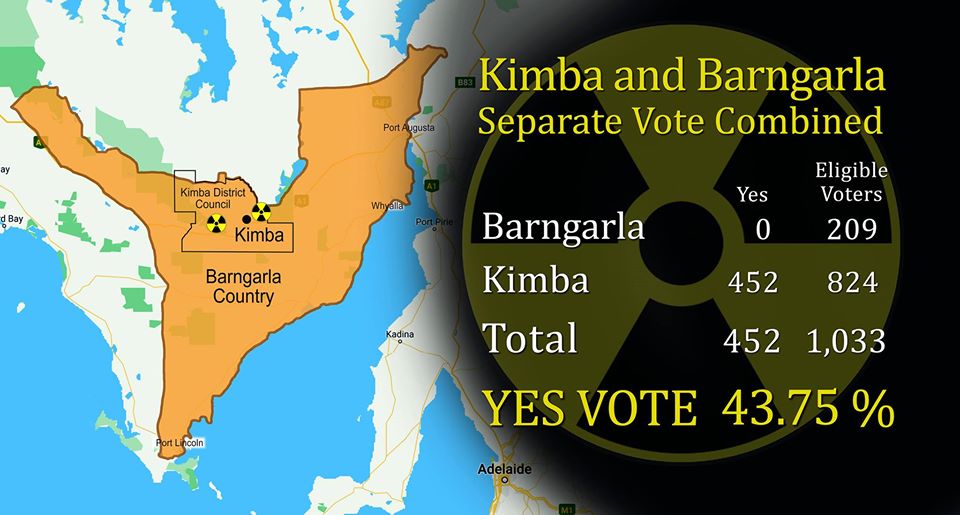
The Australia Institute recently surveyed 510 South Australians about the proposed nuclear waste facility.
Key Findings:
- Two in three South Australians (66%) say the traditional custodians of the land, the Barngarla people, should be formally consulted via a ballot before any proposal is advanced.
- Three in five South Australians (60%) believe the whole SA population should be formally consulted via a ballot before any proposal is allowed to go ahead.
- Two in five South Australians (40%) oppose the nuclear waste dump, while the same share of respondents (40%) support the plan.
- One in two South Australians (51%) oppose the potential use of the South Australian ports and roads to transport nuclear waste.
“This issue is dividing the state and there is a strong appetite for more consultation with both the Barngarla people and the general South Australian public,” said Noah Schultz-Byard, South Australian Director at The Australia Institute.
“Our research has shown that a significant number of people hold concerns about the transportation of nuclear waste on South Australian roads and through South Australian ports.
“In 2016 the current Premier Steven Marshall said he had much greater ambitions for South Australia than for it to become a nuclear waste dump. If that is still the case, the Premier should support a state Parliamentary inquiry and a far broader community conversation regarding the proposed federal facility.”
“This is a highly controversial proposal, with many questions unanswered and a lot of misinformation flying around. It’s little wonder the community is divided,” said Craig Wilkins, Chief Executive of Conservation SA.
“However, one thing is crystal clear: the Barngarla people, who are the formal native title owners of the area, have consistently said they have not been properly consulted. The South Australian people clearly believe further consultation, particularly with Barngarla Traditional Owners, must take place before this proposal progresses.
“There is no hurry: federal authorities have confirmed that there is safe and secure storage at Lucas Heights in Sydney for decades. So, let’s get the process and the consultation right – starting with genuine and respectful engagement with the Barngarla people,” he said.
Call to Australian Labor Party to state its position on Napandee nuclear waste dump plan
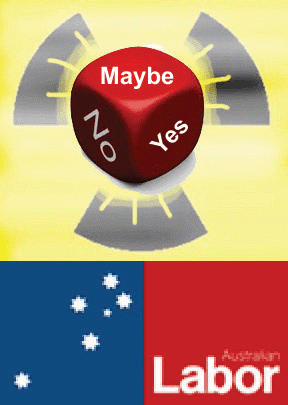 Labor split on nuclear waste dump, https://www.miragenews.com/labor-split-on-nuclear-waste-dump/ The Greens are calling on the Labor Leader in the Senate, Penny Wong to declare where her party stands on the proposed Nuclear Waste Dump in SA, after a clear division within the Labor Party was revealed in a Senate Inquiry Report released late yesterday.
NSW Labor Senator Jenny McAllister delivered a dissenting report, independent of her Labor colleagues including SA Senator Alex Gallacher who supports the majority report that SA should be a dumping ground for nuclear waste.
Greens Senator for South Australia Sarah Hanson-Young said:
“Penny Wong needs to come out today and tell South Australians where the Labor Party stands.
“Does it stand with Senator McAllister who has stated the process for selecting a site has been flawed and no meaningful community consent obtained? Or does it stand with SA Senator Alex Gallacher and the Liberal Party who want to dump on SA?
“The decision to set up a nuclear waste dump in SA will affect our state for generations to come. All South Australians should have the right to have their say on this important issue and they should know very clearly where the ‘opposition party’ stands both at a federal and state level.”
Broad support for nuclear waste dump at Napandee? Senate report shows that is a lie
|
The inquiry was established to examine controversial changes to national radioactive waste laws in order to secure the Kimba site and prevent this decision from being subject to judicial review. “This is a deeply deficient plan based on a flawed and restrictive process,” Australian Conservation Foundation campaigner Dave Sweeney said. “That one Committee inquiry has generated four separate responses from Senators shows there is no consensus on the plan. “The Coalition-dominated majority report predictably supported the waste plan, while the three other responses are critical. “The government’s proposal would lead to potentially dangerous waste management, including trucking radioactive waste from Lucas Heights in Sydney through our communities and dumping it on South Australian farmland. This is actively opposed by many in the wider region, including the Barngarla Traditional Owners who have been consistently excluded from the consultation process. This is not a credible plan. Australians deserve better than an approach which lacks credibility, is inconsistent with international standards, and shirks hard questions about what to do with the worst waste.” The federal waste plan has drawn criticism and opposition from a range of civil society and community groups and South Australia’s Labor opposition. Federal Labor voted against the plan in the House of Representatives in June. Key concerns with the plan include:
|
|
Australia’s mainstream media dutifully parrots out Government spin about gas
|
Gas Gush: the toadies of mainstream media trot out government’s fossil fuel fracking campaign https://www.michaelwest.com.au/gas-gush-the-toadies-of-mainstream-media-trot-out-governments-fossil-fuel-fracking-campaign/
 by Michael West | Sep 15, 2020 Gas fracking and a new fossil fuel power plant got a big leg-up today as News Corp, Nine Entertainment, ABC News and Guardian Australia faithfully splashed with the latest government gas plan on their front pages today. by Michael West | Sep 15, 2020 Gas fracking and a new fossil fuel power plant got a big leg-up today as News Corp, Nine Entertainment, ABC News and Guardian Australia faithfully splashed with the latest government gas plan on their front pages today.
This is not journalism. This is stenography. This is not balanced reporting. This is reporting a government press release one day early. Australia’s captive mainstream media all splashed with the same story this morning, the Morrison Government’s fossil fuel public relations campaign. The Age, the Sydney Morning Herald, The Guardian, The Australian, the Australian Financial Review. They all featured the same story on gas. Now, breakfast TV and morning radio will be left to follow it up, unquestioning, now that it’s been “in the papers”. The gas propaganda blitz did not feature the critical facts that gas is almost as polluting as coal, that fracking the Beetaloo Basin, the Galilee Basin and the North Bowen Basin will destroy water systems and endanger wildlife and farmland. Neither did this media blitz, orchestrated by expert media manipulators in the offices of government, and keenly assisted by the gas lobby, mention that the gas multinationals which stand to benefit from this campaign have been acting as a cartel, ratcheting up gas prices at a cost to all Australians and siphoning profits offshore to tax havens. Neither did the slavishly toadying coverage in the corporate media mention how much the companies Shell, BHP, Exxon, Origin and Santos and their proxies pay political parties in donations. No, the journalists and their editors simply gush the Government’s line. “Scott Morrison will announce”, “The Government will announce”. There was, and still is, no detail, nothing official from the Government but its toadies in the mainstream media have recorded the story faithfully. They are paving the way for the Government to spend billions in taxpayer money on a new gas power plant and pipelines – for a pipeline industry controlled by Chinese and Singaporean multinationals who don’t pay tax. The only difference between the big black headlines in The Age and the SMH were the words “in NSW”. “Morrison to back construction of new gas-fired power station in NSW,” touted the SMH. The team of press secretaries in the office of Prime Minister and Cabinet – a team brimming with fossil fuel advocates – could not have asked for great loyalty and dedication to the cause. “Scott Morrison is prepared to forcefully intervene in the energy market by building a new gas-fired power station in the Hunter Valley in NSW if need be, and underwriting the construction of gas pipelines to feed a new national trading hub,” wrote the AFR‘s Canberra correspondent Phil Coorey. Although there is still no press release from the Prime Minister, and nothing official from the office of Energy Minister Angus Taylor either, the AFR had four stories on the big gas plan. “The prime minister will say the government intends to pursue 13 measures,” wrote Katherine Murphy in The Guardian. How did she know that? How did they all know it? They got “the drop”. The drop is industry parlance for a leak from government which is a favour. The political operative engineers the drop to the select journalist and the select journalist is expected, in return, to deliver favourable coverage. Morning TV and radio will follow up on cue. By this afternoon, the Government’s media campaign will have dominated the 24-hour media cycle. The actual details of the plan may be released this afternoon. Late morning perhaps. By then, independent journalists and the non-spoon-fed media may become privy to the detail and report the news properly. “Power up or we build gas plant: Morrison,” is the headline in The Australian. It is accompanied by a flattering “comment piece” by Murdoch media’s top correspondent in Canberra, Simon Benson: “Morrison move to energise industry.” Already, Australia is up there with Qatar as the world’s biggest exporter of gas. Australians pay among the highest prices in the world for gas too. This is no accident. This is a failure of government and media. The corporations that dominate the gas cartel have got the better of government, completely dominated the governments state and federal in fact. They have dominated the media too. Their advertising, their slick lobbying, craven editorial management. Australia’s politicians and media have failed the people. |
|
See this graphic exposure of the coal, oil, gas, corruption in Australian government
 Australian Government Corrupt Connections – Fossil Fuels , https://tasmaniantimes.com/2020/09/corrupt-connections-fossil-fuels/Our democracy has been hijacked by the fossil fuel industry. Australians need to know about government links with the coal, oil & gas industry.Please share this so more people are aware. WE need an ICAC now!
For more information we recommend watching “Dirty Power” (15 min) which documents many of the fossil fuel links to government detailed in this thread. Australian Government Corrupt Connections – Fossil Fuels
Thread produced by @aaron_brooks10 & @DanielBleakleyMost info sourced from michaelwest.com.au
Coalition to divert renewable energy funding away from wind and solar
|
Coalition to divert renewable energy funding away from wind and solar
Scott Morrison says solar and wind are commercially viable and do not need subsidies from the $1.43bn funding, Guardian, Katharine Murphy and Adam Morton, Thu 17 Sep 2020 The Morrison government will continue to fund Australia’s renewable energy agency to the tune of $1.43bn over a decade but overhaul its mandate so there will be less investment in solar and wind, and more focus on investment in hydrogen, carbon capture and storage, microgrids and energy efficiency.The baseline funding for the Australian Renewable Energy Agency (Arena) will be supplemented by a transfer of funds from the government’s emissions reduction fund and a new grants program worth $193.4m – but that represents a funding cut to the agency which was established by the Gillard government in 2011. The significant overhaul will be unveiled by Scott Morrison on Thursday ahead of the government outlining its next steps in the technology roadmap, which is the government’s emissions reduction strategy. The energy minister, Angus Taylor, is expected to unveil the government’s inaugural low emissions technology statement during a speech at the National Press Club early next week…….. The Morrison government will continue to fund Australia’s renewable energy agency to the tune of $1.43bn over a decade but overhaul its mandate so there will be less investment in solar and wind, and more focus on investment in hydrogen, carbon capture and storage, microgrids and energy efficiency……… The government will also continue to plough more taxpayer funds into carbon capture and storage through a $50m fund, while $70.2m will be allocated for an export hydrogen hub. ……. The overhaul of Arena follows the government outlining first steps in its much vaunted “gas-led recovery” from the economic shock caused by the coronavirus. Morrison on Tuesday pointed to new commitments in the October budget, including funding of $52.9m to unlock more gas supply and boost transport infrastructure. As well as flagging that the government would back the construction of a new gas-fired power station in the Hunter Valley if the energy company AGL failed to replace Liddell, Morrison held open the option of taxpayer underwriting for priority gas projects, streamlining approvals or creating special purpose vehicles for new investment. While Morrison and Taylor have been muscling up about the importance of new generation to replace Liddell, the government’s proposition has not been backed by a taskforce report commissioned to assess the impact of its closure. Morrison said this week the government had estimated 1,000 megawatts of new dispatchable electricity generation capacity would be needed to replace Liddell, which owner AGL has announced will close in early 2023. But the taskforce does not find that 1,000MW of additional dispatchable electricity would be needed. It listed a range of energy committed and probable projects that it found would be “more than sufficient” to maintain a high level of power grid reliability as Liddell shut.https://www.theguardian.com/australia-news/2020/sep/17/coalition-to-divert-renewable-energy-funding-away-from-wind-and-solar |
|
In tropical areas, increasing heat and humidity will make life almost unbearable
These impacts will be stronger in the seasonally wet tropics (such as the Northern Territory of Australia), where more extreme warming is expected than in the equatorial zone.
Predictions for Darwin, in northern Australia, suggest an increase in days with temperatures above 35℃ from 11 days a year in 2015 to an average of 43 days under the mid-range emission scenario (IPCC’s RCP4.5 scenario) by 2030 and an average of 111 (range 54-211) days by 2090. Under the higher emission scenario (IPCC’s RCP8.5), an average of 265 days above 35℃ could be reached by 2090.
|
Climate explained: will the tropics eventually become uninhabitable? https://theconversation.com/climate-explained-will-the-tropics-eventually-become-uninhabitable-145174 James Shulmeister, Professor, School of Earth and Environmental Sciences, University of Canterbury 16 Sept 20, What is the impact of temperature increases in the tropics? How likely is it that regions along the Equator will be uninhabitable due to high wet bulb temperatures such as 35℃ and more in places like Singapore? Do we have models that suggest how likely this is and at what time frames?More than 3.3 billion people live in the tropics, representing about 40% of the world’s population. Despite some areas of affluence, such as Singapore, the tropics are also home to about 85% of the world’s poorest people and are therefore particularly susceptible to the impacts of climate change.
The tropics are expected to experience rising temperatures and changes to rainfall, and the question is whether this could make this region uninhabitable. How would this happen? Heat stressHumans regulate their body temperature in warm conditions through sweating. The sweat evaporates and cools the skin. But if conditions are humid, sweating and evaporation are much less effective. Humans can survive and function in quite high temperatures if humidity is low, but as humidity increases our ability to function decreases rapidly. This effect is measured by a heat stress index which shows the apparent temperature you feel under different relative humidity conditions. From a human health point of view, the wet bulb temperature is critical. This is the temperature a thermometer covered in a wet cloth would measure, and it reflects the maximum amount of cooling that can be achieved by evaporation. High wet bulb temperatures are more problematic to human health than high absolute temperatures. Wet bulb temperatures above 35℃ are life-threatening because they cause hyperthermia, which means the body cannot cool down and the internal body temperature exceeds 40℃. Climate modelling predictions used by the Intergovernmental Panel on Climate Change (IPCC) for the period from 2080-2100 suggest warming in the tropics of about 1.6℃ under mid-range emissions scenarios and up to 3.3℃ under high emissions scenarios, with error margins of about 0.5℃ on both predictions. Continue reading |
Australian government never intended to follow the advice of the review on environmental law
 Coalition began writing landmark environment bill before receiving review it had ordered, Guardian, Lisa Cox, Wed 16 Sep 2020 Coalition began writing landmark environment bill before receiving review it had ordered, Guardian, Lisa Cox, Wed 16 Sep 2020 Review of EPBC Act was delivered to government 11 days after process of drawing up legislation had begun, The Morrison government started preparing controversial legislation to amend Australia’s environmental laws before it had received a report from a formal review into whether the act was working.The environment department instructed the Office of Parliamentary Counsel to begin drafting the changes to the legislation on 19 June, 11 days before the government received the interim report of the review of Australia’s national environment laws.Labor, the Greens and environment groups say the evidence, provided in answers to a Senate committee, suggests the government never intended to adopt the expert advice of the review, chaired by the former competition watchdog head Graeme Samuel. Samuel delivered his interim report, a once-in-a-decade statutory review of the Environment Protection and Biodiversity Conservation (EPBC) Act, to the government on 30 June. It found Australian governments had failed to protect Australia’s unique wildlife and habitats and recommended an overhaul of the laws to make the country’s systems of environmental protection more effective. Samuel recommended the devolution of approval powers to the states along with the introduction of national environmental standards and an independent regulator to enforce the law.
But the bill introduced in August was a near replica of failed “one-stop-shop” legislation introduced under former prime minister Tony Abbott. It contained no reference to any of Samuel’s other recommendations, including national standards. It passed the lower house last month after the government gagged debate…………. Basha Stasak, from the Australian Conservation Foundation, said Samuel’s report had warned against the approach adopted by the Abbott government in 2014, in part because it lacked legislated national environmental standards. “Yet before the federal government had even received Prof Samuel’s interim report, it was already drafting legislation to hand over environmental responsibility to weaker state regimes without national standards,” she said. Crossbench senators have indicated they will not support the proposed changes, in part because they include nothing to improve the protection of Australia’s ailing wildlife and natural heritage. https://www.theguardian.com/environment/2020/sep/16/coalition-began-writing-landmark-environment-bill-before-receiving-review-it-had-ordered |
|

‘Gas-led recovery’ may actually deter energy investment: Experts
|
‘Gas-led recovery’ may actually deter energy investment: Experts, The New Daily, Josh Butler, 16 SEp 20, Climate change and clean energy campaigners were left dismayed at the
federal government’s plans to spearhead a “gas-led recovery” from COVID-19, saying it will be ineffective and damage the prospects of meeting international emissions reduction commitments. Independent MP Zali Steggall claimed the Prime Minister’s announcement was “blackmailing private companies”, while even energy companies said the announcement – however well meaning –could actually lead to further uncertainty and less investment in the market. On Tuesday, PM Scott Morrison announced plans to lean heavily on the gas sector in the nation’s recovery from the pandemic, talking up the fuel’s potential to lower power prices and shore up reliability in the electricity grid. He also flagged the possibility of the commonwealth helping foot the cost for a new gas-fired power station in NSW, if the soon-to-be-closed Liddell plant is not replaced. But climate experts and clean energy campaigners are up in arms over the plan, which they say will be far more expensive and far worse for the environment than renewables. ….. Mr Bourne, a former regional president with BP Australasia, said gas was better for the environment than coal – but only marginally, when emissions linked to its extraction, production and transmission were factored in. “It’s not that much better than coal,” he said. The Australian Energy Council, representing major investors in power generation, said the government’s announcement may actually create more uncertainty and less investment in the sector – saying “even discussions and threats of intervention act as a deterrent”…… Labor’s shadow energy minister Mark Butler slammed gas as “the most expensive way to build new energy”……… https://thenewdaily.com.au/news/2020/09/15/gas-led-recovery-climate/ |
|
1 This month
17 October, Free Public Talk on Nuclear Issues in South Australia
David Noonan will speak on public interest concerns over the new Roxby Downs Indenture Act 2026 on BHP copper-uranium mining and ore processing in SA, and on how AUKUS may face SA with a High-Level nuclear waste agenda.
Dr Jim Green will discuss international developments in the field of nuclear power including ‘small modular reactors’ and Generation 4 ‘advanced’ nuclear reactor concepts.


Help Aunty Sue Protect Her Land and Sacred Sites From Destructive Rocket Testing.
.

Australians deserve the truth
about
AUKUS – https://aukuspublicinquiry.com/

PETITION – To: Prime Minister Anthony Albanese and the Australian Labor Government

of the week – Australians for War Powers Reform (AWPR)
To see nuclear-related stories in greater depth and intensity

