Australia’s nearly 2 $trillion costs by 2050 – if we continue climate change inaction
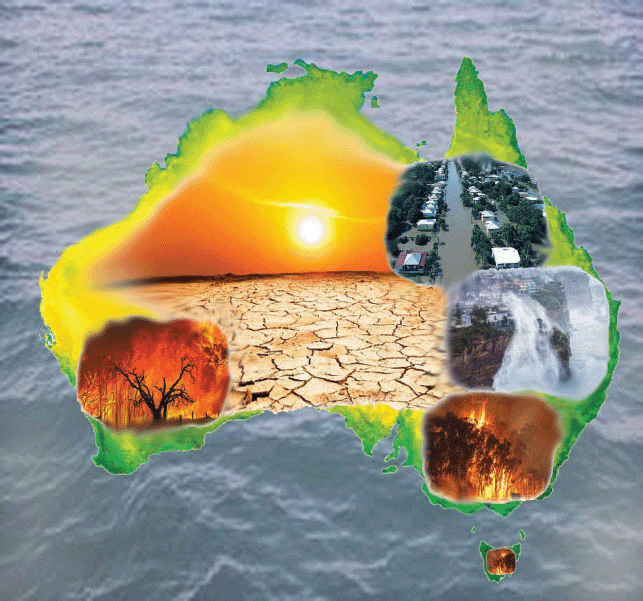 Trillions up in smoke: The staggering economic cost of climate change inaction, New Daily, Ben Silvester, 8 Sept 20, Over the next 30 years, increasing economic damages from climate change will cost the Australian economy at least $1.89 trillion – or roughly 4 per cent of projected GDP each year – if current emissions policies are maintained.New research from the University of Melbourne reveals annual economic damages by 2038 will be comparable to the current estimated annual cost of COVID-19 in Australia. Trillions up in smoke: The staggering economic cost of climate change inaction, New Daily, Ben Silvester, 8 Sept 20, Over the next 30 years, increasing economic damages from climate change will cost the Australian economy at least $1.89 trillion – or roughly 4 per cent of projected GDP each year – if current emissions policies are maintained.New research from the University of Melbourne reveals annual economic damages by 2038 will be comparable to the current estimated annual cost of COVID-19 in Australia.
There have been many attempts at estimating the economic cost of climate change, but the researchers said this is the most detailed and globally comprehensive to date. The modelling covers 139 countries in four potential warming scenarios from now to 2100. The projections draw on a modelling framework in the journal Earth’s Future in 2018 and have been continually updated through adding data points for bushfires and other ecological events. “There is no model in the world that is nearly this computationally large,” said lead researcher Professor Tom Kompas of the university’s school of biosciences. “It’s as much as 10 times larger than standard basic models.” The detail built into the projections allowed researchers to drill down and discover how each country will be affected by rising temperatures at particular points in the coming century. Previous models could only provide average damages across large regions or the world as a whole…………. If this trajectory is maintained, the research found that the economic cost of climate change for Australia alone will total at least $1.89 trillion by 2050 and exceed $100 billion in annual damages by 2038. Professor Kompas described the impact of the coronavirus pandemic as “devastating”, but he said it also puts the huge economic threat of climate change into context. “By 2038, on average projections, climate change may well be dealing a COVID-sized blow to the Australian economy every year … [it] will imply more job losses, unemployment and deeper cuts in GDP. And those damages will continue to increase disproportionately year after year,” Professor Kompas said. Much of the economic damage will be from rising sea levels wreaking havoc on property, infrastructure and agriculture along the coast. It is calculated that damages of more than $992 billion over the next three decades, or more than $30 billion a year, on average, from sea level rise and storm surge alone. The modelling also predicts productivity losses of $261 billion as rising temperatures make it harder for certain crops to grow and for outdoor labourers to work, while losses in biodiversity total $277 billion with thousands of species at risk of extinction. “Many of these damages ramp up over time,” Professor Kompas said. But he said Australia is already getting a taste of what’s around the corner, the past “Black Summer” bushfires being an example. The researchers tallied up the damage to property, infrastructure and agriculture caused by the recent bushfires, assessing the cost at $48 billion. And with research suggesting Australia will have two more “megafires” before the end of the decade, Professor Kompas calculates that by 2050 bushfires will have cost the economy about $360 billion. The $1.89 trillion cost to the economy in the next 30 years is almost certainly an underestimate, he said. His research does not yet account for damage to Australia’s major environmental assets, pollution from burning fossil fuels, tourism losses and natural disasters other than bushfires……. https://thenewdaily.com.au/news/national/2020/09/10/economic-cost-climate-change/ |
|
Labor leader Anthony Albanese says: Australia can be a ‘renewable energy superpower’
Labor leader sidesteps tension in his party around resources to call for embrace of clean energy, Guardian, Katharine Murphy, political editor, 8 Sep 20, The federal Labor leader, Anthony Albanese, says the resources sector has been the backbone of the Australian economy for decades, but the nation’s “long-term future lies in renewable energy sources”.Stepping around tensions within his own ranks, Albanese will use a speech on Wednesday about regional development to note that resources exports will “continue to meet the demands of the rapidly growing nations of our region” even as the world transitions to a lower-carbon future.But the opposition leader says in the speech the task of the coming decades is to “position our nation to be a major player in the clean energy industries that continue to grow in importance over time”.
The Labor leader says if the policy settings are right “we can transform our nation into a renewable energy superpower”.
n a speech to be delivered in the New South Wales coastal town of Coffs Harbour, Albanese will cite a report this week from the state’s chief scientist and engineer that envisages 17,000 jobs and $26bn would be added to annual growth from a domestic hydrogen industry.
The Labor leader will note that report was endorsed by the state’s environment minister, Matt Kean, but “the Morrison government appears to be blind to such opportunities”……..
Albanese’s speech on Wednesday lays out his thoughts on development opportunities for regional Australia. He insists the transition to renewable energy will create jobs in the regions.
He will argue the National party’s resistance to the energy transition is leaving them out of step with the communities they represent.
“The Nationals, who say they represent farmers, are now at odds with the National Farmers’ Federation, which recently embraced the target of net zero carbon emissions by 2050,” the Labor leader says.
He says regional Australia and the investment sector are “moving beyond this do-nothing government”.
Albanese says only Labor can tackle energy policy “in a way that recognises the value of the current resources market while seeking out the massive opportunities in renewables”.
“The right plans will create hundreds of thousands of jobs in new industries, including in regional Australia whilst also reducing power prices”. https://www.theguardian.com/australia-news/2020/sep/09/australia-can-be-a-renewable-energy-superpower-anthony-albanese-declares
Lithium for renewable energy technologies – a Covid recovery way for Australia
How Australia’s ‘white gold’ could power the global electric vehicle revolution
Miners and environmentalists have reached an uneasy truce over lithium – both agree Australia should be mining more of this key ingredient in renewable energy batteries, by Max Opray
”……….On the one side, environmentalists are engaging with a resources sector they distrust to nudge it towards lithium, an element which is used in batteries for electric vehicles and renewable energy storage systems due to its remarkably high energy density.
On the other, miners like Brown are suppressing scepticism of green causes to carve out a future in a world aiming to divest itself of fossil fuels.
Brown joined Altura Mining in 2009, and set about helping the small coal miner diversify into other resources as a way of hedging against headwinds facing the fossil fuel.
Lithium, hyped as the “white gold” of the 21st century, seemed a promising investment. But securing investors for Altura’s exploration tenements in the remote ochre deserts of the Pilbara proved challenging……..
Despite the urgency of the climate crisis, the attachment to coal runs deep for Australians like Brown, and leaving it behind wasn’t easy. ……..
The ‘white gold’ rush
Australia leads the world in lithium production and possesses an estimated 6.3m tons of lithium reserves.
The metal is fast becoming a geopolitical bargaining chip, as China, the US and other major powers jostle to secure access to an element expected to surge in demand as the global economy rapidly ramps up production of electric vehicles and renewable energy storage systems, not to mention lithium-ion mobile phone batteries.
The most common form of extraction in Australia is by crushing a hard rock called spodumene, and from that extracting lithium concentrate using a separation method that Brown says is similar to some coal processing systems.
Harry Fisher, senior consultant at business intelligence company CRU Group, believes the economic recovery from Covid-19 will be the moment the long-promised lithium rush finally gets underway.
“Governments continue to promote the merits of a ‘green recovery’, with EV subsidies being increased in Germany, France, UK and many others,” he says. “Policy is likely to continue to support demand.”
Australia has no formal green recovery plan, but Fisher suggests that might not matter if the rest of the world does.
Fisher forecasts that demand will grow to 830 kilotonnes by 2025, up from around 330 kilotonnes this year. In particular demand, Fisher says, is the spodumene that Australia specialises in…….
Altura will be a key supplier to Shanshan’s new lithium chemical plant in China, which plans to produce 25,000 tonnes per annum.
The deal came, says Brown, thanks to China’s two-year extension of state subsidies and tax breaks for electric vehicles until the end of 2022.
The subsidies were also cited by Pilbara Minerals, the operator of a neighbouring Pilgangoora lithium mine, as a reason for optimism.
Australia’s major competition in the global market is the “lithium triangle” of Bolivia, Chile and Argentina, which extracts the metal out of the region’s salt lakes……..
Elsa Dominish, research principal at the Institute for Sustainable Futures, said the environmental impact of lithium mining is similar to other forms of hard rock mining.
She says Australia has an opportunity to establish the world’s best practice for lithium mining by monitoring water and energy use, management of waste, and impact on sacred cultural sites.
Dominish emphasises that lithium’s footprint pales in comparison to the impact of coal. “In addition to emissions … coal mining is one of the most damaging forms of mining considering health and environmental impacts, particularly respiratory impacts from exposure to coal dust,” she says…….
When Adam Bandt assumed the Greens leadership in February, he immediately went to work spruiking a Green New Deal.
Bandt had even planned to visit the Greenbushes Lithium Mine in south-west WA, the largest hard rock lithium operation in the world, to sell the message of transitioning coal miners into jobs in new energy metals. The trip was called off due to the Covid-19 crisis.
Miners have long moved to where the resources are, and Queensland and New South Wales coal workers might need to relocate to the Pilbara for new lithium mining gigs. In the case of Greenbushes however, there is a coal mining community right on its doorstep.
Unions and the Western Australian government are pushing for a planned Greenbushes expansion to employ coal workers from the nearby Collie mine and power plant, in a bid to secure a future for them as the local coal industry withers away.
Industry analysts, lithium miners, and green groups also agree on something else: simply digging the lithium out of the ground and exporting it with minimal processing is a wasted opportunity.
According to the Million Jobs Plan report, produced by climate thinktank Beyond Zero Emissions, Australia earns only 0.5% of the value of its exported lithium ore, with the remainder going to overseas companies that further refine it and manufacture lithium-ion batteries.
South Australia, home to Tesla’s Big Battery, is developing battery manufacturing capacity, and BZE argues Western Australia could invest in lithium refinement, battery component manufacture, and recycling, to contribute towards 100,000 new jobs nationally by 2025. The state is already host to several processing facility projects.
Heidi Lee, project lead for the Million Jobs Plan, says the Covid-19 shutdown is a generational opportunity for the Australian government to set signals to unlock investment, such as a new renewable energy target………..
The coronavirus pandemic has devastated the economy but also presented a unique opportunity: to invest in climate action that creates jobs and stimulates investment, before it’s too late. The Green Recovery features talk to people on the frontline of Australia’s potential green recovery. https://www.theguardian.com/australia-news/2020/sep/10/how-australias-white-gold-could-power-the-global-electric-vehicle-revolution
Australia’s environmental scientists are being gagged
|
Research reveals shocking detail on how Australia’s environmental scientists are being silenced The Conversation Don Driscoll -Professor in Terrestrial Ecology, Deakin University, Bob Pressey, Professor and Program Leader, Conservation Planning, ARC Centre of Excellence for Coral Reef Studies, James Cook University, Euan Ritchie, Associate Professor in Wildlife Ecology and Conservation, Centre for Integrative Ecology, School of Life & Environmental Sciences, Deakin University, Noel D Preece, Adjunct Asssociate Professor, James Cook University, September 9, 2020 Ecologists and conservation experts in government, industry and universities are routinely constrained in communicating scientific evidence on threatened species, mining, logging and other threats to the environment, our new research has found.
Our study, just published, shows how important scientific information about environmental threats often does not reach the public or decision-makers, including government ministers. In some cases, scientists self-censor information for fear of damaging their careers, losing funding or being misrepresented in the media. In others, senior managers or ministers’ officers prevented researchers from speaking truthfully on scientific matters. This information blackout, termed “science suppression”, can hide environmentally damaging practices and policies from public scrutiny. The practice is detrimental to both nature and democracy.
Code of silenceOur online survey ran from October 25, 2018, to February 11, 2019. Through advertising and other means, we targeted Australian ecologists, conservation scientists, conservation policy makers and environmental consultants. This included academics, government employees and scientists working for industry such as consultants and non-government organisations. Some 220 people responded to the survey, comprising:
In a series of multiple-choice and open-ended questions, we asked respondents about the prevalence and consequences of suppressing science communication.
About half (52%) of government respondents, 38% from industry and 9% from universities had been prohibited from communicating scientific information. Communications via traditional (40%) and social (25%) media were most commonly prohibited across all workplaces. There were also instances of internal communications (15%), conference presentations (11%) and journal papers (5%) being prohibited.
Ministers are not receiving full information’Some 75% of respondents reported having refrained from making a contribution to public discussion when given the opportunity – most commonly in traditional media or social media. A small number of respondents self-censored conference presentations (9%) and peer-reviewed papers (7%). Factors constraining commentary from government respondents included senior management (82%), workplace policy (72%), a minister’s office (63%) and middle management (62%). Fear of barriers to advancement (49%) and concern about media misrepresentation (49%) also discouraged public communication by government respondents. Almost 60% of government respondents and 36% of industry respondents reported unduly modified internal communications.
One government respondent said:
University respondents, more than other workplaces, avoided public commentary out of fear of how they would be represented by the media (76%), fear of being drawn beyond their expertise (73%), stress (55%), fear that funding might be affected (53%) and uncertainty about their area of expertise (52%). One university respondent said: I proposed an article in The Conversation about the impacts of mining […] The uni I worked at didn’t like the idea as they received funding from (the mining company)……….
The system is brokenOf those respondents who had communicated information publicly, 42% had been harassed or criticised for doing so. Of those, 83% believed the harassers were motivated by political or economic interests………… https://theconversation.com/research-reveals-shocking-detail-on-how-australias-environmental-scientists-are-being-silenced-140026 |
–
|
Australian government helps two journalists escape Chinese oppression, but no help for Julian Assange to escape American oppression

DOUBLE STANDARDS! What a glaring example of kowtowing to USA!
Julian Assange is not getting fair treatment at the Old Bailey (London) hearing about whether or not he should be extradited to the USA, to face 175 years of gaol, on “espionage” charges. Independent journalists, people from Amnesty, or anyone else likely to give Assange’s side of the story, in reporting this bizarre hearing, is excluded from the courtroom. That’s despite the OLd Bailey’s tradition of an open courtroom.
As far as I can ascertain, they’re now charging Julian with publicising the names of USA agents. But in fact, Assange gave the documents to newspapers, I think it was the Guardian and the New York Times, with an express request to NOT publish those names. And the papers went ahead and published them. Julian didn’t. I also understand that, even then no harm came to any of those agents.
It’s all a trumped up thing. Assange revealed evidence of USA military atrocities. So, like Wilfred Burchett, decades ago, he must be punished by almighty America, and Australia must dutifully follow suit.
INJUSTICE at work? The extradition trial of Julian Assange
|
UK: Assange extradition hearing will be a key test for UK and US justice https://www.amnesty.org/en/latest/news/2020/09/uk-assange-extradition-hearing-will-be-a-key-test-for-uk-and-us-justice/?fbclid=IwAR2HY0lPIxV4m0h3u7ikxEmtaJ0m5YxUITtTgqmVViX03L6qsd40vHEwq2Y 4 September 2020 US authorities must drop all charges against Julian Assange relating to his publishing activities, and UK authorities must reject the related US extradition request, said Amnesty International ahead of Julian Assange’s extradition hearing which resumes on Monday and is expected to last several weeks. The hearing will decide on the Trump administration’s request for Julian Assange’s extradition to the US, where he faces a sentence of up to 175 years for publishing materials that document possible war crimes committed by the US military. “This hearing is the latest worrying salvo in a full-scale assault on the right to freedom of expression. If Julian Assange is prosecuted it could have a chilling effect on media freedom, leading publishers and journalists to self-censor in fear of retaliation,” said Amnesty International’s Europe Director, Nils Muižnieks. “If Julian Assange is extradited it will have far reaching human rights implications, setting a chilling precedent for the protection of those who publish classified information in the public interest.” The US extradition request is based on charges that stem directly from the publication of classified documents as part of Assange’s journalistic work with Wikileaks. Publishing such information is a cornerstone of media freedom and the public’s right to access public interest information, and must be protected rather than criminalized. In the US, Julian Assange could face trial on 18 charges, 17 of them under the Espionage Act; and one under the Computer Fraud and Abuse Act. He would also face a real risk of serious human rights violations including detention conditions that could amount to torture or other ill-treatment, including prolonged solitary confinement. Julian Assange is the first publisher to face charges under the Espionage Act. The fact that Assange was the target of a negative public campaign by US officials at the highest levels undermines his right to be presumed innocent and puts him at risk of an unfair trial. “The UK must abide by its obligations under international human rights law, which forbid the transfer of individuals to another country where they would face serious human rights violations,” said Nils Muižnieks. The case will begin at the Old Bailey, London, on the morning (9.30am UK time) of 7 September. Stefan Simanowitz will be outside the court with an Amnesty International spokesperson. Follow @StefSimanowitz for updates and analysis Amnesty will have trial observers monitoring remotely the entire series of hearings. During the first week, Sebastian Elgueta (@sebelgueta), a UK based barrister, will be monitoring. Background: Amnesty International also has concerns with regard to Julian Assange’s physical and mental well-being, particularly with the spread of COVID-19. Conditions in UK prisons and detention centres are substandard. It is imperative that health and safety protocols are put in place to reduce the risk of COVID-19 infection, while ensuring that prisoners’ and detainees’ rights are protected. Bail or release should be considered for any detainee or prisoner who has serious underlying health conditions and is particularly at risk of infection. See Amnesty International’s statement on prison conditions for Assange here |
|
Australia’s National Radioactive Waste Management Taskforce plays deceptively with statistics
 Kazzi Jai Fight to stop nuclear waste dump in the Flinders Ranges
There are so many things which are really wrong with this flawed proposal….
“The co-location of low and intermediate level waste at the facility has been the basis of the facility proposal since 2015 and the Kimba community was well informed about the proposal, in advance of their local council ballot.
Sixty-two per cent of respondents from the Kimba community supported the proposal moving ahead – 90.41 per cent of eligible locals participated in the ballot.
Apart from the fact that THIS proposal is the EXACT SAME PROPOSAL put forward FORTY YEARS AGO….and the “assumption” that the Kimba community was well informed (how EXACTLY did they determine the level of being “informed”?)…what really irks me most is the use of PERCENTAGES!
And not only that – BUT THE SELECTIVE USE OF NUMBERS IN WORDS AND FIGURES! Unless you are being a Secret Squirrel – you need to be CONSISTENT with YOUR NOMENCLATURE!
It needs to read….
” 61.58% of respondents from the Kimba community supported the proposal moving ahead – 90.41% of eligible locals participated in the ballot.
39.71% of the Barngarla Determination Aboriginal Corporation voted against the proposal in their own ballot – 58.38% did not respond – BUT 0% VOTED FOR THE DUMP!”
Or even better yet – “100% of the respondents of the Barngarla Determination Aboriginal Corporation voted against the proposal in their own ballot”….
And include….“In fact, there was no BROAD COMMUNITY CONSENT achieved in the Kimba community at all, as the MINIMUM of 2/3RDS or OVER 66.67% WAS NOT ACHIEVED IN THE COMMUNITY BALLOT!”
Scott Morrison will be praying for a Trump win: they see eye-to-eye on doing nothing about climate change

|
Scott Morrison is yearning for a Donald Trump victory The PM will be praying for a Republican win in the US to back up his inaction on climate and the Paris Agreement. The Age, Kevin Rudd 8 Sept 20, A year out from Barack Obama’s election in 2008, John Howard made a stunning admission that he thought Americans should be praying for a Republican victory. Ideologically this was unremarkable. But the fact Howard said so publicly was because he knew just how uncomfortable an Obama victory would be for him given his refusal to withdraw our troops from Iraq.Fast forward more than a decade, and Scott Morrison – even in the era of Donald Trump – will also be yearning desperately for a Republican victory come November. But this time it is the conservative recalcitrance on a very different issue that risks Australia being isolated on the world stage: climate change.
And as the next summer approaches, Australians will be reminded afresh of how climate change, and its impact on our country and economy, has not gone away. Former vice-president Joe Biden has put at the centre of his campaign a historic plan to fight climate change both at home and abroad. On his first day in office, he has promised to return the US to the Paris Agreement. And he recently unveiled an unprecedented $2 trillion green investment plan, including the complete decarbonisation of the domestic electricity system by 2035. By contrast, Morrison remains hell-bent on Australia doing its best to disrupt global momentum to tackle the climate crisis and burying our head in the sand when it comes to embracing the new economic opportunities that come with effective climate change action. As a result, if Biden is elected this November, we will be on track for a collision course with our American ally in a number of areas. First, Morrison remains recklessly determined on being able to carry over so-called “credits” from the overachievement of our 2020 Kyoto target to help it meet its already lacklustre 2030 target under the new Paris regime. No other government in the world is digging their heels in like this. None. It is nothing more than an accounting trick to allow Australia to do less. Perhaps the greatest irony is that this “overachievement” was also in large part because of the mitigation actions of our government. That aside, these carbon credits also do nothing for the atmosphere. At worst, using them beyond 2020 could be considered illegal and only opens the back door for other countries to also do less by following Morrison’s lead.
This will come to a head at the next UN climate talks in Glasgow next year. While Australia has thus far been able to dig in against objections by most of the rest of the world, a Biden victory would only strengthen the hand of the UK hosts to simply ride over the top of any further Australian intransigence. Morrison would be foolhardy to believe that Boris Johnson’s government will burn its political capital at home and abroad to defend the indefensible Australian position. Second, unlike 114 countries around the world, Morrison remains hell-bent on ignoring the central promise of Paris: that all governments increase their 2030 targets by the time they get to Glasgow. That’s because even if all those commitments were fully implemented, it would only give the planet one-third of what is necessary to keep average temperature increases within 1.5 degrees by 2100, as the Paris Agreement requires. This is why governments agreed to increase their ambition every five years as technologies improved, costs lowered and political momentum built……… Under Trump, Morrison has been able to get one giant leave pass for doing nothing on climate. But under Biden, he’ll be seen as nothing more than the climate change free-loader that he is. As he will by the rest of the world. And our economy will be punished as a result. https://www.theage.com.au/world/north-america/scott-morrison-is-yearning-for-a-donald-trump-victory-20200906-p55sxe.html |
|
Endless summers, endless wildfires,

Endless summers, endless wildfires, South Wind 8 September 2020,
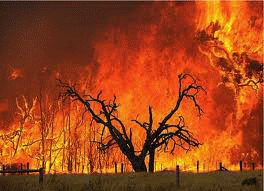
If leaders can’t get their heads around the wildfire-climate link, we had better prepare for many more nasty summers “…………. Now, everything is merged into one, and greatly enlarged. In my youth the places I recall having summer fires were Australia, the western United States, and odd outbreaks in Latin America, Africa and Mediterranean countries. Now we hear of fires erupting in other northern lands, as far north as the shores of the Arctic Ocean.
Looking back at this year so far we could be forgiven for thinking the whole world is ablaze. Almost as soon as wildfires are extinguished on one continent they seem to be breaking out afresh on another one.
2020 began with Australia’s record-breaking Black Summer fires destroying millions of hectares of forest and capturing global attention. Within a couple of months fires had broken out in Ukraine, threatening the abandoned Chernobyl nuclear plant.
A month later, smouldering peat that had been primed by years of drying and warming began to spark vegetation fires in Siberia that would eventually number over 600, emitting more carbon in two months than any preceding year and producing a smoke cloud spanning an area bigger than Europe.
The Siberian fires were still burning in mid-August when forests in California erupted into flames, more than a month earlier than the start of a “normal” season in that part of the world and less than two years after its previous record-breaking year.
At the end of a relatively quiet Californian fire season, in 2019-20 Australia got the benefit of that state’s large water-bombing aircraft, one of which crashed in the Australian Alps killing its US crew. Now, with California suffering similar devastation, we are battling to respond to its desperate appeal for reciprocal help.
Add to all those the perennial fires accompanying rainforest clearing in Southeast Asia and Brazil. The Amazon Basin situation is dire. August-September is the land-clearers’ peak burning period, and this year, with legal constraints all but destroyed under president Jair Bolsonaro, the area burnt and smoke generated looks like being even worse than what triggered last year’s global alarm.
Last week saw release of the interim report of the inquiry into Australia’s natural disaster management, led by former air force chief Mark Binskin, which was set up by the Morrison government after the Black Summer fires.
As the Black Summer fires showed, the report said, “bushfire behaviour has become more extreme and less predictable. Catastrophic fire conditions may become more common, rendering traditional bushfire prediction models and firefighting techniques less effective.”
No close observer of climate change would be surprised by the coronavirus pandemic’s global progress and the response to it of many political and vested interests. Those interests might wish it were otherwise, but this contagion operates without any reference to the things they hold dear.
Climate change, too, doesn’t recognise human boundaries. We set it off, and by failing to curb carbon emissions, we ensured its impact would continue to grow. Yet Australian governments, ignoring dire warnings from disaster experts, continue to behave as if it doesn’t exist.
This summer may see something of a reprieve. Weather authorities anticipate a wettish spring for eastern Australia. A moist understory is less likely to kindle fire from dry lightning, which has plagued recent fire management in both hemispheres.
But hoping for good weather doesn’t replace what the experts keep saying: a fire plan that doesn’t acknowledge the overwhelming influence of climate change is no plan at all. If partisan politics and vested interests prevent us acting on this, we’d better get ready for many more summers from hell. http://southwind.com.au/2020/09/08/endless-summers-endless-wildfires/
Joe Biden if president will push allies like Australia to do more on climate, adviser says
Joe Biden if president will push allies like Australia to do more on climate, adviser says
Jake Sullivan says the former vice-president, if elected, won’t ‘pull any punches’ on what is a global problem. Guardian Daniel Hurst @danielhurstbne, Mon 7 Sep 2020
Joe Biden will not pull any punches with allies including Australia in seeking to build international momentum for stronger action on the climate crisis, an adviser to the US presidential candidate has said.
If elected in November, Biden will hold heavy emitters such as China accountable for doing more “but he’s also going to push our friends to do more as well”, according to Jake Sullivan, who was the national security adviser to Biden when he was vice-president and is now in the candidate’s inner circle……..
While Australia’s prime minister, Scott Morrison, is likely to welcome the pledge of US coordination with allies on regional security issues, there may be unease in government ranks about the potential for tough conversations about Australia’s climate policies.
The Coalition government has resisted calls to embrace a target of net-zero emissions by 2050 and it proposes to use Kyoto carryover credits to meet Australia’s 2030 emission reductions pledge. Some Coalition backbenchers still openly dispute climate science.
Sullivan said climate change would be a big priority for Biden, both in domestic policy – with climate and clean energy issues placed at the heart of his economic recovery visions – and in foreign policy, where he would do more than just reverse Donald Trump’s decision to abandon the Paris agreement.
He has said right out of the gate, we’re not just rejoining Paris – we are going to rally the nations of the world to get everyone to up their game, to elevate their ambition, to do more,” Sullivan told the Lowy Institute. ………. https://www.theguardian.com/us-news/2020/sep/07/joe-biden-if-president-will-push-allies-like-australia-to-do-more-on-climate-adviser-says
PM ARGUES THAT PUBLICLY AVAILABLE INFO SHOULD REMAIN SECRET
Morrison government rushing to make Austraia’s environment laws even weaker: a recipe for extinctions
 ‘Recipe for extinction’: why Australia’s rush to change environment laws is sparking widespread concern
Critics argue shifting approval powers to the states without an independent regulator will fail to protect the environment, Guardian, Lisa Cox– 6 Sept 20
Anger over proposed changes to national environmental laws is escalating, with legal, health and conservation groups urging that they not pass the Senate, with some warning it would increase the extinction rate.
The government rammed its legislation to change Australia’s Environment Protection and Biodiversity Conservation Act through the lower house on Thursday night, prompting outrage from Labor, the Greens and crossbench.
WWF-Australia says the bill in its current reform is a “recipe for extinction” and lacks standards that would ensure strong protections for nature, as well as a commitment to an independent regulator to enforce the law.
“There is more than just wildlife at stake here,” Rachel Lowry, WWF-Australia’s chief conservation officer, says. “If approved, this bill will fail Australians at this critical moment in time because it fails to incentivise win-win solutions that stimulate our economy and protect the places and animals we love.
“Shifting approval powers to the states without an independent regulator to ensure enforcement would be the most damaging environmental decision to occur within Australia in recent decades.”
The government’s bill would amend Australia’s environmental laws, clearing the way for the transfer of development approval powers to state and territory governments.
The prime minister, Scott Morrison, and the environment minister, Sussan Ley, have argued the changes are necessary to aid Australia’s economic recovery from the Covid-19 pandemic.
The proposed changes passed the lower house on Thursday night after the government used its numbers to gag debate on the bill and amendments proposed by Labor and the crossbench.
No member of the government spoke on the bill, which still has to pass the Senate and will likely be debated during the October budget sittings.
Rachel Walmsley, the policy and law reform director at the Environmental Defenders Office, says the government is trying to avoid scrutiny.
She warns the bill has the potential to undermine the statutory review of the EPBC Act, chaired by the former competition watchdog head Graeme Samuel, which is not due to table its final report until the end of October.
The key finding of Samuel’s interim report was that Australia’s system of environmental protections had failed and the decline of wildlife and habitat was unsustainable.
“It was a fairly atrocious process that, moments before adjournment, they rammed it through,” Walmsley says.
“The gagging of the debate, the fact they prevented voting on amendments and the fact no government MP stood up to justify the policy – it prevented proper parliamentary scrutiny.”
The Climate and Health Alliance, which is a coalition of Australian health organisations, has called on the Senate to block the amendments.
“Australia’s natural environment is declining on every possible measure. We lead the world in animal extinctions,” says the alliance’s executive director, Fiona Armstrong. “There is no economy without a healthy environment.
“The government is trying to rush through amendments to our environmental protection laws that would weaken them in favour of expanding gas and fossil fuel projects that harm the environment and threaten human health.”
The Law Council of Australia has called for the bill to be put before a parliamentary committee for inquiry and not rushed through the Senate.
The government and One Nation have blocked several attempts by the Greens to have a parliamentary committee examine the bill.
International obligations
The Law Council says the government needs to make sure it retains oversight of matters of national environmental significance if it enters into bilateral approval agreements with state and territory governments.
The council says this is particularly important for ensuring Australia still meets its obligations under some 33 international treaties and protocols to which it is signatory, including for world heritage sites…….. https://www.theguardian.com/australia-news/2020/sep/06/recipe-for-extinction-why-australias-rush-to-change-environment-laws-is-sparking-widespread-concern
Environment Law: Scott Morrison’s government shows its disdain for ZaliSteggall and the cross-benchers
Independent MPs furious as government rams environmental law changes through lower house, https://www.sbs.com.au/news/independent-mps-furious-as-government-rams-environmental-law-changes-through-lower-house 4 Sept 20 The Morrison government has been branded a “bully in action” for pushing its environment law changes through the lower house without following usual process.
Independent MPs are furious with the Morrison government for throwing due process out the window and ramming controversial environmental laws through the lower house.
Crossbench MP Zali Steggall flagged amendments to the bill but the government refused to allow them to be voted on.
Instead, the coalition used its numbers to shove the bill through the lower house on Thursday night.
Ms Steggall described the government as a “bully in action”.
“The PM and every coalition MP made a mockery of due process for legislation and bulldozed environmental and water protection,” she said.
“And they were laughing while doing it. This is how they represent you. If you care, contact your MP.”
The changes to the national environment protection laws pave the way for states to take over approvals.
The states would have to abide by a set of national environment standards, which have not been developed.
The changes are in response to an interim review conducted by former competition watchdog Graeme Samuel.
Professor Samuel also recommended installing an independent environmental umpire, but the government has rejected that.
Independent Tasmanian MP Andrew Wilkie says the changes will water down environment protection.
“(The bill) hands decision-making to state and territory governments who have shown time and time again to be conflicted and incapable of protecting the environment,” he said.
“The passage of the amendment through the House of Representatives was also a chilling demonstration of the government’s complete contempt for democracy.
“Most members of the house were prevented from speaking, and foreshadowed amendments were blocked without debate. The government acted again like an elected dictatorship.”
Environment Minister Sussan Ley was quick to defend the changes after outrage over the process.
“There will be more reforms to follow,” she said.
“We will develop strong Commonwealth-led national environmental standards which will underpin new bilateral agreements with state governments.”
The bill is likely to be referred to a Senate committee for scrutiny, pumping the brakes on its progress.
Labor and the Greens oppose the legislation.
Australian government, masks its anti-environment action under the cover of Covid-19
|
And it does all this while lambasting the states for omissions and inefficiencies. Nowhere does it suggest devolving more power to these already incompetent entities. Of course this royal commission is largely focused on natural disasters rather than broader issues of environmental management and climate change, but its findings are telling in their precision: “Current arrangements do not provide a clear mechanism to elevate these matters to national leaders.” Is it possible that our national leaders don’t want these or any other tricky environmental matters elevated to them? What other conclusion can be reached when the government is trying with such energy to push through “new” legislation that greatly reduces its role in environmental issues? This is fundamentally the same proposal that Tony Abbott put forward as prime minister. It was defeated then, but the thought is that it might scrape through now under the cloak of Covid. That is the hard-nosed judgment of the same climate deniers and coal lobbyists who have run the Coalition all these years. And Scott Morrison’s hands remain as black as any. Since there is a full review of current environmental legislation being conducted by Graeme Samuel, which is due to deliver a final report in the blink of an eye (ie October this year) what possible justification can be given for ramrodding legislation into the parliament now?
Samuel’s interim report recommends “national enforceable standards” as an essential part of keeping the states honest in these matters. How necessary that is when, as Ken Henry so powerfully pointed out, the states have a complete conflict of interest in their receipt of royalties from projects and the fact that they are often the proponents of them. But there is no mention of these national standards in the proposal or of referring relevant conflicts to the federal government. …… The Australian government is the signatory to all our international commitments that relate to climate and the environment of which there are many, ranging from The World Heritage Convention to the Bonn Convention on the Conservation of Migratory Species and at least half a dozen others. The states are signatories to none. What is the logic in devolving power to the states at a time when these agreements and the obligations therein are becoming increasingly important? None?.. The root cause of all this ill-conceived thinking is a failure to understand what an economy is. In the government’s view it is an entity unto itself – it seems to operate independently of the world in which we live, until events wrench us back to it. According to this theory, the environment is somehow in conflict with the economy rather than the integral, vital essence of it. ……… https://www.theguardian.com/commentisfree/2020/sep/04/under-the-cloak-of-covid-the-government-is-rushing-ill-considered-changes-to-australias-environment-laws |
|

Aussies call for tougher environment laws
ACF’s chief Kelly O’Shanassy has sent it to Prime Minister Scott Morrison and his Environment Minister Sussan Ley, who are in the midst of tweaking the national protection laws.
The changes are in response to an interim review of the laws, but rather than strengthening environmental standards the first move is to cut red tape.
ACF’s petition calls on the government to create a “new generation of national laws to protect nature and funding to restore ecosystems to bring our wildlife back from the brink”.
In his interim review, former competition watchdog Graeme Samuel found the current laws were ineffective and Australia’s environmental trajectory is unsustainable.
He recommended an independent environmental watchdog, which has been rejected by the government.
Instead the first changes set the stage for states to take over environmental approvals.
They will have to abide by a set of national environmental standards, which have not yet been developed…….
Labor and the Greens oppose the government’s changes, and want Ms Ley to wait until Professor Samuel’s final report is handed down next month before changing the laws. https://www.denipt.com.au/national/2020/09/03/1566977/aussies-call-for-tougher-environment-laws
1 This month


Help Aunty Sue Protect Her Land and Sacred Sites From Destructive Rocket Testing.
.

Australians deserve the truth
about
AUKUS – https://aukuspublicinquiry.com/

PETITION – To: Prime Minister Anthony Albanese and the Australian Labor Government

of the week – Australians for War Powers Reform (AWPR)
To see nuclear-related stories in greater depth and intensity

