Mirrar people at last have control of Jabiru, as Ranger uranium mining set to end operations

Traditional owners regain control of Jabiru as historic land rights law passes Senate Natasha Emeck, NT News, 3 Sept 20 HISTORIC land rights legislation that will allow the traditional owners of Jabiru to regain control of their township has passed through the Senate.
Amendments to Aboriginal land rights laws passed through the upper house of federal parliament pm Thursday, returning the ownership of Jabiru to the Mirarr people and allowing for a long-term township lease.
The mining town was built in 1982 to service the Ranger uranium mine, which will cease operation in January 2021, heralding a new era for the town and surrounding Kakadu National Park.
Senator Malarndirri McCarthy said today’s historic moment had been a “long time coming” for the Mirarr people, who had been campaigning for this for 20 years.
Senior Mirarr traditional owner and Kakadu resident Yvonne Margarula, pictured in Kakadu National Park.
Mirarr senior traditional owner Yvonne Margarula said her people were glad to see the legal changes finally happen.
“They are essential to ensuring the vibrant post-mining future of Jabiru and the Kakadu region that Mirarr have been planning for,” she said.
“We look forward to welcoming visitors from all around the world to our beautiful country.”
Gundjeihmi Aboriginal Corporation, who represents the Mirarr traditional owners, have crafted a masterplan to turn Jabiru into an Indigenous-led tourism and services town.
“This bipartisan change to the legislation is an essential step to correct the historical exclusion of the town of Jabiru from Aboriginal ownership and allow Mirarr to take the legal control they need to enact their vision,” chief executive Justin O’Brien said.
Renewable energy can save the natural world – but if we’re not careful, it will also hurt it
Renewable energy can save the natural world – but if we’re not careful, it will also hurt it https://theconversation.com/renewable-energy-can-save-the-natural-world-but-if-were-not-careful-it-will-also-hurt-it-145166
September 2, 2020 Laura Sonter, Lecturer in Environmental Management, The University of Queensland, James Watson, Professor, The University of Queensland, Richard K Valenta, Director – WH Bryan Mining and Geology Research Centre – The Sustainable Minerals Institute, The University of Queensland
A vast transition from fossil fuels to renewable energy is crucial to slowing climate change. But building solar panels, wind turbines and other renewable energy infrastructure requires mining for materials. If not done responsibly, this may damage species and ecosystems.
In our research, published today, we mapped the world’s potential mining areas and assessed how they overlap with biodiversity conservation sites.
We found renewable energy production will exacerbate the threat mining poses to biodiversity – the world’s variety of animals and plants. It’s fair to assume that in some places, the extraction of renewables minerals may cause more damage to nature than the climate change it averts.
Australia is well placed to become a leader in mining of renewable energy materials and drive the push to a low-carbon world. But we must act now to protect our biodiversity from being harmed in the process.
Mining to prevent climate change
Currently, about 17% of current global energy consumption is achieved through renewable energy. To further reduce greenhouse gas emissions, this proportion must rapidly increase.
Building new renewable energy infrastructure will involve mining minerals and metals. Some of these include:
- lithium, graphite and cobalt (mostly used in battery storage)
- zinc and titanium (used mostly for wind and geothermal energy)
- copper, nickle and aluminium (used in a range of renewable energy technologies).
The World Bank estimates the production of such materials could increase by 500% by 2050. It says more than 3 billion tonnes of minerals and metals will be needed to build the wind, solar and geothermal power, and energy storage, needed to keep global warming below 2℃ this century.
However, mining can seriously damage species and places. It destroys natural habitat, and surrounding environments can be harmed by the construction of transport infrastructure such as roads and railways.
What we found
We mapped areas around the world potentially affected by mining. Our analysis involved 62,381 pre-operational, operational, and closed mines targeting 40 different materials.
We found mining may influence about 50 million km² of Earth’s land surface (or 37%, excluding Antarctica). Some 82% of these areas contain materials needed for renewable energy production. Of this, 12% overlaps with protected areas, 7% with “key biodiversity areas”, and 14% with remaining wilderness.
Our results suggest mining of renewable energy materials may increase in currently untouched and “biodiverse” places. These areas are considered critical to helping species overcome the challenges of climate change.
Threats here and abroad
Australia is well positioned to become a leading supplier of materials for renewable energy. We are also one of only 17 nations considered ecologically “megadiverse”.
Yet, many of the minerals needed for renewable energy exist in important conservation areas.
For example, Australia is rich in lithium and already accounts for half of world production. Hard-rock lithium mines operate in the Pilbara region of Western Australia.
This area has also been identified as a national biodiversity hotspot and is home to many native species. These include small marsupials such as the little red antechinus and the pebble-mound mouse, and reptiles including gecko and goanna species.
Australia is also ranked sixth in the world for deposits of rare earth elements, many of which are needed to produce magnets for wind turbines. We also have large resources of other renewables materials such as cobalt, manganese, tantalum, tungsten and zirconium.
It’s critical that mining doesn’t damage Australia’s already vulnerable biodiversity, and harm the natural places valued by Indigenous people and other communities.
In many cases, renewables minerals are found in countries where the resource sector is not strongly regulated, posing an even greater environmental threat. For example, the world’s second-largest untouched lithium reserve exists in Bolivia’s Salar de Uyuni salt pan. This naturally diverse area is mostly untouched by mining.
The renewables expansion will also require iron and steel. To date, mining for iron in Brazil has almost wiped out an entire plant community, and recent dam failures devastated the environment and communities.
We need proactive planning
Strong planning and conservation action is needed to avoid, manage and prevent the harm mining causes to the environment. However global conservation efforts are often naive to the threats posed by significant growth in renewable energies.
Some protected areas around the world prevent mining, but more than 14% contain metal mines in or near their boundaries. Consequences for biodiversity may extend many kilometres from mining sites.
Meanwhile, other areas increasingly important for conservation are focused on the needs of biodiversity, and don’t consider the distribution of mineral resources and pressures to extract them. Conservation plans for these sites must involve strategies to manage the mining threat.
There is some good news. Our analyses suggest many required materials occur outside protected areas and other conservation priorities. The challenge now is to identify which species are most at risk from current and future mining development, and develop strong policies to avoid their loss.
Murray-Darling River system; mysterious loss of more than 2 trillion litres of water

The mystery of the Murray-Darling’s vanishing flows, ABC By national science, technology and environment reporter Michael Slezak, Mark Doman, Katia Shatoba, Penny Timms and Alex Palmer 3 Sep 2020
It might be the biggest whodunnit — or what-dunnit — in Australia.
More than 2 trillion litres of water — enough to fill Sydney Harbour four and a half times — has gone missing from our largest and most precious river system — the Murray-Darling Basin.
And it’s happened in what was already one of the driest periods the basin has seen.
According to an investigation by some of Australia’s top water scientists, shared exclusively with the ABC, 20 per cent of the water expected to flow down the rivers from 2012-2019 was simply not there. That’s despite almost $7 billion being spent to protect the health of the system’s rivers and ecosystems that rely on them.
Was it stolen? Was it lost? Has climate change made it go up in steam? Or was it simply never there in the first place?
There are clues scattered up and down the rivers but one simple message is clear in the scientists’ findings. For the first time, they provide evidence that the Murray-Darling Basin Plan — the most expensive environmental program in Australia’s history — is delivering much less water than was expected.
And the implications could be huge……. EXCELLENT INTERACTIVE GRAPHICS HERE
…..“It’s a huge discrepancy to be missing a fifth of the water that’s meant to be in the rivers,” said Jamie Pittock from the ANU. He’s an expert in water management and a co-author of the Wentworth Group’s report.
“It means that there are all sorts of things that Australians value that won’t be sustained … like more water for towns … the floodplains, growing grass for sheep and cattle, in terms of biodiversity being conserved, waterbirds, red gum forests and conserving our fish.”…………
there are clues. Lots of them. We’ve seen water go missing up and down the river with clear explanations before. And looking closely at the new report, many of those explanations are consistent with the new data.
Clue one: tampered meters and criminal prosecutions
One possible explanation for the shortfall is that some of the missing water has been stolen.
An investigation by Four Corners in 2017 put water theft in the spotlight — much of it around the Barwon-Darling catchment in the Northern Basin.
Irrigators there, according to official figures, use 3 per cent of all the water taken from the entire Murray-Darling Basin.
But on top of those official figures, there has been significantly more water taken in that area. The Murray-Darling Basin Authority itself estimated that in the Northern Basin, as little as 25 per cent of surface water take has been metered.
Some of the water that went unmetered was stolen.
Peter Harris, who was named in the 2017 Four Corners, was this year found guilty of water theft just upstream from those gauges at Brewarrina.
Anthony Barlow, another person named in the program, was found guilty and fined $190,000, for water theft just upstream again.
Since the Natural Resources Access Regulator (NRAR) was formed in NSW in 2018, 15 additional charges have been laid in these locations across the state for water theft and related actions, according to an NRAR spokeswoman.
Emma Carmody, a lawyer at the Environmental Defenders’ Office, said the criminal prosecutions do not represent how widespread water theft has been.
“I’d actually go so far as to say that this situation pre-2018 was catastrophically bad in those northern catchments in relation to compliance and enforcement,” Dr Carmody said………..
Clue two: shadow take
Travel further upstream along the Macquarie River towards Dubbo, and you land in the internationally protected wetlands of the Macquarie Marshes………
In a landscape so flat, structures like roads, engineered channels and small levee banks can divert staggering volumes of floodwater — potentially shepherding it across a farmer’s fields where it is left to soak into the ground, or even pumped into dams.
This water taken by irrigators and graziers from the floodplains — rather than from the rivers — has hardly ever been measured.
Using satellite imagery, flood paths appear guided by seemingly innocuous structures, or completely cut off by others.
Richard Kingsford is a river ecologist at the University of New South Wales who has studied the Macquarie Marshes and the impacts of floodplain harvesting.
He says water that spills over floodplains often drains back into rivers, and interrupting its flow can have big impacts, including contributing to the missing flows.
“There are very few places where we have an accurate estimate of how much water is being taken from the floodplain. And to me, this has been a yawning gap in the policy,” he said…………
Clue Three: The cash splash
If we head all the way to southern NSW, we see a completely different clue.
Billions have been spent subsidising “efficiency measures” to help farmers save water there.
That can be done by upgrading old irrigation systems to deliver water directly to roots, or lining water channels, for example. Then about half of the water saved by the farmers gets handed to the government for the environment.
But according to some experts, the “inefficiencies” prior to the upgrades just meant some of the water used by irrigators flowed back into the rivers. The upgrades mean that “return flow” stops happening………..
In a report published in 2019, Professor Williams estimated that at least 280 billion litres of water per year might have been lost from the rivers — and are unaccounted for — due to this problem.
“That must be a major reason that we’re not getting the flow regimes that we need,” Professor Williams said.
The MDBA commissioned its own analysis of the issue and concluded the loss of return flows was reducing water in the rivers by 121 billion litres a year.……..
Clue Four: Climate change
There is one issue, however, that most experts do agree is a major reason for the missing water in the basin.
“The MDBA considers a changing climate to be the primary contributory factor,” said the MDBA’s Vicki Woodburn.
Since the basin plan was introduced, heat records across the area have been broken in four of the eight years. The last three years have been the hottest ever recorded in the basin.
According to the South Australian royal commission into the Murray-Darling basin plan, the MDBA “completely ignored climate change” when determining how much water needed to be saved.
If true, that means the overall target may have been set too low — that more water needs to be recovered from irrigation to save the river system.
But the same models used to set those targets have also been used to manage the rivers, and now to calculate how much water should be in the rivers. And by inadequately accounting for climate change, those models are likely over-predicting how much water is being recovered.
Climate change means more water is likely being lost between gauges, as it flows along — lost into the dry river beds and the hot air…………..
Clue five: The water was never there
In a twist worthy of any whodunnit, could it be that some of the missing water was simply never there in the first place?
According to the Wentworth Group, the government modelling used to predict how much water we should see in the river has some fundamental flaws which likely exaggerate the volumes.
For example, in 2018, the Murray-Darling Basin Authority found its modelling “has trouble predicting low flows”.
That meant that when water stopped flowing in the river, the model would still show water flowing — something that could have been particularly problematic over the past seven years when low flows were very common………….
What it all means
If there’s less water in the rivers than we ever planned for, what’s to be done about it?……………..
Professor Vertessy, who advises the MDBA, thinks this sort of shortfall could contribute to a rethink of the long-term water recovery targets. https://www.abc.net.au/news/2020-09-03/the-mystery-of-the-murray-darlings-vanishing-flows/12612166?nw=0
“We may have to — I think everyone would accept that these sustainable diversion limits aren’t quantities which you ossify for posterity,” he says.
“They’ve got to be adjusted to fit in with the new climate realities and the social preferences of the day.”
And the scientists say whatever the response to the findings, something has to give.
“The current basin plan tries to pretend that we can do everything with a smaller and smaller cake,” says Professor Pittock.
“What this really means is that society is going to have to make some hard choices. How much irrigated agriculture do we want as a society versus how much do we want to retain by way of wetlands and ecosystems [or] of sites of cultural value to Indigenous people?” https://www.abc.net.au/news/2020-09-03/the-mystery-of-the-murray-darlings-vanishing-flows/12612166?nw=0
Repower WA with Renewables: 90% by 2030
|
Repower WA with Renewables: 90% by 2030, https://www.cleanstate.org.au/repower_wa Western Australia’s energy sector is one of the best places to start to create thousands of jobs and drive down emissions. With the best sun and wind resources in the world, it’s time to harness the economic benefits and renewable potential of our state. All Australia’s other states & territories are embracing the clean energy transition with renewable energy targets, and WA’s lack of such a plan is a failure to grasp an excellent opportunity.
Repowering WA with renewable energy provides a once in a generation opportunity for infrastructure investment, jobs and value creation that will be a powerful driver for economic activity for decades to come. The proposalPowering WA’s Southwest electricity grid with renewable energy by 2030 is both affordable and achievable. The costs of building and delivering renewable energy solutions are reducing every year, and large scale wind and solar are already able to deliver cheaper electricity than coal and gas. Repowering WA can reduce energy bills for homes and businesses, and support significant growth in manufacturing, minerals processing and other energy-intensive industries that can employ more people here in WA. A report commissioned by Clean State has found the move to 90% renewable electricity on WA’s South West Interconnected System (SWIS) is technologically possible by 2030 and would create over 8600 jobs. The 90% Renewable Energy Roadmap created by expert group Sustainable Energy Now provides a transition blueprint for the SWIS – WA’s main electricity grid covering most of the population and spanning from Geraldton to Kalgoorlie. For this plan, new renewable energy generation capacity totalling 11.7 GW of will be required by 2030. Optimising the mix of technology to take into consideration electricity demand, weather, cost, technology and the design of the SWIS grid, the SEN model suggests that this should be made up of:
This investment would provide a significant number of jobs to build the infrastructure required. Each year, 800MW of new renewable energy capacity would need to be added, which is, roughly equivalent to the sum of the following:
There would also be additional investment and employment opportunities in providing energy storage and grid services to compliment this generation mix. Much of the rooftop solar can be delivered by private investment if WA’s electricity market is reformed to enable rooftop solar and battery systems to link into the grid productively. Increased battery storage would stabilise the network, and with 78,000 houses in WA coming off a 40c feed in-tariff this year, there is a prime opportunity to encourage these households to upgrade and battery. Besides the climate benefits and direct employment gains accompanying these investments and reforms, a timetable for the staged and managed closure of WA’s coal-fired power stations will avoid energy and business uncertainty, both for the state and for those currently working in the industry. Many credible studies have found that the SWIS, WA’s main grid, can transition to 100% Renewable sources by 2030. These include:
|
|
AUSTRALIAN GOVERNMENT ALLERGIC TO TRANSPARENCY AND A SENATE SHY IN ENFORCING IT


PARLIAMENT COVERS UP AUSTRALIA’S TRUE CARBON FOOTPRINT
 Parliament Covers Up Australia’s True Carbon Footprint, ByTasmanian Times, August 31, 2020 The House Standing Committee on the Environment and Energy today tabled its report on Andrew Wilkie MP’s National Greenhouse and Energy Reporting Amendment (Transparency in Carbon Emissions Accounting) Bill 2020 in Federal Parliament.
“Regrettably the Committee has voted to cover up Australia’s shameful role as one of the world’s biggest contributors to climate change,” Mr Wilkie said. “But the reasoning behind its recommendation for Parliament not to pass this Bill doesn’t stack up.”
Mr Wilkie’s Bill would require the Federal Government to include scope 3 emissions in reports of Australia’s carbon emissions, boosting transparency and accountability. Scope 3 emissions are the potential emissions contained in the gas and coal mined in Australia, which is then exported overseas. The Bill allows Australia to track its impact as one of the largest exporters of fossil fuels in the world, giving the public access to information about Australia’s role in very significantly contributing to global greenhouse gas emissions.
“Australia must have a clear picture of its contributions to global greenhouse gas emissions,” Mr Wilkie said. “This is essential as the world tries to limit warming to 1.5 degrees and halt catastrophic climate change. Keeping track of Australia’s scope 3 emissions is not double counting but gives a true picture of our responsibility for climate change around the globe.
The Committee can hardly argue that tracking scope 3 emissions is ‘too hard’ when the Department of Industry, Science, Energy and Resources has not even conducted an assessment of compliance costs. For goodness sake, the Committee acknowledges that more than a quarter of ASX200 companies already voluntarily report their scope 3 emissions.
“Further, the fact that this kind of tracking is not required by the Paris Agreement is beside the point. The Australian Government should be open and transparent for the sake of the community, rather than claiming that Australia can do little to influence climate change. The truth is that when the carbon in fossil fuel exports is taken into account, Australia accounts for about 5 per cent of the global total for fossil fuels.”
The full House Standing Committee on the Environment and Energy report can be found here.
2. ANALYSIS OF THE BILL………… HTTPS://TASMANIANTIMES.COM/2020/08/PARLIAMENT-COVERS-UP-AUSTRALIAS-TRUE-CARBON-FOOTPRINT/
GreenPower seeks to revive interest, launches refreshed brand
|
GreenPower seeks to revive interest, launches refreshed brand, RenewEconomy
Michael Mazengarb1 September 2020 Australia’s only government-backed accreditation program for renewable electricity sales, GreenPower, has unveiled new branding as it seeks to inspire renewed interest from a growing number of business looking to cut their emissions.
The GreenPower program is a voluntary way for households and businesses to purchase renewable electricity through their retailer, with the government-backed program providing a process for verifying that purchases are actually helping to grow Australia’s wind and solar sectors and cut emissions. All power purchased through the GreenPower program is in addition to the federally mandated Renewable Energy Target, ensuring that customer purchases under the voluntary program help to grow Australia’s renewable energy supplies. Around 110,000 households and 17,500 businesses currently opt-in to purchasing renewable electricity through the GreenPower program, with almost 500 wind, solar, hydro and biomass projects accredited as GreenPower generators. In addition to a refreshed logo and brand identity, the GreenPower program has launched an updated website, with new functionality that it hopes will help electricity customers identify a suitable GreenPower product……….https://reneweconomy.com.au/greenpower-seeks-to-revive-interest-launches-refreshed-brand-75246/ |
|
|
Indecent haste in Australian government’s push for law making Napandee the nuclear waste dump. What’s going on?
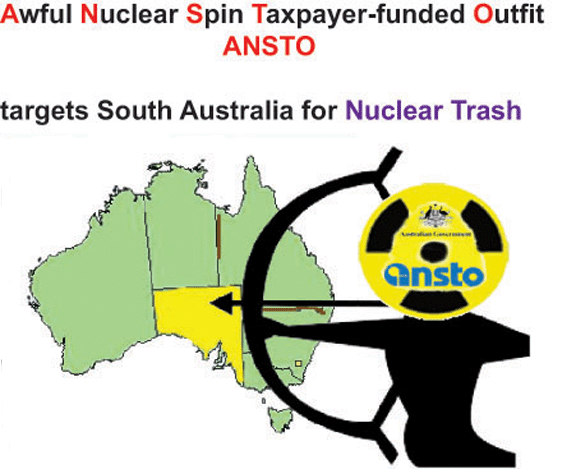
New nuclear legislation set to provide toxic dumping ground in South Australia, Independent Australia, By Noel Wauchope |
UNDER THE PRESSURE of The Australian Nuclear Science and Technology Organisation (ANSTO), The Australian Government is in a hurry to get a new bill passed. It’s not really a new bill, it’s actually a new bit tacked on to an existing one. It’s called the National Radioactive Waste Management Amendment (Site Specification, Community Fund and Other Measures) Bill 2020.
The amendment does two important things: it selects a definite place in South Australia, a farmer’s property called Napandee, as a radioactive waste dump and it removes the possibility of a judicial review of that selection.
The proposed dump is an “interim” radioactive waste facility.
It would consist of two parts:
- Temporary above-ground storage for what is known as low-level waste (LLW). LLW is a general term for a range of objects that are radioactively contaminated, but not considered to be highly radioactive nor toxic for thousands of years.
- A “temporary” above-ground storage for intermediate-level waste (ILW). ILW is a term for a mix of wastes that contains some very long-lived highly toxic radioactive matter, that does require isolation for thousands of years. While this amount would be smaller in volume, it would be far more significant. 95 per cent of this radioactive content would be spent nuclear fuel rods from ANSTO’s nuclear reactor at Lucas Heights, Sydney.
At present, these highly radioactive wastes are stored in giant canisters at Lucas Heights, where there is ample space for further canisters and experienced and skilled staff to monitor them and provide security.
ANSTO has plans to expand its operation and CEO Dr Adi Paterson’s dream of a world-leading business in exporting radionuclides for medicine and industry. Meanwhile, international nuclear security obligations demand that Australia develop a plan for the permanent disposal of nuclear wastes.
Unfortunately, this Napandee plan does nothing towards meeting these obligations. ……….
There is no plan whatsoever for the permanent disposal of this highly radioactive trash.
There’s a vague story that these wastes will later be moved from Napandee to a permanent disposal — anything from 40 to 300 years. They are most likely to suffer the fate of other such facilities in the USA and other countries and become stranded wastes…….
There was a heavy emphasis on “medical” wastes. But the reality is that the vast majority of wastes from nuclear medicine are very short-lived radioisotopes, that have no need to be transported thousands of miles and are routinely disposed of close to places such as hospitals where they are used.
A ballot was held in the area, of ratepayers only, on whether or not to support the project. Some residents close to the property were excluded, as were the Native Title holders, the Barngarla Aboriginal community. The vote result, from 824 voters, was 452 “yes”. The Barngarla held their own vote — 80 Barngarla voted, with the unanimous result of “no”.
The whole issue of the transport of the nuclear wastes and their “temporary” dumping does concern also the region, the state of South Australia and the nation. The decision should not be made solely by 452 ratepayers in one small rural area………
Non-ratepayers did not get a look-in. In this modern, almost Trumpian paradigm, outsiders such as economists, environmentalists, medical experts, sociologists and independent radiation experts are seen as “the elites” that can’t be trusted. Unfortunately, independent overseas experts on nuclear waste management have been excluded, too. Apart from the problems raised for the town and region of Kimba itself, there are serious questions about the appropriateness of the planned system, the area environmentally and geologically……..
Of course, this plan is confined to nuclear wastes produced in Australia. For now.
The plan is obviously helpful to ANSTO. They can pass this uncomfortable buck of 10,000 year-lasting radioactive wastes on to a distant South Australian rural community. It will then be managed and funded by whom? The South Australian and Australian tax-payers.
This will take the pressure of ANSTO, make it look as if they’re doing something about their radioactive trash and avoid any Lucas Heights, or rather Barden Ridge fuss, as they expand their operations. (The residential area previously part of Lucas Heights was renamed Barden Ridge to increase the real estate value of the area, as it would no longer be instantly associated with the nuclear reactor.)
It’s not so helpful to South Australia, or to Australia. The best solution is to leave those nuclear reactor wastes safely stored at Lucas Heights for the time being and to develop a national discussion and plan for what to do with those wastes for permanent disposal. Under this present, rather rushed scheme, Resources Minister Keith Pitt, Dr Paterson and the whole crew of the NRWMF will be dead and gone, long before the stranded wastes at Napandee will be properly dealt with.
A solution for the common good is what’s needed, not just a solution that suits ANSTO. ANSTO is a statutory body — a case of the tail wagging the dog, perhaps?
The National Radioactive Waste Management Amendment (Site Specification, Community Fund and Other Measures) Bill 2020 has been passed by the House of Representatives. It will be debated in the Senate later this year.
Meanwhile the Senate Economics Legislation Committee is holding an Inquiry into this bill…….
it gets interesting. Suddenly, a public hearing becomes private. The topic for this new secrecy was the discussion of some documents from the NRWMFT that had been requested by the Committee and received only a very short time before the hearing. The documents were heavily redacted. They relate to the process by which the Napandee site was selected. How spontaneous was the farmer’s offer of his land? What roles did the NRWMFT, ANSTO and the Industry Department, play in instigating this offer?
So many questions surround this plan:
- Is the new amendment being pushed because Minister Keith Pitt fears the opposition of Aboriginals, or indeed of the public in general?
- The exclusion of the Barngarla from the decision — how does this square with Indigenous rights?
- Why did the Government not provide any independent advice to the Kimba community?
- Why are the South Australian and Australian public excluded from decision-making?
- Why is this Senate Committee public hearing to be held in secret?
- Why is this all happening in such a hurry? https://independentaustralia.net/politics/politics-display/new-nuclear-legislation-set-to-provide-toxic-dumping-ground-in-south-australia,14256
The travesty of justice that is the UK extradition hearing about Julian Assange
|
August 30, 2020 by craig The travesty that is Julian Assange’s extradition hearing resumes fully on 7 September at the Old Bailey. I shall be abandoning my own legal team and going down to London to cover it again in full, for an expected three weeks. How this is going to work at the Old Bailey, I do not know. Covid restrictions presumably mean that the numbers in the public gallery will be tiny. As of now, there is no arrangement for Julian’s friends and family in place. It looks like 4am queuing is in prospect.
By 7 September it will be six months since I applied to resume my membership of the National Union of Journalists. I STILL have not the slightest idea who objected, or what the grounds were for objection. I have not heard from the NUJ for months. A senior official of an international journalists’ organisation has told us that he inquired, and learnt that the NUJ national executive has considered my application and set up a sub-committee to report. But if so, why is this secret, why have I not been informed, and why am I not allowed to know what the objection is? I find this all very sinister. At this stage it is not paranoid to wonder whose hand is behind this. The practical effect of this is that without NUJ membership I cannot access a Press card, and avail myself of whatever media arrangements are in place for the Assange hearing (just as I was kept out of most of the Salmond trial). I have now reached the stage where I would like to take legal action against the NUJ, but the finances are beyond me. I am not going to ask you to donate because we are going to need all our resources for the contempt case against me, which the Crown drags out. I shall be writing next week about my own case and that hearing earlier this week. I would just note now that the “virtual hearing” is entirely unsatisfactory and unfair on defendants. There was at least one occasion when my QC agreed with a suggestion of the judge when I would have instructed them not to had I been, as I should normally have been, seated near them in court and able to instruct. Unlike our adversaries including the Integrity Initiative, the 77th Brigade, Bellingcat, the Atlantic Council and hundreds of other warmongering propaganda operations, this blog has no source of state, corporate or institutional finance whatsoever. It runs entirely on voluntary subscriptions from its readers – many of whom do not necessarily agree with the every article, but welcome the alternative voice, insider information and debate. |
|

Australian government seeks to regurgitate Tony Abbott’s anti environment laws
 ‘Taking an eraser’ to Australia’s wildlife: ad blitz planned to fight environment law ‘Taking an eraser’ to Australia’s wildlife: ad blitz planned to fight environment law
Coalition accused of ‘breach of faith’ as it seeks to introduce almost exact replica of failed Abbott government legislation, Guardian, Lisa Cox, Sat 29 Aug 2020 Conservation groups will launch an advertising campaign aimed at building support for stronger national environment laws in response to what they say is a “breach of faith” by the Morrison government. Groups including Birdlife Australia, WWF and the Australian Conservation Foundation will begin a “Before it’s gone” campaign on Sunday with radio, print, TV and billboard advertisements featuring high-profile species including the koala and greater glider. It follows the Morrison government this week introducing legislation to hand greater powers to the states that included no measures to ensure maintained or strengthened protection for threatened species or ecosystems. Continue reading |
South Australian MP Peter Treloar says “Kimba nuclear waste dump is a federal issue”, but he’s fine with it anyway
Kimba nuclear waste site OK with Member for Flinders ahead of proposed new electoral boundaries, ABC, ABC Eyre Peninsula, By Evelyn Leckie and Gary-Jon Lysaght 28 Aug 20
With proposed electoral boundaries changing for the Eyre Peninsula, local MP Peter Treloar is poised to take on a community that remains divided on hosting the country’s nuclear waste.
Key points:
- Proposed electoral boundaries may lead to Kimba falling within the state seat of Flinders
- Peter Treloar is poised to take on Kimba’s nuclear waste storage issues
- The Kimba community remains divided on the region’s nuclear waste site
The Member for Flinders, whose electorate is slated to include Kimba after the redistribution, said although the nuclear waste dump was ultimately a federal issue, he had no problem with its proposed location.
“The Kimba community have decided themselves that they’re prepared to be accepting of that, so this process is playing out in the federal jurisdiction,” Mr Treloar said………
Earlier this year a cross-party parliamentary committee found “significant risk” that local Indigenous groups were not consulted about the nuclear dump to a standard required under international law. ……
https://www.abc.net.au/news/2020-08-27/flinders-member-weighs-in-on-nuclear-waste-in-kimba/12603022
Book: The Carbon Club -Tony Abbott and the ‘people’s revolt’ against Gillard’s climate policy
 Tony Abbott and the ‘people’s revolt’ against Gillard’s climate policy
In her new book ‘The Carbon Club’ Marian Wilkinson exposes the truth behind Australia’s inaction on climate change. Crikey, MARGOT SAVILLE, AUG 28, 2020
For several years, award-winning journalist Marian Wilkinson has been investigating the relationship between climate-sceptic politicians, business leaders and their allies. For her latest book The Carbon Club, she has conducted scores of interviews with players on both sides in order to expose the truth behind Australia’s inaction on climate change.
Bernardi teamed up with young libertarian Tim Andrews, who had trained with the Koch Brothers’ internship in the US.
“The two helped create the ‘people’s revolt’ against the climate policy, using the power of social media and the tactics of the Tea Party movement that was gaining ground in the US Republican party.
“One of the driving ideas behind the campaign was to exploit the anger and disaffection among ordinary voters towards politicians,” Wilkinson writes. …..
The “people’s revolt” against Gillard and the emissions trading scheme passed by Kevin Rudd would fundamentally fracture conservative politics in Australia, fostering splinter parties and deepening divisions in the Liberals, Wilkinson writes.
“It would destroy any chance of uniting the major political parties to face the enormous challenge of climate change.”………
Marian Wilkinson will discuss her new book at a Crikey Talks event for Inside Access members next month. Visit our Inside Access page to upgrade https://www.crikey.com.au/2020/08/28/book-review-carbon-club/
Cut through the propaganda. Population growth is NOT good for Australia
So, KPMG and its big-business clients hope that the masses will be lulled into supporting a return to higher immigration. Well, let’s hope a bit of counter-propaganda will prevent that.
Even on KPMG’s figures, this hit to the Australian economy and therefore living standards of Australians is suspect.
KPMG’s says GDP would be $117 billion lower each year by 2029-30 if we do not have these 1.1 million extra people, and that would leave every one of the 28 million Australians by then $2850 worse off each year – that is a total of $79.8 billion, let’s say $80 billion.
Bear with me with the figures.
Population growth propaganda
There was more fear-mongering, self-serving, and flawed guestimates over population this week – this time from the quintessential accountant and consultant to big business and government, KPMG.
Shock, horror, Australia’s population would be 1.1 million less by 2029-30 because of the reduction in immigration caused by Covid. That would be a “$117 billion” hit to the economy over the decade by dragging down economic growth, KPMG calculates. That would leave every Australian $2850 worse off each year, KPMG says.
So, KPMG and its big-business clients hope that the masses will be lulled into supporting a return to higher immigration. Well, let’s hope a bit of counter-propaganda will prevent that.
Even on KPMG’s figures, this hit to the Australian economy and therefore living standards of Australians is suspect.
KPMG’s says GDP would be $117 billion lower each year by 2029-30 if we do not have these 1.1 million extra people, and that would leave every one of the 28 million Australians by then $2850 worse off each year – that is a total of $79.8 billion, let’s say $80 billion.
Bear with me with the figures.
But if instead we have the extra immigrants, that $80 billion will not be “lost” because of the extra $117 billion in GDP the immigrants would provide. Take that $80 billion for the existing population away from KPMG’s $117 billion, it leaves $37 billion a year for the 1.1 million immigrants themselves, which comes to just $33,636 each immigrant per year, well below the Australian average income. So they are dragging their heels. They are a cost to the Australian community not an asset.
There is clearly something wrong with these “plucked-from-the-air” figures.
KPMG’s study looks at what would happen if there was no vaccine – and therefore no immigration – after one year and after two years. ……
But the 5.5% drop is not down to no immigration. Rather, it is down to all the other economically horrible things caused by a no-vaccine environment: closed businesses, closed borders, lack of confidence etc etc. But KPMG, to suit its own purposes, puts all of the lower GDP ($117 billion) down to no immigration and says the absence of immigration will cost every Australian $2850…..
Covid aside, there are good grounds for concluding that the John Howard-inspired high-immigration policies since the late 1990s have cost Australians dearly, not just in economic terms but also in environmental and lifestyle costs.
It is all very well bringing in immigrants with their immediate incomes which add to overall GDP in the short-term. But GDP per head in the long term is cruelled by that. Schools, hospitals and transport infrastructure have to be built to accommodate them. That might be good for KPMG’s big-business clients just as their immediate consumption needs might similarly benefit them.
But it is not so good for existing residents. Increased congestion and agricultural and wilderness land being consumed by housing are just some of the costs.
High immigration has become a self-perpetuating myth. It was a great thing for Australia from 1945 to about 1970, but thereafter it should have been questioned, but was not……..
The KPMG report is just one more bit of a continuous stream of pro-population propaganda. Couched in statistics and the “science” of economics, it goes unchallenged especially by media that should do better: the ABC, SBS, The Sydney Morning Herald and The Age. They rarely if ever challenge high immigration because of a misguided fear of being branded racist or anti-multicultural.
You don’t have to agree with high immigration to prove you are not a racist or anti-mulitculturalism. You can do that by merely supporting Australia’s laudable non-race-based refugee intake…….
The fact is, existing multicultural communities have the most to lose from high immigration because it puts extra pressure on the very services they need most: public transport, translation services, schools, health services and so on.
Covid, of course, poses a real threat to the present pro-population Ponzi scheme. If Australia experiences a couple of years’ relief from the high-immigration, high-population mantra, ordinary people might like the result. There would be less pressure on schools, hospitals, public transport, housing costs and so on.
Suddenly, people might revolt against high immigration and high population growth which enriches the few at the expense of the many and at the expense of the natural environment and its non-human inhabitants.
Small wonder KPMG and others like them are serving up the scare-mongering manipulated figures they did this week – continuing to serve their big-business clients against the interests of the vast bulk of Australian residents.
Among the many things that Australians should question and change as a consequence of Covid, high immigration should be near the top of the list….. http://www.crispinhull.com.au/2020/08/28/more-pro-population-growth-propaganda/?utm_source=mailpoet&utm_medium=email&utm_campaign=crispin-hull-column-16-nov-2019_99
Adani quietly rebranding Abbot Point terminal as company hit with $107m damages bill
 Adani quietly rebranding Abbot Point terminal as company hit with $107m damages bill
Exclusive: Queensland supreme court says company engaged in ‘unconscionable conduct’, Guardian Ben Smee @BenSmee, Fri 28 Aug 2020 Adani has quietly begun planning to rebrand its Abbot Point coal terminal – removing all reference to Adani in its company name and branding – as financiers continue to abandon the business and a Queensland court orders it to pay $106.8m in damages.
The Queensland supreme court this week ordered Adani to pay four terminal users damages for “unconscionable conduct” in a judgement that was scathing of Adani’s actions to advantage its own financial interests over other coal companies.
In the 93-page decision, the supreme court justice Jean Dalton said Adani’s ports business “attempted to disguise its behaviour in complex transactions”, engaged in conduct outside the boundaries of normal commercial behaviour, and “pleaded matters which were false”.
Name change planned as more investors pull out
Guardian Australia can reveal that Adani reserved two new company names with the Australian Securities and Investments Commission on 18 August – eight days before the court judgement. The Asic documents flag its intention to rebrand Adani Abbot Point Terminal and its holding company as the “North Queensland Export Terminal”.
In July, an Adani employee registered the web domain www.nqxt.com.au on behalf of Adani Abbot Point Operations, a separate company that manages the operations of the export terminal.
Climate campaigners say the move appears to be Adani “changing what has obviously become a toxic brand” amid its ongoing difficulties refinancing the port’s debts.
The Guardian can also reveal two additional Korean investors have, under pressure from climate activists, said they will dump their investments in Adani’s port, which has total debts of $1.5bn.
In recent days, Korean Investment Securities and Industrial Bank of Korea have written to activist groups confirming they will not offer further finance to the port, which would export coal from Adani’s controversial Carmichael coalmine………. https://www.theguardian.com/environment/2020/aug/28/adani-quietly-rebranding-abbot-point-terminal-as-company-hit-with-107m-damages-bill
Australia entangled in the military-industrial-intelligence-security complex

|
The military-industrial-intelligence-security complex https://johnmenadue.com/alison-broinowski-the-three-slash-complex/ By ALISON BROINOWSKI | On 25 August 2020 In 1961 President Eisenhower warned that a vast and permanent ‘military-industrial complex’ could produce ‘the disastrous rise of misplaced power’. Earlier, US Senators Robert La Follette and J. William Fulbright also foresaw the dangers of militarisation. Now we have a military/industrial/security/intelligence complex, and it is dangerous. Let’s start with ‘security’, which sounds harmless and desirable. Who welcomes insecurity? Our ‘safety and security’, various authorities assure us (never explaining the difference) are their prime concern, particularly after some egregious security failure on their part. Security abroad used to mean the First World remaining in control of opportunities, in its own interests. Security now additionally means controlling people euphemistically called ‘those who would do us harm’. Since 2001, national security has become an exponential, unassailable, growth area. Proliferating Australian laws criminalise knowing, revealing, or even asking anything about it. Despite some academics arguing that it includes food, health, social, economic, and environmental security, ‘hard-headed’ national security is the dominant growth area in universities and government. From there to intelligence. We lavishly fund the ‘community’ of ten security agencies which demand ever more power and resources. Several heads of ASIO, ASIS, ASD, and DFAT have followed each other in revolving door fashion. Some emerge occasionally to warn us of the new, dire, and continuing dangers we face. They can’t give details, of course, before WikiLeaks or the American media do, or until a tip-off to a Five Eyes partner inspires an ‘open source’ report. But they assure us of their best efforts – with a lot more staff – to keep us safe and secure. Their colleague from the American community, Mike Green, former Asia Director of the National Security Agency (the equivalent of ASIO), used to joke that the NSA’s job was to keep people frightened ‘so they’ll go on funding us’. From the community came the intelligence that government misused, or didn’t use, before the Bali bombing and the Lindt Café siege in Sydney. They provided intelligence that government used, or misused, to justify Australian forces’ illegal invasions of Iraq and Syria, to benefit Woodside Petroleum and disadvantage East Timor. Government is currently making an example of David McBride, a military lawyer who said what he saw Australian troops doing in Afghanistan, of Witness K, a former ASIS officer who said what he did in Dili, and of his former solicitor Bernard Collaery, who’s not allowed to say much, but who was raided in 2013 under anti-terrorism laws. The Attorney-General wants charges and court proceedings against them in the ACT to be secret, as in the Kafkaesque case of another, Witness J. The same applies in Britain, a common-law country, where a judge is likely in September to allow the extradition of Julian Assange to the US, whose CIA paid to have him spied on. Rule of law? The Australian government and opposition say nothing. To industry then. Canberra airport has become a hall of mirrors for American, British, and French arms producers. So has the Kerry Stokes-chaired Australian War Memorial, whose expansion is to cost $500 million. Less than a decade after the ‘Australia in the Asian Century’ report, Asian languages and the arts languish, and the National Library closes its Asian collection. Defence expenditure is exempt from the efficiency dividend, and much cannot be accounted for. Yet a government that criticised its predecessors for running up ‘debt and deficit’ tries to please the Americans by exceeding 2 percent of GDP, even for aircraft that are not delivered and are denied the technologies the US allows Israel, and for submarines that will lack crew and be obsolete and over budget before they hit the water. Diversification of suppliers is commendable, and local manufacture too, but value for money? Japan would have undercut the French price and delivery date for the submarines, and might not have dangled the option of nuclear power. By 1967 the US was ‘the greatest purveyor of violence in the world today’, said Martin Luther King. Now the war industry (let’s call it by its name) has proliferated in Australia, as in the US and UK. Its promises of local employment ̶ often more jobs than are delivered ̶ attract votes, particularly in South Australia. The merchants of death are to be joined by Australia as the tenth largest arms exporter. And we won’t ban nuclear weapons. So why bother searching for a vaccine to stop millions dying in the pandemic? Fourth, military. In most democracies, elected civilians debate where the armed forces should go, what they should do, what they need to do it, and when they should return. Some constitutions even require reports on progress, and independent inquiries afterwards. That worked before the undeclared, endless war. Now potential conflicts are planned years in advance, the security state identifies the priorities, the war industry gears up, and inter-operable allied forces that are not already embedded get their American orders on a given date. So the Australian military tail in effect wags the government dog. Moreover, inviting US military bases to proliferate in northern Australia, and expanding our war-games, not only makes Australia a bigger target but inevitably America’s endless wars become Australia’s. The putative enemies China, Russia, and Iran need not be Australia’s enemies. The risk grows of Australia being used as an example by China of what it could do to the US, to its real enemy. If Australia is not to be dragged into war against China or Iran by the US, our Ministers while in quarantine might reflect on the invertebrate performance they gave at the AUSMin talks in July. Bipartisan Sinophobia was recently demonstrated against NSW parliamentarian Shaoquett Moselmane. Australian security would benefit if the opposition didn’t try to outdo the government’s ‘Communist China’ McCarthyism. Trump aimed to drain the Washington swamp by filling top White House positions with ex-military people. Most have departed, but this proto-fascist tendency continues in Australia where the governor-general, governors, politicians, and even academics with military backgrounds are conspicuous. Of these former fighters, only a few have the courage, as retired General Peter Leahy did in 2016, to deplore Australia’s lack of independent military strategy and the way we go to war. If the ADF is called out to enforce the law in Australia, fascism will be next. Dr Alison Broinowski AM is a former diplomat, academic, and author, and is Vice-President of Australians for War Powers Reform. |
|
1 This month
17 October, Free Public Talk on Nuclear Issues in South Australia
David Noonan will speak on public interest concerns over the new Roxby Downs Indenture Act 2026 on BHP copper-uranium mining and ore processing in SA, and on how AUKUS may face SA with a High-Level nuclear waste agenda.
Dr Jim Green will discuss international developments in the field of nuclear power including ‘small modular reactors’ and Generation 4 ‘advanced’ nuclear reactor concepts.


Help Aunty Sue Protect Her Land and Sacred Sites From Destructive Rocket Testing.
.

Australians deserve the truth
about
AUKUS – https://aukuspublicinquiry.com/

PETITION – To: Prime Minister Anthony Albanese and the Australian Labor Government

of the week – Australians for War Powers Reform (AWPR)
To see nuclear-related stories in greater depth and intensity

