‘Nuclear will never happen in the Latrobe Valley’
 Nuclear discussion is a hot topic in the Latrobe Valley, Latrobe Valley Express, Michelle Slater, 26 Aug 20, “……..
‘Nuclear will never happen in the Latrobe Valley’
The call to lift the state’s prohibition on nuclear is not being backed by all unions, as some community groups come out swinging against any nuclear proposal in the Latrobe Valley.
Many concerns surrounded the region’s geographical instability, the use of water, dangerous waste and the need to forge ahead with large-scale renewables.
The Victorian branch of the Electrical Trades Union doubled down on its opposition in its submission into the Inquiry into Nuclear Prohibition.
It instead called for large scale renewables such as the Star of the South offshore wind farm off the Gippsland coast to provide a just transition for workers and communities.
“Renewable energy is affordable, low risk, clean, and popular. Nuclear is simply not,” the ETU submission said.
“Our shared energy future is renewable, not radioactive and our government must plan for and support a fair and just transition for energy workers, their communities and the Australian people.”
Voices of the Valley convenor Wendy Farmer backed the ETU stance, rejecting claims from the CFMMEU that nuclear would provide a “just transition” for the Valley.
Ms Farmer also rigorously argued that there was no social licence from within the local community to go ahead with nuclear.
She said any nuclear plant in the Valley, particularly if it was built on the former Hazelwood site, would be too close to homes in a seismically unstable location.
“Nuclear will never happen in the
Latrobe Valley, it’s too expensive and will take too long to build. Do we just care about jobs and not a healthy community? This would impact all of Gippsland,” Ms Farmer said.
“Yes, we need a proper transition and secure energy, but nuclear is not the way to go when we need the federal government’s will to build more renewables.”
Community over Mining spokesperson Tracey Anton has voiced her concerns about using water to rehabilitate the Latrobe Valley’s coal mines.
The community advocate said nuclear was unsuitable for the region due to the volume of water it would require, creating a burden on downstream agriculture and environmental needs.
“We’ve already over-allocated our ground and surface water, how do you fit in another industry that needs more water when we don’t have enough as it is,” Ms Anton said.
“The (state) government can’t even figure out how to rehabilitate the existing coal pits, or even how to transport asbestos safely, never mind nuclear.”
Friends of the Earth’s Yes2Renewables campaigner Patrick Simons has been working with the local proponents for the proposed Delburn wind farm, helping campaign for renewables in Gippsland.
Mr Simons said the conversations around nuclear were a “distraction” from discussing rolling out renewables in a decentralised grid.
“There is surplus grid capacity in Gippsland,” he said.
“Renewable energy built in the region will complement wind power operating in western Victoria, where the grid is constrained, making the energy system overall more resilient.”……..
nuclear power remains unlawful in Australia under federal legislation.
The Victorian government has no plans for a nuclear power industry, which has been banned since 1983 and is instead focusing on “cheaper, safer and more sustainable alternatives in the form of renewable energy and storage”.
A state government spokeswoman pointed to Victoria’s ambitious 50 per cent renewables targets by 2030, creating more than 24,000 jobs, “particularly in regional areas”…….. https://www.latrobevalleyexpress.com.au/story/6896995/nuclear-discussion-is-a-hot-topic/
Journalists have been let down by ABC management
There has been a great deal of public debate recently about funding for the ABC — the cuts to its budget and the redundancies that have resulted from those. But what of the organisation’s willingness to push back not only against funding cuts, but against political interference?
The recent departure of journalist Emma Alberici from the ABC has typified the management weaknesses that have seen the organisation too beholden to government mood and not willing enough to back its journalists, writes Denis Muller. He says Australian governments have a long history of trying to influence the way the ABC does its work, particularly when the Coalition has been in power, beginning under John Howard and going right up until the unvarnished hostility of the Abbott-Turnbull-Morrison years.
In the meantime, he says journalists have been let down. Management has one task: to provide support for its journalists to do independent work, regardless of corporate, economic or political influence. But there is no sign the ABC journalists have had that protection, least of all from the board. Instead, writes Muller, “they are at the mercy of a vindictive government, urged on by its mates in News Corporation, which has a vested interest in weakening the ABC and shamelessly campaigns for exactly that”.
ABC sacking of journalist Emma Alberici – part of years of ABC management kowtowing to the Australian government
|
ABC has for too long been unwilling to push back against interference – at its journalists’ expense, The Conversation Denis Muller
Senior Research Fellow, Centre for Advancing Journalism, University of Melbourne August 27, 2020 For those who watch the affairs of the ABC through the eyes of a critical friend, the removal of Emma Alberici, made public on August 21, is deeply disturbing.It is the climax to a destructive series of events that began more than two years ago and once again draws attention to two serious weaknesses in the ABC’s management arrangements. One is structural: the editor-in-chief is fatally compromised in that role by also being managing director. The managing director has corporate responsibilities that conflict with his or her editorial responsibilities every time the government tightens the financial screws………… after six years of cumulative budget cuts by the Abbott-Turnbull-Morrison administrations, the total effective reduction in ABC funding will amount to A$105.9 million per year by 2022. And as for defenders in cabinet, the present communications minister, Paul Fletcher, is as mute as a swan. Clearly all this has sapped morale. In September 2018, a dossier compiled by Michelle Guthrie was leaked, revealing an email in which Justin Milne, as chair of the ABC, told her to get rid of Alberici, declaring the government “hate her”. Over the preceding months, the government had repeatedly criticised stories Alberici had done in her role as chief economics correspondent. Guthrie’s dossier came to light in The Age and Sydney Morning Herald at a time when the ABC had decided to sack her. In the ensuing “firestorm” – Milne’s word – he was consumed as well. Read more: ABC inquiry finds board knew of trouble between Milne and Guthrie, but did nothing Milne had been concerned also with the work of political editor Andrew Probyn. He wanted Guthrie to “shoot” Probyn because the government hated him too and his continued presence was putting at risk half-a-billion dollars in funding for the ABC. Assuming Milne and Guthrie were telling the truth, there could not be a clearer instance of how the government was using funding to undermine the ABC’s editorial independence. The effects of this sustained intimidation are felt a long way down the ABC’s editorial food chain…….. There has been no sign the ABC’s journalists have been getting that kind of protection, least of all from the board. Instead, they are at the mercy of a vindictive government, urged on by its mates in News Corporation, which has a vested interest in weakening the ABC and shamelessly campaigns for exactly that. |
Gas is not a transition fuel to a safe climate. That ship has sailed
Gas is not a transition fuel to a safe climate. That ship has sailed, https://www.theage.com.au/environment/climate-change/gas-is-not-a-transition-fuel-to-a-safe-climate-that-ship-has-sailed-20200826-p55pec.html, Penny Sackett, 27 Aug 20
Australia’s chief scientist from 2008 to 2011 If gas-fired electricity emissions can be lower than that from coal-fired plants, should Australia expand its fossil gas industry as a means of combating climate change? The answer is a clear no if we want to avoid the worst climate change outcomes.
Science has repeatedly demonstrated that the most important action to limit global warming to well below 2 degrees is to begin to reduce all fossil fuel consumption – coal, yes, but oil and gas too – in this decade.
The primary difficulty is the large mismatch between what is required to meet that stated climate goal of the Paris Agreement and what nations have actually pledged to do. Worse still, the current policies of many countries, Australia included, would increase their national production of fossil fuels, increasing emissions above their own weak pledges.
This so-called “production gap” is the subject of a recent multi-institutional, multi-national report led by the Swedish Environment Institute. Its analysis shows that governments are planning to produce about 50 per cent more fossil fuels by 2030 than would be consistent with a 2-degree pathway and 120 per cent more than would be consistent with a 1.5-degree pathway. This means that plans for fossil fuel development or extension that are already on the table must be shelved to hold warming to the Paris target range.
Consistent with other research, the report demonstrates that to have a 66 per cent chance of holding warming to well below 2 degrees, coal, oil and gas production must all decline significantly in the next decade. That is why increasing gas development to displace coal is no longer a viable approach to maintaining a reasonably safe climate.
Over the past 30 years, coal-to-gas “fuel-switching” has played a role in reducing emissions in the United States and Britain. However, the latest information from the US Energy Information Administration shows that the US energy grid has decreased its emissions from a shift to non-fossil fuel sources by almost as much as a shift to gas. Despite the shale boom, non-carbon energy sources have now overtaken any other single source of fossil fuel in supplying energy to the US grid.
In Britain, renewables played a large role in reducing emissions in the electricity grid. Between 2006 and 2016, the renewables share of electricity production rose from 2 per cent to 25 per cent, even excluding large hydro. While the 1990’s “dash for gas” was responsible for the largest cumulative amount of avoided greenhouse emissions in Britain since 1990, the situation is different now. In 2017, the transition to renewable energy was the largest driver in its electricity sector’s emission reductions. In second place was lower electricity demand (think what we could do with energy efficiency in Australia), while coal-to-gas switching came in third.
The world we live in has already changed dramatically with global average temperatures now 1.1 degrees above pre-industrial levels. Cyclones and storm surges are more intense. Droughts are more damaging. Fire seasons are longer and bushfires more fierce. Billions of animals died in last year’s Australian bushfires alone. Entire species are becoming extinct at rates far above normal. The point of no return may have already passed for Arctic sea ice – in 15 years, globes in schoolrooms may show white ice at only one pole.
At 2 degrees of warming, heatwaves would be even more severe and more deadly to humans, animals and agriculture. Sydney and Melbourne would need to brace for 50-degree days. The fire weather that produced Australia’s Black Summer would become at least four times more likely, the amount of water available to feed dams and rivers in NSW would be reduced by 30 per cent from what was typical mid last century, and coral reefs around the world would almost certainly be eliminated.
We have all the tools to avoid that future of 2 degrees of warming. What has been lacking is coherent, science-based action that does not add yet more fuel to the climate fire. Today, when the enormous human, economic and ecological costs of even 1.1 degrees of warming are so clear, when prices of renewable energy have plummeted, and several non-fossil energy storage options are available, gas is not a transition fuel to a safe climate. That ship has sailed.
Planned and rapid coal-to-renewables switching is now the responsible path. Gas will have a role in the near term, certainly, but the science is clear. The role of gas needs to be a significantly declining one, not a growing one, if we are to avoid the worst of climate change so that Australia’s future is safe, sustainable and competitively modern.
Penny Sackett was Australia’s chief scientist between 2008 and 2011. She is an honorary professor at the Climate Change Institute, Australian National University.
Disarray in New South Wales Right-wing parties, over One Nation’s Bill to overturn ban on uranium mining
 Environmental groups have been critical of the government’s consideration of Mr Latham’s bill, with the Nature Conservation Council warning uranium mining would threaten water supply.
Berejiklian government to pursue its own uranium push, By Alexandra Smith, August 24, 2020
The Berejiklian government will pursue its own push to allow uranium mining in NSW, after cabinet ministers backed away from supporting One Nation’s nuclear power bill in the upper house.
The bill, introduced by Mark Latham, would lift the 33-year ban on uranium mining and nuclear power, but on Monday night cabinet agreed that it would consider its own bill.
In March, Deputy Premier John Barilaro stunned colleagues when he said his party would support Mr Latham’s bill, despite not taking the issue to the Nationals’ party room.
Mr Barilaro, a long-time supporter of nuclear power, said the government should “lift the ban on nuclear energy” and confirmed his party would support it.
But the move angered several senior ministers, with one saying: “I did not get into Parliament to support a One Nation bill”, while another said: “Crossbenchers don’t set the government’s agenda”.
A shift in policy around uranium mining in NSW has still not been considered by the Coalition joint party rooms, which will not meet this week because only the upper house is sitting.
Mr Barilaro has now been tasked with commissioning more research around uranium mining and will report back to cabinet before any policy decisions are made.
A senior minister said Transport Minister Andrew Constance told cabinet that he could not support the One Nation bill because it could significantly impact electorates, including Bega.
Another minister told cabinet that there needed to be strategic and economic merit and community consultation around uranium mining.
Asked about the bill before it was presented to cabinet on Monday, NSW Energy Minister Matt Kean said uranium was not a viable resource.
“Right now the uranium price is about $30 per pound, that is well below the price needed to extract this from the ground. I think this is more about headlines than actually going to see anything result from digging it out of the ground,” Mr Kean said.
A senior minister, who spoke on the condition of anonymity because the issue was before cabinet, said “uranium mining will never happen so it’s just about letting Barra [Barilaro] have a win.”
“Sometimes the fights with Barra are just not worth it,” the minister said.
Mr Latham could bring the bill on for a vote this week, after the Legislative Council was recalled for another week of sitting days. The bill has been sitting on the business paper for more than a year.
The upper house is also expected to focus this week on troubled public insurer icare.
Environmental groups have been critical of the government’s consideration of Mr Latham’s bill, with the Nature Conservation Council warning uranium mining would threaten water supply.
The council’s chief executive Chris Gambian said the “sweetheart deal with One Nation yet again places multinationals ahead of the people of regional and rural NSW”.
A parliamentary inquiry report recommended the government support the nuclear power bill.
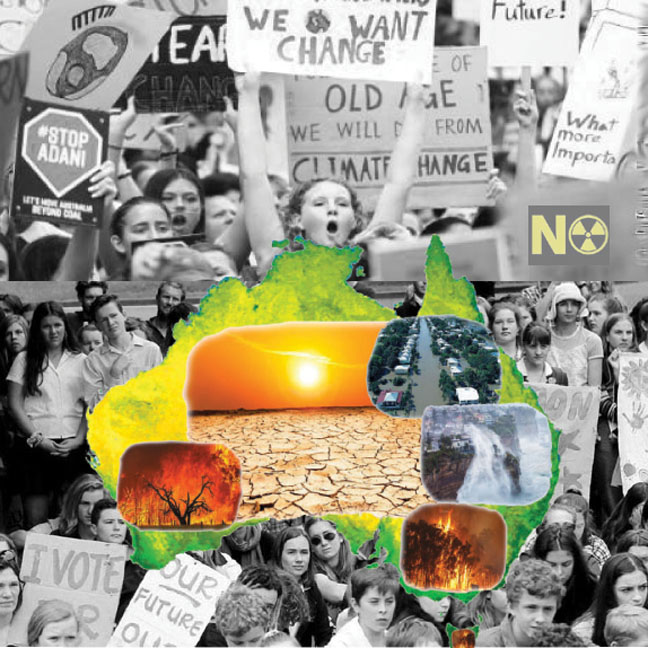
Nearly 90% of young Australians want real action on climate change
|
Young people send strong climate message, Pro Bono Maggie Coggan | 24 August
“We see the world in a different light. Politicians need to start listening to us and taking action,” a youth leader says.
Nearly 90 per cent of young people say they feel unprepared for future climate disasters and want politicians to give them a bigger voice on climate change, a new report finds. Conducted in the wake of the catastrophic summer bushfire season, the new Australian Institute for Disaster Resilience and World Vision Australia research found that despite hazards such as bushfires, floods, drought and tropical cyclones posing a greater threat, young people said they were more likely to learn about earthquakes at school. This left 88 per cent of survey respondents feeling unprepared and unable to protect themselves and their communities, even though nearly two-thirds (64 per cent) had experienced at least three events such as bushfires, heatwaves and drought in the past three years. “We anticipate that we will experience personal impacts from natural hazards in the future, whether we are living in capital cities, regional centres, or rural areas,” respondents said. “The 2020 bushfires demonstrated that you need not live in the bush to be affected by a bushfire. We are experiencing these persistent worries while having to contend with life, school, growing up and everything else that comes with being a young person in Australia.” It is the most comprehensive consultation of children and young people on climate change, disasters, and disaster-resilience in the country, with 1,500 people participating in the online survey, supported by UNICEF Australia, Plan International, Save the Children, Oaktree and Australian Red Cross. Young people concerned, but not heard ………… A full copy of the report can be found here. https://probonoaustralia.com.au/news/2020/08/young-people-send-strong-climate-message/ |
|
Gas is not transition energy we were promised, new research suggests
 Gas is not transition energy we were promised, new research suggests, SMH, By Nick O’Malley, August 24, 2020 — The good news about natural gas is that when it is burnt it creates between 40 and 50 per cent less carbon dioxide than coal would to create the same amount of energy.This is why it has been embraced by some climate activists and governments as a useful energy source to replace coal and oil while renewable energy technologies catch up with global energy demand.
But the good news ends there, and there is a lot more to the story.
Before it is burnt natural gas is mostly made up of methane, and methane is estimated to be about 28 times more potent a greenhouse gas than carbon dioxide over a 100-year period.
Over a 20-year period – about the time scientists believe we have to try to prevent the worst impacts of global warming – it is up to 80 times more potent at warming the planet than carbon dioxide.
The United States’ Environmental Protection Agency estimates that for every cubic metre of methane extracted by the US oil and gas industry, 1.4 per cent escapes into the atmosphere as so-called fugitive emissions.
But more recent research suggests this estimate is drastically low, and that, in fact, the industry in the US is leaking 13 million metric tonnes of methane a year, or 2.3 per cent.
It is not yet clear how much fugitive methane is released by the Australian gas industry, but new technologies now allow scientists to accurately measure it and the data is expected to be published in the coming months.
The US Environmental Defence Fund estimated that, in America, if just 3 per cent of methane escapes, gas is no cleaner an energy source than coal……. https://www.smh.com.au/environment/climate-change/gas-is-not-transition-energy-we-were-promised-new-research-suggests-20200824-p55ovg.html
Uranium ban brought benefit to New South Wales
 Uranium ban brought us benefit, Newcastle Herald, Dave Sweeney, Australian Conservation Foundation 23 Aug 20,
THE state government’s proposed removal of a long-standing and popular ban on uranium mining in New South Wales flies in the face of evidence, community interest and market reality. The global uranium price remains depressed following the Fukushima nuclear disaster and is not likely to recover. The uranium market is over supplied and existing producers are shelving projects across Australia and around the world.
In November 2019 the CEO of the world’s largest uranium miner, Canadian company Cameco, stated that “not only does it not make sense to invest in future primary supply, even the lowest-cost producers are deciding to preserve long-term value by leaving uranium in the ground.”
The ban has served NSW well. It has provided policy certainty and avoided the radioactive waste and legacy mine issues affecting other places, including Kakadu, where a massive $1 billion clean-up is underway at the former Ranger mine. This poorly conceived piece of gesture politics could lead to lower tier and inexperienced mining companies cutting corners and increasing environmental and community risk and it simply makes no sense for NSW to jump aboard a sinking nuclear ship. NSW’s energy future is renewable, not radioactive.
Australia’s Dept of Industry hiding the facts on choice of Kimba nuclear waste site
 Kazzi Jai No Nuclear Waste Dump Anywhere in South Australia, 22 Aug 20,
 FRIDAY NIGHT QUIZ QUESTION: How many times did the DIIS quote this EXACT SAME STATEMENT in their “Answers to Questions Notices” tabled recently for the Senate Inquiry?….more https://www.facebook.com/groups/1314655315214929/
Adam Bandt urges another Labor-Greens coalition for climate action
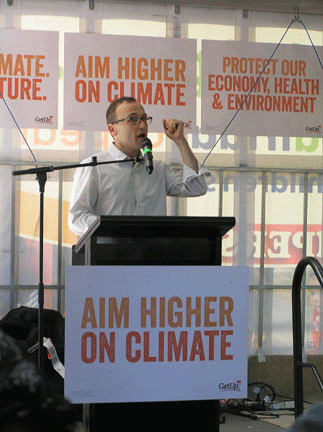 Adam Bandt urges another Labor-Greens coalition for climate action, https://www.theage.com.au/politics/federal/adam-bandt-urges-another-labor-greens-coalition-for-climate-action-20200820-p55nrc.html, By Rob Harris, August 21, 2020 —Greens leader Adam Bandt will mark 10 years since his party signed a deal to prop up the Gillard government by flagging he would be willing to again form a power-sharing deal with Labor to combat climate change.The Melbourne MP will use his address to the Greens National Conference on Saturday to urge Labor leader Anthony Albanese to commit to acting on carbon pollution by again entering into progressive pact
Labor is currently locked in a fierce internal battle over its support for coal and gas production as it wrestles with three successive election losses and poor results at the polls last year in resource-rich regional Queensland seats.
Veteran frontbencher Joel Fitzgibbon warned on Thursday his party could soon split in two, arguing it is struggling to be “all things to all people” across its inner city and regional voter bases.
Mr Bandt will tell his party faithful that it was only with the Greens holding the balance of power in both the House of Representatives and the Senate which led to “world leading climate action with a price on carbon”.
“In recent Australian history, there is one indisputable fact. The only time that climate pollution meaningfully dropped is when the Greens shared power,” Mr Bandt says in a draft copy of the speech.
“When the Greens, Labor and independents worked cooperatively and shared power like we did in 2010, we got a lot done.
As Liberal and Labor rush once more to give tax cuts to millionaires while embracing coal and gas, it is clear that Greens sharing power is the pathway to change.
Mr Bandt will also use the speech to say the climate deal reached with the Gillard government was stronger and more effective in reducing carbon emissions than the Rudd government’s scheme it blocked in the Senate.
Warning of a federal election within 12 months, Mr Bandt will say the path to climate policy progress was to put the Greens into shared power through a hung parliament.
Mr Bandt said the carbon tax legislation by Labor in 2010 with the backing of the Greens was “well-designed” and it reduced pollution for the first time in Australian industrial era history.
He will promise to “hammer” a straightforward message between now and the next election that the “only way to get real change is to vote for it and give the Greens shared power”.
“Many look longingly to New Zealand, where Jacinda Ardern leads a progressive multi-party government with Greens support, and wonder if it could happen here,” he will say.
Mr Albanese on Thursday said Labor had continually evolved and a modern party with “any self-respect” would be attempting to mitigate the effects of climate change.
In a rebuke to Mr Fitzgibbon, he said the issue of climate change was not a matter of geography because “wherever people live, they’re impacted by climate change”.
“Were about also holding the government to account. Putting forward an alternative agenda for the nation,” he said.
Slowing of population growth could be a good thing for Australia
Learning to live with less, Online Opinion,
Population growth has been a mantra of our property industry for as long as I can remember. And once again there are predictions of a surge in growth, driven (this time) by people allegedly fleeing Victoria. However, there are good reasons to think this may not happen, and that we may need to prepare for an extended period of minimal growth. This may not be a bad thing. One of the first things to understand about our recent rates of actual and predicted future population growth is that they have been extraordinary in terms of the actual numbers and also in terms of the rate (speed) of growth. On a global scale, our forecast rates of population growth in major cities exceeded many leading world cities and was on a par with places like Shanghai and Beijing. In just 15 years, Brisbane, Sydney and Melbourne were predicted to grow by around a third – roughly three times the rate of growth of cities we often like to compare ourselves with like Copenhagen (for some reason), Los Angeles, San Francisco, London or Paris. Given we started this forecast period with widely acknowledged urban infrastructure deficits (failing to keep up with population growth in the past), how we were supposed to not make the problem worse with these rates of growth is something smarter people than me might like to explain. Let’s just say the Chinese do things very differently so we can’t use Shanghai or Beijing as comparisons. These predicted rates of growth were driven by three components: international migration (net overseas migration or ‘NOM’); interstate growth (net interstate migration or ‘NIM’) and natural growth (more births over deaths). And all three now look severely compromised by the policy responses intended to manage Covid……….. each of three sources of population growth looks challenged in a post Covid Queensland, for the next few years at least. Less NOM, fewer NIM and less breeding. Is this such a bad thing though? Provided we continue with infrastructure projects, it could allow the State to begin to close the infrastructure gap which has widened significantly in recent decades. The pressure is everywhere to see – rising congestion, hospital waiting lists, rising school class numbers, and hostility to development generally. If Covid forces a breather on the rapid rates of population growth we’ve been used to, perhaps it will mean we can actually enhance our quality of life and standards of amenity in the process? It’s also worth keeping in mind that there are many global examples of low growth cities and regions which remain highly attractive and economically prosperous. The surplus of demand by people wanting to live and work there, relative to supply (deliberate limits on housing supply and population caps) invariably makes these very expensive real estate markets, completely unaffordable for many. But from a selfish property market point of view, they are still viable markets for development and redevelopment. Locally, think Noosa. Being horrendously expensive for residential or commercial property hasn’t stopped some of our other property markets before? https://www.onlineopinion.com.au/view.asp?article=21069&page=2 |
|
Reject the racist, undemocratic National Radioactive Waste Management Amendment Bill
|

Conflict of interest in Kimba Community Liaison Officer’s connection to nuclear waste dump push
 Kazzi Jai, Fight to Stop a Nuclear Waste Dump in South Australia, 20 Aug, 20
Here is what the Community Liaison Officer job was meant to entail: Job Description……”The Community Liaison Officer will represent a project, through consultation activities including meetings with members of the public, information sessions, and presentations. The Officer must possess local knowledge and be of an approachable demeanor to ensure meaningful engagement with all interested community members.”
Desired Skills and Abilities:…..”Ability to be approachable by all members of the Kimba community, regardless of their views on the Project, to provide information about the Project in a professional and independent manner.”
This really in fact comes as no surprise, given what actually happened in Hawker at the SAME time with THEIR Community Liaison Officer! – Submission 109 of previous Inquiry*
*Senate Committee Inquiry on Selection Process for Nuclear Waste Dump Site, August 2018 https://www.aph.gov.au/Parliamentary_Business/Committees/Senate/Economics/Wastemanagementfacility/Submissions
Pointless: Removal of New South Wales Uranium mining ban, as uranium glut continues, and nuclear industry declines
Nuke South Wales?, ACF, Dave Sweeney, 20 Aug 20,
The proposed removal of a long-standing and popular ban on uranium mining in New South Wales is empty gesture politics that flies in the face of community interest and market reality, the Australian Conservation Foundation (ACF) said.
The global uranium price remains depressed following the Fukushima nuclear disaster and is not likely to recover.
“The nuclear power age is winding up, so it makes no sense for NSW to jump aboard a sinking ship,” said ACF nuclear campaigner Dave Sweeney.
“The ban is popular and has served NSW well, providing policy certainty and avoiding the radioactive waste and legacy mine issues affecting other places, including Kakadu, where a massive $1 billion clean-up is underway at the former Ranger mine.
“This is empty gesture politics that could lead to lower tier and inexperienced mining companies cutting corners and increasing environmental and community risk.
“This poorly conceived plan puts political posturing above community benefit and could lead to increased pollution and risk for NSW communities and environment for scant gain.
“NSW’s energy future is renewable, not radioactive – this tired political fix is no substitute for a credible and effective energy policy.
“Deputy Premier Barilaro might see this as in the Nationals’ interest, but it is certainly not in the national interest.”
In November 2019 the CEO of the world’s largest uranium miner, Canadian company Cameco, stated, “Not only does it not make sense to invest in future primary supply, even the lowest-cost producers are deciding to preserve long-term value by leaving uranium in the ground.”
The global market is over supplied as existing producers exit or defer projects and higher-grade uranium ore deposits remain in the ground across Australia and around the world.
For context or comment contact Dave Sweeney on 0408 317 812
Uranium mining to become legal in NSW, as govt supports OneNation in nuclear push.
Uranium Mining. NSW govt to support One Nation in Nuclear Push. Daily Telegraph, 19 Aug 20,
Uranium mining looks set to become legal in NSW after a deal was struck between Premier Gladys Berejiklian and Deputy Premier John Barilaro to get it through cabinet. … (subscribers only) NSW to start mining uranium after agreement on plan to lift ban [$]
.
1 This month
17 October, Free Public Talk on Nuclear Issues in South Australia
David Noonan will speak on public interest concerns over the new Roxby Downs Indenture Act 2026 on BHP copper-uranium mining and ore processing in SA, and on how AUKUS may face SA with a High-Level nuclear waste agenda.
Dr Jim Green will discuss international developments in the field of nuclear power including ‘small modular reactors’ and Generation 4 ‘advanced’ nuclear reactor concepts.


Help Aunty Sue Protect Her Land and Sacred Sites From Destructive Rocket Testing.
.

Australians deserve the truth
about
AUKUS – https://aukuspublicinquiry.com/

PETITION – To: Prime Minister Anthony Albanese and the Australian Labor Government

of the week – Australians for War Powers Reform (AWPR)
To see nuclear-related stories in greater depth and intensity

