Australian Government’s Covid-19 advisory body – stacked with fossil fuel big-wigs, but their conflicts of interest kept secret
 Just one of six Covid commission members volunteers to release conflict-of-interest declaration Just one of six Covid commission members volunteers to release conflict-of-interest declaration
Federal government refuses to release disclosures, saying they were made ‘in confidence’, amid calls for greater transparency, Guardian, Christopher Knaus @knausc Fri 12 Jun 2020 Only one of the six commissioners on Scott Morrison’s Covid-19 commission has volunteered to release their conflicts of interest, prompting calls for greater transparency from the publicly funded body.The government has refused to release the conflict-of-interest declarations for members of its National Covid-19 Coordination Commission (NCCC), a prominent advisory body shaping non-health aspects of Australia’s Covid-19 strategy. There have been increasing concerns about a lack of proper governance structures around the taxpayer-funded commission, which operates with a broad remit and a budget of more than $5m. The commission is headed by Nev Power, the former head of Fortescue Metals, and other commissioners include the Industry Super chair Greg Combet, former health department secretary Jane Halton, rich-lister Paul Little, EnergyAustralia chair Catherine Tanna and CSIRO chair David Thodey Officials from the Department of Prime Minister and Cabinet said it could not release their conflict-of-interest declarations because they were provided “in confidence”. The Guardian approached each of the commissioners and asked whether they would release their interests of their own volition. Only Combet agreed to do so. A spokesman told the Guardian Combet’s “interests are already publicly available and widely known”, and provided a list including his chairmanship of Industry Super Australia and IFM Investors, as well as his membership of the Invest Victoria advisory board and occasional consulting roles. The interests he declared had already been published on the NCCC’s website, where others had also published their public directorships……. The Australia Institute’s climate and energy program director, Richie Merzian, said publicly disclosing conflicts was “the least the government commissioners” could do, given they had been handpicked to advise the government on spending billions of dollars taxpayer funds. “The roles of the NCCC commissioners are, by design, intended to influence government,” Merzian said. “It is clearly in the public interest for any conflicts of interest to be publicly declared. There is no excuse for any potential conflicts of interest to remain secret.” Crossbench senator Rex Patrick also urged “full disclosure” of the commissioners’ interests. “The commissioners are being paid from the public purse, are performing public activities and their output may have significant influence over the future expenditure of public money,” he said…….. https://www.theguardian.com/australia-news/2020/jun/12/just-one-of-six-covid-commission-members-volunteers-to-release-conflict-of-interest-declaration |
|
South Australia – Citizens’ Jury rejected nuclear waste dump in 2016. Decision should not be made by a tiny community
Confidential to Senate Committee on National Radioactive Waste Management Amendment (Site Specification, Community 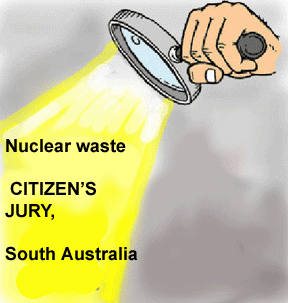 Fund and Other Measures) Bill 2020 [Provisions] Submission 31 We strongly oppose the proposal of a low and intermediate level radioactive waste storage facility at Kimba or anywhere in South Australia.We are concerned, saddened and offended that we need to write this letter.
In 2016 the South Australian State Government undertook and formed a citizens jury.The citizens jury marked the beginning of a state-wide consultation program to investigate the possible construction of a nuclear waste storage facility in South Australia.The jury members comprised 350 randomly selected South Australian residents. The jury met over six days (three weekends).The jury rejected the proposal of a nuclear waste storage facility in South Australia by an overwhelming two/thirds majority.
Why is the federal government ignoring the wishes of the South Australian residents following the citizens jury outcome?This is not a decision for only the Kimba community but for all South Australians and ultimately all Australians.We do not believe a small productive agricultural community should be placed in a position to make this decision which will have such long term and irreversible consequences for future generations.
Minister Pitt, we suggest you investigate and set up a citizens jury in your home state of Queensland.You may be able to find a suitable site for a nuclear waste storage facility in Queensland with wide community consent. You could ship and truck the radioactive waste in and out of Brisbane and offer the chosen community $32 million. Maybe the chosen Queensland community wouldn’t think thismoney is a bribe.We live on the Eyre Peninsula in South Australia and again advise we strongly oppose a low and intermediate level radioactive waste dump at Kimba in South Australia.
Australia’s govt rushes nuclear waste Bill through Lower House, but this story is not over.
The federal government’s radioactive waste laws the House of Representatives today, however they failed to win broad support or approval.
Importantly, Labor joined with Greens, Centre Alliance and independents to vote against the contested push to move Australia’s radioactive waste from ANSTO’s secure Lucas Heights facility in southern Sydney to a site near Kimba in regional South Australia.
While accepting the need for improved radioactive waste management, Labor MPs highlighted deep concerns with the government’s approach and called for further detail and review.
Concerns included:
- The double handling of problematic and long-lived Intermediate Level Waste (ILW) through the unnecessary transport from an above-ground extended interim storage facility at ANSTO to an above-ground extended interim storage at a less resourced regional facility.
- The continuing opposition of the region’s Barngarla Traditional Owners.
- The lack of a rationale for a new set of waste laws.
- The government’s decision not to de-couple consideration of the different waste streams (ILW and Low Level Waste). Labor urged the government to allow wider project consideration, including through a current Senate review.
The Greens spoke strongly against the plan – as did Zali Steggall. Andrew Wilkie and Centre Alliance’s Rebekah Sharkie also voted against the legislation – further details in the Hansard transcript and voting record attached fyi
From here – among other things – we need to work to highlight and detail the unresolved concerns via the Senate review (still tracking to report at the end of July) and the subsequent Senate consideration and vote on these laws.
Today the government has had a short-term political win at the expense of building consensus or credibility – we saw a political numbers exercise but we did not see agreement, evidence or responsibility. The government’s plan is deeply deficient and more people are seeing and acknowledging this – this story will grow and change the approach to radioactive waste management.
Australia’s House of Representatives passed the National Radioactive Waste Management Amendment Bill
 11 June 2020, Federal govt just passed the National Radioactive Waste Management Amendment Bill through the lower house of federal parliament, which sounds like bad news but could be good news, an own goal by the government and minister Keith Pitt
Labor voted against the Bill and spoke strongly against it (including the shadow minister Brendan O’Connor, SA MP Tony Zappia and others) … raising issues of Traditional Owner opposition, double-handling of intermediate-level waste, etc etc. I’m guessing Labor also pointed out that voting on the Bill before the Senate Inquiry is complete is poor form.
Zalia Steggall spoke strongly, linking the dump to BLM and raising numerous other issues.
Andrew Wilkie voted against.
Some recent lobbying by Maritime Union of Australia might have been useful in getting the ALP to show some decency, as well as lobbying by Dave Sweeney and David Noonan
The Senate Committee is meeting tomorrow to discuss the inquiry into the Bill.
The Maritime Union of Australia (SA branch) rejects Nuclear Waste Bill, discusses transport dangers
the proposal to move long-lived intermediate-level waste (ILW) from interim above-ground storage at Lucas Heights to interim above-ground storage at the Kimba site….exposes communities to unnecessary risks, and it exposes workers (including MUA members) to unnecessary risks. .. and raises “implications for security”… the considerable distances involved create a whole additional level of risk.
MUA policy is that our members will not be involved in moving nuclear waste. The toxicity
of the waste is severe.
The Maritime Union of Australia (SA branch) to Senate Committee on National Radioactive Waste Management Amendment (Site Specification, Community Fund and Other Measures) Bill 2020 [Provisions] Submission 19 The Maritime Union of Australia (SA branch) recommends that the Senate Committee rejects the National Radioactive Waste Management Amendment (Site Specification, Community Fund and Other Measures) Bill 2020 (hereafter the NRWM Amendment Bill).
The Bill is designed to advance a fundamentally flawed radioactive waste management process which should be put on hold until such time as a comprehensive independent inquiry is held to investigate all options for managing radioactive waste
powers to override Commonwealth and state laws.
in SA. The proposed nuclear waste facility is illegal under South Australia’s Nuclear Waste Facility (Prohibition) Act. Instead of respecting that state legislation, the Federal Government intends to override it and the NRWM Amendment Bill outlines a regulatory mechanism to override SA law and thus to undermine democratic rights.
Desmond Menz – Constitutional problems in Nuclear Waste Bill – could lead to High Court case?

why ultimately was South Australia the only state to contain the final three sites?
A tiny community poll seems to have informed the final decision, and contradicts the Minister’s stated position of “broad community support”. Just 0.037% of the voting public in SA have had a say.
why did South Australia become the only state to be chosen for the nuclear waste site, knowing that a Citizens Jury in 2016 had rejected a major nuclear waste storage industry in South Australia following the outcomes of the Nuclear Fuel Cycle Royal Commission? The Citizens Jury was substantially more representative of the views of the people of SA, in comparison with the very small poll of the eligible residents of the District Council of Kimba..
former Minister Canavan’s snap decision? The decision on site selection was announced on Saturday morning 1 February 2020, and by the afternoon Senator Canavan had resigned
Desmond Menz SUBMISSION TO ECONOMICS LEGISLATION COMMITTEE OF THE
AUSTRALIAN PARLIAMENT ON THE National Radioactive Waste Management Amendment (Site Specification, Community Fund and Other Measures) Bill 2020 Submission 13
In September 2019 ….I raised critical concerns about the validity of the National Radioactive Waste Management Act 2012 (NRWM Act) in relation to the Australian Constitution, and also the lawfulness of the process about site selection. I also raised concerns about breaches of South Australian law. It seems that my concerns were either ignored or dismissed. I again raise these critical matters for the attention of the Economics Legislation Committee. If they are not responded to, then it would not be too much a stretch of the imagination to have them resolved in a higher court of law, quite possibly the High Court of Australia. In my view, the Economics Legislation Committee should not make any decision on the Amendment Bill until all issues I have countenanced have been resolved.
Main Concerns
1.It is contended that inconsistency between the federal National Radioactive Waste Management Act 2012 (NRWM Act) and the South Australian Nuclear Waste Storage (Prohibition) Act 2000 (NWSP Act) (and other similar state/territory laws), has been manufactured by the Australian Parliament. This is a serious issue, and one that not even the Senate Standing Committee for the Scrutiny of Bills has acknowledged. It is incomprehensible why this matter was not addressed way back in 2010 during the establishment of the NRWM Act.
It is also contended that there are Constitutional matters that need to be resolved to affirm the safety of the federal law, including the Amendment Bill, because at the moment there are sufficient concerns relating to inconsistency between federal and state laws to inhibit the lawful and constitutional passage of the Amendment Bill. [here he gives an example from a previous High Court case]……… Continue reading
Ivan Quail says -No logic in double handling of nuclear waste, and makes 14 strong recommendations

There is no logic behind the proposal to move intermediate-level waste from interim above-ground storage at Lucas Heights to interim above-ground storage at the Kimba site. The proposed double-handling is illogical, it exposes communities to unnecessary risk, and ARPANSA’s Nuclear Safety Committee says it
breaches international best practice
It should further be borne in mind that we in Australia currently enjoy an international
reputation for clean green agricultural products and food. Are we prepared to put that at risk?
Ivan Quail to Senate Committee on National Radioactive Waste Management Amendment (Site Specification, Community Fund and Other Measures) Bill 2020 [Provisions] Submission 12
Intermediate level radioactive waste should not be stored above ground. Low- and intermediate-level radioactive wastes are buried in geological repositories. These repositories must isolate the nuclear waste from the biosphere for as long as 100,000 years. Only solid wastes are stored; liquid wastes are solidified by cementation or bitumen. The strategy adopted by many countries for the disposal of low and intermediate level radioactive wastes requires an engineered repository placed at considerable depth underground.
https://www.sciencedirect.com/topics/chemistry/intermediate-level-radioactive-waste
Long-lived intermediate-level (category S) wastes will be stored above ground in an engineered facility designed to hold them secure for an extended period and to shield their radiation until a geological repository is eventually justified and established, or alternative arrangements made.
Don’t send uranium to India- Dr Vaishali Patil speaks to Australia
 Dr Patil spoke on the first of the Yellowcake Country webinars on 10th June. She spoke of the beautiful country of the Konkon area, formerly a place of thriving agriculture, fruit growing and fishing. It is now known for having the largest nuclear power plant in the world. Despite the opposition of farmers and fishermen, this gigantic and enormously expensive nuclear project has gone ahead.
The local people have continued their protest for 15 years. The government has the right to commandeer land for nuclear activities, giving very little compensation. Many protestors have been gaoled. Livelihoods are threatened, not only by the loss of land, but also, the remaining agricultural and fishing industries lose their markets, due to both the real contamination of the environment, and the perceived contamination, as the area becomes known as a nuclear hub.
Environmental damage has affected the lives of the community, as well as their livelihoods. Radiation has resulted in a rise in cancer incidence. Men who never took part in the past, in protest movements are now joiningthe anti-nucler movement. But women have always been prominent in opposition to nuclear power, in the Jaitapur Anti-Nuclear Movement. It’s a peaceful protest, following Ghandian philosophy. But activists face gaol, and condemnation – are depicted as being against development, against the national interest.
Nuclear power contributes very little to India’s energy, less than 2% of energy supply. However the government invests hugely in it. Despite the devastation from the recent cyclone, despite the onslaught of the coronavirus, the government pours huge amounts of money into nuclear industry, nuclear weapons. This investment continues, while the cyclone destruction has ravaged the Konkon area, with 7000 school buildings collapsed, 500,000 trees uprooted, and thousands of migrant workers still walking through.
The National Alliance of Anti Nuclear Movement of India (NAAM) continues its work and calls for Australia’s anti-nuclear movement to join forces with it, and work to prevent the export of uranium to India.
Senator Rex Patrick – nuclear waste dump should not go on agricultural land

Australia’s very bad record on environment: it’s no time to weaken our laws
 Now is not the time to weaken our environmental protections, Canberra Times, Katherine Barraclough, Fiona Armstrong , 10 June 20 Now is not the time to weaken our environmental protections, Canberra Times, Katherine Barraclough, Fiona Armstrong , 10 June 20
As Australia’s primary environmental legislation undergoes a once-in-a-decade review, businesses and the government have spoken of the need to cut environmental bureaucracy (so-called “green tape”) and speed up approvals. However, health experts insist that environmental protections must be strengthened. Why? Because the stark reality is that our health is fundamentally dependent on the health of the natural world – for clean air, water and soils, food security, protection against infectious diseases and a stable climate. Nature is also the source of over half of all medicines we rely on. Last month, more than 180 health professionals and 19 health groups published an open letter to federal Environment Minister Sussan Ley, warning a failure to significantly reform Australia’s environmental law, the Environmental Protection and Biodiversity Conservation Act (EPBC Act), will risk fuelling further public health crises. Signatories included Nobel laureate Professor Peter Doherty, former Australian of the Year Professor Fiona Stanley and nutritionist and dietician Dr Rosemary Stanton. Despite being a wealthy, developed nation, Australia’s environmental track record is among the worst of all countries. We lead the world in mammal extinctions, have the highest rate of biodiversity loss bar Indonesia, and have been recognised as a land-clearing and deforestation “hotspot”. It is estimated that in Queensland and NSW alone, land clearing kills some 50 million mammals, birds and reptiles annually. Our scarce water resources are in decline, and some of our most precious marine environments, including the Great Barrier Reef, face collapse. Climate change constitutes one of the most serious threats to our natural environment and our nation’s public health, and yet Australia is one of the highest per-capita emitters of greenhouse gases. This degradation of our natural environment is, in essence, a dismantling of our life support systems. That it has occurred despite the existence of the EPBC Act is a clear indication that major environmental law reform is required. Unfortunately, examples of failed environmental protections in Australia are plentiful…….. https://www.canberratimes.com.au/story/6777567/now-is-not-the-time-to-weaken-our-environmental-protections/?cs=14230#gsc.tab=0 |
|
Azark says: nuclear waste site process unfair and Napandee unsuitable

Azark Project Pty Ltd to Senate Inquiry: National Radioactive Waste Management Amendment (Site Specification, Community Fund and Other Measures ) Bill 2020. Submission No1
Excerpts
This submission is made by Azark Project Pty Ltd who, in conjunction with the Shire of Leonora did apply to be the site to house the storage facility. We were not chosen.
Our submission will deal with, what we believe, was an unfair inquiry by the Department of Industry Innovation and Science who ran the inquiry having already decided that the facility would be above ground. They said as much when they stipulated when calling for applications that “they required no less than 100 hectares of land for the facility”………
The National Radioactive Waste Management Facility project has a Facebook page. Posted on the Facebook site on the 5 March at 16.01 was this statement: “Intermediate level waste will be stored at the NRWMF until a permanent disposal solution is developed. (Attachment 2).
Intermediate level waste disposal will require a different solution- likely a deep geological repository that will take several decades to site and build.” Attachment 3……….
Our submission would like to concentrate on the most important factors in recommending to the senate that this bill not be passed.
There is no greater responsibility that the government has to its people than to keep them safe. The current Corona Virus is a good example. The proposed site at Kimba fails miserably on this score. ILW is deadly to humans if they are exposed to it.
The Kimba proposal by the government admits that it can only be a temporary site for ILW and that it will have to be shifted before that time. This double handling presents yet another danger…………
The second factor the committee should consider is the cost to the taxpayer.Press reports, which have not been denied, put the construction cost of the Kimba facility at $325M. Because this will be borrowed money there is an
additional interest bill of $6.5M per year. That is $65M for ten years and they have a time frame of 30 years……..
There is also the cost of finding a new “deep geological repository” and constructing it within 30 years. It is safe to assume that this will run in to hundreds of millions of dollars given the cost of the current proposal.
At Attachments 4 and 5 are letter from two prominent SA geologists, with over 90 combined years of studying the Kimba region, who both state that the site at Kimba is not suitable and both of them saying what we are saying and that is
Don’t choose Kimba as the site to store ILW. Bury it underground Kimba is in an active earthquake zone
Another major consideration is the stability of the land on which the storage facility is sited……… What is important is that the real responsibility for the safe storage is regulated by ARPANSA and it is that body that will enforce the public safety standards
James Shepherdson – no true community support for Napandee nuclear waste dump, and alternative site ignored
 James Shepherdson to Senate Committee on National Radioactive Waste Management Amendment (Site Specification, Community Fund and Other Measures) Bill 2020 [Provisions] Submission 8 In regards to the federal government process of site selection for a radioactive waste repository, please let it be known to this inquiry that I being a local Kimba resident for thirty two years have observed in the past five years of the events that have taken place a number of obvious examples of what I can only describe as being a very premeditated, deceptive, unbalanced process of manipulation with an agenda to reach an outcome of support for such a facility regardless of the obvious division it has created in my community.
The following points I make are to me evidence of a completely flawed process.
1. Community was given no consultation therefore no right to make a decision prior to a land owner nominating their land.
2. The process continued regardless of the fact Minister Frydenberg conceded there was not broad community support for the initial land nominations.
3. The main criteria for the proposal to move forward was that of broad community support ,however there has never been a clear definition of what constitutes broad community support.
4. The criteria for what described a direct neighbour in the first land nominations was when two properties could share a road between them but in the second round of nominations this was changed to then to deem them to not be direct neighbours therefore the minister being able to declare that all direct neighbours were in support of the
facility when in fact they were not.
5. The traditional owners denied the right to vote.
6. Community supporting members of the Kimba district denied the right to vote just because they happened to be outside the Kimba district council boundary.
7. Given the fact that the traditional owners and residents outside of the Kimba boundary were not given the right to vote the minister always reiterated that all submissions would be taken into account when making his decision ,however by his own admission declared that only submissions from inside the Kimba boundary were taken into
consideration.This deemed 2789 submissions from concerned residents of the Eyre Peninsula and the wider community to be completely irrelevant in his view .
8. A nomination of a much more favorable site in Western Australia in 2017 was completely overlooked .This particular site had already been declared by experts to be suitable for not only the disposal of low level radioactive waste but also the deep geological burial of the intermediate level radioactive waste.
Another Australian former Senator glides easily into the weapons industry
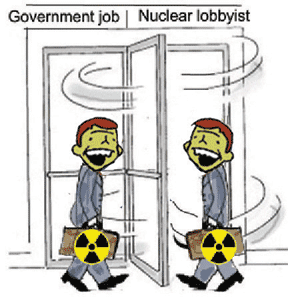
Stephen Loosley AM, MILITARY INDUSTRY REVOLVING DOOR
Stephen Loosley was a NSW ALP Senator from 1990 to 1995. From November 2012 to September 2016 he was Chair of the Woomera Prohibited Area Advisory Board, a role required to be independent, yet he concurrently sat on the Thales Australia Advisory Board. Thales is one of the world’s top 10 weapons-makers….. https://www.michaelwest.com.au/stephen-loosley-am/
Australian company Silex Systems involved in nuclear enrichment, in Kentucky’s radioactive disaster site Paducah
 SILEX SYSTEMS PRESSES AHEAD IN NUCLEAR ENRICHMENT, WILL AUSTRALIA FOLLOW? AU Manufacturing, by Peter Roberts 8 June 20 Technology development company Silex Systems is pressing ahead with a uranium enrichment project that has implications for any future move by Australia into nuclear industries.
The Sydney company has signed a sales agreement with the US Department of Energy (DOE) to allow it to process stockpiles of depleted nuclear fuels as part of its Paduach Project in Kentucky
Silex plans to process the fuels using its proprietary laser enrichment process being commercialised in partnership with Canada’s Cameco Corporation, with the partners producing uranium equivalent to one of the world’s top ten uranium mines.
While the commercialisation of the Silex process has been troubled in the past, the implications of an Australian company with the capabilities to enrich uranium could be a building block to a future nuclear fuels industry in Australia.
……….. nuclear power is always high on the wish-list of many on the political right.
The Silex project involves the construction by GLE, a venture owned 51 per cent by Silex and 49 per cent by Cameco, of the Paducah Laser Enrichment Facility to process depleted uranium over a period of several decades.
Production would begin in the late 2020s of around 2,000 tonnes of natural uranium hexafluoride per annum, the equivalent of a mine producing 5.2 million pounds of uranum oxide.
This already enriched uranium would immediately give GLE capabilities in uranium production, as a uranium conversion supplier and enriched uranium supplier – three of the four production steps of the nuclear fuel cycle.
Silex was formerly developing the project in association with GE and Hitachi, who exited the project allowing Cameco, one of the world’s largest listed uraniium companies, to increase its holding.
Silex is based at Lucas Heights in New South Wales, the site of Australia’s only nuclear reactor, and works closely with the Australian Nuclear Science and Technology Organisation (ANSTO)……..
It has been estimated that to move into nuclear power Australia would need a concerted national effort over seven to 10 years to train nuclear technicians, perform the necessary science and construct facilities…… https://www.aumanufacturing.com.au/silex-systems-presses-ahead-in-nuclear-enrichment-will-australia-follow
Order of Australia recipients for environment and conservation
from Maelor Himbury (Apologies to any I may have missed), 8 June 20
Rita BENTLEY VIC
Craig Kingston BUSH bMeerlieu VIC
Erik DAHLbKersbrook SA
Vera Frances DEACON Stockton NSW
Atticus Richard FLEMING NSW
Manfred Ernst HEIDE Teringie SA
Noel HOFFMAN Gooseberry Hill WA
Ross Edward LEDGER City Beach WA
Colin James LIMPUS Capalaba QLD
James Grant MUMME Rockingham WA
Gretel Lees PACKER NSW
William Robert PATERSON Meningie SA
Barry McGown SCOTT Sunnybank QLD
Richard John THOMSON Templestowe Lower VIC
Arron Richard WOOD Kensington VIC
Mike WOOD North Beach WA
1 This month
.

Australians deserve the truth
about
AUKUS – https://aukuspublicinquiry.com/

PETITION – To: Prime Minister Anthony Albanese and the Australian Labor Government

of the week – Australians for War Powers Reform (AWPR)
To see nuclear-related stories in greater depth and intensity

