Crina Virgona – Kimba nuclear dump plan – unfair and irresponsible to our children
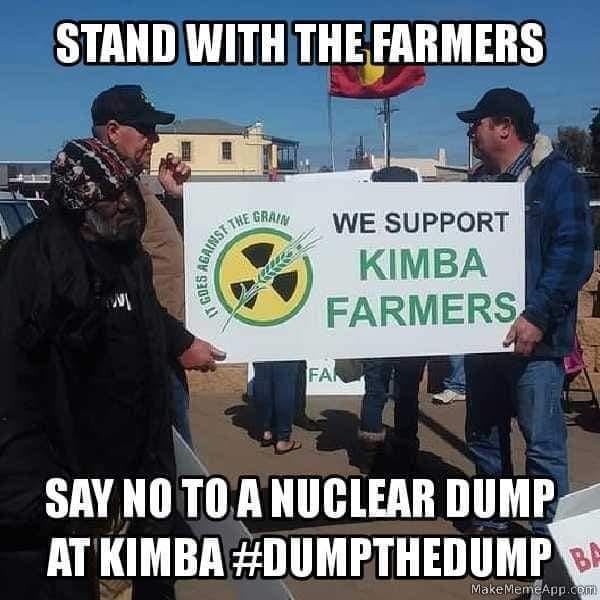
Crina Virgona to Senate Committee on National Radioactive Waste Management Amendment (Site Specification, Community Fund and Other Measures) Bill 2020 [Provisions] Submission 38
I write to you distressed to hear that the issue of the radioactive dump in South Australia is still on the table. The threat to our water supply, our food production and indeed to human life itself in unfathomable. How can you imagine that we can keep radio active material stable and safe for hundreds of years, particularly now in the face of climate change when crisis is the ‘new normal’.
Apart from drought, fire and flood, seismic activity is not as predictable as it was in the past. We can no longer be sure that the radio active material will stay safe. You cannot hand on this legacy to future generations. It is unfair and irresponsible. We have already inflicted enough of our poor decision making onto subsequent generations. Please lets stop now. It has already gone far too far and we are all endangered.
Brian and Michelle Hunt- plan for radioactive waste dump near Kimba a safety threat to us and future generations
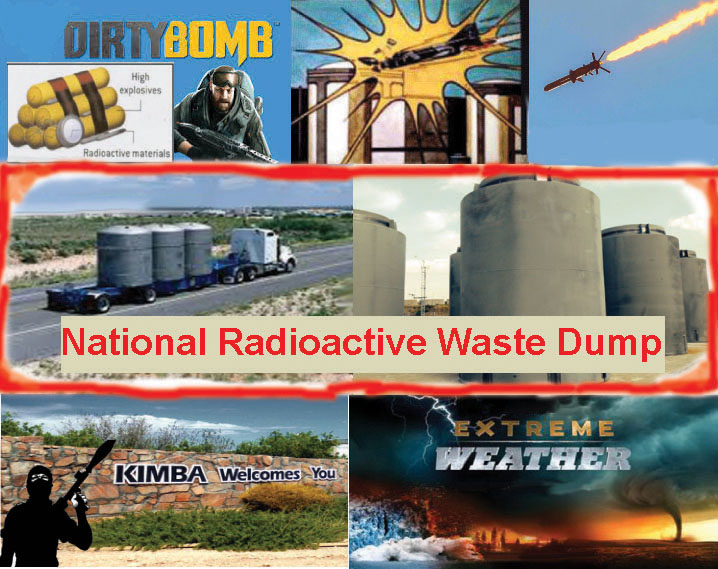
Brian and Michelle Hunt National Radioactive Waste Management Amendment (Site Specification, Community Fund and Other Measures) Bill 2020 [Provisions] Submission 40
I am writing to express our opposition to your proposal of a nuclear waste dump in Kimba. We have always
been opposed, but with what’s happening in the world at the moment it brings home to us how important it is to
feel safe in your own community, and this facility does not make us and our families feel safe for our future
generations.
We feel you’re taking advantage of a town that thinks money is the answer to everything, & for that reason we
don’t have much respect for your constant pressure to have this thing in our town.
Radioactive Waste Management Amendment Bill – a drastic attack on Aboriginal rights, heritage and environment
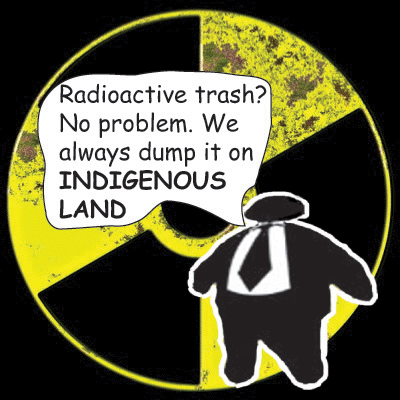
This inquiry if successful will enable Native Title to be extinguished, whether it is admitted or not.
3 Section 4 (a) seeks to repeal the definition of Aboriginal land,
9 Section 4 (b) seeks to repeal the definition of traditional Aboriginal owners
34 GA (1) (c) seeks to override the archaeological and heritage values of the land, the significance of the
land in the traditions of the Indigenous owners, by overriding existing state and territory legal protections.
34 GB (1) (a) seeks to override the Aboriginal and Torres Strait Islander Heritage Protection Act 1984.
34 GB (b) seeks to override the Environment Protection and Biodiversity Conservation Act.
Stephanie Ingerson to Sente Committee on National Radioactive Waste Management Amendment (Site Specification, Community Fund and Other Measures) Bill 2020 [Provisions] Submission 28
South Australia’s north-west desert lands were laid waste by nuclear tests conducted by the British in the
1950s and 1960s at Maralinga on the country of Aboriginal traditional owners. Despite this existing nuclear wasteland, more lands belonging to traditional owners near Kimba on Eyre Peninsula are destined for more nuclear waste. Ninety per cent of the waste will be transported from the Lucas Heights reactor in Sydney, overland and around the coastline of New South Wales, posing a potential risk for humans and the environment given the history of radioactive spills and accidents at the Lucas Heights reactor site. The waste will not just be gloves and gowns. The government does not talk about spent nuclear fuel rods and other hazardous radioactive high level waste, active for thousands of years,that may be destined for a radioactive waste site on Eyre Peninsula.
The Barngarla Aboriginal people have their traditional lands on Eyre Peninsula. They did not give their consent for a radioactive waste site, having been excluded from voting in a restricted ballot in Kimba conducted to secure the land for this purpose. Continue reading
Greg Phillips- Australia’s nuclear management amendment bill – a dishonest, manipulative process.
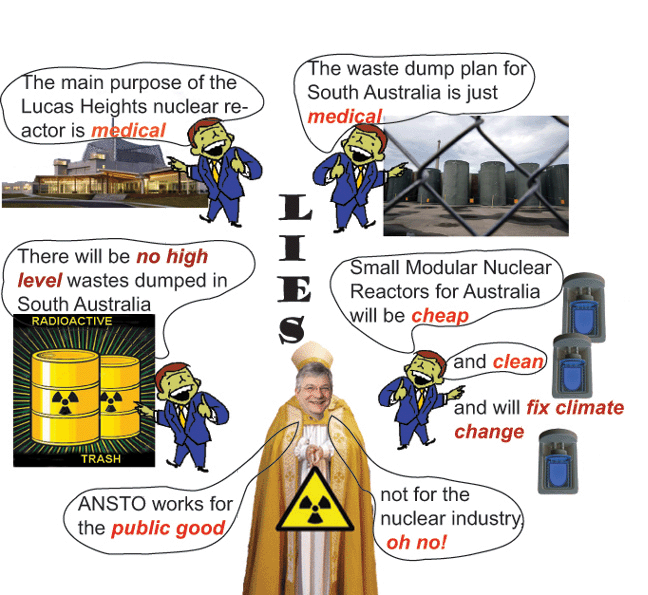
Greg Phillips to Senate Committee on National Radioactive Waste Management Amendment (Site Specification, Community Fund and Other Measures) Bill 2020 [Provisions] Submission 27
The location of a nuclear dump at Kimba (in the vicinity of valuable farmland, fishing grounds and tourism area) should be rejected. The whole process has been the result of a dishonest, manipulative process. The seat of Grey has been targeted and groomed for many years. The location of a nuclear dump at Kimba (in the vicinity of valuable farmland, fishing grounds and tourism area) should be rejected. The whole process has been the result of a dishonest, manipulative process. The seat of Grey has been targeted and groomed for many years.
The first and major dishonesty relates to Australia’s definition of Intermediate waste. The “intermediate level” waste destined for Kimba would be called “High Level Waste” (HLW) in the USA[1], Canada[2], UK[3], Japan[4], South Africa[5], Taiwan[6], Switzerland[7], South Korea[8]. Even France classified it as High Level Waste when they shipped it to us. The vitrified residue from processing spent nuclear fuel is almost universally called “High Level Waste“. Even Australia once called it High Level Waste[9]. So why do we call it “Intermediate”? Because Australia has a dishonestly slack and misleading definition of “High Level” waste that is purely based on how thermally hot it is ie. “high level radioactive material means material which has a thermal energy output of at least 2 kilowatts per cubic metre.”. The definition doesn’t even mention the radioactivity of the waste! No other country does this. It’s like passing a law that says “manure is only manure if it is hotter than 30 degrees C“. If the “intermediate” waste inner containers were taken out of their massive transport container (the “TN81” container, with 10- inch thick solid steel walls), standing next to it would give a person a fatal radiation dose in seconds. The sole purpose of this definition seems to be to make the importation of High Level
Waste invisible to the public.
The dishonesty of the definition should be enough to stop this process now. It puts Australia at risk because it means that other countries could send their High Level Waste to us and it will be magically redefined as “Intermediate” by our laws. (Note: don’t be tricked by misleading statements from nuclear experts/lobbyists such as “reprocessing removes the bulk of the radioactive material” – the vitrified residues left over from reprocessing are almost as radioactive as the original spent fuel, the “bulky” Uranium and Plutonium removed are relatively low radioactivity[10]. Also, spent fuel from research reactors (whether HEU or LEU types) is still considered HLW[2])
Nuclear medicine (the production of nuclear isotopes) is often used to justify the existence of this dump. But many countries are moving to methods that produce isotopes that don’t produce wastes. Cyclotrons and accelerators can produce isotopes with no reactor waste[11, 12]. The medical isotopes used for the superior imaging of PET scans are produced with a cyclotron. These isotopes decay so quickly that they can be thrown out in normal trash after a few weeks
[13] – no radioactive dump required. ANSTO decided to gamble taxpayer’s money to try and dominate the world medical isotope market with a complex, messy isotope manufacturing technique that produces a lot of problematic waste – waste that the taxpayer (and workers) will have to pay dearly to manage[14]. Canada is moving to a network of Cyclotrons to produce isotopes – it is safer, cleaner and more reliable than relying on a single nuclear reactor (probably cheaper too). Some even predict that the superior imaging of PET will make Technetium-99m/Mo-99 imaging begin to disappear over the next 10 years[15].
The nuclear power/arms/mining pushers see the Kimba dump as a foot in the door for an international dump. It is located near several ports that could be used to directly import nuclear waste. If Australia is going to continue to generate dangerous nuclear waste, it should be stored where there is already high security to protect it ie. Lucas Heights. There is plenty of room for the reactor waste there. Meanwhile Lucas Heights needs to work hard at reducing the waste produced from its production of medical isotopes. Accelerators are the way of the future, but ANSTO has a conflict in interest in that it knows that pushing cyclotrons/accelerators will undermine its reactor/isotope business. ANSTO’s dream of shipping taxpayer funded isotopes to the world (while taxpayers also fund the waste disposal) should be given up. If Australia
concentrated on producing isotopes for its own uses only, then the volume of radioactive wastes ANSTO produces would be reduced dramatically.
Here in South Australia we have been bombarded with lobbyists over the last few years trying to create an International nuclear waste dump in our state. One of the main pushers for a nuclear dump seems to be the Uranium miners (who want to increase their international Uranium sales by giving other countries an easy place for them to abandon their problematic, highly toxic, nuclear waste). It is worth remembering at this point that spent nuclear fuel (and reprocessed spent fuel) is millions of times more radioactive than the Uranium ore we dig up.
Shipping and handling nuclear waste would put our workers and our fisheries, farmers, tourism,
security etc. at risk.
Nuclear lobbyists are often deceptive about the risks of radioactive contamination. They try to make people think that inhaling or ingesting radioactive particles/contamination is the same as the non-contaminating radiation you get from an X-ray (or the increased Cosmic rays when traveling in an airplane). Ingesting or inhaling radioactive contamination is much more dangerous, it is more like inhaling Asbestos. It could sit in your lungs, muscles, bones for years/decades, increasing the risk of cancer. Because illnesses from such contamination take years to develop, the lobbyists dishonestly dismiss any consequences from the Chernobyl and Fukushima catastrophes. The young and the pregnant are most vulnerable to such
contamination. If someone covered a group of people (or land) with Asbestos dust, you wouldn’t say “no harm was done” – unfortunately that is what nuclear lobbyists try to do. No one dies immediately from inhaling Asbestos dust, but we know that the deadly effects can take years/decades to appear. The Cesium-137 that contaminates large areas of Japan will take hundreds of years to decay away, meanwhile the young and pregnant are at risk of disturbing it and breathing this slow-acting poison into their system.
The whole process of selecting a site has been so flawed and dishonest that it should be started again.
References
60 years ago, Aborginal people’s land desecrated by nuclear bombs. Now a new desecration – nuclear wastes?
Even I know off by heart the supercilious tones of the Chief Scientist of the British nuclear tests, Ernest Titterton’s on-screen completely false declaration: ‘No Aboriginal people were harmed.’ The discovery of Edie Milpuddie and family as they camped on the edge of the Marcoo bomb crater was dramatic exposure of that cruel fiction. It is extraordinary to see the actual footage of this moment in the film; and so sobering to hear again the terrible repercussions among her descendants.
‘No Aboriginal people were harmed.’ Add into that mix, English and Australian servicemen and the various pastoral landholders; and from the strong desert winds including across the APY Lands, we will never know the results of the further fallout across the state and nation.
Wind forward another 30 years again and the well being of another almost neighbouring group of Aboriginal people is threatened with nuclear repercussions: this time by the plan for the nation’s nuclear waste ‘stored’ (dumped) on their Country. Again as Traditional Owners, the Barngarla denied a say on their own Country, while a few white ‘latecomers’ were given theirs.
The nuclear fight: then and now, Eureka Street Michele Madigan, 04 June 2020 heeded? https://www.eurekastreet.com.au/article/the-nuclear-fight–then-and-now?utm_medium=email&utm_campaign=Eureka%20Street%20Daily%20-%20Thursday%204%20June%202020&utm_content=Eureka%20Street%20Daily%20-%20Thursday%204%20June%202020+CID_d497ae8df79099faf8643a0a84a8536d&utm_source=Jescom%20Newsletters&utm_term=READ%20MORE On Sunday 24th May, the ABC showed the documentary Maralinga Tjarutja produced and directed by lawyer, academic, filmmaker and Eualeyai/Kamillaroi woman Larissa Berendt. It was wonderful to see the Traditional Owners including the women given a current national voice as survivors of the British nuclear tests on their lands. Mima Smart OAM former long-term chairperson of Yalata Community was co-presenter with the chair of Maralinga Tjarutja, Jeremy Lebois; Mima’s Maralinga art, painted in collaboration with other Yalata minyma tjuta — women artists, becoming an integral background story — sometimes even in animation.
New Zealand puts Australia to shame – with its environment – pandemic recovery programme
Australia’s destructive COVID-19 recovery
An opportunity for Australia
Economic stimulus through conservation and land management is not yet recognised as a way for Australia to respond to both the COVID-19 crisis and long-standing conservation needs.
Australian governments, if they invested similarly to New Zealand, could create jobs in the short term in any desired target region, based on economic and environmental need….
|
Let’s fix Australia’s environment with any pandemic recovery aid – the Kiwis are doing it https://theconversation.com/lets-fix-australias-environment-with-any-pandemic-recovery-aid-the-kiwis-are-doing-it-139305 5 June 20, Lachlan G. Howell, John Clulow,John Rodger, Ryan R. Witt The COVID-19 pandemic is causing significant economic challenges for Australia. With April figures showing more than 800,000 people unemployed and last month 1.6 million on JobSeeker payments, a key focus will be job creation.
Lessons should be learned from what’s happening in New Zealand, where the government is funding projects that revive the environment. Unfortunately, Australia seems to be going the other way. New Zealand gets itAs part of New Zealand’s innovative Wellbeing Budget the government will invest NZ$50 billion in a direct COVID-19 recovery response. Of that, NZ$1.1 billion will be spent on creating 11,000 “nature jobs” to combat unemployment and supplement pandemic-affected sectors. This unique investment will be delivered in a number of targeted environmental programs. Continue reading
|
Nuclear missile submarines in the Indo-Pacific
Increasing Indo-Pacific nuclear boats and the impact on strategic stability Defence Connect, Stephen Kuper, 5 June 20, As the Indo-Pacific continues to evolve economically and strategically, one of the traditional measures of great power status – nuclear attack and missile submarines – will become more prominent. For ASPI academic Stephan Fruehling, this will have a dramatic impact on the strategic stability and calculus Australia depends upon.
Much like the submarine competition between the US and Soviet Union, this new arms race is resulting in fleets of hunter-killers and strategic missile submarines stalking the depths, however the US and China are far from the only emerging and established Indo-Pacific nations seeking to leverage the power of nuclear submarines.
The growing proliferation of advanced nuclear weapons systems, including the relatively crude, yet still capable submarine launch ballistic missiles recently tested by North Korea, and the increasingly capable nuclear-powered submarine fleets introduced by China and Russia, South Korea has moved to address a tactical and strategic shortfall: a lack of nuclear-powered submarines.
While seemingly a shock move, the South Korean strategic policy institute, the Korea Defense Network (KDN), commissioned a research review into the feasibility of developing an indigenous nuclear-powered attack submarine.
It is reported that the results suggested that South Korea consider building a nuclear-powered attack submarine modelled after the French 5,300-tonne Barracuda Class submarine, the design model for Australia’s own fleet of $50 billion Attack Class submarines.
India also fields a growing array of domestic and foreign nuclear submarine designs in both the attack and ballistic missile variants providing an already tense regional balance of power with yet another platform to complicate the tactical and strategic decision making processes for many nations, including Australia……..
For Australia, this raises the question, can the nation depend on the nuclear umbrella provided by the US or, for that matter, the UK at a stretch? If not, what is the solution for Australia? ……..https://www.defenceconnect.com.au/maritime-antisub/6227-increasing-indo-pacific-nuclear-boats-and-the-impact-on-strategic-stability
Australia must plan for future disasters, bushfires, floods – NSW Resilience Commissioner
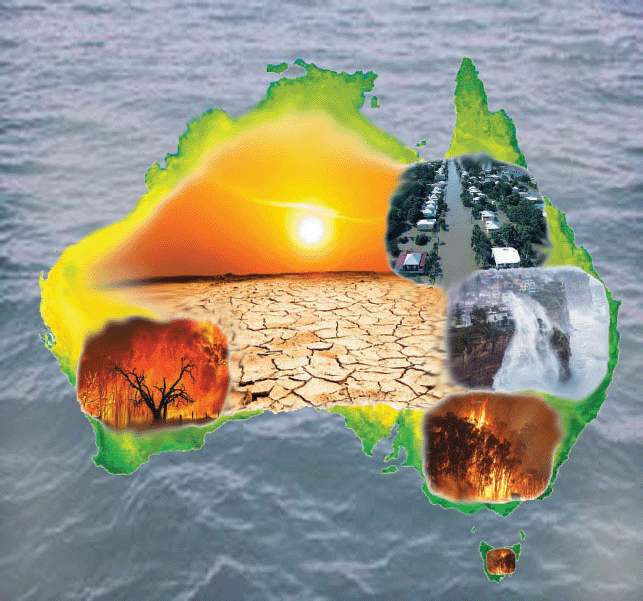 NSW Resilience Commissioner Shane Fitzsimmons is urging Australians to start planning now for future disasters. SBS, 5 June 20, Resilience NSW Commissioner Shane Fitzsimmons says Australia’s disaster recovery will be “quite significant” and that people should start planning for future disasters.
The former NSW Rural Fire Service boss says the country has faced unprecedented damage and destruction during the bushfire season, which was compounded by storms and floods and the COVID-19 pandemic.
“There are communities that have been so profoundly impacted and affected, and whilst there’s a tremendous focus on the rebuilding of infrastructure, on people’s homes, it’s a massive undertaking,” he said in an online webinar on Friday.
The commissioner is urging individuals, families, businesses, industries, and governments to begin having conversations about how they might respond to disruptions caused by disasters in the future to build resilience…….. https://www.sbs.com.au/news/australians-told-to-start-planning-for-future-disasters-following-profound-bushfire-impact
Australian media watchdog found Andrew Bolt breached press standards by vilifying Greta Thunberg
Andrew Bolt breached media standards calling Greta Thunberg ‘deeply disturbed’, watchdog rules, SBS, The Australian media watchdog has found Andrew Bolt breached press standards by attempting to “diminish the credibility” of Greta Thunberg on the basis of her disability.
BY MAANI TRUU, 5 June 20 A column by News Corp writer Andrew Bolt mocking teenage climate change activist Greta Thunberg breached standards by attempting to “diminish the credibility” of her opinions on the basis of her disability, the Australian media watchdog has found.
The column, published online in August last year, referred to the 17-year-old as “freakishly influential”, “deeply disturbed”, and a “strange girl”.
“I have never seen a girl so young, with so many mental disorders, treated by so many adults as a guru,” Bolt wrote.
The Australian Press Council found the article breached General Principle 6 of its standards of practice, which requires media organisations to avoid causing offence, distress, prejudice, or a substantial risk to the health and safety of an individual, unless publishing the story is in the public interest. …..
“[The column] attempts to diminish the credibility of Ms Thunberg’s opinions on the basis of her disabilities and by pillorying her supporters on the basis of her disabilities,” the watchdog’s findings, published on Thursday, read. ……. https://www.sbs.com.au/news/andrew-bolt-breached-media-standards-calling-greta-thunberg-deeply-disturbed-watchdog-rules
A reality check on the cost of nuclear power for Australia
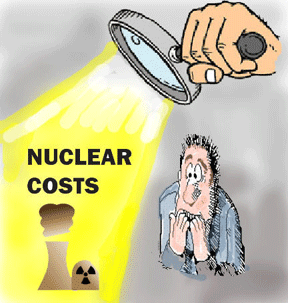 Nuclear cost and water consumption – The elephants in the control room, Open Forum.com.au. Peter Farley | December 20, 2019 Nuclear cost and water consumption – The elephants in the control room, Open Forum.com.au. Peter Farley | December 20, 2019 Cost There are four nuclear plants being built around the world where public information on costs is reasonably reliable.
These are Plant Vogtle in the US (US$27.5bn, 2.2GW), Framanville France (€12.4bn+, 1.6 GW), Olkiluoto in Finland (around €10 bn+, 1.6 GW) and Hinckley Point in the UK (₤22 bn+, 3.2 GW). There are two further plants whose power costs have been published, Akkuyu in Turkey US$127/MWh and Barakah in the Emirates US$110/MWh. It should be emphasised that none of these costs are the full cost recovery. For example in the British case it is estimated that some $10 bn has been spent by others on upgrading the grid and backup power supplies. In Turkey the cost of the plant is just that, and doesn’t include civil works, grid connections, cooling water supply. In the US plant Vogtle has benefited from some US$8bn of federal government loan guarantees and an unusual form of financing where customers have paid about 8% premium on their bills for 10-12 years before the plant is to be commissioned. All of the plants get catastrophe insurance and some security from their government and most have inadequate bond structures for long term waste storage. They also rarely pay for cooling water. Many have preferential supply agreements which will require other cheaper sources of power to turn off to allow the nuclear plants to keep running. However, even on the published information, nuclear power plants in democracies are running at about A$13m/MW. In our case we do not have an experienced nuclear workforce, Australian construction costs are higher by 20-30% for large projects – and there are 5,000 tradesmen on site at Plant Vogtle out of a workforce of 9,000 as nuclear power plants are very large projects. We do not have the heavy fabrication facilities required, and these cost hundreds of millions to build For example the Osborne Naval Shipyard design for 1/10th of the throughput of a nuclear fab shop cost $380m. Even the inspectors would have to be imported. So it is reasonable to suggest that new nuclear in Australia would cost at least A$16m per MW including subsidised construction finance, resulting in a first day of operation cost of a 2.2 GW plant of A$41 bn. Amortised over 50 years station life at a very low weighted average cost of capital at 5.5% – lower than plant Vogtle – that still works out at about $2.4 bn/yr. Due to the variability of demand in Australia the plants would be unlikely to be able to achieve a capacity factor above about 80% – halfway between the US and France and higher than Korea. So over a typical year a two unit 2.2 GW plant would be expected to generate about 15,500,000 MWh meaning the fixed costs per MWh would be $2.4bn/15.5m or $156/MWh. The daily running costs of US nuclear plants average out at US$40/MWh. This is lower than France and almost certainly lower than any new nuclear plant in Australia could achieve due to the much larger American skill base, higher utilisation and lower operating temperatures. The best case for Australia would be A$60+ for maintenace and operation. Thus an Australian nuclear power station could be expected to deliver power at a cost of A$216/MWh. Now if you use the cheaper Barrakah design at about US$5,300/MW and allow for 15 years of inflation at 1.5% to allow time for the project to come online, and a modest 10% Australian premium, power here could be produced at about A$10.4 bn per GW. After a slightly lower capacity factor of 75%, about the same as Korea, and a realistic WACC of 6.5% the ammortisation amounts to $107/MWh with a similar A$60/MWh operating and maintenance cost and the total delivered cost of power is a mere A $167/MWh. This figure aligns closely with the figure quoted by the CEO of the Barrakah plant some years ago at US$110/MWh The costs of a renewable alternative It should be noted that many of the arguments about relative costs are based on the figures used in the Finkel report. These are well out of date. Nuclear power has become even more expensive and actual renewable contracts in Australia are down 40-50% on the Finkel figures. Thus if we dispersed 2 GW of wind $3.6 bn, 1.2 GW of tracking solar $1.8bn, 2 GW of rooftop solar $2.5 bn, 1 GW of waste/biomass/geothermal $2.5bn and 1 GW/15GWh of pumped hydro $1.8 bn and 1 GW/ 2 GWh of batteries $1.2bn across the NEM the total cost would be $13.5 bn. Annual generation would be 17,500 GWh – more than the nuclear plant – and minimum available output would be 2.5 GW+. Typical hot day peak demand at 5pm would be about 4GW. About 30% of generation would go through storage at 85% efficiency, so net output would be around 16,500 GWh. Some would be curtailed so we can assume a similar annual output to the nuclear plant. However the operating costs average around $18 and the capital, even if amortised over 30 years are only $59/MWh for a total of $77 including backup. In summary, for 1/3rd of the investment, in one third of the time, we can get renewable power and backup for 1/3rd of the cost of nuclear power……https://www.openforum.com.au/nuclear-cost-and-water-consumption-the-elephants-in-the-control-room/?fbclid=IwAR2M3NxMjfrDJNWTG9tatKSARHGUKWVcG_CE-bSW5wtnAbwhGnYxd1ElugU |
|
Graham Mantle: substantial bribe and biased propaganda, as the Australian Government foists a nuclear waste dump on a farming community
 Graham Mantle, To the Committee of Inquiry: National Radioactive Waste Management Amendment (Site Specification, Community Fund and Other Measures) Bill 2020 [Provisions] Submission 44
The possibility of a National Radioactive Waste Management Facility at Kimba concerns far more than 61.58% of the people of Kimba. (Approximately 600 in favour)
I submit that this facility, together with a substantial bribe for Kimba, is being foisted on South Australia and the Eyre Peninsula in particular because no other state wants it. The fact that it has taken the government five
years to gain a 61.58% majority of the Kimba population of 1057 speaks for itself.
I have seen the kind of persuasive information to which the people of Kimba have been subjected. The ‘information’ fed to them carefully avoided mention of the possibility or probability of adverse perceptions, not only towards Kimba and what is grown there, but towards the entire Eyre Peninsula and even South Australia as a whole. viz “ South Australia – oh yes, the nuclear dump state…”
Farming, though rewarding, is a tough game and, after overcoming all the other issues, you don’t need adverse
perceptions when it comes to selling your produce. Tourism, too, can be a fickle business and perceptions are
vital to attracting visitors to the peninsula.
The Barngarla traditional owners a voice for over 3000 First Nation people who reside on Eyre Peninsula have
been denied a hearing in this deliberation. That is inexcusable in the spirit of reconciliation. They, together with
all who live on the Eyre Peninsula, have a right to be heard.
Finally, I draw your attention to South Australian Legislation:
Nuclear Waste Storage Facility (Prohibition) Act 2000.
This Act binds the Crown in right of the State and, in so far as the legislative power of the State permits, in all
its other capacities.
The objects of this Act are to protect the health, safety and welfare of the people of South Australia and to
protect the environment in which they live by prohibiting the establishment of certain nuclear waste storage
facilities in this State.
I implore you to reject the proposal to put a radioactive waste facility at Kimba.
With respect
Graham Mantle
Injustice of UK court process regarding Julian Assange. Assange too sick to attend

2. In addition to other ongoing health concerns, Assange faces the serious risk of exposure to Covid in Belmarsh prison, and has been advised that even going to the video room to take part in hearings is unsafe. This is another reason he should be immediately released.
3. Assange’s lawyers have long complained they have had insufficient access to him in prison. Under lockdown conditions, they have had no access to him at all. They have repeatedly flagged that this lack of access seriously impacts their ability to prepare his defence.
4. One of the next steps agreed today is that psychiatric reports on Assange from the prosecution and defence will be due to the court on 31 July. Remember that UN Special Rapporteur @NilsMelzer has expressed alarm many times that Assange shows symptoms of psychological torture.
5. It is a welcome step that the continuation of the full extradition hearing was adjourned, as lockdown conditions present clear barriers to open justice – but 7 September may not be late enough to make a meaningful difference. Also the court is still struggling to find a venue.
6. It remains extremely frustrating that the court does not adequately accommodate NGO observers. I have never experienced so much difficulty accessing a trial in any country as at Woolwich Crown Court in February, and the teleconference option we now have is far from sufficient.
7. The press are also facing severe restrictions. Only 6 journalists have been allowed to attend in person the past 2 hearings, with others limited to the awful phone line. This case is of high public interest and a better solution must be found before the full hearing resumes.
8. Assange’s next callover hearing has been scheduled for 29 June at 10 am. We urge the court to find workable solutions to enable his safe attendance and ensure the press and observers are able to properly monitor proceedings. /END
COVID-19 Commission stacked with fossil-fuel bigwigs. Surprise surprise -they find gas is the answer
 Transparency called for in fossil fuel-stacked COVID-19 Commission, Independent Australia, Martin Hirst | 2 June 2020 Who’s running the country and where are they taking us? Dr Martin Hirst thinks the Canberra bubble is filling with gas.
IN THE LAST WEEK of March, right at the start of Australia’s response to the coronavirus pandemic, Prime Minister Scott Morrison announced the formation of the National COVID-19 Coordination Commission (NC-19CC). He said it would “solve problems” so “we all get through to the other side”.
Now, at the start of June, we have some idea of what the “other side” looks like according to the leading figures on the Coordination Commission. From what we can glean from the cheap seats in the bleachers, the future is going to be a gas — literally gas……
For a start, the NC-19CC is an energy sector lovefest.
The Commission chair is Neville (Nev) Power and he’s well connected to the Australian energy and mining industries. He is Deputy Chairman of Strike Energy Ltd and for nearly a decade was managing director and CEO of Fortescue Metals Group.
Catherine Tanna is the managing director of Energy Australia, ‘one of Australia’s leading electricity and gas retailers’ according to the helpful but rather anodyne biographies provided on the commission’s website.
The commission’s “special advisor” is the American chemical industry leader, Andrew Liveris, a former CEO and chairman of the Dow Chemical Company and on the board of a major Saudi oil company.
There are two other important members of NC-19CC: the head of the Department of Prime Minister and Cabinet, Phil Gaetjens and the head of Home Affairs, Mike Pezzulo. These are also political appointments — Gaetjens is a loyal fixer for Morrison and Pezzulo is Home Affairs Minister Peter Dutton’s lieutenant.
Who does the Commission report to?
Australians first heard of the Coordinating Commission when Morrison announced it at a media event on 25 March, but he didn’t tell us how the members were selected, or why, or by whom.
Presumably, it was a “captain’s pick” by Morrison……
In mid-May, the Senate select committee that is holding an ongoing inquiry into the Government’s response to the pandemic requested Mr Power come and chat with it, but he didn’t show up. Instead, the PM’s protector, Phil Gaetjens and Peter Harris, the CEO of the Commission, came to block any real scrutiny of the Commission.
All that the senators were able to learn was that there are no rules in place for managing conflicts of interest and that the Commission’s members and advisors were being handsomely paid for their time and service. According to the transcript, almost every other question was stonewalled.
Apparently, the commissioners are also recruiting other people “through their own networks” according to Phil Gaetjens, but who remain largely unknown to the public — to help across various things to do with the economy re-opening.
Greens Senator Peter Whish-Wilson grilled Phil Gaetjens about the advice the commissioners might provide, but the PM’s advisor would only say that most advice would be confidential.
This has not satisfied a coalition of public interest watchdog groups who collectively issued a statement calling for greater transparency round the discussions and decisions of the NC-19CC………
I should mention that many environmental groups are concerned that the COVID-19 Commission is stacked with fossil fuel advocates, and with good reason. …… https://independentaustralia.net/politics/politics-display/transparency-called-for-in-fossil-fuel-stacked-covid-19-commission,13954
National Radioactive Waste Management Amendment Bill aims to prevent Bangarla people from legal action against the nuclear dump
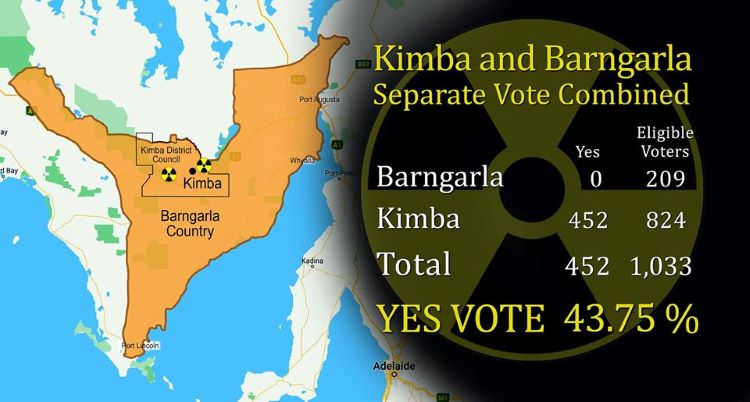
Schedule 1 of the Bill is a blatant and indisputable attempt to prevent any judicial review proceedings which would have been initiated by the Barngarla people (and potentially other members of the Kimba Community)
There is clearly no broad community support and such material suggesting there is, was manufactured by gerrymandering the ballot to exclude the Barngarla.
The Barngarla Determination Aboriginal Corporation to Senate Committee on National Radioactive Waste Management Amendment (Site Specification, Community Fund and Other Measures) Bill 2020 [Provisions]
Submission 25 The Barngarla Determination Aboriginal Corporation RNTBC ICN 8603 (BDAC) is the
registered native title body corporate for the Barngarla native title holders.1 As the determined native title holders for the Kimba area, which includes the site of Napandee, the Barngarla people seek to make a submission to the Senate Standing Committees on Economics (the Committee) as part of the Committee’s inquiry…….
………….., once the pandemic is resolved, BDAC consider it important that the Committee should attend on Country and hear from the Barngarla people directly. BDAC would welcome this opportunity and may seek to provide supplementary submissions at this time.
4. The Committee would be aware that members of BDAC were excluded from participating in a community ballot, facilitated by the District Council of Kimba between 3 October 2019 and 7 November 2019, to gauge support for the nominated sites of Napandee and Lyndhurst at Kimba.2 As the First Peoples for the Kimba area, this exclusion was alarming to our community given the permanent impact that the National Radioactive Waste Management Facility (NRWMF) would have on Country.
The Barngarla people also hold many parcels of native title land very close to the NRWMF location, and have the right to live on and use this land. That native title land was, and is in many cases, closer to the proposed site than the town of Kimba to the site. To be excluded from the ballot on the technicality that the land was not rateable,
was terrible for the Barngarla community. The ballot returned a yes vote whilst excluding over 200 Barngarla persons who would likely have voted no. Clearly the entire legitimacy of the site selection process is, at best, highly questionable in these circumstances. It is Barngarla’s position that the site selection process has entirely miscarried. There is clearly no broad community support and such material suggesting there is, was manufactured by gerrymandering the ballot to exclude the Barngarla. We are also aware that community consultation was not consistent with processes used for the Wallerberdina site and, as a result, also excluded members of the farming
community living and working in the Kimba area from the community ballot.
However, we respectfully submit to the Committee that the introduction of this Bill (in particular Schedule 1 of the Bill) presents a significantly more disturbing issue which goes beyond the exclusion of voters, seeking to have a voice on the NRWMF, from a community ballot.
6. We respectfully state that the issues raised in our submission, outline such a significant matter of principle that it will become evident to the Committee that Schedule 1 of the Bill should not be passed. We understand that Schedule 1 of the Bill seeks to directly legislate Napandee, as the specified site for the NRWMF, following
the policy decision (which was mischaracterised as a declaration) of the former Minister for Resources and Northern Australia on 1 February 2020. BDAC make clear that the Bill is in no way supported by the Barngarla people and is of the greatest concern to us, not only as the First Peoples for the Kimba area but as Australians in general, given that it effectively removes our right to seek judicial review .
Summary of Submission Continue reading
Southern Australia to be among the worst-hit by global heating
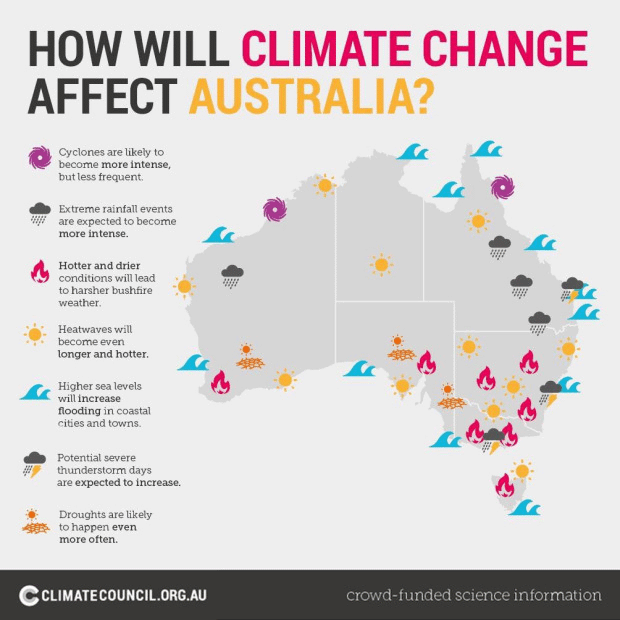 Australia among global ‘hot spots’ as droughts worsen in warming world, The Age, By Peter Hannam, June 1, 2020 The world’s major food baskets will experience more extreme droughts than previously forecast as greenhouse gases rise, with southern Australia among the worst-hit, climate projections show.
Scientists at the Australian National University and the University of NSW made the findings after running the latest generation of climate models used by the Intergovernmental Panel on Climate Change (IPCC). Future drought changes were larger and more consistent, the researchers found.
“Australia is one of the hot spots along with the Amazon and the Mediterranean, especially,” said Anna Ukkola, a research fellow at the ARC Centre of Excellence for Climate Extremes and lead author of the paper published in Geophysical Research Letters.
For southern Australia, the shift to longer, more frequent and more intense droughts up to 2100 will be due to greater variability in rainfall rather than a reduction in average rainfall. For the Amazon, both mean rain and variability changes…….
One reason for the prediction of worse droughts is that the latest models assume the climate will respond more than previously understood to increased atmospheric levels of carbon dioxide and other greenhouse gases.
Australia’s vulnerability to big shifts in annual rainfall already challenge the country’s farming sector, while also leaving much of the country’s south more at risk of bad bushfire seasons – such as last summer’s – as forests dry out.
The CSIRO has long forecast a large reduction in stream flows in the Murray-Darling Basin, for instance, as reduced cool-season rainfall combines with higher temperatures. Such a trend appears to have already begun.
While a more moderate emissions trajectory will still produce more intense, frequent and longer lasting droughts in most of the world’s mid-latitude regions than current conditions, the shift will be less than if carbon emissions remain near the top of forecasts. ……..https://www.theage.com.au/environment/climate-change/australia-among-global-hot-spots-as-droughts-worsen-in-warming-world-20200601-p54ydh.html
1 This month


Help Aunty Sue Protect Her Land and Sacred Sites From Destructive Rocket Testing.
.

Australians deserve the truth
about
AUKUS – https://aukuspublicinquiry.com/

PETITION – To: Prime Minister Anthony Albanese and the Australian Labor Government

of the week – Australians for War Powers Reform (AWPR)
To see nuclear-related stories in greater depth and intensity

