Sebastian Tops: National Radioactive Waste Management Amendment Bill uses vague unspecified term “controlled material” FOR SECRET REASONS? “

Sebastian Tops to Senate Committee on National Radioactive Waste Management Amendment (Site Specification, Community Fund and Other Measures) Bill 2020 [Provisions] Submission 22
Argument: This Bill involves possible Mutiny or even Treason. My argument here is that this Bill proposal is most disrespectful in several ways. To me this (amendment) Bill does involve democratic mutiny, Federal but also
State.
The Bill has ignored fundamental recommendations and Verdicts from S.A.’s Citizen’s Jury (2016) entirely. Great disloyalty to Australian lands and citizens is also still optionally hidden inside this Bill, for ‘non-Commonwealth’ entities can also be ‘doing their thing’. That disrespectful proposal possibility presents the idea of treason. If (only) a military land zone is required – please say and do so – but that should follow a different process.
This Bill does state to rely on “The principle of voluntarism” (Explanatory Memo, p.1). This Bill therefore fails because it cannot be found reasonable or legal for only one, or even a few South Australian land owner(s) to decide to sell land for purposes that will impact an entire region’s State future outlook negatively in several ways. Could anyone find it democratically respectful and reasonable for one single landowner’s (temporary life) choice and this Bill, to impact an entire State, here possibly South Australia, to become the proposed nuclear victim, again?
There is no ‘voluntary principle’ apart from the one, or two apparent S.A. landowner(s). There might be an NSW heritage or family history link? It would then involve fraud (false declaration), and or treason, at least against S.A.. These are matters relating directly to ethics which have failed fundamental (Australian) morals.
The Bill here proposes to introduce possibly new payment categories for NAW, in Item 33 par. 34B(1)(b) and (c) (Expl. Memo, p.19) “payable to the Commonwealth”. England is part of the ‘Commonwealth’. Further, only a fee is payable “by non-Commonwealth and non-host State users”. Does this mean England can store their (nuclear active) waste in Australia at no cost? This Bill continues to be unspecific on proposals related directly to nuclear most hazardous topics.
With anything nuclear; any relevant information should have been part of, and timely provided to each of the applicable eligible voter prior a vote on the matter. That officially presented voter information determines what could only possibly be stored in an appropriately ‘selected’ region. Not what is possibly proposed in the Bill here, after the actual vote. Otherwise, again, no proper political processes have been applied in this matter (2015 – 2019).
Neither the AEC, nor the District Council of Kimba seem to be willing or able to inform the public what printed information was provided to each of those limited few local voters, prior considering their vote. It could explain why ballots were
not returned. Likely due to a lack of trust in the applied political processes.
Vague unspecified term uses regarding anything nuclear. Who considers that ethical? The term use of “controlled material” is extremely vague, and can involve “all types of waste” (Expl. Memo, Schedule 3, Other Amendments, point 132, p.25). It has unspecified additional unknown liabilities and outcomes, and involves other unspecified responsibilities. Within the JCV (1997). The term use of “controlled material” amends the Object of Act (Expl. Memo, p.12). Controlled
material remains secretive for dubious reasons, and did admittedly under Schedule 3, point 132 not form part at all of the applied vote processes. Were voters made timely aware of any “controlled material” involving “primarily” from “State and Territory Governments, industry, hospitals and universities” (Expl. Memo, part 6A, p.3) to which even “laws cannot apply to regulate, hinder or prevent the doing of a thing” (Expl. Memo, point 94, p.20)?
This Bill fails to specify a clear set of criteria, full accountabilities, appropriate specifications of various necessary kinds, or responsibilities for all parts of this proposal. The proposed long-distance transport of highly hazardous (nuclear active) waste products produced in another State is entirely unnecessary
The Bill proposes for the EPA to not be able to report on environmental matters regarding the proposals inside the Bill put. What is generally known is the necessity to protect life against any poison’s hazard life duration. NAW is supposed to be safely ‘managed’ to protect vital sources like water, esp. in drought affected regions. The lifetime involvement of the EPA would be an absolute minimum requirement as such for any Australian NAW proposal. By not explicitly stating any poison responsible needs for its still unknown hazard life duration, and all its necessary more costly safety requirements, seems rather unprofessional. This Bill presents its disregard for another’s (State or Territory) land, by meaning to apply intentional disrespect to another by not demanding compliance with fundamental NAW safety requirements.
Any hazardous material is to be maintained closest to its source (for safe containment reducing wider risk exposures), minimize handling, introduce future monitoring and re-packing facilities in NSW etc.. Otherwise, if this Bill was to pass then more fully operational regional hospitals would be needed prior commencement of introducing the spread of any hazardous substances etc.. No new strategically located regional fully operational hospitals are proposed in this Bill.
Democratic Human Rights – Self-Determination (not to ever have to endure another State’s own produced (nuclear active) wastes to at least prevent image impairment and future economic opportunity losses.)……
To claim that “The specification of the site … is supported by a comprehensive consultation process” (Explanatory Memo, p.4), is incorrect, as a similar (also foreign) NAW proposal was considered earlier in the process. That process did receive an official S.A. Citizens Verdict, stating: “Under no circumstances do we pursue the disposal of nuclear waste because the potential brand damage is too great a risk to the state”. “It is a threat to a $17.5billion/year (1) income to the state generated from tourism, international students, agriculture, food, wine, seafood, livestock, and this is just the beginning. This is a risk we are not willing to take”. One can suggest that related to foreign (nuclear active) wastes only but, RCNCJ reasons go much deeper into their debated, wider considered, and broader researched nuclear related findings than this Bill seemingly has.
The RCNCJ expressed the need to prevent a lasting State or Territory ‘image impairment’. Storing another’s (nuclear) wastes would have ramifications to South Australia’s economy and negatively impact future opportunities like trade. That particular finding received 82% support. That economic Verdict finding alone relates directly to this Bill amendment proposal. Like “The jury felt it was it was important for environmental impact studies to include impacts beyond radiation”. The reasons state that overall, no economic benefits are sufficient to lose or damage one’s clean and safe image which South Australia still has. The Gawler Ranges are still brilliant. Several other “No” reasons are expressed within that RCNCJ verdict. Another such example: “The project will have significant social costs. Particularly, through the divisiveness of the issue”. How true is that finding alone, and who did dictatorially decide to allow politicians to totally ignore those Citizens Verdict findings?
The (Two-third or three-quarter) majority requirement has not been achieved………
At least two non-compliant issues are present within this Bill as it fails:
1. The JCV (66.6% majority), respecting dubious vote result (under 55%).
2. The Consultation paragraph of the explanatory memo (K. Pitt), as well the Bill ignore South Australian RCNCJ (2016) Verdict. Misrepresentations regarding NAW, “controlled material”, or “doing a thing” do involve inappropriately controlled voting processes, contrary to a controlled RCNCJ (2016) “No” Verdict(s). Non-compliant issues described are to have immediate political ramifications for this (Amendment) Bill and should be denied any further considerations in its
entirety. I elaborate on (also other) reasons in the Appendix “No Because”.
References………..
Appendix “No Because”
Other additional reasons to stop this (Amendment) Bill entirely:
As this amendment Bill relates directly to (anything) nuclear,
1. it would be logical to be very specific, clear, and state exactly what will be included and excluded.
2. full professional and personal accountabilities are to apply at all times, under any of the applicable Laws (State or Federal), otherwise nuclear should finally admit that (anything) nuclear is actually the least regulated industry………
ERA’s focus is now on rehabilitating the Ranger uranium mine site.
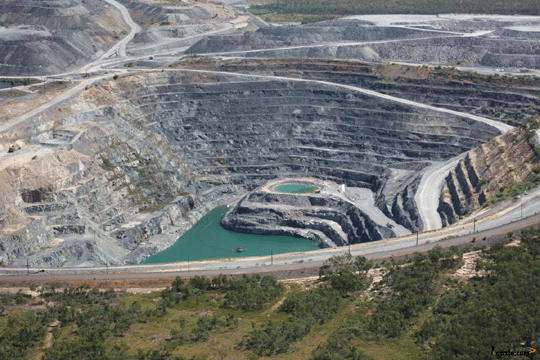 ERA, operator of Jabiru’s Ranger uranium mine, has held its last AGM as shutdown date looms
The company behind a contentious uranium mine in Jabiru has held its final AGM before production grinds to a halt, telling shareholders its focus is now on rehabilitating the site.
MADURA MCCORMACK, NT News, 31 May 20 https://www.ntnews.com.au/business/era-operator-of-jabirus-ranger-uranium-mine-has-held-its-last-agm-as-shutdown-date-looms/news-story/ad7601dd3ed45def1a63d8286e4b1b6c
THE company behind a contentious uranium mine in Jabiru has held its final annual general meeting before production grinds to a halt, telling shareholders its focus is now on the “successful rehabilitation” of the site. Energy Resources Australia, which has run the Ranger uranium mine since 1980, has seven months left to process remaining ore before it is legally required to shut down the site and commence a rigorous five-year rehabilitation program.Mining giant Rio Tinto, which this week made headlines for legally blasting an ancient Aboriginal heritage site in WA to expand a mine, owns a controlling 86.3 per cent stake in ERA. ERA chief executive Paul Arnold told shareholders on Friday the company had spent $92 million rehabilitating the mine in 2019, made $6 million in profit after tax, and $210 million from the sale of uranium oxide. In February, ERA finalised an offer from Rio Tinto to tip $476 million toward mine rehabilitation obligations in return for a larger shareholding slice, a deal that prevented ERA from collapsing financially.
“Expenditure on rehabilitation will only increase in coming years and this is a major Northern Territory project in its own right,” chairman Peter Mansell said in his address to shareholders. “The strategic priority for ERA now is the successful rehabilitation of the Ranger Project Area.”
Australian Conservation Foundation nuclear free campaigner Dave Sweeney said the rehabilitation standard set for Ranger mine was one “never previously attempted or achieved”, warning mining giant Rio Tinto and ERA that all eyes were on them to get this right. “The challenge is how to rehabilitate the heavily affected mine site and larger Ranger Project Area in a way that reduces adverse impacts and provides confidence that the living and peopled landscape of Kakadu is well protected, now and into the future,” Mr Sweeney said.
Rehabilitation of the mine must conclude in January 2026 and, according to ERA, it will include treating more than 16.5 gigalitres of water and planting 1.1 million trees on site.
Australia’s national environment laws ‘actually allow extinction to happen’
Australia’s national environment laws ‘actually allow extinction to happen’
Carnaby’s black-cockatoo, the grey range thick-billed grasswren and the swift parrot just three species in deep trouble after laws fail them, Guardian, Lisa Cox, Sun 31 May 2020 Scientists and conservationists are calling for changes to Australia’s national environment law to urgently address failures in how it is protecting native wildlife, including bird species that have declined significantly over the past decade.
Samantha Vine, the head of conservation at BirdLife Australia, says: “Our laws are actually allowing extinction to happen.”
With the Environment Protection and Biodiversity (EPBC) Act under review by the businessman Prof Graeme Samuel, environmentalists have pointed to several bird species as examples of the inadequate protection provided by the legislation…….https://www.theguardian.com/environment/2020/may/31/australias-national-environment-laws-actually-allow-extinction-to-happen
Megan Johnson: National Radioactive Waste Act – not democratic, not transparent, a hasty inadequate plan
I urge you to reject the bill until the community is presented with a transparent, democratic, comprehensive, long-term plan.
Megan Johnson to Senate Inquiry on National Radioactive Waste Management Amendment (Site Specification, Community Fund and Other Measures) Bill 2020 [Provisions]Submission 41
- Democratic Process
The Community Consultation process has not been adequate. This is a matter that affects all South Australians,
and all South Australians should have the democratic right to vote on it.
It is particularly concerning that the Barngarla were excluded from the vote – traditional landowners should be
entitled to a vote, just as residents of Kimba District were entitled to a vote.
The proposed facility is for permanent disposal of low-level waste and temporary storage of intermediate-level
waste. These are two very different concerns, but there has been a down-playing of the role of intermediate-level
waste at the facility. The term ’gloves-and-gowns’ waste has become common parlance in the discussion. This is
not an accurate description of intermediate-level waste, which will not decay to an acceptable level
“during the time for which institutional controls can be relied upon”.
waste. Therefore, intermediate level-waste should be given at least equal discussion.
into service only 5 years ago at Lucas Heights. No-one has been able to adequately explain what purpose is
served by moving intermediate-level waste from the Lucas Heights location to temporary storage at Napandee.
facility. However, the Aube facility is for permanent disposal of low-level waste only. It is not at all comparable
to the proposed facility at Napandee, and is therefore misleading. In the interest of balance, DIIS should have
brought representatives from a community that lives near a temporary storage facility for intermediate-level
waste.
be removed from Napandee between 50-100 years after it is installed. At this stage, the waste will be nowhere
near its half-life. There is no plan and no funding allocated for this re-location.
unintentionally. The community has not been given enough information to make an informed decision.
There are circumstances under which a nuclear waste facility could be the right deal for a community and a
permanent solution to our national waste management. However, the current offering is very poor – I urge you to
reject the bill until the community is presented with a transparent, democratic, comprehensive, long-term plan.
Today’s News Corp cuts represent an enormous threat to Australian democracy
 Dark day for journalism as Murdoch’s global empire sells democracy down the river
Today’s News Corp cuts represent an enormous threat to Australian democracy — and a grim reminder of the power of a single family. ERIC BEECHER AND PETER FRAY, MAY 28, 2020
Australian news journalism has never seen a day as black as today — and not just because News Corp has closed 12 of its 17 regional daily newspapers, leaving Australia with just 20 remaining.
Today also demonstrates the grotesque power of
one company — and one family — to decimate a large slice of a country’s
news in a single media release.
A company worth $16.3 billion, run from New York, has wielded a knife through large swathes of Australian democracy….. (subscribers only) https://www.crikey.com.au/2020/05/28/rupert-murdochs-global-empire-sells-democracy-down-the-river/?utm_campaign=Weekender&utm_medium=email&utm_source=newsletter&wkndr=VWI3bngzTjl0a0V6UEhQbEJJeTFxUT09
Australia must not forget – the plutonium abuse of an Australian child, by Argonne National Laboratory

Paul Langley, https://www.facebook.com/paul.langley.9822/posts/10213752429593121CAL-2, 14 Aug 17, 5 yr-old Simon Shaw and his mum. Simon was flown from Australia to the US on the pretext of medical treatment for his bone cancer. Instead, he was secretly injected with plutonium to see what would happen. His urine was measured, and he was flown back to Australia.
Though his bodily fluids remained radioactive, Australian medical staff were not informed. No benefit was imparted to Simon by this alleged “medical treatment” and he died of his disease after suffering a trip across the world and back at the behest of the USA despite his painful condition. The USA merely wanted a plutonium test subject. They called him CAL-2. And did their deed under the cover of phony medicine.
“Congress of the United States, House of Representatives, Washington, DC 20515-2107, Edward J. Markey, 7th District, Massachusetts Committees, [word deleted] and Commerce, Chairman Subcommittee on Telecommunications and Finance, Natural Resources, Commission on Security and Cooperation in Europe] MEMORANDUM To: Congressman Edward J. Markey From: Staff Subject: The Plutonium Papers Date: 4/20/94
Staff Memo on Plutonium Papers
The medical file for Cal-2 also contains correspondence seeking follow-up from Argonne National Laboratory in the 1980s. Cal-2 was an Australian boy, not quite five years old, who was flown to the U.S. in 1946 for treatment of bone cancer. During his hospitalization in San Francisco, he was chosen as a subject for plutonium injection. He returned to Australia, where he died less than one year later.
Document 700474 is a letter from Dr. Stebbings to an official at the Institute of Public Health in Sydney, Australia, in an attempt to reach the family of Cal-2. This letter reports that the child was “injected with a long-lived alpha-emitting radionuclide.” Document 700471 is a letter from Dr. Stebbings to New South Wales, Australia (names and town deleted), inquiring about recollections of the boy’s hospitalization in 1946. The letter notes that, “those events have become rather important in some official circles here,” but provides few details to the family.
A hand-written note on the letter reports no response through October 8, 1987. Considering the history on the lack of informed consent with these experiments, it is surprising that the letters to Australia failed to mention the word “plutonium.”
The Australian news media has since identified Cal-2 as Simeon Shaw, the son of a wool buyer in New South Wales, and information on the injection created an international incident. The information in the medical file does indicate that at a time when Secretary Herrington told you that no follow-up would be conducted on living subjects, the Department of Energy was desperately interested in conducting follow-up on a deceased Australian patient.
In an effort to determine the full extent of follow-up by the Department after 1986, your staff has requested, through the Department’s office of congressional affairs, the opportunity to speak with Dr. Stebbings, Dr. Robertson, and any other officials who may have been involved in the follow-up. So far, that request has been unsuccessful. It remains an open question as to what was the full extent of follow-up performed in the 1980s, and whether the efforts then would facilitate any further follow-up on subjects now. It seems appropriate for the Interagency Working Group to address these questions as its efforts continue.”
Source: National Security Archives, George Washington University, http://www.gwu.edu/…/…/mstreet/commeet/meet1/brief1/br1n.txt
See also ACHRE Final Report.
NO MORE DUAL USE ABUSE OF AUSTRALIANS MR PRESIDENT. STOP FUNDING SYKES AND FLINDERS UNIVERSITY IN THE DOE QUEST FOR CHEAP CLEANUP OF URANIUM CONTAMINATED SITES.
Mr. President, you are wrong if you think you can do the same again re hormesis funding in Australia as the USA did with CAL-2. We have not forgotten and do not trust you or your paid agents in Australian universities such as Flinders.
Friends of the Earth condemns shameful Radioactive Waste Management Bill, offers positive alternatives

Friends of the Earth,. to Senate Committee on National Radioactive Waste Management Amendment (Site Specification, Community Fund and Other Measures) Bill 2020 [Provisions] Submission 54
The National Radioactive Waste Management (NRWM) Amendment Bill is deeply flawed and should be rejected. Further, the existing Act is deeply flawed and should be repealed.
The proposal to proceed with the nuclear waste facility despite the unanimous opposition of the Barngarla Traditional Owners is unconscionable and must not be allowed to stand. Shamefully, the federal government excluded Barngarla Traditional Owners from a ‘community ballot’ held in 2019. Therefore the Barngarla Determination Aboriginal Corporation initiated a separate, confidential postal survey of Traditional Owners, conducted by Australian Election Company. This resulted in 100% of respondents voting ‘no’ to the proposed nuclear facility. If the results of the two ballots are combined, the overall level of support falls to just 43.8% of eligible voters (452/824 for the government-initiated
ballot, and 0/209 for the Barngarla ballot) ‒ well short of the government’s benchmark of 65% for ‘broad community support’.
committed the SA Labor Party to “support communities opposing the nomination of their lands or region for a dump site, and any workers who refuse to facilitate the construction and operation or transport and handling of radioactive waste material destined for any contested facility or sites including South Australian Port communities.”
committed the SA Labor Party to “support communities opposing the nomination of their lands or region for a dump site, and any workers who refuse to facilitate the construction and operation or transport and handling of radioactive waste material destined for any contested facility or sites including South Australian Port communities.”
Illegal under SA law: The proposed nuclear waste facility is illegal under South Australia’s
Nuclear Waste Facility (Prohibition) Act, introduced by the SA Liberal Government in the
year 2000 and strengthened by the SA Labor Government in 2002. The federal government is expected to take the draconian and unacceptable step of using regulations to specifically override the SA Nuclear Waste Facility (Prohibition) Act. South Australians are opposed to the proposed nuclear waste facility: a 2015 survey found just 15.7% support for a nuclear waste dump, and a 2018 survey found that those who strongly agreed with stopping the dump outnumbered those who strongly disagreed by a factor of three (41:14).
1 https://www.transcontinental.com.au/story/6454080/state-labor-party-weighs-in-on-nucleardebate/?
cs=1538
2 https://phys.org/news/2020-02-tribal-vote-nixes-radioactive-storage.html
in a region which has no known significant natural resources, including potentially valuable mineral deposits, and which has little or no potential for agriculture or outdoor recreational use”.
waste currently stored at ANSTO’s Lucas Heights site in NSW accounts for an overwhelming majority (>90%) of the waste destined for the nuclear waste facility in SA. There is no logic behind the proposal to move intermediate-level waste from interim abovegroundstorage at Lucas Heights to interim above-ground storage at the Kimba site. The proposed double-handling is illogical, it exposes communities to unnecessary risk, and ARPANSA’s Nuclear Safety Committee has indicated that it is not consistent with international best practice.
from Industry, Innovation and Science to another minister and department (e.g. health) who might do a better job.
Friends of the Earth Australia wishes to emphasise that not only is the NRWM Amendment Bill deploy flawed, the existing National Radioactive Waste Management Act 2012 (NRWMA) is undemocratic in many respects. The Act should either be repealed or radically amended to remove clauses which disempower Australians and in particular First Nations.The current Bill does the exact opposite..
The NRWMA gives the federal government the power to extinguish rights and interests in land targeted for a radioactive waste facility. In so doing the relevant Minister must “take into account any relevant comments by persons with a right or interest in the land” but there is no requirement to secure consent from Traditional Owners.
Muckaty in the Northern Territory.
Previous, failed attempts to establish a Commonwealth radioactive waste facility (repository and store) assumed the need for off-site, centralised facilities. This assumption continues with the current project configuration. However, a closer examination indicates both that this assumption may not be warranted and that there are major information gaps that need to be addressed before informed decisions can be made.
the adequacy/inadequacy of existing storage sites. The failure to actively address these basic issues has worked against progression to the resolution of this contentious public issue in recent decades.
that ANSTO is likely to be operating at its current site for many decades to come.
they significantly raise public-acceptance obstacles. The current co-location proposal would mean double handling i.e. transport to the interim national store then future transport to a currently non-determined disposal site. Such an approach would be likely fail the net benefit test that ARPANSA would need to apply in response to any license application
• Dr Clarence Hardy, Australian Nuclear Association: “It would be entirely feasible to keep storing it [radioactive waste] at Lucas Heights …”7
• Then ARPANSA CEO John Loy: “Should it come about that the national approach to a waste repository not proceed, it will be necessary for the Commonwealth to devise an approach to final disposal of LLW from Lucas Heights, including LLW generated by operation of the RRR [Replacement Research Reactor]. In the meantime, this waste will
have to be continued to be handled properly on the Lucas Heights site. I am satisfied, on the basis of my assessment of the present waste management plan, including the license and conditions applying to the waste operations on site, that it can be.”8
• Department of Education, Science and Tourism: “A significant factor is that ANSTO has the capacity to safety store considerable volumes of waste at Lucas Heights and is unlikely to seek the holding of frequent campaigns to disposal of waste holdings generated after the initial campaign.”9
“ANSTO is capable of handling and storing wastes for long periods of time. There is no difficulty with that. I think we’ve been doing it for many years. We have the capability and technology to do so.”5
3 Friends of the Earth, Beyond Nuclear Initiative, Australian Conservation Foundation, November
Commission Of Inquiry’, https://nuclear.foe.org.au/wp-content/uploads/Responsible-Radioactive-
http://web.archive.org/web/20040610143043/http://www.arpansa.gov.au/reposit/nrwr.htm#for
um
6 September 2008, www.abc.net.au/news/2008-09-22/new-nuclear-waste-site-for-sydney/517372
7 ARPANSA forum, Adelaide, 26 February 2004,
http://web.archive.org/web/20040610143043/http://www.arpansa.gov.au/reposit/nrwr.htm#for
6 September 2008,
7 ARPANSA forum, Adelaide, 26 February 2004,
Reactor at Lucas Heights. Reasons for Decision”, p.30.
9 Application to ARPANSA, 2003, Vol.iii Ch.9 Waste – Transfer and Documentation p.5.
Maurice Blackburn: nuclear waste Bill Amendment is against natural justice, excludes Aboriginal community and concerns
the proposed bill removes the right of judicial review and greatly narrows the review rights of an administrative decision, after the site selection process is underway.
The removal of a fundamental right should only be considered in extreme circumstances,
such as in the case of an emergency. It is clear that the expansion of land for the site is not an emergency, and such, the removal of further review mechanisms is at odds with the principles of natural justice and procedural fairness.
Maurice Blackburn and Co. Submission to the Economics Legislation Committee, National Radioactive Waste Management Amendment (Site Specification, Community Fund and Other Measures) Bill 2020 [Provisions] Submission 76
include any protection or consideration for cultural heritage or the protection for Aboriginal culture as part of this section.
community) and reinforces a perception that the Commonwealth does not take Aboriginal culture and concerns seriously.
Further, while sections 34GA and 34GB are also transitional and replicate current provisions in the Act, we are concerned that the Bill simply replicates these provisions and does not include any explicit protection of consideration of Aboriginal culture or heritage. This is concerning to our clients and other Aboriginal communities (particularly the Barngarla
community) and reinforces a perception that the Commonwealth does not take Aboriginal culture and concerns seriously.
The addition of section 19C in its proposed form purports to provide for procedural fairness, but it is limited in scope and does not prescribe any real requirements to the Minister to meaningfully consider community views or submissions.
The requirement that the Minister must invite any person who has a right or interest to the land to comment and to take into account those comments is a broad concept. It is not clear who will have a right or interest in the land. In our experience Native Title Holders and Traditional Owners are often excluded from consultation and community is often given a narrow interpretation. As we have seen from the community ballots conducted by the Flinders Ranges Council and the Kimba Council, many Native Title holders were precluded from voting in the ballot. This provision, and whether members of the Aboriginal community may comment is left ambiguous.
The requirement that the Minister must ‘take into account any relevant comments’ under subsection 19C(1)(b) is vague and does not prescribe any requirements for the Minister. It does not require the Minister to do anything with the comments or take any action, and minimises the community engagement and consultation paramount to any additional
acquisition or expansion of land.
We submit that the proposed provision places a proactive requirement on the Minister to:
1. Publish any relevant comments on a public forum; and
2. The Minister publish a response showing the consideration given to these comments.
Further, section 19C(4) provides that:
“This section is taken to be an exhaustive statement of the requirements of the
natural justice hearing rule in relation to the following:
(a) a decision about the making of regulations under subsection 19A(1);
(b) the Minister’s decision whether to make an instrument under subsection 19B(1)”.
Maurice Blackburn considers such an exhaustive provision to be draconian in nature, as it limits the ability for community members to challenge and appeal the decisions of the Minister, and submit that this be reconsidered.
In its current form, the proposed bill removes the right of judicial review and greatly narrows the review rights of an administrative decision, after the site selection process is underway.
The removal of a fundamental right should only be considered in extreme circumstances,
such as in the case of an emergency. It is clear that the expansion of land for the site is not an emergency, and such, the removal of further review mechanisms is at odds with the principles of natural justice and procedural fairness.
We submit that section 19C be amended to include meaningful community engagement and mechanisms to challenge and appeal the regulations and decisions by the Minister that accordance with Natural Justice. We propose that this take the form of a mandatory request for submissions from the relevant community and a public response by the Minister within a specified timeframe.
Finally, in recognition of the special connection Aboriginal people have with the land, this provision should make it clear that members of the Aboriginal community are included in this process irrespective of whether they are local residents or title holders.
Brett Pike: The overwhelming majority of South Australians do not want a nuclear waste dump in their State
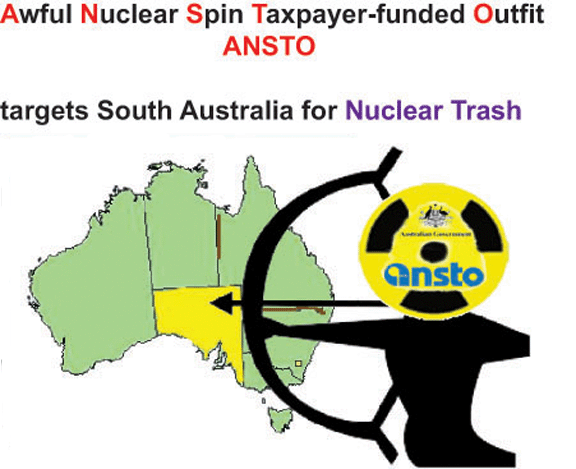 Brett Pike to Senate Committee on National Radioactive Waste Management Amendment (Site Specification, Community Fund and Other Measures) Bill 2020 [Provisions] Submission 67
I am writing today to register my concern and frustration at the continued reoccurring proposals of a Nuclear Waste Dump here in my home state of South Australia.
From the devastating environmental impacts with being so close to National Parks, the long term prolonged economic impact of the local Kimba region due to the stigma associated with hosting a Nuclear Waste Dump, the already vocal disapproval from the local indigenous authority and the cherry picking of voters in the local ballot all suggest that the shadiness of the operation to clout the public’s best interest and render the land useless for the rest of time.
To put it plainly, we don’t want any Nuclear Waste Dumps here in South Australia. We never have and we never will. The overwhelming majority of South Australian’s do not want it here. This bill has to go.
Nancy Lennon:: ensure that key environmental laws are applied to National National Radioactive Waste Management Act
 Nancy Lennon National Radioactive Waste Management Amendment (Site Specification, Community Fund and Other Measures) Bill 202 [Provisions] Submission 66
I respectfully request your rejection of the federal governments proposed changes to the National Radioactive
Waste Management Act.
The government has not made a clear case about the need for the planned national facility at Kimba. Moving
radioactive waste across long distances is extremely hazardous and completely unnecessary. This waste is
presently managed near the site it is generated at Lucas Heights, and it should remain stored in that area.
In particular, I am requesting you to remove options for judicial review of the government’s site selection
under current laws. Rather, please ensure that the key environmental and cultural heritage protection laws are
applied to any future changes in the NRWM Act.
The coronavirus pandemic and the uranium industry
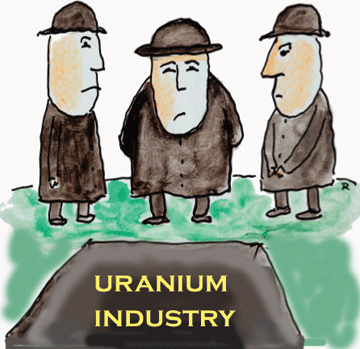 The coronavirus pandemic and the uranium industry
Jim Green, 25 May 2020, Nuclear Monitor #885, www.wiseinternational.org/nuclear-monitor/885/nuclear-monitor-885-25-may-2020
The uranium industry has been harder hit by the coronavirus pandemic than other sectors of the nuclear fuel cycle. Major producers have sharply cut production.
First, a quick summary of the past 15 or so years to put the current turmoil in context. Uranium mine production increased by 50% from 2007 to 2016.1 But the expected nuclear renaissance didn’t eventuate so increased uranium production has resulted in ever-growing stockpiles. Those stockpiles alone would suffice to keep the entire global reactor fleet operating for roughly eight years.2
Surplus production and stagnant demand have put persistent downward pressure on uranium prices. AMP Capital estimated in 2018 that around half the world’s uranium mines are losing money.3 The World Nuclear Association acknowledged in September 2019 that oversupply in recent years has led to a sizable reduction in uranium production levels at existing mines and a sharp decrease in investment in the development of new and existing mines.4 In 2011, according to a uranium company executive, there were about 420 companies around the world exploring for or mining uranium; now, the number is 62, of which 27 have “limited to non-existent resources”.5
Even before the recent pandemic-related cutbacks, numerous mines had been put into care-and-maintenance or production was reduced:6
- In Australia, the Beverley, Beverley North and Honeymoon mines were put into care-and-maintenance (and at the Ranger mine, mining has ceased and the processing of stockpiled ore will be soon be completed).
- Cameco has put several uranium mines into care-and-maintenance in recent years: McArthur River (and the Key Lake mill) and Rabbit Lake in Canada, and the Crow Butte and Smith Ranch-Highland in-situ leach mines in the US.7 Plans to expand Crow Butte were abandoned in 2019.
- Kazakhstan’s (mostly) state-owned uranium producer Kazatomprom cut uranium production by 20% in late 2017. Kazatomprom announced last year that the 20% curtailment of production will be extended until 2021, and its statement left plenty of wriggle-room for curtailment beyond then.8
- In Africa, the Langer Heinrich and Kayelekera mines were put into care-and-maintenance (and Paladin has since sold the Kayelekera mine).9
BHP Olympic Dam copper-uranium mine operates on outdated 1991 era Occupational Radiation Exposure Limits:
BHP Olympic Dam copper-uranium mine operates on outdated 1991 era Occupational Radiation Exposure Limits:
A Bill for a new Radiation Protection and Control Act 2020 goes to the SA Parliament for debate on/from Tues 2nd June, involving a range of untenable 1982 Indenture Act legal privileges to BHP that are retained in the Bill and proposed to be just rolled over into a new Act – which is unfit for the 2020’s…
Please see a Briefing Paper (4 pages) – with sub-headings covering key points:
“BHP Olympic Dam operates under outdated 1991 era Radiation Exposure Standards”
Briefing Paper prepared by David Noonan, Independent Environment Campaigner, 18 May 2020
Strong evidence to Reform a 30-year old standard and apply a Safer Lower Worker Exposure Limit p.1
BHP Olympic Dam underground mine workers face a significant increase in cancer risk p.2
BHP Olympic Dam workers face radiation health impacts double that of cancer risks alone p.3
The Bill and the Olympic Dam mine expansion must trigger a Radiation Safety Review p.4
How long will SA wait to Review and Reform worker radiation exposure health risks?
Covert-19: Government stacks Covid Commission with oil and gas mates
Covert-19: Government stacks Covid Commission with oil and gas mates, cosy deals follow, Michael West Media, by | May 13, 2020
The Government is quietly blowing away years of environmental protections under cover of Covid. Its Covid Commission (NCCC) is stacked with executives from the gas and mining lobbies in what is turning out to be a bonanza for multinationals and yet another destructive blow to Australia’s efforts to curb global warming. Sandi Keane investigates.
His declaration in Parliament, “This is coal; don’t be scared”, came back to haunt Prime Minister Scott Morrison when summer’s catastrophic wildfires brought global media attention over his handling of the crisis and Australia’s response to climate change.
Fast forward from bushfires to COVID-19 and his reputation has reversed thanks to the handling of the virus. Yet, while the attention of the nation has been drawn to the daily COVID-19 count and embracing the digital world of schooling, working and socialising from home, the fossil fuel industry – with help from the Morrison Government – has quietly seized the opportunity to entrench its power and profits.
A report from environmental advocacy group 350 Australia has detailed 36 individual policy changes or requests for project-specific support — all under cover of COVID-19. SEE THE EXCELLENT TABLE ON THE ORIGINAL
-
Tax cuts and other financial concessions = 💸
-
Slashing environmental or other corporate regulation = ✄
-
Fast-track project approvals = ✅
-
Delay or rollback of climate and renewables policies = 🔥
-
Attacks on charities and right to protest = 🚫
-
Undermining local communities and workers rights =
The findings are shocking. While we’ve been in a deep funk, as of May 7, 69% of demands from the fossil fuel sector have already been enacted or agreed to by the Government. Concessions and sweetheart deals include 14 requests to slash important environmental or corporate regulations, 11 requests for tax cuts and financial concessions, and 12 instances of requests to fast-track project assessment.
Lucy Manne, CEO of 350 Australia, called it out:
“It is rank opportunism for the fossil fuel lobby to call for slashing of corporate taxes and important environmental protections under the cover of COVID-19.”
Taking a cue from Howard’s love-in with the mining industry when alone among the rest of the developed world, he took key mining lobbyists to Kyoto rather than climate scientists, Morrison awarded key positions in the PM’s office to former mining executives and lobbyists. It, therefore, comes as no surprise that the National COVID-19 Co-ordination Committee (NCCC) has been:
COVID-19 National Co-ordination Committee’s links to fossil fuels
The NCCC was set up on March 25 with no terms of reference, no register of conflicts of interest with even less divulged about its financial resources. So let’s look at what 350 Australia has dug up on its links to fossil fuels.
Its six-strong Executive Board of Directors is supported by the Secretaries of the Department of the Prime Minister and Cabinet, Philip Gaetjens, and Home Affairs Mike Pezzullo. Gaetjens was intimately involved with the controversial community grants pre-Election. NCCC’s role is described as two-fold … “to help minimise and mitigate the impact of COVID-19 on jobs and businesses and to facilitate the fastest recovery possible once the virus has passed.”
Here are the key players:………https://www.michaelwest.com.au/covert-19-government-stacks-covid-commission-with-oil-and-gas-mates-cosy-deals-follow/
COVID-19: US Military Pursues War Games Amid Contagion. Australia involved
The U.S. Army is also pursuing a 6,000-person war game in Poland, June 5-19, with a Polish airborne operation and a U.S.-Polish division-size river crossing.
If these weren’t too many military operations during an epidemic in which personnel on 40 U.S. Navy ships have come down with the hyper-contagious virus and during which military personnel and their families have been told not to travel, plans are also underway for a U.S. Army division-sized exercise in the Indo-Pacific region in less than a year. Known as Defender 2021, the U.S. Army has requested $364 million to conduct the war exercises throughout Asian and Pacific countries.
The pivot to the Pacific, begun under the Obama administration, and maintained by the Trump administration, is reflected in a U.S. National Defense Strategy (NDS) that sees the world as “a great power competition rather than counterterrorism and has formulated its strategy to confront China as a long-term, strategic competitor.”
Earlier in May, the U.S. Navy sent at least seven submarines, including all four Guam-based attack submarines, several Hawaii-based ships and the San Diego-based USS Alexandria to the western Pacific in what the Pacific Fleet Submarine Force announced as simultaneous “contingency response operations” for all of its forward-deployed subs. This was all in support of the Pentagon’s “free and open Indo-Pacific ” policy — aimed at countering China’s expansionism in the South China Sea — and as a show of force to counter ideas that the capabilities of U.S. Navy forces have been reduced by Covid-19…….
In May, 2020, the Australian government announced that a delayed six-month rotation of 2,500 U.S. Marines to a military base in Australia’s northern city of Darwin will go ahead based on strict adherence to Covid-19 measures including a 14-day quarantine. The Marines had been scheduled to arrive in April but their arrival was postponed in March because of the pandemic.
The remote Northern Territory, which had recorded just 30 Covid-19 cases, closed its borders to international and interstate visitors in March, and any arrivals must now undergo mandatory quarantine for 14 days. U.S. Marine deployments to Australia began in 2012 with 250 personnel and have grown to 2,500. The Joint U.S. Defense facility Pine Gap— the U.S. Department of Defense, Five Eyes and CIA surveillance facility that pinpoints airstrikes around the world and targets nuclear weapons, among other military and intelligence tasks — was also adapting its policy and procedures to comply with Australian government COVID restrictions.
As the U.S. military expands its presence in Asia and the Pacific, one place it will NOT be returning to is Wuhan, China. In October 2019, the Pentagon sent 17 teams with more than 280 athletes and other staff members to the Military World Games in Wuhan. Over 100 nations sent a total of 10,000 military personnel to the games in Wuhan last October.
The presence of a large U.S. military contingent in Wuhan just months before the outbreak of the Covid-19 in Wuhan in December 2019, fueled a theory by some Chinese officials that the U.S. military was somehow involved in the outbreak, which now has been used by the Trump administration and its allies in Congress and the media that the Chinese deliberately used the virus to infect the world and adding justification for the U.S. military build-up in the Pacific region.
Ann Wright served 29 years in the U.S. Army/Army Reserves and retired as a colonel. She was a U.S. diplomat for 16 years and served in U.S. Embassies in Nicaragua, Grenada, Somalia, Uzbekistan, Kyrgyzstan, Micronesia, Afghanistan and Mongolia. She resigned from the U.S. government in March 2003 in opposition to President George W. Bush’s war on Iraq. She is co-author of “Dissent: Voices of Conscience.” https://consortiumnews.com/2020/05/26/covid-19-military-pursues-war-exercises-amid-contagion/
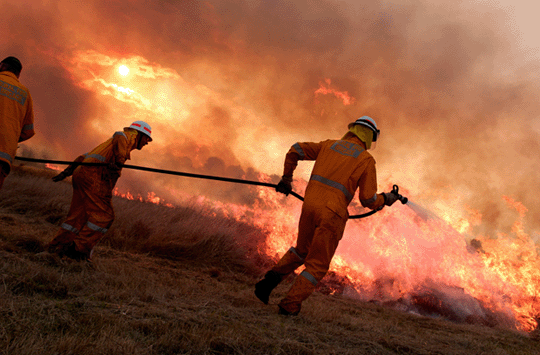
In 2019, fire chiefs were ‘gagged’ when trying to give climate change warnings to government
|
Asked by Victorian Liberal senator James Paterson if he thought “the current serving fire chiefs are gagged in some way”, Mr Mullins replied: “yes”. Mr Mullins, a former Fire and Rescue NSW commissioner, said when he was in the role “some things were out of bounds and often climate change was one of those issues, even to the point of having to work around it when preparing documents, and I think that is a tragedy”. Greens senator Janet Rice asked Mr Mullins if it was “still the case” that fire chiefs were discouraged from raising the effect of climate change on bushfire risks with politicians. “I know it’s the case,” Mr Mullins said. “I’ve had a number of discussions and it’s clear.” Mr Mullins had a 39-year career in NSW Fire and Rescue, and was appointed commissioner in 2003. He retired in 2017. Mr Mullins was representing the Emergency Leaders for Climate Action group, which comprises 33 former fire and emergency service leaders from around the country. Mr Mullins said he was pressured not to speak out on climate change when he was a public servant. “We self-censored because we knew what would be acceptable, and what would not, for certain political masters and if you went outside those bounds life could be made very unpleasant for you,” he said. The Emergency Leaders for Climate Action unsuccessfully sought meetings with Prime Minister Scott Morrison in April and again in May last year, ahead of the long 2019-20 summer bushfire season about the looming “catastrophic” fire season…….https://www.theage.com.au/politics/federal/some-things-were-out-of-bounds-fire-chiefs-gagged-on-climate-change-warnings-to-government-commission-told-20200527-p54wxv.html |
|
1 This month


Help Aunty Sue Protect Her Land and Sacred Sites From Destructive Rocket Testing.
.

Australians deserve the truth
about
AUKUS – https://aukuspublicinquiry.com/

PETITION – To: Prime Minister Anthony Albanese and the Australian Labor Government

of the week – Australians for War Powers Reform (AWPR)
To see nuclear-related stories in greater depth and intensity

