David Myer : nuclear lobby bullying their way by their effort to change the National Radioactive Waste Management Act

David Myer to Senate Committee on National Radioactive Waste Management Amendment (Site Specification, Community Fund and Other Measures) Bill 2020 [Provisions] Submission 68
The proposed waste facility at Kimba is a bad idea.
1. Handling and transport of nuclear waste is seriously hazardous.
2. The native people of the Kimba regoin have not been consulted. This is deeply troubling after years of being
ignored, we finally apologise for our historical appalling treatment of our aborigines, and now here we are
again, pretending they don’t exist, don’t have an opinion and don’t matter. Talk about third class citizens.
3. Removal of common law rights, as proposed in the draft legislation, through the denial of access to judicial
review and exempting environmental and heritage legislation, is tantamount to admitting that “this proposal
won’t stack up so we are bullying our way through.” How dare they exempt the law of the land!
Please do not support the proposed changes to the Act.
A WASTE OF TIME – submissions re radioactive waste dump Inquiry- ONLY TECHNICAL MATTERS will be considered
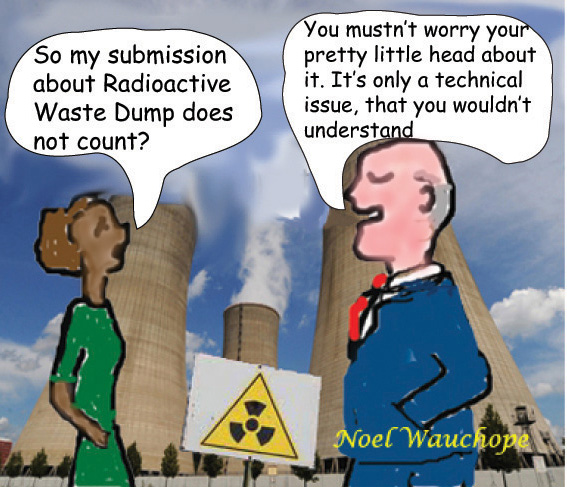
Noel Wauchope 27 May 20 It looks like the Senate Committee inquiring into the Bill to amend the National Radioactive Waste Management Act 2012 will limit the scope of their inquiries to mainly technical and scientific information. This will be done for two reasons.
The first reason is to bolster ANSTO’s position for getting all the licences for the facility at Napandee as described in ARPANSA’s submission since there are strong and real doubts that ANSTO will not succeed in getting them.
This would make the whole selection process a futile and unnecessary exercise without a result. We all know that this cost millions of dollars.
The second reason is that by concentrating on the technical factors the Committee will be able to avoid dealing with the more emotive questions based on the differences within the community, the outcome of the Parliament’s Joint Committee on Human Rights and the destroying of Native Title and other matters. The result is that many of fine submissions to the Committee will now be simply ignored as they do not include technical data.
What hope does the general community have?
Bob and Sue Tulloch: scrutiny needed on Radioactive Waste Management Amendment- paves the way to import foreign nuclear wastes
 Bob and Sue Tulloch ( Flinders Local Action Group ) to Senate Inquiry on National Radioactive Waste Management Amendment (Site Specification, Community Fund and Other Measures) Bill 2020 [Provisions] Submission 72
There is a lot of misinformation about the Federal Government’s proposed National
Nuclear Waste Management Facility at Kimba. Information has been with held from most Australians via a deliberate, discriminatory voting process, with only two South Australian communities ( Hawker / Quorn and
Kimba ) allowed to vote, (1300 citizens) a process that has so far failed them.
Do our law makers understand WHAT they are voting for?
This is NOT, just mainly a low level nuclear waste dump for hospital gloves and gowns. Two dumps co-located are planned. The second, a temporary storage facility, for far more dangerous intermediate level waste. This will include reprocessed spent fuel rods, used in the nuclear reactors at Lucas Heights, being returned to Australia from
France and the UK. Waste needing serious isolation from humans and the environment for 10,000 years. It is the temporary storage of this ILW, that worry people.
Case for keeping ILW at Lucas Heights
World’s best practice for dealing with Intermediate Level Waste, or High Level waste as classified in France and the UK, is permanent, deep underground burial. There are currently no plans for this to happen in Australia. There is also no time limit set for the storage of this waste, to be placed ‘temporarily’ in an above ground shed at Kimba, if moved from its current modern safe, secure storage facility at ANSTO’s Lucas Heights complex.
It is well documented that the cost of establishing a permanent, deep underground disposal facility for Australia’s relatively low volumes of ILW, is prohibitive. Unless the Australian Government is planning to subsidise the cost of establishing a nuclear waste storage and disposal facility at Kimba, by importing nuclear waste from overseas,
one must question the economical rational to relocate ILW to a second, temporary storage facility at, huge expense to the Australian tax payer.
Australian Nuclear Waste Law
Ref. Protecting Authority, Burying Dissent: An Analysis of Australian Nuclear Waste Law – Angela
Morsley. 2016
This paper considers the Australian legal framework for a national nuclear waste repository. The paper argues that the current law protects the Commonwealth’s decision- making in relation to a repository site, at the expense of ‘the place for
public participation in the development of the land’, conservation of Aboriginal heritage and environmental impacts, legitimate protections that under the proposed changes to the Act will be even more eroded.
In 2010 the Senate Legal and Constitutional Affairs Legislation Committee recommended that the NRWMA not be enacted unless mandatory provision was made for a Regional Consultative Committee. Closer analysis reveals that the RCC
has no power or influence over a Ministerial declaration, it’s function being merely to ‘facilitate communication’ between the host community and the Commonwealth’.
….. ‘Consultation may be provided for under the NRWMA, but there is no evidence to suggest that it has anything other that a tokenistic place within a legal framework that positions site selection as an almost inevitable outcome of nomination, supported by Ministerial fiat, rather than broadly sought public consent.’
The South Australian Parliament has legislation in place under the Nuclear Waste Storage Facility (Prohibition) Act 2000 to prevent the construction of such a facility and the transportation of radioactive waste through the state. The proposed
amendment to the NRWNA to nominate the Napandee site near Kimba as the‘relevant land’, will exclude all state legislation from regulation of all activities associated with the NRWMF. ARPANSA’s Code of Practice for the Safe Transport
of Radioactive Materials, is merely a code of practice and not a statute, is unenforceable in regards to the transportation of radioactive waste through South Australia.
Australia’s Future Nuclear Industry Involvement
Questions about nuclear power generation in Australia, future lucrative ‘fuel leasing’ plans involving an Australian Nuclear Fuel Industry as detailed in the following government reports, and the role a ILW storage facility at Kimba will play, need
clarification and public disclosure.
Australia’s Uranium – Greenhouse friendly fuel for an energy hungry world
A case study into the strategic importance of Australia’s uranium resources for the Inquiry into
developing Australia’s non-fossil fuel energy industry. November 2006
Final Report and recommendations of the SA Nuclear Fuel Cycle Royal Commission.
May 2016
Not without your approval: a way forward for nuclear technology in Australia;
Report of the inquiry into the prerequisites for nuclear energy in Australia; Dec 2019
A report by the House of Representatives Standing Committee on the Environment & Energy.
The proposed amendments to NRWM Act, 4A, specifically, refers to ‘radioactive waste’ to be replaced with ‘controlled materials’ (ref ARPANSA Act 1998 ‘controlled material means any natural or artificial material, whether in solid or liquid form, or in the form of a gas or vapour, which emits ionizing radiation spontaneously’), and removal of the words ‘domestic origin’, can allow future operations of the storage facility to encompass nuclear power and nuclear fuel leasing industries as detailed in the Dec 2019 ‘Not without your approval’ report.
For these reasons, more scrutiny on this proposal should be obligatory, and a genuine national discussion implemented. Information supplied to the communities of Hawker/Quorn, Kimba did not include these possibilities, and ballot results obtained from 1207 votes does NOT therefore represent an honest national conversation.
To pass the proposed amendments to the NRWM Act now, would be irresponsible and premature to say the least.
Legal action to follow the shonky National Radioactive Waste Management’s processes?
 This is an extract from Peter Remta – submission to Senate Committee on National Radioactive Waste Management Amendment (Site Specification, Community Fund and Other Measures) Bill 2020 [Provisions] Submission 65
“…………..PROVIDED INFORMATION
All of the information on which the government has based its proposals for the facility has been completely one-sided and self-serving and without any opposing or contrary research and opinions being presented to the Kimba community.
At no stage has the government provided or suggested any review or assessment of its information by the general community of Kimba especially when its members have asked some awkward questions which were mostly responded to by deflecting information or simply left unanswered.
When it was requested to do so the government neither responded nor provided any financial assistance for an independent assessment and scrutiny of its proposals and the information provided by the government and the District Council to the Kimba community.
This is a most unfair and unsatisfactory situation considering the quantum of substantial grants made by the government to the Kimba and previously Hawker communities in order to obtain their approval for hosting the government’s facility.
To that extent the members of the Kimba community opposing the government’s proposals have been deprived of properly and fully testing the validity of the information given by the government as in many instances it lacked credibility and caused grave concern within the Kimba community.
All of this flies completely in the face of the facts and the implications of human rights described in the explanatory memorandum especially as the members of the Kimba community were deprived of the full benefits of those rights and their consequences.
BALLOTS
The Kimba District Council has held two ballots to gauge the community support for
proposed facility with the later being in October 2019.
The results of that ballot were:
Voting papers issued 824
Formal votes accepted 735
Yes vote 452
No vote 283
Informal (no vote) 89
The government decided that the result is the percentage of yes votes of the total formal votes accepted and this is 61.5% in favour. However if the informal 89 votes were rightly included then the result is 54.8% in favour.
The voting base for this ballot was relatively limited as explained in the Federal Court decision dismissing the Barngarla appeal and even excluding the Barngarla many people within the Kimba region who should have been given a vote were not included The irony is that there were residents of the Kimba area who were denied a right to
vote yet they lived closer to the town than some of the eligible voters.
A previous community ballot was held at Kimba in June 2017 with people in the District being encouraged to participate in voting. While it was claimed that this ballot achieved voting of 57.4% in favour and 42.6% against on a total of 691 votes accepted the result in favour dropped to slightly less as they were not resident ratepayers which was the necessary qualification prescribed for the voting.than 50% based on the total of 793 voting papers issued.
INFORMED CONSENT
For a proper and fair ballot vote the Kimba District Council which arranged the ballot should have provided the voters with full written explanations accompanying the voting papers as to both sides of the question to be decided by the ballot so as to enable the intending voters to make a fully considered and informed decision. This has not been done and therefore makes the result highly suspect and unreliable.
Most importantly all the information regarding every aspect of the facility has been provided solely by the government and has been completely one-sided without any information to the contrary or at least a proper scrutiny of the government’s proposals.
Still on the issue of informed consent the government has never enabled or offered the members of the Kimba community who oppose the facility to obtain their own independent advice and assessment of the government’s proposals or to provide funds to meet the costs involved.
This has become extremely important as some of the information given by or on behalf of the government or the District Council of Kimba as proponents of the facility has been misleading or plainly wrong.
It is a well established legal principle that the Kimba District Council owes a duty of care to its community in providing proper and full information on any important issue such as the proposal to establish the facility but the Council has quite clearly failed tosatisfy that duty at law.
Leaving aside any legal rights and remedies available to the Kimba community in that regard the most pragmatic and practical solution would be for the government to pay for a full and proper independent assessment and critical analysis of the whole situation for or on behalf of the members of the community opposing or questioning
the government’s proposals.
This could then be followed by a much wider based ballot which would include explanations of the for and against cases in full so that a properly informed decision can be made by the intending voters. In the overall situation this is probably the most important factor having regard to the mainly disingenuous or at least misleading information from the government over the past four years.
This becomes even more relevant having regard to the numerous requests for information which have never been satisfied by the government in any of its guises and to that extent the community of Kimba were deprived of their full rights described in the explanatory memorandum.
LEGAL ACTIONS
It would seem that in all the circumstances the members of the Kimba community opposing the facility (should they feel so inclined) would have a right of action against the District Council and probably the federal government on the issues of failing to provide full and proper information and holding a fair and more extended ballot based on that information.
It could readily be argued by the Kimba community members who feel aggrieved by the actions of the District Council and the government that the voting rights should be extended to a much broader area and include persons who are not necessarily on the ratepayers’ roll but still have a close affinity to Kimba. For example there are apparently instances of community members who are not on the roll but are much closer to the Kimba township than some of the persons entered on the roll.
An Email from Stichting Thorium MSR — The Industry Push to Force Nuclear Power in Australia

Why is the Majority Report of the Australian Senate here: https://www.aph.gov.au/-/media/02_Parliamentary_Business/24_Committees/243_Reps_Committees/EnvironmentEnergy/Nuclear_energy/Full_Report.pdf?la=en&hash=2826513C078551487B8265502776DAD5D23EB71D so full of misinformation and a totally false set of technical assertions???
via An Email from Stichting Thorium MSR — The Industry Push to Force Nuclear Power in Australia
Australian nuclear dump decision trashes indigenous peoples’ rights
|
Australian nuclear dump decision trashes indigenous peoples’ rights, https://www.foe.org.au/australian_nuclear_dump_decision_trashes_indigenous_peoples_rights Jim Green and Michele Madigan, 26 May 20, Earlier this year, the Saugeen Ojibway Nation voted against plans for a deep geological repository near Lake Huron. The Canadian government will respect the decision and will no longer target the site. Sadly, the situation in Australia is the exact opposite: Traditional Owners were denied a right to vote in a ‘community ballot’ concerning a national nuclear waste dump, and the federal government is proceeding with the dump despite their unanimous opposition.
The federal government announced in February that it plans to establish a national nuclear waste ‘facility’ near Kimba on South Australia’s Eyre Peninsula. It will comprise a permanent dump for low-level nuclear waste, and an ‘interim’ store for long-lived intermediate-level waste. Shamefully, the federal government has decided to move ahead despite the unanimous opposition of the Barngarla Traditional Owners, native title holders over the area. The federal government refused a request from the Barngarla Determination Aboriginal Corporation (BDAC) to include traditional owners in a ‘community ballot’ held last year. So BDAC engaged the Australian Election Company to conduct a confidential postal ballot open to all Barngarla Traditional Owners. None of the respondents voted in favour of the dump. Jim Green and Michele Madigan Earlier this year, the Saugeen Ojibway Nation voted against plans for a deep geological repository near Lake Huron. The Canadian government will respect the decision and will no longer target the site. Sadly, the situation in Australia is the exact opposite: Traditional Owners were denied a right to vote in a ‘community ballot’ concerning a national nuclear waste dump, and the federal government is proceeding with the dump despite their unanimous opposition. The federal government announced in February that it plans to establish a national nuclear waste ‘facility’ near Kimba on South Australia’s Eyre Peninsula. It will comprise a permanent dump for low-level nuclear waste, and an ‘interim’ store for long-lived intermediate-level waste. Shamefully, the federal government has decided to move ahead despite the unanimous opposition of the Barngarla Traditional Owners, native title holders over the area. The federal government refused a request from the Barngarla Determination Aboriginal Corporation (BDAC) to include traditional owners in a ‘community ballot’ held last year. So BDAC engaged the Australian Election Company to conduct a confidential postal ballot open to all Barngarla Traditional Owners. None of the respondents voted in favour of the dump. Racist legislation The National Radioactive Waste Management Act systematically discriminates against Australia’s First Nations. For example, the nomination of a site for a nuclear dump is valid even if Aboriginal traditional owners were not consulted and did not give consent. And the Act has sections which nullify or curtail the application of laws such as the Aboriginal and Torres Strait Islander Heritage Protection Act 1984, and the Native Title Act 1993. The federal government recently announced that it plans to amend the Waste Management Act. While the Act is sorely in need of an overhaul, the planned amendments aren’t those that are needed. Clauses in the Act that dispossess and disempower traditional owners will remain untouched. Indeed, the planned amendments will, if passed, further disempower traditional owners. Barngarla Traditional Owners are lobbying opposition and cross-bench federal parliamentarians regarding the flawed amendments. A recent report by the federal parliament’s Joint Committee on Human Rights found that the amendments could breach international law by failing to protect the human rights of Barngarla Traditional Owners and that the amendments pose a significant risk to their right to culture and self-determination. Appalling process The South Australian Labor Party argues that traditional owners ought to have a right of veto over nuclear projects given the sad and sorry history of the nuclear industry in South Australia, stretching back to the British atomic bomb tests at Maralinga and Emu Field. Deputy Leader of the Opposition Susan Close says that South Australian Labor is “utterly opposed” to the “appalling” process which led to the announcement regarding the Kimba site. Compare that to the federal government, whose mind-set seems not to have advanced from the ‘Aboriginal natives shall not be counted’ clause in the Constitution Act 1900. As Barngarla Traditional Owner Jeanne Miller says, Aboriginal people with no voting power are put back 50 years, “again classed as flora and fauna.” The current debate follows a history of similar proposals ‒ all of them defeated, with traditional owners repeatedly leading successful campaigns. In 2004, after a six-year battle, the Howard government abandoned plans for a national nuclear waste dump in SA. The Kupa Piti Kungka Tjuta ‒ a senior Aboriginal women’s council ‒ congratulated the government for belatedly getting their ‘ears out of their pockets’. In 2016, the plan to import high-level nuclear waste from around the world was abandoned after a Citizens’ Jury noted the lack of Aboriginal consent and concluded that “the government should accept that the Elders have said NO and stop ignoring their opinions.” And last year, the federal government abandoned plans for a national nuclear dump in South Australia’s Flinders Ranges, a plan that was fiercely contested by Adnyamathanha Traditional Owners. South Australian Premier Steven Marshall is rightly proud of his record promoting the growth of renewable energy in the state. And he’s proud of his significant role in putting an end to the plan to import high-level nuclear waste from around the world. But the Premier ‒ whose portfolio includes Aboriginal Affairs and Reconciliation ‒ supports the federal government’s nuclear dump plan. He needs, as the Kungkas put it, to get his ears out of his pockets and to respect the unanimous opposition of the Barngarla Traditional Owners. The fight goes on! More information: www.nuclear.foe.org.au/waste Jim Green is the national nuclear campaigner with Friends of the Earth Australia. Michele Madigan is a Sister of St Joseph who has spent the past 40 years working with Aboriginal people across South Australia. |
|
Australia could address another global threat by supporting the UN the Treaty on the Prohibition of Nuclear Weapons.
|
As we wait for a vaccine, there is another global threat we could address today, https://www.canberratimes.com.au/story/6767846/as-we-wait-for-a-vaccine-there-is-another-global-threat-we-could-address-today/?cs=14246 Sue Wareham, 25 May 20
Calls by scientists and others have been made for climate action to play a key role in the post-COVID-lockdown world that is slowly coming into view. These calls are critically important; no responsible government can ignore them. After warnings in recent years about the risk of a global pandemic, we should have learnt that risks don’t go away simply by being ignored. However, there is another call to action on a profound risk to humanity that has received less attention – the need to get rid of the 14,000 nuclear weapons in existence. This risk has been highlighted again this month by President Trump’s discussions with senior officials of a possible resumption of US nuclear testing, a dangerous move that would break a nuclear test moratorium which has been honoured for over two decades by all nations except North Korea. In addition, an important high-level meeting, the five-yearly Review Conference of the Nuclear Non-Proliferation Treaty (NPT), which was scheduled to take place at the UN in New York from April 27 to May 22, has been postponed for the obvious reason until early 2021.
The NPT entered into force exactly half a century ago, in 1970, and has played a very significant role in preventing the rapid spread of nuclear weapons; currently there are just nine nuclear-armed states. At the quarter-century mark, in 1995, it was extended indefinitely, with member states reaffirming their commitment to the complete elimination of nuclear weapons, a goal that is central to the treaty and yet remains unfulfilled. That failure lies at the heart of growing tensions, between the countries with the weapons and those without, that have marked the five-yearly NPT Review Conferences since 1995. Far from disarming, the nuclear-armed states are updating their arsenals.
The US, followed by Russia, abandoned the Intermediate Nuclear Forces (INF) Treaty in February last year, with mutual accusations of violations. In 2018 Trump pulled out of the nuclear accord with Iran. The New START (Strategic Arms Reduction Treaty), the last remaining treaty limiting the world’s two largest nuclear arsenals (the US and Russia), is due to expire next February, with no renewal in sight.
The same rules apply to all nations, and the rule is zero tolerance of the world’s worst weapons. Australia boycotted the whole process, arguing that the security needs of the nuclear-armed states need special consideration – a bit like special pleading for those planning genocide. Entry into force of the TPNW was expected this year but, like everything else, is now delayed.
The driver for negotiating the TPNW was the overwhelming scientific evidence of the catastrophic harm that humanity would face with any use of nuclear weapons, and the knowledge that the risk is increasing. In January this year, the Bulletin of the Atomic Scientists advanced the hands of its Doomsday Clock to 100 seconds to midnight, closer to global catastrophe than at any other time, including during the Cold War.
|
|
Australian media is not doing its job to expose power and corruption
|
What lies beneath must be resurfaced — or the media is not doing its job to expose power and corruption
And yesterday, the government released a discussion paper proposing that the declining role of gas in Australia’s energy production and manufacturing sectors instead be significantly expanded, which would also directly benefit Santos. In between, the government’s COVID economic recovery panel, chaired by another energy company executive, also urged that gas be used as part of Australia’s economic recovery. Both ideas would require massive government subsidies for gas companies like Santos. As a result Santos has had a good week. Last Friday, the company saw its share price close at $4.60. Yesterday it closed at $5.29, a 15% rise compared to just 3% on the ASX 200. This represents a handy return on investment. Santos is the country’s second-biggest fossil fuel industry political donor after Clive Palmer, having given over $1 million to the Coalition in the last decade. It has a rich history of exchanging staff with Coalition governments…… [In the media coverage] The story was treated as an energy or climate policy story, rather than one about corruption and power……. When even good, experienced journalists fail to give a full account of the fossil fuel companies working to not merely stymie climate action but to turn climate policies to their financial advantage, it points to a serious problem in our media — an inability to explore how surface events reflect underlying structures of power in Australia. And it results in a normalisation of corruption. Why do we instinctively see corruption if Trump does something, but if the government here does exactly the same thing, it’s written up seriously as an energy policy story, with the government and business on one side of a serious debate and “green groups” on the other? We see through the words a figure like Trump uses to disguise their corruption; here, the same words are taken at face value, and debated as serious contributions to policy…… Turnbull at least spoke and wrote about the role of fossil fuel interests and News Corp (which he correctly described as a foreign political party, rather than what it purports to be, an Australian media company) ….. Despite the woeful level of transparency around influence-peddling, there is considerable information available about the financial and personal links between key stakeholders and policymakers across federal politics.
At the ABC, Stephen Long is one of the few mainstream media journalists who sees his “investigative” role as extending to the structures of power rather than simply the surface. Paul Karp of The Guardian is also attuned to the tendency of donors to benefit from political parties. But they are, sadly, exceptions. We’ve seen before what happens when the media ignores the underlying reasons for decisions by policymakers. For years, the extensive donations by the major banks to the Liberal Party, and the revolving door between the executive suites of banks and the ranks of both ministerial staff and ministers themselves, was ignored by the media. The donations and revolving doors operated for both political parties, but the Liberals had — and have — by far the deepest and richest links with the banks. But the role of these financial and personal links in the Liberals’ long-running protection of the banks from regulation, and their constant attacks on industry superannuation funds, received little attention……. Australia’s political system is corrupted. Corrupted not merely or even particularly in the NSW Labor way of bags of cash and dodgy deals for mates, but systemically, institutionally corrupt, a pervasive soft corruption in which the powerful use money and lobbying to influence policymakers and get favourable policies, indeed, as we’ve seen this week, often get to craft policy themselves. All it takes to understand and explain that is to look beneath the surface. Is the Australian media holding policymakers to account? Let us know your thoughts by writing to letters@crikey.com.au. Please include your full name to be considered for publication in Crikey’s Your Say column. https://www.crikey.com.au/2020/05/22/political-reporters-not-doing-their-job-power-corruption/ |
|


A tribute to the Maralinga traditional owners
This is a critical and never-ending land management responsibility which the Maralinga people, who suffered the environmental and health effects of the nuclear tests, have shouldered on behalf of the Australian community.
He was able to relate to Aboriginal and non-Aboriginal people, cabinet ministers and homeless people alike. He treated everyone with candour and respect.
By word and deed he refused to accept that Aboriginal people were inferior
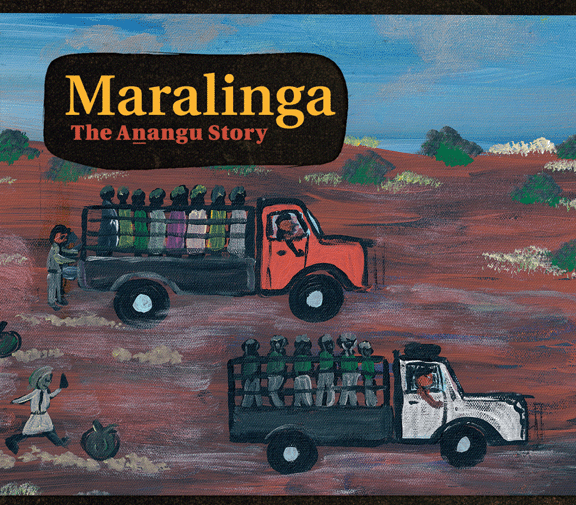 Why Archie Barton and the Maralinga traditional owners are the unsung heroes of the British nuclear test program in Australia https://www.abc.net.au/news/2020-05-25/andrew-collett-on-archie-barton-unsung-heroes-of-maralinga-tests/12272284 By Andrew Collett
Politicians, bureaucrats, scientists and advisers come and go. The traditional owners must plug on with the management and rehabilitation of their land — on behalf of us all.
Andrew Collett is an Adelaide barrister and one of the lawyers who has represented the Maralinga traditional owners since 1984. Find out more about the story of the people of Oak Valley and Yalata in a new ABC TV documentary, Maralinga Tjarutja, available to stream now on iview.
The traditional owners of the 100,000 square kilometre Maralinga Lands didn’t only shoulder the harsh legacy of the British nuclear testing while it was happening in the 1950s and 60s.
To this day, they are managing the still contaminated test sites in far-west South Australia on behalf of Australia and Britain.
For this they receive little recognition and inadequate financial assistance — despite having established extremely constructive and enduring relationships with Australian scientists and government representatives.
Aboriginal and Torres Strait Islander readers are advised that the following article contains names and images of people who have died.
The Maralinga people were kept away from their lands and from any knowledge about what happened in the nuclear tests from 1955 until they obtained land rights and finally returned to their lands in 1985 — an isolation of 30 years, or well over a generation in Aboriginal terms.
For that 30 years the Maralinga people were kept at the Lutheran Mission at Yalata, away from their traditional lands, isolated from their Pitjantjatjara and Yankunytjatjara communities over 400 kilometres to the north and from much of their vibrant Western Desert tradition and ceremony.
They fell prey to social and cultural isolation and deteriorating health outcomes.
When they returned to their traditional lands in 1985, having been granted land rights to all their lands apart from the test sites, a royal commission was sitting in London examining what had happened during the Maralinga nuclear tests and why.
A constructive partnership with governmen Continue reading
#ScottyFromMarketing – yes Australia is run by an otherwise talentless marketing man
 Scotty from Marketing: What a way to run a country, Independent Australia, By Jennifer Wilson | 26 May 2020, Word is, Prime Minister Scott Morrison intensely dislikes the moniker “Scotty from Marketing” bestowed upon him last year by the Betoota Advocate.
It’s difficult to escape the strong impression that one of Morrison’s few talents is the grand announcement that, not much later, turns out to have minimum substance. Just one example is the $2 billion bushfire fund — $1.6 billion of which remains unallocated while survivors who lost everything are still living in tents and caravans without running water and toilet facilities…….
For the Prime Minister, the thrill is in the making of the promise, not the delivery of its substance, as may be in keeping with the general goals of a marketing man. Delivery is long and boring. Gratification comes immediately with the grand announcement and the praise with which it is greeted, particularly by the media. Who cares if the damn thing actually works or not?
So what if the $130 billion JobKeeper wage subsidy program has gone astoundingly awry in so many ways, not least of which is that it was overestimated to the tune of some $60 billion? Who cares? Announcing “the biggest economic lifeline in the country’s history”, as Morrison proclaimed at the time, brought him peak gratification and was immediately rewarded by lavish praise from business groups and the mainstream media……
Morrison’s primary goal is to persuade the punters he’s a good “dad” to the country and to this end, he seeks to dwell in the eternal present. The past is a country he increasingly needs to move on from, with a vicious cattle dog nipping at his heels — unless of course it’s got something to do with Labor that can be spun to his advantage. The future is of equal irrelevance, outside of Morrison’s personal ambitions. The Liberal Party itself is little more than a vehicle for the realisation of these personal ambitions, as is Morrison’s affiliation with his church — the man would likely hurl both of them under the bus if they in got in the way of the gaping maw of his gluttonous ambition.
Morrison’s primary talent is marketing himself. He did actually win the last Federal Election almost entirely without assistance from his ratbag crew of discontents and right-wing loons — and this is an indicator of his bottomless supply of self-belief and enviable lack of doubt.
Which brings us to China. On 22 April this year, Morrison had a phone chat with U.S. President, Donald Trump…….
What the mainstream media is far too inclined to overlook is Morrison’s utter ruthlessness. He is pragmatic and many appear to admire that quality, but it is a pragmatism whose genesis is to be found in breathtaking ruthlessness, and overweening self-interest — and it is not admirable. ……..
This is Scotty from Marketing. Find something to sell, and sell it regardless of the consequences. It’s the selling, stupid. What a way to run a country.https://independentaustralia.net/politics/politics-display/scotty-from-marketing-what-a-way-to-run-a-country,13931#.XsyKe2S6_gA.twitter
The false economics promised by the government’s National Radioactive Waste Management plan
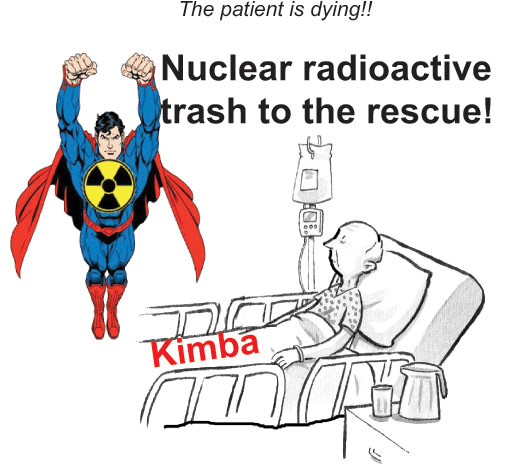
on all proper assessments and studies it is quite clear that the suggested benefits will not become a reality and in fact may lead to a deterioration in the value of the farming lands and residential properties at Kimba due the presence of the nuclear waste facility.
the government is doing no more than attempting to create a false economy which regrettably is being seized on by some members of the Kimba community as the misconceived salvation of its present depressed rural conditions which are actually common to the rest of Australia.
This is an extract from Peter Remta – submission to Senate Committee on National Radioactive Waste Management Amendment (Site Specification, Community Fund and Other Measures) Bill 2020 [Provisions] Submission 65
“………FINANCIAL GRANTS
The government has made significant financial grants to Kimba and also previously Hawker to gain community approval for its proposals. While it is a little difficult to ascertain the exact amounts of the grants the list of
recipients indicates that many of them were for rather nebulous and unnecessary purposes with little support or justification. In December 2018 the government first mentioned a so called community purposes
grant of $31million but failed to provide full details of the grant and its application.
Eventually it was explained that this grant would be a community development package to build economic capacity skills and resilience within those communities and to help realise the economic benefits of hosting the facility.
The three components of the package were:
(a) $8 million for community skills and development
(b) $3 million from the government’s Indigenous Advancement Strategy to support economic opportunities for the local Aboriginal community
(c) $20 million as a community fund to contribute towards a range of community focused projects including sustainable health services agricultural research and development and enhancements to local infrastructure such as roads and telecommunications
Even if component (a) were excluded the remaining applications of money should be part of the normal expenditure by the federal and state governments and be completely unrelated to and independent of the community’s acceptance of the facility.
In fact the local Aboriginal community considers that the moneys from the Advancement Strategy would be available to it in any event under previous arrangements.
Yet at the Senate estimates hearing on 21 February 2019 Manager Chard of the so called national radioactive waste management taskforce stated on behalf of the Department that the community development package of $31 million (she referred to it as $30 million) was being “enshrined” in legislation because this was requested by the community.
She also said that fund – being presumably the component of $20 million of the total package – was “not dependent on the legislation change” since it was envisaged that a fund would be established to support the community when the existing legislation was “conceived” in 2012 even though there had never been any public release or mention of the package and its value until December 2018.
ECONOMIC BENEFITS
The government has constantly promoted the notion and claimed that the establishment of the facility will lead to significant economic benefits for the Kimba region and its community.
The argument espoused and promoted by the government is that Kimba is a dying agricultural area with no future prospects of revival and consequently the establishment of the facility will provide significant increased employment and other infrastructure benefits ensuring its future for an even quoted figure of 300 years. The economic prospects for Kimba would also be augmented and improved by the intended grants from the government already described as the community development package.
However on all proper assessments and studies it is quite clear that the suggested benefits will not become a reality and in fact may lead to a deterioration in the value of the farming lands and residential properties at Kimba due the presence of the nuclear waste facility.
Based on proper and considered financial advice it seems that the government is doing no more than attempting to create a false economy which regrettably is being seized on by some members of the Kimba community as the misconceived salvation of its present depressed rural conditions which are actually common to the rest of Australia.
This is a completely wishful but unrealistic perception since it has already been shown by other examples that the facility would in a normal commercial sense need less than 10 workers unlike the government’s constantly quoted figure of 45 workers. Moreover the construction of the facility at Kimba will probably be carried out by already qualified and well experienced contractors from outside of Kimba and their presence during the building stage will add little to the local community……….”
Australia, and other countries – deaths from global heating are being underestimated

|
Experts Warn Climate Change Is Already Killing Way More People Than We Record, Science Alert ,CARLY CASSELLA, 25 MAY 2020
People around the world are already dying from the climate crisis,and yet all too often, official death records do not reflect the impact of these large-scale environmental catastrophes. According to a team of Australian health experts, heat is the most dominant risk posed by climate change in the country. If the world’s emissions remain the same, by 2080 Australian cities could see at least four times the number of deaths from increasing temperatures alone. “Climate change is a killer, but we don’t acknowledge it on death certificates,” says physician Arnagretta Hunter from the Australian National University. That’s a potentially serious oversight. In a newly-published correspondence, Hunter and four other public health experts estimate Australia’s mortality records have substantially underreported heat-related deaths – at least 50-fold. While death certificates in Australia do actually have a section for pre-existing conditions and other factors, external climate conditions are rarely taken into account. Between 2006 and 2017, the analysis found less than 0.1 percent of 1.7 million deaths were attributed directly or indirectly to excessive natural heat. But this new analysis suggests the nation’s heat-related mortality is around 2 percent. “We know the summer bushfires were a consequence of extraordinary heat and drought and people who died during the bushfires were not just those fighting fires – many Australians had early deaths due to smoke exposure,” says Hunter……. “Death certification needs to be modernised, indirect causes should be reported, with all death certification prompting for external factors contributing to death, and these death data must be coupled with large-scale environmental datasets so that impact assessments can be done.” …… Such action, they say, is imperative. Not only for Australia but many other countries in the world. The United Kingdom has documented some problems with accurately filling out death certificates, and cities in several parts of the world are on track for similar heat-related mortality rates as Australia. But there are some places that will need to do more than just update their current system. In the tropics, there’s little valid mortality data on the more than 2 billion people who live in this heat-vulnerable region. And that makes predicting what will happen to these communities in the future much trickier. “Climate change is the single greatest health threat that we face globally even after we recover from coronavirus,” says Hunter. “We are successfully tracking deaths from coronavirus, but we also need healthcare workers and systems to acknowledge the relationship between our health and our environment.” In an unpredictable world, if we want to know where we’re going, we have to know where we’ve been. Figuring out how many of us have already died from climate change will be key to that process. We can’t ignore it any longer. The correspondence was published in The Lancet Planetary Health. https://www.sciencealert.com/official-death-records-are-terrible-at-showing-how-many-people-are-dying-from-the-climate-crisis |
|
|
Australian government’s climate and post-Covid policy is a sop to the fossil fuel industries
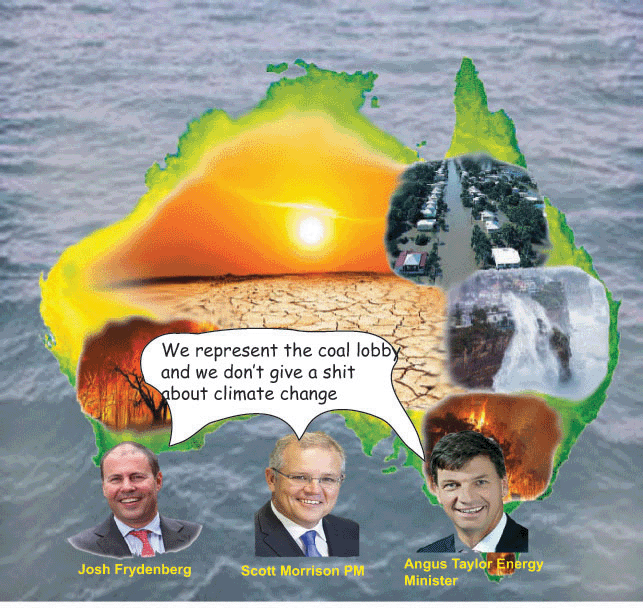
Angus Taylor suggesting it is not government policy to achieve net zero emissions by 2050, and the government giving in-principle support to recommendations made by a panel headed by a former CEO of Origin Energy, Grant King, to allow the Australian Renewable Energy Agency and the Clean Energy Finance Corporation fund projects involving carbon capture and storage.
pushes for the same energy mixes that were being advocated a decade ago – more gas, the discredited carbon capture, as well as nuclear power.
The climate crisis looms as the Coalition fiddles with fossil fuels https://www.theguardian.com/commentisfree/2020/may/24/the-climate-crisis-looms-as-the-coalition-fiddles-with-fossil-fuelsGreg Jericho The government is like a smoker switching to low-tar cigarettes. Its energy policy is just a sop
We may be dealing with a health crisis, but the climate change crisis has not gone away, nor become any less urgent. In fact, the opposite.
A few conservative commentators have suggested Covid-19 shows what a real crisis looks like compared with, in their opinion, the hyperventilating over climate change.
What bollocks.
Nasa estimates that last month was the hottest April on record and the first four months of this year are the second hottest start to a year.
The past seven months have all been 1C or higher than the 1951-1980 average (roughly around 1.3C above the pre-industrial average) – tied with the longest streak set from October 2015 to April 2016. But unlike in 2015 and 2016 the Bureau of Meteorology records we are currently not in El Niño.
That very much suggests the pace of warming is speeding up.
The linear trend of temperatures over the past 60 years suggests we will hit 2C above pre-industrial levels in 50 years; the trend of the past 20 years has it happening in around 30 years, but the trend of the past decade would see us hit that level in 2038 –just 18 years’ time.
And no, the virus has not bought us more time.
A study published this week in Nature Climate Change estimates the annual global drop in emissions due to virus shutdowns will be “comparable to the rates of decrease needed year-on-year over the next decades to limit climate change to a 1.5°C warming”.
That it took forcing people to stop their lives to achieve such cuts highlights just how big the job ahead of us is and how it cannot be done through individual action alone.
Cutting emissions without crippling the economy requires not everyone self-isolating, but changing industries and the very foundations of our economy.
We need to move away from oil, coal and gas to renewable energy.
And so it should be of great concern that the government is using the coronavirus as cover to push fossil fuels.
This week Adam Morton revealed that a manufacturing taskforce, headed by Dow Chemical executive and Saudi Aramco board member Andrew Liveris, is recommending to the National Covid-19 Coordination Commission (itself headed by the current deputy chairman of Strike Energy, Neville Power) that “the Morrison government make sweeping changes to ‘create the market’ for gas and build fossil fuel infrastructure that would operate for decades”.
It comes off the back of Angus Taylor suggesting it is not government policy to achieve net zero emissions by 2050, and the government giving in-principle support to recommendations made by a panel headed by a former CEO of Origin Energy, Grant King, to allow the Australian Renewable Energy Agency and the Clean Energy Finance Corporation fund projects involving carbon capture and storage.
Taylor also this week released a discussion paper for a “framework to accelerate low emissions technologies”. While suggesting renewables are vital, it essentially pushes for the same energy mixes that were being advocated a decade ago – more gas, the discredited carbon capture, as well as nuclear power.
It’s the wrong policy at precisely the wrong time.
As Morton has reported, organisations and governments around the world are advocating using economic stimulus measures to push towards a greener economy.
A report released this week by the Australian Conservation Foundation echoed the Grattan Institute’s recent “Start with steel: A practical plan to support carbon workers and cut emissions” report, arguing that we should see the virus as an opportunity to transform our economy and invest in renewable energy.
But no. It is clear the government remains wedded to a fossil-fuel based economy in which its climate change policy is merely a sop rather being designed to deal with a major crisis that is only becoming more urgent.
Leading doctors in Australia (over 180 of them) want Australia’s Australia’s Environmental Protection and Biodiversity Conservation Act 1999 (EPBC Act) made stronger, not weaker
 More than 180 doctors sign open letter calling for overhaul of ‘failing’ environmental laws, https://www.sbs.com.au/news/more-than-180-doctors-sign-open-letter-calling-for-overhaul-of-failing-environmental-laws 25 May 20, More than 180 health professionals have signed a letter warning the Commonwealth must strengthen Australia’s environmental laws to protect people’s health.
Doctors for the Environment Australia and the Climate and Health Alliance have sent an open letter to federal Environment Minister Sussan Ley as she undertakes a once-in-a-decade review of environmental protection laws.
Australia’s Environmental Protection and Biodiversity Conservation Act 1999 (EPBC Act) was established more than 20 years ago at a time when the doctors say the effects of climate change and its links to human health were not widely considered to be related.
The review comes amid the COVID-19 pandemic and follows Australia’s catastrophic summer bushfires with the health professionals warning that failing to conserve the environment will expose Australians to further devastation and health risks.
“We must protect the natural environment in order to prevent further and potentially even more deadly pandemics,” the letter says.
“The degradation of Australia’s natural environment and loss of our unique biodiversity is in effect a dismantling of our life support systems.”
The doctors argue the laws have failed as Australia has the second-highest rate of biodiversity in the world and is recognised as a land clearing and deforestation hotspot.
“The EPBC Act has failed to achieve its objectives of protecting Australia’s environment and promoting ecologically sustainable development and biodiversity conservation,” the letter says.
The letter, also signed by former Australian of the Year Professor Fiona Stanley, calls for an “entirely new generation” of environmental laws that focus on the impacts on human health and which have greater protections in place for biodiversity.
Associate Professor Katherine Barraclough from Doctors for the Environment Australia argues clearing forests and wildlife habitat increases the risk of infectious diseases being transferred from wildlife to people.
“The COVID-19 pandemic and the summer’s fires serve as a wake-up call. We must recognise the interconnections between humans, animals and natural places,” she said in a statement.
Climate and Health Alliance founder Fiona Armstrong said the government listened to the science in its response to COVID-19 and should do the same in regards to the environment and climate change.
An interim report into the Environment Protection and Biodiversity Conservation Act review is expected mid-year with the final report expected in October.
National Coordination COVID-19 Commission – a fossil fuel mates’ rort of staggering proportions.
 Coalition’s COVID-19 Commission: Another reason for a Federal ICAC Now! Independent Australia By Ross Jones | 25 May 2020 Just how much slush do you reckon is going to wash around the Coalition’s so-called National Coordination COVID-19 Commission? Coalition’s COVID-19 Commission: Another reason for a Federal ICAC Now! Independent Australia By Ross Jones | 25 May 2020 Just how much slush do you reckon is going to wash around the Coalition’s so-called National Coordination COVID-19 Commission?
It is brutally evident that, much like birds in a Hitchcock movie, masses of spivs are preening their flight feathers, readying themselves for a terrifying assault on Australia’s fragile environment to line their own – and others’ – already luxurious nests. This is going to be a mates’ rort of staggering proportions. There are a lot of approaches Australia could take to emerge from the COVID-19 problem a better place. Certainly, Australia is awash with economic problems — high unemployment, battered production capabilities, smashed asset values and a looming surplus of exports are just the start. As you would expect, the Morrison Government eschewed any sensible approaches to these problems, like rebooting manufacturing to set the country up for efficient, long-term solutions, which would enable us to contribute to global attempts to slow climate change while boosting levels of meaningful employment. Instead, the Coalition wants to unleash the dogs of destruction, just to make sure no other generation of Australians has anywhere near the opportunity this lot of privileged elitists has enjoyed. Once fracked and drilled, that land – our children’s land – will be rendered useless. Destroyed. Why are they doing this? Money. Lots of it. Greed, bribes, backhanders and sly winks will ensure the brown paper bags – or Cayman Island cupboards – are nice and plump for all the abusers of our long-term well-being to jam their porky little mitts into. This is exactly why we need an empowered Federal ICAC and that is exactly the reason IA is proposing the formation of a new Australian political party to be named — Federal ICAC Now (FIN). A Federal ICAC won’t stop all the malfeasance but it could put a fair-sized dent in it. Also, it would be great to have a few senators in the House whose focus is on corruption detection and prevention. The next half-senate election, when the term of those elected in 2016 expires, can be held as early as 7 August 2021 but must be held by 30 June 2022. Before the election, and especially in the last months leading up to the big event a registered FIN party would have a presence alerting voters to the issues. At the election, the above-the-line party might just have a chance. A previous IA article floated the idea of FIN and asked readers if they would be willing to join such a party………. https://independentaustralia.net/politics/politics-display/coalitions-covid-19-commission-another-reason-for-a-federal-icac-now,13928 |
|
1 This month
.

Australians deserve the truth
about
AUKUS – https://aukuspublicinquiry.com/

PETITION – To: Prime Minister Anthony Albanese and the Australian Labor Government

of the week – Australians for War Powers Reform (AWPR)
To see nuclear-related stories in greater depth and intensity

