Resources Minister Keith Pitt shows poor grasp of nuclear waste issues.
From Keith Pitt’s Website…. There are some glaring problems with his understanding of the portfolio including “the people of Napandee”….storage of Low Level Waste when it is Disposal….the inference that waste at the other 100 sites is nuclear medicine related….that nuclear medicine “keeps us well”….just to name a few,
 Interview with Paul Culliver, Breakfast program of ABC North and West SA, 4 March 2020
Interviewer: Paul Culliver
Subject: Radioactive waste facility site, community consultation, progress with facility legislation, National Party Government to be built in Kimba. I just asked him: coming to this portfolio, and this process, what his mindset is. ………
PAUL CULLIVER: Obviously, Matt Canavan’s been the face of it for the Government for many years now and it’s now going to be you. Does anything change?
KEITH PITT: ……. really we just want to move forward with the legislation, get it through the system in terms of the House, the Senate, get royal assent and start to deliver for the people of Napandee.
PAUL CULLIVER: ……… Obviously, there’s people still with very strong views about this and very strong concerns about the process. I mean are you interested in hearing from those people still or are you just pushing forward?
KEITH PITT: We’re moving forward. We’ll always continue to consult with the community, but there’s been very broad community support; 61 per cent of the voters in Kimba support the facility; close on 60 per cent of local businesses; close on 60 per cent of submissions supported it; 100 per cent of the direct neighbours that share a boundary support the facility……..
PAUL CULLIVER: And what’s your feeling on the fact that the Barngarla people feel left out of that consultation process when people talk about broad community support? The Barngarla people say well we didn’t get a say in that community vote.
KEITH PITT: Well firstly, we’ve worked very closely with Barngarla people and there’s still an opportunity for us to continue to work closely with them as we’ve said we would both publicly and privately.
PAUL CULLIVER: The legislation’s gone into Parliament now; it’s been referred to a Senate inquiry. Could you just explain sort of what the process is there? What’s going to happen with that legislation?
KEITH PITT: Well firstly, the legislation’s been introduced to the Parliament. It will probably be debated in the House of Reps sometime this week,……. It will be debated in the Senate. Once it passes both the House and the Senate, after the committee process, it goes to what’s called royal assent with the Governor-General and becomes law and then we push on.
PAUL CULLIVER: And what exactly does this legislation do?
KEITH PITT: So effectively, it does make some changes around some pre-existing legislation to identify the site at Napandee as the site. There’s some bits around the community development package. ……….. but one of the points I really want to make is, you know, the low level waste which we stored here, around 80 per cent of that comes from nuclear medicine. ……
PAUL CULLIVER: One criticism from people vocal about this facility is that the intermediate waste is going to have to be moved on again somewhere anyway, so what’s the point of parking it in one place if you’re just going to have to find a new facility for it later?
KEITH PITT: So what we’ve said from the beginning is that this will be a storage facility for low level, and potentially intermediate waste. …….. we just have to be able to deal with the waste in a practical and sensible way.
PAUL CULLIVER: Will you be visiting Kimba?
KEITH PITT: It’s certainly on the list……I’ve spoken with Rowan Ramsey a number of times and I’ll take the first opportunity I can to get down in South Australia and talk to the local community…… https://www.facebook.com/groups/941313402573199/
ANSTO lies about necessity of nuclear reactor: Nuclear medicines are being made in Adelaide, without dirty nuclear reactor
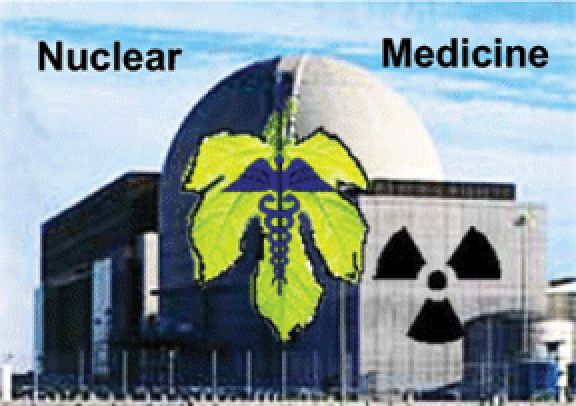 Brett Burnard Stokes No Nuclear Waste Dump Anywhere in South Australia 12 Mar 20 Nuclear medicines are being made here in Adelaide the modern way, with no waste problems.
To say this illegal dump is needed for nuclear medicines – that is deception. https://www.facebook.com/groups/1314655315214929/
|
The Molecular Imaging and Therapy Research Unit (MITRU) is a pharmaceutical production and research unit focused on developing tracers for molecular imaging centred on incorporating radiation. The site began the task of becoming a Therapeutic Goods Administration (TGA) manufacturing facility when the SAHMRI team moved in at the end of 2013. Eight months later they had their first federal inspection and achieved a TGA licence to provide a radiopharmaceutical FDG, a cancer diagnosis imaging tool, for patient administration across Australia. The unit began to provide the FDG for South Australia imaging facilities soon after allowing patients to no longer be reliant on this tracer being imported into the state. The demand for FDG, has begun to grow slowly in South Australia, limited currently by the lack of scanners in the state, however the SAHMRI has been able to obtain smaller scanners to utilise this and future agents through Research funding. Since the initial move to the SAHMRI iconic building on North Terrace at the end of 2013 the team has grown from two persons to a total of 10, awaiting another senior radiochemist to join within the next few months. The unit has expanded its work to include PET-generator based products to ensure expansion further into the radiopharmaceutical field and recently using the particle accelerator, GE Cyclotron, into generating further isotopes that could be provided regularly across Australia forging new research grounds. The unit is currently developing radioactive tracers that have shown promise in neurology in early diagnosis detection of Alzheimer’s, various dementia models and spinal cord injuries as and when funding is secured. It is further involved in commercial process for labelling safely radio-therapeutic drugs for several cancer to allow access across Australia using ANSTO developed materials. MITRU is a commercial facility, able to conduct research when required, that has obtained the highest manufacturing standards to allowing their current and future developments to be moved into clinical practice sooner. The timeframes for projects are often smaller as they have a unique funding model where costs are recuperated through sales once initial funding is obtained to ensure that there is a further demand. Overall this reduces the costs and adds a demand focus to the units’ endeavours. The unit is also involved with pre-arranged tours to the public, high-school and University students, where several of the team lecture on or are associated with South Australian Universities. Currently the unit has a shared supervision of several students developing agents for diagnosis and to increase disease understanding. All the team in unit do not have direct funding from grants and look for funding through either philanthropic or general research opportunities to allow them to development further into new tracer avenues with some small success which has helped the unit to become a centre of excellence for several equipment vendors. The profile in the community has grown through public and peer talks, conferences, radio, TV and newspaper articles, which is hoped to be furthered with the presence on the unit on the internet in the near future. The unit hopes to develop further tracers to ensure small animal trials to understand mechanism of disease and use this to move quickly into human work, as seen with Ga68-PSMA for prostate cancer where in less than 6months from initial donation to patient injection was possible. Work has begun to align and work together with facilities globally by developing satellite radiopharmaceutical and imaging centres using common protocols. The unit continues to expand its TGA licence and it is hoped in the near future will ensure testing of pharmaceuticals used in cold kits for SPECT imaging and implementation of new global diagnostic PET-agents for examination in Australia safely. |
|
Australian govt rejects a report that recommends nuclear submarines
French submarine program ‘dangerously off track’ warns report urging Australia to consider nuclear alternative, ABC News, By defence correspondent Andrew Greene 11 Mar, 20 Australia’s $80 billion Future Submarine Program is “dangerously off track” according to a new report that urges the Government to ditch the controversial project and consider a nuclear option.
Key points:
- The report indicates there are fears the current project is at a high risk of failing
- The Defence Minister denies those fears and maintains the project remains on track
- Under a proposed “Plan B” scenario, the company that designed the Collins class submarines would prepare an updated design
Businessman Gary Johnston, who commissioned and funded the study, fears the current plan to build 12 attack class submarines designed by French company Naval Group is at “high risk” of failing.
His report, prepared by Insight Economics, suggests Australia should instead immediately begin work on a “Plan B” — an evolved version of the current Collins class fleet — before eventually acquiring nuclear-powered boats.
Earlier this year, a report from the auditor-general confirmed the Future Submarine Program was running nine months late and Defence was unable to show whether the $396 million spent so far had been “fully effective”.
“The Government’s own advisory body, including three American admirals, even recommended the Government should consider walking away from the project,” Mr Johnston said.
Under the proposed “Plan B”, Swedish company Saab Kockums, which designed the navy’s Collins class submarines, would be asked to prepare an updated design for the future submarine fleet.
In 2022-23, both Naval Group and Saab will present their competing preliminary design studies for building the first batch of three submarines in Adelaide — based on a fixed price, capability, delivery and local content.
Mr Johnston, along with former naval officers in the Submarines for Australia organisation, argue that over the long term the Government should begin preparing to acquire nuclear submarines……
Government rejects report, issues warning
The Submarines for Australia report will be formally launched by ANU Emeritus Professor Hugh White at the National Press Club today, but it is already drawing fire from the Morrison Government.
“I totally reject the premise that this project is ‘dangerously off track’, as stated in the new Submarines for Australia report”, Defence Minister Linda Reynolds said.
“The delivery of the attack class submarine remains on track, with construction set to commence in 2023.”
Senator Reynolds said the technical feasibility of delivering an evolved Collins class submarine was reviewed in 2013-14, but a review found it would be equivalent to a whole new design, involving similar costs and risks, without a commensurate gain in capability.
“This assessment by Submarines for Australia will only increase cost, delay the delivery, and put at risk our submarine capability.”
The Defence Minister also flatly rejected any suggestion of a nuclear-powered submarine in the future.
“As has been the policy of successive Australian Governments, a nuclear-powered submarine is not being considered as an option for the attack class submarine,” Senator Reynolds said.
https://www.abc.net.au/news/2020-03-11/australia-urged-to-embrace-nuclear-submarines/12043444
Small Nuclear Reactors, like large ones, are out of the question for Australia, due to staggering costs
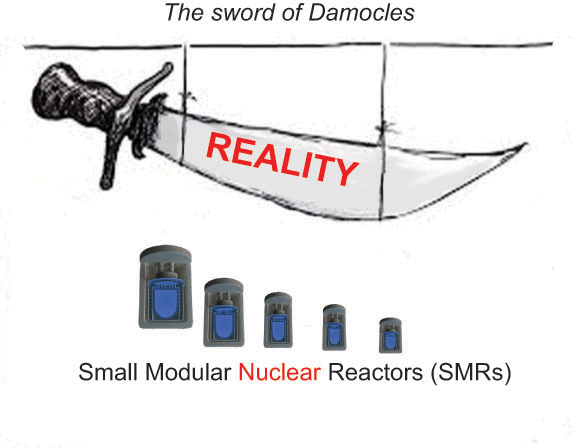
Insiders and lobbyists freely acknowledge that the nuclear power industry is in crisis and that worldwide decline is certain. But its Australian supporters are unfazed. Their only sideways nod to reality is to argue that even if large, conventional reactors are too expensive, the emerging “small modular reactors” would be a good fit for Australia.
Again, a reality check is in order. A handful of small reactors is under construction but they have been subject to huge cost overruns and delays. William Von Hoene, senior vice-president of Exelon ‒ the largest operator of nuclear power plants in the US ‒ says that no more large reactors will be built in the US and that the cost of small reactors is “prohibitive”.
Rolls-Royce sharply reduced its small-reactor investment to “a handful of salaries” in 2018 and is threatening to abandon its R&D altogether unless the British government agrees to an outrageous set of demands and subsidies.
|
March 10, 2020 The NSW Parliament’s State Development Committee released its report into nuclear power last week. Conservative committee members recommended repeal of state laws banning uranium mining and nuclear power, while Labor members want to retain the legal bans.
What the conservatives and other supporters of nuclear power ignore is that it has priced itself out of the energy debate. Continue reading |
The dangers of so called intermediate level nuclear waste, include the devaluation of the region’s agriculture

Bev Spriggs Fight To Stop A Nuclear Waste Dump In South Australia, 10 Mar 20, The dangers of so called intermediate level nuke waste, – it is considered high level waste in the countries that want us to take it. Mr Baldock will be astonished to learn of the devaluation of his crops and the rest of his land and that of his neighbours once that poison comes to town. As for the 45 job creations….that may happen during construction, then they will disappear and there will only be 8 to 10 jobs to caretake the facility. The 31 mill promised for the community will happen once only, when it is gone there will be no more. https://www.facebook.com/groups/941313402573199/
Small nuclear reactors, (just like large) can survive only with massive government subsidies
|
NUCLEAR PRICES ITSELF OUT OF THE FUTURE, HTTPS://WWW.AUMANUFACTURING.COM.AU/NUCLEAR-PRICES-ITSELF-OUT-OF-THE-FUTURE BY PETER ROBERTS, 9 Mar 20, I was at lunch the other day and out came the familiar theme – Australia should go nuclear to de-carbonise the economy. Well, a just-released report from the NSW Parliament’s State Development Committee should put an end to such talk – it is just too expensive and problematic. The report, detailed in Channel 9 media, found the cost of the two reactors being built in the US is now thought to be between $20.4 billion and $22.6 billion for each reactor. In the UK the cost of two reactors being build has jumped seven-fold to $25.9 billion each. And those being built in France and Finland are now costed at upwards of $17.7 billion each. Cost over-runs and delays mean that big nuclear power plants are only going to be built where there are massive government subsidies. And this is even before factoring in the cost of the odd Fukushima or Chernobyl. This morning on social media the pro-nuclear trolls were out in force – people are living happily now at Chernobyl one said. Well I visited Chernobyl 18 months ago and there is nothing normal about it. Maintaining the remains of the reactors at Chernobyl consumes 10 per cent of Ukraine’s admittedly modest GDP, and the long term effects of radiation continue to be felt. This is why nuclear proponents now talk about snazzy new small reactors which are going to be the next big thing. The same story is unfolding in small reactor construction as large – cost over-runs, very few small reactors actually under construction, and the need for massive, yes there’s that word again, government subsidies. We already know what the answer to our carbon crisis is – renewables. Wind and solar plus storage is already cheaper and getting cheaper every day. The future is not nuclear. |
|

Global heating is intensifying a rare natural phenomenon that brings severe drought to Australia.
 A rare natural phenomenon brings severe drought to Australia. Climate change is making it more common, The Conversation, Nicky Wright, Research Fellow, Australian National University, Bethany Ellis, PhD Candidate, Australian National University, Nerilie Abram, Professor; ARC Future Fellow; Chief Investigator for the ARC Centre of Excellence for Climate Extremes, Australian National University, March 10, 2020
Weather-wise, 2019 was a crazy way to end a decade. Fires spread through much of southeast Australia, fuelled by dry vegetation from the ongoing drought and fanned by hot, windy fire weather.
On the other side of the Indian Ocean, torrential rainfall and flooding devastated parts of eastern Africa. Communities there now face a locust plague and food shortages.
These intense events can partly be blamed on the extreme positive Indian Ocean Dipole, a climate phenomenon that unfolded in the second half of 2019.
The Indian Ocean Dipole refers to the difference in sea surface temperature on either side of the Indian Ocean, which alters rainfall patterns in Australia and other nations in the region. The dipole is a lesser-known relative of the Pacific Ocean’s El Niño.
In research published today in Nature, we reconstructed Indian Ocean Dipole variability over the last millennium. We found “extreme positive” Indian Ocean Dipole events like last year’s are historically very rare, but becoming more common due to human-caused climate change. This is big news for a planet already struggling to contain global warming.
So what does this new side-effect of climate change mean for the future?
The Indian Ocean brings drought and flooding rain
First, let’s explore what a “positive” and “negative” Indian Ocean Dipole means.
During a “positive” Indian Ocean Dipole event, waters in the eastern Indian Ocean become cooler than normal, while waters in the western Indian Ocean become warmer than normal.
Warmer water causes rising warm, moist air, bringing intense rainfall and flooding to east Africa. At the same time, atmospheric moisture is reduced over the cool waters of the eastern Indian Ocean. This turns off one of Australia’s important rainfall sources.
In fact, over the past century, positive Indian Ocean Dipoles have led to the worst droughts and bushfires in southeast Australia.
The Indian Ocean Dipole also has a negative phase, which is important to bring drought-breaking rain to Australia. But the positive phase is much stronger and has more intense climate impacts.
We’ve experienced extreme positive Indian Ocean Dipole events before. Reliable instrumental records of the phenomenon began in 1958, and since then a string of very strong positive Indian Ocean Dipoles have occurred in 1961, 1994, 1997 and now 2019.
But this instrumental record is very short, and it’s tainted by the external influence of climate change.
This means it’s impossible to tell from instrumental records alone how extreme Indian Ocean Dipoles can be, and whether human-caused climate change is influencing the phenomenon.
Diving into the past with corals
To uncover just how the Indian Ocean Dipole has changed, we looked back through the last millennium using natural records: “cores” taken from nine coral skeletons (one modern, eight fossilised)……….
positive Indian Ocean Dipole events have been occurring more often in recent decades, and becoming more intense…….
climate change is causing the western side of the Indian Ocean to warm faster than in the east, making it easier for positive Indian Ocean Dipole events to establish.
In other words, drought-causing positive Indian Ocean Dipole events will become more frequent as our climate continues to warm. In fact, climate model projections indicate extreme positive Indian Ocean Dipole events will occur three times more often this century than last, if high greenhouse gas emissions continue.
This means events like last year will almost certainly unfold again soon, and we’re upping the odds of even worse events that, through the fossil coral data, we now know are possible.
Knowing we haven’t yet seen the worst of the Indian Ocean Dipole is important in planning for future climate risks. Future extremes from the Indian Ocean will act on top of long-term warming, giving a double-whammy effect to their impacts in Australia, like the record-breaking heat and drought of 2019.
But perhaps most importantly, rapidly cutting greenhouse gas emissions will limit how often positive Indian Ocean Dipole events occur in future.https://theconversation.com/a-rare-natural-phenomenon-brings-severe-drought-to-australia-climate-change-is-making-it-more-common-133058
Liberal-National Coalition in nuclear disarray
|
Mr Barilaro’s position is also causing division in his National Party, with some of the party’s coastal MPs concerned that his position would put their seats at risk. The Nationals’ leader last week declared his party would support Mr Latham’s bill when it comes back before the upper house for a vote this month. The bill would allow the bans on uranium mining and nuclear power to be lifted but it has not yet been considered by the Liberal or National party rooms or cabinet. It follows a parliamentary inquiry report, which said the government should support the bill. But the issue has caused such anger within Liberal ranks that one senior minister told the Herald they would quit cabinet before supporting Mr Latham’s bill. A senior Liberal minister said: “I did not get into Parliament to support a One Nation bill”, while another minister said: “Crossbenchers don’t set the government’s agenda”. “It’s amazing that John Barilaro listens to the views of One Nation over his colleagues,” a fourth senior minister said. Last week, Local Government Minister and Liberal MP Shelley Hancock told Parliament she would not support a nuclear reactor in her electorate. But Mr Barilaro shot back and said the Liberals repeatedly say they “support technology agnostic energy policy” but then refuse to have a discussion about the role of nuclear. “Forget about this being a crossbench bill, I would take this to my party room and then put up my own bill if I need to,” Mr Barilaro said. |
|
|

Christiana Figueres- “Australia, you’re not ‘meeting and beating’ your emissions targets”

Be honest Australia, you’re not ‘meeting and beating’ your emissions targets https://www.smh.com.au/environment/climate-change/be-honest-australia-you-re-not-meeting-and-beating-your-emissions-targets-20200307-p547u1.html 8 Mar 20, Optimistic. Prosperous. A country of rare beauty, blessed with abundant natural resources. Australia has all the “golden eggs” needed to position itself as a global leader, to help its Asia-Pacific region leapfrog to a new energy future, and to guarantee Australian prosperity in the process.
Watching this summer’s unprecedented firestorms, I was heartbroken by the sheer scale of the human and ecological tragedy. “This must be the tipping point on climate politics in Australia,” I said to myself. “Surely now the politicians will join hands and forge a bipartisan plan for a better future.”
Instead, the climate wars have returned, driven by a handful of deniers afraid to let go of longstanding vested interests, and given air by powerful media sympathisers and a Prime Minister unwilling to fully embrace the science and stare them down.
For Australia, the choice between danger and opportunity is clear, and that choice must be made now. Since the 2008 Stern Review, the world has known that the cost of not acting is much greater than the cost of our current path. And since the 2008 Garnaut Review, Australians have known that without stronger action, droughts and bushfires would become more frequent and intense, and “observable by 2020”. It is time to move on from denial, delusion and delay towards preparedness, productivity and prosperity.
The following three steps will put Australia on track to the future we must create.
First, be honest about where Australia is at. Your country is much more than 1.3 per cent of the global climate problem. Carbon emissions from Australia’s use and export of fossil fuels account for about 5 per cent of the global fossil fuel footprint. With exports included, Australians have the biggest per capita carbon footprint in the world.
Australia is not “meeting and beating” its emissions targets. Emissions have increased in every calendar year since 2014. The government’s own projections say Australia will reduce emissions by only 16 per cent by 2030, not the 26 to 28 per cent it promised in Paris, nor the 50 per cent required by science to limit warming to 1.5 degrees. Kyoto “carryover” can’t be used to make up the gap. The Paris Agreement doesn’t allow it. To suggest otherwise is at best an attempt to paper over Australia’s lagging efforts; and at worst, a legally baseless ploy that encourages cheating and holds back development of the next phase of carbon markets.
A highly vulnerable Australia cannot address climate change on its own, but its heel dragging leaves it without the international credibility to drive a stronger global response. The Australian government must look seriously at how to really meet and beat its 2030 target, and ask other major emitters to join it in an alliance for higher ambition at the COP26 climate summit in Glasgow this November.
Second, Australia needs a bipartisan, long-term vision for decarbonisation. Rattled by the bushfires and growing evidence of climate-related risks and stresses, Australia’s biggest corporations – including Rio Tinto, Qantas, Telstra and BHP – have announced support for a national net zero target for 2050. For them, legislating this target is important to finally end the climate wars, and provide the necessary certainty to underpin investment in the transition.
All states and territories have 2050 net zero targets, as do 73 other nations, including Britain and Canada. British Prime Minister Boris Johnson would welcome Australia joining these ranks ahead of the COP26, and giving consideration to the British model of using an independent expert body to advise government on five-yearly carbon budgets en route to net zero by 2050. Independent MP Zali Steggall’s private members’ bill does exactly that.
Third, Australia must embrace net zero by 2050 as a central pillar of its economic plan for the future. The plan must prioritise the policies, industries and technologies that are scientifically aligned with the 1.5 degree temperature limit, and retire those that are not, albeit with gratitude for the service provided in the past.
Despite a booming renewables industry, coal still accounts for around 60 per cent of Australia’s energy mix. But the technology is tired and unreliable in the summer, highly polluting, and no longer price competitive with solar and wind, firmed up by big batteries or pumped hydro. There is no place for governments signed up to the Paris Agreement to provide subsidies for dying coal. We must instead invest in the future.
These ground-breaking projects are just three examples of how Australia can lead and prosper. With political honesty and vision, ambitious targets, and a stubborn commitment to innovation, Australia stands ready to assume its rightful place as a clean energy superpower of the world. With the right choices, the future is bright.
Christiana Figueres is the former UN climate chief who oversaw the negotiation of the 2015 Paris Agreement, and is convenor of the Mission 2020 climate campaign. She is co-author of The Future We Choose and is visiting Australia this week.
New South Wales South Coast to become a nuclear wasteland? That’s the plan of the National Party
Nationals to support nuclear power;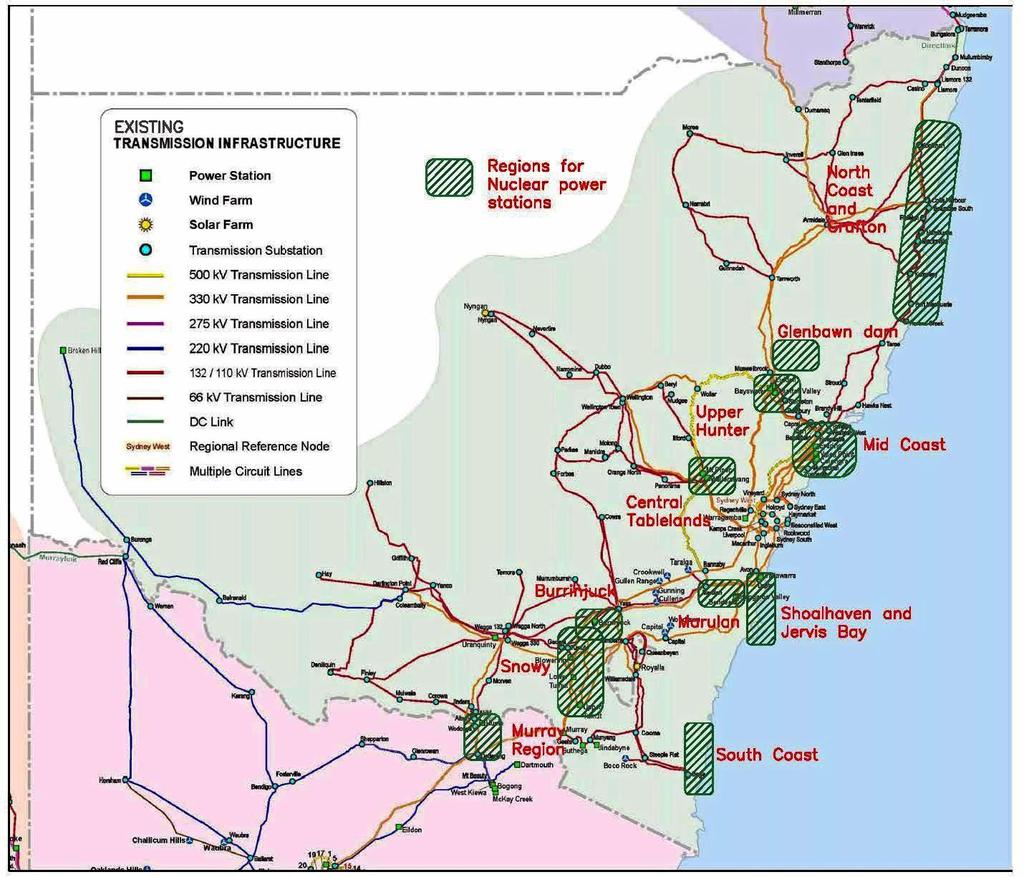 Far South Coast flagged as possible location https://www.begadistrictnews.com.au/story/6665667/nationals-to-support-nuclear-power-far-south-coast-flagged-as-possible-location/, Albert McKnight 6 Mar 20,
The Nationals will support a bill to allow nuclear power in NSW, while separately the Far South Coast has been flagged as a possible location for a nuclear power plant.
When speaking to Sky News earlier this week, Deputy Premier John Barilaro confirmed The Nationals would support a bill proposed by One Nation on the matter, and said the state would not achieve its 2050 net zero emissions target without nuclear energy.
Mr Barilaro has been vocal about the nuclear power issue for years, last year saying it was “guaranteed baseload energy with zero emissions, no fossil fuels and probably the cheapest cost to the average Australian household”.
In a study by Nuclear for Climate Australia published on its website, the area between Bermagui and Merimbula is among 18 proposed areas of interest in NSW for a nuclear power station.
Under its proposal it states the South Coast has potential if included with other power plants that could be built at East Gippsland, the Snowy Mountains or Jervis Bay.
While it states the coast has many sites with “good access to once-through sea water cooling” – running a large amount of water through a power plant’s condensers then discharging it into a waterway with only a small amount of evaporation – an extensive grid upgrade would be required for a 2.2GW plant.
Shadow Minister for Climate Change and Energy Adam Searle confirmed a McKay Labor Government would maintain a ban on uranium exploration, extraction and export.
“Nuclear is the most expensive form of power and its waste is a disaster for the environment,” he said.
“Regional and coastal communities now face the grim prospect of becoming a nuclear power plant wasteland, as a result of Mr Barilaro leading this government by the nose.”
Shadow Minister for the Illawarra and South Coast Ryan Park said coastal communities would never embrace nuclear energy.
“This has clearly divided the Liberal-National Government,” he said.
“[Member for South Coast] Shelley Hancock has already said she would not support nuclear plants on the South Coast.”
He said Member for Bega Andrew Constance should do the same. Mr Constance has been approached for comment.
One Nation’s Mark Latham introduced the bill to lift the ban on nuclear power and uranium mining in NSW, saying it would “create jobs, investment” and “undertake the long-term planning needed to keep the lights on”.
Does NSW need nuclear power? Write a letter to the editor
Nature Conservation Council says the Nationals’ support for nuclear power is a “dangerous and expensive distraction”
|
Environment groups say nuclear push a “dangerous distraction” to clean energy debate, Macquarie Port News, 6 Mar 20, THE Nature Conservation Council says the Nationals’ support for nuclear power is a “dangerous and expensive distraction” from the coal to clean energy debate and is not the sustainable, long-term priority for the environment. Deputy premier John Barilaro has confirmed The Nationals will support a One Nation bill to allow nuclear power in NSW, reigniting debate on the controversial topic. NSW One Nation leader Mark Latham’s Uranium Mining And Nuclear Facilities (Prohibitions) Repeal Bill is currently before the upper house and, if successful, would see the 36-year prohibition on uranium mining and nuclear lifted.
NSW Labor hit back immediately confirming it would not introduce nuclear power in NSW, if elected. Port Macquarie, Kempsey, Grafton and Coffs Harbour have all been flagged as regions of
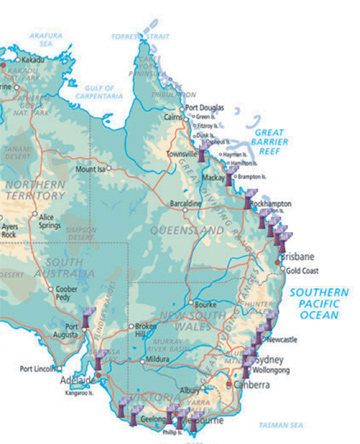 interest for nuclear power plants. interest for nuclear power plants.Other regions include the Upper Hunter (Singleton, Muswellbrook), Shoalhaven (Jervis Bay, Nowra), Central West (Lithgow), Snowy Mountains, and Albury/Wodonga. “Local MPs Leslie Williams and Stephen Bromhead need to tell us whether they support their leader’s plans to make it legal to build a nuclear power plant on the Mid-North Coast,” Nature Conservation Council chief executive Chris Gambian said. “Nuclear power is extremely dangerous and leaves a legacy of radiation pollution that lasts generations. “It is a dangerous and expensive distraction from urgent work we need to do to transition from coal to clean energy and storage. “People on the Mid-North Coast don’t want nuclear power and they don’t need it. “Clean energy is by far the cheapest, cleanest and most sustainable way to meet our energy needs and it offers regional areas a very bright future. “The transition from dirty coal and gas to clean solar, wind and storage will attract $25 billion of investment, result in the construction of about 2,500 wind turbines and installation of more 42 million solar panels across the state.”….. Newcastle MP Tim Crakanthorp slammed the Nationals’ move and condemned the Nationals’ “reckless support” for nuclear power in NSW at its 2019 conference. https://www.portnews.com.au/story/6665518/environment-groups-say-nuclear-push-a-dangerous-distraction/ |
|
Why don’t we treat the climate crisis with the same urgency as coronavirus?
 Why don’t we treat the climate crisis with the same urgency as coronavirus? Owen Jones Guardian, 6 Mar 2020 No Cobra meetings, no sombre speeches from No 10, yet the consequences of runaway global heating are catastrophic, It is a global emergency that has already killed on a mass scale and threatens to send millions more to early graves. As its effects spread, it could destabilise entire economies and overwhelm poorer countries lacking resources and infrastructure. But this is the climate crisis, not the coronavirus. Governments are not assembling emergency national plans and you’re not getting push notifications transmitted to your phone breathlessly alerting you to dramatic twists and developments from South Korea to Italy.More than 3,000 people have succumbed to coronavirus yet, according to the World Health Organization, air pollution alone – just one aspect of our central planetary crisis – kills seven million people every year. There have been no Cobra meetings for the climate crisis, no sombre prime ministerial statements detailing the emergency action being taken to reassure the public. In time, we’ll overcome any coronavirus pandemic. With the climate crisis, we are already out of time, and are now left mitigating the inevitably disastrous consequences hurtling towards us. While coronavirus is understandably treated as an imminent danger, the climate crisis is still presented as an abstraction whose consequences are decades away. Unlike an illness, it is harder to visualise how climate breakdown will affect us each as individuals. Perhaps when unprecedented wildfires engulfed parts of the Arctic last summer there could have been an urgent conversation about how the climate crisis was fuelling extreme weather, yet there wasn’t. In 2018, more than 60 million people suffered the consequences of extreme weather and climate change, including more than 1,600 who perished in Europe, Japan and the US because of heatwaves and wildfires. Mozambique, Malawi and Zimbabwe were devastated by cyclone Idai, while hurricanes Florence and Michael inflicted $24bn (£18.7bn) worth of damage on the US economy, according to the World Meteorological Organization.As the recent Yorkshire floods illustrate, extreme weather – with its terrible human and economic costs – is ever more a fact of British life. Antarctic ice is melting more than six times faster than it was four decades ago and Greenland’s ice sheet four times faster than previously thought. According to the UN, we have 10 years to prevent a 1.5C rise above pre-industrial temperature but, whatever happens, we will suffer.
Pandemics and the climate crisis may go hand in hand, too: research suggests that changing weather patterns may drive species to higher altitudes, potentially putting them in contact with diseases for which they have little immunity. “It’s strange when people see the climate crisis as being in the future, compared to coronavirus, which we’re facing now,” says Friends of the Earth’s co-executive director, Miriam Turner. “It might be something that feels far away when sitting in an office in central London, but the emergency footing of the climate crisis is being felt by hundreds of millions already.”
Imagine, then, that we felt the same sense of emergency about the climate crisis as we do about coronavirus. What action would we take? ….. https://www.theguardian.com/commentisfree/2020/mar/05/governments-coronavirus-urgent-climate-crisis
The demonisation of Julian Assange: Former foreign minister Carr calls on the Australian govt to intervene
As anger mounts over Assange’s persecution, former foreign minister Carr calls for moral appeals to Australian government, WSWS, By Richard Phillips, 6 March 2020
Popular opposition to the ongoing imprisonment and state persecution of WikiLeaks publisher Julian Assange is increasing following last week’s extradition hearing in Britain. The four-day show trial, which blatantly violated Assange’s basic legal rights and subjected him to even more psychological torture, has deeply shocked many people and intensified the determination of those fighting for Assange’s release.
Addressing a public meeting last week in the New South Wales (NSW) parliament, Bob Carr, a former federal foreign minister and state Labor premier from 1995–2005, denounced the bogus espionage charges against Assange and warned that if extradited to the US, he would die.
Carr and other speakers, including Assange’s Australian lawyer Greg Barns and former SBS television journalist Mary Kostakidis, insisted, however, that those defending Assange should concentrate on lobbying state and federal MPs.
This orientation, they suggested, would pressure the Liberal-National Coalition government and Foreign Minister Marisa Payne to ask Washington to release the WikiLeaks publisher.
uCarr called for Payne to have a “friendly chat” with Mike Pompeo, the former CIA chief and current US Secretary of State, and offered some talking points…….
Carr said nothing about Pompeo’s threatening denunciations of WikiLeaks as a “non-state hostile intelligence service,” his visit to Sydney last August when he demanded greater Australian involvement in Washington’s aggressive confrontations with Beijing and Iran, or his role as former CIA chief.
As for Payne, she rejected any defence of Assange, declaring in the Senate a day earlier that the WikiLeaks publisher would receive a fair trial and disparaging UN Special Rapporteur on Torture Nils Melzer’s reports on the decade-long persecution of Assange.
Carr’s opposition to the US-led vendetta against Assange, which he first voiced in May, appears to constitute a remarkable political turn around. Eight years ago, as foreign minister in the Labor government of Prime Minister Julia Gillard—from early 2012 to September 2013—Carr, like other federal Labor MPs and the party as a whole, was virulently hostile to Assange…….
The demonisation of Assange by Australia’s political establishment and the corporate media, which is part and parcel of its commitment to the US alliance, has not convinced tens of thousands of ordinary Australians. Important layers of workers, young people, students and middle-class people have taken up Assange’s defence as part of a growing international movement. …… https://www.wsws.org/en/articles/2020/03/06/carr-m06.html
Morrison to cancel Australia’s participation in the Energy Transition Hub
 Morrison government to stop funding international collaboration on shift to zero emissions. The five-year Australian-German initiative to transition to new energy and low emissions was due to end in 2022, Guardian , Adam Morton Environment editor @adamlmorton Fri 6 Mar 2020 The Morrison government has told researchers at two of Australia’s leading universities it will break a commitment to fund an international collaboration into what is required to shift to a zero emissions future. Morrison government to stop funding international collaboration on shift to zero emissions. The five-year Australian-German initiative to transition to new energy and low emissions was due to end in 2022, Guardian , Adam Morton Environment editor @adamlmorton Fri 6 Mar 2020 The Morrison government has told researchers at two of Australia’s leading universities it will break a commitment to fund an international collaboration into what is required to shift to a zero emissions future.
The Australian-German Energy Transition Hub was announced in 2017 by then prime minister Malcolm Turnbull and German chancellor Angela Merkel as a collaboration that would “help the technical, economic and social transition to new energy systems and a low emissions economy”. Based at the University of Melbourne, the Australian National University and three German institutions, it was to receive $4m over five years from the Department of Foreign Affairs and Trade as part of an eventual full cross-country funding of $20m. But in an email to staff on Friday afternoon, hub managers said the department had told them the government had decided it would “not follow through on its original commitment to fund the hub until 2022”. Government funding for the hub will end in June. Guardian Australia has been told there is $1.75m unpaid from the original agreement. Some researchers said the decision made little sense given the hub’s work included areas of government interest, particularly the development of a clean hydrogen industry. Other hub projects focus on energy storage, energy system modelling, plans for a just transition to clean energy and integrating solar energy into the grid……..https://www.theguardian.com/environment/2020/mar/06/morrison-government-to-stop-funding-20m-international-collaboration-on-shift-to-zero-emissions |
|
|
Conservative push for nuclear power will drive a wedge into the Coalition
 Conservative push for nuclear power will drive a wedge into the Coalition, Jim Green, 5 March 2020, RenewEconomy https://reneweconomy.com.au/conservative-push-for-nuclear-power-will-drive-a-wedge-into-the-coalition-39428/
The NSW Parliament’s State Development Committee has released its report into nuclear power. In a rare show of unity, conservative committee members held together, with Liberals, Nationals, Shooters Fishers and Farmers, and Paulina Hanson’s One Nation all recommending repeal of state laws banning uranium mining and nuclear power. But that unity is unlikely to last. Comments by Premier Gladys Berejiklian and Energy Minister Matt Kean suggest they oppose the push to repeal legislation banning nuclear power.
Elsewhere, deep rifts are evident within the Coalition. The SA Liberal government’s submission to a 2019 federal nuclear inquiry opposed the pursuit of nuclear power, as did the Tasmanian Liberal government’s submission and even that of the Queensland Liberal-National Party.
The federal government said it would not repeal laws banning nuclear power even before it established the nuclear inquiry. The majority report of the inquiry recommended a partial repeal of the bans ‒ retaining the ban against large, conventional reactors but permitting the development of non-existent ‘Generation IV’ reactor concepts ‒ but that recommendation is unlikely to be adopted by the Morrison government.
The prospects for Generation IV concepts ‒ such as thorium or fusion ‒ were studied by the South Australian Nuclear Fuel Cycle Royal Commission. The Commission concluded in its 2016 report that Generation IV concepts are unlikely to be feasible or viable in the foreseeable future, and carry a high commercial and technical risk.
For both conventional and Generation IV nuclear power, cost is the main sticking point ‒ even for conservatives. “I don’t sign up on anything if I can’t look Australians in the eye and say how much it will cost,” Prime Minister Morrison recently said.
There are many examples of shocking cost overruns overseas. The cost of the two reactors under construction in the US state of Georgia has doubled and now stands at A$20.4‒22.6 billion per reactor. In 2006, Westinghouse said it could build a reactor for as little as A$2.1 billion ‒ 10 times lower than the current estimate.
The only other reactor construction project in the US, a twin-reactor project in South Carolina, was abandoned in 2017 after the expenditure of at least A$13.4 billion. Westinghouse filed for bankruptcy soon after, almost bankrupting its parent company Toshiba in the process.
The cost of the only reactor under construction in France has nearly quadrupled and now stands at A$20.0 billion. The cost of the only reactor under construction in Finland has nearly quadrupled and now stands at A$17.7 billion. The projects in France and Finland are both 10 years behind schedule, and still incomplete.
The cost of the four reactors under construction in the United Arab Emirates has increased from A$7.5 billion per reactor to A$10‒12 billion per reactor. South Korea ‒ which is supplying the UAE reactors ‒ is held out to be a model for the global nuclear industry. But South Korea is slowly phasing out its nuclear reactors, its nuclear industry is riddled with corruption (the courts have dispensed a cumulative 253 years of jail time to 68 offenders), and its business model clearly sacrifices safety in order to improve economics.
In the UK, the estimated cost of the only two reactors under construction is A$25.9 billion per reactor. In the mid-2000s, the estimated cost was almost seven times lower. The UK National Audit Office estimates that taxpayer subsidies for the project will amount to A$58 billion, despite earlier government promises that no taxpayer subsidies would be made available.
The Australian debate should be seen in the context of the culture wars, not the energy debate. With few exceptions, pro-nuclear conservatives don’t believe in climate science, they support subsidised fossil fuel plants, and they vigorously oppose renewables. Former Prime Minister Malcolm Turnbull describes nuclear power as the “loopy current fad … which is the current weapon of mass distraction for the backbench”.
Pro-nuclear conservatives hope to split the Labor Party and environmentalists on nuclear power, but they are only dividing themselves. They should take a history lesson. The Howard government’s promotion of nuclear power was alive in the 2007 election campaign, but the policy did nothing to divide the Labor Party or the environment movement.
On the contrary, it divided the Coalition, with at least 22 Coalition candidates publicly distancing themselves from the government’s promotion of nuclear power during the 2007 election campaign. The policy of promoting nuclear power was seen to be a liability and it was ditched immediately after the election.
A December 2019 report by CSIRO and the Australian Energy Market Operator finds that construction costs for nuclear reactors are 2‒8 times higher than costs for wind or solar. Costs per unit of energy produced are 2‒3 times greater for nuclear compared to wind or solar including either two hours of battery storage or six hours of pumped hydro energy storage.
Australia can do better than fuel higher carbon emissions and unnecessary radioactive risk. We need to embrace the fastest growing global energy sector and become a driver of clean energy thinking and technology and a world leader in renewable energy technology. Our shared energy future is renewable, not radioactive.
Dr. Jim Green is the national nuclear campaigner with Friends of the Earth Australia and editor of the World Information Service on Energy’s Nuclear Monitor newsletter.
1 This month
.

Australians deserve the truth
about
AUKUS – https://aukuspublicinquiry.com/

PETITION – To: Prime Minister Anthony Albanese and the Australian Labor Government

of the week – Australians for War Powers Reform (AWPR)
To see nuclear-related stories in greater depth and intensity

