Honeymoon uranium mine might restart this year, and pigs might fly
 Uranium miner flags restart at Honeymoon within a year if prices jump, others aren’t so sure, ABC BROKEN HILL BY DECLAN GOOCH AND SARA TOMEVSKA 22 Jan 2020, The company behind a proposal to restart uranium mining in north-east South Australia says it would be ready to begin production within a year if prices improve.
But the Australian Conservation Foundation (ACF) has cast doubt on the likelihood of that occurring, arguing the market is moving away from uranium.
Key points:
- Honeymoon is one of only four Australian uranium mines with an export licence but has been mothballed since 2013
- New owner Boss Resources says technology will help it lower operational costs and will reopen the mine once uranium prices improve
- Anti-nuclear campaigners doubt the mine’s prospects, saying significant uranium producers have been deferring or halting development
The Honeymoon uranium mine was mothballed in 2013 because it had become too expensive to run.
But in 2015, the mine, which is about 80 kilometres north-west of Broken Hill, was purchased by WA exploration company Boss Resources.
Boss chief executive Duncan Craib said the company had developed new technology to lower operational costs and had finalised a feasibility study.
He said the mine would reopen once uranium prices improved, which he was expecting to happen soon.
“We don’t want to destroy the resource at low uranium prices, so we’d like an uptick in the market before proceeding,” Mr Craib said.
Honeymoon is one of only four Australian uranium mines with an export licence.
However, Mr Craib said uranium was under-utilised in Australia and he would like to see a domestic uptake of nuclear power…….
Optimism baseless, campaigner says
Anti-nuclear campaigner Dave Sweeney from the ACF said he believed the announcement was without substance.
“There is nothing new in their statement,” he said.
“It’s pretty much a holding-pattern statement from a mining company with not a lot of resources, not a lot of projects, that are trying to continue to hold a place in the market, where the market is increasingly in freefall.
“Obviously, Boss is going to say the uranium price is going to soar — they’re a uranium miner.
“We’ve got major producers in this country … We’ve got a third of the world’s uranium and we’re not digging much, and that is because the price is not there.
Mr Sweeney said significant producers were deferring or halting development.
Rio Tinto, a massive mining company, is exiting at the Ranger mine in Kakadu,” he said.
“Cameco, the world’s largest dedicated uranium producer, has written down an asset that it spent $500 million on a decade ago in WA, and says that the best way to preserve the value of uranium is to keep it in the ground.”…….. https://mobile.abc.net.au/news/2020-01-22/honeymoon-uranium-mine-production-within-a-year-company-says/11889466
SA Greens senator Sarah Hanson-Young slams investment in South Australian uranium mine
Honeymoon isn’t over: SA uranium mine to reopen, The Advertiser, 22 January 2020 A closed uranium mine near Broken Hill will be reopened to seize on a renewed demand, its owner says.
The Honeymoon uranium mine in the state’s east “will be Australia’s next uranium producer” following a $93 million restart, its owner Boss Resources says.
The ASX-listed company says the mine “can be fast-tracked to re-start production in 12 months with low capital intensity to seize an anticipated rally in the uranium market’’…..
The Honeymoon project uses “in-situ recovery”, which involves injecting solvent into wells drilled into the deposit, dissolving the uranium, then recovering it at the surface. …..
 SA Greens senator Sarah Hanson-Young said the focus should be on renewables, not nuclear energy.
“South Australia doesn’t need to tether itself anymore to the toxic and dangerous cycle of the nuclear industry,’’ Ms Hanson-Young said
“SA is better than this and we are best placed in the world to reap the renewables and green industry revolution.
“Rather than a big new uranium mine, SA needs investment in our clean green energy industry. We should be working towards SA being a net exporter of renewable energy and technologies. ‘Green’ mining and industries like lithium for batteries, green hydrogen and renewable powered manufacturing will create jobs fit for the climate crisis Australia is in.”
Wilderness Society SA director Peter Owen said they would prefer to see investment in the state’s vast renewable resources such as wind and solar.
Former Prime Minister Turnbull scathing about #MorrisonFromMarketing, on the climate issue
Last year, The New Daily revealed the Prime Minister had embarked on a secret trip to Hawaii while fires were devastating Australian communities.
The former prime minister, who has a new book out this year, also slammed the US President Donald Trump for playing a “very destructive” role in the climate debate.
“Trump makes no bones about it. He says global warming is rubbish,” Mr Turnbull said.
“Trump is trying to put a brake on global action to reduce emissions. The lack of American leadership is extremely damaging.
Mr Turnbull also accused his own predecessor, Tony Abbott, of being the nation’s most prominent climate denier in Australian politics, who was joined by others in a shameful “war against science”.
“It is an extraordinarily irrational and self-destructive approach,” Mr Turnbull said.
“The right [wing] in the Liberal Party essentially operate like terrorists,” he said.
“Now I’m not suggesting that they use guns and bombs or anything like that, but their approach is one of intimidation.
“And they basically say to the rest of the party… if you don’t do what we want, we will blow the show up. Famously one of the coup leaders said to me, ‘you have to give in to the terrorists’.” https://thenewdaily.com.au/news/world/2020/01/23/malcolm-turnbull-scott-morrison-climate-denial/
Australia May Add Record Amount of Renewable Power in 2020,
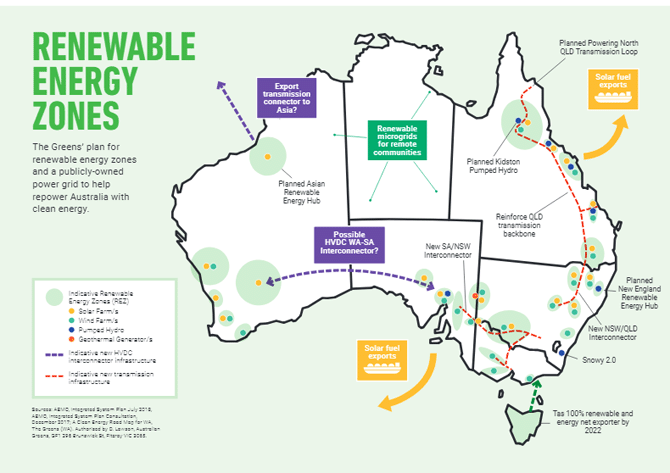
Australia May Add Record Amount of Renewable Power in 2020, Bloomberg, By James Thornhill, January 21, 2020
-
Corporate demand for clean electricity driving growth: Rystad
- Policy uncertainty seen undermining longer term expansion
Australia is set to add a record amount of renewable power in 2020, driven by growing corporate demand for clean electricity and to fill generation gaps created by the retirement of aging coal-fired plants.
New markets are expected to unlock growth as pilot hydrogen projects start and oil, gas and mining projects invest in off-grid renewables generation, according to Rystad Energy. The positive outlook would be a rebound for Australia’s clean energy developers after a sharp drop in investment in 2019.
“We expect the industry to bounce back in the second half of 2020,” Rystad said in a media release, citing projects with corporate power purchase agreements and the winners of government auction schemes that are scheduled to start construction this year.
Nearly 2 gigawatts of large-scale solar projects and 1.6 gigawatts of wind power are due to complete commissioning in the year ahead, up nearly 40% on 2019 levels. Wind and solar developers are also lining up to replace the Liddell coal plant in New South Wales, which is due to close by April 2023.
Still, developers may face headwinds over the longer term. The industry has already met the government’s 2020 target for renewable generation and there is no new target to replace it. Meanwhile, the profitability of projects located a long way from major demand centers has been hit by marginal loss factors — the amount of power lost along transmission lines.
Losing Momentum
Australia renewables investment fell 38% last year “While the outlook for the commissioning of new projects still looks solid in 2020, there is a risk that activity tails off in the years ahead as the impact of falling investment starts to feed through,” said BloombergNEF analyst Leonard Quong. AT TOP https://www.bloomberg.com/news/articles/2020-01-21/australia-may-add-record-amount-of-renewable-power-in-2020

Australia’s Finance Minister Mathias Cormann spruiks for coal and for Trump at Davos summit
 Davos 2020: Climate critics are wrong, says Matthias Cormann THE AUSTRALIAN, 22 Jan 2020
Finance Minister Mathias Cormann has declared global perceptions of Australia’s climate action are “false” as he defended both the coal industry and US President Donald Trump in front of world leaders at the Davos summit…. (subscribers only)
Bob Katter hails remote spots as safe for nuclear reactors
 KATTER HAILS REMOTE SPOTS AS SAFE FOR NUCLEAR REACTORS
A nuclear reactor could be built in north west Queensland because the uranium deposits are there, the terrorists have multiple different ways to carry out mass killings, and barely anyone lives out there, maverick Federal MP Bob Katter has said…. (subscribers only) Townsville Bulletin, 20 Jan 2020
Australia’s billion of animal deaths – conservationists must not give up

|
Conservation scientists are grieving after the bushfires – but we must
not give up, The Conversation, January 21, 2020 Stephen Garnett,
Professor of Conservation and Sustainable Livelihoods, Charles Darwin
John Woinarski, Professor (conservation biology), Charles Darwin University,
Sarah Legge, Professor, Australian National University
That a billion animals may die as a result of this summer’s fires has horrified the world. For many conservation biologists and managers, however, the unprecedented extent and ferocity of the fires has incinerated much more than koalas and their kin.The scale of the destruction has challenged what is fundamentally an optimistic worldview held by conservationists: that with sufficient time, love and money, every species threatened by Australia’s 250 years of colonial transformation cannot just be saved from extinction, but can flourish once again. The nation’s silent, apocalyptic firescapes have left many conservation biologists grieving – for the animals, the species, their optimism, and for some, lifetimes of diligent work. So many of us are wondering: have lives spent furthering conservation been wasted? Should we give up on conservation work, when destructioncan be wrought on the environment at such unprecedented scales? The answer is, simply, no. Acknowledge the grief Federal government figures released on Monday showed more than half of the area occupied by about 115 threatened species has been affected by fire. Some of these species will now be at significantly greater threat of extinction. They include the long-footed potoroo, Kangaroo Island’s glossy black-cockatoo and the East Lynne midge orchid………. 1.action is an effective therapy for grief. There is plenty to do: assess the extent of damage, find and nurture the unburned fragments, and feed the survivors. The official recovery response has been swift. Victoria, New South Wales and now the Commonwealth have all issued clear statements about what’s happened and how they’re responding. The determination and unity among government agencies, researchers and conservation groups has been remarkable……. |
|
Bangladesh and Australia- both vulnerable to climate change – but will that stop the coal lobby?
 Despite climate impact, Bangladesh wants Australian coal to fire 29 new power stations, https://www.theage.com.au/politics/federal/rba-told-to-mobilise-all-forces-to-save-the-economy-from-climate-change-20200120-p53szi.html Bangladesh has been criticised for its ambitious plans to build 29 new coal-fired power stations, but its high commissioner to Australia believes the new projects could be an opportunity for greater trade between the two nations. 20 Jan 2020 , BY BRETT MASON SBS chief political correspondent Brett Mason reports from Dhaka, Bangladesh Despite climate impact, Bangladesh wants Australian coal to fire 29 new power stations, https://www.theage.com.au/politics/federal/rba-told-to-mobilise-all-forces-to-save-the-economy-from-climate-change-20200120-p53szi.html Bangladesh has been criticised for its ambitious plans to build 29 new coal-fired power stations, but its high commissioner to Australia believes the new projects could be an opportunity for greater trade between the two nations. 20 Jan 2020 , BY BRETT MASON SBS chief political correspondent Brett Mason reports from Dhaka, Bangladesh
Bangladesh’s high commissioner to Australia has urged the Australian government to consider new trade opportunities with the country, including the potential to supply it with 80 million tonnes of coal over the next five years. SBS News is currently in Bangladesh as part of a parliamentary learning tour organised by Save the Children. Speaking to SBS News ahead of the trip, Mohammad Sufiur Rahman said Bangladesh’s controversial plans to construct 29 new power stations over the next two decades would require a “huge quantum” of coal to power them. “We’ll have to source it from places, either Indonesia, or Australia, or maybe South Africa,” he said. Mr Rahman began spruiking the “enormous” export opportunity to the Australian media last year and doubled down on it in his interview with SBS News. “The quality and calorific value of Australian coal is much better in comparison to other sources,” he said. Climate impactBangladesh has the sixth-highest number of current and proposed coal-powered projects compared to the rest of the world, according to environmental advocacy group Market Forces. But the nation is also particularly vulnerable to climate change, with fears a projected half a metre sea-level rise by 2050 could leave 11 per cent of the country’s landmass underwater and 15 million people displaced. Continue reading |
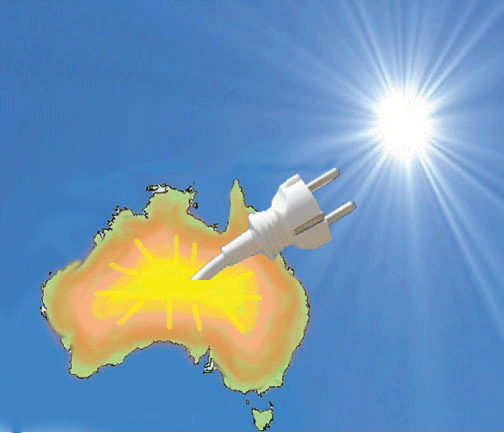
Australia’s future as a renewable energy superpower
|
Australia has a real future as a renewables superpower, https://www.canberratimes.com.au/story/6587200/australia-has-a-real-future-as-a-renewables-superpower/?cs=14246Tristan Edis, 19 19 Jan 2020, Amid almost daily complaints from industry about skyrocketing electricity costs, out dropped an announcement recently so counter to the dominant news flow that it seemed beyond belief. Yet there it was in the business pages: Australian software billionaire Mike Cannon-Brookes and iron ore billionaire Andrew “Twiggy” Forrest have a plan to supply a fifth of Singapore’s electricity needs – all of it from solar power – via a 3750-kilometre underwater cable from the Northern Territory. The proposed solar farm, near Tennant Creek, would be the world’s biggest by a comfortable margin. It would stretch as far as the eye can see, across an area equal to more than 20,000 soccer fields.Despite Cannon-Brookes’s self-deprecating description of the project as “batshit insane”, it could actually make technical and economic sense. And it’s not the only mega-renewable energy project being pursued by credible Australian companies with the aim of powering the many hundreds of millions of people living to the north of us. Continue reading |
Fire fighter’s anger at Scott Morrison, over climate change

cartoon – Reproduced with permission from Mark David and Independent Australia.
The Firefighter Whose Denunciation of Australia’s Prime Minister Made Him a Folk Hero New Yorker, By Amanda Schaffer, January 18, 2020
Since September, millions of acres of land have burned, thousands of people have lost their homes and businesses, and at least twenty-eight have perished.
Morrison’s history of skepticism toward climate change and the government’s record of inaction have infuriated Australians who understand that record-breaking heat and dryness, symptomatic of a warming planet, are fuelling the crisis. On Sunday, Morrison announced an inquiry into the country’s fire response, nodding to the role of climate change but failing to support policies to decrease fossil-fuel use or promote renewable energy……
“Then the wind changed, so the flames were fully involved across the road, and we had to drive the truck through the fire front to get ourselves out. We were driving to stop the fire from going into the village, and we saw a TV-news team down on one of the access roads. It just was a boiling point for me. I said, ‘Are you from the media? Tell the Prime Minister to go and get fucked, from Nelligen. . . . We really enjoy doing this shit.’
“A couple of weeks earlier, the Prime Minister commented that Rural Fire Service members enjoy going out and fighting fires. He’s just got no understanding of what it’s all about. We don’t enjoy fighting bushfires and saving people’s homes. We do it because we have to. He’s got no understanding of what real people in Australia go through. And he doesn’t care anyway. Any real man would never have left the country while his country was in turmoil…….
“Climate change is also a real thing. It’s not something that can be fixed overnight, and the government’s got to make a stand at some stage. Scott Morrison doesn’t even believe in climate change. I don’t think he even considers that we are going through climate change……. https://www.newyorker.com/news/as-told-to/the-firefighter-whose-denunciation-of-australias-prime-minister-made-him-a-folk-hero
Australia reMade – a primer for our climate action future
ReMAKERS’ MEMO #1, January 2020 An Australia reMADE primer to talking about the bushfires and where to from here *V2, updated 14th  Jan 2020
…………..Conclusion https://www.australiaremade.org/
We get told that now is not the time, or we have to be ever wealthier first, before we can decide to care for people and planet. We’ve already seen the hollowness of the ‘cost of action’ argument in light of the ‘cost of inaction’ reality. Business as usual is no longer an option. Let’s name what we want, and talk about the transformation required to get there. https://antinuclear.net/wp-content/uploads/2020/01/578d2-remakersmemo_1_14jan2020.pdf
Liberal Party misinformation on climate change
 Notorious climate denier Craig Kelly at it again, Independent Australia, By Steve Bishop | 19 January 2020, Official figures reveal the Liberals’ foremost climate change denying MP, Craig Kelly, resorted to lies and misinformation to dispute factual evidence in his presentation to a Sky News program.Kelly and other MPs such as George Christensen, have helped sabotage the Federal Government’s climate change policy to a point where it is viewed as the worst in the world.
Just examine the absurd whoppers Kelly told in claiming most of the U.S.’s hottest years on record had occurred in the 1930s.
He used these lies to justify an even bigger lie: Here’s a transcript of Kelly’s snake-oil claims:
……… The United States’ climate records are kept by the National Oceanic and Atmospheric Administration (NOAA).
I have searched the records, which go back to 1895, and can find no statistics to support Kelly’s claims.
The only set of figures which bear any resemblance to Kelly’s fake news are for one-off freak temperature extremes in each state……….
All Australians should be concerned by Kelly’s lies because he has the personal backing of Prime Minister Scott Morrison, who intervened before the last election to ensure the climate change denier was selected as the candidate for Hughes.
This gives Kelly credibility with the ridiculous right of the party when coal-loving Morrison, as PM, has to appeal to a broad church….. https://independentaustralia.net/politics/politics-display/notorious-climate-denier-craig-kelly-at-it-again,13501
Australia led the world in climate action, in 2012 with the Gillard Labor government
Who to Blame for Australia’s Bullshit Approach to Climate Change https://www.vice.com/en_au/article/dygvjy/who-to-blame-for-australia-coal-mining-lobbyists-fires-bushfires-bullshit-approach-to-climate-change
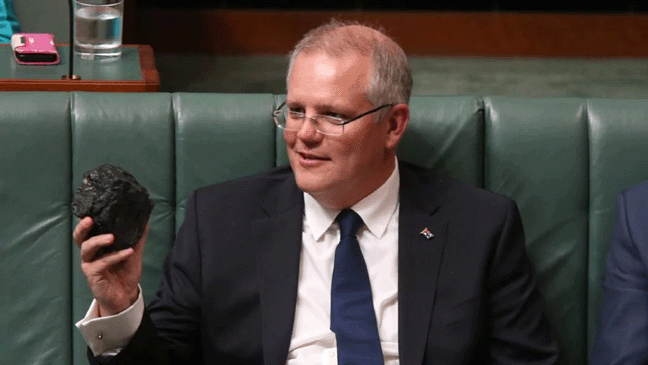 Look these coal lobbyists in the eye. Remember their names. By Royce Kurmelovs, 16 January 2020,
Now people are asking: “why?”
The answer, for many, is that we’ve begun a long and unnerving slide into a world of supercharged weather. The CO2 humanity had been pumping into the atmosphere for decades is now affecting our seasons in precisely all the ways we were warned. For Australia, that means hotter summers with less rainfall, which is exactly what 2019 delivered.
Australia just sweltered through its hottest year on record with temperatures averaging 1.52C above the 1961—1990 average, according to data from the Bureau of Meteorology. This came after an unprecedented period of drought across much of the country’s east, which unsurprisingly led to widespread fires.
But even if the science is clear, the reality seems lost on those who hold the country’s highest political offices. When confronted with the suggestion his government was not acting in a meaningful way on climate change, Prime Minister Scott Morrison has simply said he “did not accept that” and insisted, like his Minister for Emissions Reduction Angus Taylor, that Australia has been “doing its part”.
he truth is that Australia is the fourth largest coal producer in the world, and has relied on tricky accounting practices to book progress toward reducing its carbon emissions while actually doing the bare minimum.
Because of this, Australia was recently rated 57th on a list of countries for its handling of climate change—placing it just slightly above Iran with its oil-dependent national economy.
 And yet just eight years ago, Australia was leading the world on climate change action. In 2012 we’d achieved what many pundits believed was a political impossibility. Australia had levied a tax on carbon that forced an almost immediate drop in the country’s CO2 emissions. That was until a new conservative government took power and repealed the carbon tax a short two years later.
Experienced physicist doubts the value of small modular nuclear reactors for Australia
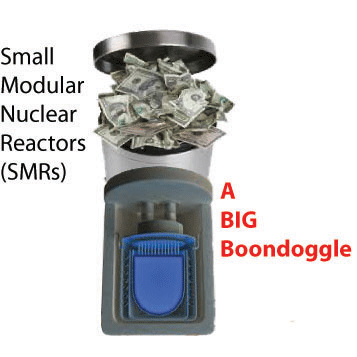 Despite a good safety record, nuclear power is not straight forward, THE AUSTRALIAN, Leslie Cook 20 Jan 2020
As a physicist with the British Atomic Energy Authority in the 1960s, I remember the scale and complexity of the task and the breadth of expertise required in science, engineering and regulation, even if an existing design is used.
This simply does not exist in Australia. Nor does the necessary construction capacity — and the thought of the CFMEU controlling concrete pours of 18,000 cubic metres is daunting. Small modular reactors exist only on paper at present and will also require infrastructure. , https://www.theaustralian.com.au/commentary/letters/despite-a-good-safety-record-nuclear-power-is-not-straight-forward/news-story/eb791793ea9751dc3a905a7869687e01
PM under pressure as Coalition changes tune on climate change
PM under pressure as Coalition changes tune on climate change , Daily Telegraph , 19 Jan 2020
Prime Minister Scott Morrison could be facing a cabinet revolt on climate change with the horror bushfire season sparking new calls for action from his own top-ranking MPs…. (subscribers only)
1 This month
.

Australians deserve the truth
about
AUKUS – https://aukuspublicinquiry.com/

PETITION – To: Prime Minister Anthony Albanese and the Australian Labor Government

of the week – Australians for War Powers Reform (AWPR)
To see nuclear-related stories in greater depth and intensity

