Federal Labor is taking up powers to impose AUKUS N-sub nuclear wastes on communities across SA, WA and the NT:
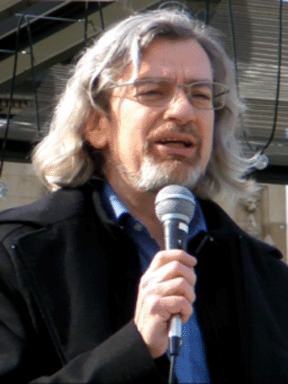
Democratic Rights and Public Safety are compromised by AUKUS Regulations Section.105, an untenable override of State & Territory laws that prohibit nuclear waste storage.
Public Submission by Mr David Noonan B.Sc., M.Env.St, -to AUKUS ‘Australian Naval Nuclear Power Safety Regulations – public consultation’ 12 July 2025 https://nuclear.foe.org.au/wp-content/uploads/Noonan-AUKUS-N-sub-regulations-to-override-SA-laws-July-2025.pdf
Contents:
Overview p2
The public has a ‘Right to Know’ who is targeted for storage of High-Level nuclear wastes 3
Indigenous People have a UN recognised Human Right to Say No to nuclear wastes 4
Regulations Section 105 overrides SA, NT and WA prohibitions on nuclear waste storage 5
Port Adelaide Enfield Council opposes AUKUS N-sub waste storage at Osborne 6
Premier Rann passed Laws that prohibits the storage of nuclear reactor waste at Osborne 7
Recommendations, in public interest disclosures required by Defence 8
As to my Relevant Background 9
Re: Democratic Rights and Public Safety are compromised by AUKUS Regulations Sec.105,
an untenable override of State & Territory laws that prohibit nuclear waste storage.
An array of key Public Interests are at stake across SA, NT and WA as a consequence of draft
AUKUS Australian Naval Nuclear Power Safety Regulations 2025 and in particular Section
105 State and Territory laws that do not apply in relation to a regulated activity.
I provide public input along with Recommendations as disclosures required by Defence (p.8) on
public interest matters pertaining to the Regulations, some of my relevant background to these
issues as a long-term environment, nuclear and public interest campaigner is cited (p.9).
Integrity, transparency, and accountability are key to public confidence in governance in
Australia. The AUKUS nuclear submarine (N-sub) agenda repeatedly fails these standards. The
AUKUS Regulations are the pointed end of an unfolding federal Labor agenda to take up powers
to impose unwelcome and illegal AUKUS N-sub nuclear wastes on our communities. AUKUS
Regulations Section 105 further undermines public confidence and trust in government.
The public has a ‘Right to Know’ who is targeted for storage of High-Level N-sub nuclear wastes.
Over three years into AUKUS: Why is there still not even an announced N-waste siting process?
An uncosted liability in AUKUS N-sub nuclear wastes is being imposed on all future generations
through the Regulations Section 105 over-ride of State and Territory Radiation Safety and
nuclear waste related laws. As a consequence, communities across SA, the NT and WA face a
future as primary targets for a federal imposed AUKUS High-Level nuclear waste storage site.
Community health and nuclear safety regards AUKUS N-subs is to be taken over by a nonindependent military nuclear regulator, set in ‘conflict of interest’ reporting to the Defence
Minister – to replace the independent civilian ARPANS Agency that reports to Health Minister.
Nuclear risks to community safety warrant full transparency, accountability and public interest
disclosures. The storage of N-sub so called ‘Low Level’ radioactive wastes at Osborne has been
rejected by the Port Adelaide Enfield Council (12 Nov 2024, p.213-218). It is an illegal act under
the SA Nuclear Waste Storage (Prohibition) Act 2000 as amended by Labor Premier Mike Rann.
These AUKUS Regulations are to override SA Law and to override the will of the people in SA.
The AUKUS Regulations place the Safety, Health and Welfare, and democratic Rights and
Interests of targeted Australian communities and Indigenous People at risk and unacceptably
compromise’s the protection of the Environment in which they live. The Regulations specifically
fail to recognise and respect Indigenous People’s UN recognised Human Right to Say No to
imposition of hazardous materials, re AUKUS N-sub nuclear wastes, on their lands.
Defence should realise civil society across SA, NT and WA will actively oppose an unacceptable
imposition of intractable nuclear wastes in Australia, what-ever the source. High-Level nuclear
waste is a dangerous and undemocratic imposition on all future generations.
The untenable state of AUKUS N-sub nuclear waste issues demonstrates why an AUKUS
military nuclear regulator can-not be trusted to protect the public interest.
The public has a ‘Right to Know’ who is targeted for storage of High-Level nuclear wastes:
Minister Richard Marles MP has still not made a promised ‘announcement’, said to be by early
2024, on a process to manage High-Level nuclear waste and to site a waste disposal facility, he
saying “obviously that facility will be remote from populations” (ABC News 15 March 2023).
Best safety practice requires a storage site to be identified before acquisition or generation of
High-Level nuclear wastes. AUKUS requires a site before purchase of a N-sub in early 2030’s.
The national press (11 August 2023) reports the Woomera rocket range is understood to be a
‘favoured location’ for storage and disposal of nuclear sub wastes (“Woomera looms as
national nuclear waste dump site including for AUKUS submarine high-level waste afr.com).
Political leaders in WA, Qld and Vic have already rejected a High-Level nuclear waste disposal
site. SA’s Premier has so far only said it should go to a ‘remote’ location in the national interest.
A ‘Review’ of the Woomera Prohibited Area was announced by Minister Marles MP: “to ensure it
remains fit for purpose and meets Australia’s national security requirements” – to read also as
AUKUS requirements. Public input to that Review has opposed an AUKUS N-waste storage.
Federal Labor can-not claim to have a ‘social license’ for Defence to operate on AUKUS in SA,
NT and WA while failing to inform affected communities of the AUKUS nuclear risks, the
cultural, environmental & socio-economic impacts they face in siting for nuclear waste storage.
The public and Traditional Owners have rights to full disclosure of nuclear risks and impacts in
advance of this flawed Regulatory process that assumes a right to impose High-Level nuclear
waste storage in SA, NT or WA through override of democratic laws prohibiting such wastes.
Nuclear wastes are a threat to the democratic rights of a people to decide their own future.
Storage of nuclear wastes is known to compromise the Safety and Welfare of the people of SA,
that is why it is prohibited by the SA Nuclear Waste Storage (Prohibition) Act 2000. The Objects
of this Act set out the fundamental public interests that are at stake:
“The Objects of this Act are to protect the health, safety and welfare of the people of
South Australia and to protect the environment in which they live by prohibiting the
establishment of certain nuclear waste storage facilities in this State.“
This Defence regulatory process must declare in advance whether or not Defence will commit
to comply with the United Nations Declaration on the Rights of Indigenous Peoples Article 29
provision of Indigenous People’s Rights to “Free, Prior and Informed Consent” over storage or
disposal of hazardous materials, including nuclear wastes, on their lands.
I refer this Defence process to consider “The Politics of Nuclear Waste Disposal: Lessons
from Australia”, a Report by Dr Jim Green and Dimity Hawkins AM, Published by the Asia-Pacific
Leadership Network (January 2024). Labor’s AUKUS agenda is failing to learn these lessons.
There is an onus on this Defence regulatory process to see that it doesn’t add to a sad history of
nuclear disrespect for Indigenous Human Rights and Interests across SA, the NT and WA.
Indigenous People have a UN recognised Human Right to Say No to nuclear wastes:
Traditional owners Human Right to Say No to imposition of nuclear wastes must be respected.
The AUKUS N-sub agenda triggers the United Nations Declaration on the Rights of Indigenous
Peoples (UNDRIP, adopted by United Nations, Sept 2007) in Indigenous People’s Article 29
Rights to “Free, Prior and Informed Consent” over storage or disposal of hazardous materials
on their lands. AUKUS N-sub nuclear wastes absolutely are ‘hazardous materials’.
These Regulations should be framed in accordance with the Recommendations of the Federal
Inquiry Report (Nov 2023) into the UN Declaration on the Rights of Indigenous Peoples and
respect Chair of the Inquiry, Indigenous Labor Senator Patrick Dodson’s clear views, stating
“the Commonwealth Government ensure its approach to developing legislation and
policy on matters relating to Aboriginal and Torres Strait Islander people be consistent
with the Articles outlined in the UNDRIP”.
It is concerning Labor has so far failed to act on key Rec. No.6 of that UNDRIP Inquiry, stating:
“The Committee recommends that the Human Rights (Parliamentary Scrutiny) Act 2011
(Cth) be amended to include the UNDRIP in the definition of ‘human rights’, so that it be
formally considered when scrutinising legislation.”
Transparency is a minimum public interest standard to expect from a Federal Government.
The intensions of the Labor Federal Government AUKUS N-sub agenda, and of the Regulations in governing N-sub wastes, must be made clear: does Labor support or intend to override the
Rights of Indigenous Australians under the UNDRIP Article 29 to “Free, Prior and Informed
Consent” – as a Human Right to Say No – over Storage of AUKUS N-sub wastes on their lands?
Issues of Indigenous Rights verses imposition of AUKUS N-sub wastes have been repeatedly
raised without response. For instance, my public input to the 2023 Defence Review and to an
Inquiry into the AUKUS Bill that led to these Regulations called for needed transparency:
Defence should become transparent over proposed Navy High-Level nuclear waste
disposal, policy, siting process, rights and legal issues. Defence should commit to
respect and to comply with the United Nations Declaration on the Rights of Indigenous
Peoples Article 29 provision of Indigenous People’s rights to “Free, Prior and Informed
Consent” over storage or disposal of hazardous materials on their lands.
The Labor Federal Government has long standing questions to answer, see “AUKUS nuclear
waste dump must be subject to Indigenous veto” (by Michelle Fahy, May 2023):
“Bipartisan secrecy and Defence’s poor record with Indigenous groups at Woomera are
red flags for consultations over an AUKUS nuclear waste dump. Human rights experts
say government must establish an Indigenous veto right.”
The draft AUKUS Regulations unacceptably disregard Indigenous Peoples UN recognised
Right to Say No to the imposed storage of AUKUS N-sub nuclear waste on their land.
Regulations Section 105 overrides SA, NT and WA prohibitions on nuclear waste storage:
Federal Labor is taking powers to impose AUKUS nuclear waste on SA, or on the NT, or on WA.
The Australian Naval Nuclear Power Safety Regulations 2025 sets out Section 105 State and
Territory laws that do not apply in relation to a regulated activity to override State & Ter Laws.
The Draft Explanatory Statement (DOCX, 145.38 KB (p.73) explains Section 105 as (extract):
Subsection 105(1) prescribes, for the purposes of section 135 of the Act, the
subsections of the provision which prescribes the laws of States and Territories that do
not apply in relation to a regulated activity. …
Subsection 105(3) provides that any provision of any other State or Territory law that
regulates nuclear activities is prescribed and do not apply in relation to a regulated
activity. This means that the laws prescribed in subsection 105(2) are expressly
excluded and do not apply in relation to regulated activities; and that any parts of any
other laws of States or Territories that also regulate nuclear activities do not apply to
regulated activities, as defined by the Act.
The note under subsection 105(3) clarifies that such provision of a law includes
provisions regulating the disposal of nuclear waste, the handling or storage of nuclear
material or material contaminated with radiation, or the design, construction, operation,
decommissioning or disposal of nuclear facilities.
Subsection 105(4) clarifies that subsection 105(3) does not apply to a provision of a law
that is predominately for the purposes of regulating work or occupational health and
safety, or protecting the environment.
The Parliamentary Report “Current prohibitions on nuclear activities in Australia: a quick
guide” (May 2024) provides an overview of current prohibitions on nuclear activities under SA,
NT and WA laws that protect community from the risks and impacts of nuclear wastes:
The Nuclear Waste Transport, Storage and Disposal (Prohibition) Act 2004 (NT) prohibits the
construction and operation of nuclear waste storage facilities, as well as the transportation of
nuclear waste for storage at a nuclear waste storage facility in the NT (Sec.6 & 7). Nuclear waste
is defined as including waste material from nuclear plants or the conditioning or reprocessing of
spent nuclear fuel (Sec.2). …
The Nuclear Waste Storage Facility (Prohibition) Act 2000 (SA) prohibits the construction or
operation of a nuclear waste storage facility, and the import to SA or transport within SA of
nuclear waste for delivery to a nuclear waste storage facility (Sec.8 & 9).
The Nuclear Waste Storage Facility (Prohibition) Act prohibits the SA Government from
expending public funds to encourage or finance the construction or operation of nuclear waste
storage facilities (Sec.13). The Act would also require the SA Parliament to hold an inquiry into
the proposed construction or operation of a nuclear waste storage facility in SA authorised
under a Commonwealth law (Sec.14). …
The Nuclear Waste Storage and Transportation (Prohibition) Act 1999 (WA) also prohibits the
storage, disposal or transportation in Western Australia of certain nuclear waste, including
waste from a nuclear plant or nuclear weapons (Sec.7 & 7 A, nuclear waste is defined in Sec.3).
Port Adelaide Enfield Council opposes AUKUS N-sub waste storage at Osborne:
Federal and State Labor Governments failed to engage the Port Adelaide Enfield Council (PAE)
on their plan for decades of ongoing storage of AUKUS N-sub nuclear reactor radioactive
wastes at Osborne, see Minutes of an PAE Ordinary Council Meeting 12 Nov 2024 (p.5-6).
11.1 Questions on Notice – Cr. den Hartog – Nuclear Waste Storage
Question 1. Has there been any correspondence or other communication between
Council staff and or any elected member(s) and the Federal or State Government or
Federal or State Government department regarding a dedicated nuclear waste facility at
Osborne under the AUKUS Law?
Answer To the best of our knowledge there has been no correspondence or
communication of this specific nature.
… Question 3. If a nuclear waste facility is established at Osborne, what is the
legislative responsibility of the Council regarding community safety and well-being?
Answer Given the regulations under the Bill have yet to be publicly released, it is still
unclear what legislative responsibilities under the new legislation would rest with
council, if any.
However, councils are charged with many aspects of the health, safety and well-being
of people under existing legislation. The Local Government Act, Public and
Environmental Health Act and Environment Protection Act are examples of legislation
that prescribe Council’s role and responsibilities about community safety and wellbeing. Local Government’s legislated powers in areas related to nuclear power weapons and defence are limited, but under existing legislation councils can advocate on issues relevant to their communities needs and concerns. This is one of the central premises of the draft PAE Decision Making Framework for AUKUS, which is being considered as part of tonight’s Council agenda.
Commendably, PAE decided to advocate on their communities needs & concerns over AUKUS
and decided to oppose storage of low-level radioactive waste at Osborne, see the PAE Council
Recommendations passed at the Ordinary Council Meeting – 12 Nov 2024 (Agenda p.213-218):
Recommendations:
The nuclear safety component of AUKUS in particular demands community
engagement. It is therefore recommended that Council write to the relevant local State
and Federal MPs and Ministers advising them of Council’s
- position that any applications for licencing for the management, storage or disposal of
radioactive waste ‘facilities’ and ‘activities’ at the AUKUS operations at the Osborne
Naval Shipyard should be subject to full community engagement; and, - opposition to the permanent storage or disposal of low-level radioactive waste and,
any temporary or permanent storage or disposal of medium and high-level radioactive
waste in the AUKUS facilities at Osborne Naval Shipyard. (p.217-218)
However, the AUKUS Regulations disrespects PAE’s opposition by taking up powers to
impose radioactive waste storage at Osborne regardless of the will of the local community.
Premier Rann passed Laws that prohibits the storage of nuclear reactor waste at Osborne:
Hon Mike Rann AC CNZM, Premier of SA from March 2002 through to 2011, passed Labor
amendments to expand public interest protections in nuclear reactor waste prohibitions in SA.
Federal Labor’s intended decades of storage of AUKUS N-sub reactor radioactive wastes at
Osborne, promoted by current SA Labor State Government, is illegal – against the Law – in SA.
Following years of silence and secrecy from federal and state Labor over the illegality of their
plans for N-sub waste storage at Osborne, the AUKUS Regulations 2025 are to override our legal
protections in SA and take up powers to impose N-sub waste storage at Osborne by decree.
AUKUS Minister Richard Marles, Defence, local federal MP the Hon Mark Butler the Minister for
Health (also responsible for the ARPANS Agency) and local state MP the Hon Susan Close the
Minister for Environment & Water and Deputy Premier in SA, should explain this to community.
They all have an onus to explain the legal context and consequences of passage of the AUKUS
Regulations 2025 in a federal override of long-standing public interest protections in SA Law.
In 2000 the SA Liberal Premier John Olsen showed leadership in legislating to prohibit the
import, transport, storage and disposal of ‘nuclear waste’ derived from nuclear reactor
operations, using a definition prohibiting High-Level and Intermediate Level radioactive wastes.
This was a response to PM Howard targeting SA for storage of ANSTO nuclear fuel wastes.
This SA Law, the will of the Parliament and the people, still stands and applies to legally prohibit
the storage of AUKUS N-sub nuclear reactor High-Level and Intermediate Level wastes that
Minister Marles may seek to target SA with, with a reported focus on the Woomera Area.
In 2002 the incoming SA Labor Premier Mike Rann showed leadership in legislating to expand
the range of prohibitions on ‘nuclear waste’ derived from nuclear reactor operations to also
cover ‘Low Level’ radioactive wastes (that can require isolation for up to 300 years).
Storage of N-sub nuclear reactor ‘Low Level’ radioactive wastes at Osborne is illegal in SA Law.
Minister Marles AUKUS Regulations 2025 Section 105 is intended to override and set aside
these key public interest SA Laws passed under the leadership of Liberal & Labor Premiers.
In the near term, Minister Marles wants to use the proposed draft AUKUS Regulations 2025 to
impose storage of so called ‘Low Level’ radioactive waste at Osborne, and in the long-term
Minister Marles wants the option to impose storage of AUKUS High-Level wastes onto SA.
Q: where is the political leadership today from the State Labor Government in response to this?
It is undemocratic of a Federal Labor Government to seek to override State and Territory laws,
that protect the Health, Safety and Welfare of the People and the Environment in which they
live, so as to impose the hazards, risks and impacts in storage of AUKUS N-sub nuclear wastes.
Recommendation:
The undemocratic AUKUS Regulations “Section 105 (3) State and Territory laws that do not
apply in relation to a regulated activity” that is intended to take up powers to impose N-sub
nuclear reactor wastes which are currently illegal in SA, in the NT, and in WA, must be
withdrawn by the AUKUS Minister Richard Marles MP and by Defence.
Recommendations:
Recommendations by David Noonan comprise public interest disclosures that are required by Defence for an informed, transparent and accountable process on AUKUS Regulations 2025.
1. Civil Society faces federal imposition of untenable AUKUS N-sub nuclear waste storage.
Defence must respect affected Australian communities and Indigenous People’s ‘Right to Know’ the nuclear risks they face in imposed AUKUS nuclear waste storage facilities:
1.1 Defence must declare its intention to over-ride the SA Nuclear Waste Storage (Prohibition) Act 2000 to impose AUKUS N-sub reactor nuclear waste storage at Osborne, Port Adelaide.
1.2 Defence must publicly disclose which Australian regions and Indigenous Peoples are currently under consideration for imposed siting and compulsory land acquisition for an AUKUS High-Level nuclear waste storage, and which – if any – existing Defence lands are included in the regional short list that is currently being prepared across SA, the NT and WA.
1.3 Defence must become accountable over the future and fate of the Woomera Area, understood in national media to be a ‘favoured location’ for storage and disposal of AUKUS Nsub nuclear waste (“Woomera looms as national nuclear waste dump site including for AUKUS submarine high-level waste afr.com AFR 11 August 2023).
1.4 Defence must declare its reserved right to override the SA Nuclear Waste Storage (Prohibition) Act 2000 through powers in the Australian Naval Nuclear Power Safety Act 2024 Section.135 “Operation of State and Territory laws” to impose an AUKUS nuclear waste dump on outback lands and unwilling community in SA, by decree through these AUKUS Regulations.
2. Indigenous People have a UN recognised Human Right to Say No to nuclear wastes.
Defence should respect the clear views of Indigenous Labor Senator Patrick Dodson and act to make the AUKUS Regulations consistent with the Recommendations of a Federal Inquiry Report (Nov 2023) into the UN Declaration on the Rights of Indigenous Peoples, stating:
“the Commonwealth Government ensure its approach to developing legislation and policy on matters relating to Aboriginal and Torres Strait Islander people be consistent with the Articles outlined in the UNDRIP”.
2.1 Defence must provide a clear disclosure as to whether or not they will commit to respect and comply with the United Nations Declaration on the Rights of Indigenous Peoples Article 29 provision of Indigenous Peoples Rights to “Free, Prior and Informed Consent”, as a Right to Say No, over storage or disposal of hazardous materials on their lands – in this case AUKUS HighLevel & Intermediate Level nuclear waste storage.
3. The undemocratic AUKUS Regulations “Section 105 (3) State and Territory laws that do not apply in relation to a regulated activity” that is intended to take up powers to impose Nsub nuclear reactor wastes which are currently illegal in SA, in the NT, and in WA, must be withdrawn by the AUKUS Minister Richard Marles MP and by Defence.
As to my Relevant Background:
In 30 years’ experience scrutinising environment & nuclear public interest issues and providing
public input and Recommendations on nuclear waste matters pertinent to these Regulations:
US military waste contractor with flawed safety record backing Australian N-waste dump
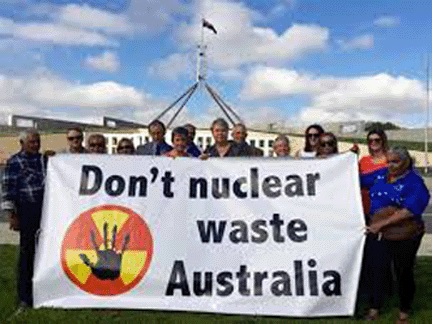
Declassified Australia can report that over a 10-year period from 2012 to 2022, during which Amentum managed the WIPP facility, multiple highly hazardous incidents occurred.
Amidst allegations of “gross mismanagement”, the dangerous incidents at the WIPP facility cost US taxpayers at least US$2 billion, and caused a three-year closure of the nuclear waste plant while redesign, repair, and remediation efforts were undertaken.
Jorgen Doyle, June 7, 2025 https://johnmenadue.com/post/2025/06/us-military-waste-contractor-with-flawed-safety-record-backing-australian-n-waste-dump/
A US military mega-contractor assisting an Australian company to develop a proposal for a nuclear waste dump in Central Australia has a flawed safety record in handling nuclear waste storage.
A DECLASSIFIED AUSTRALIA SPECIAL INVESTIGATION
In Alice Springs, Central Arrernte Country, the giant American military contractor, Amentum Holdings, is responsible for the day-to-day running of facilities for the secretive US-Australian Pine Gap satellite surveillance base. Now it’s involved in developing a proposed nuclear waste dump in Central Australia.
Declassified Australia can reveal that Amentum’s Alice Springs-based workforce of 400 people provides a myriad of support services to keep the ever-expanding base functioning, including infrastructure management, facilities operations, and maintenance services.
The proposal for the low-level nuclear waste dump comes as the Australian Government is seeking ways to manage and ultimately dispose of high-level nuclear waste from nuclear reactors in the proposed AUKUS submarines, as well as from other defence-related nuclear and hazardous waste, including visiting US and UK nuclear-powered submarines and warships.
As Declassified Australia exclusively reports, despite Amentum having a problematic record of nuclear waste management overseas, it is now involved in the nuclear waste disposal business in Australia.
Proposed Chandler waste facility
Amentum has been contracted to advise Australian hazardous waste company, Tellus Holdings, on the Chandler nuclear waste dump in Central Australia.
The Chandler nuclear waste dump is proposed to be constructed within a salt formation on Southern Arrernte country, 15km from the Aboriginal community of Titjikala and 120km south of Alice Springs.
The Northern Territory Environmental Protection Authority’s assessment report for the Chandler dump describes the project components as including construction of an underground salt mine at a depth of up to 860 metres, permanent hazardous waste disposal vaults within mined-out salt caverns, temporary above-ground storage facilities for hazardous waste, and associated infrastructure like haul roads, access roads, and salt stockpiles.
In August 2024, Tellus announced that the company had contracted Amentum to conduct a Strategic Review of the project to assess timelines, feasibility and potential international waste streams to be disposed of at the facility.
Sydney-based Tellus Holdings was founded in 2009 and describes its mission as “providing advance[d] end-to-end solutions for managing the world’s most challenging hazardous materials”. The company operates Australia’s first geological repository for low-level nuclear waste which started in 2021 at Sandy Ridge, 240km northwest of Kalgoorlie.
When Tellus’ American-born chief executive Nate Smith, a former attorney at powerful Wall Street law firm Sullivan & Cromwell, was interviewed on ABC Radio last August, he cited the proximity of Amentum’s workforce based in Alice Springs as a strong reason for selecting Amentum to carry out the strategic review of the proposed nuclear waste dump.
Declassified Australia can exclusively reveal that at an NT Defence Week presentation held in Alice Springs in May 2024, an Amentum speaker stated that the company is contracted directly by the US Government, and “employs roughly 400 people” providing services to the Pine Gap base.
According to an attendee at the event, the speaker said Amentum provides the operation services and maintenance of facilities, utilities management, renovation, security, environmental health and safety, catering, and housing services.
The company regularly posts ads for the employment of new contractors to provide services like cleaning, gardening and even swimming pool repair. On some days, the speaker said, there have been as many as 200 contractors for Amentum working on site at the spy base, 15km south of Alice Springs.
Amentum and the US military
Based in Virginia, Amentum is one of the US’s largest military contractors. The company employs 53,000 people across 80 countries, and provides services as diverse as chemical and biological weapons decommissioning, US army helicopter training, to running the Nevada Bombing Range and the Kennedy Space Centre.
As well as supporting the US’s most important satellite surveillance base outside the US at Pine Gap, Amentum also works extensively in managing and maintaining US military facilities, primarily in West Asia and sub-Saharan Africa.
The company operates in Bahrain, Jordan, Kuwait, Saudi Arabia, Qatar and the United Arab Emirates, where it provides operations and maintenance services on US military installations.
In Iraq, it manages and maintains US air force bases; and has previously operated in Afghanistan, where it maintained helicopters for the Afghan Air Force, and serviced airfields and trained Afghan police, until US forces evacuated the country.
In Somalia, Amentum is assisting in the construction of six new military bases, while in Ethiopia it is working to “enhance biosafety and biosecurity” at a vaccine lab and training facility.
Amentum is also involved more directly in training armed militias and military forces. In western Africa, the company operates in Benin, where it trains the country’s armed forces for “counter-terrorism” operations.
However, Amentum’s activities have been subject to controversy, even by the standards of a global military contractor.
Amentum is providing training to three of Libya’s armed groups as part of attempts to unify major armed factions in Tripoli to “counter Russian influence” within the country and across the African continent.
The company is currently defending a case before a US court on charges of human trafficking in Kuwait, through its predecessor companies AECOM and DynCorp. The companies allegedly participated in abusive practices against 29 interpreters working under US Army contracts during the US-led invasion of Iraq, “Operation Iraqi Freedom”. The abusive practices included forced labour under threat of deportation and arrest.
Amentum’s nuclear activities
In addition to its military contracts, Amentum has been working to support the development of nuclear reactors and facilities across a number of countries.
In the UK, Amentum has recently been selected as project manager for the proposed Sizewell C nuclear power plant on the Suffolk coast.
In South Africa, the company is working on extending the life of the country’s only nuclear reactor by 20 years. In the Netherlands, Amentum has been commissioned to undertake technical feasibility studies for two proposed new nuclear reactors.
It is on the American continent that Amentum’s reputation for managing nuclear facilities has suffered serious blows.
In 2012, Amentum formed the Nuclear Waste Partnership, a limited liability company, with BWX Technologies, in order to bid on a US Department of Energy contract to operate and manage a US nuclear weapons waste disposal facility in New Mexico, known as the Waste Isolation Pilot Plant.
Amentum’s experience managing the WIPP nuclear weapons waste disposal facility is cited as one of the reasons Tellus selected Amentum as its partner to carry out the strategic review of the planned Chandler project.
However, Declassified Australia can report that over a 10-year period from 2012 to 2022, during which Amentum managed the WIPP facility, multiple highly hazardous incidents occurred.
The incidents, described by an expert on the WIPP as a “horrific comedy of errors”, transformed a facility once regarded as “the flagship of the [US] Energy Department” into an object of serious concern.
Amidst allegations of “gross mismanagement”, the dangerous incidents at the WIPP facility cost US taxpayers at least US$2 billion, and caused a three-year closure of the nuclear waste plant while redesign, repair, and remediation efforts were undertaken.
Nuclear weapons waste disposal
The WIPP is, like Tellus’ proposed Chandler Project in Central Australia, located within a salt formation. Salt formations are generally considered ideal for the storage of nuclear waste because of their geological stability, capacity to dissipate heat generated by waste, low permeability to water and gasses, and self-sealing properties.
The WIPP site is massive. Its underground footprint currently includes 10 excavated “panels”, each consisting of seven rooms, totalling 100 acres. An 11th panel is under construction, and the US Department of Energy intends to expand the site to eventually consist of nineteen panels.
The facility has received more than 14,000 shipments of military nuclear waste since becoming operational in 1999. Its 800-strong workforce transfers transuranic waste received in drums to storage rooms 655 metres underground for permanent disposal.
The WIPP facility exclusively receives waste from the US’s nuclear weapons program, including tonnes of excess plutonium. Waste originating from 22 Department of Energy facilities, including the infamous Los Alamos National Laboratory (birthplace of the atomic bomb) is transferred to the WIPP facility for long-term storage.
There are proposals for the WIPP to take waste now classified as “high-level” once that waste has been ‘reclassified’ as transuranic (non-uranium) waste. This would pave the way for its storage at WIPP.
“Reclassification of nuclear waste could make disposal simpler and cheaper” is the breezy conclusion of one such proposal written by the editorial staff of Nature journal.
The site is legislated to receive 175,564 cubic metres of waste, and as of 2021, had reached 56.7% of its capacity.
Originally slated to begin closure in 2024, expansion plans and permit modifications have led nuclear watchdog groups to warn that what was only intended as a pilot plant is morphing into “Forever WIPP”.
The US Department of Energy itself now admits that “ final facility closure could begin no earlier than 2083”.
Faulty design and handling at the Waste Isolation Pilot Plant
On 5 February 2014, less than 18 months into the Nuclear Waste Partnership’s management of the WIPP site, a truck caught fire within the facility, and six workers were hospitalised with smoke inhalation.
A subcontractor under the Nuclear Waste Partnership subsequently sued the company for “gross mismanagement of a major construction contract” involving reconstruction of an underground air-monitoring system that failed during the truck fire.
The subcontractor alleged that the Nuclear Waste Partnership, run by Amentum and BWX Technologies, “was such a disorganised project manager that it caused repeated delays and cost overruns, resulting in multiple breaches of contract”.
The subcontractor claimed that NWP “used faulty designs that caused chronic problems and forced crews to redo large and expensive parts of the project”.
The faulty problems cited by the subcontractor included “a flawed design in hollow-roof panels requir[ing] an extensive redesign that dragged on for almost a year and at times forced work to shut down in other areas”.
Further, “[t]he building’s foundation had to be redesigned, requiring crews to move underground pipes they had already installed; and [a] defective design plagu[ed] the building’s control system”.
Less than a fortnight after the truck fire, on 14 February 2014, a barrel containing americium, plutonium, nitrate salts and organic kitty litter ruptured at the facility.
The rupture quickly spread contaminants “through about one-third of the underground caverns and tunnels, up the exhaust shaft, and into the outside environment”, exposing 22 workers at the WIPP facility to low levels of radioactive contamination.
Following the incident, the site was shuttered for three years. Clean-up efforts cost US$640 million, and a further US$600 million in operational costs were accrued during the years 2014-2017 while the site was being remediated and not accepting new waste.
In addition, the US Government paid US$74 million to New Mexico to settle permit violations involving the radiation release and the truck fire two weeks earlier.
Once costs associated with temporarily storing the nuclear waste that had been destined for WIPP are taken into account ( “hotel costs”, including the weekly inspection of more than 24,000 barrels of nuclear waste for leaks), the long-term cost of the incidents to US taxpayers is likely in excess of US$2 billion.
The WIPP site finally reopened in 2017 after three years of remediation efforts. The installation of a new ventilation system to replace the previous one contaminated in the incident of February 14, 2014 cost an additional US$486 million, and was only completed in March 2025.
A safety analysis conducted prior to the WIPP facility becoming operational reassured regulators that the likely frequency of accidents involving the release of radioactive material at the facility would be once every 200,000 years.
However the two serious incidents of February 2014, resulting in a three-year closure of the WIPP facility, occurred just 15 years into the site’s operation.
The US Department of Energy faced years of pressure from nuclear watchdog groups to end the Amentum and BWX partnership responsible for running the WIPP from 2012.
The Department finally decided not to renew Amentum and BWX partnership’s decade-long contract managing the WIPP nuclear weapons waste disposal facility. They exited in 2022.
The proposed Australian project
Back in Central Australia, Amentum’s strategic review of the Chandler Project is due to be completed soon.
Neither Tellus nor Amentum responded to a series of questions put to them about aspects of the nuclear waste dump project.
With Tellus eager to push on, the massive international nuclear waste dump proposed for Southern Arrernte country 120km south of Alice Springs could commence as early as 2028.
Nuclear future off the agenda in Port Augusta, as locals turn to renewables and mining
ABC News, By Kathryn Bermingham, Stateline, 15 May 25
In short:
Port Augusta was thrust into the spotlight when it was announced as one of several sites earmarked, under a Coalition election pledge, to host a nuclear reactor.
While the Coalition has not formally abandoned the plan, its resounding defeat at the recent federal election suggested voters did not embrace the idea.
What’s next?
As Port Augusta looks ahead, locals say its future could lie in several directions, including renewables and mining…………………………………………………………………………………………….
Nuclear off the agenda
Port Augusta was thrust into the national spotlight last year when it was announced as one of the sites earmarked to host a nuclear reactor under a Coalition election pledge.
While the Coalition has not formally abandoned the plan, its resounding defeat at the recent federal election suggested voters did not embrace the idea……………………….
………………………. A future in power generation
Greg Bannon felt the region had scarcely settled one nuclear debate — the now-scrapped proposal to build a low-level nuclear waste dump near Kimba — when the Coalition’s plan was put forward.
“It was really like a punch in the guts,” he said.
Mr Bannon, who lives 40 kilometres from Port Augusta at Quorn and had campaigned against the dump, said Port Augusta has had to reinvent itself in the past and could do so again.
“We also had a very big railway workshop here, it was a huge employer with lots of apprenticeships,” he said.
“Railways built everything. So that was a big loss when that was taken away and of course the most recent large employer has been the coal-fired power station.”
He said the transition to renewables had been more economically beneficial than some gave it credit for — and maintained that Port Augusta’s future was still in energy generation.
“Renewables have provided jobs,” he said.
“We’ve got Sundrop Farm down there, which … grows tomatoes from gulf water that’s been desalinated and solar mirrors.”………………………………………………….. https://www.abc.net.au/news/2025-05-15/nuclear-off-the-table-for-port-augusta/105285976
South Australia Liberals who first pushed 100 pct renewables – then went nuclear – now reverse course after poll wipeout
ReNewEconomy, May 5, 2025, Joshua S Hill
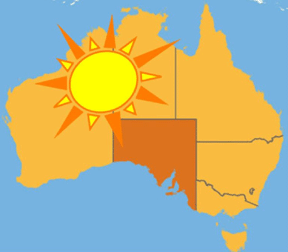
The South Australian Liberal party, which set the state’s first 100 per cent renewables target when in government six years ago, before embracing nuclear while in opposition, has reversed course again after the federal poll wipeout and the loss of a long time Liberal seat in Adelaide.
South Australia leads the world in the uptake of variable renewables, with a 72 per cent share of local demand over the last 12 months.
The then Liberal state government in 2019 set a target of reaching 100 per cent “net” renewables by 2030, before the current Labor government accelerated that target to 2027, and enshrined it into law, based on the planning for new wind and solar projects, battery storage and transmission.
New state Liberal leader Vincent Tarzia reversed course on renewables last year, supporting the federal Coalition’s plan to build nuclear power at seven sites across Australia, including at Port Augusta in South Australia, the site of the coal fired power stations that closed nearly a decade ago.
However, speaking to ABC Radio Adelaide, Tarzia has now backed away from his party’s election commitment to hold a Royal Commission into nuclear energy, saying it was clear that the technology has been “comprehensively rejected” by the electorate.
A potential nuclear future had been a top priority for the South Australian Liberal Party, promising in June last year to hold yet another Royal Commission into the technology. This was followed in August by the appointment of Stephen Patterson, the state MP for Morphett, as spokesman for Nuclear Readiness.
Tarzia’s comments came after the Liberals lost the last of their Adelaide based federal seats, including the once safe seat of Sturt, in last weekend’s federal election campaign…………………………………. https://reneweconomy.com.au/s-a-liberals-who-first-pushed-100-pct-renewables-then-went-nuclear-reverse-course-after-poll-wipeout/
Greens fear AUKUS overreach as State Development Coordination and Facilitation Bill 2025 passes SA parliament

A new $4m planning office will be granted unprecedented powers, sparking calls to temper the power of the four bureaucrats set to wield them.
Sweeping new powers will be invested in a $4m office to fast track “significant” SA projects including housing and AUKUS – raising fears they could avoid tougher planning checks.
The State Government is planning to appoint four staff to the office, including an AUKUS expert, with unprecedented powers to “case manage” projects.
Premier Peter Malinauskas has flagged this would allow faster approvals in designated “go zones” for projects like the AUKUS nuclear-powered submarines, housing and renewable energy projects.
The move flared concerns about existing heritage, environment, coastal protection and pastoral land act processes being downgraded after the State Development Coordination and Facilitation Bill 2025 passed this week.
Mr Malinauskas previously said the law meant the State Government could designate “state development areas” as “go-zones”.
Regulatory work in these zones would be completed before developers moved in “allowing for quicker approvals within them once an application is made”.
This was meant to save time in passing “urgent and significant projects”.
A government spokesperson assured provisions meant the new office must perform any assessment independently and it could not be directed “by any Minister to either approve or reject any application.”
The office could not deal with nuclear waste projects.
And the Adelaide Parklands was protected by the Adelaide Parklands Act and the new bill states it “may never be designated as a state development area”.
But SA Greens party co-leader Robert Simms was still concerned.
He feared the inclusion of an AUKUS expert meant approvals for the project would bypass usual safety guards.
“SA parliament has just given the Malinauskas Government the biggest blank cheque in South Australian history,” he said.
“This bill gives an unelected office the power to override South Australian laws to enable controversial projects, including AUKUS, yet it passed the Upper House in the blink of an eye.”
“This bill isn’t about facilitating housing developments, it’s about giving the state government the power to ride roughshod over the community. It’s a power grab of epic proportions that should have been given much more scrutiny.”
It was confirmed in the senate the office would cost $4m a year to operate.
State Liberals nuke nuclear promise

The SA Liberals have broken a key election promise with just 10 months to go until the state poll, with Liberal leader Vincent Tarzia dumping his party’s only energy policy.
5 May 25,https://www.premier.sa.gov.au/media-releases/news-items/state-liberals-nuke-nuclear-promise
In a stunning backdown, Mr Tarzia admitted on ABC Radio Adelaide that the Liberals’ election commitment to hold a Royal Commission into nuclear energy would be dumped in the wake of the federal election:
Rory McClaren: That’s what I was going to ask you… should nuclear from a Liberal Party policy perspective now be parked?
Vincent Tarzia: Yes, at the moment it’s been comprehensively rejected and we know the thing is with the energy transition, in three years’ time we will be in another position again.
The State Liberals made the pursuit of nuclear power their top priority, announcing their pursuit of a Royal Commission as their key commitment in their Budget Reply speech in June.
In August, Liberal Leader Vincent Tarzia appointed Stephen Patterson as Shadow Minister for Nuclear Readiness.
Now, just eight months later, the promise has been abandoned.
The 2016 Nuclear Fuel Cycle Royal Commission found nuclear power was not commercially viable in South Australia.
Quotes
Attributable to Tom Koutsantonis
What do the South Australian Liberals stand for?
They’re breaking election promises even before they’ve got to an election.
Only a few months ago, they were making the pursuit of nuclear energy their sole energy policy focus. Now, they’ve dumped it.
Vincent Tarzia must now dump his Shadow Minister for Nuclear Readiness, who has absolutely no policy offering other than the pursuit of an energy source that evidence shows will drive up bills for South Australians.
At a time when the Opposition should be outlining its policy platform ahead of the 2026 State Election, the State Liberals are instead ditching their only energy policy.
Election Lesson: Coalition Must Dump Nuclear Policy

Friends of the Earth Adelaide Federal Election Campaign, Philip White May 5, 2025
Friends of the Earth Adelaide ran a targeted campaign in two marginal seats leading up to the federal election. We created an election leaflet advising voters about the dangers of nuclear power and asking them to “vote nuclear free”.
We are pleased that the Australian people rejected the nuclear option. We hope the Coalition gets the message and dumps its nuclear energy policy and becomes a constructive supporter of real climate action. Let this election mark an end to the climate wars.
Boothby
We delivered 50,000 of our leaflets to the letterboxes of voters in Boothby, a marginal seat in southern Adelaide held by Labor on a 3.3% margin prior to the election. Our aim was to prevent Boothby falling to a pro-nuclear candidate. We are very grateful to a grant from FOE Australia which paid for much of the printing and distribution of 45,000 of the leaflets by Australia Post. The remaining 5,000 leaflets were delivered by hand by our volunteers, who we are also very grateful to. We considered that a good reach of the 80,000 letterboxes in Boothby.
We are very pleased that Boothby was retained by an anti-nuclear candidate (Louise Miller-Frost for Labor, with Joanna Wells of the Greens also doing well). That’s one more seat to keep Australia free from nuclear power. We hope that the large loss the Coalition received means they will drop nuclear power as a policy.
Sturt
In late April a bus load of Traditional Owners from Port Augusta came to the city for a meeting in the marginal eastern Adelaide suburb of Sturt, held by the Liberals on a 0.5% margin prior to the election. Their aim was to appeal to Sturt voters for their support in keeping Port Augusta nuclear free. Friends of the Earth Adelaide co-hosted the meeting along with Don’t Nuke Port Augusta, with financial help from CANA. Traditional Owners spoke strongly of their lives and love for Port Augusta’s land and waterways, and of the tragic intergenerational consequences for their families of the nuclear testing in SA in the 1950s. The meeting was videoed and can be seen at https://www.youtube.com/live/lJ1tpcfkZIU and many great photos are on the Don’t Nuke Port Augusta Facebook page.
The Port Augusta contingent were prominent at the May Day Worker’s Right’s rally the following day. They got a great shoutout from the MC, the SA Unions Secretary, and huge applause and appreciation from the crowd of unionists. Also, that evening, they staged a demonstration at the Arkaba Hotel where Peter Dutton was promoting the Liberal candidate for Sturt. They said, “If Dutton won’t visit us, we’ll come to him.”
Victorian Liberal leader distances state party from Peter Dutton’s nuclear proposal: ‘Our focus is gas’
Brad Battin says he had a conversation with the federal opposition leader about the ‘language’ he would use about plans to build a nuclear reactor in eastern Victoria
Benita Kolovos Victorian state correspondent, https://www.theguardian.com/australia-news/2025/apr/15/victorian-liberal-leader-brad-battin-distances-state-party-from-peter-dutton-nuclear-proposal
The Victorian opposition leader says he discussed the language he would use to distance the state party from the federal Coalition’s campaign to build a nuclear reactor in the Latrobe Valley, telling Peter Dutton “it’s your campaign”.
The Loy Yang coal-fired power station in the Latrobe Valley east of Melbourne is one of seven proposed sites for the federal Coalition’s proposal to build nuclear reactors, the centrepiece energy policy the federal Liberal leader will be taking to the 3 May poll.
But in his first interview with Guardian Australia since becoming the state Liberal leader in December, Brad Battin was clear to separate his team from the proposal, saying: “Our focus is gas, let the feds get on with what they’ve got to get on with.”
He confirmed he had not spoken to anyone in the federal Coalition about its two-and-a-half-year consultation plan for each proposed nuclear site, with the issue “barely raised” at all on the campaign trail.
However, Battin said a conversation had taken place with Dutton and his office about how he would handle questions on the policy.
“I’ve had the conversation with Dutton and his office around what my language is going to be, which is basically saying, ‘We’re happy to have a conversation at the right time. But for us, it’s your campaign at the moment. Our priority, our focus, is on gas,’” he said.
Battin said the federal Coalition would need state parliament to overturn Victoria’s Nuclear Activities (Prohibitions) Act of 1983, which bans the construction and operation of nuclear facilities in the state. Asked if he would be happy with that law being overturned, he said: “I’ll let you know on 4 May.”
Without the support of state parliament, Battin said a Dutton government would face a “difficult process” under section 109 of the constitution, which allows federal law to override state law in the case of conflict.
At his campaign launch on Sunday, Dutton vowed that Australia would become a “nuclear-powered nation” under the Coalition if elected. He said nuclear energy would reduce the need for “sprawling solar and windfarms or laying down 28,000km of transmission lines”.
Battin, however, said most Victorians wanted cheaper energy but “don’t know what the answer to that is yet”.
He said that as existing gas fields in Victoria’s Gippsland and Otway basins continue to deplete, the state should prioritise expanding onshore gas exploration instead.
The comments mark a shift in tone for Battin, who has spent months sticking to a carefully worded position that the Victorian Coalition was open to an “adult conversation” about the policy. He has also repeatedly refused to provide a personal view on nuclear energy.
Response to Submarine Construction Yard Environmental Impact Statement
Friends of the Earth Adelaide 31 Mar 2025
Our submission raised questions about assumptions made about the nuclear submarine agreements:
“The Environmental Impact Statement (EIS) is premised on the assumption that the proposed AUKUS nuclear submarines are in Australia’s strategic interest (pp. 9-10) and South Australia’s economic interests (pp. 12-13). Both these premises are false.
Many highly qualified defence experts argue that nuclear submarines are not in Australia’s strategic interest. [1]
Along with these experts, and retired senior politicians like Paul Keating, Gareth Evans and Malcolm Turnbull, we believe that Australia will be less safe if it acquires nuclear powered submarines. Although it is the federal government that has made this strategic blunder, the EIS should not lend it any credence (as in section 1.5.4).…
AUKUS submarines will also be prejudicial to our economic interest. Some of the abovementioned analysts don’t think Australia will actually ever get the promised nuclear submarines, certainly not in a reasonable time frame. This is a view not restricted to left-leaning people. Conservative commentator Greg Sheridan has criticised AUKUS for this reason.[2]”
[1] Hugh White, “From the submarine to the ridiculous”, The Saturday Paper, 18 September 2021 https://www.thesaturdaypaper.com.au/2021/09/18/the-submarine-the-ridiculous/163188720012499#mtr
Major General Michael G Smith AO (Ret’d), ‘How should Australia defend itself in the 21st century? Silencing the drums and dogs of war’, The New Daily, May 26, 2023 https://thenewdaily.com.au/news/world/2023/05/26/how-should-australia-defend-itself-in-the-21st-century-silencingthe-drums-and-dogs-of-war/
Sam Roggeveen, ‘Spiky questions remain for AUKUS proponents’, Inside Story, 19 March 2024 https://insidestory.org.au/spiky-questions-remain-for-aukus-proponents/[2] Greg Sheridan, ‘Our nuclear subs fantasy adds up to military net zero’, The Australian, 6 October 2021. https://www.theaustralian.com.au/commentary/our-nuclear-subs-fantasy-adds-up-to-military-net-zero/newsstory/cec3b5e94c5bacac405a5eb535b3a628
Read our full submission: 250314AUKUS EIS – FoEAdelaide
Response to Osborne Submarine Construction Yard Strategic Assessment
Friends of the Earth Adelaide 1 April 25
Our recommendations:
1. Correct the factual errors regarding the effects of radiation.
2. Include active commissioning in the assessment.
3. Include the disposal of radioactive waste in the assessment and publish plans for management, storage and disposal of all streams of radioactive waste, including intermediate and high-level waste and spent nuclear fuel.
4. Include a proper analysis of the risks and consequences of incidents and accidents that could lead to a release of radioactive material into the environment.
5. Inform the public about the potential for exposure to radiation and the levels of radiation they could be exposed to.
6. The Commonwealth Government should consult with other levels of government, the Australian Radiation Protection and Nuclear Safety Agency, emergency services and with the general public to develop a response plan for radiological emergencies.
7. Publish the Strategic Assessment Plan before finalizing the Strategic Impact Assessment Report.
Read our full submission: https://adelaidefoe.org/wp-content/uploads/2025/03/250314AUKUS-SIA-FoEAdelaide.pdf
The Lizard’s Revenge
topnrosdeS146ag, https://www.facebook.com/profile.php?id=100064594993745
Anti-nuclear activists target BHP headquarters and block Collins St to mark the 14th anniversary of the Fukushima nuclear disaster.
Just after 10am today around 20 anti-nuclear activists dressed in white radioactive suits used barrels marked with the radioactive symbols and a car decorated with anti-nuclear statements to block the BHP head office. Inside the car a man in his 60s
secured himself to the steering wheel using a bike lock.
The Desert Liberation Front, who organised the protest highlighted the relationship between uranium mined by BHP and the Fukushima disaster:
“BHP makes its billions from destroying the planet and it is not only complicit in Fukushima by supplying the uranium but is part of the push for nuclear power in Australia, a plan that puts all of us and our planet in danger of another Fukushima.”
“The 14th anniversary of the Fukushima nuclear disaster comes at a time in Australia when the Liberal Party is attempting to dress up nuclear power as safe and the Labor Party is continuing with its commitment to AUKUS, a plan that will not only bring nuclear subs to ports around the country but will also result in nuclear waste dumps on sacred land.”
“We call on all political parties and private companies operating in this country to commit to banning the mining of uranium and the banning of all forms of nuclear power, both for weapons of war and as a false alternative to renewable energy.”
What if a Fukushima-sized nuclear accident happened in Australia?
Today is the 14th anniversary of the Fukushima disaster, and this morning the good folks at Don’t Nuke the Climate released a huge research project that shows what a Fukushima-style nuclear disaster would look like if it happened at one of Dutton’s seven proposed reactor sites.
About these maps, https://nuclearplume.au/ 11 Mar 25
The seven sites on this map have been selected by the federal Coalition to house multiple nuclear power reactors.
You can select the reactor site and wind direction to see how a Fukushima-scale nuclear disaster would contaminate different areas surrounding the seven sites in Australia.
The interactive map uses a radiation plume map, originally peer reviewed and published by the European Geosciences Union. It shows the deposition of radioactive caesium-137 from the Fukushima disaster as of July 2011. The darker the shading, the higher the level of radioactive contamination and the higher the radiation exposures for people in those areas. At distances far from the Fukushima plant, radiation exposures were low but even low radiation doses can cause negative health impacts including fatal cancers and cardiovascular disease.
Caesium-137 has been one of the most significant radioactive contaminants since the March 2011 Fukushima disaster but many other types of radioactive particles contaminated wide areas (iodine-131, xenon-133, etc.).
Other radiation fallout maps from the Fukushima disaster can be seen here and here.
Australia’s technocratic drive to nuclear ignorance
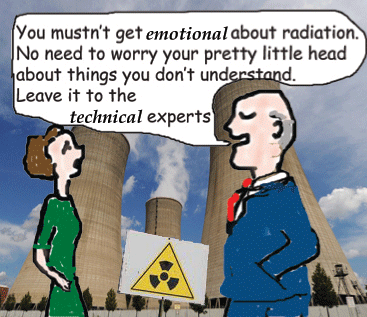
The worshipped role of the expert has excised public debate from nuclear policy. The expert’s validation exonerates the government from the onus of explanation, excluding constituents from relevant information and thus precluding commentary. Nuclear science, a field shrouded in esotericism, marks the summit of techno-scientific rationality, in which utter destruction is intellectually atomised out of politics to the realm of the expert/executive.
ARENA, Sybilla George, 11 Dec 2024
Australia is ‘going nuclear’. The addition of nuclear-powered submarines to Australia’s defence arsenal through the $368 billion AUKUS deal passes a threshold of nuclear legitimisation that Oceania’s anti-nuclear activists have been battling for decades. Nuclearisation used to be an eco-ethical debate, as with the anti- vs pro-uranium mining battles since the 70s that have seen wins and losses on both sides. The rapid increase of Australia’s nuclear involvement, however, signals the reframing of national nuclear rhetoric as techno-scientific rationality that precludes dialogue and authorises executive ruling.
While the AUKUS deal plays out in the limelight, at RAAF Tindal in the Northern Territory the building of facilities to host six United States B-52H Stratofortress bombers on rotational deployment, alongside ‘up to 75’ US Armed Force permanent staff, is underway. The facility renovations are funded through the Force Postures Initiative, the most recent phase of the Force Postures Agreement which since 2014 has defined the United States’s military agenda in Australia, with the consent of successive Australian governments. The Enhanced Air Cooperation branch of the US Alliance was recently ratified when Australian Defence provided ‘air-to-air refuelling’ to B-2 Spirit bombers involved in the US’s October strike on Houthi targets in Yemen.
More than half of the United States’s stock of 76 active B-52 bombers is capable of carrying and deploying nuclear weapons; the remainder is conventionally armed. These jets have been flying over Australian airspace for half a century; however, stationing them at RAAF Tindal signals a significant escalation in nuclear involvement, as it will produce for the first time the conditions ‘to support potential nuclear combat missions from Australian soil’, according to a Nautilus Institute Special Report published in August.
This would be illegal under the United Nations Treaty on the Prohibition of Nuclear Weapons (TPNW), an agreement on which Australia under Labor has abstained since 2022 when it rescinded the Coalition government’s ‘No’ vote. Signing and ratifying the treaty features as a goal in Labor’s 2023 National Platform. Yet progress seems unlikely, given Australia’s third abstention on the TPNW on 1 November 2024 and the persistent silence from the government on the United States’s policy to ‘neither confirm nor deny’ the presence of nuclear arms aboard aircraft or ships. Under this policy, Australia will not be informed whether B-52 bombers on deployment at RAAF Tindal are carrying nuclear weapons.
The public interest in the disclosure of the presence of nuclear weapons includes matters of security, ethics and democratic transparency. Of great concern is the Albanese government’s passive concession to a foreign state’s policy that conflicts with its own commitment to ‘full knowledge and concurrence’ of foreign activities conducted in Australia. Restricted speech has been increasingly utilised as a tactic to expedite pro-nuclear policy in the rush towards technological rationality.
Another example is Albanese’s Nuclear Power Safety Bill, which was rammed through the Senate without debate in October 2024. It stipulates two dumping ‘zones’ for highly irradiated ‘spent nuclear fuel’, to be located within dozens of kilometres of Perth and Adelaide—Western and South Australia being selected once again to play host to nuclear, as during the United Kingdom’s nuclear testing campaign. Indeed, Defence recently withdrew its environmental approval application for developments to prepare HMAS Stirling to host nuclear-powered submarines, and The Australian has reported that the government will resubmit the application with an additional request for the rights to store irradiated waste materials at the facility, which would thus be ‘subject to a single round of community feedback’.
Deferral to the United States’s ‘neither confirm nor deny’ nuclear weapons policy is an appeal to ignorance, and thus innocence, which in turn forecloses systems of accountability, since governments’ denial of information renders their constituents ignorant. The current government’s silence on the presence of nuclear weapons on US aircraft stationed at RAAF Tindal eerily resembles Robert Menzies’ ‘extreme’ commitment to the United Kingdom’s ‘need to know’ policy during the nuclear testing campaign from 1952 to 1963. As prime minister, Menzies exclusively assented without consulting Cabinet or scientific advisers to the use of the Montebello Islands as the site of Operation Hurricane, the nuclear bomb detonation that cemented the United Kingdom as the world’s third nuclear power. The program was not announced until 1952, prior to which Menzies deliberately misled the media about plans for nuclear testing on Australian soil, claiming he had ‘heard nothing’ about it.
The worshipped role of the expert has excised public debate from nuclear policy. The expert’s validation exonerates the government from the onus of explanation, excluding constituents from relevant information and thus precluding commentary. Nuclear science, a field shrouded in esotericism, marks the summit of techno-scientific rationality, in which utter destruction is intellectually atomised out of politics to the realm of the expert/executive.
. The UK nuclear testing campaign caused massive human and ecological suffering to Aboriginal communities in Western and South Australia. It was not until the publication of the 1985 Royal Commission into British Nuclear Tests in Australia, more than two decades after the final tests, that the extent of Australian government collusion was revealed, typified by Menzies’ ‘complete’ acceptance that Australia be entirely excluded from technical information about the tests. This submission to an allied foreign state enacts the technocratic power of nuclear, which pitches influence disproportionally towards those with technical knowledge and renders those without it mute and nakedly vulnerable to, in the case of nuclear arms, annihilation………………………………
The Albanese government’s silence on the presence of nuclear weapons aboard B-52s at RAAF Tindal regurgitates the United States’s policy so as to allow it to skirt its democratic responsibility to inform the public of potential nuclear escalation. Extensive control of messaging and media across the decade-long nuclear testing campaign by Menzies on behalf of the United Kingdom, particularly regarding its true health risks, denied Australians the opportunity to establish informed opinions on the tests. The drive to ignorance common to both Menzies’s and Albanese’s nuclear policy strategies has been achieved via the interiorisation of allied foreign states’ intelligence protocols. This techno-scientific rationale dangerously licences executives to accelerate nuclear proliferation beyond the forum of public debate to which it belongs, and into reality. https://arena.org.au/australias-technocratic-drive-to-nuclear-ignorance/
Coalition trying to brainwash Queenslanders into nuclear

David Wilson, Rothwell, Qld, The Saturday Paper, 8 Feb 25
The Coalition are spending big trying to brainwash Queenslanders into nuclear, and as this letter to the Saturday Paper points out, it contains a lot of misinformation.
“… Selective reasoning
I have just received the Coalition’s A3 double-sided promo arguing the case for nuclear energy. When a political party argues a policy case based on misinformation, suppression of economic and critical science analysis, and contextomy of scientific experts, they go beyond bias and enter the realms of propaganda.
The pamphlet argues we should develop small modular reactors (SMRs) because nuclear generation is common in 32 other countries. It fails to point out that no country has established the cost-benefit of SMRs or operates them commercially.
Furthermore, the 32 countries cited employ large-scale reactors that have achieved cost-benefit only by their economies of scale. SMRs depend on a supply of enriched uranium. While pointing out Australia has uranium, it fails to address the virtual impossibility of enriching it – given the enormous cost of set-up, supply chains, political opposition, and available expertise (Karen Barlow, “Exclusive: Dutton’s nuclear plan requires ‘huge’ new bureaucracy”, February 1-7). Importing enriched uranium will have similar problems and costs.
Former chief scientist Alan Finkel is quoted selectively as a supporter of Coalition policy when in fact his focus is renewable energy and energy storage. Perhaps we can speed up political fact-checking with AI? – …” https://www.thesaturdaypaper.com.au/letters/2025/02/07/selective-reasoning?fbclid=IwY2xjawITiE1leHRuA2FlbQIxMQABHSG1rbvgyOAkw2CIH8F4KBgSOe81fOz4SJAZ8JmjDMZaGceUg1ZguRtGNA_aem_ki4o0GqJqIOC-jNRB_HK8A#mtr
Former US beauty queen and nuclear energy expert Grace Stanke promotes nuclear in WA
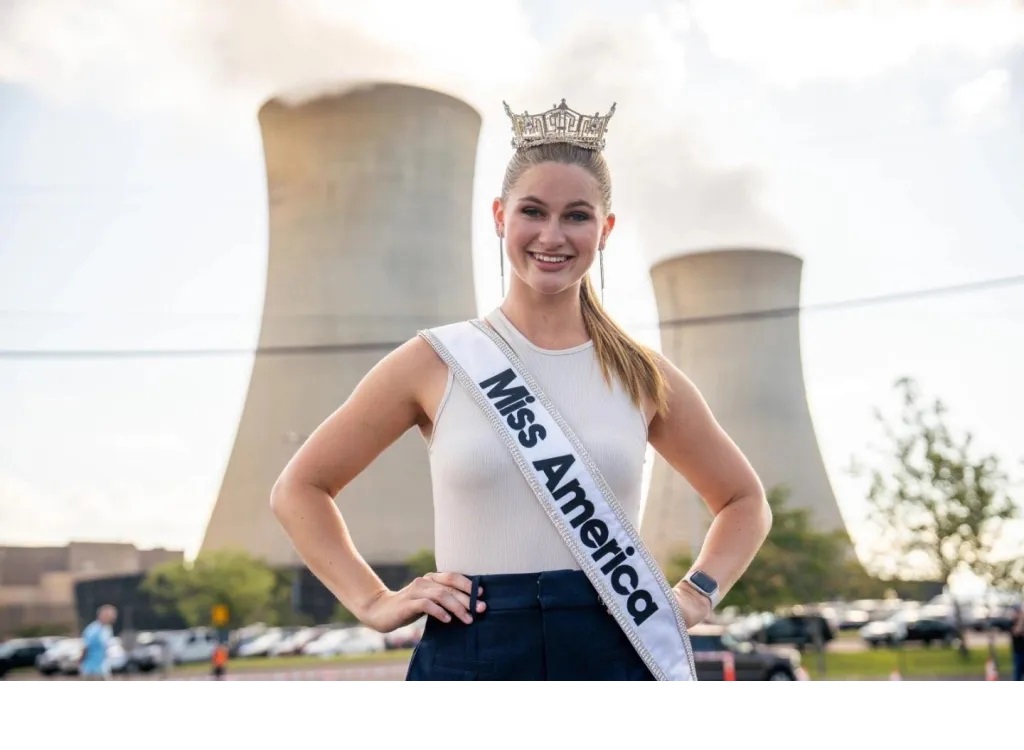
“The perception from a lot of the community is they were using beauty to brainwash.”
By Kate Forrester, ABC South West WA
In short:
A campaign by proponents of nuclear have funded former Miss America and engineer Grace Stanke’s pro-nuclear tour of Australia.
Attendees say they had mixed emotions to whether or not the campaign message was what locals needed to hear.
What’s Next?
The tour, funded by Australian electronics mogul, Dick Smith will see the 22-year-old visit locations around Australia over the next week, to advocate for a nuclear future.
Nuclear energy advocates have begun a national tour to win the hearts and minds of coal towns promised nuclear facilities by the opposition.
Last year, federal opposition leader Peter Dutton identified seven sites across the nation to transition coal-fired power stations into nuclear power plants.
The South West town of Collie, 200 kilometres south of Perth, is one of seven sites identified by Mr Dutton.
Collie was the first stop on the campaign, spearheaded by former Miss America and nuclear fuels engineer Grace Stanke…………………………………..
One of the points the American presented to the crowd was jobs being transferable.
“I think for this town specifically, a lot of the skills current coal workers have can translate into a nuclear power plant or multiple power plants,” she said.
Differing opinions
Greg Busson, Secretary of the Mining and Energy Union, went to the meeting on Thursday night.
He disagreed with Ms Stanke’s position on jobs being transferable from coal to nuclear but said hearing another perspective was always worth it. ….majority of the workers I cover in Collie are coal miners. I don’t see where the link is there. They’ve never worked in a powerhouse.
“We don’t mine uranium, so where do those people fit in? What other industries are there that are linked to the nuclear industry that will give those coal workers comfort?”
Mr Busson said, looking around the hall, he thought a lot of the attendees had come from out of town.
“I think part of the problem is they portrayed Grace as a beauty queen, not just as a nuclear engineer,” Mr Busson said.
“The perception from a lot of the community is they were using beauty to brainwash.”…………………………………..more https://www.abc.net.au/news/2025-01-31/former-beauty-queen-grace-stanke-promotes-nuclear-in-wa-/104881056
1 This month

of the week – Australians for War Powers Reform (AWPR)
To see nuclear-related stories in greater depth and intensity
 Antinuclear