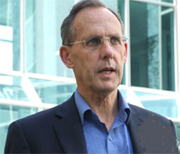
Federal election 2019: Ex-Liberal leader John Hewson endorses South Australian Senator Sarah Hanson-Young
Federal election 2019: Ex-Liberal leader John Hewson endorses SA …
At last – HENRY COX, a Senate Candidate with the guts to fight the nuclear waste dump plan !

Confident Clive Palmer predicts tax-payer funding for nuclear power
The Australian Tribune 10 May 19, “……………What’s needed for Palmer to win Nuclear Project?
Mr Palmer is confident that his party could hold the balance of power in the senate, which would guarantee the go ahead of the project.
‘We will need about five to six seats and our polling is showing we will win five to six seats pretty easily and we should be able to win more,’ he said.
‘Australia has had nuclear reactors for 50 years in Lucas Heights in the middle of Sydney.
‘There are no safety issues there, they operate every day and they’re still there.’
Mr Palmer is calling for the federal government to fund the power plant, using the Commonwealth government’s previous handling of steelworks as an example.
‘The Commonwealth government in 1913 provided a guaranteed establishment to SteelWorks in Whyalla and they can do it again,’ Senator Palmer said. https://www.theaustraliantribune.com.au/2019/05/palmers-case-for-nuclear-power/
Bill Shorten urged to declare climate emergency if Labor wins
 Peter Garrett urges Bill Shorten to declare climate emergency if Labor wins
Former environment minister calls for creation of ‘war’ cabinet committee to plot transition to zero carbon, Guardian, Katharine Murphy Political editor@murpharoo 9 May 2019 The former environment minister Peter Garrett has urged an incoming Labor government to convene a climate emergency summit to plot a transition to zero carbon, and create a super department aligned to Treasury, like the Department of Post War Reconstruction after the second world war, to implement the transition…….
$571 billion loss by 2030 estimated for Australian property values due to climate change
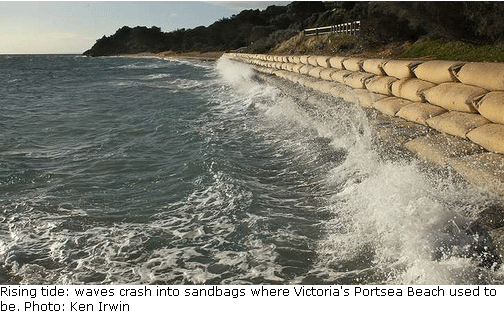 Climate change could slash $571b from property values, study warns, ABC, 10 May 19,
Key points:
- The Climate Council estimates Australian real estate will lose $571b, or almost 9pc, of its value by 2030
- The losses will be concentrated amongst 5-6pc of property owners, with many properties virtually uninsurable
- The report estimates $4 trillion could be wiped off economic growth over the next 80 years if carbon emissions do not fall
The research estimates residential property value losses of $571 billion by 2030 related to increased extreme weather events, inundation of some low-lying coastal properties and higher insurance premiums.
That would wipe approximately 9 per cent of the nation’s total residential property value — about as much as has been lost so far in the current property downturn, which is on track to be the worst in Australia’s recent history.
However, these losses would not be evenly spread, as an estimated 5-6 per cent of property owners bear the brunt of climate change risks.
As insurance companies reshape their risk strategies to manage extreme weather events, the report predicts, the cost of insuring properties — particularly those on the coast — could become unaffordable for one in 19 owners, who would have to pay annual premiums equivalent to 1 per cent of their property value.
A recent study by the Actuaries Institute — actuaries are the statisticians who calculate risk for insurers — warns that as many as one in 10 properties could become uninsurable by the end of this century due to climate change.
Climate risk expert and report author Karl Mallon warned insurance companies were constantly updating their risk strategies, and could hike premiums to deal with extreme events such as rising sea levels, heatwaves and floods.
“Increasingly, Australians are also going to struggle to pay for home insurance. On current trends, by 2030 one in every 19 property owners faces the prospect of insurance premiums that will be effectively unaffordable,” Dr Mallon said.
Even for Australians who can afford to pay, general insurance currently does not cover damage from coastal inundation and erosion — events which are likely to become more common because of climate change.”
‘There are real costs of failing to act’
The report also warns $4 trillion could be wiped off economic growth over the next 80 years if carbon emissions do not fall.
Climate Council chief executive Amanda McKenzie told The World Today both major parties needed to confront climate change with policies that showed political will……..
The new report, Compound Costs, says coastal areas are likely to be hit hardest, and highly populated areas such as the Sunshine Coast, the Gold Coast and Melbourne are all vulnerable. ……
Climate an election issue…..
The Climate Council research follows warnings from the Reserve Bank and the Australian Prudential Regulation Authority that climate change poses serious economic risks and that companies need to disclose their exposures to investors.
https://www.abc.net.au/news/2019-05-09/climate-change-could-wipe-571b-off-property-values/11096768
Former UN climate leader supports MP Zali Steggall, Kerryn Phelps, Mayo MP Rebekha Sharkie, and MP, Julia Banks
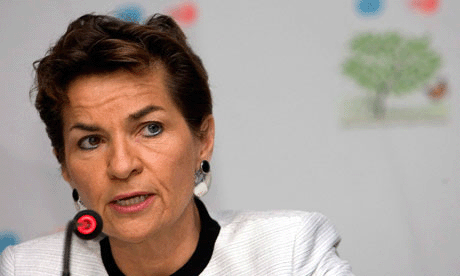 ‘Appalling’ policy inaction draws former UN climate leader into
  federal election campaign https://www.abc.net.au/news/2019-05-07/canberra-inaction-on-climate-change-appallling/11088336
Key points:
- Christiana Figueres led the global negotiating process that culminated in the 2015 Paris climate change agreement
- She has thrown her support behind four female independents whose key opponents are Liberals
- Speaking to a Sydney forum, Ms Figueres said the Paris Agreement required countries to bring forward the most ambitious possible national targets every five years
Christiana Figueres led the UN’s global negotiating process that culminated in the 2015 Paris climate change agreement, and is now a climate leader at the World Bank.
She has thrown her support behind Zali Steggall, who is standing against former prime minister Tony Abbott in the NSW seat of Warringah, Wentworth MP Kerryn Phelps, Mayo MP Rebekha Sharkie and the MP for Chisholm, Julia Banks, who resigned from the Liberal Party and is contesting the nearby seat of Flinders as an independent.
Ms Figueres said the four women “set out strong policy platforms and longer-term vision for what it would take for Australia to take its rightful place as a leader in the global fight against climate change”.
She condemned what she called “the ridiculous climate wars in Australia that have led to a very damaging climate and energy policy vacuum for more than a decade”.
“This inaction is putting us at war with a climate that has no more room for atmospheric pollution,” Ms Figueres said.
Independents praised for their ‘courage’
Two of the four candidates — Dr Phelps and Ms Steggall — on Tuesday attended a meeting in Sydney of Mission 2020, which was established after the Paris Agreement to drive global action on climate change in order to cap greenhouse gas emissions and limit global temperature rises to 1.5 degrees Celsius.
Speaking via video link, Ms Figueres praised the four independents for “your courage and leadership in having put climate action and clean energy at the forefront of your respective campaigns.
“As mothers, we all share a deep sense of responsibility to make right what is currently going very wrong.”
After the meeting Dr Phelps told the ABC that she thought it “enormously significant that a world leader on climate change has backed the independents who are backing action on climate change.”
“We have a moment in time when can put in place policies that will make a difference to the future of our planet,” Dr Phelps said.
Business leaders, clean energy lobbyists and investors advocating stronger climate change action and policy signals briefed the candidates at the forum.
We have been hearing today from investors … and people who understand the science of climate change better than anyone in the country and they are telling us that not only is there an urgent need for action, but governments can no longer afford to delay their action,” Ms Phelps said.
“There is a dire message from the science on climate change but there is a positive message about where we can go,” Zali Steggall added.
“With clear policy from government the market will take care of it and we have great potential.”
Cost of inaction
Ms Steggall also responded to concerns raised during the campaign about the cost of Labor’s proposed climate change policies.
“The price of climate change action is nothing compared to the price of inaction.”
Speaking to the Sydney forum, Ms Figueres said the Paris Agreement required countries to bring forward the most ambitious possible national targets every five years.
“Whoever is elected needs to be prepared to bring a revised 2030 target to the table in the next 12 months,” she warned.
The former UN climate change leader dismissed arguments that action in Australia to limit global warming would make little difference to global climate change.
“The fact that Australia only contributes 1.5 per cent of global emissions is not an excuse not to act,” she said.
“If every country adopted that stance, we would be on track to oblivion. Your island neighbours in the Pacific would go under the waves.”
“We look hopefully to the Land Down Under for a watershed election that sparks a new wave of climate leadership.”
Scott Morrison on “cutting green tape” – commentators respond savagely and sceptically
 There was a great long stack of comments on the Brisbane Times article (below) – and all condemned Prime Minister Scott Morrison’s pledge to cut environmental regulations – he chose the same day as the UN’s damning report on biodiversity loss was released. Here’s just a couple of samples .
They call it “green tape”, many others call it saving the environment from destructive ultra right policies.
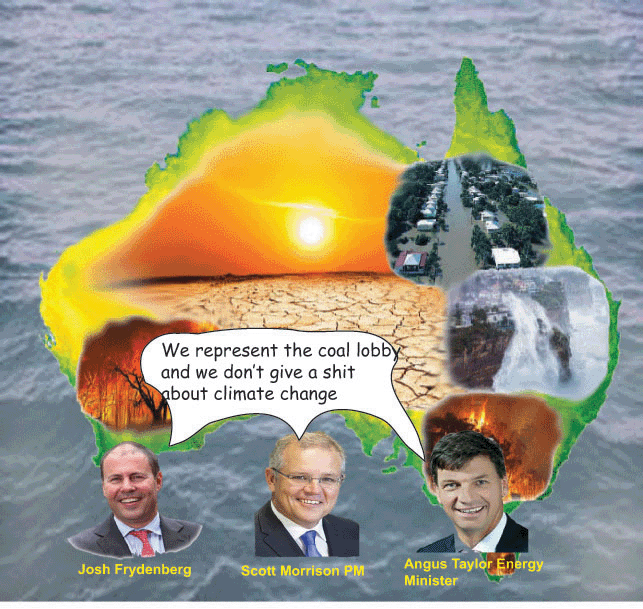 Scott Morrison perpetuating the Liberal policy of ‘cutting environmental red tape’.
No wonder 1 million species of flora and fauna around the world are on the brink of extinction within just decades..
“Federal government botched scrutiny of plan to bulldoze pristine forest”
(SMH 27 Nov 2018) “The Morrison government has conceded it botched scrutiny of a plan to bulldoze 2000 hectares of pristine Queensland forest near the Great Barrier
Reef and has been forced back to the drawing board following a legal challenge by conservationists.”
“The development comes as confidential documents show government MPs lobbied environmental officials to wave through the proposal, which would raze land almost three times the size of the combined central business districts of Sydney and Melbourne.”
“Old growth forest in the vicinity of Kingvale Station, where 2000 hectares is set to be cleared.”
“Environment Minister Melissa Price agreed to court orders that the weak assessment applied to the Kingvale proposal was unlawful.” https://www.smh.com.au/politics/federal/federal-government-botched-scrutiny-of-plan-to-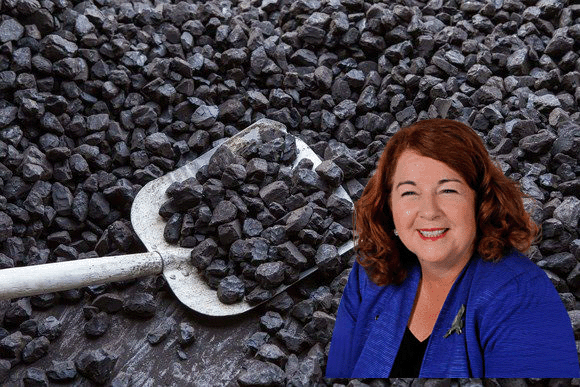 bulldoze-pristine-forest-20181127-p50il2.html#comments
Melissa Price is the Liberal member for Durack in WA.
Only 10 more days until Melissa Price can be kicked out of parliament for good.
PM shifts attack on Labor to ‘green tape’ he says costs Australian jobs, Brisbane Times, By David Crowe, May 7, 2019 Prime Minister Scott Morrison has vowed to stop the spread of union power and stem the growth of environmental rules that he blames for costing Australian jobs, as he sharpens his pitch to voters in the final days of the election campaign.
Ahead of his final debate against Opposition Leader Bill Shorten in Canberra on Wednesday night, Mr Morrison warned of a threat to the economy from the expansion of union “red tape” and environmental “green tape” that tied down employers when they should have more freedom to expand and hire workers…….
Lagging Labor in the polls with only 10 days to go until ballots are cast, the Prime Minister warned that a vote for Labor would give unions control over industrial laws and the Greens control over environmental laws.
“I don’t want to see the Labor Party get to office where they tie businesses up with all sorts of union red tape and all sorts of the Greens’ green tape, which would just cost people jobs,” he said……
The Coalition has blamed “lawfare” and “green tape” for halting or delaying mining and other projects in recent years, turning this into a major dispute with Labor and the Greens.
Mr Morrison said voters should remember that Labor sought to apply native vegetation laws more widely and increase the power of the Environmental Protection Agency to slow down developments.
“They want to hypercharge an Environment Protection Authority which will basically interfere and seek to slow down and prevent projects all around the country,” he said.
Scott Morrison and climate leadership ?
|
Fijian PM to call for climate leadership SBS, 8 May 19 Prime Minister Scott Morrison has admitted Australia’s emissions have increased, as a new report warns major change is needed to protect the environment. Scott Morrison has admitted Australia’s emissions have been rising, as a new international report shows climate change is a key factor driving species to extinction.”Yeah they have lifted,” the prime minister told ABC’s 730 program on Monday night, when asked about carbon emissions……
A new report warns that major change is needed globally to prevent further environmental destruction, with one million species currently at risk of extinction. The Intergovernmental Science-Policy Platform on Biodiversity and Ecosystem Services global assessment reveals nature is declining at rates previously unseen in human history. Frogs, big cats and birds are at great risk of extinction and change is needed now, co-chair of the report Sandra Diaz says. “When nature is in trouble we, and our wellbeing, are in trouble,” Prof Diaz told ABC Radio National on Tuesday. “Our style of consumption and production and trade and general lifestyles are costing us the earth, literally.” The report, which is based on 15,000 scientific and government sources, says the biggest drivers of environmental destruction are changes in land and sea use, exploitation of organisms, climate change, pollution, and invasive species. “Climate change is going to become an increasingly important driver,” Prof Diaz said. “We will be seeing an accelerated decrease in biodiversity … unless we change dramatically the way we trade, we consume, we produce, we do business.” Reducing the amount of meat we eat is an easy start, she added. Findings from the report will be used at a global conference next year in China, where leaders are expected to agree to a “Paris agreement for nature”. Labor leader Bill Shorten says climate change is one of the top four issues of the election. “The government just gets itself tied up in knots over doing anything, and in the meantime businesses and community and young people, they all just want real action on climate change.” Mr Shorten has come under pressure to explain the cost of his climate policies, which includes a 45 per cent emissions reduction target by 2030, but he says the cost of not acting is far greater.https://www.sbs.com.au/news/fijian-pm-to-call-for-climate-leadership |
|
Unfinished business: a new report on the Ranger uranium mine: what its clean-up means for Kakadu National Park
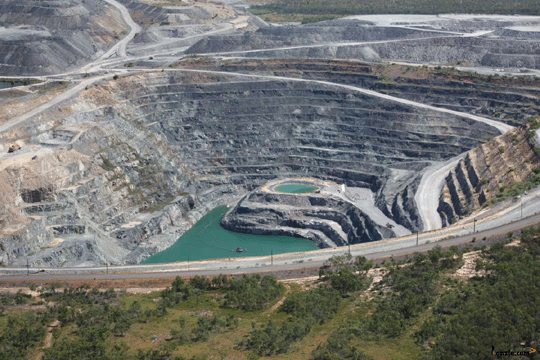
Unfinished business: Kakadu needs a new approach to cleaning up an old mine, https://www.acf.org.au/unfinished_business_kakadu_needs_a_new_approach 7 May 19, How well the Ranger uranium mine is cleaned up is key to the long-term health of Kakadu.
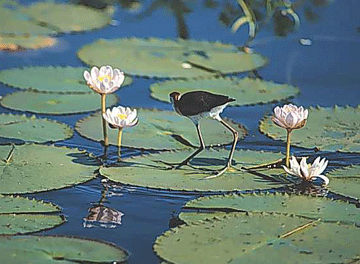 A new report has found Australia’s largest national park is at long-term risk unless the clean-up of the Ranger uranium mine in Kakadu is done comprehensively and effectively.
Unfinished business, co-authored by the Sydney Environment Institute (SEI) at the University of Sydney and the Australian Conservation Foundation (ACF), identifies significant data deficiencies, a lack of clarity around regulatory and governance frameworks and uncertainty over the adequacy of current and future financing – especially in relation to future monitoring and mitigation works for the controversial mine site.
Mine operator Energy Resources of Australia (ERA) and parent company Rio Tinto are required to clean up the site to a standard suitable for inclusion in the surrounding Kakadu National Park, dual-listed on UNESCO’s World Heritage list.
“No mine in the world has ever successfully achieved this standard of clean up,” said report co-author Dr Rebecca Lawrence from SEI.
“Rehabilitating what is essentially a toxic waste dump is no easy task. Rio Tinto faces a complex and costly rehabilitation job.
“The challenge is not to simply scrape rocks into holes and plant trees, it is to make sure mine tailings, radioactive slurry and toxic by-products of mining are isolated from the surrounding environment for 10,000 years.
“To ensure this in a monsoonal environment, such as Kakadu, which is already being impacted by climate change, raises enormous environmental and governance challenges.
“For the rehabilitation process to even have a chance at success, the existing opaque and complex regulatory regime needs an urgent overhaul,” Dr Lawrence said.
Tailings, the waste material remaining after the processing of finely ground ore, are one of the serious environmental risks outlined in the report. The report examines how ERA and Rio Tinto intend to deliver on the federal government’s requirement to protect the Kakadu environment by isolating any tailings and making sure contaminants do not result in any detrimental environmental impacts for at least 10,000 years.
“Long after the miners have gone this waste remains a direct human and environmental challenge,” said report co-author Dave Sweeney from ACF.
“This issue is key to the long-term health of Kakadu but there is insufficient evidence and detail on how this work will be managed and assured in the future. Without this detail there will be a sleeping toxic time bomb deep inside Kakadu.
“At its London AGM last month Rio again committed to make sure ERA has the financial resources to deliver its rehabilitation obligations, however the financial mechanism to do so remains undisclosed.
“The community and environment of Kakadu need certainty and a comprehensive clean up.
“This work is a key test of the commitment and capacity of Northern Territory and Commonwealth regulators as well as the mining companies.”
The report makes recommendations to improve the chances of a successful clean-up at Ranger. It calls for increased transparency, public release of key project documents, a better alignment of research and operations and open review processes for key decision points.
The full report is here.
Zali Steggall, Independent candidate for Warringah, aims to tackle the health impacts of climate change
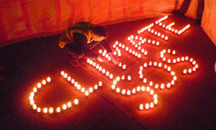 Zali Steggall promises action to stem health impact of climate change https://www.theguardian.com/australia-news/2019/may/06/zali-steggall-promises-action-to-stem-health-impact-of-climate-change 6 May 19,
The Warringah independent signs up to strategy to tackle problems of increased asthma, mental illness and heat-related deaths
Independent candidate for Warringah, Zali Steggall, has pledged to address the health impacts of climate change if she wins Warringah as an independent.
Like her fellow independent, Kerryn Phelps in Wentworth, Steggall signed up on Monday to the strategy developed by the Climate Health Alliance, which has more than one million health professionals behind it through their representative groups. It is pushing governments to start factoring climate change into their thinking about health policy, warning that a rise of 3C in world temperatures would have catastrophic consequences for the health of Australians.
Among the health impacts of climate change are an expected jump in severe asthma attacks, more disease due to severe weather events such as flooding, increased mental illness due to prolonged droughts and higher death rates among the elderly and chronically ill due to more frequent very hot days.
On 21 November 2016 thousands of people were taken ill and 10 people died in Melbourne due to thunderstorm asthma. High temperatures, thunderstorms and windy conditions blew rye grass pollen into the city causing the mass incident.
Melbourne has now implemented an alert system for epidemic asthma which operates during October and December each year when pollen levels are at their highest.
Mary Chiarella, professor of nursing at Sydney university, said increasingly warm weather meant there would be more out-of-season pollen that would extend the asthma risk season.
More hot days would drive hospital admissions putting additional stress – and costs – on the health system.
“[Economist] Warwick McKibbon says no action is not a zero sum game. Just because you don’t spend the money taking action, doesn’t mean it will deliver a zero cost,” said Steggall.
“We are in one of the most exposed regions to climate change,” she said.
Steggall said she would be pushing for the expert panel to look into the climate change impacts on health outcomes and to advise the government on its response.
“My point of difference [with Tony Abbott] is I do like facts and data,” she said, a reference to the criticism that Abbott has made of her expert panel proposal.
At a debate last week, Abbott said Steggall would be shirking her responsibilities as a parliamentarian when she said she would be “led by experts” on climate change policy and what emissions cuts the nation should commit to.
She also criticised Abbott’s focus on power costs due to measures to address climate change.
“The more people understand the other impacts on them personally, the more the case for action,” she said.
UN Report – One million species at risk of extinction – Australia not interested?
|
|
|

Australian rare earths company Lynas is determined to keep its radioactive trash in Malaysia
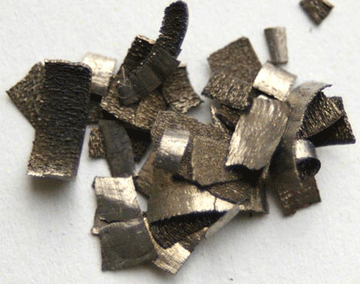 Lynas backs Malaysian waste solution despite removal order, Fin Rev Brad Thompson 6 May 19, Lynas Corporation is pushing ahead with plans to build a permanent disposal facility for low-level radioactive waste in Malaysia despite a contested ultimatum to export about 450,000 tonnes of residue already stockpiled by September.
The Wesfarmers takeover target said on Monday it was confident of meeting conditions outlined by Malaysian prime minister Mahathir Mohamad to ….. (subscribers only) ..https://www.afr.com/business/mining/rare-earths/lynas-backs-malaysian-waste-solution-despite-removal-order-20190506-p51kh2
Australian Greens will push Australian Parliament to declare a “climate emergency”, as Britain has done
 Greens urge climate emergency declaration, https://www.sbs.com.au/news/greens-urge-climate-emergency-declaration 4 May 19, The Greens will push the Australian parliament to declare a “climate emergency” after the federal election, party leader Richard Di Natale says.The federal Greens will push for Australia to declare a national “climate emergency”, following in the footsteps of the UK.
With Britain’s parliament becoming the first in the world to make such a declaration, federal Greens leader Richard Di Natale says it’s time to do the same at home.
With Britain’s parliament becoming the first in the world to make such a declaration, federal Greens leader Richard Di Natale says it’s time to do the same at home.
“We’ve put forward proposals to the parliament already. We’ll be doing that again when we return to the parliament,” he told AAP on Saturday.
“We’re calling on both the Liberal and the Labor party to support what the conservative party in the UK have now adopted.”
Senator Di Natale says the push isn’t a lost cause in Australia’s political environment because “the pressure (to act) is building and it’s building very fast”.
“The major parties ignore the community at their own peril.”
The Greens leader also said he wanted environmental laws to be changed so projects had to specifically take into account their effect on climate change.
Senator Di Natale also backed Labor’s $1 billion pledge for environmental initiatives, including a native species protection fund and protecting beaches from erosion.
But the Greens want a “climate trigger” put into environment laws.
“Quite simply when any proposal is being put forward and the environment impact is being considered, what we have to do is make sure climate change is the first thing that’s considered as part of environmental impact,” Senator Di Natale said.
Adani coal mine expansion is the critical test for Australia’s climate action. We must stop it – Bob Brown
 ‘It is up to us,’ to stop Adani: Bob Brown’s dire warning on coal mine, SBS, 5 May 19, The stop Adani convoy has ended its long j
 ourney in Canberra with a rally on the lawns of Parliament House where Paul Kelly performed.
Veteran environmental activist Bob Brown has told thousands of climate action supporters they can’t rely on divine intervention to prevent the Adani coal mine. “It is up to us”.
The former federal Greens leader led the stop-Adani convoy that began in Hobart just before Easter and travelled to Clermont in central Queensland before reaching its final destination in Canberra on Sunday where a rally was held on the lawns of Parliament House.
Organisers estimated there were 2,500 people at the rally – “a bigger crowd than Bill Shorten will face today and a bigger crowd than Scott Morrison will ever face”, Dr Brown said.
He told the crowd that neither of the big parties were willing to stop the Adani mine to secure the planet for Australia’s kids……..
Dr Brown told reporters the convoy had been peaceful and law abiding but participants had endured hardships along the route.
“We had rocks thrown at us, we had people spat on, some people were actually physically absued.”…..
Greens leader Richard Di Natale told reporters Australia was in the midst of a climate election.
“Right now the Adani coal mine is a test of whether Liberal or Labor are serious about stopping climate change and right now,” he said,
“Liberal and Labor have failed the test.”……. https://www.sbs.com.au/news/it-is-up-to-us-to-stop-adani-bob-brown-s-dire-warning-on-coal-mine
After a while, the planned South Australian would by more aptly called “A Nuclear Abandonment Site.”
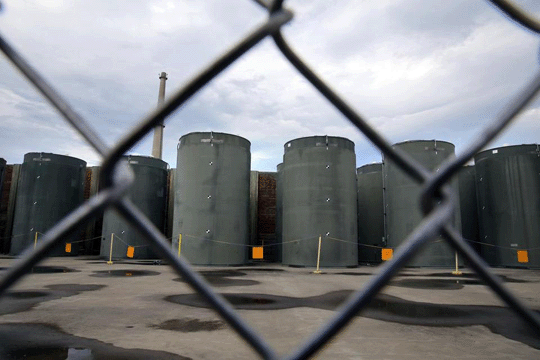 Paul Waldon Fight To Stop Nuclear Waste Dump In Flinders Ranges SA, 6 May 19,
 1 This month
.

Australians deserve the truth
about
AUKUS – https://aukuspublicinquiry.com/

PETITION – To: Prime Minister Anthony Albanese and the Australian Labor Government

of the week – Australians for War Powers Reform (AWPR)
To see nuclear-related stories in greater depth and intensity

