Grey power protesters stage Adani sit in. https://www.sbs.com.au/news/grey-power-protesters-stage-adani-sit-in12 Apr 19, Older voters opposed to Adani’s Queensland coal mine have vowed to continue a protest in Brisbane until they’re arrested. Queensland grandmother Rae Sheridan has been arrested three times at protests demanding action on climate change.
If she has her way, it’ll be four by the end of the day.
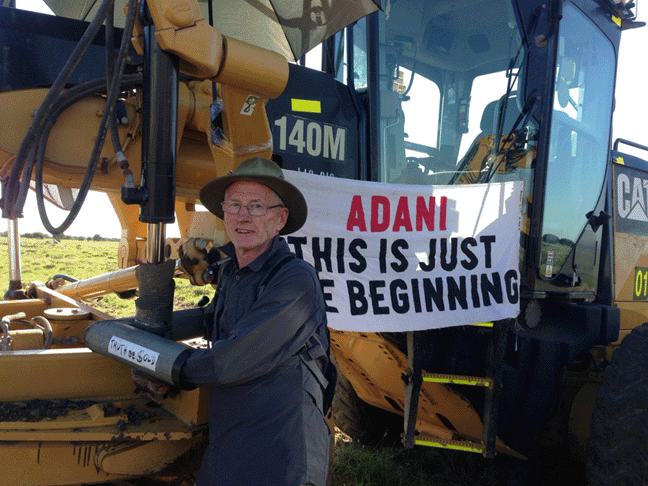
The 74-year-old is among a band of “grey power” activists who are staging a small but determined protest against Adani’s proposed coal mine in outback Queensland. (I’d) probably rather die in jail than in a nursing home,” Ms Sheridan told AAP on Thursday.
“This issue is of such importance, because stopping Adani is a line in the sand for our relationship with coal. It has to stay in the ground … New Zealand has done it, Australia can do it too.”
Fellow protester Greg McLachlan says he was moved to take action after watching thousands of school students take to the streets across the globe, calling on governments to protect their futures.
“We should have done more, and we should be doing more,” he told AAP, welling up with sadness.
“The future is their’s, not ours, and we are letting them down.”
Adani’s Carmichael mine project is an issue because Queensland is one of the key states needed to win federal government.
It is popular in the state’s central and northern regions, but could cost support among voters in inner-city seats who want more action on global warming. Labor’s environment spokesman Tony Burke says the prime minister called the election on Thursday to avoid Senate estimates hearings that would have seen the CSIRO grilled about the recent groundwater approval handed to Adani.
The hearings were promptly cancelled after Scott Morrison called the poll for May 18.
Adani’s plan manage groundwater now needs state government approval so that it can start digging.
But Labor Premier Annastacia Palaszczuk’s government says it won’t be rushed into a decision to approve that plan, and another to manage the tiny and endangered black-throated finch.
Snowden points out that the WikiLeaks team has won many awards for its reporting. These include:
The Economist New Media Award (2008)
The Amnesty New Media Award (2009)
The Sam Adams Award for Integrity (2010)
The National Union of Journalists Journalist of the Year (Hrafnsson) (2011)
The Sydney Peace Foundation Gold Medal (2011)
The Walkley Award for Most Outstanding Contribution to Journalism (2011)
The Voltaire Award for Free Speech (2011)
The International Piero Passetti Journalism Prize of the National Union of Italian Journalists (2011)
The Privacy International Hero of Privacy (2012)
The Global Exchange Human Rights People’s Choice Award (2013)
The Brazilian Press Association Human Rights Award (2013)
The Kazakhstan Union of Journalists Top Prize (2014) https://www.facebook.com/dunrenard?__tn__=%2CdC-R-R&eid=ARDsY6zh-XW-n6LQ3xBNitIkpLlrj2d_EY3QVMtZpkpIpUitBAOcbg-Jneyv9V0sBuUmUzP8kTPjKdaJ&hc_ref=ART42xFstjUK2mNP1sgOwKX9KXHTBaFbBxJ3FqA5K4sDWZN1J_D46gCLZpRG74XZMjc&fref=nf
“We will inspire and train older Australians to take BOLD and creative nonviolent action to help change the politics of climate change for good.
Grey Nomads will become Green Nomads. We’ll organise #GreyPower blocs at the school strikes and bring the kids/grandkids with us. Politicians in marginal electorates will feel our presence day after day after day.
Our mission is to use our power to protect the climate now and for future generations and our #GreyPower uprising will demand the real change needed to address the climate emergency.
We are political but nonpartisan. We will target the political parties with the worst climate change policies the most, but will still push other parties to do better. We do not support or promote any political party.” www.climateprotectors.earth/greypower/
WikiLeaks founder Julian Assange has been dragged out of the Ecuadorian Embassy in London where he has spent the last seven years. That’s after Ecuador’s president Moreno withdrew asylum.
That’s only a day after WikiLeaks Editor-in-Chief Kristinn Hrafnsson claimed that an extensive spying operation was conducted against Assange in the Ecuadorian Embassy. During an explosive media conference Hrafnsson alleged that the operation was designed to get Assange extradited.
Assange’s relationship with Ecuadorian officials appeared increasingly strained since the current president came to power in the Latin American country in 2017. His internet connection was cut off in March of last year, with officials saying the move was to stop Assange from “interfering in the affairs of other sovereign states.”
The whistleblower garnered massive international attention in 2010 when WikiLeaks released classified US military footage, entitled ‘Collateral Murder’, of a US Apache helicopter gunship opening fire on a number of people, killing 12 including two Reuters staff, and injuring two children.
The footage, as well as US war logs from Iraq and Afghanistan and more than 200,000 diplomatic cables, were leaked to the site by US Army soldier Chelsea Manning. She was tried by a US tribunal and sentenced to 35 years in jail for disclosing the materials.
Manning was pardoned by outgoing President Barack Obama in 2017 after spending seven years in US custody. She is currently being held again in a US jail for refusing to testify before a secret grand jury in a case apparently related to WikiLeaks.
Julian Assange ‘won’t get any special treatment’: Scott Morrison, SMH , By Michael Koziol and Latika Bourke April 12, 2019 Prime Minister Scott Morrison has confirmed Australia is providing consular assistance to Julian Assange following his arrest in London but the Wikileaks founder will receive “no special treatment”, even in the wake of a US extradition request.
An Australian citizen, Assange had been living in the Ecuadorian embassy for more than six years until that country ended his political asylum on Thursday for “discourteous and aggressive behaviour” and WikiLeaks’ “hostile and threatening declarations” against Ecuador.
He was charged with skipping bail by entering the embassy in 2012. Appearing in Westminster Magistrates’ Court four hours later, he pleaded not guilty, claiming he had a reasonable excuse for seeking asylum as his arrest would end in his extradition to the US.
That extradition request, on charges related to the publication of vast quantities of classified information by Wikileaks, is forthcoming but will be fought by Assange’s lawyers…..
Scott Morrison – “He won’t be getting any special treatment from Australia, he’ll be getting the same treatment that any other Australian would get.”
Asked whether Australia would fight a move to extradite Assange to the US, Mr Morrison said the Wikileaks founder was at the mercy of the British justice system. ……
Opposition Leader Bill Shorten, also commencing the election campaign in Sydney, said Assange was entitled to his day in court but had no view on his extradition to the US.
This prospect prompted the UN Working Group on Arbitrary Detention and 33 EU parliamentarians to issue strongly worded statements to both the UK and Ecuadorian governments in December last year, warning against facilitating the prosecution of a journalist, editor and publisher for “publishing the truth”. The statements demanded Assange’s “immediate release, together with his safe passage to a safe country”, and reminded the UK of its “binding” legal obligations to secure freedom for Assange.
A critical task for propagandists such as those waging a psychological war on Wilkileaks, then, is to feed audiences material that supports official narratives and exclude that which does not. Since its inception, the smear campaign against Julian Assange and Wikileaks has been remarkably concerted and consistent in that regard.
With the new year, however, news broke that the International Monetary Fund (IMF) had offered Ecuador a $10 billion bailout in return for handing Julian Assange over to the United States. This bounty came on top of earlier US pressures and inducements, reportedly including increased oil exports, military co-operation and another $1.1 billion in IMF loans, with the US representative of the IMF instructing Ecuador that it must “resolve” its relationship with Julian Assange in order to receive the IMF money.
Australian Barrister Greg Barns has called it the blackmailing of a nation. News website 21st Century Wirecalled it “one of the biggest international bribery (or extortion) cases in history.”
While there is “not a single shred of evidence that any of [Wikileaks’] disclosures caused anyone harm”, writes journalist and author Nozomi Hayase, what Wikileaks did do in 2010 was expose thousands of previously unreported civilian deaths in Iraq and Afghanistan. These deaths included the nonchalant gunning down of children, journalists and their rescuers, and other “indiscriminate violence… torture, lies [and]bribery”, writes Chris Hedges. According to Pentagon Papers whistleblower Daniel Elsberg, the leaks exposed “a massive cover-up over a number of years by the American authorities”.
Julian in ‘critical danger’, new rules ‘torture’ – Assange mother *AUDIO*
The Psychology Of Getting Julian Assange, Part 2: The Court Of Public Opinion And The Blood-Curdling Untold Story, New Matilda, By Dr Lissa JohnsonFebruary 25, 2019In her ongoing special investigation into the detention of Julian Assange, Dr Lissa Johnson turns to the art of smear, and how to corrupt a judicial system.
On Friday 14th February, the Editor in Chief of news website Consortium News, Joe Lauria, visited Sydney to host a ‘Politics in the Pub’ event: Whistleblowing, Wikileaks and the Future of Democracy. The event took place in anticipation of upcoming rallies to free Assange…….
. It is imperative that we pressure the Australian government to make sure its citizen, Julian Assange, is protected from the lawlessness of the American Empire.” Continue reading →
Now Adani has been approved, these are the nine at-risk Coalition seats most concerned about climate change, ABC By political reporter Jackson Gothe-Snape, 10 Apr 19, Liberal seats held by vacating and conservative MPs have extremely high levels of concern for climate change.
Key points:
New research shows seats where climate change concerns are most common
“Keeping day to day living costs down” is the issue most often identified by Australians as a concern
Electorate-level research released on Wednesday shows the extent of concern for climate change as the election looms.
The polling, completed by Roy Morgan during 2018 as part of the democracy non-profit Australian Futures Project, shows “keeping day-to-day living costs down” is the most pressing concern across Australia, ahead of “improving health services and hospitals” and “open and honest government”.
Climate change is the next most commonly identified issue.
At least one in three people (33 per cent) have climate change concerns in nine Liberal seats that are potentially vulnerable at the coming election.
That is significantly above the national average of approximately one in four people (26 per cent).
Traditional Owners opposed to the Carmichael mine will mount a legal challenge in the federal court next month to overturn Adani’s crucial agreement with Indigenous landholders.
The mining company’s groundwater management plan was approved this week by Federal Environment Melissa Price and before construction can begin the Queensland government needs to sign off on environmental approvals.
However, if successful, next month’s court hearing could have severe ramifications.
A handful of Wangan and Jagalingou (W&J) native title claimants are seeking to invalidate Adani’s Indigenous Land Use Agreement (ILUA), which is required for the mining company to build key infrastructure.
Some W&J native title claimants support the mine but those who oppose it say the ILUA is a “sham”.
Their claims were dismissed in a court hearing last year and the group will now appeal that verdict to the full bench of the federal court.
‘An act of war on our people’
Adrian Burragubba, one of the anti-Adani claimants, said he felt confident ahead of the hearing.
“That full bench federal court has allowed us to argue at least ten points – all we need is one of those points to get up in that argument and that ILUA will then become null and void,” he told NITV News.
“You can’t start building a mine until you get that ILUA, so nobody wants to talk about it because it’s the main thing that’s holding up the mine.”
Mr Burragubba also criticised the federal government’s decision to approve Adani’s groundwater management plan, claiming the project would destroy ancient springs.
“Water is part of our dreaming as First Nations people,” he said.
“This will fracture our ties with our ancestors and will essentially be an act of war on our people.”
Environmental approval ‘reeks of political interference’
Meanwhile, Queensland Environment Minister Leeanne Enoch said she would not be rushing the remaining approvals.
“I will not be bullied and I will not allow the regulator to be bullied,” the Labor MP said.
“The federal minister’s decision yesterday to approve Adani’s [groundwater management plan] reeks of political interference, and in many ways puts into question the integrity of her decision-making process.”
Adani Australia CEO Lucas Dow said the approval followed 18 months of environmental evaluation by CSIRO and Geoscience Australia.
“The measures outlined in the plans will ensure groundwater at the mine, and the ecosystems that depend on it, are protected,” he said in a statement.
The controversy is over the definition of wastes from the Lynas’ water leach purification (WLP) process, which contains thorium and uranium.
Lynas claims that the wastes are naturally-occurring radioactive material (called NORM), while we claim that the wastes are not naturally-occurring, but have been technologically-enhanced and should be called technologically-enhanced naturally-occurring radioactive material known as TENORM.
Citing “two eminent scientists”, Lynas states as fact that “the small amount of thorium and uranium in the WLP generated are not man-made but naturally occurring radionuclides found in soil, water and in food.”
Lynas is clearly distorting the facts.
First of all, the thorium and uranium containing wastes generated by Lynas are not found to naturally occur in the Gebeng area, where the plant is located. On the contrary, the raw material which is processed by the Lynas plant is lanthanide concentrate that contains the thorium, uranium and the rare-earth.
This raw material is processed and imported from the Mount Weld mine in Australia and is brought to Malaysia. It is then subject to further processing in Gebeng by Lynas.
Therefore, how can it be said that say that the thorium and uranium are naturally occurring in the soil, water and in food when they were not there before in the Gebeng area, if not for the Lynas operations?
Moreover, what is even more significant is that we are talking about the generation of an accumulated amount of more than 450,000 metric tonnes of radioactive wastes from the Lynas operations thus far. To call this naturally-occurring radioactive material is indeed unscientific.
Secondly, the wastes that Lynas has generated from the WLP process clearly falls within the definition of TENORM, as defined by the US Environmental Protection Agency (USEPA) as: “Naturally occurring radioactive materials that have been concentrated or exposed to the accessible environment as a result of human activities such as manufacturing, mineral extraction, or water processing.”
The USEPA also states that “technologically enhanced” means that the radiological, physical, and chemical properties of the radioactive material have been concentrated or further altered by having been processed, or beneficiated, or disturbed in a way that increases the potential for human and/or environmental exposures.”
Indeed, Lynas seems to have forgotten that its own Radiological Impact Assessment of 2010 refers to the residues from its operations as TENORM.
Moreover, in a study co-authored by, Dr. Sukiman Sarmani (the “eminent scientist” that Lynas refers to in its letter) and three others (published in 2014 on the Lynas plant residue), shows that the WLP residue has a high radioactivity of Thorium 232 compared to the natural background levels of Malaysian soils and therefore comes under the purview of the regulatory authorities.
These facts fortify our position.
Lynas in its letter also refers to us as “unqualified people.”
For the record, SAM and CAP have very deep and detailed knowledge of how rare-earth plants can impact public health and the environment, having had years of considerable experience from being involved in the Asian Rare Earth (ARE) case in Bukit Merah, Ipoh.
We assisted the people of Bukit Merah over many years countering the claims of ARE, the Atomic Energy Licensing Board, the International Atomic Energy Agency and others.
This we did by being engaged and involved with many scientists and public health experts both from Malaysia and abroad, who helped the community battle in the courts, that finally led to its closure. We have over the years documented the serious health impacts suffered by the Bukit Merah community, that continue till today, due to the impacts of low-level radiation.
Surely our rich experience and knowledge cannot simply be dismissed by the likes of Lynas. SM MOHAMED IDRIS is president of both environmental movement Sahabat Alam Malaysia (SAM) and NGO Consumers Association of Penang (CAP).
SBS News , 8 Apr 19 Anti-Adani protesters have disrupted a Scott Morrison speech, as Coalition tension mount around the controversial project. Anti-Adani protesters have disrupted Scott Morrison at a Brisbane business lunch, but the prime minister appeared to take in his stride.One woman carrying a Stop Adani protest flag managed to reach Mr Morrison’s side, saying “we care about the climate. This will be a climate election … Shame”.
She was dragged away by security as a second protester stood to yell “stop Adani”………
Australian Youth Climate Coalition organiser, Melanie McAuliffe, said they wanted to highlight LNP government’s inability to react on climate change.
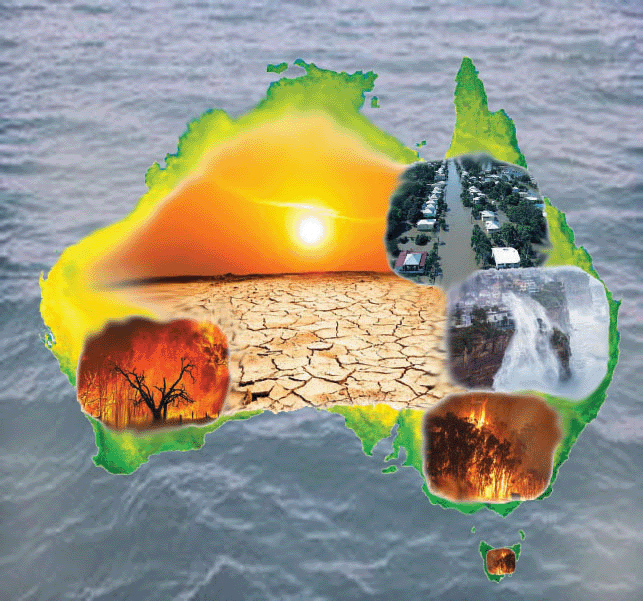
“We just had a summer of unprecedented heatwave, bushfires and floods and yet this government still continues to ignore what we need to do to address the climate crisis.”…….
Several teenagers said they were looking for action to save the planet.
Jo, from Cleveland, told the crowd outside the business lunch that all she wanted was a future.
“I am 17 years old and I want is for our government to do what they need to to save the planet,” she told the crowd.
“This is our home, this is what houses us, we have a responsibility to care for it.”………
ABC News, By political reporter Jackson Gothe-Snape 8 Apr 19,Adani’s controversial mine awaits its final Federal approval this week, days before the election is called.
Key points:
Only one significant approval remains for Federal Government to approve Adani mine
Securing sign-off before the federal election is called would mean Queensland MPs in marginal seats could campaign on the issue
Queensland State Government still has two outstanding approvals
And pressure is growing from some of her colleagues for her to approve the mine so Queensland MPs can talk up the project during the election campaign.
This is the latest on what exactly is needed before the Adani mine can go ahead.
Federal groundwater hurdle
The last major federal environmental approval required is around how the mine will affect the local water system.
It’s formally called the Groundwater Dependent Ecosystem Management Plan (GDEMP).
The Federal Government has asked the CSIRO and Geoscience Australia to assess the plan, but the decision to approve or deny the plan rests with the Environment Minister.
It’s not clear what these organisations have concluded, but a spokesperson for the Department of Environment told the ABC the department “has provided its assessment” to the Minister.
Prime Minister Scott Morrison said on Monday the Government would be “relying on the scientific evidence”.
an example of the sensitive, clandestine, real-world CIA psychology deployed against ‘terrorists’ and enemies of the state, as Julian Assange and Wikileaks have been branded.
In this case, the adversary in the US crosshairs has been not only Julian Assange and Wikileaks, but the global populations that Wikileaks seeks to inform. It is our own vulnerabilities – the vulnerabilities in the information processing systems of all human beings – that have been leveraged and exploited in order to undermine and discredit Wikileaks.
The fundamental psychological task is to render truth suspicious and deceit reassuring, war criminals virtuous and their critics corrupt, pacifism threatening and violence comforting, abuse of power righteous and resistance reprobate, torture forgivable and whistleblowing a crime, censorship a bastion of democracy and free speech a menace to be overcome. Much as George Orwell foresaw.
In order to justify the psychological war on Wikileaks, US powerbrokers have branded Wikileaks and Assange “anti-American” “terrorists”, a “non-state hostile intelligence service” and “enemy combatants”. Bolstered by these factually indefensible slurs, Julian Assange now faces imminent extradition to the United States to face secret charges, most likely for 2010 scoops exposing US war crimes in Iraq and Afghanistan.
Peace is bad. War is good. Truth is dangerous. Censorship will set you free. These are the positions underpinning the war on Wikileaks.
“…. Assange faces extradition to the United States and secret charges for his publishing activities should he step outside the Ecuadorian Embassy in London. This cross-border, extraterritorial persecution threatens not only Assange’s health, and possibly his life according to a recent UN statement, but poses grave legal risks both to journalism and dissent…..
The Australian rallies join a growing international chorus of organisations and individuals sounding increasingly urgent alarms over Julian Assange’s plight, and its implications for freedom of speech and democratic rights.
Late last year, as secret US charges against Julian Assange surfaced, and the threat of his imminent extradition to the US loomed, the United Nations Working Group on Arbitrary Detention (UNWGAD) issued a strongly worded statement to the UK Government, having previously ruled twice that Assange is being arbitrarily detained in the Ecuadorian Embassy in London.
In its statement, the UNWGAD demanded that the UK abide by its “binding” legal obligations and “immediately” secure freedom for Julian Assange. The UN reminded the UK Government that “human rights treaty law is binding law, it is not discretionary law. It is not some passing fancy”.
The same fears prompted 33 EU parliamentarians to write a similarly strongly worded letter to the British Prime Minister, the Ecuadorian President and the UN Secretary General on December 10th, condemning the “very serious and egregious violations of human rights in the heart of Europe.” They called for Assange’s “immediate release, together with his safe passage to a safe country.”
Two German MPs followed with a visit to the Ecuadorian Embassy on December 20th, at which they denounced the violation of Assange’s “fundamental rights” and expressed their “demand that this case has to be solved: that no publisher, no editor, no journalist is detained because of publishing the truth”.
All of these leading legal and human rights authorities have been making essentially the same fundamental point: that Julian Assange is being persecuted for publishing truth in the public interest, placing public interest journalism itself at risk, along with freedom of speech and other democratic and human rights principles.
It is the same fundamental point made by several speakers at an earlier Australian rally to free Julian Assange, held in Sydney in June last year. John Pilger spoke at that rally also.
Pilger’s important 2018 speech, however, like the rally itself, was subject to a near total, if not total, mainstream media blackout. So if you missed it, that may be why. And if you haven’t followed the US war on Wikileaks from the outset, as I hadn’t when I attended last year’s rally, Pilger’s speech is a powerful way to bring yourself up to speed. Continue reading →
Ipsos poll: Voters back Labor to deal with climate change, The Age, Michael Koziol, 7 Apr 19 Only half the Coalition’s voters believe it is the best to handle climate change, as the Morrison government struggles to manage a damaging split over the Adani mine and shift the focus back to Labor’s energy policies…..
an Ipsos poll taken last week – after Labor released its climate policy on Monday – shows voters have firmed in their view that Labor is better than the Coalition on climate change, with 42 per cent saying the opposition had the superior policy of the two major parties.
Only 25 per cent felt the Coalition’s climate policy was preferable – a decrease of 12 percentage points from when the question was asked in 2012. …
Climate and the environment have returned to the fore as Prime Minister Scott Morrison prepares to call an election, with Labor wheeling out its energy policy and the government exposed to internal divisions over the final ministerial approvals for the Adani coal mine.
Queensland Liberal National MPs and candidates are agitating for Environment Minister Melissa Price to rubber stamp the process quickly while they work to defend vulnerable Coalition seats up north, but Liberals in capital cities are urging a delay to avoid the issue blowing up just as the campaign begins.
Cabinet sources indicated they did not want to “elevate” Adani in the national mindset, nor risk any decision being challenged in the courts because it had been rushed……..
The Ipsos phone poll of 1200 voters found Labor supporters were much more likely to back their party’s climate policy than Coalition supporters: 72 per cent of Labor voters said their party had the best policy, while 5 per cent backed the Coalition and 23 per cent didn’t know.

 “We will inspire and train older Australians to take BOLD and creative nonviolent action to help change the politics of climate change for good.