Environment Minister Melissa Price confirms Malaysia’s request for Australia to take back Lynas’ radioactive trash
 Minister confirms Malaysian request on Lynas waste, Fin Rev 2 Apr 19 Brad Thompson Environment minister Melissa Price has confirmed receiving a letter from her Malaysian counterpart requesting collaboration on the removal of low-level radioactive waste produced by Lynas Corporation.
Ms Price’s office said on Tuesday that it was premature to comment further until the request had been properly considered.
Malaysia wants Australia to accept 450,000 tonnes of waste created at the Lynas plant near Kuantan in the processing of rare earths from the company’s Mount Weld mine in Western Australia.
A spokesman for Ms Price said Australia’s Department of the Environment and Energy handled import permit applications for hazardous materials on a case-by-case basis.
Similarly, the Australian Radiation Protection and Nuclear Safety Agency handled import permit applications for radioactive material on a case-by-case basis.
It remains unclear how the Lynas waste will be classified. It is understood West Australian authorities would also have to sign off on the transport of any waste within the state, possibly all the way back out to the remote Mount Weld mine.
Lynas refuses to concede it will have to find a way to remove low-level radioactive waste from Malaysia to keep its operations going, despite increasing political pressure.
The Wesfarmers’ takeover target said on Tuesday that it continued to engage productively with the Malaysian government over the waste issue.
Lynas remains optimistic it can resolve the issue within Malaysia despite an order to remove the waste by September if it wants to continue operating its $800 million Kuantan plant.
Lynas, led by Amanda Lacaze, declined to comment on the Malaysian minister’s formal request for the Australian government to collaborate on the waste removal………
Wesfarmers is reported to have told Lynas it is willing to build a first-stage processing plant at Kwinana, south of Perth, to overcome the waste issue. Connect with Brad on Twitter.Email Brad at bradthompson@afr.com.au https://www.afr.com/business/mining/environment-minister-confirms-malaysian-request-on-lynas-waste-20190402-p51a1x?fbclid=IwAR3P_yvHRTW0Z3LAj1bBwWTkFrfdiLP0S9wmykaxQoY-QZfymcRZXtG5U5g
How Sky News and Peter Ridd try to mislead Australians about the Great Barrier Reef
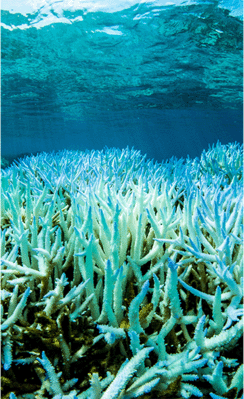 Great Barrier Reef: Sky News and Peter Ridd are deliberately misleading, Independent Australia, By Graham Readfearn | 6 April 2019, According to misinformation from sources such as Sky News and scientist Peter Ridd, the Great Barrier Reef is in perfect health, writes DeSmogBlog’s Graham Readfearn.
AUSTRALIA’S GREAT BARRIER REEF is in some serious trouble, with the latest research in the journal Nature showing the number of new corals has dropped by 89%.
In 2016 and 2017, the Reef was smashed by back-to-back mass bleaching events and heat stress caused by global warming that killed about half the corals.
‘Dead corals don’t make babies,’ said James Cook University’s Professor Terry Hughes, the paper’s lead author.
‘We used to think that the Great Barrier Reef was too big to fail — until now,’ added colleague Professor Morgan Pratchett.
The paper was just the latest in a steady and, many would agree, depressing parade of findings for the World Heritage icon. And if the scientific papers don’t do it for you, then there are always the pictures.
But the release of the study served as a remarkable contrast to the way the Rupert Murdoch-owned Sky News, furnished with material from climate science denial think tank the Institute of Public Affairs, has been “reporting” on reef science in the past week.
On at least five occasions, the channel has interviewed the IPA’s policy director, Gideon Rozner, who has been updating the channel on the case of Dr Peter Ridd, a marine scientist specialising in sediments who was fired in March 2018 from James Cook University.
According to the various interviews, the Reef is in great shape, the science is probably wrong, and Ridd is a “world renowned” Reef expert in a historic fight for freedom. None of this is true, yet the claims have been allowed to stand unchecked.
The saga of Peter Ridd
Ridd’s saga is a long one, but here’s the short version (and, while we’re here, in the interests of full disclosure, in the time since I first started writing about Ridd’s case, I’ve taken a part-time job at an Australian marine conservation charity as a media adviser).
Ridd does not think that human-caused climate change is a problem and he thinks the Reef is in fabulous health. This has been his public position for at least a decade.
But in 2017, Ridd started to publicly accuse his scientific colleagues, some of who were based at his own university in Townsville, of being untrustworthy. This went against the university’s code of conduct. The university censured him. Ridd refused to back down and made more statements. He published “private” university correspondence on his website. He was further disciplined, so he sued his employer. Then they fired him.
Last week, Ridd’s case was finally heard in court with three days of hearings. A judgment is expected in the coming months.
Now, the IPA has gone all out to create a narrative around Ridd’s case. …….https://independentaustralia.net/business/business-display/great-barrier-reef-sky-news-and-peter-ridd-are-deliberately-misleading,12545
Treasurer Josh Frydenberg passes the buck on Adani coal mine to Minister For Coal , Melissa Price
 Adani mine in minister’s hands: treasurer, SBS News 7 Apr 19, Treasurer Josh Frydenberg says
  the final approvals for the Adani coal mine are in the environment minister’s hands, defending an apparent delay on the project.
Treasurer Josh Frydenberg has defended a hold-up in final approvals for the Adani coal mine in Queensland.
Mr Frydenberg said all major boxes had already been checked, and the environment minister was now working through “sub-approvals” in consultation with scientists.
“That’s in the hands of the minister,” he told the ABC’s Insiders on Sunday……https://www.sbs.com.au/news/adani-mine-in-minister-s-hands-treasurer
Port Lincoln the likely thoroughfare for nuclear waste entering South Australia?
 Port named as potential nuclear waste thoroughfare https://www.portlincolntimes.com.au/story/5995142/port-named-as-potential-nuclear-waste-thoroughfare/, Lauren Dinni, 5 Apr 19,
Fellow campaigner Jim Green also voiced the same concerns.
Ms Bonacci said the traditional landowners had lodged a formal complaint for racial discrimination and bad consultation.
“It is a non-binding ballot, and very narrow in scope,” she said.
“There are Kimba farms five kilometres from the site but aren’t in the district and so are not eligible to vote.”
She also said towns along transport routes and around the four ports named should also be consulted, which would include Port Pirie, Whyalla, a proposed port on the east coast of the Eyre Peninsula, and Port Lincoln.
Both Mr Green and Ms Bonacci instead advocate for the continuing interim storing of intermediate-level nuclear waste to remain in Lucas Heights in New South Wales, and the continuing storage of low-level waste on defence land.
As Kimba and Hawker are proposed as above-ground, non-permanent (up to 100 years) storage sites of nuclear waste, Friends of the Earth are advocating for a permanent solution to be discussed while capacity is still viable at Lucas Heights.
“Move it once, not twice,” said Ms Bonacci.
“There is no proven need for this facility and there is certainly no need for it to be sited in SA.”
Mr Green said there was “no logic” to moving the waste to South Australia, and the government has no permanent solution for the long-term storage of low-level and intermediate waste.
“There’s no reason for (the government) to drive it,” he said.
Friends of the Earth nuclear waste campaigners have travelled to Port Pirie, Port Augusta, Whyalla and Port Lincoln to meet with councils, Grey Candidates, trade unions and traditional owners to raise their issues.
“It’s divisive and unnecessarily expensive,” said Mr Green.
“Whoever fights the least hardest gets nuclear waste transported through their ports.”
Mayor Brad Flaherty met with the advocates this week and said it was the first he had heard of the Port Lincoln port being named as a potential thoroughfare.
“But I don’t see it as likely (to be used), they would have just looked at the radius around the geographical area and chosen four of the closest ports.”
ANSTO can afford to help China build new reactors, but apparently not to maintain its own building safely
 How come, if ANSTO is so cash-strapped, that its CEO Dr Adi Paterson, can find the money to join with China’s SINAP in developing Thorium Molten Salt Reactors? https://independentaustralia.net/environment/environment-display/australia-is-back-in-the-nuclear-game,12488#.XJWdhxDqitc.twitter
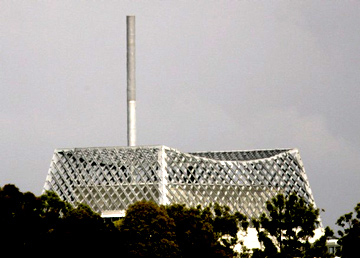
 Federal budget leaves ‘urgent’ rebuild of Sydney nuclear facility up in air https://www.smh.com.au/national/federal-budget-leaves-urgent-rebuild-of-sydney-nuclear-facility-up-in-air-20190403-p51ags.html#comments, By Carrie Fellner, April 4, 2019 The Morrison government has failed to provide the $210 million needed to decommission an “unsafe” nuclear medicine facility at Lucas Heights, with money only provided towards a business case in this week’s federal budget.
The decision has sparked concern for public safety, after an independent panel of experts found the building did not meet modern nuclear safety standards and called for its urgent replacement last October.
“The lack of a permanent replacement solution … is undermining the possibility of truly effective risk control,” the reviewers found.
Known as “Building 23”, the facility – built in the 1950s – has been dogged by accidents and near-misses in recent years, including a radioactive spill in 2017 that was then classified as the most serious incident in the world.
The Australian Nuclear Science and Technology Organisation (ANSTO) is responsible for maintaining Building 23.
Tuesday’s federal budget sets ANSTO’s 2019-20 funding at $354.9 million, which includes more than $56.4 million for the support of nuclear medicine production.
Money to plan for the replacement of the building must be drawn from a bucket of $26 million given to ANSTO for the “maintenance of ageing infrastructure”, according to an ANSTO statement.
The same money must also cover the management of spent nuclear fuel and waste and planning for the production of nuclear medicine in the future.
Minister for Science and Technology Karen Andrews said the funding given would allow “the development of a business case to consider options to secure the long-term and sustainable future of Australia’s nuclear medicine supply”.
“The funding will enable proactive maintenance work and equipment upgrades to support the ongoing operations of the nuclear medicine production facility,” she said.
But Labor slammed the government’s decision not to provide the full amount to replace the building, arguing it was “clear it is no longer fit for purpose”.
“Despite warnings from ANSTO, and the recent independent report, the government has not made public any plans to replace or upgrade Building 23,” opposition spokesman for science and research Kim Carr said.
“As a matter of public safety, we expect that the government should act on this matter.
A spokesman for ANSTO welcomed the overall funding increase of $112.4 million since the previous financial year, and said the budget had made provision “to start the necessary planning work” for the replacement of Building 23, to occur “over a five- to 10-year horizon”.
“Regarding Building 23, it is typical practice around the world, including Australia, that nuclear facilities are both planned for, then operated, over horizons of many decades,” the spokesman said.
The most serious of the accidents at the building occurred in August 2017, when a worker suffered blisters after a vial of radioactive material spilled onto his hands. The employee received a “significant radiation dose”, elevating his risk of cancer.
There were a further three incidents within the following 12 months.
A replacement facility had been in the pipeline for several years but plans had been hindered because of federal government budget restrictions, the review found.
“Heightened expectations and then subsequent failure to secure backing for replacing this
ageing facility has led to frustration, disappointment and cynicism amongst the staff,” it said.
The review made 85 recommendations, including that the Australian government commit to a replacement facility as soon as practicable.
According to the regulator – the Australian Radiation Protection and Nuclear Safety Agency [ARPANSA] – an implementation plan to address the rest of the recommendations is still under development.
ANSTO submitted a draft of the plan to the regulator last December, but is yet to receive approval.
An ARPANSA spokeswoman said the organisation had “demonstrated progress” towards addressing the recommendations.
“However [it was] felt that ANSTO did not provide sufficient detail around the objectives and strategies that would achieve the desired improvements and safety outcomes,” she said.
The organisations were in “frequent communication” and it was anticipated the plan would be approved in coming months.
“Twenty actions responding to the recommendations in the report have already been completed,” the ANSTO spokesman added.
Australia and Britain’s shameful history of Nuclear Bombing of First Nations Lands
Living with the legacy of British Nuclear testing: Bobby Brown
Maralinga No More: The British Nuclear Bombing of First Nations Lands https://www.sydneycriminallawyers.com.au/blog/maralinga-no-more-the-british-nuclear-bombing-of-first-nations-lands/?fbclid=IwAR0UIC6VK_x6i8NAStEyZHZXK-Sld-IH4HFyE9gy-Zngp4RzaLtVeiWV7tM, By 31/03/2019
As former Australian Conservation Foundation anti-nuclear campaigner David Noonan put it in 2005, “Australia is the only society to have ever provided its own uranium to an overseas nuclear weapons state to make nuclear weapons to then bomb back on their own land.”
And it was Scott Morrison’s pin-up boy, former prime minister Robert Menzies, who in 1950 said yes to the British government carrying out secret nuclear weapons tests without initially consulting cabinet, whilst making assurances that no negative radioactive impact would occur.
Around 800 kilometres northeast of Adelaide, Maralinga was chosen as the main nuclear testing site, as the government found that the Maralinga Tjarutja people – who’d been living there since time immemorial – weren’t actually using the land.
The local Indigenous peoples were never consulted about the testing. Many were forcibly removed from their lands and taken to Yalata mission in SA, which effectively served as a prison camp. Some remained in the vicinity of the test site. Signs written in English were erected warning them to leave.
Indeed, on 27 September 1956, when the first nuclear device, One Tree, was detonated at Maralinga, First Nations peoples had no rights under Commonwealth Law. The vote didn’t come until 1962, while citizenship rights weren’t granted until the 1967 Referendum.
A toxic legacy
The Menzies Liberal government passed the Defence (Special Undertakings) Act 1952, which effectively allowed the British to access remotes parts of Australia to test atomic weapons. The general public for the most part had no awareness or understanding of what would take place.
British and Australian servicemen built a test site, airstrip and township at Maralinga known as Section 400. Australian troops signed documents under Australian secrecy laws that required them never to divulge any operational information, with the threat of harsh prison sentences.
Between September 1956 and October 1957, the British set off seven above ground nuclear bombs ranging from 1 to 27 kilotons. The first four were part of Operation Buffalo, while the last three made up Operation Antler.
Following these tests, the British continued to carry out around 600 minor nuclear warhead tests up until 1963. And it was these that caused the greatest contamination. The most dire being the Vixen B tests that led to massive contamination of plutonium, which has a half-life of over 24,000 years.
The impact upon First Nations
Around 1,200 Aboriginal people were exposed to the radioactive fallout of the tests. This could lead to blindness, skin rashes and fever. It caused the early deaths of entire families. And long-term illnesses such as cancer and lung disease became prevalent amongst these communities.
As for those who were moved away from their homelands, their way of life was destroyed. The Maralinga Tjarutja Land Rights Act was passed by the SA parliament in 1984, which ensured the damaged land was handed back freehold to traditional owners, as soon as it became “safe” again.
The Maralinga Tjarutja people, as well as other First Nations peoples, gradually returned to their homelands. Australia and reluctant British governments carried out initially terribly shonky clean-ups, that got progressively better, of the Maralinga site in 1967, 2000 and 2009.
And the British government eventually paid affected Aboriginal peoples $13.5 million in compensation for the loss and contamination of their lands in 1995.
Prior to Maralinga
The late Yankunytjatjara elder Yami Lester was just a boy living at Walatinna in the South Australian outback, when at 7 am on 15 October 1953, the British detonated a nuclear bomb at a test site at Emu Fields, northeast of Maralinga.
Mr Lester watched as a long, black cloud of smoke stretched out from the bomb site towards his homelands. In the wake of two tests carried out at Emu Fields within 12 days of each other, Yemi permanently lost his site, sudden deaths occurred, and his people suffered long-term illnesses.
The Emu Fields blasts were not the first on Australian soils. The initial nuclear bomb blast was carried out on the Monte Bello Islands in October 1952, while two more blasts took place in this Indian Ocean region in 1956.
And just like the Maralinga and Emu Fields blasts, the radioactive waste from these islands travelled across the entire continent. Two hotspots of excessive radioactive fallout resulting from the Emu Fields blasts were the NSW towns of Lismore and Dubbo.
Adding insult to injury
In 1989, the federal government announced it was establishing a nuclear waste dump near Coober Pedy in SA on the lands the Kupa Piti Kungka Tjuta, a senior women’s council representing the local peoples, many of whom had directly suffered the impacts of British nuclear testing.
As opposition to the dump grew, the government used the provisions of the Land Acquisition Act 1989 to seize the land, where it proposed to store the waste that was being produced at Sydney’s Lucas Heights reactor.
n July 2004, after a six year long battle the Kungka Tjuta senior women brought a stop the nuclear waste repository being situated on their land. And the federal government then turned to the NT’s Muckaty Station to dump the NSW waste. However, after that fell through, it’s still looking for a site.
The global threat continues
Maralinga took place at the height of the Cold War, after the US government refused to continue its nuclear program with British participation. And following World War Two, the crumbling empire sought to develop its own nuclear capacities in its faraway colonial backyard.
But, while many believe the threat of nuclear war faded with the end of the Cold War, renowned political analyst Noam Chomsky still warns that the two major threats in the world today are climate change and nuclear war.
Chomsky has pointed to a March 2007 article published in the Bulletin of the Atomic Sciences that revealed the “extremely dangerous” threat the Trump administration’s nuclear forces modernisation program is creating.
And as of January this year, the Doomsday Clock – which measures the likelihood of human-made global catastrophe – is still set at two minutes to midnight, as it first was 12 months prior. Based on the two threats identified by Chomsky, this setting is the closest to midnight it’s been since 1953.
Incompetent management of CSIRO’s nuclear waste – used by ARPANSA to promote South Australian Hawker waste dump plan?
 This article looks like one of those softening up articles that ANSTO and ARPANSA like
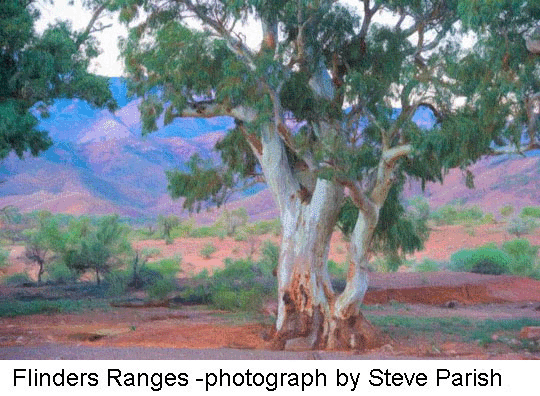 to put out – to persuade the Australian public that a radioactive waste dump is needed, in the beautiful Flinders Ranges.
It’s time that we all really woke up to the fact that the nuclear industry, its ignorant lobbyists and craven politicians, are incompetent simpletons regarding the global nuclear mess, and should not be trusted with their decisions that are aimed at furthering this toxic industry.

Rusted barrels of radioactive waste cost CSIRO $30 million Steven Trask, Canberra Times, 7 Mar 17
CSIRO faces a $30 million clean up bill after barrels of radioactive waste at a major facility were found to be “deteriorating rapidly” and possibly leaking.
An inspection found “significant rusting” on many of the 9,725 drums, which are understood to contain radioactive waste and other toxic chemicals.
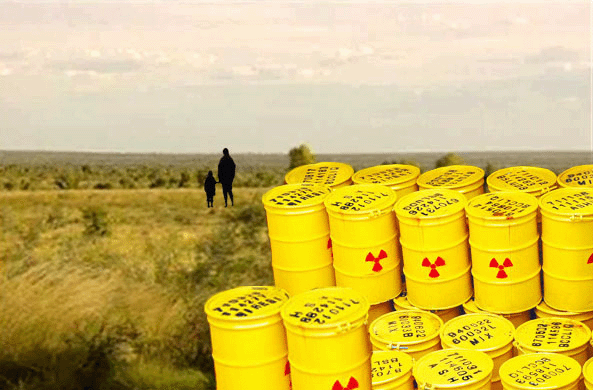
CSIRO flagged a $29.7 million budget provision for “remediation works” at a remote location in its latest annual report. Fairfax Media can reveal the work will take place at a CSIRO facility located on Department of Defence land near Woomera, South Australia.
The Woomera facility is currently one of Australia’s largest storage sites for low and intermediate-level radioactive waste. A damning report of the Woomera facility was issued by the Australian Radiation Protection and Nuclear Safety Agency (ARPANSA) after an inspection in April last year.
“Evidence was sighted that indicates the drums are now beginning to deteriorate rapidly,” read the report, seen by Fairfax Media. “Significant rust on a number of the drums, deterioration of the plastic drum-liners and crushing of some stacked drums was observed.” Tests confirmed the presence of radioactive isotopes at one location and inspectors said there was a possibility the drums were leaking.
“Although unlikely, there is the possibility that the presence of deceased animals such as rodents and birds may indicate that some of the drums, which contain industrial chemicals, may be leaking into the environment.”
The mixture of water and concentrated radioactive material inside some of the drums also had the potential to produce explosive hydrogen gas, inspectors found.
They also noted CSIRO had little knowledge of what was inside many of the barrels, some of which are believed to date back more than 50 years.
“Without full knowledge [of] the contents of the drums, risks cannot be fully identified and risk controls cannot be appropriately implements to protect people and the environment,” inspectors noted in the report.
Many of the drums are understood to contain contaminated soil generated by government research into radioactive ores at Melbourne’s Fishermans Bend throughout the 1940s and 1950s.
The toxic soil was discovered by the Department of Defence in 1989, who sent it to Sydney’s Lucas Heights facility before it was palmed off to Woomera in 1994.
An ARPANSA spokeswoman said the $29.7 million estimate would cover the characterisation, handling, re-packaging and storage of the toxic material.
“As a result of an ARPANSA inspection in 2016, it was recognised that additional work was required to scientifically characterise some of the contents of the legacy materials more accurately,” she said.
“The work that needs to be undertaken is significant.”
A spokesman for CSIRO said the first phase of the three-year clean up would begin next month.
“CSIRO currently has a radioactive waste store located on defence land at Woomera, South Australia. The store currently has 9,725 drums of long-lived waste,” he said…..
The country’s other major radioactive waste storage facility at Lucas Heights, Sydney, is rapidly approaching full capacity. Coupled with issues at the CSIRO site, the revelations highlighted the urgent need for a national radioactive waste storage solution, experts said.. http://www.canberratimes.com.au/national/rusted-barrels-of-radioactive-waste-cost-csiro-30-million-20170307-gusb6v.html
Where do candidates stand on nuclear waste dumping? Friends of the Earth are finding out
 Sounding out candidates on nuclear https://www.whyallanewsonline.com.au/story/5991908/sounding-out-candidates-on-nuclear/?fbclid=IwAR3jlaHvuyECA2gwYQCZOGo6ysCmFwSKSGtyFUA8hD4IEex8CKJg6lK3GkQ, Louis Mayfield 3Apr19
Friends of the Earth National Nuclear Campaigners have been speaking to candidates for the seat of Grey ahead of the federal election to see where they stand on the proposed nuclear waste dump regional SA.
Mara Bonacci and Jim Green were in Whyalla on Tuesday and met with trade unionists and one of the candidates for Grey.
The process of establishing a low-level and intermediate waste dump in Kimba or Hawker is currently delayed because of two court cases brought on by the Barngarla and Adnyamathanha traditional land owners.
“Unless people go out to find the information towns like Whyalla, Pirie or Lincoln don’t get it,” she said
“The Department of Industry, Innovation and Science are still open for submissions. People can still write to the government about this issue.”
Ms Bonacci said the scope of the federal government’s consultation during the site process had been very narrow.
“They’re looking at the sites proposed to house the facility rather than the towns it’s going to impact which is potentially all of the Eyre Peninsula,” she said.
Their visit is also a follow-up on a report from the Department of Industry, Innovation and Science made public last year which named Whalla, Port Pirie and Port Lincoln (among others) as potential nuclear waste ports. “There are communities that haven’t been told at all about being a nuclear port unless NGOs like the ones we work through had trawled through reports and identified these port towns,” Mr Green said.
“They’ve had no say, let alone a meaningful say on whether this goes ahead.”
To make a submission to the Department of Industry, Innovation and Science click here.
Julian Assange, Chelsea Manning, and the campaign to criminalise whistleblowing
Collateral Murder?
Chelsea Manning and the New Inquisition Truth Dig, Chris Hedges, 3 Apr 19
The U.S. government, determined to extradite and try Julian Assange for espionage, must find a way to separate what Assange and WikiLeaks did in publishing classified material leaked to them by Chelsea Manning from what The New York Times and The Washington Post did in publishing the same material. There is no federal law that prohibits the press from publishing government secrets. It is a crime, however, to steal them. The long persecution of Manning, who on March 8 was sent back to jail for refusing to testify before a grand jury, is about this issue.
If Manning, a former Army private, admits she was instructed by WikiLeaks and Assange in how to obtain and pass on the leaked material, which exposed U.S. war crimes in Afghanistan and Iraq, the publisher could be tried for the theft of classified documents. The prosecution of government whistleblowers was accelerated during the Obama administration, which under the Espionage Act charged eight people with leaking to the media—Thomas Drake, Shamai Leibowitz, Stephen Kim, Manning, Donald Sachtleben, Jeffrey Sterling, John Kiriakou and Edward Snowden. By the time Donald Trump took office, the vital connection between investigative reporters and sources inside the government had been severed.
Manning, who worked as an Army intelligence analyst in Iraq in 2009, provided WikiLeaks with over 500,000 documents copied from military and government archives, including the “Collateral Murder” video footage of an Army helicopter gunning down a group of unarmed civilians that included two Reuters journalists. She was arrested in 2010 and found guilty in 2013.
The campaign to criminalize whistleblowing has, by default, left the exposure of government lies, fraud and crimes to those who have the skills or access, as Manning and Edward Snowden did, needed to hack into or otherwise obtain government electronic documents. This is why hackers, and those who publish their material such as Assange and WikiLeaks, are being relentlessly persecuted. The goal of the corporate state is to shroud in total secrecy the inner workings of power, especially those activities that violate the law. Movement toward this goal is very far advanced. The failure of news organizations such as The New York Times and The Washington Post to vigorously defend Manning and Assange will soon come back to haunt them. The corporate state hardly intends to stop with Manning and Assange. The target is the press itself………
Manning has always insisted her leak of the classified documents and videos was prompted solely by her own conscience. She has refused to implicate Assange and WikiLeaks. Earlier this month, although President Barack Obama in 2010 commuted her 35-year sentence after she served seven years, she was jailed again for refusing to answer questions before a secret grand jury investigating Assange and WikiLeaks ……
The New York Times, Britain’s The Guardian, Spain’s El País, France’s Le Monde and Germany’s Der Spiegel all published the WikiLeaks files provided by Manning. How could they not? WikiLeaks had shamed them into doing their jobs. But once they took the incendiary material from Manning and Assange, these organizations callously abandoned them. No doubt they assume that by joining the lynch mob organized against the two they will be spared. They must not read history. What is taking place is a series of incremental steps designed to strangle the press and cement into place an American version of China’s totalitarian capitalism……….
“The internet, our greatest tool of emancipation,” Assange writes, “has been transformed into the most dangerous facilitator of totalitarianism we have ever seen.”
That is where we are headed. A few resist. Assange and Manning are two. Those who stand by passively as they are persecuted will be next. https://www.truthdig.com/articles/chelsea-manning-and-the-silencing-of-the-press/
Australia gets a very bad environmental report for 2018
 Australia’s 2018 environmental scorecard: a dreadful year that demands action The Conversation, Albert Van Dijk, Professor, Water and Landscape Dynamics, Fenner School of Environment & Society, Australian National University, April 4, 2019 Environmental news is rarely good. But even by those low standards, 2018 was especially bad. That is the main conclusion from Australia’s Environment in 2018, the latest in an annual series of environmental condition reports, released today.
Every year, we analyse vast amounts of measurements from satellites and on-ground stations using algorithms and prediction models on a supercomputer. These volumes of data are turned into regional summary accounts that can be explored on our Australian Environment Explorer website. We interpret these data, along with other information from national and international reports, to assess how our environment is tracking.
A bad year
Whereas 2017 was already quite bad, 2018 saw many indicators dip even further into the red. Temperatures went up again, rainfall declined further, and the destruction of vegetation and ecosystems by drought, fire and land clearing continued. Soil moisture, rivers and wetlands all declined, and vegetation growth was poor.
In short, our environment took a beating in 2018, and that was even before the oppressive heatwaves, bushfires and Darling River fish kills of January 2019.
The combined pressures from habitat destruction, climate change, and invasive pests and diseases are taking their toll on our unique plants and animals. Another 54 species were added to the official list of threatened species, which now stands at 1,775. That is 47% more than 18 years ago and puts Australia among the world’s worst performers in biodiversity protection. On the upside, the number of predator-proof islands or fenced-off reserves in Australia reached 188 in 2018, covering close to 2,500 square kilometres. They offer good prospects of saving at least 13 mammal species from extinction. ……..
A bad start to 2019
Although it is too early for a full picture, the first months of 2019 continued as badly as 2018 ended. The 2018-19 summer broke heat records across the country by large margins, bushfires raged through Tasmania’s forests, and a sudden turn in the hot weather killed scores of fish in the Darling River. The monsoon in northern Australia did not come until late January, the latest in decades, but then dumped a huge amount of rain on northern Queensland, flooding vast swathes of land……. https://theconversation.com/australias-2018-environmental-scorecard-a-dreadful-year-that-demands-action-114760
Australian Mining touts Honeymoon uranium mine, but only IF URANIUM PRICE IMPROVES
 They headed the article “Boss discovers ‘major breakthrough‘ for Honeymoon uranium expansion ” and went on to detail how the Honeymoon uranium mine project restart in South Australia will ramp up production. But even in its enthusiasm, , Australian mining gave a hint about the low prospects for the uranium industry. It will all happen – “ assuming a favourable global uranium price for shareholders is achieved” https://www.australianmining.com.au/news/boss-resources-discovers-major-breakthrough-for-honeymoon-expansion/
March was the hottest month ever recorded in Australia
 SBS News, 3 Apr 19, March was the hottest on record for Australia, the Bureau of Meteorology says, but a wet end to the month saved it from being the driest. Australia has sweltered through its hottest March on record.
The national mean temperature was 27.7C, making it 2.13C above average according to The Bureau of Meteorology’s monthly climate report.
It was particularly warm in the Northern Territory and Western Australia, both of which posted their hottest March on record, while it was among the six warmest for NSW, Queensland and South Australia.
In Rabbit Flat, northwest of Alice Springs, temperatures reached at least 39C for 115 straight days between December 1 and March 25 – smashing the previous record of 106 days at Marble Bar in WA in 1921-22.
A “vigorous trough” and cold front across southern Australia cooled temperatures down towards the end of the month, the report said….https://www.sbs.com.au/news/march-was-the-hottest-month-ever-recorded-in-australia
Coalition government rejects Clive Palmer’s call for nuclear power for Australia
Clive Palmer’s nuclear power plan for SA knocked back by Coalition, Chris Russell, The Advertiser, March 31, 2019
A push by the United Australia Party for nuclear power has been swiftly rejected by the Federal Government.
A spokesman for the party led by Clive Palmer confirmed nuclear was on the agenda.
“South Australia has a major energy problem and we, as a party, are discussing nuclear,” he said. “Australia has uranium reserves and nuclear is emissions free.
“Kristian Rees, our number one senate candidate is speaking with his SA candidates and party members on major issues like cheaper power, manufacturing and jobs.”
A planned announcement on nuclear power, reported by the Sunday Mail, was revealed early by Professor Adrian Cheok who quit the party despite being the No. 2 Senate candidate in SA.
The party spokesman said it was “disappointing someone who didn’t get what they wanted leaked confidential discussions”.
Federal Energy Minister Angus Taylor rejected the nuclear call.
“Nuclear power remains illegal in Australia and highly expensive to build and operate,” he said.
The Government has short-listed electricity generation projects that could warrant underwriting — but the program specifically excluded nuclear.
Last financial year, SA generated more electricity than it used, exporting the excess to Victoria.
Wholesale prices were 11 per cent lower than the year before, according to the Australian Energy Market Operator’s report on SA electricity.
Mr Palmer is the national leader but has yet to nominate for a seat. His options include his former seat of Fairfax, on the Sunshine Coast, and Herbert, based in Townsville.
The Senate ticket for Queensland also is unresolved.
A party spokesman said Mr Palmer was expected to be endorsed “very soon”.
Western Australian Aboriginal community uses solar hydropanel to solve problem of uranium in water
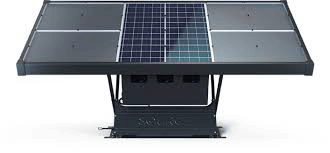 Buttah Windee in remote WA now has clean water thanks to solar hydropanel technology https://www.abc.net.au/news/2019-03-31/solar-hydropanels-fix-water-supply-in-remote-community/10941788?fbclid=IwAR2j446RfOuRIZNBC0K1xY6CWBq3Jnn48zx0b-WiuI8o96Jklb-bL1pfZHQ
Key points:
- Six solar hydropanels have been installed in the small WA community, capturing 900 litres of water a month from the air
- The community had discovered its water supply contained uranium more than twice the national health standard, and the State Government deemed it too expensive to address
- With the help of crowdfunding and technology donated by a WA company, the residents of the community no longer need to live elsewhere
The remote Aboriginal community is 760 kilometres north-east of Perth on the outskirts of Meekatharra.
Almost a decade ago, resident Andrew Binsiar discovered the community’s water was tainted with naturally occurring uranium at more than twice the national health standard.
“I was actually very surprised,” he said.
“You’d imagine people would test the water for human consumption before people are allowed to drink it.”
Unable to drink the community’s tap water, most of the 50 people who lived at Buttah Windee left.
Too expensive to fix: State Government
But for Andrew Binsiar and his wife Janine, leaving the home where they had raised their five children was not an option.
He turned to the State Government for help, but was told fixing the water supply would be too expensive.
“They come out and put up ‘do not drink the water’ signs and that was their solution to it,” Mr Binsiar said.
The State Government offered to move the remaining residents into state housing in Meekatharra, but Mr Binsiar was apprehensive about exposing his family to the town’s social issues.
“We knocked them back … for the simple reason I’d already been there and done that. My life changed when I moved here,” he said.
“I wasn’t a very good father when I lived in Meeka.”
Solar hydropanels pull water from air
Almost a decade on, Buttah Windee is the first remote Aboriginal community in Australia to use innovative technology for its water supply.
Six solar hydropanels have been installed at the outback community, donated by a WA company who heard about the community’s plight and wanted to help out.
Director of Wilco Electrical Frank Mitchell said the units captured water from the air and produced up to 900 litres of water a month.
“Those fans, you can hear them whirring away, are just drawing in air all day, all around, and the piece of material inside collects … the moisture in the air, then condenses down into the tank where it’s got a pump straight out to the tap,” he said.
Mr Binsiar said it was a simple idea, which should be introduced to all remote communities.
“Water is a basic human right that everyone deserves,” he said.
“It could mean better health for your children … I would guarantee that most communities have bad water.”
Crowdfunding rallies support
The near decade-long battle for clean drinking water has not come easily for the Buttah Windee residents, with Mr Binsiar turning to crowdfunding as a last resort.
Word spread quickly when Mr Binsiar began the fundraising campaign last year, and people from across Australia donated nearly $26,000 in three months.
“It was a huge success. The Australian public have been awesome,” he said.
Mr Binsiar used the funds to install a reverse osmosis water treatment plant.
“Reverse osmosis takes out all the contaminants in the water … on the back end of it, it puts the minerals your body needs back into the water,” he said.
“They’ve given us a chance where no-one else would and we are really proud of what we have done here.”
Barramundi fish farm to boost employment
The two separate systems now supply the community with safe drinking water and enough water to run a small barramundi fish farm.
Mr Binsiar and several residents built the fish farm hoping it would eventually provide local employment and a potential source of income. “Hopefully we can continue on and make it bigger and provide this region with fresh barramundi,” he said.
“I’d like to welcome everyone out to Buttah Windee and come and look at the work we do.”
1 This month
.

Australians deserve the truth
about
AUKUS – https://aukuspublicinquiry.com/

PETITION – To: Prime Minister Anthony Albanese and the Australian Labor Government

of the week – Australians for War Powers Reform (AWPR)
To see nuclear-related stories in greater depth and intensity

