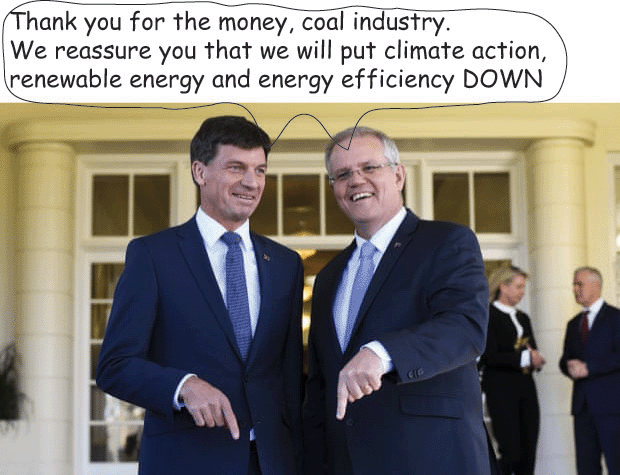
 The Australian Greens have warned against the Morrison government
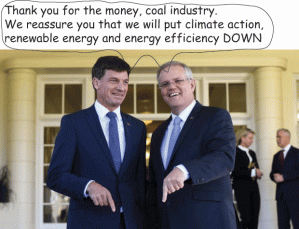 backing a coal-led energy policy over the Snowy Hydro 2.0 project. SBS, 15 Oct 18
 Greens MP Adam Bandt has warned the Coalition’s views on climate change and renewable energy will “kill people”.A major report released last week, referencing more than 6000 scientific studies, stated drastic changes are needed in global society to prevent world temperatures from rising by two degrees Celsius.
The Coalition Government says it will not renew or replace the Renewable Energy Target when it lapses in 2020.
Mr Bandt’s claim comes on the same day as former Deputy Prime Minister Barnaby Joyce declared the expected $4.5 billion cost for the Snowy 2.0 scheme would be better off used on funding new coal-fired power stations.
“The Coalition’s energy policy will kill people – it’s as simple as that,” Mr Bandt told reporters on Monday.
“Australia is going to be one of the countries worst hit by climate change and the Morrison government seems to not care how many people will die because of its policies.
“If Barnaby Joyce is concerned about farmers then he’d want to switch from coal to renewables.”
Mr Joyce told The Australian he would prioritise coal-fired power stations, two months ahead of a decision on the Snowy 2.0 scheme……https://www.sbs.com.au/news/coalition-s-climate-change-stance-will-kill-people-say-greens
October 16, 2018
Posted by Christina Macpherson |
AUSTRALIA - NATIONAL, climate change - global warming, politics |
Leave a comment
 Nuclear industry responds by calling those who disagree with the ICRP and IAEA in these matters “radiophobes”. The Japanese government responds to the disagreement coming from its people with more and more imposed secrecy, and greater compliance with international nuclear bodies. Looked at in another way, the Japanese government obeys the IAEA and ICRP.
It is little wonder theJapanese world nuclear industry via its local mouthpieces and puppets in every land continues to claim the effects of the nuclear disaster have no consequence. Nor is it any surprise that the nuclear industry continues to illegally diagnose opponents to its dictates and insults as being “radiophobic”.
Earthquake Damage At Fukushima – is Industry’s Narrative Truthful or Certain? Nuclear History, 16 Oct 18 “……..As I have pointed out previously, the declared extent of decontamination in Japan has enable some evacuees to return to their homes. The residual contamination remaining in those cleanup areas being about the same, roughly, as the Maralinga lands in South Australia after cleanup there. The risk of radiogenic cancer in the Maralinga Lands in 1 in 50,000 over 50 years. The owners of the Maralinga lands had been suffering forced removal from their lands from the 1950s until the 1990s, with full return of lands completed in the 21st century. Many people died waiting to return.
In Japan many people are concerned that they have been economically forced to return to places prior to a proper cleanup. In Australia, many people are concerned that the Maralinga cleanup was a dud, cheap, and insufficient. As usual vitrification in nuclear residues resulted in explosions and so elements including plutonium were simply buried in trenches.
In Japan, great piles of contaminated material, so active the piles have to be shielded with sand bag shielding in order to protected nuclear garbage workers, remain in the open air. A minority of the material is under cover in interim storage.
But all of this is claimed to be of no consequence according to the nuclear industry.
Since the 1990s, when the Maralinga cleanup was designed around the new intervention level proposed by the ICRP planned for the 21 century, many Australians have stated that the new levels allowed are too high. And that the risk at Maralinga is too high. The ICRP intervention level is 10 mSv. The actual level aimed at Maralinga was 5 mSv. Japan complies with the guidelines. And that fact is in actual reality no comfort for many many affected Japanese people. No comfort at all. Because those people do not trust either nuclear authorities or their own government. Continue reading →
October 16, 2018
Posted by Christina Macpherson |
AUSTRALIA - NATIONAL, spinbuster |
Leave a comment
|
 New Aust uranium deal for UK after Brexit https://www.sbs.com.au/news/new-aust-uranium-deal-for-uk-after-brexit, 15 Oct 18. New Aust uranium deal for UK after Brexit https://www.sbs.com.au/news/new-aust-uranium-deal-for-uk-after-brexit, 15 Oct 18.
Australia is working on a new deal for selling uranium to the United Kingdom once it leaves the European Union. Australia is working on a new nuclear deal with the United Kingdom once it leaves the European Union.One fifth of Australia’s uranium goes to the UK, but it cannot be used for military purposes, or sold to other countries who use it for their militaries.
Dr John Kalish, acting director general of the Australian Safeguards and Non-proliferation Office, says a new deal will have to be done with the UK to mirror the old one with the EU.
Under the old deal and the proposed one, the UK can only sell the uranium on to certain countries.
“Retransfers can only be made to third parties that have a nuclear cooperation agreement with Australia,” Dr Kalish told a parliamentary committee on Monday.
But Dr Kalish could not reveal which countries Australian uranium ends up in, citing “commercial in confidence”.
Liberal MP Andrew Wallace can’t understand why.
“I’m just trying to work out why the Australian people can’t be informed what third party countries the UK might reassign or retransfer uranium that comes out of this country?” he asked.
Dr Kalish said he could give the committee the names of the countries, but they would have to remain secret.
Meanwhile, Labor’s foreign affairs spokeswoman Penny Wong gave a speech to the Australian Institute of International Affairs on Monday, in which she called for Australia to take a greater role in banning nuclear weapons.
“A Shorten Labor government will seek to muster wide international support, including from the states that possess nuclear weapons, for a ‘No First Use’ declaration,” she said.
“For states with nuclear weapons to adopt a ‘No First Use’ policy would constitute a major step forward in reducing tensions and risks of accidental or mistaken use.”
Senator Wong says Labor will also use Australia’s strong relationships with nuclear weapons states to push for a reduction in their nuclear stockpiles.
“Dismantling 15,000 nuclear warheads and the security arrangements that rest upon them is not going to happen overnight,” she said.
|
|
October 16, 2018
Posted by Christina Macpherson |
AUSTRALIA - NATIONAL, business, politics international |
Leave a comment
 Modest member: Go nuclear for a clean energy future The modern nuclear reactor is small, modular, self-contained and safer than any other energy generation, Financial Review, by Amanda Stoker 14 Oct 18 Amanda Stoker is a Liberal National Party senator for Queensland
Australia must develop a nuclear energy industry. It promises to provide clean and reliable energy from a resource we have in abundance.
The modern nuclear reactor is small, modular, self-contained and safer than any other energy generation method. It provides flexible generation capacity, as it can increase or reduce electricity output to reflect demand. [Ed . Just a pity that it doesn’t exist – among other drawbacks]
Prime Minister Scott Morrison has acknowledged that all electricity generation options with the capacity to reduce electricity prices need to be considered……
For too long we have allowed nuclear energy to remain off-limits in the discussion about the security of Australia’s energy supply. What we need is an informed and rational debate that isn’t driven by fear.
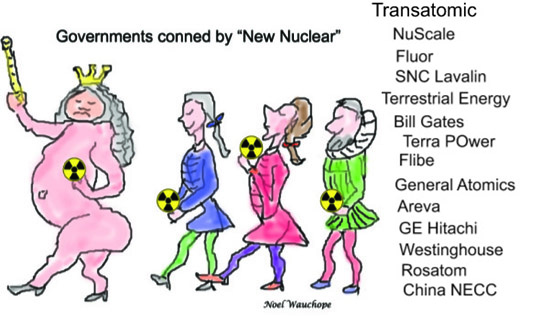
 While the high capital cost of traditional nuclear reactors makes them unattractive compared to coal and natural gas as a source of dispatchable baseload power, the advent of safer and cheaper small modular reactors (SMRs), for example the NuScale facility commissioned in Idaho, offer a competitive and cost-effective entry point for Australia to cutting edge nuclear energy technology.
The projected levelised cost of electricity (LCOE) of NuScale’s SMR is comparable to other forms of dispatchable generation in the pipeline. [ Ed. Wha..aaa,..t?
The Australian Nuclear Science and Technology Organisation (ANSTO) has said a nuclear energy industry built either on SMRs or Generation IV reactors is technically feasible in Australia, but we do not have the necessary expertise available…….
The Australian Radiation Protection and Nuclear Safety Act and the Environmental Protection and Biodiversity Conservation Act prohibit the approval, licensing, construction, or operation of a nuclear fuel fabrication plant, a nuclear power plant, an enrichment plant or a reprocessing facility.
These acts should be amended to enable a nuclear energy industry to develop in Australia……. https://www.afr.com/opinion/modest-member-go-nuclear-for-a-clean-energy-future-20181014-h16m17
October 16, 2018
Posted by Christina Macpherson |
AUSTRALIA - NATIONAL, politics |
Leave a comment
ABC, By Jane Bardon 16 Oct 18 A group of Indigenous traditional owners from remote parts of the Northern Territory will travel to Origin Energy’s annual general meeting in Sydney on Wednesday to tell shareholders they have not given permission for the company to frack their land for gas.
Key points:
- A group of Indigenous traditional owners will soon tell Origin Energy shareholders they did not give consent for its planned developments
- They will ask the company to review consent agreements
- But the company is confident traditional owners already gave consent
Origin Energy gained official approvals for gas exploration, including test fracking, in the gas-rich Beetaloo Basin, both from traditional owners through the Northern Land Council, and the Northern Territory Government.
But some of the traditional owners plan to tell the shareholder meeting they oppose fracking, and did not give their “free, prior and informed consent”.
They hope to tell the meeting when permission for fracking was sought by Origin Energy, they did not fully understand the company’s explanations of processes, or the potential size of developments potentially numbering hundreds of wells.
“The letter that we’re bringing up to Origin, we want that to be recognised, and to be respected for who we are,” Alawa traditional owner Naomi Wilfred said.
The Alawa traditional owner, whose country includes Nutwood Downs in the northern part of Origin Energy’s EP98 permit area, said she is worried about potential environmental impacts if production goes ahead……..http://www.abc.net.au/news/2018-10-16/indigenous-traditional-owners-origin-energy-fracking-consent/10379162
October 16, 2018
Posted by Christina Macpherson |
aboriginal issues, Northern Territory |
Leave a comment
The status of “Station Blackout” is a serious one.
“it will be many years before the Japanese people know exactly what happened at Fukushima Daiichi on 11 March 2011. One of the key mysteries was role, if any, the magnitude 9 earthquake played in damaging the plant’s reactor cooling systems. Until lethal levels of radiation inside the reactors fall and workers can carry out comprehensive investigations, the truth about the tremor’s impact will remain a subject of conjecture and contention”
Mr. Takamatsu states with expert authority that the pipes of cooling system ware not designed for the 50 second vibration of the magnitude quake. Barry Brook, kangaroo expert, disagrees and tells the world the quake caused no damage at Fukushima. Yet Mr. Brook must surely know the earthquake caused grid blackout. For reactors are all shut down by earthquakes. A solar plant would have kept generating until the last panel shattered. No one would have been evacuated from such a solar plant.
I submit that Prof. Barry Brook’s description of the effects of earthquake upon the Fukushima Diiachi on 11 March 2011 is totally ignorant of the facts as presented by many qualified experts and fly in the face of the independent commission set up by the Japanese Parliament (Diet). It is confirmed that expert investigators concern aspects of TEPCO’s explanations regarding the quake are “irrational”.
Thus any narrative based upon the nuclear industry view, in line with TEPCO’s may fairly be said to be “irrational”. For the industry view is that there is no possibility of quake damage to any structure or sub structure, such as coolant pipes and valves.
Earthquake Damage At Fukushima – is Industry’s Narrative Truthful or Certain? Nuclear History, 16 Oct 18 I am again going to contrast the statements made by Barry Brook in regard to the events and outcomes at Fukushima Daiichi in 2011 with the facts as presented by Mark Willacy. These facts are published in Willacy’s book, “Fukushima – Japan’s tsunami and the inside story of the nuclear meltdowns”, Willacy, M., Pan Macmillan, copyright 2013, Mark Willacy.
However, I will also include information related to the events which were first published and discussed in 2011. ………..
The earthquake generated the tsunami. What else did the earthquake cause?
In this blog I have included posts which give the IAEA considerations for the electrical grids which are connected to nuclear power plants. The IAEA states that the level of engineering and resilience built into such grids may be a significant additional cost for any nation considering generation to nuclear power.
It comes as no surprise then the electrical grid connected to the Fukushima Daiichi NPP failed for two reasons. 1. The earthquake caused all the nuclear reactors connected to the same grid to rapidly shut down. Thus the earthquake caused a blackout due to cessation of electrical generation. 2. The physical grid infrastructure – poles and wires – were damaged by the earthquake. At Fukushima this meant that more than one of the reactors was physically separated from the grid by the earthquake.
It can therefore be seen that the earthquake meant A. Fukushima Diiachi could not generate nuclear electricity as the quake had shut the reactors down. B. The Fukushima Diiachi Nuclear Power Plant was in Station Blackout for one reason: earth quake damage to nuclear infrastructure – the electrical grid. Continue reading →
October 16, 2018
Posted by Christina Macpherson |
AUSTRALIA - NATIONAL, spinbuster |
Leave a comment
 Climate right for solar plan: Reynolds, HOBART residents and
  businesses would be able to install solar energy systems with no upfront costs under an initiative proposed by mayoral candidate Anna Reynolds. HELEN KEMPTON, news.com.au Sunday Tasmanian OCTOBER 14, 2018
HOBART residents and businesses would be able to install solar energy systems with no upfront costs under an initiative proposed by mayoral candidate Anna Reynolds.
Ald Reynolds says the city should strive to double solar installations over the next five years.
Hobart is a poor performer compared with other Tasmanian local government areas with Sustainable Living Tasmania figures placing it 16th in terms of solar installations per capita.
“Council has taken action to install solar panels on its own buildings but there is so much more we can do,” Ald Reynolds said.
“I will advocate for a solar saver program to help Hobart residents, businesses and organisations install solar panels.
“Council will pay the upfront cost for the system and you, or your landlord, pay it off over 10 years, interest free.
“The savings made on energy bills will more than outweigh the payments to council, leaving you better off.”
The independent candidate’s push is backed by the chief strategist of climate advocacy group 350 Australia……..https://www.news.com.au/national/tasmania/climate-right-for-solar-plan-reynolds/news-story/1aa9c5761666dbbb411a35f424b0c8a0
October 15, 2018
Posted by Christina Macpherson |
solar, Tasmania |
Leave a comment
 Barnaby backs coal unless Australians want nuclear power supply, Northern Daily Leader, Chris Bath 15 Oct 18
Barnaby Joyce has called the Intergovernmental Panel on Climate Change’s (IPCC) recommendation to phase out coal by 2050 as “wrong and ridiculous”, while once again suggesting Australians need to look at nuclear power………..
This week the Federal Government rubbished the IPCC report, instead backing coal fired power stations to drive down electricity prices, and Mr Joyce agrees.
“To say that I’m not allowed to get one product (coal) and say that you’re not allowed to use it anymore is wrong, and more than that it is ridiculous,” he said.
October 15, 2018
Posted by Christina Macpherson |
AUSTRALIA - NATIONAL, climate change - global warming, politics |
Leave a comment
Menzies “immediately agreed to the proposal,” without consulting any of his cabinet colleagues or the Australian parliament. Indeed, until weeks before the first test was carried out, only three government ministers knew about it.
The most devastating effects were suffered by two groups: Australian and British soldiers working on the tests themselves, and the Indigenous populations local to Emu Field and the later testing site of Maralinga.
One prominent member of the testing team, Sir Ernest Titterton, later said that if Indigenous people had a problem with the government, they should vote it out, ignoring that Indigenous Australians did not have full political rights until 1967.
an Australian defense ministry report was leaked to the press, warning that large amounts of plutonium left at Maralinga could potentially be a target of terrorists.
those wrongs have not been fully addressed. Health problems stemming from the tests continue for those still living, and while the veracity of Lester and other victims’ stories has been acknowledged, what exactly happened to them remains unclear, the details of the nuclear test still kept top secret.
“To this day we don’t know what Totem I did, those records are still classified by the British,
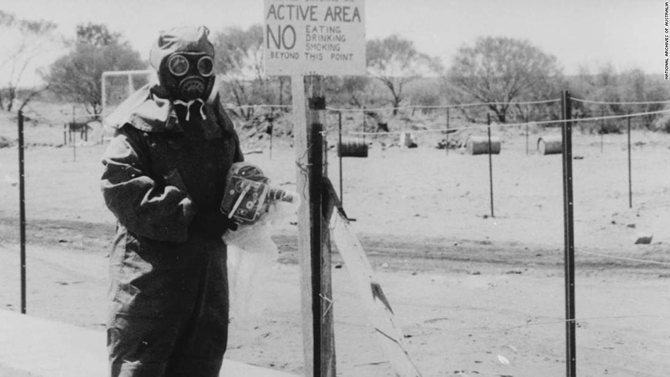
Yami Lester was 12 years old when the black mist came to Walatinna.
Early on the morning of October 15, 1953, Lester heard a “big bang” in the distance. This was followed by a dark, ominous-looking cloud which drifted low over the ground like a slow-moving dust storm, bringing with it an unpleasant smell.
A tiny speck in the vast South Australian outback, the area around Walatinna was regarded as “depressingly inhospitable to Europeans” by early colonizers, few of whom settled there. But Indigenous people had a long history in the region, including Lester’s tribe.
As the dark cloud settled over the Walatinna camp, the tribal elders attempted to ward it off, thinking it was a malevolent spirit. In many ways they were right.
As those exposed to it later told investigators, the black mist caused their eyes to sting and their skin to break out in rashes. Others vomited and suffered from diarrhea.
It took almost three decades until the cause of the mist was acknowledged as the Totem I nuclear bomb test, as Indigenous people had been claiming for years.
That test was one of a number conducted in the 1950s and ’60s, not by the Australian government, but by its former colonial master, the UK. Today, 65 years after the Totem I test, the effects are still being felt in South Australia and beyond. Continue reading →
|
October 15, 2018
Posted by Christina Macpherson |
AUSTRALIA - NATIONAL, history, reference |
Leave a comment


 ‘Jaw dropping’: New Zealand offers lessons in tackling climate change, By Peter Hannam, Brisbane Times, 13 October 2018 Scott Simpson, New Zealand’s National Party environment spokesman, stunned a trans-Tasman investment meeting last week by stating that climate action was “too important to be playing politics with”.
Or rather, it was the Australian delegates who were shocked, so used are they to the toxic debates in Canberra.
“It made my jaw drop, that’s for sure,” said Emma Herd, chief executive of the Investor Group on Climate Change.
Also well-received was Mr Simpson’s comment that it was vital “for all of us and our grandchildren that we have a [climate action] framework that is enduring”, coming as it did soon after the UN’s Intergovernmental Panel on Climate Change had issued its latest report warning about the perils of even another half degree of warming.
That Mr Simpson hails from the centre-right opposition party roughly equivalent to our Liberal-National coalition only underscored the contrast between the nations.
New Zealand’s major parties, busy trying to thrash out a Zero Carbon Bill by year’s end, are dismayed by the absence of similar bipartisanship across the Tasman, James Shaw, climate change minister in the Labor-led government told Fairfax Media.
“We do tend to look at what’s going on in Australia politics, in particular in relation to climate policies, and we think, ‘We cannot afford to let this happen in New Zealand’,” Mr Shaw said. “It seems like a pretty strong lesson in what not to do.”……..
In government, the National Party signed up to the Paris climate accord and introduced an emissions trading scheme.
To remove the politics from the negotiations, all sides agreed to take advice on New Zealand’s targets from an independent climate commission. (Australia has a Climate Change Authority but all the original board members have been replaced since it was set up by the Gillard government and its role as an advocate for action has largely disappeared.)……
Mr Shaw (of the ruling Coalition ) said the Opposition could have exploited a potentially divisive policy – agriculture contributes half of New Zealand’s greenhouse gas emissions – but didn’t.
“They are playing an absolute straight bat,” he said. “There’s a genuine best effort to get a consensus outcome.”
New Zealanders, like Australians, have endured an increasing spate of extreme weather events, which the government attributes in part to climate change. These include a record hot year in 2016, droughts and a major forest fire last year.
“We’ve definitely had a lot more extreme rainfall events,” Nava Fedaeff, a climate scientist with the National Institute of Water and Atmospheric Research (NIWA), said. These include damaging ex-tropical cyclones hitting the nation, with the average jumping from less than one a year to three over the last summer season.
Farmers, who have in the past objected fiercely to taxes on methane, appear more ready to accept the need to act.
DairyNZ, for instance, has welcomed the prospect of emissions targets enshrined in legislation to give the sector “much needed certainty”.
Trish Rankin, a dairy farmer managing 440 cows for a Maori-owned co-operative near Hawera in the Taranaki region of the North Island, said climate action “needs to be apolitical – it needs to be able to last over time”.
Ms Rankin said New Zealand farmers realise their social licence depends on them being good custodians of the land, and the principle extends to curbing emissions. Open consultations with experts have also helped.
“If you know they are listening to you, you’re more likely to listen to them,” she said.
October 15, 2018
Posted by Christina Macpherson |
AUSTRALIA - NATIONAL, politics international |
Leave a comment
 Prof. Brook is probably, in my opinion, clearly very inadequate when he researches things such as nuclear industry. He claims academic privilege when he communicates his mere opinions related to a field he possesses no training or little training or qualifications in. He can’t have it both ways. The privilege which springs from his actual qualifications may give him status in other things on campus. Away from the lecture theatre though, his opinions of the nature of nuclear industry have zero academic weight….“I’m an academic and therefore I am right” does not wash with me
2003 saw Prof. Shimazaki speak at the first meeting of the government’s Disaster Management Council. This council formed government disaster policy. He urged the council to study the Jogan earthquake of 869 and warned the Japanese Trench could generate earthquakes anywhere along Japan’s Pacific coast.
since 2008 TEPCO management had been busy suppressing THE SAME CONCLUSION of grave risk of 15 metre tsunamis hitting the Fukushima coast, made by TEPCO’s own engineers using simulations and mathematics.
Expert fore warning of the 2011 Tsunami Ignored and Suppressed by Nuclear Authorities. Nuclear Exhaust 12 Oct 18
this post is in progress. Not finished.
I am again going to contrast the statements made by Barry Brook in regard to the tsunami defences at Fukushima Daiichi with the facts as presented by Mark Willacy. These facts are published in Willacy’s book, “Fukushima – Japan’s tsunami and the inside story of the nuclear meltdowns”, Willacy, M., Pan Macmillan, copyright 2013, Mark Willacy.
An interesting aspect of the work of Barry Brook is this: The views expressed by Barry are very frequently attributed by Barry to people who are, according to Barry, experts in nuclear industry. I have heard Barry’s public broadcasts in which Barry makes this attribution. I have not heard Barry give the names of his advisors and friends in the nuclear industry. However it is extremely likely Barry is correct in his attributions. Barry’s statements of opinions and claimed facts can reasonably be assumed to have been provided to Barry by unnamed – as far as I am aware – experts in the nuclear industry. The credibility of Barry statements ride therefore upon the credibility of the nuclear industry.
Of course it is no surprise to hear Barry Brook mirror the statements of nuclear experts from around the world in 2011. The narrative of the global nuclear industry as broadcast by the mass media and the narrative provided by Barry Brook were, as I recall, mutually re-affirming.
Here again is a selected, partial transcript of Barry Brook’s Australian ABC TV interview (please watch the complete interview at the youtube link https://www.youtube.com/watch?v=SFs_-8DtZvo
“Prof. Brook: “I think they (events) show the vulnerability of any human infrastructure to the forces of nature. Especially when they are unleashed with such fury as they were with that massive earthquake, the largest one to hit Japan in recorded times, and a 10 metre tsunami. I don’t think it’s reasonable to expect any infrastructure along a coastline like that to survive an event like that. But what it does highlight is that decisions were made back in the ‘60s, when that nuclear power plant was planned and built, they did not anticipate the scale of the natural disaster that occurred here.”
Prof. Brook: “They predicted up to a 6.5 metres tsunami and protected against that. But of course, as events turned out, the tsunami was even bigger than that………
In a previous post I pointed out that Willacy had found that Dr.Yukinobu Okamura, the director of Japan’s Active Fault and Earthquake Research Centre, had, in 2007, found evidence in the geologic record that the Fukushima coast had been hit by massive tsunamis in its past. (Fukushima, page 26)
I also pointed out that in 2008 TEPCO engineers using simulations and calculations discovered that tsunamis as high as 15.7 metres were possible at the site of the Fukushima Daiichi power plant. (Fukushima, page 29)
This discovery by TEPCO engineers was suppressed by TEPCO management from the Japanese people and Japanese government until 7 March 2011, or 4 days before the 3/11 quake and tsunami disaster. (Fukushima, page 29) Continue reading →
October 15, 2018
Posted by Christina Macpherson |
AUSTRALIA - NATIONAL, reference, spinbuster |
Leave a comment
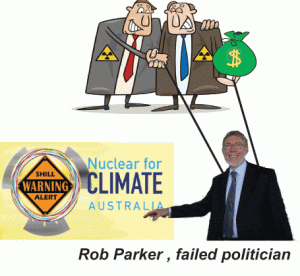 ‘ Nuclear Fuel Cycle Watch South Australia, 12 Oct 18 “Of course none of this has any impact on plants built at coastal locations
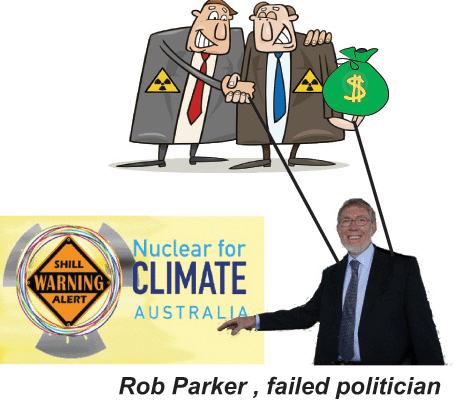
…” Robert Parker, speaking about release of nuclear reactor’s hot water into sea.
Dismissing this saying no impact is simply, false.
Nonetheless, that fact, is subjective to whether an individual or corporate group values the earth environment in saying: ‘there is no impact’.
Because it is a matter of record there are three major outcomes.
1. The temperature increase in the bodies of water can have serious adverse effects on aquatic life.
2. Warm water holds less oxygen than cold water, thus discharge from once-through cooling systems can create a “temperature squeeze” that elevates the metabolic rate for fish.
3. Additionally, suction pipes that are used to intake water can draw plankton, eggs and larvae into the plant’s machinery, while larger organisms can be trapped against the protective screens of the pipes.
Furthermore, before anyone comes back with a smart comment just be aware these nuclear reactor cooling systems run 24/7, 356 days per year.
Pushing out up to 3.745 gigalitres of water, taking excess heat out of the nuclear reactor system.
3.745 gigalitres = 3,785,411,784 litres per day of heated water is dumped into a coastal ecosystem.
* Based on whose value system, is there ‘no impact’, on the ocean environment from the hot water out of a nuclear reactor? https://www.facebook.com/groups/1021186047913052/permalink/2148091265222519/?comment_id=2149661798398799&reply_comment_id=2149928731705439¬if_id=1539243606787050¬if_t=group_comment
October 13, 2018
Posted by Christina Macpherson |
AUSTRALIA - NATIONAL, spinbuster |
1 Comment

MoU for Australian and Vietnamese nuclear organisations, WNN, 10 October 2018, The Australian Nuclear Science and Technology Organisation (ANSTO) and the Vietnam Atomic Energy Agency (VAEA) have signed a Memorandum of Understanding to allow further collaboration between the two organisations. The agreement was signed during a visit to ANSTO by a delegation led by VAEA Director General Hoang Anh Tuan.
ANSTO CEO Adi Paterson said the MoU would give the organisations an opportunity to cooperate more closely on areas of mutual benefit. “ANSTO has worked with a variety of Vietnamese agencies for many years through multilateral fora such as the IAEA, the Regional Cooperative Agreement, and the Forum for Nuclear Cooperation in Asia”, he said.
Discussions were held on possible areas for cooperation including research reactor operation and utilisation, environmental monitoring of mining tails, and food provenance…………The visit, which has been facilitated by ANSTO’s International Affairs team, is part of the International Atomic Energy’s Technical Cooperation Programme. http://world-nuclear-news.org/Articles/MoU-for-Australian-and-Vietnamese-nuclear-organisa
October 13, 2018
Posted by Christina Macpherson |
AUSTRALIA - NATIONAL, politics international |
Leave a comment