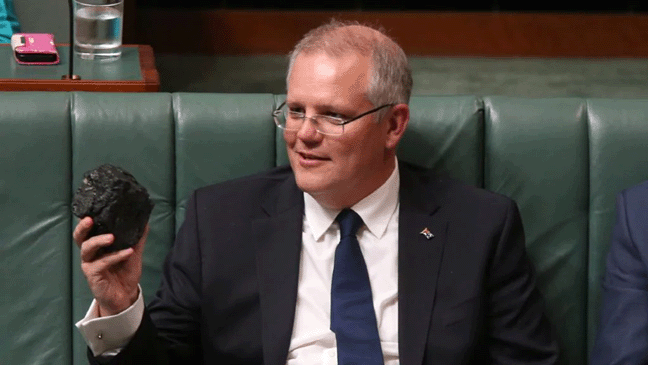
Earlier this week, Scott Morrison suggested there was no investment case for nuclear power in Australia.
But Australian Conservatives leader Cory Bernardi begs to differ and has confirmed he will lay out an investment case to pursue the power generation option next week.
“If Scott Morrison says he’s not afraid to use the nuclear word, I want to give him the economic case so that he can seize the mantle and stop this 20 year green moratorium on even contemplating nuclear power in this country,” Bernardi tells Luke Grant. “I will lay out an investment case that makes nuclear a compelling opportunity. It will detail not only the energy benefits of nuclear energy but the whole range of other spin-off benefits. It could relieve drought-affected areas, it could ensure greater crop production.”
“We can also detail a way, which is a little riskier in a political sense, that it could be built with no additional capital input from the government right now.”
Bernadi says the time for an elimination of the ban is now, with the blanket prohibition precluding Australia from capitalising on its uranium resource abundance and shutting us off from the economic advantages that would flow on.
“We’re crazy,” he says.
“There’s 30% of the world’s uranium resources in this country, something like 20% in South Australia alone. We could radically change Australia’s economic future. You can do it perfectly safely and to those who want to stop carbon dioxide emissions, you can cure that problem too.”
Grattan on Friday: Malcolm Turnbull is gone but son Alex keeps the climate faith, The Conversation, Michelle Grattan, Professorial Fellow, University of Canberra, October 11, 2018 In a Thursday video for the Wentworth byelection, Malcolm Turnbull’s son Alex has denounced “extremists on the hard right” who, he says, have taken over the Liberal Party.
The younger Turnbull called on voters in his dad’s old seat to register a protest about the party’s direction, and deliver a message on climate change. “If you want to pull the Liberal party back from the brink, there is one clear signal you can send,” he said, urging people not to vote Liberal.
Apart from the leadership coup Turnbull, a Singapore-based investment manager, highlighted energy policy to make his point about the hard right’s “crazy agenda”.
“As an investor in energy, I’ve seen that in particular there’s no way coal can compete anymore. Renewables have gotten too cheap, firming costs are reasonable, and really there’s no trade off any more between lowering your power bills and reducing emissions. And yet still some would like to prosecute a culture war over this issue”.
Kerry Schott, head of the Energy Security Board, is coming from a rather different place but at the Australian Financial Review’s energy summit this week she delivered an equally blunt message about the politics of energy, describing “the general state of affairs right now as anarchy”. ……..
Business is more tuned into, and willing to talk about, the emissions challenge and climate change than the government is. For the government, going there takes it down the alley of internal ideological conflict.
When the Intergovernmental Panel on Climate Change’s report came this week, the Coalition was unimpressed by its call for the international community to phase out coal by mid-century in order to contain the temperature rise. After all, the government is still under internal pressure to underpin investment in new coal-fired power, if investors can be found.
Back in 2008, only one-third of farmers accepted the science of climate change. Our 2010-11 survey of 946 irrigators in the southern Murray-Darling Basin (published in 2013) found similar results: 32% accepted that climate change posed a risk to their region; half disagreed; and 18% did not know.
These numbers have consistently trailed behind the wider public, a clear majority of whom have consistently accepted the science. More Australians in 2018 accepted the reality of climate change than at almost any time, with 76% accepting climate change is occurring, 11% not believing in it and 13% being unsure.
Our latest preliminary research results have also revealed evidence of this change. We surveyed 1,000 irrigators in 2015-16 in the southern Murray-Darling Basin, and found attitudes have shifted significantly since the 2010 survey.
Is Australia’s ruling Liberal-National coalition even more in danger from the extreme right-wing than we thought? This all-male crowd likes violence – fighting (The Lads Society), racism, anti-semitism, and of course – coal and nuclear power.
The ABC has uncovered a covert plot by Australia’s alt-right movement to join major political parties and influence their policy agendas from within.
Haircuts and hatred
Inside Australia’s alt-right movement. Who are its members and what does their manifesto reveal about their political ambitions?
Background Briefing has witnessed members of the NSW Young Nationals in Sydney attending a secret men’s-only fight club set up by some of the country’s most prominent alt-right nationalists.
The program has also gained access to a private Facebook group in which these same people discuss their manifesto, which includes plans to shake up mainstream politics.
The group is called The New Guard and its followers are self-described fascists
At least three NSW Young Nationals — including Clifford Jennings, who sits on the executive of the party’s youth wing — are, or recently have been, members.
On Facebook and elsewhere online, more NSW Young Nationals are sharing alt-right talking points, racist in-jokes containing coded references to Hitler, and theories of a global Jewish conspiracy.
In response to these revelations, one member of the party has been asked to resign, while two others have been sent show-cause notices.
The first sign of an alt-right push within the NSW Young Nationals came during a dramatic state conference in May. Continue reading →
ABC by environment, science and technology reporter Michael Slezak 13 Oct 18, Australia would need to shut 12 of its coal power stations by 2030 in order to do what the Intergovernmental Panel on Climate Change (IPCC) says is necessary to avoid catastrophic effects of climate change.
Key points:
The IPCC said coal-generated power needed to drop by 78 per cent of 2010 levels
The Parliamentary Library ran the numbers and, in Australia, that means 12 stations have to close
The Government says coal will “continue to play a vital role in our energy mix, now and into the future”
The implication comes from simple arithmetic, produced by the Parliamentary Library, and would require nine power stations closing before the end of their scheduled life.
But another figure went unreported: the IPCC also said to get to zero by 2050, we need to get to 78 per cent below 2010 levels within 12 years.
At the request of the Greens, the Parliamentary Library crunched the numbers for what that meant in Australia, assuming that reduction was shared equally among each country. Continue reading →
Jobs not sustainable JIM GREEN Friends of the Earth Australia, Eyre Peninsula Tribune, 10 Oct 18
The federal government claims that 45 jobs will be created at its proposed national radioactive waste facility in Kimba or the Flinders Ranges.
The government further claims that its jobs estimate has been “tested” against comparable overseas facilities.
But such comparisons prove that the government’s jobs estimate is grossly inflated. The CSA radioactive waste facility in France processes 73 cubic metres (m3) per employee per year. The El Cabril radioactive waste facility in Spain processes 10 cubic metres (m3) per employee per year.
Yet the Australian government estimates productivity of just 1 m3 per employee per year. The government evidently has a dim view of the productivity of Australian workers, or, more likely, its jobs estimate is grossly inflated.
If we assume that Australia matched the lowest of the figures given above ‒ 10 m3 per employee per year at El Cabril in Spain ‒ then the staff at an Australian facility would be processing waste for just one month each year.
The government might be willing to pay 45 staff to do nothing for 11 months each year, but it’s not a sustainable situation. The Department of Finance wouldn’t tolerate it. Staffing would be dramatically culled.
Almost certainly, a future government would revert to the plan pursued by previous governments: keeping the waste facility closed most of the time, and opening it occasionally for waste disposal and storage. https://www.eyretribune.com.au/story/5693747/letters-to-the-editor/
UN group responds to Scott Morrison’s statement that Australia won’t be ‘throwing money’ into fund, https://www.theguardian.com/environment/2018/oct/10/poor-countries-urge-australia-to-honour-green-climate-fund-commitments, Graham Readfearn, An official United Nations grouping of 47 of the world’s poorest countries has urged Australia to “honour its international commitments” after the prime minister, Scott Morrison, said the country would not be “throwing money” into a key international climate change fund.Australia has previously pledged $200m to the Green Climate Fund (GCF), set up through the UN’s climate convention to help developing countries adapt to the impacts of climate change and cut their own greenhouse gas emissions.
One international climate expert said that geopolitically it was “mildly insane” that Australia was backing out of the GCF.
In a statement to Guardian Australia, Ethiopian Gebru Jember Endalew, the chair of the Least Developed Countries (LDC) Group, said: “Funding from wealthy nations such as Australia is key to enabling an effective global response.
“LDCs and other developing countries have made ambitious plans, but these plans cannot be implemented without sufficient tools and resources being mobilised. The Green Climate Fund plays an integral role in delivering these funds and continues to be underresourced.”
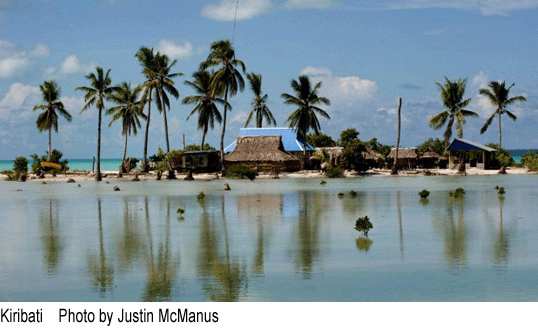
The LDC Group represents 47 countries at UN climate negotiations and says its members are “specially vulnerable to climate change but have done the least to cause the problem”. African nations dominate the LDC group, alongside Pacific and East Asian countries Timor-Leste, Kiribati, Vanuatu and Tuvalu. Continue reading →
Dave Sharma says Liberals ‘doing enough’ on climate after Hewson attack
The Wentworth candidate rejects former leader’s view that party’s policy on emissions is inadequate, Guardian, Anne Davies, @annefdavies 10 Oct 2018 The Liberal candidate for Wentworth, Dave Sharma, said his party is “doing enough” and has “a good record” on climate change, after a blistering attack from former leader John Hewson, who said the party deserved a “drubbing” over its inaction on the issue…….Hewson has accused the Liberals of putting their heads in the sand on the issue and kicking the issue down the road for future generations.
The former prime minister Malcolm Turnbull dropped plans for a national energy guarantee that would have imposed emissions reduction targets and then was dumped by his own party, which was deeply divided over his plan……
the economy has been growing and so too have overall emissions.
Australia is on a trajectory that will see it miss its Paris climate targets – a reduction of 26% to 28% based on 2005 levels – according to figures from the consultants, NDEVR Environmental, for the year up to the end of June 2018.
The NDVER figures showed Australia’s emissions were again the highest on record when unreliable data from the land use and forestry sectors was excluded. This was the third consecutive year for record-breaking emissions.
Despite this, Frydenberg claimed that the nation is on track to meet its Paris commitments – even without the Neg, which he had supported. He also lauded the Coalition’s record on investment in renewables…….
news.com.au , 10 Oct 18, IT WAS Australia’s big hope for cutting your electricity bills and ending the climate wars but today it’s been confirmed that’s not going to happen. EVERYONE has been crying out for the major parties to agree on an energy policy for Australia but it’s becoming clear this is probably not going to happen.
At an energy forum being held in Sydney today, new Federal Energy Minister Angus Taylor dismissed suggestions a bipartisan agreement was the way forward and pointed to the huge difference in the policies of the major parties.
“I don’t know how we’re going to get bipartisanship given we have a 26 per cent emissions reduction target … and the other side has 45 per cent,” Mr Taylor told the AFR Energy Forum 2018.
Australia’s energy policy is in tatters after the National Energy Guarantee was abandoned by the Coalition after Malcolm Turnbull lost the prime ministership.
Now even Labor’s shadow minister for climate change and energy Mark Butler has acknowledged defeat. Speaking after Mr Taylor, he said the idea of developing a bipartisan “market mechanism” to address climate and energy policy would not happen.
“We need to recognise that the solution we’ve been banking on now for a number of years … has been snatched away,” he told the forum.
“They (the Coalition) have walked away from the table because they’ve said they can’t countenance any agreement with Labor over climate and energy policy.”
Mr Butler noted the two parties got close in 2016 with the emissions intensity scheme, then again in 2017 with the clean energy target and most recently with the NEG this year, but each time the policies were taken off the table largely due to revolt within the Coalition party room led by Tony Abbott, despite the policies having broad support among state and territory governments as well as the business community.
“Now we confront a position … where investors are left with no rules to guide their investment decisions once the renewable energy target starts to taper off in coming months.”
As Australia heads towards its next federal election — likely to be held next year — Mr Butler noted there were warnings electricity prices would rise if the NEG was not passed and the futures market was already predicting hikes next year.
But he acknowledged there was no quick fix and said getting the unit price of electricity would be difficult. He said Labor would focus on policies to reduce consumption as a way of lowering bills. It has already announced plans to help businesses with tax write-offs for capital upgrades and software to make them more energy efficient.
He said Australia’s energy efficiency and productivity was already lower than average compared to some other OECD countries and China, which haven’t enjoyed low prices in the past like Australia has.
“The pathway for really substantial reductions to energy bills for business and households, I think, lie more in an aggressive approach to energy efficiency and productivity,” Mr Butler said.
When it comes to the Coalition’s approach, Mr Taylor said Prime Minister Scott Morrison had given him one KPI (Key Performance Indicator) and that was to lower power prices while keeping the lights on………
Opposition Leader Bill Shorten says a lack of policy is preventing Australia from becoming a renewable energy superpower, but admits coal will be part of the mix for the foreseeable future.
“What we need to do is create investment certainty, write out what the rules are so we can get more renewable energy,” he told reporters in Melbourne on Wednesday.
Renewable energy “is getting cheaper and I want to make it more accessible to small business and consumers.”
PRIME Minister Scott Morrison says he is willing to do “whatever it takes” to bring down power bills, and would consider going nuclear if he was convinced it made economic sense.
Mr Morrison has opened a new flank in the energy battle by saying he was open-minded about nuclear, a move South Australia’s former Labor premier Jay Weatherill also once entertained.
Mr Morrison told 2GB radio in Sydney he would overturn a legal ban on building nuclear reactors in Australia if he believed it would put downward pressure on power prices.
Mr Morrison said he would do “whatever it takes” to make electricity cheaper, and have no issues allowing nuclear reactors to be built if it would make lower household bills.
But he warned the investment case to build a nuclear reactor did not “stack up”.
SA’s Nuclear Fuel Cycle Royal Commission, called by Mr Weatherill and completed in 2016, was arguably the most comprehensive examination of the matter undertaken in Australia.
Its strongest recommendation was to pursue construction of a high-level dump for international waste, but the commission also suggested national bans on nuclear be loosened.
Prime Minister Scott Morrison said he would overturn the ban on building nuclear reactors if he believed it would bring down power prices. File image.
It concluded that nuclear power did not make sense in SA because of the state’s relatively low energy demand, and starting from scratch meant a delay until at least 2030 to build a facility.
“This allows 14 years for establishing regulatory systems and expertise, undertaking a detailed assessment of the nuclear supply chain before pre-licensing activities, licensing, project development and construction for a large plant,” the report stated.
“This is an ambitious time frame, but the commission considers it reasonable if there were an imperative.”
It said the economic case for a nuclear plant would strengthen if governments put in place aggressive policies to cut carbon emissions in a bid to stave off catastrophic climate change.
“The potential viability of a nuclear power plant in SA improved under more stringent carbon policies, but remained unviable even under the strong carbon price scenario,” the report found. Former prime minister Tony Abbott last month called for an end to the nuclear ban.
The push to revive the nuclear debate comes after Mr Morrison declared dead the national energy guarantee policy of his predecessor.
Opposition energy spokesman Mark Butler has held out the prospect of Labor reviving the policy in government after industry consultation.
Opposition Leader Bill Shorten said: “At the same time as the site of the Chernobyl nuclear disaster transforms into a massive solar farm, Morrison thinks it’s time to take Australia nuclear. You’ve got to be kidding”.
Australia is the world’s largest coal exporter, with thermal and coking coal shipments last year totalling 382 million tonnes.
The findings of the report are at odds with the Morrison government’s insistence that coal will play an essential role in the nation’s economic future.
For the first time in a IPCC report, the authors included social and economic impacts. That marked “the end of magical thinking” that sustainable development goals and poverty reduction could be divorced from climate action.
“If governments fail to drastically and urgently reduce emissions, they are knowingly contributing to the dangers of a world that is at least 1.5 degrees warmer,” Tessa Khan, co-director of the Climate Litigation Network.
“This has clear legal consequences and governments will inevitably be held accountable for knowingly putting people in harm’s way,” Ms Khan said, noting citizens in the Netherlands, Ireland, Switzerland, Norway, Colombia, the US and New Zealand have already taken their governments to court.
“This litigation is only just picking up speed.”
‘Next decade critical’: Perils mount at 1.5 degrees of warming, says IPCC , Sydney Morning Herald, By Peter Hannam & Nicole Hasham 8 October 2018—The amount of coal and other fossil fuels the world can burn without unleashing dangerous climate change that will undermine the livelihoods of hundreds of millions of people and all but wipe out the Great Barrier Reef is “very small”, according to a major climate report.
The Intergovernmental Panel on Climate Change’s special report on a 1.5-degree hotter planet, released on Monday, said limiting warming to that amount remains possible, but only with “rapid, far-reaching and unprecedented changes in all aspects of society”……..
We’re currently heading towards about 3 degrees or 4 degrees of warming by 2100,” said Mark Howden, director of the Climate Change Institute at the Australian National University and one of the review’s editors.
“Limiting global warming to 1.5 degrees is not impossible but would actually require major transitions in many aspects of society, and to do those transitions, the next 10 years are critical.”
Many of those transitions will mean curbing if not halting entirely the release of greenhouse gas emissions from the burning of fossil fuels, land-clearing and other human activities.
Average temperature rises mask extreme events. Temperatures of hot days are forecast to increase three degrees in a 1.5 degree warmer world, and by four degrees if mean temperatures rise by 2 degrees.
The political will to prevent climate change is lacking, even as the cost climbs Brisbane Times By David Crowe,8 October 2018Australians are being presented with another startling contrast between colossal risk and paltry action over climate change.The latest scientific advice is that human activity has already caused an increase of 1 degree in world temperatures, with global warming estimated to reach 1.5 degrees by 2052 on current trends.
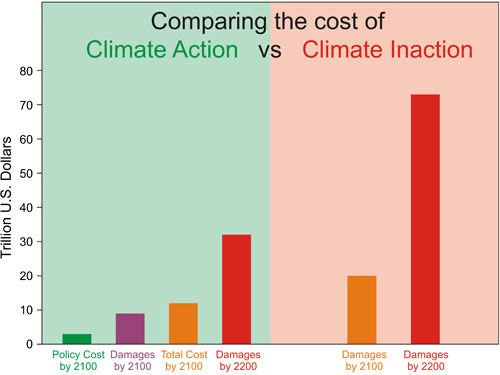
The cost is astronomical. The damage over the years to 2100 would reach $US54 trillion in today’s dollars if warming was kept to 1.5 degrees. The cost would climb to $US69 trillion if warming reached 2 degrees.
The obvious message from the report is to stop the 2 degree scenario. The scientists say this means halting the use of coal by 2050, accelerating the use of renewables and making mammoth investments to change the economy.
This cost is just as draw-dropping. The report says the investment would need to be $US2.4 trillion a year by 2034 across the global economy. There is no country-by-country analysis of what this means but Australia makes up about 1 per cent of global emissions, so it may have the same share of the expense.
Can Australia invest $US24 billion a year to avert dangerous climate change? That is more than the federal government spends on public hospitals.
The answer from the Greens is to shut down coal-fired power stations and stop coal exports, but only about 10 per cent of Australian voters supported this position at the last election by giving the Greens their primary vote.
The two major parties will not rush the closure of coal-fired power stations.
The answer from the government is to ask for more time to come up with a policy. The leadership turmoil in August left the Liberals and Nationals without a plan to reduce emissions.
Prime Minister Scott Morrison insisted on Monday that Australia would meet its emission targets “in a canter” but this is disputed by climate experts. It is a laughable message – nothing more than saying “trust us” – when the demise of the National Energy Guarantee proved again that the Coalition party room is incapable of reaching a consensus and then holding its nerve on energy and climate policy.
IPCC issues dire climate warning, says coal must go to save Great Barrier Reef http://www.abc.net.au/news/science/2018-10-08/ipcc-climate-change-report/10348720Australia and the rest of the world must virtually eliminate the use of coal for electricity within 22 years if there is to be a chance to save even some of the Great Barrier Reef, the world’s most authoritative climate science body has warned.
Key points:
Greenhouse gas pollution must reach zero by about 2050 to stop global warming at 1.5C, a report by the UN climate body warns
At 1.5C coral reefs are expected to decline by a further 70 to 90 per cent, the report says
Experts say coal power needs to drop to between 0 and 2 per cent of existing usage
In a report authored by more than 90 scientists, and pulling together thousands of pieces of climate research, the UN’s Intergovernmental Panel on Climate Change (IPCC) said global emissions of greenhouse gas pollution must reach zero by about 2050 in order to stop global warming at 1.5 degrees Celsius.
At current rates, they said 1.5C would be breached as early as 2040, and 2C would be breached in the 2060s.
If that happens, temperatures over many land regions would increase by double that amount. And at 2C of warming, the authors warn the world would risk hitting “tipping points”, setting a course towards uncontrollable temperatures.
With the world already 1C warmer than pre-industrial times, experts said this report, released by the IPCC in Incheon, Korea, was likely our final warning before it becomes impossible to keep warming at 1.5C.
“To limit temperature change to 1.5 degrees we have to strongly reduce carbon dioxide emissions,” said report contributor Professor Mark Howden from ANU. “They have to decline about 45 per cent by 2030 and they have to reach zero by 2050.
1.5C vs 2C: What’s the difference?
Coral reefs would be a particular casualty. They are expected to decline by a further 70 to 90 per cent even under 1.5C, but that rises to more than 99 per cent reef loss as temperature rises hit 2C.
In Australia, that means the vast majority of the Great Barrier Reef will undergo significant upheaval or collapse.
Combined with increased ocean acidification due to higher carbon dioxide concentrations, this is expected to heavily affect fish stocks and diversity.
Meanwhile on land, a rise of 2C would mean three times as much of the earth’s terrestrial ecosystems would undergo transformations, compared to a rise of 1.5C, significantly increasing species extinctions.
Then there are the rising waters. Modern humans have never seen an ice-free Arctic, but at 2C that would happen once a decade, compared to once a century at 1.5C.
A 2C rise would also mean an extra 10 centimetres of average sea-level rise by the end of the century, affecting an extra 10 million people.
And while some are inundated, a 2C rise would also double the number of people experiencing water scarcity.
We would be hit with more extreme hot weather events in every part of the world: more floods in most, and more drought in some.
Those extreme events would be “far worse” as temperature increases go beyond 1.5C, according to Will Steffen from ANU’s Climate Change Institute.
“Loss of the Amazon forests, melting of the permafrost, loss of ice in West Antarctic and Greenland, they are much riskier at 2 degrees than they are at 1.5,” Professor Steffen said.
“They could lead to a tipping cascade where the system will get hotter and hotter even if we bring our emissions down.”
Paul Waldon Fight To Stop Nuclear Waste Dump In Flinders Ranges SA, 7 Oct 18Conversation Starter · The birth of a nuclear program more than just a few years young will burden not one but two unwilling communities with the country’s legacy of radioactive wastes, one community serving as a cushion to soften the impact of what maybe yet another one of the governments failures, so they can push their program forward to the second chosen site.
This program has seen false codification of high grade waste, and we have all heard the ongoing resounding factoid that nuclear will be a rainmaker with a promise of no less than 45 jobs on offer.
However they fail to tell us the economic void to tourism and impacts to other industries that can not be financially satisfied by embracing such waste from the nuclear industry, for they live in denial of the existential risks, and threats.
Most people may think I’m talking just about South Australia, however there is yet another program in the nuclear seasoned country of America where they are trying to place the burden of radioactive wastes on southeast New Mexico, and west Texas, with a promise of no less than 45 jobs which mirrors the image of the DIIS’s program and is running parallel, and the only difference I see with both of these programs is the acronyms of the governing bodies. https://www.facebook.com/groups/344452605899556/
25 October – Film –Britain’s Nuclear Bomb Scandal: Our Story – part of the Adelaide Film Festival,
Screening and Conversation
A screening of Britain’s Nuclear Bomb Scandal: Our Story (2024) followed by a talk with 2026 Bettison and James Awardee and Tradtional Owner Karina Lester in conversation with Simone Tur.
When: Sun 25 Oct, 12:00pm-Screening, 1:15pm-Talk
Where: The Mercury
Free admission, register below by clicking on BUY TICKETS and select free event tickets, at end of web page: