 Marchers unite against federal nuclear dump https://www.eurekastreet.com.au/article.aspx?aeid=56295, Michele Madigan, 26 August 2018
‘United we can fight. We can’t fight singularly. We have to band together with like-minded people to stop this destruction of our country and make sure that our country is safer for our younger generations.’ — Harry Dare, chairperson, Barngala Determination Aboriginal Corporation.
There were, to quote Port Augusta’sTranscontinental,‘hundreds ‘ of us crossing the bridge on Sunday 19 August, the ‘younger generations’ in the forefront. The glory of the Flinders Ranges were well in sight to our east, the international grain farming land of Kimba 158km to the southwest. The constant cry ‘Not Flinders, Not Kimba, No waste dump is our call’ rang out.
Among the powerful speeches that followed were Harry Dare’s stirring words quoted above, as well as a spellbinding address by young Adnyamathanha woman, Candace Champion, who said: ‘I do not want to bring a child into this world knowing that I’m going to leave them more burdens and heartbreak … You can study your whole life in a classroom, but my family have studied, witnessed, watched and grown on that land for 60,000 years.’
In recent weeks there have been many developments in the federal government’s plan for a national radioactive waste management ‘facility’. In time for the planned vote by a tiny percentage of those who will be impacted by the site selection, the Resources Minister, visiting both regions, tripled to $31 million the amount which the federal government is offering the final site community. And instead of 15 promised jobs, there are now 45.
Paradoxes abound. The $31 million includes $3 million allocated for ‘Aboriginal economic and cultural heritage’ — awarded for a project which many Adnyamathanha say will destroy the Aboriginal culture of the region.
The proposed facilities design finally appeared three years into the campaign. Continue reading →
August 31, 2018
Posted by Christina Macpherson |
AUSTRALIA - NATIONAL, Federal nuclear waste dump |
Leave a comment
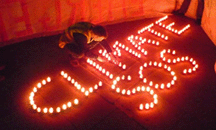 Samoan Prime Minister Tuilaepa Sailele hits out at climate change sceptics during fiery speech, ABC News 31 Aug 18 By Pacific affairs reporter Stephen Dziedzic Samoan Prime Minister Tuilaepa Sailele has lashed out at climate sceptics and urged Australia to make deeper cuts to carbon emissions to help save Pacific Island nations from the “disaster” of climate change.
Key points:
- Mr Sailele says “greater ambition” is needed to stop impact of climate change
- He warns geostrategic competition is creating uncertainty for small Pacific countries
- Australia, New Zealand and the US have been scrambling to reassert influence in the Pacific
Mr Sailele told the Lowy Institute in Sydney that climate change posed an “existential challenge” to low lying islands in the Pacific, and developed countries needed to reduce pollution in order to curb rising temperatures and sea levels.
“We all know the problem, we all know the solutions, and all that is left would be some political courage, some political guts, to tell people of your country there is a certainty of disaster,” Mr Sailele said.
The Prime Minister’s intervention came as some Coalition MPs press the new Prime Minister Scott Morrison to abandon Australia’s promise to cut carbon emissions under the Paris agreement.
New Foreign Minister Marise Payne is also expected to face questions about Australia’s climate change policies at the Pacific Islands Forum leader’s meeting in Nauru next week.
Senator Payne and Pacific leaders are set to sign the “Biketawa Plus” security agreement, which declares that climate change remains the “single greatest threat to the livelihoods, security and wellbeing of the peoples of the Pacific”.
Several other leaders — including Fiji’s Prime Minster Frank Bainimarama and the Marshall Island’s President Hilda Heine — have also called on Australia to do more to cut emissions.
Mr Sailele told the audience that “greater ambition” was needed to stop the destructive impact of climate change.
“While climate change may be considered a slow onset threat by some in the region, its adverse impacts are already being felt by Island communities,” he said……… http://www.abc.net.au/news/2018-08-31/samoan-prime-minister-hits-out-at-climate-change-sceptics/10185142
August 31, 2018
Posted by Christina Macpherson |
AUSTRALIA - NATIONAL, climate change - global warming, politics international |
Leave a comment

Oz is the only country in the world to adopt an ambitious price on carbon pollution and then promptly repeal it.
All this does not bode well for advocates of climate action. Extreme weather is battering Australia on all fronts: Carbon-warmed oceans are plundering its Great Barrier Reef, and a record-breaking drought is ravaging the country’s well-populated southeast. Yet even its center-right-led, middling attempt at a climate policy is withering on the vine. On Monday, in one of his first public appearances since taking office, Prime Minister Morrison declined to comment on whether climate change is intensifying the country’s drought.
The Global Rightward Shift on Climate Change, President Trump may be leading the rich, English-speaking world to scale back environmental policies. The Atlantic , ROBINSON MEYER, AUG 28, 2018 Last Thursday, Malcolm Turnbull was the prime minister of Australia. By the end of this week, he’ll be just another guy in Sydney.
Turnbull was felled by climate-change policy. His attempt at a moderate, even milquetoast energy bill—which included some mild cuts in greenhouse-gas emissions—proved too aggressive for his co-partisans. On Friday, members of Australia’s center-right Liberal Party voted him out of office…..
Turnbull’s tumble remains a disquieting sign for anyone hoping for an aggressive global climate policy. In Australia—where global warming has contributed to the die-off of half the coralin the Great Barrier Reef since 2016—even a mild climate bill could not pass under a conservative government.
It points to an emerging pattern: Moderate national leaders—on both the center-left and center-right—in some of the world’s richest and most advanced countries are finding it far easier to talk about climate change than to actually fight it.
At a basic level, this pattern holds up, well, everywhere. Every country except the United States supports the Paris Agreement on climate change. But no major developed country is on track to meet its Paris climate goals, according to the Climate Action Tracker, an independent analysis produced by three European research organizations. Even Germany, Japan, and the United Kingdom—where right-wing governments have made combatting climate change a national priority—seem likely to miss their goals.
Simply put: This kind of failure, writ large, would devastate Earth in the century to come. The world would blow its stated goal of limiting atmospheric temperature rise. Heatwaves might regularly last for six punishing weeks, sea levels could soar by feet in a few short decades, and certain fragile ecosystems—like the delicate Arctic permafrost or the kaleidoscopic plenty of coral reefs—would disappear from the planet entirely.
Australia’s recent instability further complicates this unease. The global climate action of 2016 may be producing something like a worldwide climate backlash—especially in countries with powerful fossil-fuel interests, like Australia and Canada. Or—far more worryingly for climate advocates—these changes in policy may be trickling down from the biggest historical emitter of greenhouse gases of them all: the United States.
The victims of climate change are already here Continue reading →
August 31, 2018
Posted by Christina Macpherson |
AUSTRALIA - NATIONAL, climate change - global warming, politics international |
Leave a comment
‘Mad’ and ‘morally irresponsible’: Liberal moderates roast new emissions stance, Canberra Times By Nicole Hasham, 31 August 2018, Senior Liberal figures have labelled the Morrison government’s stance on climate change as “mad” and “morally irresponsible” as the party’s moderate wing reels at the ultra-conservative takeover of Australia’s energy policy.In his first speech as Energy Minister in Melbourne on Thursday, Angus Taylor reiterated the Morrison government’s intention to curb electricity prices, but made no mention of reducing greenhouse gas emissions created by burning fossil fuels for energy.
There will be no ideology in what I do … my goal, the goal of my department and the goal of the electricity sector must be simple and unambiguous – get prices down while keeping the lights on,” he said.
Mr Taylor did not take questions after the speech at the Council of Small Business of Australia summit in Melbourne, reportedly avoiding waiting media by retreating to a meeting room then leaving via a back door.
Prime Minister Scott Morrison on Thursday confirmed that responsibilities for meeting Australia’s emissions reduction targets under the Paris treaty will now fall to new Environment Minister Melissa Price.
The Coalition’s plans to legislate emissions reduction as part of its energy plan were shelved in the final days of Malcolm Turnbull’s prime ministership following a backlash from conservative backbenchers who threatened to cross the floor.
Fairfax Media spoke to several moderate senior Liberal Party figures dismayed at the direction of the Morrison administration’s energy policy and concerned at the appointment of Mr Taylor, who has campaigned against wind farms and renewable energy subsidies.
A senior NSW government source said the federal Coalition’s avoidance of emissions reduction was “just putting off the inevitable”.
“[They] are going to have to deal with it because that’s what the Australian public wants. Kicking it down the road is unhelpful,” the source said.
It’s been 10 years now and we are still no closer to getting this issue resolved. Nobody in Canberra can hold their heads up high in regards to this.”
A senior NSW Liberal MP said any politician who acknowledged the science of climate change was “morally obliged to do something about it”…….https://www.canberratimes.com.au/politics/federal/mad-and-morally-irresponsible-liberal-moderates-roast-new-emissions-stance-20180830-p500r2.html
August 31, 2018
Posted by Christina Macpherson |
AUSTRALIA - NATIONAL, climate change - global warming, politics |
Leave a comment
Author: Luke Pearson Luke Pearson is the founder and director of IndigenousX. 31 August 18
‘It is patronising because we do not need a ‘special envoy’ when we have
so many capable and talented Indigenous people in Australia
more than able to speak for ourselves.
We do not need a non-Indigenous individual to act as a ‘conduit’
between us and government, or to give advice on our behalf.
Especially not when that individual already did so much damage
to the Indigenous Affairs portfolio when he was in power.
The only solace we can take is that he has much less power in this new role.
‘In case you forgot, Tony Abbott was responsible for disbanding
a wide array of Indigenous advisory groups which he
replaced with his handpicked ‘PM’ advisory group.
He took over half a billion dollars out of the Indigenous Affairs budget
with no real planning or reflection. … ‘ indigenousx.com.au/we-do-not-need-a-special-envoy-we-need-our-leaders-to-listen/
August 31, 2018
Posted by Christina Macpherson |
aboriginal issues, AUSTRALIA - NATIONAL |
Leave a comment
Fighting for life in the “place of death”https://beyondnuclearinternational.org/2018/08/27/fighting-for-life-in-the-place-of-death/ August 27, 2018 by beyondnuclearinternationa
Traditional owners won’t give up 40-year opposition to Yeelirrie uranium mine, By Linda Pentz Gunter
In the local Aboriginal language, the name Yeelirrie means to weep or mourn. It is referred to as a “place of death.” Yeelirrie is on Tjiwarl Native Title lands in Western Australia, where it has long been faithfully protected by Aboriginal traditional owners. The Seven Sisters Dreaming songline is there. It is home to many important cultural sites. And for 40 years, due to resolute indigenous opposition, and thousands of community submissions of protest, it had been spared plans by the Canadian mining company, Cameco, to plunder it for uranium.
The earth guardians know that such a desecration would cause the extinction of multiple species of subterranean fauna. It would release death. It would destroy Yeelirrie.
Now the fate of those tiny creatures hangs in the balance, their future in the hands of three brave women, backed by environmental organizations, after the outgoing Western Australian government decided to allow the Yeelirrie uranium mine project to go forward.
That decision was made in January 2017, despite the fact that, in August 2016, the Western Australia Environmental Protection Agency (WAEPA) had recommended that the Yeelirrie project be rejected.
The Conservation Council of Western Australia (CCWA), which is engaged in contesting the uranium mining permit for Yeelirrie, said the WAEPA had rejected the Yeelirrie mine plan “on the grounds that the project is inconsistent with three of the objectives of the Environmental Protection Act — the Precautionary Principle, the Principle of conservation of biological diversity, and the Principle of intergenerational equity. The EPA decision was based on the overwhelming evidence that the project would make several species of subterranean fauna extinct.”
But former Minister for Environment, Albert Jacob, threw all that aside to approve the Yeelirrie mine in the waning days of Western Australia’s Liberal government, now replaced by Labor, which came in on a mandate to end uranium mining that it now may not be able to enforce.
In February 2018, CCWA and three members of the Tjiwarl community initiated proceedings in the Western Australia Supreme Court in an attempt to invalidate the approval decision made by Jacob. The case was dismissed by the court, a decision said CCWA executive director, Piers Verstegen, that shows that “our environmental laws are deeply inadequate,” and “confines species to extinction with the stroke of a pen.”
However, while the decision was a set-back, Verstegen said, “it’s absolutely not the end of the road for Yeelirrie or the other uranium mines that are being strongly contested here in Western Australia.”
Accordingly, CCWA and the three Tjiwarl women — Shirley Wonyabong, Elizabeth Wonyabong, and Vicky Abdullah (pictured left to right above the headline) vow to fight on, and have begun proceedings in the WA Court of Appeal to review the Supreme Court decision.
“I grew up here, my ancestors were Traditional Owners of country, and I don’t want a toxic legacy here for my grandchildren,” Abdullah told Western Australia Today in an August 2017 article.
“We have no choice but to defend our country, our culture, and the environment from the threat of uranium mining — not just for us but for everyone.”
Yeelirrie is one of four uranium mines proposed for Western Australia. The other three are Vimy’s Mulga Rock project, Toro Energy’s Wiluna project, and Cameco’s and Mitsubishi’s Kintyre project. Each of them is home to precious species, but Yeelirrie got special attention from the WAEPA because the proposed mine there would cause actual extinctions of 11 species, mostly tiny underground creatures that few people ever see.
According to a new animated short film, produced by the Western Australia Nuclear-Free Alliance, all four of these proposed mines could irreparably damage wildlife, habitat and the health of the landscape and the people and animals who depend on it. The film highlights Yeelirrie, but also describes the other three proposed uranium mines and the threats they pose.
At Mulga Rock, in the Queen Victoria Desert, the site is home to the Sandhill Dunnart, the Marsupial Mole, the Mulgara and the Rainbow Bee Eater, according to the film.
Wiluna, a unique desert lake system, could see uranium mining across two salt lakes that would leave 50 million tonnes of radioactive mine waste on the shores of Lake Way, which is prone to flooding.
The Kintyre uranium deposit was excluded from the protection of the Karlamilyi National Park within which it sits so that uranium could be mined there. It is a fragile desert ecosystem where 28 threatened species would be put at risk, including the Northern Quoll, Greater Bilby, Crest Tailed Mulgara, Marsupial Mole and Rock Wallaby.
At Yeelirrie, says the CCWA, “Cameco plans to construct a 9km open mine pit and uranium processing plant. The project would destroy 2,421 hectares of native vegetation and generate 36 million tonnes of radioactive mine waste to be stored in open pits.”
The mine would likely operate for 22 years and use 8.7 million litres of water a day.
Under Australian laws, ‘nuclear actions’ like the Yeelirrie proposal also require approval by the Federal Environment Minister. CCWA and Nuclear-Free Western Australia, have launched a campaign directed at Federal Environment Minister, Josh Frydenberg, calling for a halt to the Yeelirrie mine, given the immense risk it poses to “unique subterranean fauna that have been found nowhere else on the planet.” They point out that the Minister has the opportunity to “protect these unique species from becoming extinct.
“Species have a right to life no matter how great or small,” they wrote. “One extinction can massively disrupt an entire ecosystem. No one should have the right to knowingly eliminate an entire species from our planet forever.”
August 29, 2018
Posted by Christina Macpherson |
aboriginal issues, opposition to nuclear, uranium, Western Australia |
Leave a comment
Business-SA published a regional survey today & despite widespread opposition they continue to pursue an international radioactive suppository. Like their Federal cronies, the ignorant BS credulity can only deliver divisive smokescreens of vain leadership divorced from the lives of the people they claim to provide for.
Anecdotally, some regional business owners in the Far North, members of B-SA; claim they had no knowledge of the survey prior to it’s release……
High Level Waste mentioned on pages:
p15 = 55% against overall;
p24 = Eyre Peninsular 41% anti 41% pro;
p27 = Far North including Port Augusta & Whyalla 50% pro 39% anti;
p32 = Murray/Riverland 50% anti:
p74 = Barossa 80% anti + KI 74% anti + SE 63% anti
http://business-sa.com/getmedia/35736f09-7f57-4cc7-bbff-e30bd4856077/Regional-Voice_Brochure
August 29, 2018
Posted by Christina Macpherson |
Federal nuclear waste dump, politics, South Australia |
Leave a comment

 Aboriginal Elders Face Off with Uranium Mining Co. in the Australian Outback, Earth Island Journal , BY ELIZABETH MURRAY – AUGUST 27, 2018
With four new mines approved in the Western Desert, the Tjiwarl turn to courts for help
Members of one of Australia’s most remote Aboriginal nations, the Tjiwarl, who live in the red heart of the Western Desert lands, are embroiled in a long running battle to protect their ancestral home from mining interests.
Last year, the government of Western Australia approved four new uranium projects in the state, despite warnings issued by the Western Australian Environmental Protection Authority, and a global slump in the price of uranium.
Two of the projects, in Yeelirrie and Kintyre, belong to the Canadian mining giant Cameco. The other two are by Australia-based companies, Vimy Resources and Toro Energy.
While uranium use is banned in Australia it holds 33 percent of the world’s uranium deposits, and, it is the world’s third-largest producer of the mineral after Kazakhstan and Canada. Seen as controversial among Australian politicians and unpopular with electorates, uranium operations have drawn both federal and state government bans at various times.
In February this year, the Supreme Court of Western Australia backed the expedited approval of the Yeelirrie uranium project granted by the previous state government in January 2017, but recognized the duty of the Tjiwarl applicants as cultural custodians of Yeelirrie, to preserve those lands. Tjiwarl Elders, Elizabeth and Shirley Wonyabong, and Tjiwarl Traditional Owner Vicky Abdullah, are now appealing that Supreme Court decision, with the support of the Conservation Council of WA.
Western Desert Aboriginal nations have battled against uranium mining on their lands for forty years. It is just one of the many struggles they have faced to preserve their 40,000 year-old culture and spiritual connections to the land in the face of contemporary society’s competing priorities…….
Conservation Council of Western Australia Director, Piers Verstegen, said that the Yeelirrie approval had undermined the existing environmental protection framework. He said the approval “knowingly allows the extinction of multiple species” in Yeelirrie and “treats the EPA and its environmental assessment as something to be casually dismissed.”…….
If the Tjiwarl appeal was successful, it would restore the normal approval process and protect it from political influence, he said. Conversely, if it fails, governments in Western Australia will forever be able to use ministerial oversight to override the independent authority of the Environmental Protection Agency.
The council has previously expressed alarm over the Yeelirrie project’s proposal to clear 2421 hectares of native vegetation for a 9 km-open-pit mine, which they estimate could generate 36 million tons of radioactive waste.
Dr. Euan Ritchie, Associate Professor in Wildlife Ecology and Conservation at Deakin University, independent of the proceedings, said some remote regions are under-surveyed and Yeelirrie may fit that category. In such a circumstance, “where the fauna is unique…species that are not found in other areas, and/or it is in an area that is under-surveyed…there’s a risk of inadvertently having a negative effect on species because of our lack of understanding of what species are there.”
He said important research is developing in relation to cryptic species (species that are morphologically similar but genetically different, and unable to interbreed).
Thorough surveys of plant, animal and other organisms in the area of potential developments were vital, above and below ground, he stressed. The impact of uranium on water resources can be critical for many species in the food chain over a wide expanse, he added, and could extend well beyond the boundaries of a project.
Apart from the delicate, unique ecology of Yeelirrie, the area also includes multiple ancient Aboriginal spiritual sites there are so sacred that they cannot even be discussed or explained in open court or media……..
Cameco Australia has decided not to proceed with the Yeelirrie project until there’s renewed market demand for uranium. Additionally, in Cameco’s 2017 third-quarter report, the company’s global chief Tim Gitzel said “difficult conditions” were continuing and there had been “little change in the market.” In fact, earlier this year, just a week before the Tjiwarl filed their appeal against the project, Cameco suspended two more of its key mines in Canada, citing the global glut and the company’s own large inventory. ……
Financial pundits have also questioned if uranium prices can ever make a comeback with the growing strength of renewables on the market. http://www.earthisland.org/journal/index.php/elist/eListRead/aboriginal_elders_face_off_with_uranium_mining_co._in_the_australian_outbac/
August 29, 2018
Posted by Christina Macpherson |
aboriginal issues, opposition to nuclear, uranium, Western Australia |
Leave a comment
 ‘Kick This Mob Out’: Hanson-Young Takes Aim Over Climate Policy Paralysis https://newmatilda.com/2018/08/28/kick-mob-hanson-young-takes-aim-climate-policy-paralysis/ By Sarah Hanson-Young on August 28, 2018
The Liberal Party of Australia is now officially a party split in half by climate denial. Greens Senator Sarah Hanson-Young explains. We have no chance of seeing the Liberal Government take any type of climate policy to the election.
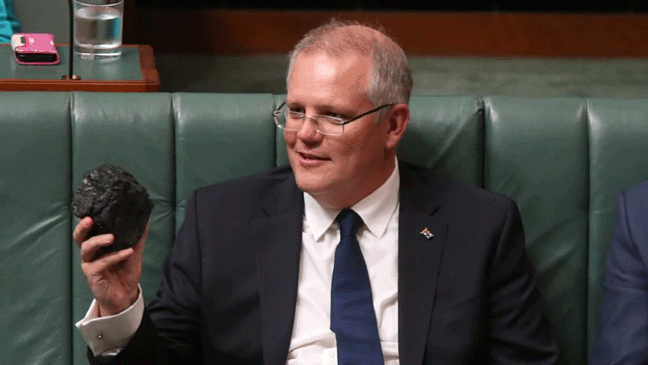
After dumping Malcolm Turnbull for daring to utter the words “carbon emissions”, Scott Morrison, the man who brought a lump of coal into the Parliament, has appointed a climate sceptic as Environment Minister. He has put an anti-wind farm campaigner at the helm of the Energy Ministry.
While Scott Morrison’s new front bench will spend the week sopping up blood and repeating unconvincing lines of “unity and renewal”, the rest of the country looks on in disgust.
As the nation burns in winter, drought ravages New South Wales, and the Murray Darling River runs to a trickle, the mob governing the country couldn’t give a damn.
In a last-minute attempt to save his own job, Malcolm Turnbull served a fatal blow to the environment making it near impossible for the Coalition to have a climate policy for at least a generation.
Roughly half of the Liberal Party room don’t believe in the science of climate change, and now their leader is a bloke whose pet rock is a lump of coal. A growing number of Australians, tired of waiting for leadership out of Canberra, are taking matters into their own hands. And the good news is, there’s plenty of ways to make a difference.
Whether it is about the waste we create, the food we eat and putting solar panels on our homes to reduce power bills and pollution, we all have the opportunity to help reduce our impact on the planet and environment. But, while everyday Australians are chipping in, our politicians are tapping out, and unfortunately, some problems can’t be solved without political leadership.
The environment needs a strong political advocate. Sadly, the people Scott Morrison has put in place will do nothing to alleviate fears of Australians worried about our impact on the health of the planet.
New Environment Minister Melissa Price is a climate sceptic and advocate for the mining industry, and Angus Taylor, a known anti-windfarm campaigner will put a wrecking ball through renewables as Energy Minister.
After all the internal drama that stopped the Government from governing last week, political leadership on climate change is further away than ever. Dumping any emissions reduction target means there is now no prospect of a roadmap to help drive pollution down or support a transition to renewables. This is worse than policy paralysis, it is policy regression.
We need strong action to save the Murray Darling River system for future generations, arrest climate change by reducing pollution, protect our oceans and stop the extinction crisis in its tracks.
The battle lines are clear. The only way to do any of this now is to kick this mob out.
August 29, 2018
Posted by Christina Macpherson |
AUSTRALIA - NATIONAL, climate change - global warming, politics |
Leave a comment
Nuclear Free WA, K-A Garlick, 29 Aug 18 It’s the last week of the Walkatjurra Walkabout! Over 60 people have walked through awesome country in support and solidarity with Traditional Owners to stop uranium mine projects on their country. From Lake Way in Wiluna to the gates of Yeelirrie and finally finishing in Leonora this week they have walked over 250kms to raise awareness about this toxic industry that would destroy beautiful land, water and communities. The walk will finish with a public meeting in Leonora to share messages from the Walkatjurra Walkabout and to give updates on the Yeelirrie court challenge and the proposed national radioactive waste dump. You can see photos and read about their adventures here.
We welcome the new Federal Environment Minister, Melissa Price, Member for Durak, WA that includes Wiluna and Yeelirrie in her electorate not to Federally approve the Yeelirrrie uranium project and look forward to working with her on this issue.
Looking forward to seeing you all at the Projections at Parliament event on the 11th September to send a clear and important message to the WA Government to ban uranium mining permanently. See below for further details.
If you haven’t seen it … please watch and share the short 2 min video Uranium: West Australia under threat to make uranium mining extinct – not WAs unique species.
August 29, 2018
Posted by Christina Macpherson |
opposition to nuclear, uranium, Western Australia |
Leave a comment
 Can’t vote Liberal ‘in good conscience‘: Alex Turnbull blasts climate stance , Brisbane Times, By Peter Hannam, 27 August 2018
 Alex Turnbull blamed “rent-seekers” backing the coal industry for
felling his father Malcolm Turnbull as prime minister, saying it’s “impossible” to vote for the Liberal-National coalition “in good conscience” because of its climate stance.
In a wide-ranging interview just days after his father lost power in a party room putsch, the Singapore-based fund manager told Fairfax Media the Liberal Party faced being hijacked by financial interests that stood to make windfall profits if coal-related assets were bolstered by taxpayers.
Those interests “have their hooks into the Liberal Party … which has no money”, Mr Turnbull said, adding that returns could be “100 to 1” if policies fall investors’ way.
Mr Turnbull’s experience includes a stint at investment banking giant Goldman Sachs. Some of his work has also involved trading debt for Australian-based coal-fired power plants, giving him insights into that industry’s outlook.
“If you create such an environment – with such a high rate of return – you’ll see a lot more of that [influence peddling],” he said……..
“It’s impossible to vote for the LNP in good conscience,” Mr Turnbull said, adding he had no intention of entering politics himself. “My father fought the stupid and the stupid won.”
Mr Turnbull was also critical of the government’s overall climate action, saying that pulling the Paris Agreement – as conservative MPs and pundits have been demanding – was irrelevant at this point.
“It’s like being in a university course, final exams are coming and you haven’t done three-quarters of the work,” he said. “You’re going to fail anyway.”……
He predicted Labor’s left would keep that party “honest” on climate change.
Bill Shorten “doesn’t really care about climate change – he just wants the jobs”, Mr Turnbull said, adding that there were lots of them in Victoria and elsewhere as the renewable energy boom rolls on.
Two terms of federal Labor should mean Australia’s electricity sector “would have crossed the magic line” – such as exceeding 40 per cent of supply from wind and solar. “They’re not going to be able to go back.”
Taking serious action on climate change “should be the response of any sane leader”, he said. https://www.brisbanetimes.com.au/environment/climate-change/can-t-vote-liberal-in-good-conscience-alex-turnbull-blasts-climate-stance-20180827-p50018.html
August 29, 2018
Posted by Christina Macpherson |
AUSTRALIA - NATIONAL, climate change - global warming, politics |
Leave a comment
‘A Senate report warning of damage to the 50,000-year-old treasures
has persuaded the state government to act’ Calla Wahlquist
@callapilla,27 Aug 2018
‘The Western Australian government has formally committed to
pursuing world heritage status for the Burrup peninsula,
one of the oldest and richest examples of rock art in the world.
‘It comes five months after a Senate inquiry report into managing the site warned that the cumulative emissions from heavy industry on the peninsula, centred around the north-west shelf gas project, could be damaging
the surface of the rock art and causing it to degrade.
‘The step towards nomination has been welcomed by rock art experts,
who say it is one of the most significant archeological sites in the southern hemisphere.
‘“The thing that is unique about this is that it covers almost the entire origin of the north-west coast of Australia, and it is hunter-gatherers from the bottom to the top,”
director of the University of Western Australia’s centre for rock art
research and management, Jo McDonald, said.
“Nowhere else has it covered 50,000 years of hunter-gatherer human history.” … ‘ Read more of Calla Wahlquist‘s ground-breaking & comprehensive & well-researchedarticle:
www.theguardian.com/australia-news/2018/aug/27/burrup-peninsula-rock-art-western-australia-to-seek-world-heritage-listing
August 29, 2018
Posted by Christina Macpherson |
aboriginal issues, art and culture, Western Australia |
Leave a comment
Climate change is World War III, and we are leaderless, ABC News, 28 Aug18 By David Shearman
“,World War III is well and truly underway. And we are losing,” writes environmental activist Bill McKibben, so when Malcolm Turnbull implied that the insurgency that demolished his government was based on climate ideology, what lessons are there for Scott Morrison?
As a child in Britain during WWII, I lived in a street of mothers and children. ……..
Britain was a united and cohesive community. Young and old worked daily in small ways for the common cause. But most importantly, in the free world, two countries — Britain and the US — had leaders in Winston Churchill and Franklin D Roosevelt who could explain the need for duty and sacrifice.
Their like is yet to emerge today, and indeed the Western world is bereft, perhaps apart from French President Emmanuel Macron, who explained to Congress and the American people that secure borders are irrelevant to this threat, and all of us are world citizens needing to act in concert. “There is no Planet B,” he said.
He challenged Malcolm Turnbull to show leadership on climate change.
US and Australia trading ideology for human lives
Two of the world’s highest per capita carbon emitters, the United States and Australia, have deserted the trenches of WWIII by trading ideology for human lives and health.
Climate change litigation rising with the seas
The US response to the climate threat has been withdrawal from the Paris agreement and a full-frontal attack on the US Environmental Protection Authority, a national defence against climate change, pollution and ill-health — as irrational as if the Germans had demolished their “Siegfried Line” of WWII.
As a doctor, I know that they will compromise the health of children and families from relaxation of pollution standards on coal-fired power stationsand from weaker fuel standards. Their actions are an attack on all humanity and thereby the US has abandoned world leadership.
Australia’s response to climate change is devious; under the guise of action, the transition to renewable energy has been carefully modulated to maintain coal. Policy was corrupted by deference to a party clique of climate deniers who proudly named their group after Australia’s most illustrious WW1 general John Monash, and were deaf to his descendants pleading for his name to be removed.
Like the US, Australia is failing to save the lives of its citizens by prolonging the life of polluting coal-fired power.
As a wealthy, technological nation failing to assist others in a transition from fossil fuels, and soon to become the leading exporter of coal and gas in the world, Australia has failed to temper its quest for prosperity and serve the needs of humanity……..http://www.abc.net.au/news/2018-08-28/climate-change-is-world-war-3-and-we-are-leaderless/10168962
August 29, 2018
Posted by Christina Macpherson |
AUSTRALIA - NATIONAL, climate change - global warming, politics |
Leave a comment
|
 PM Scott Morrison evades climate change link to drought, 9 News PM Scott Morrison evades climate change link to drought, 9 News
4:22pm Aug 27, 2018 Scott Morrison won’t say if human-induced climate change is associated with the drought in Queensland and NSW because it doesn’t help solve practical problems.The new prime minister visited a drought-stricken Quilpie farm in rural Queensland in his first visit in the job, but refused to say if he thought climate change was affecting the drought.
“Climate is changing, everybody knows that,” he told reporters today.
“It’s not a debate I’ve participated a lot in in the past, because I’m practically interested in the policies that will address what is going on here right and now. “I’m interested in getting people’s electricity prices down and I’m not terribly interested in engaging in those sorts of debates at this point.”…….Labor attacked Mr Morrison for making Barnaby Joyce a special drought envoy, calling the decision a slap in the face for farmers.
Opposition agriculture spokesman Joel Fitzgibbon said the position would allow the former Nationals leader to campaign across Australia at public expense.
“The appointment of climate change denier Barnaby Joyce as his drought envoy is a joke and a slap in the face for all in the sector who want meaningful drought policy reform,” Mr Fitzgibbon said. ……Mr Fitzgibbon said Mr Morrison had made a bad start, accusing the prime minister of using drought as a plaything to improve his image. https://www.9news.com.au/2018/08/27/15/46/prime-minister-scott-morrison-visits-drought-hit-southern-queensland
|
|
August 29, 2018
Posted by Christina Macpherson |
AUSTRALIA - NATIONAL, climate change - global warming, politics |
Leave a comment
 Marco Balsamo www.transcontinental.com.au/profile/605/marco-balsamo
PROTEST: ‘Hundreds of people from across the state came together to rally
against the proposed national radioactive waste management facility. …
‘ The rally was organised by the Barngarla people, just two days after
the Supreme Court of South Australia granted an interlocutory injunction
on the community postal ballot.
Barngarla man Harry Dare said it was important for people of all backgrounds
to stand together against the facility.
‘“United we can fight. We can’t fight singularly,” Mr Dare said. …
‘Adnyamathanha woman Candace Champion was among the guest speakers,
calling on the government to listen to the opinions of the traditional owners.
‘“I do not want to bring a child into this world knowing that I’m going to leave them
more burdens and heartbreak than blessings and a safe environment,” she said.
‘“You can study your whole life in a classroom, but my family have
studied, witnessed, watched and grown on that land for 60,000 years.”’
Read more of Marco Balsamo‘s interesting reportback:
www.transcontinental.com.au/story/5596675/standing-up-against-nuclear/?cs=5812
August 26, 2018
Posted by Christina Macpherson |
aboriginal issues, AUSTRALIA - NATIONAL, Federal nuclear waste dump, Opposition to nuclear |
Leave a comment













 Antinuclear