Black Mist Burnt Country: art under the nuclear cloud of Maralinga
https://www.smh.com.au/entertainment/art-and-design/black-mist-burnt-country-art-under-the-nuclear-cloud-of-maralinga-20180823-p4zz7i.html, By Karen Hardy 24 August 2018 On September 27, 1956, the British exploded an atomic bomb on Pitjantjatjara land in South Australia. The place would become known as Maralinga, which means “thunder” in the now-extinct Garik Aboriginal language.
Black Mist Burnt Country tells the stories of the atomic tests in Australia in the 1950s and ’60s, revisiting the events and locations through the artworks of Indigenous and non-Indigenous contemporary artists across the mediums of painting, print-making, sculpture, photography, video and new media.
Now showing at the National Museum of Australia, it has been touring with great success since September 2016, opening then to commemorate the 60th anniversary of the first test at Maralinga.
Curator JD Mittman, from the Burrinja Dandenong Ranges Cultural Centre, grew up “under the nuclear cloud” in Germany during the 1980s and when he came to Australia he was surprised to learn there had been atomic tests here.
In the collection of the small community arts centre he found a large canvas work by Jonathan Kumintjarra Brown entitled Maralinga Before the Atomic Test.
The question for me was what did ‘after’ look like?”
When he began his research he was surprised to find so many works concerning Australia’s place in the nuclear race.
Artist Arthur Boyd participated in anti-nuclear demonstrations in the 1960s and his Jonah on the Shoalhaven – Outside the City (1976), features a tiny mushroom cloud, blending biblical imagery with contemporary landscape and personal symbolism.
Sidney Nolan’s Central Desert: Atomic Test (1952-57) is part of a classic series of desert landscapes Nolan began in the late 1940s. He added a mushroom cloud on the horizon at a later date.
“Every generation has taken a different approach.”
There are large canvases by Kumintjarra Brown, one Frogmen, shows three men in masks and protective suits, another Black Rain tells the tragic story of a group of Anangu people who were found huddled together, dead, in a crater near the bomb site.
Mittman says it’s important for Australians, particularly generations who may not have even heard of the testing, let alone those of us to whom Maralinga is a familiar word but were unaware of such details as then prime minister Robert Menzies did not even consult cabinet when he gave permission to begin the testing.
“There is great concern among the indigenous community, and I don’t want to speak on their behalf, about the ongoing repercussions of the testing on country.
“And it’s even more than that, the multi-media work from Linda Dement and Jessie Boylan builds a bridge between the past and the present. “There are 15,000 warheads in the world at present, many of them on planes, in submarines, ready to strike within minutes.
He says it’s somewhat fitting that the exhibition opens in Canberra in the same week the International Campaign to Abolish Nuclear Weapons protest arrives in Canberra heading to parliament to urge politicians to ratify the nuclear weapon ban treaty.
Black Mist Burnt Country at the National Museum of Australia until November 18.
What can we expect of Australia’s new Environment Minister?
 It looks like being Melissa Price – who seems to have a good background in environment, and even believes in climate change! On the other hand, she previously worked for Crossland Resources, (they may or may not be connected to Crossland Uranium Resources).
WA regional MP Melissa Price set to be new federal environment minister , WA Today By Nathan Hondros, 26 August 2018 Western Australian MP Melissa Price will be promoted to the environment portfolio as part of Prime Minister Scott Morrison’s Cabinet shake up.
Ms Price, who represents the North West seat of Durack – the largest single member electorate in the world, assisted former environment minister Josh Frydenberg in the role and is understood to have supported Mr Morrison for the Liberal party leadership……..
Ms Price was a lawyer before entering parliament, working as general counsel for CBH Group and Crosslands Resources Ltd.
As assistant environment minister, Ms Price has been responsible for climate adaptation and resilience, biodiversity, chemicals, waste, air quality and ozone policy, and was the director of Australia’s national parks. https://www.watoday.com.au/politics/western-australia/wa-regional-mp-melissa-price-set-to-be-new-federal-environment-minister-20180826-p4zzuh.html
Barngarla Aboriginal community’s Native Title includes the land around Kimba nuclear waste dump plan: Human Rights Commission to consider their voting rights
 Kimba vote debate moves to Human Rights Commission, Eyre Tribune, 24 Aug 18 Jarrad Delaney
The Barngarla community of Eyre Peninsula are hoping to take another step towards inclusion in the National Radioactive Waste Management Facility site selection ballot for Kimba as the matter now heads to the Australian Human Rights Commission.
On Thursday the Supreme Court of South Australia adjourned the matter of Barngarla Determination Aboriginal Corporation v Kimba District Council with the two parties now scheduled to participate in conciliation in the commission at a date yet to be determined.
The injunction restricting the council from conducting the ballot remains in place.
Corporation co-chairperson Emma Richards said this was a great result and hopefully it would lead to the wider Barngarla community having a say on what happens on their land.
“We’re really happy with that because it allows us to challenge being excluded from the vote,” she said.
“We shouldn’t have to ask (to be included).”
Ms Richards said this also highlighted how the Barngarla community missed out on the consultation process.
The Barngarla community celebrated determination of Native Title with a handover ceremony held in Whyalla in June. The claim covers 44,500 hectares of the Eyre Peninsula and Iron Triangle, and includes the land around Kimba….
The Adnyamathanha Traditional Lands Association, who is also challenging against the location of a potential site near Hawker, has applauded the court’s decision and the Barngarla’s efforts.
“If Traditional Owners are shut out of this ballot then the government will not be in a position to rely on the results as any sort of community support or otherwise,” association chief executive officer Vince Coulthard said.https://www.eyretribune.com.au/story/5605912/kimba-vote-matter-moves-to-commission/
Kimba’s aging population will hand the disaster of a “temporary” nuclear waste dump on to their descendants

“The Federal Government has consistently misled Kimba residents about its intentions. Residents have been repeatedly told that the above ground store for long-lived intermediate-level waste^ would hold waste for several decades until a deep underground disposal facility is available,” Mr Green saidMost of Kimba’s residents are the Silent and Baby Boomer generation so are unlikely to see a deep repository built,
Furthermore, this group will never face the outcome of our future, and this is a serious matter of choice being made for thousands of generations, by so very few.
keywords: ‘Residents’, ‘above-ground store’, repeatedly told’, ‘long-lived intermediate-level waste’, ‘several decades’.
_____________
^including spent nuclear fuel reprocessing waste
source: the advertiser news blog – Adelaide now
https://goo.gl/NFSz5b
population of Kimba: https://goo.gl/CkaRZj
47.8% are over 45
33.2% are over 55
34.3% are 24 – 44
26.9% are under 24
Pathetic Australia ?- freeloading as the rest of the world grapples with climate change
 Richard Glover on climate policy: Australia insignificant? Pathetic and absurd, Brisbane Times By Richard Glover , 24 Aug 18 “……..Australia was a small place of little import, dwarfed by these [overseas] humming centres of real life.
Once you’ve grown up with that idea, as many Australians did, it can be hard to shift gear. That’s why – some years on – I was taken aback when I acquired a copy of the Times Atlas of the World. It had a table listing the great cities of the world, according to the size of their population…….
Australia now has the 13th largest economy in the world, with predictions it will be the 11th largest within a decade. If NSW went it alone, as a separate country, the economy would be the 26th biggest in the world. In military terms, a recent comparison listed the country in 21st position, out of 136.
The latest version of this dire, cringing attitude formed the background to this week’s leadership spill. The Dutton forces kept repeating the same mantra: Australia is so small it has no impact on carbon emissions. We may as well do nothing. Anything else is grandstanding or “virtue-signalling”.
It’s true, of course, that Australia’s emissions are less than those of the United States and China, but that doesn’t mean they are “nothing” or “negligible”, the terms always employed.
Australia was responsible for 1.1 per cent of global emissions in 2016, making us the 16th most polluting country in the world. Per head we’re among the worst.
Then there’s the idea that – due to our size – we should give up the ambition of having a positive impact on the world. Important battles – this is the underlying thought – should be left to others. We can stand on the sidelines and freeload………
It’s the cringe, writ large. It shows neither national pride nor global spirit. It’s also out of step with a balanced understanding of our relatively-significant place in the world.
We need, finally, to overcome this demeaning sense of self. The alternative: a fresh generation of Australians, fingers tracing maps, dreaming of a country that treats itself with a bit more dignity. https://www.brisbanetimes.com.au/opinion/richard-glover-on-climate-policy-australia-insignificant–pathetic-and-absurd-20180821-h149jc.html
Australia’s climate change policy sets a dangerous precedent for the world
if all other countries were to follow Australia’s current policy settings, warming could reach over 3°C and up to 4°C.
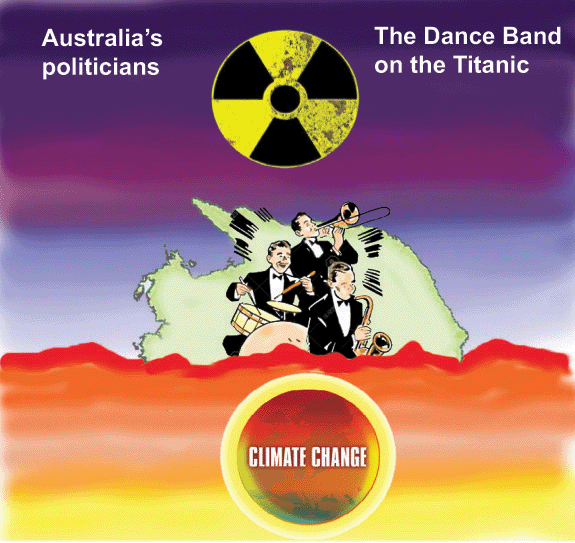 Climate Change Policy Toppled Australia’s Leader. Here’s What It Means for Others, New York Times, By Somini Sengupta Aug. 24, 2018
Climate change policy toppled the government in Australia on Friday.
How much does that really matter?
It is certain to keep Australia from meeting its emissions targets under the Paris climate agreement.
It’s also a glimpse into what a potent political issue climate change and energy policy can be in a handful of countries with powerful fossil fuel lobbies, namely Australia, Canada and the United States.
In Australia, the world’s largest exporter of coal, climate and energy policy have infused politics for a decade, helping to bring down both liberal and conservative lawmakers.
This week, the failure to pass legislation that would have reined in greenhouse gas emissions precipitated Malcolm Turnbull’s ouster as prime minister. He was elbowed out by Scott Morrison, an ardent champion of the Australian coal industry who is known for having brought a lump of the stuff to Parliament.
It could be a bellwether for next year’s Canadian elections, expected in October, in which Prime Minister Justin Trudeau faces a powerful challenge from politicians aligned with the country’s oil industry. Conservatives have pledged to undo Mr. Trudeau’s plans to put a price on carbon nationwide if they take power. At the provincial level, conservatives won a majority in Ontario after campaigning against the province’s newly enacted cap-and-trade program.
The Australian parallels with the United States are striking. The Trump administration has promised to revive the coal industry, rolled back fuel emissions standards and announced the country’s exit from the Paris pact altogether. Climate change is not a driving issue in the United States midterm election campaign, though it is for liberal Democrats, a recent study by the Yale Program on Climate Change Communication has shown.
Environmental policy and global warming are top priorities for those who describe themselves as liberal Democrats, the study found, after health care and gun control.
……… Robert C. Orr, dean of the School of Public Policy at the University of Maryland, pointed to another parallel: In both Australia and the United States, local leaders have embraced renewable energy even as national politicians promote fossil fuels.
“Australia is a lot like the U.S.,” said Dr. Orr, who is also the special adviser on climate change to the United Nations secretary general. “Climate policy has really been driven from below, from the state, local and business level. That is not going to change.”
Most Australian states have renewable energy targets, and Australians are powering their houses with solar energy at one of the highest rates in the world. But Australia’s emissions have continued to rise.
Australia is among several industrialized nations that are not on track to reduce greenhouse gas emissions to keep global warming below two degrees Celsius as the Paris accord promises, according to independent analyses.
Climate Action Tracker, an alliance of European think tanks that tracks countries’ climate pledges under the agreement, concluded recently that “if all other countries were to follow Australia’s current policy settings, warming could reach over 3°C and up to 4°C.” Those are levels that climate scientists consider “highly insufficient” to stop the worst effects of climate change. https://www.nytimes.com/2018/08/24/climate/australia-climate-change.html
The Liberal Party is imploding largely because of climate change.

‘Climate wars’ claim another political scalp IN Daily, 24 Aug 18 While some remain unconvinced that climate change is wreaking havoc with our weather systems, the current circus in federal politics proves it is doing inordinate damage to our political system, writes climate lobbyist Rod Mitchell. It may not be obvious to all that climate change is beginning to wreak havoc with our weather systems but the last few days in federal politics makes it clear as day that climate change is doing inordinate damage to our political system.
The ‘climate wars’ have deeply infected and divided our parliament. Now they have formally divided the Coalition, perhaps fatally.
The Liberal Party is imploding in large part because of climate change.
The feelings that it engenders have latched onto and amplified other tensions and differences in the party and lit the fuse of self-destruction. The prospect of legislating our Paris Climate Agreement target as part of the NEG was just the last straw in a struggle that has been going on since 2009, at least.
Climate change was a major factor in the successive downfalls of Rudd and Gillard and the end of the Labor government itself. And it has been a significant cause of the increasing polarisation in politics, both here and in other parts of the world.
The great divide between US Democrats and Republicans has been fuelled by vested interests who have funded think tanks to sow seeds of doubt about climate change and have made many ‘political donations’ to Members of Congress.
So why is climate change having such a powerful effect on politics? There are two main reasons.
First, the implications of climate change are truly frightening, so much so that for most of us it is too hard to look at. It is so much easier to look away, to keep busy with life and to welcome the soothing words of anyone who suggests that it is not happening. The survival instincts we have inherited from our ancestors are finely tuned to respond to immediate danger but have not yet evolved to encompass more distant threats. We tend to live for the present and for the short-term future. We can think about setting up our kids with a good education and job prospects but find it too hard to think about leaving them a liveable world.
Secondly, our economic system is set up in such a way that it is unable to put medium to long-term risk ahead of short-term gain. Quite simply, the profits to be made from activities that feed climate change are so great that most industries and their customers (that’s most of us) cannot resist the temptation. Furthermore, companies are obliged to grow their business and produce surpluses, but only in the short term. Only recently are they being urged (but not obliged) to factor climate risk into longer-term planning.
This is the way our economic system has evolved and it is inevitable that corporations would use the political power their wealth has generated to keep it evolving in their interests. Funding think tanks, donating to political parties and MPs and lavishing decision makers with their largesse make perfect economic, if not moral sense. Political instability, opportunist politicking and policy paralysis are acceptable forms of collateral damage if the profits keep flowing.
There comes a tipping point however where the damage begins to threaten the economy itself and the society it is supposed to serve. Perhaps that point has arrived, and our current political crisis may be the most glaring symptom yet.
Coniston Aboriginal massacre descendants reunite to push for national truth-telling process
to hear massacre happened just 10 years after end of WWI’
‘Descendants of the perpetrators and the survivors of the last officially recorded frontier massacre,
90 years ago at Coniston in central Australia, will reunite today
to call for a national truth-telling process, so the nation can move forward “as one mob”.
‘“Too few people know about the massacres,”
the Central Land Council chairman, Francis Tjupurrurla Kelly, told Guardian Australia.
“I think they would be shocked if they knew these murders did not happen
during some distant past but 10 years after the first world war ended.”
‘In August 1928 a white dingo trapper, Fred Brooks, was found
murdered on Coniston station.
Brooks had been living at a waterhole called Yurrkuru,
west of the homestead.
‘In reprisal, groups of men on horseback, led by mounted constable George Murray,
shot and killed more than 50 men, women and children at at least
six sites between August and October 1928, according to historians.
‘But Warlpiri, Anmatyerre and Kaytetye people say that up to 170 people died.
‘No charges were ever laid; a board of inquiry set up to investigate the killings
ruled the party had “acted in self-defence”. …. ‘
Lorena Allam www.theguardian.com/profile/lorena-allam
www.theguardian.com/australia-news/2018/aug/24/coniston-massacre-descendants-reunite-to-push-for-national-truth-telling-process
With Scott Morrison as Australia’s new Prime Minister- no hope for action on climate change
 “Scoal-Mo” as PM. What does that mean for climate and energy policy? REneweconomy 24 August 2018
……a relief for the renewable energy industry in Australia – because it is clear that Dutton may have led Australia out of the Paris climate agreement and even brought renewable energy schemes to a crashing halt.
But it may not be cause for celebration. Morrison will lead and will have as his deputy Josh Frydenberg, the man who put together the National Energy Guarantee that proposed no new investment in wind and solar for a decade.
Morrison is known as “Sco-Mo”, an abbreviation of his name. But he might just as well be known as “Scoal-Mo” after brandishing a lump of coal thoughtfully lacquered by the Minerals Council of Australia in parliament in February last year.
But we were. In doing this, Morrison was pinning his colours to the mast of energy policy idiocy of the sort you find in the Murdoch media and on talk back radio, and on the front and back benches of the Coalition.
And Morrison dived even deeper into the murky depths of ignorance a few months later.
South Australia had followed that outage in February – caused by the failure of a gas plant to switch on – by building the Tesla big battery – in just 100 days – but Morrison decried it as being as useful as the Big Banana………
Morrison, as Treasurer, also ignored climate change in his most recent budget, making no mention of it in his speech, apart from insisting that Australia would “maintain our responsible and achievable emissions reduction target at 26-28 per cent and not the 45 per cent demanded by the opposition.”……
Right now, there is no policy in place. Australia’s emissions are rising, predicted to miss the weak 2030 target by a wide margin, and there is complete uncertainty about the National Energy Guarantee that Frydenberg has been spending a year putting together with the Energy Security Board and the big business lobbies.
Frydenberg has had to run the line between good energy policy and the madness of the right wing, and ended up with a policy proposal that sought no emissions reductions from the sector that can deliver the cheapest……https://reneweconomy.com.au/scoal-mo-as-pm-what-does-that-mean-for-climate-and-energy-policy-26556/
Aboriginal group’s call for inclusion in nuclear waste vote now goes to the Human Rights Commission
 Aboriginal group ‘just want to be included’ in vote on proposed nuclear waste dump in SA http://www.abc.net.au/news/2018-08-23/sa-nuclear-waste-dump-vote-in-discrimination-claim/10157678, By court reporter Rebecca Opie, The Human Rights Commission has been asked to decide whether an Aboriginal group should have a say on the location of a proposed nuclear waste dump in regional South Australia.
A community vote on the proposed dump on the Eyre Peninsula was referred to the commission following accusations it discriminated against Aboriginal native title holders.
The Barngarla Determination Aboriginal Corporation last week won a Supreme Court injunction against the District Council of Kimba, postponing the postal vote which was scheduled to be sent out last Monday.
The group argued the vote of about 800 Kimba residents contravened the Racial Discrimination Act by not including native title holders. On Thursday, the group’s lawyer Daniel O’Gorman SC said the matter had been referred to the Human Rights Commission which could be a “shorter route to the finish line” than proceeding through the court.
He said he would urge the commission to give the matter urgent consideration, but he was still waiting to hear back regarding the timeline.
Outside court, Linda Dare from the Barngarla Determination Aboriginal Corporation said it was not fair her family could not have their say.
“It’s depressing that we don’t get to have a say over our country,” she said.
“Everybody else gets to have a say — the Government and everybody else, the Kimba residents — but it’s my family that’s missing out. “We don’t want it. It is on our country — they can’t give it to us then take it away just like that. It’s not right.”
Native title holders ‘just want to to be included’
During last week’s hearing, the court heard the majority of the 211 native title holders lived outside the council’s boundaries, and that excluding them from the vote had the effect of “nullifying or impairing their rights”.
The group’s lawyer Mr O’Gorman said his clients had no issue with the vote going ahead, they just wanted to be included in it.
“That’s all they want, they just want to be included, they don’t want to be treated any differently because their rights are Aboriginal rights,” he said.
“There is no justification for excluding people on the basis of native title rights.”
Michael Burnett, representing the District Council of Kimba, told the court the fairest manner for the council to conduct the vote was to comply with “the statutory procedure that applies in the case of elections”.
“It’s not a vote that has direct consequences … it’s part of a range of consultations that will be taken into account,” he said.
Mr Burnett said there were direct consultations taking place with native title holders about the proposed sites, a claim which Mr O’Gorman rejected.
Annabel Crabb outlines the demise of Australia’s climate policy in 7 killings
Australia’s recent climate change policy: A brief history of seven killings http://www.abc.net.au/news/2018-08-23/climate-change-policy-a-brief-history-of-seven-killings/10152616, By Annabel Crabb
The story starts in 1997, when the brand-new Howard government (sweating through a brief and cock-up-infested first term during which it lost a series of ministers and most of the margin with which it had wrested power from Paul Keating) sends its environment minister, Robert Hill, to Japan for the seminal Kyoto Climate Summit.
At the summit, Senator Hill negotiates generous terms for his country in the global deal; Australia emerged with large concessions for its agricultural activities and is one of only three countries permitted to increase its emissions under the deal.
Senator Hill is welcomed home as a conquering hero.
However, over the years enthusiasm for the compact is replaced within the government by scepticism.
First casualty Continue reading
Right wing MPs wanted Dutton as PM to exit Paris climate agreement
 MPs push for Paris climate exit under Dutton, The Age, By Eryk Bagshaw23 August 2018 —Conservative MPs would ramp up the pressure on a Dutton government to exit the Paris climate agreement, opening up Australia to the risk of trade sanctions, stalling negotiations with the European Union and critically endangering relationships with the Pacific.
……..The conservative vanguard, led by former prime minister Tony Abbott and backbenchers Craig Kelly, Jim Molan and Eric Abetz, have been fierce advocates of dumping the Paris climate deal and delivering the Catholic school sector millions in extra funding.
The group has been instrumental in elevating Mr Dutton to within striking distance of the Lodge on a platform of lowering energy bills, cutting immigration and wrestling control of the Liberal Party away from the “inner-city elite”.
Mr Dutton refused to commit to the Paris agreement when he announced he was challenging Prime Minister Malcolm Turnbull for his job. “My judgment is that we do whatever reduces power prices,” he said. …….Mr Kelly, a Dutton ally, said there should a full national audit of the impact of the Paris target on the economy.
……..The agreement locks in an emissions cut of 26-28 per cent on 2005 levels by 2030.
Pulling out of it, which can not be done before 2020, would put Australia in breach of international trade agreements, potentially endangering a free trade deal with the EU that is in the middle of negotiations.
Legislation does not have to pass Parliament to exit Paris. A prime ministerial direction to the joint committee on treaties would be enough to remove Australia from the deal.
Robyn Eckerlsey, a climate treaty expert at the University of Melbourne, said it “was a crazy thing” to be considering given the pledged targets are voluntary and there were no formal penalties……
The Pacific Islands Forum is due to be held in the first week of September, where Australia could be represented by Mr Turnbull, Mr Dutton, Scott Morrison or Julie Bishop if there is a party-room vote on Friday.
The landmass of some of the nations attending – including Kiribati and the Maldives – are directly threatened by rising sea levels…….https://www.theage.com.au/politics/federal/mps-push-for-paris-climate-exit-under-dutton-20180823-p4zz9y.html
CSIRO roadmap finds hydrogen industry set for scale-up
24 Aug 18 An economically-sustainable hydrogen industry could soon be on the cards according to a blueprint released by CSIRO, the national science agency, which found that cost competitiveness is firmly on the horizon.
The National Hydrogen Roadmap sets out a path to develop the action and investment plans required to realise the full benefits of a hydrogen economy. Hydrogen is a clean-burning fuel with a range of uses, from powering vehicles, to storing energy.
Hydrogen can service multiple markets and if produced using low-emissions energy sources, will enable deep decarbonisation across the energy and industrial sectors.
Roadmap findings include:
- Hydrogen technologies are reaching maturity, with the narrative now shifting from R&D to market activation.
- Hydrogen presents a new export opportunity for Australia and could also play a significant role in enabling the further uptake of renewable energy.
- While the benefits are clear, current barriers to market activation include a lack of supporting infrastructure such as hydrogen refuelling stations for transport, and the cost of hydrogen supply for some applications.
- An appropriate policy framework could create a ‘market pull’ for hydrogen, with investment in infrastructure then likely to follow.
- In or around 2025, clean hydrogen could be cost-competitive with existing industrial feedstocks such as natural gas, and energy carriers such as batteries in many applications.
CSIRO Chief Executive Dr Larry Marshall described the Roadmap as a unique opportunity.
“Australia has a unique and urgent opportunity to turn significant natural resources, including coal, gas, and renewables like solar and wind energy, into a low-emissions energy product and ship it around the world – in some cases literally exporting Aussie sunshine,” Dr Marshall said.
“CSIRO is at the forefront of innovation with our partners in industry, government and the research sector, like our recently developed, world-first membrane to separate hydrogen from ammonia for fuel cell vehicles.
“We’ve established a strong network of partners and collaborators that support current, practical research and technology development initiatives right across the hydrogen energy value chain,” Dr Hartley said.
“And while much of the required technology is at a mature stage, there is considerable scope for further R&D to further improve process efficiencies and develop new applications.”
The national science agency consulted broadly to develop the Roadmap, which was sponsored by 21 industry and government bodies.
Two major solar farms for Whyalla, South Australia
Steel city’s solar rush gets a head of steam Whyalla could soon be home to two major solar farms after Adani Renewables announced it had received pre-construction approval for a 400 hectare project just outside the city. – …..(subscribers only)
Supreme Court keeps the halt on Kimba nuclear waste dump vote

At the supreme court today supporting the Barngarla people.
The case has been sent to the Human Rights Commission, which is great to see they recognise this as a human rights issue.
The injunction remains in place
This has been a good day in court
1 This month.
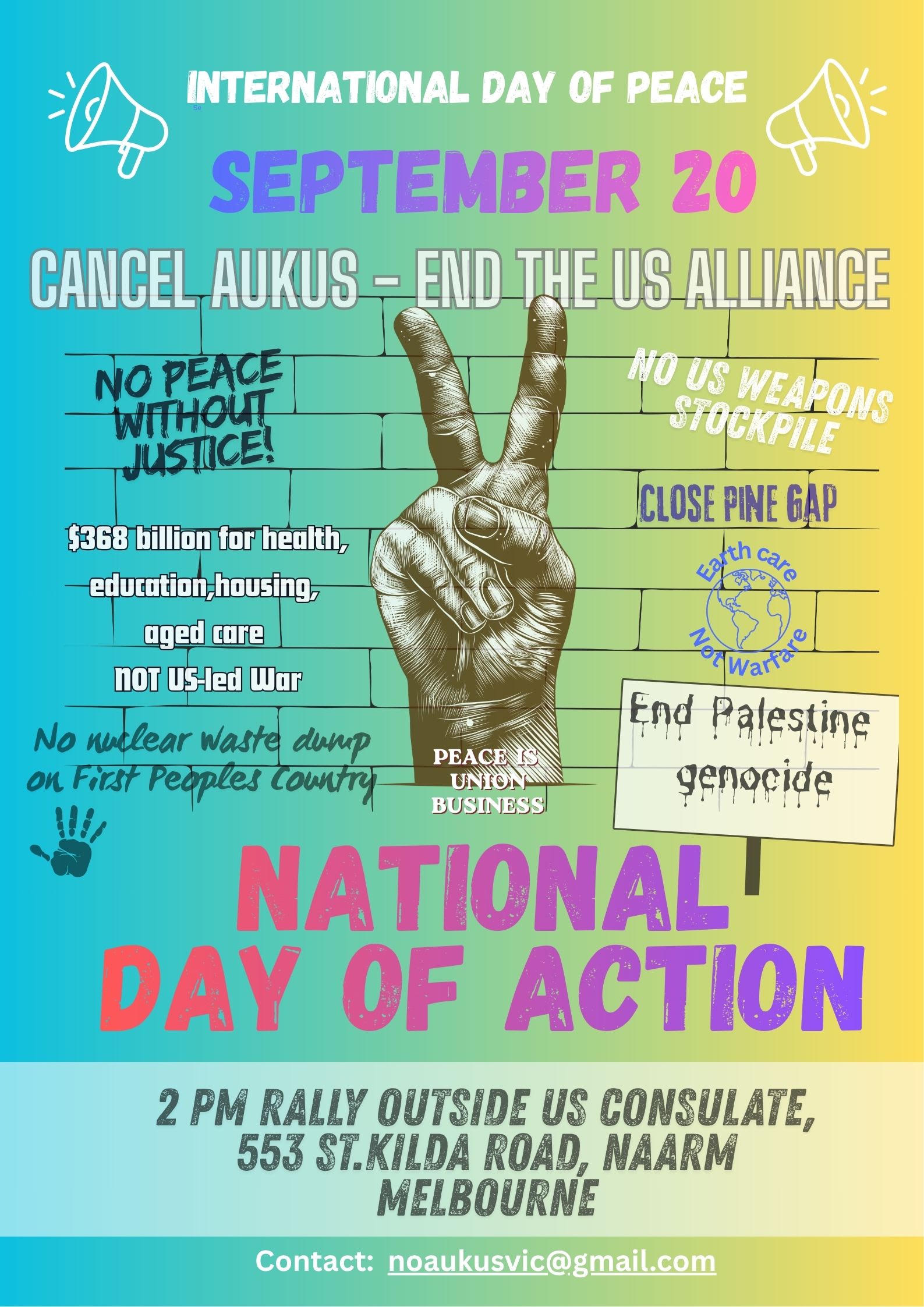
20 September –National Day of Action in Melbourne on the International Day of Peace

Help Aunty Sue Protect Her Land and Sacred Sites From Destructive Rocket Testing.
.

Australians deserve the truth
about
AUKUS – https://aukuspublicinquiry.com/
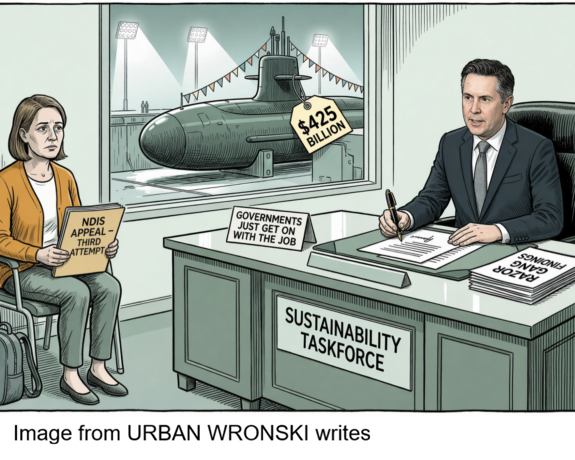

PETITION – To: Prime Minister Anthony Albanese and the Australian Labor Government

of the week – Australians for War Powers Reform (AWPR)
To see nuclear-related stories in greater depth and intensity
 Antinuclear