Climate change is increasing Australia’s heat and drought
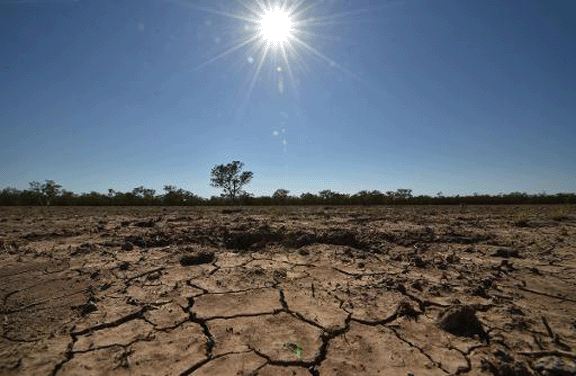
Great southern drought: Australian farmers crippled, climate action stalled https://www.dw.com/en/great-southern-drought-australian-farmers-crippled-climate-action-stalled/a-45015773
Amidst the worst drought in living memory, the world’s driest continent is also heating up due to climate change. Critics say too little is being done to prevent increasing temperatures and decreasing rainfall.
New South Wales, which is Australia’s most populous state and about the size of France, was declared 100 percent in drought on Wednesday.
Despite the fact that it is winter, farmers in the state and throughout the southern region of Australia are struggling to maintain their livelihood as crops fail and livestock die.
With grazing land turned to dust, some farmers have resorted to hand-feeding to keep their stock alive. They also have permission to shoot kangaroos that compete for pasture. Depression and suicide among farmers are on the rise.
And yet, there is no end in sight to this crippling drought, unseen for generations. The predicted start of bushfire season has been brought forward two months in New South Wales to prepare for what could be an apocalyptic summer scenario.
Though Australia is the driest inhabited continent on Earth and has regularly experienced intense droughts since modern record-taking began after European colonization, the relatively fertile southern regions continue getting hotter while receiving less rain.
Autumn of 2017 in southern Australia was the driest for 116 years. And 2017 was also the hottest year ever in New South Wales.
Increasing drought
“These regions experienced increasing intensity and frequency of hot days and heat waves over the past 50 years, in turn increasing drought severity,” said Lesley Hughes, a professor of biology at Sydney’s Macquarie University and councillor with the Climate Council — a climate change information nonprofit created after the current government closed down the state-funded Climate Commission.
But the “source of the problem is complex,” she told DW.
Scientists are confident that warming linked to human-induced climate change “has contributed to a southward shift in weather fronts from the Southern Ocean, which typically bring rain to southern Australia during winter and spring,” Hughes explained of the reduced precipitation.
As rain-inducing weather fronts drift away from land to the Southern Ocean, the risk of drought has increased, especially in agricultural heartlands such as the Murray Darling Basin in New South Wales.
Benjamin Henley, a research fellow in climate and water resources at the University of Melbourne, shares this view.
“Climate model projections suggest that with anthropogenic emissions, the storm track will shift south, reducing rainfall [over land] in the south,” he told DW.
But global warming could also be increasing the intensity of drought. “Higher temperatures during droughts, which influence evaporation rates, can be due to both the lack of rain itself [due to the reduced evaporative cooling], and the higher probability of warmer temperatures due to climate change,” Henley explained.
Extracts from today’s Webinar about Managing Australia’s Nuclear Wastes
transcribed by Noel Wauchope 10 August 18
Dr Margarert Beavis : –
“Less than 1% of the total wastes of the nuclear reactor comes from medical use… For Intermediate Level Waste, (ILW) ARPANSA says repeatedly that there is no urgency for a news interim waste facility. Internationally, ILW is stored near reactors….
ANSTO is expanding nuclear activities, which will mean massive increases in wastes.
Information about nuclear medicine has been over-blown. It’s very clear that nuclear medicine will continue regardless of the dump”
Cyclotrons are the fastest growing area of producing nuclear medicine. Canada and UK are phasing in cyclotrons. ANSTO’s massive reactor plans mean not only more ILW, but also massive costs. Selling nuclear medicine gets back only 10% of the costs of managing the wastes”
“for informed consent, people need excellent information. Tours offered to ANSTO, not to Woomera. People told by Bruce Wilson “this site will not leak”
Scott Ludlam –
“The argument “that ILW has to be moved – that is contestable. If it is perfectly safe,as claimed, why the push for moving it far away? We should not have the process for an interim site before having the process for permanent disposal. Is it a case of ‘out of sight out of mind’ “
“What’s the definition of ‘Broad Community Support’ ? What will you do if both communities (general and indigenous) are not broadly supportive?
The material will be dangerous for 10,000 years. On a politicaland electoral basis- we do have time. You are not letting medicine down if you think that this interim waste dump is not an appropriate thing to do.
Jim Green. –
Reminds about the “-overarching legislation- allows Federal government to override local communities and State governments. Overrides legislation on Aboriginal rights. There’s a need to remove undemocratic aspects of the National Radioactive Waste Management Act” (Bruce Wilson then criticises Jim Green’s ‘very emotive language’)
“About the operation of the facility. It will not be operating all of the time. There will be several dozen jobs over the first 3 or 4 years. .. Wates volume – one truckload every 10 weeks. For 90% of the time, workers would be doing nothing. The fcaility is likley to be opened once every 3-5 years. That was the government plan – it based its estimates on facilites overseas. But they are not comparable, (much greater). At most there’s be a handful of security jobs. (Dr Adi Paterson answered this with an expansive vision of the dump being the centre of a scientific mission, and “a really cool form of tourism”)
Many traditional owners would say that they have been treated disgracefully by the Department”
Dave Sweeney.
“it is incumbent on the proponent to demonstrate the need for an activity. There has been no pre-study of the net benefit. The regulator wants 2 separate licenses – for Low Level Wastes (LLW) and Intermediate Level Wastes (ILW) There should be 2 separate debates. There should be a detailed business case – We are told that this is an internal matter – a matter for cabinet.
You need to select the pathway (to final disposal) , including the transport route, before selecting the interim waste facility site. We have 10,000 years lasting wastes, yet the Minister wants a decision on 20 August. A purpose built national radioactive Waste Facility demands a higher level of scrutiny.”
“Nuclear medicine has been used as the argument, time and time again – that people who don’t support the nuclear waste dump are not supportive of nuclear medicine”
Sweeney spoke of the”power imbalance” “hard for Aborigines, for a farmer working 12 hours on a header – to go against detailed information from the State.”
Dave Sweeney urges Federal government to pause and consider, rather than rushing into nuclear waste dumping in Kimba
 Slow down nuclear process: Sweeney, Whyalla News, Louis Mayfield 7 August 18 An environmentalist is urging the federal government to slow down their site selection process for the National Radioactive Waste Management Facility as a community vote looms for Kimba and Hawker.
Nuclear Free Campaigner Dave Sweeney has accused Federal Resources Minister Matt Canavan of being on a politically-influenced timeline to lock in a location for the nuclear facility.
“Last night it was heartening to hear that it’s not the regulator who is pushing this timeline it’s politics,” Mr Sweeney said.
“Instead of rushing this decision we need to seriously explore the long-term management options for long-lasting nuclear waste before moving it from a site with a high level of expertise and security to regional South Australia.
“We don’t need to make a decision by Christmas, we need to get it right.”…….. Mr Sweeney said there was increasing unrest in the Kimba community about the federal government’s plans to potentially use the ports in Whyalla, Port Pirie and Port Lincoln to transport nuclear waste.
“People are wanting detailed consultation, they want the government to outline what they’re going to do with the ports before they go ahead with it,” he said.
A decision on the location of the NRWMF could come as early as October. The five-week community ballot for Kimba begins on August 20. https://www.whyallanewsonline.com.au/story/5571749/slow-down-nuclear-process-sweeney/?cs=5814
The Maritime Union of Australia (MUA) Says No To Nuclear Ports In South Australia
 MUA Says No To Nuclear Ports In South Australia https://www.miragenews.com/mua-says-no-to-nuclear-ports-in-south-australia/ 8 Aug 18
The Maritime Union of Australia (MUA) is continuing its long-running stance against the shipping of any nuclear material in or out of South Australia.
The Turnbull Government has shortlisted three sites in South Australia that could be used to permanently hold low-level nuclear waste and temporarily store intermediate-level waste.
Two of these sites are at Kimba, on the Eyre Peninsula, while a third is near Hawker, in the northern Flinders Ranges.
Whyalla, Port Lincoln and Port Pirie were named as potential nuclear waste ports in three “Site Characterisation, Technical Reports” released by the Federal Department of Industry in July.
MUA South Australian Branch Secretary Jamie Newlyn said MUA members are long time opponents of Nuclear Waste Storage in Australia and led the charge against the former SA Government’s International Waste Dump Royal Commission and consequent citizens’ jury.
“The Turnbull Government’s recent declaration that sites in Kimba and Flinders Ranges could be used to store intermediate-level nuclear waste is incredibly concerning,” Newlyn said.
“The MUA is further alarmed that the Federal Department of Industry has identified Whyalla and Port Pirie – where our members currently work – as potential ports to unload this toxic and unsafe material.
“The MUA, along with the mayors of Port Pirie and Whyalla, have been blindsided by this announcement yet the safety of port workers and the communities through which this hazardous material is transported is critical.
A postal ballot will begin in Kimba and Hawker on August 20 to determine public support.
Federal Minister for Resources Matt Canavan has said the facility would need “broad community support” to go ahead, noting that he will take into account the views of neighbouring landholders and the Adnyamathanha Traditional Lands Association (ATLA).
Before the ballot, a Senate inquiry into the site selection process, which includes the impact a community benefits program is having on support, will hand down its findings.
“The Turnbull Government is dividing communities, dividing families and dividing friendships over this decision and are trying to ruin the fabric of these country areas,” Newlyn said.
“The MUA will be discussing this with our members in the region to explain the dangers and we are confident that our decisions will again be on the right side of history.
“The MUA is well-known for taking a strong stand against South Africa’s apartheid regime, supporting Indonesian independence, demonstrating against the Vietnam War and refusing to load pig iron to Japan in the lead-up to World War II.”
Whyalla’s port could be used to receive and ship nuclear waste to and from a waste management facility
 NUCLEAR TRANSPORT, Whyalla News (print edition, 9 Aug 18 ) Whyalla’s port could be used to receive and ship nuclear waste to and from a waste management facility, according to a report by the Federal Industry Department (DIIS).
But the federal government, who have plans to establish a National Radioactive Waste Management Facility (NRWMF) in Kimba or Hawker, have poured cold water on the idea.
A shipment of nuclear waste is due from Sellafield in UK and a shipment out of Port Kembla is planned from the ANSTO Lucas Heights reactor of nuclear waste received from France in 2015.
“There is potential to have waste shipped from Port Kembla, NSW to key port locations such as Whyalla, Port Pirie and Port Lincoln,” say DIIS in their site characterisation report for Lyndhurst.
“From here, waste would either be shipped via road or rail to the waste facility location. This may be necessary for the transportation of TN81 containers.”
But Member for Grey Rowan Ramsey there wouldn’t necessarily be enough waste to be shipped via sea.
“Any discussions about use of ports are only possible options,” he said.,
Friends of the Earth environmentalist David Noonan believes the federal government could face ‘serious obstacles’ to secure the use of a port to move nuclear waste.
“These targeted port communities are denied a say in Minister Canavan’s pending decision on siting a Federal dump in South Australia,” he said.
“They haven’t been consulted on use of their ports, and are excluded from ‘votes’ in the Hawker and Kimba districts between August and September on whether or not to locate a NRWMF in those areas.
Mr Noonan claimed that the federal government had been targeting ports to transport nuclear waste in South Australia for over two years.
Mr Ramsey said there had been no decision to locate the facility in South Australia so far.
“Two communities are to vote later this month as to whether they are willing to host the facility. If neither agrees there is no project,” he said.
Mayor Lyn Breuer said she would not commit to supporting the use of Whyalla’s port for transporting nuclear waste until the council received a guarantee it would be safe.
“While I don’t think it would have any significant environmental impact on our community barring an accident, this would require significant community consultation,” she said.
“In the past Whyalla has opposed any nuclear or radioactive shipping in this region.”
Kimba nuclear waste dump proposal is in breach of International Atomic Agency Safety Guide
Susan Craig Fight To Stop Nuclear Waste Dump In Flinders Ranges SA, 9 Aug 18 THE FEDERAL GOVERNMENT’S PROPOSAL IS IN BREACH OF THE INTERNATIONAL ATOMIC AGENCY GUIDE ON TWO COUNTS.
UNDER PARAGRAPH 2.22 AT PAGE 12 STATES:
2.22 In the classification scheme set out in this Safety Guide, low level waste is waste that is suitable for NEAR SURFACE DISPOSAL. This is a disposal option suitable for waste that contains such an amount of radioactive material that robust containment and isolation for limited periods of time up to a FEW HUNDRED YEARS are required.
This requirement is pretty much copied into the ARPANSA Guide under the heading of LOW LEVEL WASTE (LLW) at page 13 in Section 3.2
WITH RESPECT TO INTERMEDIATE LEVEL WASTE THE IAEA GUIDE UNDER PARAGRAPH 2.28 AT PAGE 14 STATES:
2.28 Intermediate level waste is defined as waste that contains long lived radionuclides in quantities that need a greater degree of containment and isolation from the biosphere than is provided by NEAR SURFACE DISPOSAL. Disposal in a facility at a depth of between a FEW TENS AND A FEW HUNDREDS OF METRES is indicated for ILW.
Again practically the same description is given on page 15 of ARPANSA Guide under the heading of INTERMEDIATE LEVEL WASTE.
As both IAEA and ARPANSA clearly say BOTH LLW and ILW has to be “near surface disposal” and certainly not above ground as proposed by the Department on behalf of the federal government.
The IAEA promotes adherence to and implementation of international legal instruments on nuclear safety adopted under its auspices. https://www.facebook.com/groups/344452605899556/
Julian Assange should be assured of immunity before taking risk of testifying to Senate
 Assange should secure immunity before taking risk of testifying to Senate – whistleblower Kiriakou https://www.rt.com/usa/435543-assange-senate-testimony-kiriakou/
“If Assange is offered immunity by the committee, he then could not be charged with the crime because anything he said before the committee could not be used against him,” Kiriakou stressed, recalling how in 1987 former marine Oliver North was granted congressional immunity in exchange for his testimony on the Iran-Contra affair.
The Department of Justice then filed multiple felony charges against North, and he was arrested. But the Supreme Court later dismissed the charges, citing his immunity. Kiriakou believes the same measure can shield Assange, who has spent the last six years living in the Ecuadorian embassy in London fearing extradition to the US. Continue reading
Highlights of Australian Government Nuclear Information Session in Kimba
Dave Sweeney, 8 Aug 18 an update of the highlights from last night’s federal agency forum in Kimba: https://www.eyretribune.com.au/story/5569566/nuclear-information-session-in-kimba/
Between 120-150 people put in three hours in a very cold hall listening to presentations from ARPANSA, ANSTO, DIIS and others then to responses to pre-submitted questions.
As usual there was considerable running down of the clock and unrelated/ off the mark responses – but still a fair bit of interest and use, including:
 ARPANSA
- no urgency to move ILW from Lucas Heights – this was clear and repeated – proponent would need to prove need/ rationale and safety case
- new ARPANSA code has reaffirmed that siting on agricultural land is less preferred (nb: this is guidance, not a requirement)
- will require two separate license applications for LLW and ILW as they have different requirements
- 12-18 months further work required on Woomera waste characterisation
 ANSTO
ANSTO
- lots of detailed nuclear medicine/ science application talk – scant explanation of need to move ILW
- CEO agreed with ARPANSA that current ILW storage at LH is ‘safe’
- including already returned reprocessed waste returns there is a maximum of five TH81 casks of ILW over the next forty years
 DIIS
DIIS
- ‘possible no current site will be selected’
- uncertainty re transport route and use of local ports
- intention is to amend the NRWM Act to make the community benefit fund larger and more directed by some form of community input – but only post site selection
- Minister is the sole decision maker and they are expecting some ADJR challenge
- ballot is ‘Kimba’s last chance’ – there will no further offers or re-visiting if not supported
- Minister wants to make a decision in October
Western Australia based Azark wants nuclear waste dump site to be Leonora, W.A.
 Calls for a nuclear waste facility in WA. Business News Western Australia, 7 August 18 Western Australia based Azark projects is calling on the Federal government to review its preference for a nuclear waste storage facility in South Australia, with the George Gear led company proposing Leonora as a more suitable location……. https://www.businessnews.com.au/article/Calls-for-nuclear-waste-facility-in-WA
NUCLEAR WASTE DUMP – Senate Inquiry
The Federal Government selects prime agricultural wheat farmland and the most seismically active Flinders Ranges to become Australia’s Radioactive Nuclear Waste Central Depot. Questions have not been answered truthfully and the site selection process smacks of a fixed match.
NUCLEAR WASTE DUMP – Senate Committee of Inquiry
Vince Coulthard reiterates the Adnyamathanha people’s firm opposition to nuclear waste dumping on their traditional country
Vince Coulthard Fight To Stop Nuclear Waste Dump In Flinders Ranges SA, 7 Aug 18 am sick and tired of the lies about me in relation to the nuclear waste dump.
I do not want it anywhere in Adnyamathanha Yarta/country.
As Adnyamathanha people we have been entrusted by our ancestors, with the responsibility of caring for our country and there is no way any sane person would want to poison our land for hundreds of generations to come.
I know some people are trying to discredit me by misquoting me but anyone who knows me would already know there is NO WAY I would support this waste dump and only FOOLS sucked in by the $$$ would think it was ok to make these accusations against me.
And to suggest that I would want this toxic dump anywhere near my homeland and my family is even more foolish. This is ridiculous and I would ask that you please share this status as I have had enough of this slander. https://www.facebook.com/groups/344452605899556/
Uncontrolled nuclear top gun Adi Paterson to spin to Kimba, Hawker and Quorn
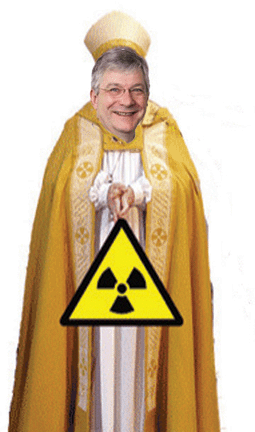
Dr Adi Paterson is the man behind the nuclear push by secretive taxpayer-funded agency Australian Nuclear Science and Technology Organisation (ANSTO).
Australians are not privy to information on how much ANSTO spends, particularly on this latest frenzy to convince rural South Australians that they have a moral duty to public health to host radioactive trash, – further encouraged by generous bribes.
Adi Paterson seems to have not only an open cheque to spend on this, but also carte blanche to do whatever he likes regarding nuclear decisions.
In 2016, he signed Australia up, all on his own, to the Framework Agreement for Generation IV Nuclear Energy Systems, committing Australia to work towards the establishment of new nuclear reactors. The government was informed of this afterwards. A month later, a Senate Committee simply ratified Adi Paterson’s action. No Parliamentary discussion, no public discussion. How long will Australians let this man make nuclear decisions for us, and pull the wool over the eyes of poorly informed farmers?
6 August, 2018 ANSTO CEO, Dr Adi Paterson, is part of a delegation who are visiting the communities of Kimba, Hawker and Quorn on 6 and 7 August, for Community Information Sessions being led by the Department of Industry, Innovation and Science.
Three sites in South Australia, two in Kimba and one at Wallerberdina Station near Quorn and Hawker, are considering whether to host Australia’s National Radioactive Waste Management Facility.
The Community Information Sessions are an opportunity for those communities to ask any remaining questions ahead of a five-week community ballot that begins on 20 August.
Dr Paterson will join the CEO of the Australian Radiation Protection and Nuclear Safety Agency (ARPANSA) Dr Carl-Magnus Larsson, and representatives from the Department.
“In particular, I will be focused on talking about the partnerships that are possible between nuclear organisations and their neighbouring communities.
Opinions on siting a nuclear waste dump at Kimba or Hawker, South Australia
https://cooberpedyregionaltimes.files.wordpress.com/2018/07/coober-pedy-regional-times-26-07-20181.pdf Resources Minister Matt Canavan announced ( THE AUSTRALIAN, 18/6/18) that on 20 August, there will be a ballot to gauge community support for a federal nuclear waste dump near one of the small towns of Kimba or Hawker, about 450km north of Adelaide. The vote will be confined to the residents in the immediate local area.“The decision will be made in the second half of this year” said Canavan ““We do not want this overlapping with a federal election”.
A Senate Inquiry will report on this on 14 August, possibly too late to make a difference. However, many people are taking this Inquiry very seriously, and have sent in 109 submissions, nearly all of which can be read at the Senate Committee’s website.
As I’ve been going through 98 published submissions to this Senate Inquiry on Selection process for a national radioactive waste management facility in South Australia, I’ve been able to learn some of the reasons why people support or oppose the idea of the nuclear waste dump.
The division of opinion was clear in the answers to the 5 main Terms of Reference, asking whether the following aspects were satisfactory: – financial compensation for land, community support, indigenous support, Community Benefit Program, and confining consultation to the local community. Answers were consistently “Yes” in submissions supporting the plan, and “No” in those opposing it.
More interesting were the comments in the 6th Term of Reference – ” Any related matters”
The 40 supporting submissions. Almost every one of the supporting submissions came from local residents, several explaining that they have been very thoroughly informed by the Department of Industry, Innovation and Science, including tours of the Lucas Heights nuclear reactor. Four submissions spent time praising the Department of Industry Innovation and Science (DIIS) and Australian Nuclear Science and Technology Organisation (ANSTO)
Their answers regarding “Any related matters” were strongly concerned with the local area and its future. Several were enthusiastic that the nuclear waste facility would ensure the survival of the town into the future. It would have no negative impact. It would be good for local business. It would be beneficial to Australia. Some complained of misleading information from anti nuclear activists. There was strong opposition to “outsiders” having a say in the decision. Kimba District Council needed detail on important financial benefits. Submissions from DIIS and ANSTO said that the facility was essential for nuclear medicine. Lobbyist Ben Heard said that it is needed for the expansion of the Lucas Heights nuclear centre.
The 58 opposing submissions come from a variety of organisations and individuals, and include residents of Eyre Peninsula. These were generally more comprehensive and wide-ranging. When it comes to “Any related matters”, they had a lot to say:
There were several comprehensive criticisms of the entire site selection process – no justification for the dump – why the assumption it has to be in South Australia? – the process is flawed. One was opposed to the process, not necessarily to the dump. One call to end the process. Concern on longterm negative effects.
Nuclear waste issues were discussed . Call for re-examination of waste plans- dangerous waste types – intermediate level wastes – probability of stranded nuclear wastes – Lucas Heights the most suitable site – this facility a prelude to commercial waste import?
Issues of dishonesty – lack of trust – dishonest process -hypocrisy of DIIS – biased committees biased and misleading information given – Conflicts of interest .
Aboriginal ssues well beyond the Term of Reference about this – strongly Aboriginal in depth on Aboriginal interaction – history of Aboriginal interaction.
Other issues discussed: – seismic danger – floods, groundwater – tourism -nuclear medicine not needing the dump – prediction of legal action – mental health issues – aim for a nuclear free world.
You can read more about these submissions, in the summaries at https://antinuclear.net/submissions-to-senate-inquiry-18–and also find links to each full submission.
Senate sites: https://www.aph.gov.au/Parliamentary_Business/Committees/Senate/Economics/Wastemanagementfacility
DEPARTMENT FAILS TO DEFINE ‘BROAD COMMUNITY SUPPORT’ – AGAIN!
Senator Rex Patrick Fight To Stop Nuclear Waste Dump In Flinders Ranges SA,
Inquiry into the Site Selction Process of the Radioactive Waste Management Facility Canberra
DEPARTMENT FAILS TO DEFINE ‘BROAD COMMUNITY SUPPORT’ – AGAIN!
At today’s hearing into the Site Selection Process for the Radioactive Waste Management Facility, the Department of Industry, Innovation and Science were unable to explain what ‘broad community support’ is.
Instead, they’re going to leave that definition up to Minister Canavan who is on record saying he wants this issue done and dusted before the next federal election.
Noting the secrecy surronding all of this, the people in Kimba and Hawker are going to get to experience what it was like to vote in the Soviet Union -the State will tell you what’s best for you.
For a good ten minutes I tried to find out how the Minister will come to his decision, to no avail. Here’s a quick 50 second snapshot, but you can watch the full exchange here. https://www.facebook.com/groups/344452605899556/?multi_permalinks=791599437851535¬if_id=1533450785067354¬if_t=group_activity
Uranium, nuclear, reactor produced isotopes – unstable industries with poor future
 Anne McMenamin Fight To Stop Nuclear Waste Dump In Flinders Ranges SA 5 Aug 18 Olympic Dam produces 90 times as much copper as uranium. Without the copper sales, the mine would not be viable. The amount of uranium produced has barely gone up over the last 10 years, and, across Australia, it’s actually gone down. Beverley is almost mined out. Four mile has recently come on line, but produced less last year than the year before. World-wide the industry is winding down.
1 This month
25 October – Film –Britain’s Nuclear Bomb Scandal: Our Story – part of the Adelaide Film Festival,
Screening and Conversation
A screening of Britain’s Nuclear Bomb Scandal: Our Story (2024) followed by a talk with 2026 Bettison and James Awardee and Tradtional Owner Karina Lester in conversation with Simone Tur.
When: Sun 25 Oct, 12:00pm-Screening, 1:15pm-Talk
Where: The Mercury
Free admission, register below by clicking on BUY TICKETS and select free event tickets, at end of web page:
https://www.adelaidefilmfestival.org/program/2026/britains-nuclear-bomb-scandal-our-story
.

Australians deserve the truth
about
AUKUS – https://aukuspublicinquiry.com/

PETITION – To: Prime Minister Anthony Albanese and the Australian Labor Government

of the week – Australians for War Powers Reform (AWPR)
To see nuclear-related stories in greater depth and intensity

