At long last, Australia could be getting a Treaty with First Nation people
Could Australia soon recognise sovereigns other than the Queen?
‘It’s the last ex-British colony to not ratify a treaty with its First Nations people,
but that may be changing.’
by Gabriella Marchant
29 Jul 2018
‘ … “Treaty is [an agreement] between two sovereigns and to be asking the government to at least
acknowledge that Aboriginal people … maintain their sovereignty [supreme authority],
I don’t think that’s too much to ask,” says Gunnai-Gunditjmara woman Lidia Thorpe,
a Greens member of parliament in Victoria state.
‘”You know there’s this tokenistic gesture all the time to blackfellas in this country.
If you want true reconciliation and true healing then let’s be real about it
and stop these tokenistic gestures.”
‘Indeed, a treaty was the only thing indigenous leaders from Australia’s Yolngu nation
brought up with Prince Charles on his most recent visit. …
What is a treaty?
‘A treaty – defined as an “international agreement concluded between two states”
in 1969’s Vienna Convention on the Law of Treaties – would require the
government to legitimise Aboriginal nations as separate to the nation of Australia.
From there, they must negotiate decisions that affect them
as equals and on equal terms.
‘Associate Professor Dominic O’Sullivan, whose work centres on indigenous governance,
says unlike neighbouring New Zealand,
treaties were never a part of Australia’s settler history.
‘”Terra nullius was used to justify the British claim to sovereignty.
‘”Britain couldn’t identify an organised political or social order
among the indigenous population, and under international law,
these were required for a people to hold sovereignty,” O’Sullivan says.
‘”One could argue that it suited [the colony’s first Governor] Philip not to look too hard..” …
‘Obstacles remain, however, on a national level.
The current federal government has not addressed the call for
an Indigenous process similar to a treaty, makarrata, which after two years
of consultation was presented in an open letter, the Uluru Statement of the Heart.
‘”[Prime Minister] Turnbull’s government has been completely inactive in this space
and really quite offensive I think, particularly on the Uluru Statement,”
says Victorian Ged Kearney, whose opposition party supports Makaratta. … ‘
Read much much more of Gabriella Marchant‘s comprehensive, well-researched & in depth feature in Al Jazeera News:
www.aljazeera.com/indepth/features/australia-recognise-sovereigns-queen-180711052948923.html
Aboriginal landowners not allowed to vote on planned nuclear waste dump
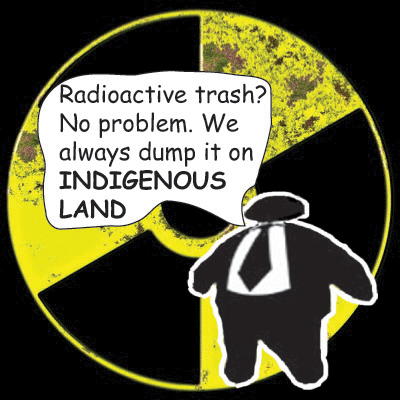
Traditional owners “locked out” of nuclear waste vote, InDaily, 3 Aug 18 Stephanie Richards The head of the Adnyamathanha Traditional Lands Association says the majority of Adnyamathanha people have been denied a vote on a proposed radioactive waste management facility near the town of Hawker in the Flinders Rangers.
Wallerberdina Station, located approximately 30km northwest of Hawker on Adnyamathanha country, has been shortlisted by the Federal Government for a facility that will permanently hold low-level nuclear waste and temporarily hold intermediate level waste.
It is one of three sites, the other two situated close to Kimba, that were shortlisted by the Federal Government to store nuclear waste.
The selection process is entering its final stages, with a postal ballot beginning on August 20 to measure community support for the three nominated sites.
But ATLA CEO Vince Coulthard said the voting guidelines were disrespectful to traditional owners, as the majority of Adnyamathanha people do not live close enough to the proposed Wallerberdina site to be eligible to vote.
The voting range includes residents of the Flinders Ranges Council and those who live within a 50km radius of the Wallerberdina site.
According to Coulthard, there are approximately 2500 Adnyamathanha people in total but only about 300 Adnyamathanha people who live in the voting range.
Coulthard said about 50 Adnyamathanha people who lived outside the voting range had expressed interest in voting, but when ATLA asked Federal Resources Minister Matt Canavan during a consultation trip to Hawker last week if those people could be granted a vote, Coulthard said Canavan told him that only those living in the prescribed voting range could participate.
“It’s a crazy situation,” Coulthard said.
“This is Adnyamathanha country and it is a very important place to the Adnyamathanha nation.
“People have strong connections to land. There’s a large amount of people, many who don’t live on the land but they go back on a regular basis to travel around the land.”
……… Coulthard said he was disappointed that Canavan had not consulted with all ATLA members during his consultation visit.
He said Adnyamathanha people had been “locked out” from the vote, despite holding native title rights over the land.
“Canavan is saying this will strengthen our culture, that this will be good for us, but what it is actually doing is punishing the environment.
“This is a place where we have gone to get bush tucker, where we have come as traditional owners for thousands of years.
They’ve shown us disrespect and this is very hurtful.”
The proposed site holds sacred meaning for Adnyamathanha people, as it is located close to the Hookina Waterhole and ancient burial sites.
…….. Last month, the Federal Government tripled the incentive package for the community that hosts the nuclear waste repository.
The Government had promised to spend more than $10 million in the district where the facility is built, but under new incentives announced by Canavan, the Government increased funding to $31 million.
……. The Government has previously indicated it wants to choose a preferred site before the end of this year. https://indaily.com.au/news/2018/08/03/traditional-owners-locked-out-of-nuclear-waste-vote/
Aboriginal landowners Wangan and Jagalingou take land rights fight to the UN
3 August 2018 wanganjagalingou.com.au/wj-council-takes-land-rights-fight-to-u-n/
‘Traditional Owners take land rights fight to U.N.
to head off threat of native title extinguishment for Adani
‘Authorised representatives of the Wangan and Jagalingou Traditional Owners Council,
Adrian Burragubba and Murrawah Johnson, have submitted a request to the
United Nations Committee on the Elimination of Racial Discrimination (CERD)
for urgent action under the early warning and urgent action procedure.
‘The request to the CERD is in relation to Australia’s violations of the
Convention on the Elimination of All Forms of Racial Discrimination,
for the Committee’s consideration during its upcoming 96th session in Geneva.
The complaint raises six violations of Australia’s international obligations under the Convention..
(Link to the CERD submission wanganjagalingou.com.au/request-for-urgent-action-by-wangan-and-jagalingou-people-to-cerd-31-july-2018/ )
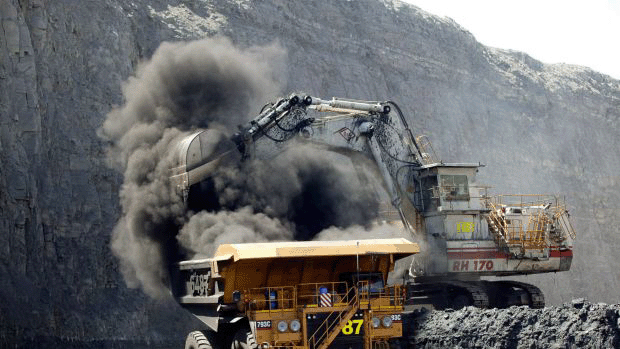 ‘The complaint was also sent to the Queensland Premier and Ministers in the Queensland Government,
as well as the Foreign Affairs Minister and Federal Attorney General.
‘Adrian Burragubba, Wangan and Jagalingou (W&J) Traditional Owners’ Council spokespersonand cultural leader said,
our ancestral homelands, waters, and sacred sites by Adani’s
massive Carmichael Coal Mine and Rail Project. Continue reading
Australian govt names Whyalla, Port Pirie, South Australian Ports to impose nuclear waste shipments

Federal gov. names SA Ports to impose nuclear waste shipments Nuclear Brief (1st August 2018) by David Noonan, Independent Environment Campaigner
Amidst rising controversy, the Federal Industry Department (DIIS) has named proposed Ports in SA that may have to take shipments of irradiated nuclear fuel wastes to go on to a Federal dump site.
DIIS reports (p.179) two intended shipments of reprocessed nuclear fuel wastes into SA within the first 2 years of operations of a proposed National Radioactive Waste Management Facility (NRWMF).
A shipment of nuclear waste is due from Sellafield in UK and a shipment out of Port Kembla is planned from the ANSTO Lucas Heights reactor of nuclear waste received from France in 2015.
After years of secrecy over intended nuclear waste shipments to an SA Port, DIIS has now named Whyalla, Port Pirie, a new Eyre Peninsula commodities port (if built) and even Port Lincoln, as potential nuclear waste ports, in three “Site Characterisation, Technical Reports” released in July.
However, all of these ill-considered plans for nuclear waste ports face an array of serious obstacles
These targeted port communities are denied a say in Minister Canavan’s pending decision on siting a Federal dump in SA, they haven’t been consulted on use of their ports, and are excluded from ‘votes’ in the Hawker & Kimba districts over Aug-Sept on whether or not to locate a NRWMF in those areas.
The Federal gov. is in continued breach of advice of the Nuclear Safety Committee (NSC) to the nuclear regulator ARPANSA (Nov 2016) on the NRWMF, on transparency in decisions, and for:
“The ongoing requirement to clearly and effectively engage all stakeholders, including those along transport routes.” With the NSC stating that: “Such engagement is essential…”
Proposed indefinite above ground storage of nuclear fuel wastes compromises safety, is illegal in SA, and must not be allowed now. ARPANSA states these wastes require isolation for 10 000 years.
This was recognised by the previous SA State Liberal gov. that prohibited the import, transport, storage and disposal of nuclear fuel wastes under the Nuclear Waste Storage (Prohibition) Act 2000.
“The Objects of this Act are to protect the health, safety and welfare of the people of South Australia and to protect the environment in which they live by prohibiting the establishment of certain nuclear waste storage facilities in this State.”
The new SA State Liberal gov. under the leadership of Premier Marshall has a key responsibility to protect the public interest and to uphold the law in our State. These are fundamentally State issues.
The Howard Federal gov. targeted SA for nuclear dumping over 1998 – 2004 but had to abandon that “National Store Project” & associated shipping and transport of nuclear waste across SA.
This Federal dump plan poses reputational risks and material impacts to the Kimba & Eyre Peninsula agricultural region, to the iconic Flinders Ranges tourism region, and now to targeted Ports in SA.
Nuclear waste can pose serious Accident & Security Risks and Impacts:
“In the event of a major nuclear accident, adverse impacts on the tourism, agriculture and property sectors could potentially be profound.”
SA Nuclear Royal Commission: Tentative Findings, Risks and Challenges, Impacts on other Sectors (Feb 2016, p.28)
Key questions on safety & security in nuclear fuel waste transport and storage remain unanswered (see D Noonan submission to Senate Inquiry, p.10). Nuclear fuel wastes must not be allowed into SA
The UK Nuclear Free Local Authorities “Briefing: Nuclear security concerns – how secure is the UK civil nuclear sector?” (NFLA, May 2016) highlights key security threats including the risks from potential malicious attack on a nuclear waste transport or on a nuclear waste storage site.
NFLA (p.8) cites the views of nuclear engineer Dr John Large on safety as at the heart of its concerns:
“Movement of nuclear materials is inherently risky both in terms of severe accident and terrorist attack. Not all accident scenarios and accident severities can be foreseen; it is only possible to maintain a limited security cordon around the flask and its consignment; … terrorists are able to seek out and exploit vulnerabilities in the transport arrangements and localities on the route; and emergency planning is difficult to maintain over the entire route.”
NFLA Recommendations (p.15) call for real discussion on the aftermath of a nuclear security incident given the major emergency response issues that arise. SA is unprepared for any such consequences.
Any use of SA Ports for nuclear waste poses significant logistical & other constraints:
The DIIS “Site Characterisation, Technical Report – Wallerberdina” for a proposed Federal nuclear dump site near Hawker, Section 4.1 Transport (p.174-186), at “Proximity to Ports” (p.177) states:
“There is potential to have waste shipped from Port Kembla, NSW to key port locations such as Whyalla and Port Pirie. From here waste would either be shipped via road or rail to the site.”
Hundreds of Police were required for security at July nuclear waste shipment out of Port Kembla.
Use of Port Pirie to road would lock down the National Highway to Port Augusta with 130 tonne Nuclear Canisters on over dimension & over-mass special vehicles. To rail would require waste transfer onto national gauge alongside Port Pirie and a second transfer on to State gauge in Port Augusta, with rehabilitation of the disused Cotabena Railway (p.177 & 186), to go on to the Flinders.
Use of the Port of Whyalla to road would require upgrade of Yorkeys Crossing to bypass the Port Augusta Bridge and to try “to avoid occurrences of complete shutdown” (p.181) in Port Augusta.
The Iron Triangle cities of Whyalla, Port Augusta and Port Pirie are now openly targeted for nuclear fuel waste transport and should have a right to refuse these untenable Federal gov. nuclear plans.
Influential Port Lincoln may be able to defend itself: other Port communities shouldn’t have to do so.
The Marshall gov must protect all SA regional communities and reject a Federal nuclear dump in SA
Senator Matt Canavan wants a nuclear waste site chosen by November.
 Proposed nuclear waste facility has South Australian towns divided as locals prepare for ballot, ABC West Coast SA By Samantha Jonscher and Gary-Jon Lysaght, 3 Aug 18,
Paul Richards refutes nuclear lobbyist Robert Parker
Paul Richards Nuclear Fuel Cycle Watch South Australia comments on nuclear lobbyist Robert Parker , quoting Parker’s statement ‘...we do want the legislation changed so that nuclear energy can be assessed fairly on its economic, environmental and technical merits.’
The logic is flawed.
The experiment to prove it works has already been running continuously with both fission and fusion reactors since the 1950s.
Yet, there still is no metrics proving nuclear energy is competitive.
Furthermore;
* we live on the driest continent on earth, with
* least amount of potable water,
* have an abundance of sun and
* wind, as natural resources.
Then there is the fact the last nuclear reactor built in the US took;
* more than 43 years to be built,
* over 21 years to construct,
* over 5 years to commission,
* and was built on one of the largest freshwater rivers in the US.
Building reactors as a response to AGW, with subsequent climate change, requires;
* a much faster response than the history of reactor builds proves is realistically feasible.
The reality is, both solar PV and wind turbines are rapidly developed, relatively easily deployed, and systemically recycled safely.
Furthermore, there is over a decade of independent auditors metrics proving solar PV and wind turbines make cheaper electricity.
Cheaper electricity, integrated with a plethora of energy storage systems, able to distribute electricity seamlessly across geopolitical borders using current electrical design engineering systems.
____________
^ As of December 1, 2017, the average age of U.S. commercial reactors was about 37 years, and they still prove to be unviable economically. https://www.facebook.com/groups/1021186047913052/
Minister Matt Canavan is a real dill: doesn’t know what he’s talking about re nuclear wastes
 Steve Dale Fight To Stop Nuclear Waste Dump In Flinders Ranges , 2 August 18, SA Canavan was also on ABC radio 891 Make sure you continue to listen to Victor Gostin. I have to re-listen but Canavan claims that the Vitrified Waste returning from France is “Low level”!
Here is Canavan talking about the Vitrified waste that returns from France
“when it comes back here the radioactivity of that material is not materially higher than the low level waste it does have a longer half life though, it will take thousands of years for that radioactivity to disappear… ” http://www.abc.net.au/…/prog…/mornings/mornings/1003697
Brett Burnard Stokes calling out just one of the lies involved in this massive bribery and deception operation led by Con Job Canavan.
In Queensland where Canavan comes from, they make nuclear medicines without making waste … and Con Job Canavan pretends that does not happen … Con Job Canavan says the waste is an essential byproduct from production of nuclear medicines.
Petition to South Australian Premier to block nuclear waste dump
 State government urged to block nuclear facility https://www.transcontinental.com.au/story/5562602/petition-pushes-for-nuclear-block/, Marco Balsamo 2 August 18 A petition calling on the state government to block the National Radioactive Waste Management Facility has attracted over 10,000 signatures.
The Australian Conservation Foundation (ACF) submitted the petition to state Member for Stuart Dan van Holst Pellekaan at a recent meeting.
The act was established to “protect the health, safety and welfare” of South Australians by prohibiting nuclear waste storage facilities in the state.
ACF Nuclear Free Campaigner Dave Sweeney urged Premier Steven Marshall to “stand up, honour and represent the state” by opposing the national facility.
“We wanted the South Australian government to know that there’s strong support and an expectation that they will respect and reflect about the existing Waste Prohibition Act,” Mr Sweeney said.
Wallerberdina Station near Hawker is one of three nominated sites for the national facility, with the other two both based in Kimba.
The selection process is coming to the pointy end, with a postal ballot commencing on August 20 to measure the community support for the three nominated sites.
Representatives from ACF, Conservation Council SA and the Adnyamathanha community attended the meeting with Mr van Holst Pellekaan.
Mr Sweeney described the sit-down as “constructive and respectful”, giving the groups an opportunity to present their concerns to the MP.
“This is being presented by the federal government as if it’s a local economic development issue, but it is Australia’s first ever purpose-built national radioactive waste dump,” he said.
“What it would receive is materials, some of which needs to be isolated and managed for 10,000 years. It is a national responsibility that has long-lasting implications that need a national approach, so we conveyed that to Dan and he understood that.
“We also conveyed our concerns about the process, how divisive it has been and how much stress it has caused on communities.”
Mr van Holst Pellekaan said he has spoken with federal Minister for Resources and Northern Australia Matt Canavan about local concerns regarding the facility.
“As a local MP, I believe it is important to meet with many people with a wide range of views on this topic and have been doing exactly that,” he said.
“I’ve had regular contact with federal Minister Canavan, have shared the opinions of our local people with him and will continue to do so.”
Mr van Holst Pellekaan confirmed the petition has been passed on to the Premier as promised at the meeting.
The punishing effect on Australia’s environment by rapid population boom
 Environment the biggest loser as Australia’s population hits 25 million https://independentaustralia.net/politics/politics-display/environment-the-biggest-loser-as-australias-population-hits-25-million,11748 Michael Bayliss
Australia’s population growth has several disadvantages, one of the main ones being environmentalimpact, writes Michael Bayliss.
AUSTRALIA IS ON THE CUSP of a major demographic milestone. Our population will reach 25 million by mid-August this year.
We were never expected to reach this “milestone” so soon. In 1999, then Minister for Immigration Philip Ruddock said that there was no need for a population policy as the nation was on course to reach 23 million “by the middle of next century”. Not only have we surpassed 23 million, but we are now heading to reach 40 million by 2050.
The consequences of rapid population growth are many. Housing security, job security, traffic congestion and infrastructure are all concerns increasingly felt by many Australians feeling the pressures of growth. It has been reported that population has become a primary political issue among voters this year.
Another casualty of population growth is Australia’s natural environment. If we agree it is impossible to have a healthy economy on a dead planet, then we should be paying more attention to the impacts of growth in our national backyard.
Australia’s population ballooned quicker than any other developed country on the planet from 1990 to 2017, during which time we have grown by 50%. At the same time, Australia is leading the developed world in terms of rapid land clearance. This is no coincidence.
Australia’s leading ecologists agree growth is a major driver of species loss and degradation of habitats in our country. Successive State of the Environment Reports (at both national and state level) have recorded ongoing deterioration of all environmental indicators; increasing population density, urbanisation and settlement patterns have all been cited as leading causes of this deterioration.
The koala and emu, both Australian icons, are fast becoming the poster animals of the victims of urban sprawl and the clearance of native habitat. It is no coincidence that their habitats overlap with the areas of most rapid urban expansion, for example the peri-urban areas around Sydney and Brisbane. It is anticipated that the continual urban expansion in NSW and Queensland will result in a crash of wild koala populations within several decades. We won’t solve this problem by putting solar panels on the new housing estates or hybrid cars on our roads. Endless urban growth corridors will wreck native habitats, regardless of how “green” these new developments are — and most new suburbs are anything but green.
If the impact on other species is not a strong enough motivator for change, perhaps we should consider the impacts of growth for future generations. Take Melbourne, Australia’s fastest growing capital city, for example. Continued urban sprawl will reduce the city’s food bowl capacitysignificantly — from 40% now to around 18% by 2050.
Last year, our emissions grew by 1.5%, whilst the population grew by almost the same amount. The figures speak for themselves. If we grow by the size of a new Canberra every year, our emissions will go up regardless of how innovative we are or how many plastic bags we no longer use.
This highlights the many difficulties for rapidly growing nations such as Australia to meet their responsibilities under the Paris Agreement. For example, to meet the agreement, Australia will need to reduce national emissions by 30% over the next three decades. Adding an extra 50% to our population over the period will make this monumental task even more difficult to achieve and likely to mask any gains achieved in fuel and energy efficiency over the same period.
The “creeping normalcy” of both densification (more apartment blocks) and urban sprawl are easy to overlook against our busy pace of life. At 1.5% per annum, population increase can appear gradual against the rapid rate of change in our world. But the changes over a decade leave a tangible and permanent legacy on our landscape. The remaining strands of forest and open space on the urban fringe will be swallowed by housing estates while productive farmland is converted into roads and concrete. The hasty planning and development that accompanies rapid population growth locks future generations into high carbon living.
t is often asked as to what is Australia’s optimum population size. Whilst this can be difficult to quantify, most of us can agree that Australia cannot grow at 1.5% per annum indefinitely — the laws of physics do not allow for exponential growth on a finite space.
The idea that Australia is a continent of empty plains and that we can solve the problem by moving inland does hold up to scrutiny. Australia is the world’s second driest continent and our only major river system, the Murray-Darling basin, has a fraction of the water flow compared with other major river systems, such as the Mississippi. We are also one of the least fertile continents on earth, with only 6% of our land area arable, mostly around our capital cities and on the coast. It is these very areas that are being encroached on by urban development. It is not viable to densify much of Australia and to suggest so makes almost as much sense as developing Antarctica.
It is critical that as a nation we can move beyond the assumption that we need to keep growing for growth’s sake. It is necessary that we reduce and level off our carbon emissions, the rate in which we destroy our ecosystem and native habitats and the rate in which we concrete over our food bowls. This requires a transition to a post-growth economy, where our per capita consumption andour population remain stable. Only then can any improvements to technology and efficiency have any lasting impact.
In South Australia pro nuclear people have been seeded into positions of power
 Regina McKenzie Fight To Stop Nuclear Waste Dump In Flinders Ranges SA, 2 Aug 18
Is Minister Canavan lying about nuclear wastes, or is he just uninformed?
Susan Craig, Fight To Stop Nuclear Waste Dump In Flinders Ranges SA, 1 Aug 18, Mr. Canavan stated on ABC radio this morning that the radioactive waste dump proposed for South Australia was safe for both low level waste above ground storage and intermediate level waste above ground temporary storage. The ANSTO & ARPANSA report states that the low level waste be stored below the surface, however, the Federal Governments proposal is for above ground.
 surface.
 However, the intermediate level waste for South Australia will be stored in ZWILAG TN81 container, above ground which only lasts 40 years.
EXTRACT FROM INTERIM WASTE STORE OPERATING LICENCE SUMMARY SAFETY CASE FOR THE INTERIM WASTE STORE AT LHSTC
ARPANSA AND ANSTO DOCUMENT
“The Government is currently assessing the siting and construction of the NRWMF, a co-located near surface disposal repository for Low Level Waste (LLW) and an above-ground store for Intermediate Level Waste (ILW).
Joy Engelman Unfortunately Susan, nuclear waste is not safe which is exactly why the government is not keeping it at Lucas Heights but wanting to put it as far from major urban areas as possible. It will never be safe. There are so many nuclear waste facilities around the world now with huge problems, leaking canisters, isotopes becoming active in the biosphere etc etc. It is also not possible to store canisters containg the waste above ground in the temperatures experienced in the outback nor with the possibility of flooding. Not only that, the waste does contain high level waste from Australia’s propensity to try to develop weapons grade waste over the late 20th Century. Canavan needs to be properly educated about the nuclear industry before he opens his mouth and not just be another puppet.
France, USA, UK, Japan call it High Level Waste: Australia calls it Intermediate Level Waste

Steve Dale Nuclear Fuel Cycle Watch South Australia,
Funny. Spent fuel rods (which the USA and other countries would call High Level Waste (HLW)) leaves this country. Vitrified waste remnants will return one day (which the French, USA, UK, Japan would call HLW) – but at no time in Australia will this be honestly called High Level Waste.
“‘The spent fuel rods at Lucas Heights can only sensibly be treated as high level waste The pretence that spent fuel rods constitute an asset must stop” from the Research Reactor Review, Future Reactions: Report of the Research Reactor Review, 1993
Seems like the pretense at ANSTO has a longer half life than some of the isotopes they produce. https://www.facebook.com/groups/1021186047913052/
Catholic Religious Australia: temporary nuclear waste dump will cause serious future problems
 Catholic Religious Australia 1 August 2018
Catholic Religious Australia (CRA) comprises representatives of religious congregations of women and men throughout the nation. As a group historically involved with the education of generations of young Australians, CRA is concerned that short term proposals for the storage of Australia’s nuclear waste will leave insoluble problems for present and future generations.
Three sites, all in South Australia, have been shortlisted by the Federal Government for a nuclear waste facility that will permanently hold low-level nuclear waste and temporarily hold intermediate level waste, toxic for up to 10,000 years. Two are close to the international grain farming area near Kimba and one near Hawker in the iconic Flinders Ranges. All three sites are strongly contested.
‘Our members’, said CRA President, Sr Monica Cavanagh, ‘question the sense, the expense and the risks of transporting long lived intermediate nuclear waste from where it is temporarily housed at Lucas Heights, 1700 kilometres across the country to be temporarily stored in a regional, yet to be built, facility.’ ‘It is disturbing,’ she went on, ‘that it is not clear how long the intermediate level waste will be simply stored at this temporary site as there is no plan for its permanent disposal.’
CRA warns that acknowledging ‘Aboriginal peoples’ strong relationship to the land’ must be more than words. We are uneasy that acknowledgement and the promise of ready, substantial money to under-funded communities/regions both Aboriginal and non-Aboriginal, has exerted unfair pressure to expose their lands and community members to such risks now and for countless generations.
CRA points out that the unknown dangers of groundwater contamination have not been sufficiently examined and that transport accidents are a real possibility. Moreover, the Barndioota site, and the entire Flinders Ranges, is considered seismically active. Understandably, the Kimba international grain farming markets are also at risk by association.
The submissions to the Senate inquiry make sobering reading. This process makes communities feel powerless – no support is given to those with opposing views, it is a process that is heavily favoured towards those pro-nuclear and when the rules keep changing to suit those in favour it really gives people a sense of hopelessness. Kimba resident (Submission No. 61)
Given that most of Australia’s intermediate level nuclear waste comes from Lucas Heights many believe that it should be kept there, at least until a final disposal solution is established.
‘Surely care of Earth and reverence for our land should be our underlying principles’, concluded Sr Monica.
Processing of radioactive wastes at Woomera to take 5 to 10 years
 Woomera’s 10,000 nuclear waste barrels have ‘low levels’ of radiation, says CSIRO, ABC News 30 July18 Ten thousand barrels of radioactive waste stored at Woomera in South Australia’s far north have no significant levels of radiation, according to the latest assessment from Australia’s leading scientific research agency.
Investigative journalism greatly threatened by Nine-Fairfax merger
 Nine-Fairfax merger rings warning bells for investigative journalism – and Australian democracy https://theconversation.com/nine-fairfax-merger-rings-warning-bells-for-investigative-journalism-and-australian-democracy-100747?utm_medium=email&utm_campaign=Latest%20from%20The%20Conversation%20for%20August%201%202018%20-%20107769581&utm_content=Latest%20from%20The%20Conversation%20for%20August%201%202018%20-%20107769581+CID_13595e5e9a6e76046365f409b090bf10&utm_source=campaign_monitor&utm_term=Nine-Fairfax%20merger%20rings%20warning%20bells%20for%20investigative%20journalism%20%20and%20Australian%20democracy
Incoming Associate Professor at LaTrobe University. Former Lecturer, Political Science, School of Social and Political Sciences; Honorary Research Fellow, Centre for Advancing Journalism, University of Melbourne
If you value the media’s watchdog role in democracy, then the opening words in the deal enabling Channel Nine to acquire Fairfax Media, the biggest single shake-up of the Australian media in more than 30 years, ring alarm bells.
The opening gambit is an appeal to advertisers, not readers. It promises to enhance “brand” and “scale” and to deliver “data solutions” combined with “premium content”. Exciting stuff for a media business in the digital age. But for a news organisation what is missing are key words like “news”, “journalism” and “public interest”.
Those behind the deal, its political architects who scrapped the cross-media ownership laws last year, and its corporate men, Fairfax’s and Nine’s CEOs, proffer a commercial rather than public interest argument for the merger. They contend that for two legacy media companies to survive into the 21st century, this acquisition is vital.
Perhaps so. But Australia’s democratic health relies on more than a A$4 billion media merger that delivers video streaming services like Stan, a lucrative real estate advertising website like Domain, and a high-rating television program like Love Island.
The news media isn’t just any business. It does more than entertain us and sell us things. Through its journalism, it provides important public interest functions.
Ideally, news should accurately inform Australians. A healthy democracy is predicated on the widest possible participation of an informed citizenry. According to liberal democratic theorists, the news media facilitate informed participation by offering a diverse range of views so that we can make considered choices, especially during election campaigns when we decide who will govern us.
Journalists have other roles too, providing a check on the power of governments and the excesses of the market, to expose abuses that hurt ordinary Australians.
This watchdog role is why I am concerned about Nine merging with Fairfax. To be clear, until last week, I was cautiously optimistic about the future of investigative journalism in Australia.
Newspapers like The Sydney Morning Herald, The Age, the Newcastle Herald and the Financial Review have a strong record of using their commercial activities to subsidise expensive investigative journalism to strengthen democratic accountability by exposing wrongdoing. Channel Nine does not.
Since the formation of The Age’s Insight team in 1967, Fairfax investigations have had many important public outcomes after exposing transgressions including: judicial inquiries, criminal charges, high-profile political and bureaucratic sackings, and law reforms. Recent examples include the dogged work of Fairfax and ABC journalists to expose systemic child sex abuse in the Catholic Church and elsewhere, leading to a royal commission and National Redress Scheme for victims. Another was the exposure of dodgy lending practices that cost thousands of Australians their life savings and homes, which also triggered a royal commission.
The problem with Nine’s proposed takeover of Fairfax (if it goes ahead) is that it is unlikely to be “business as usual” for investigative journalism in the new Nine entity. First, there is a cultural misalignment and, with Nine in charge, theirs is likely to dominate.
With notable exceptions such as some 60 Minutes reporting, Nine is better known for its foot-in-the-door muckraking and chequebook journalism than its investigative journalism. In comparison, seven decades of award-winning investigative journalism data reveal Fairfax mastheads have produced more Walkley award-winning watchdog reporting than any other commercial outlet.
Second, even as the financial fortunes of Fairfax have waned in the digital age, it has maintained its award-winning investigative journalism through clever adaptations including cross-media collaborations, mainly with the ABC. This has worked well for both outlets, sharing costs and increasing a story’s reach and impact across print, radio, online and television.
How will this partnership be regarded when Fairfax is Nine’s newlywed? Will the ABC be able to go it alone with the same degree of investigative reporting in light of its successive federal government budget cuts?
Third, my latest research (see graph, on original) ) has shown that in Australia, as in Britain and the United States, investigative stories and their targets have changed this decade to accommodate newsroom cost-cutting.
Investigations are more likely to focus on stories that are cheaper and easier to pursue. This means some areas such as local politics and industrial relations have fallen off the investigative journalist’s radar. Here and abroad, this reflects cost-cutting and a loss of specialist reporters.
Echoing this, The Boston Globe’s Spotlight editor, Walter Robinson, warned:
There are so many important junctures in life where there is no journalistic surveillance going on. There are too many journalistic communities in the United States now where the newspaper doesn’t have the reporter to cover the city council, the school committee, the mayor’s office … we have about half the number of reporters that we had in the late 1990s. You can’t possibly contend that you are doing the same level or depth of reporting. Too much stuff is just slipping through too many cracks.
Of concern, Australian award-winning investigations already cover a smaller breadth of topics compared to larger international media markets. The merger of Fairfax mastheads with Channel Nine further consolidates Australia’s newsrooms. If investigative journalism continues, story targets are likely to be narrow.
Finally, investigative journalism is expensive. It requires time, resources and, because it challenges power, an institutional commitment to fight hefty lawsuits. Fairfax has a history of defending its investigative reporters in the courts, at great expense.
Will Nine show the same commitment to defending its newly adopted watchdog reporters using earnings from its focus on “brand”, “scale” and “data solutions”? For the sake of democratic accountability, I hope so.
1 This month.
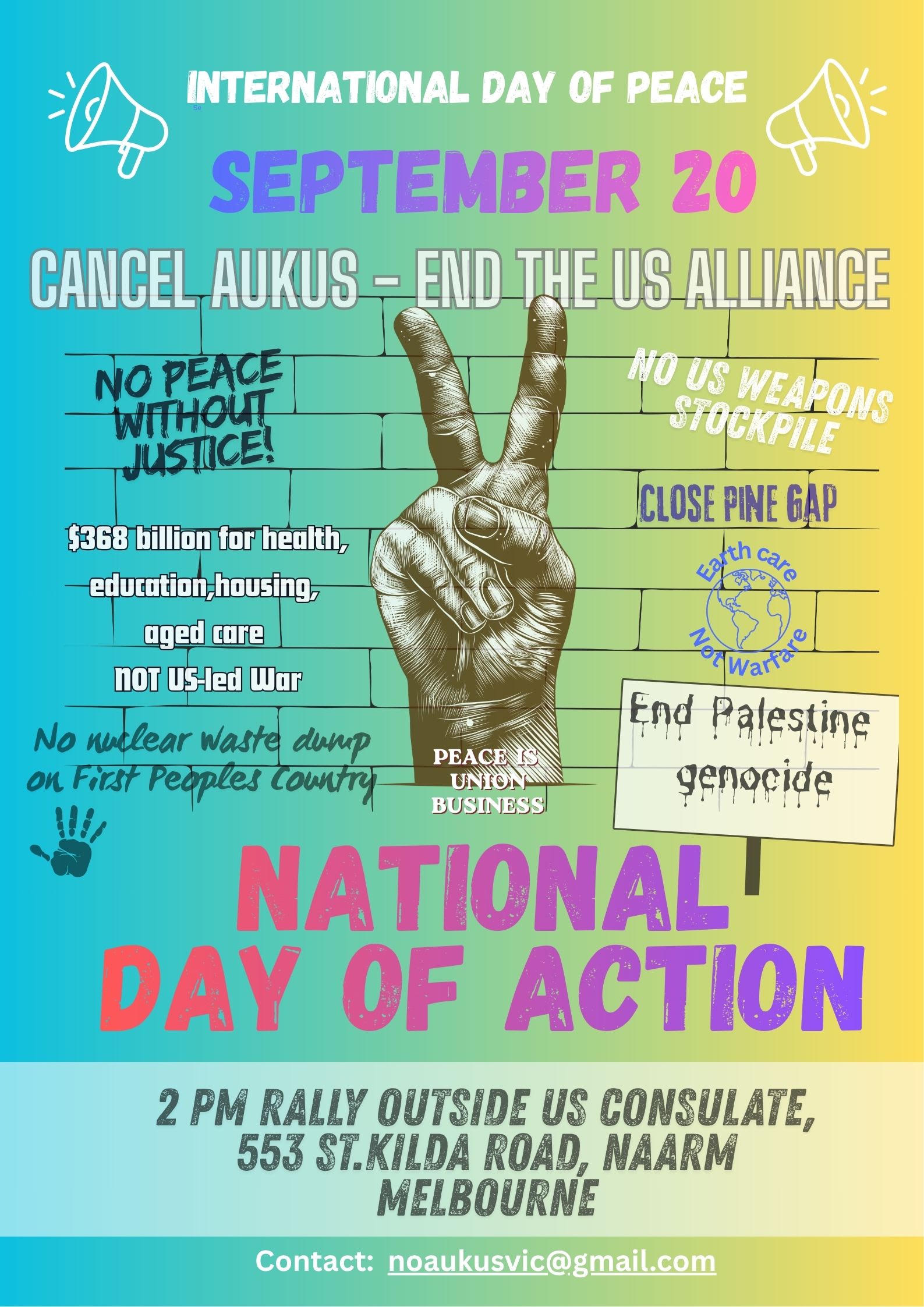
20 September –National Day of Action in Melbourne on the International Day of Peace

Help Aunty Sue Protect Her Land and Sacred Sites From Destructive Rocket Testing.
.

Australians deserve the truth
about
AUKUS – https://aukuspublicinquiry.com/

PETITION – To: Prime Minister Anthony Albanese and the Australian Labor Government

of the week – Australians for War Powers Reform (AWPR)
To see nuclear-related stories in greater depth and intensity
 Antinuclear