Investigative journalism greatly threatened by Nine-Fairfax merger
 Nine-Fairfax merger rings warning bells for investigative journalism – and Australian democracy https://theconversation.com/nine-fairfax-merger-rings-warning-bells-for-investigative-journalism-and-australian-democracy-100747?utm_medium=email&utm_campaign=Latest%20from%20The%20Conversation%20for%20August%201%202018%20-%20107769581&utm_content=Latest%20from%20The%20Conversation%20for%20August%201%202018%20-%20107769581+CID_13595e5e9a6e76046365f409b090bf10&utm_source=campaign_monitor&utm_term=Nine-Fairfax%20merger%20rings%20warning%20bells%20for%20investigative%20journalism%20%20and%20Australian%20democracy
Incoming Associate Professor at LaTrobe University. Former Lecturer, Political Science, School of Social and Political Sciences; Honorary Research Fellow, Centre for Advancing Journalism, University of Melbourne
If you value the media’s watchdog role in democracy, then the opening words in the deal enabling Channel Nine to acquire Fairfax Media, the biggest single shake-up of the Australian media in more than 30 years, ring alarm bells.
The opening gambit is an appeal to advertisers, not readers. It promises to enhance “brand” and “scale” and to deliver “data solutions” combined with “premium content”. Exciting stuff for a media business in the digital age. But for a news organisation what is missing are key words like “news”, “journalism” and “public interest”.
Those behind the deal, its political architects who scrapped the cross-media ownership laws last year, and its corporate men, Fairfax’s and Nine’s CEOs, proffer a commercial rather than public interest argument for the merger. They contend that for two legacy media companies to survive into the 21st century, this acquisition is vital.
Perhaps so. But Australia’s democratic health relies on more than a A$4 billion media merger that delivers video streaming services like Stan, a lucrative real estate advertising website like Domain, and a high-rating television program like Love Island.
The news media isn’t just any business. It does more than entertain us and sell us things. Through its journalism, it provides important public interest functions.
Ideally, news should accurately inform Australians. A healthy democracy is predicated on the widest possible participation of an informed citizenry. According to liberal democratic theorists, the news media facilitate informed participation by offering a diverse range of views so that we can make considered choices, especially during election campaigns when we decide who will govern us.
Journalists have other roles too, providing a check on the power of governments and the excesses of the market, to expose abuses that hurt ordinary Australians.
This watchdog role is why I am concerned about Nine merging with Fairfax. To be clear, until last week, I was cautiously optimistic about the future of investigative journalism in Australia.
Newspapers like The Sydney Morning Herald, The Age, the Newcastle Herald and the Financial Review have a strong record of using their commercial activities to subsidise expensive investigative journalism to strengthen democratic accountability by exposing wrongdoing. Channel Nine does not.
Since the formation of The Age’s Insight team in 1967, Fairfax investigations have had many important public outcomes after exposing transgressions including: judicial inquiries, criminal charges, high-profile political and bureaucratic sackings, and law reforms. Recent examples include the dogged work of Fairfax and ABC journalists to expose systemic child sex abuse in the Catholic Church and elsewhere, leading to a royal commission and National Redress Scheme for victims. Another was the exposure of dodgy lending practices that cost thousands of Australians their life savings and homes, which also triggered a royal commission.
The problem with Nine’s proposed takeover of Fairfax (if it goes ahead) is that it is unlikely to be “business as usual” for investigative journalism in the new Nine entity. First, there is a cultural misalignment and, with Nine in charge, theirs is likely to dominate.
With notable exceptions such as some 60 Minutes reporting, Nine is better known for its foot-in-the-door muckraking and chequebook journalism than its investigative journalism. In comparison, seven decades of award-winning investigative journalism data reveal Fairfax mastheads have produced more Walkley award-winning watchdog reporting than any other commercial outlet.
Second, even as the financial fortunes of Fairfax have waned in the digital age, it has maintained its award-winning investigative journalism through clever adaptations including cross-media collaborations, mainly with the ABC. This has worked well for both outlets, sharing costs and increasing a story’s reach and impact across print, radio, online and television.
How will this partnership be regarded when Fairfax is Nine’s newlywed? Will the ABC be able to go it alone with the same degree of investigative reporting in light of its successive federal government budget cuts?
Third, my latest research (see graph, on original) ) has shown that in Australia, as in Britain and the United States, investigative stories and their targets have changed this decade to accommodate newsroom cost-cutting.
Investigations are more likely to focus on stories that are cheaper and easier to pursue. This means some areas such as local politics and industrial relations have fallen off the investigative journalist’s radar. Here and abroad, this reflects cost-cutting and a loss of specialist reporters.
Echoing this, The Boston Globe’s Spotlight editor, Walter Robinson, warned:
There are so many important junctures in life where there is no journalistic surveillance going on. There are too many journalistic communities in the United States now where the newspaper doesn’t have the reporter to cover the city council, the school committee, the mayor’s office … we have about half the number of reporters that we had in the late 1990s. You can’t possibly contend that you are doing the same level or depth of reporting. Too much stuff is just slipping through too many cracks.
Of concern, Australian award-winning investigations already cover a smaller breadth of topics compared to larger international media markets. The merger of Fairfax mastheads with Channel Nine further consolidates Australia’s newsrooms. If investigative journalism continues, story targets are likely to be narrow.
Finally, investigative journalism is expensive. It requires time, resources and, because it challenges power, an institutional commitment to fight hefty lawsuits. Fairfax has a history of defending its investigative reporters in the courts, at great expense.
Will Nine show the same commitment to defending its newly adopted watchdog reporters using earnings from its focus on “brand”, “scale” and “data solutions”? For the sake of democratic accountability, I hope so.
Overnight secret transport of nuclear wastes through Sydney
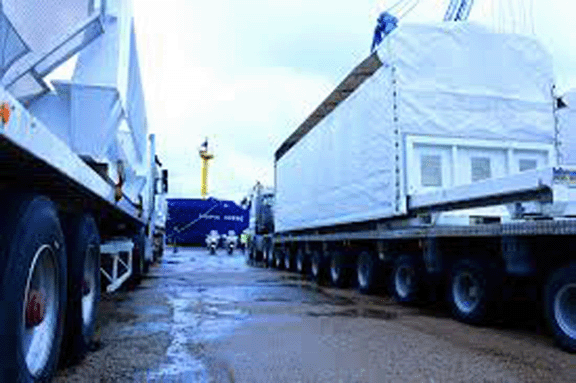
Radioactive nuclear rods leave Sydney bound for France, ABC 30 July 18
Bringing to the fore Indigenous voices the media ignore
 Stephen Langford www.greenleft.org.au/glw-authors/stephen-langford
July 27, 2018
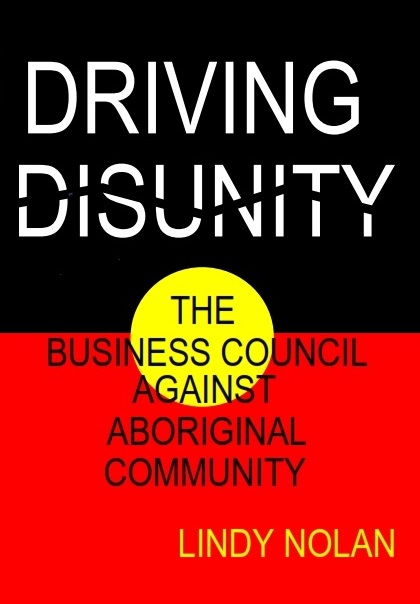
Driving Disunity: The Business Council Against Aboriginal Community
By Lindy Nolan
Bexley: Spirit of Eureka, 2017
‘In reviewing this important – but not self-important – book by Lindy Nolan,
I can hardly do better than start by quoting Rosalie Kunoth-Monks,
Northern Territory Australian of the Year in 2015 and Amatjere Elder,
from the backcover of the book: “Such deep and fearless truth.”
‘Award-winning journalist Jeff McMullen, meanwhile notes:
“This important study highlights destructive strategies in the neoliberal era
that undermine Aboriginal progress through the age old tactic of divide and conquer.” …
‘Lindy Nolan is an activist in the Stop The Intervention Collective Sydney (STICS).
This is a small but talented group of people who organise events against the NT Intervention,
now 11 years since its disastrous and fraudulent imposition
by the John Howard government. …
‘Nolan has written a book full of Indigenous voices that most people will not have heard,
because the mainstream media has been mainly accepting Murdoch’s anointed “leaders”. …
‘I hope you buy or borrow Driving Disunity – and read it.
It is full of Indigenous voices you simply will not hear in the mainstream.’
Read much, much more of Stephen Langford‘s comprehensive & interesting review of Lindy Nolan‘s book:
www.greenleft.org.au/content/bringing-fore-indigenous-voices-media-ignore
99% of South Australians are excluded from vote on nuclear waste dump for South Australia
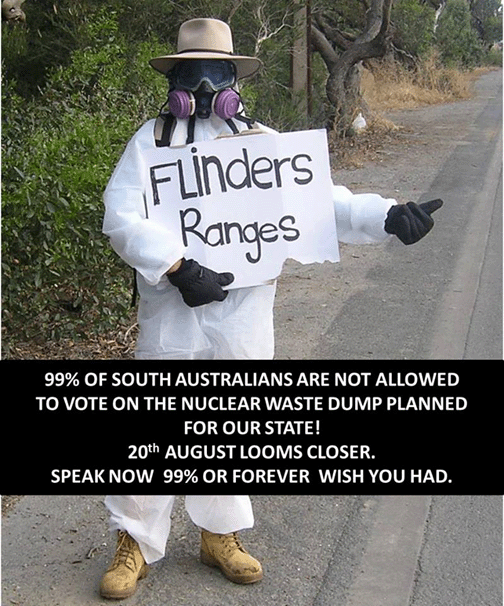
Susan Craig Fight To Stop Nuclear Waste Dump In Flinders Ranges SA, 24 July 18
• The proposed site is for an ABOVE GROUND temporary facility, stored in above ground bins, 40kms from Wilpena Pound and in our wheat farming land at Kimba.
• Both low level and INTERMEDIATE radioactive waste will be stored.
• INTERMEDIATE level is classified HIGH GRADE in France and has a half- life of TENS OF THOUSANDS OF YEARS. The containers proposed for storage only last for a few hundred years.
• ANSTO have the capacity (500 hectares) and the expertise to continue storage at Lucas Heights for another three decades.
• We should use this time to prepare a PERMANENT UNDERGROUND intelligent and cohesive solution to Australia’s burgeoning nuclear waste.
• Not just move it from one site to another.
• Mr. Canavan said and I quote: “It’s perfectly safe”. So why move it?
• ANSTO currently store 10 tonne of intermediate level nuclear waste at Lucas Heights NSW.
• Another similar quantity of intermediate level nuclear waste is arriving from Britain in a few years and proposed for South Australia.
• Current nuclear medicine using isotopes can be replaced with new technology using Cyclotrons which have a half-life of just hours rendering the waste benign. Awesome!
• Many countries around the world are moving to Cyclotrons for nuclear medicine and Australia should investigate this!
*ANSTO are developing a nuclear waste storage system called SYNROC it’s a synthetic casing for nuclear waste. However, this will only be used at LUCAS HEIGHTS and there is no intention of using SYNROC for the storage of nuclear waste proposed for South Australia.
The Federal Government is showing total disregard, disrespect and contempt for the people of South Australia, including the Adnyamathanha community of the Flinders Ranges. https://www.facebook.com/groups/344452605899556/
Nuclear reactor’s costly processes for medical isotopes: cyclotron production clean and cheaper
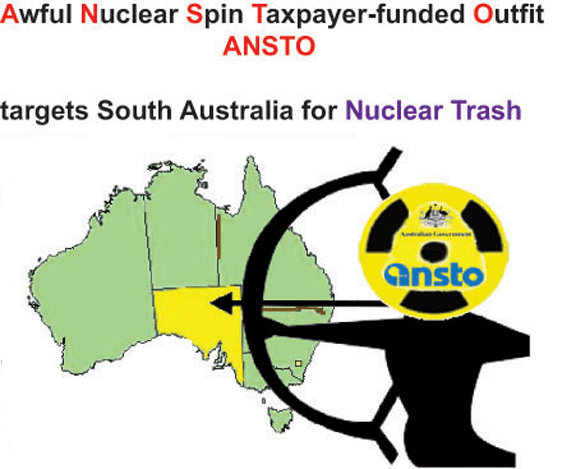 Steve Dale Fight To Stop Nuclear Waste Dump In Flinders Ranges SA 28 July 18 ANSTO ships most of its isotopes overseas, yet Australia has to deal with 100% of the large amount of waste produced from its messy isotope process.
PET/cyclotron isotopes give better imaging and no waste. If ANSTO was truly a commercial company and had to pay the true cost of its waste it would go broke immediately. https://www.facebook.com/groups/344452605899556/
Journalists’ rights in danger, if Julian Assange is prosecuted for Wikileaks

 Judges Hear Warning on Prosecution of WikiLeaks https://www.courthousenews.com/judges-hear-warning-on-prosecution-of-wikileaks/ July 24, 2018MARIA DINZEO NAHEIM, Calif. (CN) – Prosecuting WikiLeaks founder Julian Assange for publishing leaked documents related to the 2016 presidential election would set a terrible precedent for journalists, the top lawyer for The New York Times said Tuesday.
Addressing a room full of federal and circuit judges at the Ninth Circuit’s annual judicial conference, David McCraw, the deputy general counsel for The New York Times, explained that regardless of how one feels about Assange and traditional news outlets receiving the same kind of deference over publishing leaked materials, his prosecution would be a gut punch to free speech.
“I think the prosecution of him would be a very, very bad precedent for publishers,” McCraw said. “From that incident, from everything I know, he’s sort of in a classic publisher’s position and I think the law would have a very hard time drawing a distinction between The New York Times and WikiLeaks.”
McCraw went on to clarify that while Assange employs certain methods that he finds discomfiting and irresponsible, such as dumping unredacted documents revealing the personal information of ordinary people, Assange should be afforded the same protections as a traditional journalist.
“Do I wish journalism was practiced in a certain way, like it is with The New York Times, The Washington Post, or The Wall Street Journal? Of course. But I also think new ways of publishing have their value. Our colleagues who are not only challenging us financially but journalistically have raised an awareness that there are different ways to report,” McCraw said.
“But if someone is in the business of publishing information, I think that whatever privilege happens to apply – whatever extension of the law that would apply – should be there. Because the question isn’t whether he’s a journalist. It’s in that instance was he committing an act of journalism.”
Assange has long considered himself a journalist operating no differently than other news outlets. This has complicated matters, because if Assange can be prosecuted for publishing leaked information, why not prosecute news organizations like The New York Times?
Earlier this month, a grand jury returned an indictment against twelve Russian military spies for hacking into the servers and emails of the Democratic National Committee and state election officials, stealing documents and staging the release of those documents to interfere with the 2016 presidential election. While the indictment did not name Assange and WikiLeaks specifically, it has been widely suggested that WikiLeaks received the materials and could very well be the group referred to in the indictment as “Organization Number 1.”
Barry Pollack, who represents Assange in an ongoing criminal investigation in the Eastern District of Virginia, weighed in on the indictment Tuesday.
“If you read the indictment that just came out on Russians and you look at what Organization Number 1, which is clearly WikiLeaks, is alleged to have done in that indictment, it is doing exactly what The New York Times and The Washington Post do every day of the week,” Pollack said. “He [Assange] is communicating with a source, the source provides him with information, he publishes that information.
“There are no questions about the truthfulness or accuracy or authenticity of that information. And then he encourages the source to give him more information. He says ‘don’t give it to my competitors, give it to me. This story will have more impact if I publish it.’”
Pollack and McCraw spoke as part of a panel titled “The Law of Leaks,” a session on how the United States has ramped up efforts to prosecute people who have leaked state secrets. Thirteen people have been prosecuted under the first law against leaking state secrets, the Espionage Act of 1917, most under the Obama administration.
President Donald Trump has waged an unprecedented war against the media, taking to Twitter last year to call the media “the enemy of the American people.” Yet no publisher has ever been indicted over leaks, and both McCraw and Pollack expressed doubts about whether it will happen any time soon.
“Unlike firing off a tweet, bringing a prosecution requires a career professional prosecutor to sign off on the prosecution, so there also is a tremendous check there that doesn’t exist in some of the rhetoric we hear,” Pollack said.
“Prosecutions of journalists would be difficult,” McCraw said. “I think they’d be unpopular, I think they’d be wrong, and I think they’d be unsuccessful. I see this PR campaign against the press as almost an alternative to legal measures.”
Nuclear industry bigwig Jim McDowell now boss of South Australia’s public sector
 JimMcDowell, most recently CEO of BAE Systems Saudi Arabia, now chair of Australian Nuclear Science and Technology Organisation
South Aust gets new public sector boss,
Former BAE Systems chief executive Jim McDowell has been appointed to head up South Australia’s Department of Premier and Cabinet.
Premier Steven Marshall described Mr McDowell as a talented leader with decades of international business experience in industries critical to South Australia’s future prosperity.
“Mr McDowell is well placed to guide the South Australian public sector as we seek to take full advantage of the Commonwealth’s naval shipbuilding program and other defence contracts based in South Australia,” Mr Marshall said on Thursday.
Scrutiny on Hansard reveals the Australian government’s confusion about nuclear wastes

Federal nuclear waste dump will have large storage for intermediate to high grade storage
The $31 million bribe to entice Hawker to become a nuclear waste sacrifice zone
 $31 million boost for nuclear location, The Transcontinental, Marco Balsamo -23 July 18 The Flinders Ranges community could receive up to $31 million through a Community Development Package if the Wallerberdina Station site is chosen to host the National Radioactive Waste Management Facility.
Initially touted to be about $10M, federal government has more than tripled the package to be awarded to the selected community.
“This enhanced package will ensure the successful community is ready and able to take advantage of the benefits of hosting this facility both during construction and the lifetime of its operation,” he said.
“What shipbuilding or aircraft bases do for some communities, and steel-making or mining does for other towns, the National Radioactive Waste Management Facility will do for its host town in terms of employment, opportunities for new careers in trades and university qualified positions and flow-on benefits.”
The package includes a $20M National Radioactive Waste Management Facility Community Fund, delivering infrastructure and development benefits to the community………
The announcement from federal government has been slammed by Australian Greens Senator Sarah Hanson-Young, who recently visited the Wallerberdina Station site.
“Resources Minister Matt Canavan should be ashamed of himself for trying to bribe the community in return for dumping radioactive waste on them,” Ms Hanson-Young said.
“Putting money on the table, just weeks before the Kimba and Hawker communities vote on whether they want a nuclear waste dump in their front yard smacks of desperation and bribery.
“Polling shows the majority of South Australians want our state to put a stop to this project. Nuclear waste is not welcome in Kimba or the Flinders Ranges, and the rest of the state is behind these two communities in their fight against this proposal.”
Ms Hanson-Young also questioned why the Liberal government has not revealed how much profit former Liberal Senator Grant Chapman, who owns the Wallerberdina Station site, would earn from a successful bid.
The Wallerberdina Station site is one of three nominated locations for the national facility, with the other two both based in Kimba.
A postal ballot is set to commence on August 20 to measure the community support for the three nominated sites.
Federal Member for Grey Rowan Ramsey said the successful community would have the opportunity to “create a long-term future for itself”.
“Now, coupled with the commitment of a minimum 45 jobs on site, it will really give the citizens of both communities something to contemplate before next month’s vote,” Mr Ramsey said.
“This facility will provide wonderful opportunities for either community if selected.” https://www.transcontinental.com.au/story/5540993/31-million-boost-for-nuclear-location/
The death of Australia’s quality news media – Fairfax gobbled up by Nine
 A modern tragedy: Nine-Fairfax merger a disaster for quality media, The Conversation, Senior Research Fellow in the Centre for Advancing Journalism, University of Melbourne,
All deaths are sudden, even if long expected.
Appropriately enough, this is the opening sentence of a book called Journalism in a Culture of Grief.
And if ever there was a time of grief for journalism in Australia, it is today, with the announcement that Nine Entertainment is taking over Fairfax Media.
It means the death of Fairfax and is the most consequential change in Australian media ownership in 31 years.
It also means that three of Australia’s best and biggest newspapers – The Age, The Sydney Morning Herald and The Australian Financial Review – are now subsumed into a media conglomerate whose editorial culture is characterised by mediocre journalism.
Nine’s news bulletins consist largely of police stories with a tincture of politics, and highlights of colourful or violent events overseas.Its current affairs program, A Current Affair, is a formulaic procession of stories about consumer rorts and personal tragedies.
So there is a huge question mark over the future editorial quality of the newspapers.
A particularly pressing question is: what will happen to The Age’s investigative unit?
It is led by two of the best investigative reporters Australia has produced, Nick McKenzie and Richard Baker.
In addition to breaking an extraordinary range of major stories on subjects like organised crime and scandals in the banking industry, they have developed a highly successful collaboration with the ABC’s Four Corners team.
It seems very unlikely Nine would allow this collaboration to continue, since it involves a rival television channel.
There is also a question about editorial independence.
Fairfax has a charter of editorial independence, which all owners since 1990 have signed up to. Will Nine sign up to it? Will the charter have any meaning when the newspapers are owned by a company whose chairman, Peter Costello, was treasurer in the Liberal-National Coalition government of former Prime Minister John Howard?
The answers to these questions will not be known for some time. They will depend largely on who is given editorial control of the combined operation. Since the Nine CEO, Hugh Marks, is to be CEO of the combined operation, it seems more likely than not that it will be a Nine executive who calls the editorial shots, too.
The takeover also means a further loss of diversity in an already highly concentrated media-ownership landscape. The big players are now down to four: News Corp, Nine, Seven West Media and the ABC.
And it is almost certain to mean the loss of yet more journalists’ jobs.
Since 2012, more than 3,000 jobs have been lost across Australian journalism. Yet, if the takeover is really going to represent “compelling value” for shareholders, as Fairfax chairman Nick Falloon says, then newsroom “synergies” – to borrow the corporate jargon – are likely to be essential.
The Fairfax company’s death throes have been painful and prolonged……https://theconversation.com/a-modern-tragedy-nine-fairfax-merger-a-disaster-for-quality-media-100584?utm_medium=email&utm_campaign=Latest%20from%20The%20Conversation%20for%20July%2027%202018%20-%20107389538&utm_content=Latest%20from%20The%20Conversation%20for%20July%2027%202018%
South Australia’s Liberal government now happy with progress towards 75% renewables target
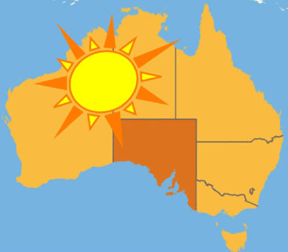 South Australia on track to meet 75% renewables target Liberals promised to scrap, Guardian, Adam Morton , 26 July 18
Liberal energy minister, who inherited policy criticised as a mix of ‘ideology and idiocy’, says he’ll ensure it does not come at too high a price
South Australia’s energy minister says the state is on track to have 75% of its electricity from renewable sources by 2025 – the target set by the former Labor premier Jay Weatherill and once rejected by his Liberal government. And Dan van Holst Pellekaan pledged to ensure it does not come at too high a price.
But several expert analyses have found the state is likely to meet or nearly meet the aspirational target, which was not tied to a policy mechanism. The Australian Energy Market Operator has projected South Australia would have 73% renewable power by 2020/21 while consultants Green Energy Markets found it could reach 74% by 2025 without any additional policies being introduced.
The South Australian energy and mining minister, Dan van Holst Pellekaan, said that was also his understanding. “That’s what the reports I’ve read are saying,” he said. “We need to harness it properly so consumers aren’t paying too high a price along the way.”
Van Holst Pellekaan has responsibility for shaping the future of energy in a state that already gets about half its electricity from variable sources such as wind and solar – a situation that Weatherill described in 2015 as “a big international experiment”. The new minister has inherited some of Labor’s proposed solutions, including a giant lithium-ion battery, a 20-year power purchase contract to underwrite a solar thermal plant with built-in storage and a “virtual power plant” of solar and batteries across public housing sites. ……..
Speaking in his electorate office in Port Augusta, home to the state’s coal power until the last plant closed in 2016, and now with up to 13 clean energy at varying stages of development including the solar thermal project, van Holst Pellekaan said the shift from coal to more clean energy in South Australia had been messier than it needed to be, but was inevitable.
“We must transition away from fossil fuels towards renewable energy,” he said. “There’s no doubt about it. And we need to do it sensibly.”
……… South Australia is also backing small-scale storage. Under a deal signed by Labor, the government is installing a “virtual power plant” – initially 1,100 solar panels and Tesla batteries in public housing backed by a $30m loan from taxpayers.
Van Holst Pellekaan announced last week an initial trial had been a success, increasing supply and the reliability of the network and lowering cost at times of peak demand. He said delivering Labor’s full promise of 50,000 public housing systems depended on private-sector financing and Tesla and the government signing off on the final program design.
The Labor scheme will sit alongside a Liberal-pledged $100m plan to subsidise batteries at 40,000 private homes. Details are promised in coming months………
He stressed the importance of improved connection between the states, particularly a long-mooted link between South Australia and New South Wales, to improve grid efficiency and reliability. The transmission company ElectraNet has recommended a $1.5b interconnector between South Australia’s mid-north and Wagga Wagga.
Van Holst Pellekaan, a National Basketball League player in the 1980s with the Hobart Devils, said South Australia’s energy policies were in line with recent advice from the Australia Energy Market Operator and the competition and consumer watchdog…..https://www.theguardian.com/environment/2018/jul/25/south-australia-to-hit-75-renewables-target-by-2025-liberal-energy-minister-says
The announced takeover of Fairfax by Channel Nine will change the news landscape of Australia altogether.
The Fairfax takeover is a great pity – Nine has the ethics of an alley cat, Guardian, The kind of merger announced today between Channel Nine and Fairfax was bound to happen the moment the cross-media legislation introduced by the Hawke government 30 years ago was suspended.
The so-called cross-media rule gave Australia 30 years of media diversity, especially between Australia’s major television networks and its capital city print.
Those barriers in the wholesaling of news underwrote diversity of opinion, guaranteeing an altogether better informed and livelier public debate.
It is true that the technology has brought myriad voices to a public eager for diversity of information. But the atomisation of web-based content, much of it other than local, cannot in terms of impact, be compared with the big local media players, particularly in consolidations of the kind announced today.
The announced takeover of Fairfax by Channel Nine will change the news landscape of Australia altogether.
Notwithstanding the obvious disruption that international platforms like Google and Facebook have made to advertising and traditional media revenues, the answer for Australia is diversity of income streams for Australia’s majors and not a closedown in news and content with major print being taken over by major television.
This is an exceptionally bad development.
……… If in the announced arrangement Channel Nine has a majority of the stock, Channel Nine will run the editorial policy.
The problem with this is that, in terms of news management, Channel Nine, for over half a century, has never other than displayed the opportunism and ethics of an alley cat.
There has been no commanding ethical or moral basis for the conduct of its news and information policy.
Through various changes of ownership, no one has lanced the carbuncle at the centre of Nine’s approach to news management. And, as sure as night follows day, that pus will inevitably leak into Fairfax.
For the country, this is a great pity.
And, of course, if the government really had its way, Australia would face this much closed down and managed landscape without an ABC as it is today – an independent national broadcaster.
On competition grounds and those of the imperative of local diversity, the competition commissioner should put this proposal under high scrutiny.
Of course, the current managements of Nine and Fairfax will scream enhanced media diversity via the web – news and views everywhere. And some of this is true. https://www.theguardian.com/media/2018/jul/26/the-fairfax-takeover-is-exceptionally-bad-news-nine-has-the-journalistic-ethics-of-an-alley-cat
Waste dump for Kimba- nuclear bonanza or nuclear sacrifice zone?
Coalition’s Kimba nuclear dump exploits local area and puts nation at risk https://independentaustralia.net/politics/politics-display/coalitions-kimba-nuclear-dump-exploits-local-area-and-puts-nation-at-risk,11717 Noel Wauchope 23 July 2018,
How is a small rural town to cope with a proposition that may transform the community by providing an economic boon or be a long-term curse?
This is the dilemma facing the towns of Kimba and Hawker, both in the Eyre Peninsula, South Australia.
Individual landowners offered their land to the Turnbull Government for a radioactive waste storage site and the Government’s National RadioactiveWaste Management Facility (NRWMF) team swung into action.
There’s quite a hurry on, about this. Resources Minister Matt Canavan announced that, on 20 August, there will be a local ballot to gauge community support for a nuclear waste dump.
Following that, said Canavan:
“The decision will be made in the second half of this year … We do not want this overlapping with a Federal election.”
Much can be said about this plan, not least that it contravenes South Australian law. One might ask, too, why the inquiry stipulates South Australia when the waste to be stored would have to travel 1,700 km from the Lucas Heights nuclear reactor in Sydney? However, the most notable immediate ramifications concern its impact on Eyre Peninsula rural communities.
As one local resident put it:
‘Stress levels are through the roof for a lot of people within our communities. People are getting sick, and some are just sick and tired of hearing about it, with many wanting the dump to just go away!’
And in the words of another resident:
‘Before a nuclear waste dump came into our lives, people enjoyed cultural activities together … Today it isn’t like that, a once close family ruined and torn apart all because of a proposed nuclear waste dump that could be put on Adnyamathanha traditional lands, which will destroy our culture and … cause cultural genocide.’
Community division is obvious when one reads the submissions that local and Eyre Peninsula residents have sent to a Senate Committee of Inquiry. The Inquiry called for submissions, stipulating fairly narrow Terms of Reference (TOR), about the ‘Selection process for a national radioactive waste management facility in South Australia’.
Among the 40 supporters of the plan, most are local residents, enthusiastic about hosting the waste dump.
Repeatedly, their submissions include phrases like ‘no negative impacts’ and ‘comfortable and satisfied with the prospect of hosting the proposed nuclear waste facility’
Numbers below in brackets refer to the submission numbers listed on the Senate website.
John Hennessy( No 7), is “bubbling with enthusiasm” for nuclear waste dump in Hawker. “Hawker has “ a once in a lifetime opportunity”
Jessica Morgan, (no.37) ” I have stood [at ANSTO] next to and touched the canister containing the intermediate level waste with my 9 month old baby in a carrier on my chest, feeling totally confident of my own safety and that of my child.”
Annie Clements, (No 35) – happy to see nuclear waste dump “powering Kimba community into the future”.
And here we come to another aspect of their support for the waste dump plan. It’s not just that Kimba might be “powered into the future”. It’s the thought that Kimba might not have a future unless it hosts the dump.
Again and again this argument appears in the pro nuclear submissions:
This repository would ensure our towns survival – Ian Carpenter.( No 3 )
Kimba is struggling, population is declining,… we are in need of a life line …. The possibilities this facility could provide a small failing community is endless – Jodie Joyce (No 33)
this project will ensure the long term viability of this small country town – Janice McInnis, ( No 4 )
it will save Kimba ” for many more generations to come– Melanie Orman (No 77)
A third, much repeated, theme in these submissions is that this matter concerns only the local community.
This is frequently expressed with the dismissal of the opinions of people outside the immediate area and also, at times, with downright hostility to those who oppose the dump:
‘People outside our area could be influenced by anti-nuclear scare campaigns and wild allegations that have no relevance to this facility.’ ~ Annie Clements (35)
‘Activists and politicians who have been using [this] project as a vehicle for their anti-nuclear stance should not be entitled to any say …’ ~ Heather Baldock (64)
Outsiders do not care if Hawker dies a slow death due to lack of employment etc – Chelsea Haywood (No. 2)
‘We disagree that we need “broader community views” and the need to stretch the boundaries outside of our District Council. What is happening in our Community is exactly that: our community.’ As residents of Kimba for the last 43 years, plus ++ We see no reason that the rest of SA has a right to tell us what we can and can’t have. It is our back yard, not theirs. ….. . It’s a shame we have to have this inquiry. ~ Margaret and Charlie Milton (34)
These three themes – enthusiasm for the project, distrust of critics, and resistance to the involvement of outsiders, merge into a kind of strong local patriotism allied to trusting loyalty to the federal government, which has run a huge informational campaign in the towns.
As to the 58 submissions opposing the plan, at least half come from residents of the Eyre Peninsula. As with the rest of the opponents, they do express a variety of arguments, but local submissions are most often concerned with the local area.
Above all, they are dissatisfied with the community consultation process, and the lack of clarity about what is meant by “broad community support”. They want the wider community, Eyre Peninsula, South Australia, to be consulted, and, indeed they see the federal nuclear waste facility as a national issue. They also do not believe that the project has Indigenous support.
Readers of all 98 submissions can’t fail to notice that, on the whole, these 55 opposing ones have more comprehensive, detailed, and referenced writing, as compared with the pro nuclear ones. And this is certainly true of the very thoughtful and measured arguments of the farmers from the local areas concerned.
These raise some issues which are rarely mentioned on the pro-nuclear side:
- concern about co-location of low and intermediate level wastes, especially the prospect of stranded “temporary” wastes, with no plan for final disposal;
- transport dangers;
- seismic and flood dangers;
- impacts on agricultural markets and tourism; and
- the fear that this waste dump would lead to a full-scale commercial importation of nuclear waste.
Kay Fels, a Flinders Ranges farmer.(No 63) ‘s submission is representative of the concerns of many others:
our stock (sheep and cattle) may also be stigmatised by the proximity of the waste dump and our organic status compromised Agriculture and tourist industries will be jeopardised as the clean, green image of the Flinders Ranges is tarnished . The sites are located in an area where the underground water table is almost at surface level. This could lead to contamination of the underground water source, so vital to the region. The location is also on a piedmont plain and prone to flooding
Given that the proposal is to store low level waste in an above ground facility, and temporarily store intermediate waste in that same facility, it seems ludicrous that this is even considered given the geological and environmental features and risks involved.
The consultation phase was a tokenism with ANSTO telling us what will be happening, how safe it is and pushing the affirmative – not a true reflection of the community’s views and concerns. The consultative committee is a rubber stamp
Many are strongly sceptical of the consultations held by the Department of Industry Innovation and Science (DIIS), and of the information campaign by Australian Nuclear Science and Technology Organisation (ANSTO) . There is strong criticism of the nomination of Wallerberdina property by non-resident former Liberal Senator Grant Chapman, with close links to the nuclear industry. They also claim hypocrisy of DIIS in biased and misleading information, and dismissal and indeed, exclusion of critics.
‘
I am not against having a LLW facility in Australia. I am against the way in which DIIS have gone about finding a quick fix for something that will affect all South Australians for centuries to come. It should not be up to a small council area to overrule our Prohibition Act 2000, if we are to vote for something of such national importance.” My problem is a complete lack of trust with DIIS in the way in which they have treated ordinary people from Quorn, Hawker and Kimba – Leon Ashton (No 73)
there are far too many discrepancies in the information, consultation process and long term impacts to have such a facility based at Kimba (or Hawker). the consultation process has been an insult to the intelligence of rural people. – Leanne Lienert (No. 50)
Sue Tulloch (no 32) makes a scathing criticism of the federal nuclear waste dump process and “shambolic “Barndioota Consultative Committee.
Aboriginal voices are passionate, at the same time as providing factual information and references:
The Senate took a long time to publish this one – perhaps because they recognised it as the most important one? Regina McKenzie (No 107) , a very well informed traditional indigenous owner of the selected are at Barndioota, focuses on the cultural heritage rights and interests of identified traditional owners and the State/Federal obligations regarding those rights. The Department of Industry, Innovation and Science (DIIS) has ignored Australia’s commitment to United Nations Declaration on the Rights of Indigenous Peoples. DIIS has poorly assessed Aboriginal cultural heritage, and engaged inappropriate consultants. –
In this article, I have avoided the wider arguments expressed in the submissions, including the ones from organisations on both sides of the argument. Through studying 98 submissions, I have tried to get to the feelings of the communities involved – to what it must be like, to be part of a community caught in this dilemma.
Our biggest worry of this process is the detrimental effect it will have and is already having on the local community as a whole. Along with my family we have never seen an event in this area cause so much angst and division in a once very proud close knit community which was the envy of many other communities. – Philip Fels (No 84)
The mental health and well-being of communities is completely ignored in this process and this is a serious issue that needs to be addressed in future frameworks and guidelines. This process makes communities feel powerless – no support is given to those with opposing views, it is a process that is heavily favoured towards those pro-nuclear and when the rules keep changing to suit those in favour it really gives people a sense of hopelessness. Chloe Hannan, Kimba : (No. 61)
As an outsider, I can’t really gauge this social situation. But, whatever the outcome of the federal government’s plan, Kimba and Hawker communities will never be quite the same again
Kimba’s nuclear waste dump is planned to facilitate DOUBLING of nuclear wastes in Australia
 The Department has provided some updated info on estimated Intermediate Level Waste (ILW) volumes – set to double – and on the claimed period of proposed operations of the above ground ILW Store.
1 This month
25 October – Film –Britain’s Nuclear Bomb Scandal: Our Story – part of the Adelaide Film Festival,
Screening and Conversation
A screening of Britain’s Nuclear Bomb Scandal: Our Story (2024) followed by a talk with 2026 Bettison and James Awardee and Tradtional Owner Karina Lester in conversation with Simone Tur.
When: Sun 25 Oct, 12:00pm-Screening, 1:15pm-Talk
Where: The Mercury
Free admission, register below by clicking on BUY TICKETS and select free event tickets, at end of web page:
https://www.adelaidefilmfestival.org/program/2026/britains-nuclear-bomb-scandal-our-story
.

Australians deserve the truth
about
AUKUS – https://aukuspublicinquiry.com/

PETITION – To: Prime Minister Anthony Albanese and the Australian Labor Government

of the week – Australians for War Powers Reform (AWPR)
To see nuclear-related stories in greater depth and intensity

