Just thinking, the proposed nuclear rubbish dump been forced upon us and the rest of the Adnyamathanha people is like imperialism. It is an economic, political dominance over us.
We as traditional owners have not heard of or seen any report of the so called cultural heritage assessment that was done upon our traditional lands, so I believe and see that as tokenism, because the wider community of Adnyamathanha people weren’t involved or weren’t consulted in a proper manner and it looks like we will never get to see the cultural heritage report.
So why is there so much secrecy on the cultural heritage report because at the end of the day, we are the Adnyamathanha people and its our traditional land and cultural heritage, our overall a big part of our cultural stytem our Muda that will be destroyed.
It will be total cultural genocide, so please dont destroy our culture our Muda by ripping out the pages of our story lines just for a nuclear waste repository. Listen to the first sovereign people, the Adnyamathanha of the Flinders Ranges, because we know the end of the story and the consequences that the Muda will bring, please respect it as we dont want mankind to suffer today, tomorrow and in the years to come.
Leave the poison nuclear waste at Lucas Heights or wherever it is around the world today, we dont want it on and in our yarta its muntha, no good! Hopefully oned ay, but at the moment it is only a big dream, our knowlege of our yarta and of the Dreaming, our people will be accepted, respected and embraced by all non Aboriginal Australians as true history and sovereign people of the northern Flinders Ranges and surrounding areas so please dont put a nuclear waste dump on our yarta.
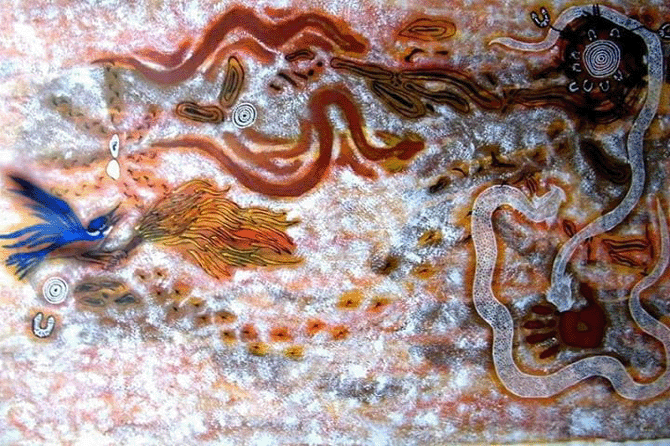
painting done by Regina McKenzie 6 yrs ago about Yurlus Dreaming tracks and where he went. This one depicts the a part of the tracks area where Yurlu went, but unfortunately now this area destined for a nuclear waste repository which will destroy the story and Dreaming tracks storyline and songs.
I want to stress, that I dont hate anyone regardless of race creed or colour all I want is for us as all Adnyamathanha people a tribal nation to be listened to by DIIS so that they dont destroy our cultural beliefs, our heritage our stories of creation of this land and where it goes. https://www.facebook.com/groups/344452605899556/
Australian mining companies have a poor track record operating in Africa. Australian uranium company Paladin Energy has now put two of its mines into ‘care-and-maintenance’ and bankruptcy looms. But who cleans up the company’s mess in Namibia and Malawi, asks JIM GREEN
Many Australian mining projects in Africa are outposts of good governance – this is what Julie Bishop, the country’s Foreign Minister, told the Africa Down Under mining conference in Western Australia in September 2017. The Australian government “encourages the people of Africa to see us as an open-cut mine for lessons-learned, for skills, for innovation and, I would like to think, inspiration,” the minister said.
But such claims sit uneasily with the highly critical findings arising from a detailed investigation by the International Consortium of Independent Journalists (ICIJ). The ICIJ noted in a 2015 report that since 2004, more than 380 people have died in mining accidents or in off-site skirmishes connected to Australian mining companies in Africa.
The ICIJ report further stated: “Multiple Australian mining companies are accused of negligence, unfair dismissal, violence and environmental law-breaking across Africa, according to legal filings and community petitions gathered from South Africa, Botswana, Tanzania, Zambia, Madagascar, Malawi, Mali, Cote d’Ivoire, Senegal and Ghana.”
Paladin Energy’s Kayelekera uranium mine in Malawi provides a case study of the problems with Australian mining companies in Africa. Western Australia-based Paladin exploited Malawi’s poverty to secure numerous reductions and exemptions from payments normally required by foreign investors.
United Nations’ Special Rapporteur Olivier De Schutter noted in a 2013 report that “revenue losses from special incentives given to Australian mining company Paladin Energy, which manages the Kayelekera uranium mine, are estimated to amount to at least US$205 million (MWK 67 billion) and could be up to US$281 million (MWK 92 billion) over the 13-year lifespan of the mine.”
‘Our kids need proper water’: Families plead for action over uranium in drinking water, ABC, 7.30 by Indigenous affairs reporters Isabella Higgins, Bridget Brennan and Emily Napangarti Butcher, 19 June 18,
Key points:
At least three communities in central Australia have levels of uranium in drinking water that exceed health guidelines
Dozens of other communities not meeting aesthetic guidelines, which ensure taste, feel and smell are up to standard
Residents fear water could be harming them and say governments have failed to act
Aboriginal community of Laramba, north of Alice Springs, drinking water contains more than double the recommended levels of uranium, and it’s been like that for a decade.
Billy Briscoe, a long-term resident, is deeply concerned about the impact that water is having on his family.
“The really important thing is about kids. Our kids need proper water, not with uranium. They need quality, really good water,” he said.
“We all drink the bore water … if there’s no water, how can you survive?
Official data obtained by the ABC’s 7.30 program shows Laramba’s water supply contains uranium at higher than 0.04 milligrams per litre (mg/L).
Australia’s drinking-water guidelines outline it should not exceed 0.017mg/L.
“The main toxic effect of short-term exposure to high concentrations of uranium is inflammation of the kidney,” according to the National Health and Medical Research Council.
“Little is known about the long-term exposure to low concentrations.”
Most communities in the Northern Territory rely on bore water, pumped up from an aquifer deep underground, which often contains high concentrations of naturally occurring minerals and contaminants — like uranium.
….. 7.30 can reveal that, in total, seven communities in the NT have exceeded health guidelines in the last financial year due to elevated levels of contaminants including uranium, barium, antimony, chromium and fluoride……A report from the West Australian auditor-general released in 2015 said three remote communities had exceeded the safe limit of uranium about half the time. ……
Arrernte elder Bob Liddle took this fight to the Federal Government after what he saw as inaction from the Territory Government.
The Federal Government said the provision of clean, safe, drinking water was not a federal responsibility.
“It is a responsibility of state, territory and local governments,” a spokeswoman for the Department of the Prime Minister and Cabinet said……
Mr Liddle said his biggest frustration was that he believed no level of government was taking carriage of fixing the water in his home communities.
“It’s an international scandal that this is allowed to happen in a country like Australia — a rich country like Australia,” he said.
“If that was happening in Victoria, you’d have a hell of a row. There would be politicians on the guillotine.
ABC managing director Michelle Guthrie has hit back against critics with a Deloitte Access Economics assessment that the public broadcaster contributed more than A$1 billion to the Australian economy in the last financial year.
This was on a par with the public funding of the organisation, she told the Melbourne Press Club, in an address coming days after the Liberal Federal Council urged the ABC be privatised – a call rejected by the government.
Far from being a drain on the public purse, the audience, community and economic value stemming from ABC activity is a real and tangible benefit,“ she said. The Deloitte study was commissioned by the ABC; Guthrie said its report was still being compiled and would be released next month.
Of the $1 billion, “more than a third is economic support for the broader media ecosystem. Far from being Ultimo-centric, the ABC is boosting activity across the country,” she said, giving as examples the filming of Mystery Road in the Kimberley and the production of Rosehaven outside Hobart.
Deloitte calculated the ABC was helping sustain more than 6000 full-time equivalent jobs across the economy. “It means that for every three full-time equivalent jobs created by the ABC, there are another two supported in our supply chain – local artists, writers, technicians, transport workers and many more.
“In hard figures, the research shows that the ABC helps to sustain 2500 full-time equivalent jobs in addition to the 4000 women and men who are directly employed by the public broadcaster.
“When broken down this equates to more than 500 additional jobs in production companies, over 400 jobs elsewhere in the broadcast sector, and close to 300 full-time equivalent jobs in the professional services.
“Amidst the debate over the ABC’s purpose and its funding we should all remember that there are 2500 jobs outside public broadcasting at risk in any move to curtail our remit and activities”.
Addressing the critics’ argument that the ABC’s about $1 billion funding wasn’t well spent, Guthrie pointed out that the broadcaster’s per capita funding had halved in real terms in three decades while the demands on it had increased, and that this financial year 92% of its budget would be spent on making content, supporting content makers and distribution.
“Thirty years ago, the ABC had five platforms and 6000 people working around the country. Today, Your ABC has two-thirds the number of people operating six times the number of platforms and services with half the real per capita funding”.
Guthrie argued that the claim that the latest 1% efficiency dividend could easily be accommodated ignored the accumulation of efficiency takes over the past four years, and the fact these efficiencies robbed the organisation of its ability to finance new content and innovation.
She rejected what she described as two other “fallacies” – that the ABC should be stripped back to servicing gaps in the market, becoming a “media failure operator”, and that the ABC served only sectional interests.
Referring to the ABC charter, she said that “as the independent national public broadcaster, our purpose is to provide a balance between broadcasting programs of wide appeal as well as specialised interest”.
Public broadcasting was “about providing the distinctive programs that Australians young and old, left and right, rich and poor, in Bourke and in Brisbane, both want and need”.
She attacked those commentators and politicians who liked “to pigeonhole our audience as being of a particular political bent or social strata.
“In the two years since I’ve been in this role, I have been constantly reminded how wrong that is”, she said, citing the 12 million Australians who would watch ABC TV this week, the nearly five million who’d listen to ABC radio, and the 13 million ABC podcast downloads that occurred every month.
“If all those listeners and viewers were on the one side of politics, there wouldn’t be much politicking left to do.
“I note also the findings of the recent Reuters Digital News Report. Australia may have an increasingly polarised media sector, but ABC television attracts viewers from across the political spectrum for its news coverage”.
Guthrie said that Australians regarded the ABC “as one of the great national institutions” and “deeply resent it being used as a punching bag by narrow political, commercial or ideological interests”.
June 19 marks six years since the founder of WikiLeaks entered the building of the Ecuadorian Embassy in London. He hasn’t stepped foot outside it since.
Julian Assange has been residing at the Ecuadorian Embassy in London since 2012, where he sought refuge while facing sexual assault allegations in Sweden.
981 days have passed since the Metropolitan police removed dedicated 24/7 guards from outside the Ecuadorian Embassy on October 12, 2015.
“Like all public services, MPS resources are finite. With so many different criminal, and other, threats to the city it protects, the current deployment of officers is no longer believed proportionate,” a statement by the Met police said.
865 days since the UN Working Group on Arbitrary Detention (WGAD) ruled in a majority decision that Assange was being detained inside the Ecuadorian Embassy in London arbitrarily and was allowed to leave.
396 days since the allegations were dropped by Swedish prosecutors, but the Wikileaks founder would still get arrested if he left the embassy’s premises — by the UK police — for failing to surrender to the court in 2012.
158 days since Assange was granted Ecuadorian citizenship and subsequently the UK was asked to recognize the whistleblower as a diplomatic agent. Had the British agreed — it would have given Assange immunity to finally leave the embassy.
83 days since the whistleblower’s access to the Internet was cut off “in order to prevent any potential harm.”
“The government of Ecuador has suspended the systems that allows Julian Assange to communicate with the world outside of the Ecuadorian Embassy in London… The measure was adopted due to Assange not complying with a written promise which he made with the government in late 2017, whereby he was obliged not to send messages which entailed interference in relation to other states,” the government of Ecuador said in a statement.
Julian Assange fears extradition to the United States to be prosecuted for espionage after his website leaked classified US data.
With the Senate not reporting on this until August 14, it is clear that this selection will be a rushed job. It is no doubt the government’s intention that the Senate Inquiry should be irrelevant.
A ballot to gauge community support in the small towns of Kimba and Hawker, about 450km north of Adelaide, for the facility will be held on August 20, Senator Canavan said.
“The decision will be made in the second half of this year … one way or another we need to make a decision,” he said. “We do not want this overlapping with a federal election. We have to find a solution.”
Senator Canavan told The Australian that economic benefits, including 45 direct jobs and a $10 million community fund, were behind support of more than 60 per cent in the communities affected by the proposal, following 18 months of consultation.
But Peter Woolfoord, president of a community group opposed to the facility, said Kimba was “completely divided” and insisted a waste repository should not be on agricultural land where “it poses unacceptable risks to our industry”.
Centre Alliance senator Rex Patrick said the site selection process “looks like an absolute sham” and claimed the Turnbull government was “determined to rush to select one of the South Australian sites despite there being a divided community”.
Senator Patrick said the government should properly engage with the remote mining town of Leonora, 240km north of Kalgoorlie in Western Australia, on its bid to host the facility.
Senator Canavan said there was already broad community support for three South Australian properties — two near Kimba, on the Eyre Peninsula, and Wallerberdina Station, near Hawker in the Flinders Ranges.
He said an “aggressive” push by the Azark company and the Shire of Leonora for a site on Clover Downs pastoral station, about 20km northwest of the central WA mining town, was a “plan B”.
“They want to run the facility themselves, which we haven’t ruled out … their initial scope was more focused on also taking overseas radioactive waste, which we definitely do not want,” Senator Canavan said.
“If we can’t get the support in South Australia we’ll most likely return to this other option (Leonora) as a plan B.”
The federal government has tried to find a site for a national radioactive waste management facility for more than a decade.
Marshall still open to nuclear powerIn Daily, Tom Richardson ADELAIDE April 11, 2018 Marshall today embarked on his third regional tour since seizing office at last month’s election, visiting the South-East seat of Mount Gambier where Liberal-turned-Independent MP Troy Bell is a firm advocate for nuclear power.
Marshall and Bell broke bread this morning, their second face-to-face meeting since election day.
Bell quit the party after being charged with dishonesty offences following an ICAC investigation. He is pleading not guilty in an ongoing court case……….
“I’ve always worked with Troy Bell… it’s quite obvious we share a lot of common aspirations for the people of the South-East,” he said.
One of those aspirations could yet be the establishment of a nuclear generator after Marshall last year flagged his interest in considering the industry, despite Royal Commissioner Kevin Scarce rejecting it as a commercially viable option “in the foreseeable future”.
“There will be a time when it may become viable, and desperate times call for desperate solutions – and we are in a desperate situation,” Marshall told media in February 2017.
Bell, who spearheaded the Liberals’ South-East fracking moratorium before he left the party-room, is a strong advocate for nuclear power and told InDaily he was “absolutely happy to lead the discussion” about establishing a local industry.
Paul Waldon Fight To Stop Nuclear Waste Dump In Flinders Ranges SA, 18 June 18
The American Department Of Energy’s (DOE), June 4th 2018 proposal to re-label (reclassify or rename) Hanford’s highly radioactive tank waste so it will not have to comply with the time consuming requirements of treating or disposing of such waste.
And if the DOE gets their way, high level radioactive waste “residue” will become “Waste Incidental to Reprocessing,” or WIR. This also means, radioactive waste in Hanford’s leaky tanks will only be cemented or grouted over, and will continue to purge its dangerous contents into the neighbouring Columbia river.
America’s irresponsible attempt to reclassify high grade radioactive waste is reminiscing of Australia labeling high grade waste as intermediate, and for those people that can’t remember it was only on the eve of WIPP’s inauguration that the residents of Carlsbad were adroit to the fact that radioactive waste to be accepted was of a greater classification at their unseen backdoor than indicated coming through the documented front-door.
Montebello Islands are a nuclear radiation risk, but boaters and campers flout the rules,ABC North West WABySusan Standen , 17 June 18
The Montebello Islands remain a nuclear radiation risk more than half a century after British bomb tests in the area, yet increasing numbers of people are risking their health by straying too close to the danger zones and even camping there.
There are more than 260 islands and islets in the Montebellos, which lie about 120 kilometres off the coast of Dampier in north-west Western Australia.
They are only accessible by boat and are rich in natural marine diversity and human history.
They are also the site of British nuclear testing in the 1950s.
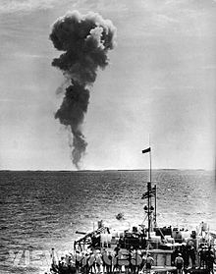
One of the test blasts conducted by the British military in the 1950s was filmed by a group of men from WA Newspapers camped on Karratha Station, approximately 150 kilometres away, then a thriving sheep station.
A family video of the action was made by station leaseholder Mrs Normie Leslie, mother of well-known local author Tish Lees, who is featured standing on the fence watching the blast.
Today the remoteness of the islands together with other personal health and safety concerns have prompted Parks and Wildlife Service staff to again highlight warnings to boating visitors.
With boating recreation a popular pastime in the coastal towns of Karratha, Dampier, Onslow and Port Hedland, some people are venturing further afield to offshore islands like the Montebellos.
Steve Dale shared a link. Fight To Stop Nuclear Waste Dump In Flinders Ranges SA, 18 June 18
If the ABC was privatised, I think the public would hear even less about our nuclear fight. The IPA supports nuke power and apparently the privatisation of the ABC. From the following article:
“In Mayo, the council motion has handed Ms Sharkie a small gift. There will be interest in what Ms Downer, who comes from the IPA, has to say about how she would like to see the future of the ABC.” https://www.facebook.com/groups/344452605899556/
A re-elected Turnbull government wouldn’t sell the ABC, whatever scare Bill Shorten might be raising. But you’d have to be an optimist to think that if it wins, it won’t intensify its bullying and denigration of the public broadcaster.
ust a while ago, the Government was surfing on the skirmishing on refugee policy ahead of the ALP national conference, only to see that dispute put on the backburner when Labor delayed the conference because the byelections were set for the same date.
The council motion came from the Young Liberals — who over the years are variously on the left or the right ofthe party — and called for “the full privatisation of the Australian Broadcasting Corporation, except for services into regional areas that are not commercially viable.”
Unlike Labor, where conference policies formally carry heft with the MPs, Liberal council motions are non-binding.
This one has been described as “virtue-signalling” to the base. I think it is rather more serious than that. It will reinforce the anti-ABC sentiment of some in government ranks — which has reached, frankly, absurd levels.
The fact that Malcolm Turnbull and his colleagues did not, would not, could not prevent its passage says a lot, especially about the Prime Minister.
When he was clawing his way towards the leadership, Mr Turnbull was the conspicuous friend of the ABC. Now he’s critic-in-chief, as Communications Minister Mitch Fifield and the Prime Minister’s Office fire off complaints about errors and interpretations.
No-one should object when the Prime Minister or ministers call out journalists’ factual mistakes (though they make quite a few of their own). And it is absolutely their right to argue the toss on commentary.
But we know there’s a lot more to this than robust criticism. Much of it is an attempt — that to a degree has been successful — at intimidation.
This isn’t the first government to engage in ABC bashing. On the other side of politics the Hawke government at one stage had (to borrow a Turnbullism) a red hot go. But I don’t remember any government sustaining the onslaught so strongly for so long.
What makes the assault even more concerning is that it’s part of the culture wars now engulfing multiple fronts of public debate. The media provide battlegrounds and targets in these wars.
News Corp, fuelled by financial imperatives as well as ideology, relentlessly stalks the ABC. News Corp is squeezed between the strains on the commercial media’s business model and the successful expansion, especially online, of the ABC.
The ABC is cast not simply as another competitor, but one that must be discredited in terms of both professionalism and legitimacy, by portraying it as out of touch with the “mainstream” and robbing the commercial media of what’s rightfully theirs.
As parts of News Corp have increasingly become bold, self-declared standard-bearers for the right, they are ever drawn to the ABC as a useful punching bag.
A gesture of frustration?One can see what’s in this for the ABC’s commercial competitors, and indeed for a right-wing think tank such as the Institute of Public Affairs (IPA), which urges that the ABC be privatised.
It’s more difficult to discern what the Government gets out of its obsession with attacking the ABC to a degree disproportionate to the alleged sins of individual journalists or the organisation as a whole.
Perhaps it’s a gesture of frustration — kicking the car tyres when you find you have a puncture. Or the feeling that if you can just cow the buggers, they mightn’t be so “biased” — ignoring that the perception of “bias” mostly varies according to where you’re coming from, and in journalism the notion of giving diverse viewpoints a fair go can be a more manageable one.
It’s noteworthy that for all their carrying on, ministers still seem anxious to appear on the ABC. If it were so bad, so unresponsive to the “mainstream”, you’d think some might be calling for a boycott now and then.
One reason why they line up is they actually know the public regards it as a trusted and credible media outlet.
The Australia Institute at the weekend released an ABC question taken from its earlier ReachTEL poll in Mayo that showed crossbencher Rebecca Sharkie leading Liberal Georgina Downer 58-42 per cent in two-party terms. The June 5 poll asked: “In the budget the Government cut the ABC’s funding by $83.7 million. Do you think funding for the ABC should be reduced, increased, or stay the same?” Nearly three-quarters said funding should be increased (40.5 per cent) or stay the same (33.5 per cent), with only 23 per cent saying it should be decreased.
Last week Mr Shorten promised a Labor government would restore that funding. The Liberal council motion has played into his hands.
In Mayo, the council motion has handed Ms Sharkie a small gift. There will be interest in what Ms Downer, who comes from the IPA, has to say about how she would like to see the future of the ABC.
Not quite as interesting, however, as hearing members of the Turnbull team protest they really are committed to the ABC, however badly they behave towards it. That they have to do so is a sort of perverse justice — the price of overreach.
Michelle Grattan is a professorial fellow at the University of Canberra and chief political correspondent for The Conversation, where this article first appeared.
‘The burgeoning movements against coal and gas projects,
to defend the Great Barrier Reef and to conserve precious water resources
were boosted by the Beyond Coal and Gas Jamboree
held on the Sunshine Coast in Queensland over May 31 to June 3.
‘More than 350 activists from around Australia joined
international guests from the Pacific, the US and India
at the fourth Beyond Coal and Gas gathering.
Participants included Indigenous campaigners
against fracking in the Kimberley, Western Australia; the Northern Territory; and
against coal mining on traditional lands in the Galilee Basin, in Queensland. …
‘All age groups were present but youth, particularly Indigenous people and women,
were well represented, …
Indigenous campaigns
‘The opening session, “Indigenous rising: protecting country and organising our people”, heard how Indigenous communities are heading up the fight to defend their lands from coal and coal seam gas mining.
‘Adrian Burragubba from the Wangan and Jagalingou Traditional Owners Council (W&J) spoke
of their opposition since 2012 of the Adani Carmichael coal project in the Galilee Basin,
and the court challenges they have faced. The current challenge is
against Adani’s bogus Indigenous Land Use Agreement.
The mine cannot go ahead until this issue is resolved.
If the Federal Court rules in Adani’s favour, the W&J will call for a judicial review
and have pledged to take it all the way to the High Court. …
‘Micklo Corpus a Traditional owner from Yaruru people in Broome, Western Australia,
has been campaigning since 2014 against gas company Buru Energy,
where many of the gas wells are located in wetlands.
The government is claiming veto over land to which his people have exclusive rights.
‘“The gas mining company’s offer is only for 40 years financial benefit,” Corpus said.
“I say ‘put the money back in your pockets’, we have 40,000 years to safeguard.”
‘The opening session also included speakers from the Indigenous youth climate network SEED,
who work with remote communities facing extractive industries.
‘Yorta Yorta woman Karrina Nolan spoke of communities having to choose
between safeguarding country and meeting basic needs.
“Communities in poverty shouldn’t have to give into mining to get services
which should be provided by government anyway,” she said. … ‘
Friends of the Earth , Contact: Jim Green B.Med.Sci.(Hons.) PhD National Nuclear Campaigner ‒Australia SUBMISSION TO SENATE STANDING COMMITTEES ON ECONOMICS Selection process for a national radioactive waste management facility in South Australia Friends of the Earth Australia www.nuclear.foe.org.au/waste(Submission No. 86)
(Ed note. This copy of this submission does not include the copious references which are provided on the original at the Senate website. )
CONTENTS
Introduction
The financial compensation offered to applicants for the acquisition of land under the nominations of land guidelines
How the need for ‘broad community support’ has played and will continue to play a part in the process
How any need for Indigenous support has played and will continue to play a part in the process
Whether and/or how the Government’s ‘community benefit program’ payments affect broad community and Indigenous community sentiment
Whether wider (Eyre Peninsular or state-wide) community views should be taken into consideration and, if so, how this is occurring or should be occurring
Any Other Related Matters ‒ Alleged Need for a Dump and Store
Any Other Related Matters ‒ Long-lived Intermediate-level Waste
Any Other Related Matters ‒ Need for an Independent Commission of Inquiry
Introduction
Friends of the Earth Australia (FoE) welcomes the opportunity to provide a submission to this inquiry and would welcome the opportunity to appear at a hearing of the Senate Committee.
This submission comments on terms of reference (a) to (e).
Comment is also provided on several issues under term of reference (f) ‘any other related matters’.
In this introduction we wish to draw attention to two vital issues: the grossly deficient National Radioactive Waste Management Act, and the alleged need for a central waste facility. National Radioactive Waste Management Act We wish to emphasise gross deficiencies in the National Radioactive Waste Management Act (NRWMA), the federal legislation governing the nuclear waste management process.
The NRWMA is grossly undemocratic and it systematically disadvantages Aboriginal people. There is little point in seeking to improve processes under the NRWMA when the overarching legislation is itself deeply flawed. Conversely, significantly amending the NRWMA would be a logical starting point for resolution of intractable waste management issues. For those reasons, consideration of this issue should be central to the Committee’s deliberations.
It is noteworthy that in defending the government’s decision to oppose this Senate Inquiry, the Assistant Minister to the Prime Minister said the government is assessing three sites in SA “following a voluntary and fully transparent, community-driven process, consistent with the National Radioactive Waste Management Act 2012.” 1 Yet the government itself implicitly acknowledged serious flaws in the process by significantly amending it (for example compare the initial and subsequent nominations of sites near Kimba). Deficient processes have arisen from deficient legislation and the logical starting point to resolve the situation is to amend the legislation.
The NRWMA gives the federal government the power to extinguish rights and interests in land targeted for a radioactive waste facility. The Minister must “take into account any relevant comments by persons with a right or interest in the land” but there is no requirement to secure consent. Traditional Owners, local communities, pastoralists, business owners, local councils and State/Territory Governments are all disadvantaged and disempowered by the NRWMA.
The NRWMA disempowers Traditional Owners in multiple ways, including:
The nomination of a site for a radioactive waste facility is valid even if Aboriginal owners were not consulted and did not give consent.
The NRWMA has sections which nullify State or Territory laws that protect the archaeological or heritage values of land or objects, including those which relate to Indigenous traditions.
The NRWMA curtails the application of Commonwealth laws including the Aboriginal and Torres Strait Islander Heritage Protection Act 1984 and the Native Title Act 1993 in the important site-selection stage
. • The Native Title Act 1993 is expressly overridden in relation to land acquisition for a radioactive waste facility.
The NRWMA also puts the federal government’s radioactive waste agenda above environmental protection as it seeks to curtail the application of the Environment Protection and Biodiversity Conservation Act 1999.
The NRWMA needs to be radically amended or replaced
Further deficiencies in the NRWMA are discussed in a briefing paper written by Monash University fifth-year law student Amanda Ngo in 2017. Her paper, ‘National Radioactive Waste Management Act 2012’, is posted at http://tinyurl.com/nrwma-2017 and we urge Committee members to read the paper.
The alleged need for a centralised site and the absurdity of moving intermediate-level waste from Lucas Heights to a store adjacent to the planned repository.
Much of the discussion around nuclear waste management in Australia assume the need for a centralised, remote waste management site. Yet successive governments have failed to demonstrate the need for a centralised site. This contradiction is most acute in regards to long-lived intermediate-level waste (LLILW) (including spent fuel reprocessing waste) currently stored at Lucas Heights.
Plans to move LLILW from Lucas Heights (and elsewhere) to an above-ground store colocated with the repository for lower-level wastes, and then to an unspecified site at an unspecified later date, make no sense from a policy perspective and they significantly raise public-acceptance obstacles. At best, the current co-location proposal would mean double handling i.e. transport to the interim national store then future transport to a currently undetermined disposal site. Such an approach would fail a net-benefit test (as required under the ARPANS Act) as it would involve a net increase in public health and environmental risks. The government plans to increase public health and environmental risks, and increase public acceptance obstacles, for no logical, defensible reason whatsoever. The current Coalition government should revert to the policy of the previous Howard Coalition government and separate the processes for managing LLILW and lower-level waste.
Even if the Senate Committee is unwilling to systematically investigate the claimed need for a centralised repository and co-located LLILW store, the Committee should at the very least explore the absurd proposal to transport LLILW from Lucas Heights to a co-located store and thence to a disposal site which could be located in any of Australia’s states or territories.
Sites other than those in SA.
Sites other than those in SA (Flinders Ranges and Kimba) have progressed towards formal nomination ‒ in particular, Leonora (WA) and Brewarrina (NSW). We urge the Senate Committee to consider submissions from local people and groups in those areas. Those sites are not further discussed in this submission but other submissions will alert the Committee to glaring process errors, such as a community survey initiated by the Brewarrina Council which made no mention of the words ‘radioactive’ or ‘nuclear’. 2.
The financial compensation offered to applicants for the acquisition of land under the nominations of land guidelines.
The federal government is offering $10 million for hosting the radioactive waste management facility. The facility will operate for approximately 300 years. Thus the compensation amounts to about $33,000 per year, i.e. next to nothing. The $10 million would likely be spent in a matter of years ‒ so for decades and centuries the local community would have to deal with the risks and problems associated with the facility, with no compensation.
There has been discussion about states/territories paying for the use of the national radioactive waste facility but details are vague and it is inconceivable that that could amount to anything more than a negligible revenue stream given that total national radioactive waste generation amounts to approx. 45 cubic metres annually according to the federal government (40 cubic metres of low-level waste and 5 cubic metres of intermediatelevel waste).2
The government’s claims about job creation are implausible and we urge the Senate Committee to say so clearly in its report. From 1998-2004, the Howard government stated that there would be zero permanent jobs at its proposed national repository site near Woomera. When attention later focused on the Muckaty site in the NT, successive governments said there would be six security jobs at the site and no other permanent jobs. Work would be available when waste was transferred to the facility, but there was no expectation that it would involve locals, and waste transfers to the site were only anticipated infrequently (once every 3‒5 years).3
The current government position is that “at least 15 full-time equivalent jobs will be needed to operate the facility.” 4 It is plausible that there might be 15 jobs in the initial stage as waste holdings are transferred to the site, processed/packaged and disposed of (or stored in the case of LLILW). However, it is implausible that 15 permanent jobs would be maintained beyond that initial phase given that waste transfers to the site would be low-volume and infrequent (once every three to five years). Annual generation of 45 cubic metres of waste could not sustain 15 jobs ‒ the claim is absurd and the government should be held to account by the Senate Committee for raising false expectations.
How the need for ‘broad community support’ has played and will continue to play a part in the process, including: i) the definition of ‘broad community support’, and ii) how ‘broad community support’ has been or will be determined for each process advancement stage.
Minister Matt Canavan suggested 65% as the marker for ‘broad community support’ but then continued with the Kimba sites even after an AEC survey determined that support fell considerably short of that level at 56%.
There seems little point in assessing the level of community support and opposition when the government simply shifts the goal-posts to suit its political purposes. This issue will arise again with the government’s plan to formally survey local public opinion around nominated sites in August / September 2018 Continue reading →
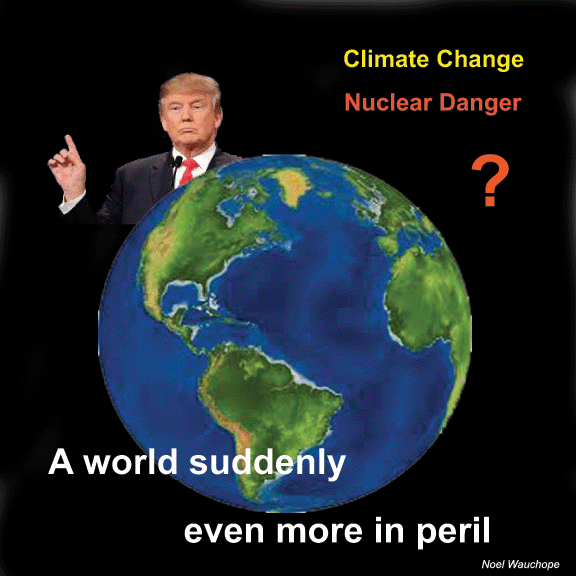
“The irony of the North Korean denuclearisation deal could be that everybody else decides to go nuclear. If it fails and Kim remains in power and countries doubt our commitment, then what’s to stop Japan or South Korea or Australia going nuclear?”
Trump triggers talk of Australia going nuclear, SMH, By Peter Hartcher
Should Australia develop its own nuclear weapons? It seems an outlandishly radical thought for such a safe country to consider. But a former adviser to Malcolm Turnbull and Julie Bishop thinks it’s an idea whose time is fast approaching.
In his book Why Australia Slept, launched this week, Peter Hendy says that Australia needs to consider nuclear weapons because “if we could financially afford them, [they] would secure an even more independent foreign policy” for the country.
Hendy, a former Liberal federal MP, former head of the Australian Chamber of Commerce and Industry and now a consultant, is not the first to raise this delicate subject. The way things are going he won’t be the last.
Three former deputy secretaries of Australia’s Defence Department – strategists Hugh White, Paul Dibb and Richard Brabin-Smith – have mooted the idea in the past year. Till these most recent months, it’s been something of a taboo topic in respectable circles.
One big reason? Australia already has the protection of the United States nuclear umbrella. Under this system, the US pledges that if anyone should launch a nuclear strike on one of its allies, Washington would retaliate against the aggressor.
So to suggest that Australia now needs its own atomic arsenal is to suggest that there has been a fundamental breakdown in trust. In short, that the US alliance is dead. Continue reading →
Philip Fels Selection process for a national radioactive waste management facility in South Australia Submission 84
To the Senate standing committee on Economics, Regarding the proposed nuclear waste facility at Barndioota near Hawker S.A.
As a family which has lived and worked the land very near to the proposed nuclear waste facility for more than 130 yrs we are very strongly against this facility going ahead for some of the reasons which we will try and point out in the text following.
The site in question shouldn’t have been allowed to be nominated by a person or persons with out any consultation with people whom this may directly effect considering they have only owned the property for a short time and have never lived or worked on the property or are ever likely to.
The land in question is one of the most unstable areas in Australia and we have earth tremors weekly if not daily and the Wilkatana Fault runs right up through this area.
As the soil structure is very porous and their is no granite bedrock in this area seepage or leakage into the local underground water table and then ultimately Lake Torrens is a very real risk.
As well as sustainably farming Merino Sheep and beef cattle for a very long time we also have a successful tourism business which we have been running on the property for 50 yrs which we fear will be severely impacted.
Our biggest worry of this process is the detrimental effect it will have and is already having on the local community as a whole.
Along with my family we have never seen an event in this area cause so much angst and division in a once very proud close knit community which was the envy of many other communities.
It saddens us greatly that somebody or bodies can come into a community for such a short time and cause such social stress which will only compound if this facility goes ahead.
Thank you if you took the time to read this and act on any of the concerns we have because they are real !!
25 October – Film –Britain’s Nuclear Bomb Scandal: Our Story – part of the Adelaide Film Festival,
Screening and Conversation
A screening of Britain’s Nuclear Bomb Scandal: Our Story (2024) followed by a talk with 2026 Bettison and James Awardee and Tradtional Owner Karina Lester in conversation with Simone Tur.
When: Sun 25 Oct, 12:00pm-Screening, 1:15pm-Talk
Where: The Mercury
Free admission, register below by clicking on BUY TICKETS and select free event tickets, at end of web page:




 –18 June 18 A site for the country’s first nuclear waste dump will be settled before the next federal election and will likely be in South Australia’s mid-north, Resources Minister Matt Canavan says.