Australian Radiation Protection and Nuclear Safety Agency (ARPANSA) agreement with IAEA on enhanced protection for uranium workers
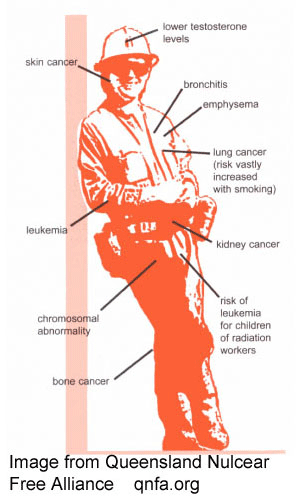 IAEA and Australia’s Regulatory Body Strengthen Cooperation to Enhance Radiation Protection of Uranium Mining and Processing Workers https://www.iaea.org/newscenter/news/iaea-and-australias-regulatory-body-strengthen-cooperation-to-enhance-radiation-protection-of-uranium-mining-and-processing-workers ,
Anna Taylor: Lucas Heights is the appropriate place, with the technology and expertise, for temporary storage of nuclear wastes
 Anna Taylor Submission to Senate on Selection process for a national radioactive waste management facility in South Australia Submission No 82
Introduction I live on the Eyre Peninsula and have deep concerns about this plan, including site selection, community consent, and the consultation process which lacks transparency and is fundamentally flawed. I do not support this current plan and welcome this opportunity to formally convey my concerns and opposition to the inquiry.
The Government has stated that it will not impose such a facility on an unwilling community. Myself and many locals believe the storage of intermediate level nuclear waste will affect tourism and primary industries. The issue continues to cause deep division and stress in the affected communities. Many Traditional Owners do not want cultural heritage sites and their spiritual connection to country put at risk.
After 70 years of the nuclear industry the federal government has no plans for a permanent solution of the long-lived intermediate-level waste. ‘Interim’ aboveground storage in SA could stretch to 100 years or more, this is not acceptable. The current project has not considered the full range of options to best advance responsible radioactive waste management in Australia
The federal government has not made a clear or compelling case that we need a national nuclear waste dump in SA. Australia must take responsibility for this waste; we must minimize future waste production and have a transparent approach to the future safety of intermediate level waste.
SITE SELECTION
I believe that
a) the process of site selection should be based on finding a permanent solution that is best suited to the safe management of this most Hazardous waste, with minimal transportation.Without expansion Lucas Heights has the knowledge and expertise to manage this waste for decades to come until a permanent (not a temporary storage facility) solution is found. Operations at the Lucas Heights site are licensed for a further three decades, which has the highest concentration of people with nuclear expertise and radiation response capacity in Australia. ANSTO and ARPANSA have publicly identified storage at ANSTO as a credible and feasible option
b) A single individual or property owner should not be allowed to nominate a site for a nuclear waste dump. .
COMMUNITY CONSENT Selection process for a national radioactive waste management facility in South Australia
Finding a solution rather than a location should begin with the government up holding its commitment to State community consent. I believe that the definition of broad community consent is extremely important and does not just belong to the people of one town adjacent to the proposed site but to a “broad” area as the term implies. The safe management of Australia’s nuclear waste is not only relevant to all of the Eyre peninsula / Flinders ranges population but too all South Australians and all populations along transportation routes. So far broad community consultation to the broader community has been non-existent. Consent within the communities is marginal but the site selection process has continued to the next stage regardless. This is extremely questionable, how can the community trust a process that does not listen to its results? I think its fair to say 57% community support in Kimba is not broad and should not have progressed further. We must clarify what percentage is acceptable for such a hazardous waste and this must not be the main factor in advancements of stages. This issue is an issue for all Australians and singling out a small community to deal with waste of this magnitude is ridiculous.
The South Australian community have already said no and raised enough concern back in 2002 when our state government passed the “ Nuclear Waste Prohibition act 2000” legislating protection to Sa from: A) The storage of nuclear waste (other than South Australia’s waste) B) A ban on the transportation of nuclear waste from interstate or overseas for the purpose of sending it to a national waste dump in this state.
I believe a failure of the National Waste Management Project has been to fully inform local communities about the facts of the intermediate level waste; where it is, how much of it there is and how radioactive it is. The public information campaign has been dishonest scare mongering, misleading to say the least. Linking the need for centralized radioactive waste storage facility with the production of isotopes for nuclear medicine is misleading. It is vital to provide accurate information to communities if you are genuinely looking for informed consent. Proponents claim that most of the waste planned to be stored in a national repository is from medicine, specifically medical radio isotopes, however measured by radio activity the figure is just 10-20%.*(1). The absence of a dump hasn’t harmed nuclear medicines and the establishment of a national dump won’t help nuclear medicine. There are new technologies to embrace,superseding nuclear medicine, such as making isotopes using cyclotrons that produce no long-term waste
I live near but outside the boundary for community consent and my conversations at the local community liaison office in Kimba have been unprofessional, misleading and not formally acknowledged.
COMMUNITY BENEFIT PROGRAMME The community benefit programme is questionable, verging on bribery creating further division in small communities .Its is an appalling approach to offer money (instead of transparent information) in return for a product that is poisonous to life for greater than your lifetime let alone hundreds of generations. I believe there should be no more taxpayer’s money spent on a site selection process that is flawed.
TRADITIONAL OWNERS
Traditional Owners have flagged concerns over cultural heritage issues. This must be recognized and acted on. The Barndioota site near Hawker has significant cultural values to the Adnyamathana peoples, this must be acknowledged and respected and ruled out of any more consideration.
ADVANCEMENTS OF STAGES Any advancements of stages of these site selections seems inappropriate whilst the proposal is for a “interim” solution that could stretch to a hundred years. This approach is not the safest management of Australia’s most long lived waste. The government needs to review future nuclear waste production with a commitment to reduce and phase out the creation of more nuclear waste.
Traditional Owners have flagged concerns over cultural heritage issues. This must be recognized and acted on. The Barndioota site near Hawker has significant cultural values to the Adnyamathana peoples, this must be acknowledged and respected and ruled out of any more consideration.
SUMMARY
The current project has not considered the full range of options to best advance responsible radioactive waste management in Australia. The waste can and should remain secured and monitored at Lucas Heights until a dedicated public review of the full range of options for waste management is carried out. I believe we need an expert open and independent inquiry into the full range of options. Nuclear waste management requires the highest quality decision-making and information. We must start afresh on planning and establishing the best way to deal with this highly toxic waste.
References:
*(1) Nuclear Medicine and the National Dump Site, Jim Green Med Sci. (Hons) PhD, Jan 2018 10 more questions about Australia’s nuclear waste. Nov 2017.
Dr Margaret Beavis and Dr Peter Karanoskos, Medical Association for Prevention Of War-Health professionals promoting peace.
The case for a revised approach: Extended interim storage and option assessment, Dave Sweeny
Kimba farmers Darren and Kellie Hunt deplore the Australian government’s flawed process for selection of nuclear waste dump site
Darren and Kellie Hunt SUBMISSION TO THE SENATE INQUIRY INTO THE SELECTION PROCESS FOR A NATIONAL RADIOACTIVE WASTE MANAGEMENT FACILITY IN SOUTH AUSTRALIA. (Submission No 80)
We are farmers in the Buckleboo district of Kimba, where we live with our three young children. We are both active members of the Kimba community and have been dismayed at the ongoing division and stress this proposal had caused amongst community members.
We feel the process that has brought us to this situation has been flawed and unfair, and we thank the Senate for their willingness to consider this issue.
Concerns we have include the lack of definition of what constitutes Broad Community Support, the use of financial incentive to coerce the community and the lack of consideration given to the potential implications to our agricultural industry.
a) The financial compensation offered to applicants for the acquisition of land under the Nominations of Land Guidelines;
Clearly, the landholders who have volunteered their land are the only persons to directly and personally benefit from this proposal. We understand that they will receive 4 time the value of their land for the section that is acquired, however it has not been made clear exactly how this value will be determined. Also, we understand that the nominators are receiving compensation for access to their land during the site evaluation phase, however information on the value of these payments have been kept from the public. If this process is to be ‘fair and transparent’ as the Department have insisted it is, we believe that this information should be available to the community.
b) How the need for ‘broad community support’ has played and will continue to play a part in the process, including: i) The definition of broad community support and ii) How broad community support has been or will be determined for each process advancement stage
- One of our greatest concerns regarding this process has been Ministers refusal to clearly define the term “broad community support’. As arguably the most important aspect in finding a suitable site, and certainly the biggest hurdle the Government have faced in their bids to date to do so, the unwillingness to clearly explain what they consider both ‘Broad’ and “Community” has created confusion and caused an escalating lack of trust towards the Minister and the process. It is very apparent that the reasoning behind the lack of clear definition is to allow the Minister to effectively ‘move the goal posts’, as was clearly evident when Kimba was accepted to phase two following our June 2017 vote.
- Having stated in the senate that he would require a number in the vicinity of 65% of the community voting to progress with the proposal, Minister Canavan chose to push Kimba into phase two of the process with a supporting vote of 57%. This result is subjective to the number of people who chose to participate in the vote, in actual fact those in support represented 49.94% of those within the community eligible to vote.One of the reasons the Minister given for his refusal to quantify broad community support is to enable him to accept opinions given from those who are ineligible to vote, via submissions. Prior to the June vote, 396 submissions were received both from the community and outside. The phase 1 summary report states that of the 112 local submission 86% were opposed. The remaining 294 submission were not given consideration in the report. Despite these results, Minister Canavan determined that broad community support existed in Kimba to progress the proposal to phase 2
We do not feel that Kimba should have continued to phase two after the vote as there was no clear indication of broad community support, merely proof that our community so divided in opinion on this issue. We believe strong consideration should be given to who has the right to vote, and if we are to continue to a further ballot, a definitive number must be provided prior as to what percentage of the overall community must be supportive for the proposal to progress. We believe this should be at least an absolute majority of 67% (of all eligible voters)
- How any need for indigenous support has played and will continue to play a part in the process, including how indigenous support has been or will be determined for each process advancement stage;We feel that the traditional land owners must be consulted and heard in this decision making process. We have not been aware of any consideration given to the Bungala people in the Kimba process at this stage.
- Whether and/or how the Governments community benefit program payment affect broad community and Indigenous community sentiment;The community benefits program was not a part of the initial package, and was announced prior to the 2017 Kimba vote, labelled ‘disruption money’. Clearly, the Minister was aware that this process has caused stress and division within communities, and felt that additional financial incentive would help to garner support. Unfortunately, no amount of ‘compensation’ can repair the damage that has been done and the division that we are forced to face on a daily basis.
f) Any other related matters.
We strongly believe that the facility is not suitable for Agricultural land. The storage of nuclear waste in a food growing region in a country which had as much un-arable land as ours makes no sense. The perception of the proximity of the nations nuclear waste to our productive land has the potential to adversely impact our commodity prices and land values and these are unacceptable risks to our business.
Clearly consideration has been given to potential impacts on agriculture as the draft ARPANSA’s Code for Disposal of Solid Radioactive Waste selection criteria includes ‘The immediate vicinity of the facility has no known significant resources, including potentially valuable mineral deposits, and which has little or no potential for agriculture or outdoor recreational use’.
This process has caused immeasurable contention and division within our town. The Department has upheld that they are running a fair and transparent process, and that everyone’s opinions are valid and will be respected. However, they have clearly put much effort into convincing those opposed to change their views. On a recent trip to Lucas Heights Selection process for a national radioactive waste management facility in South Australia Submission 80 (fully taxpayer funded and clearly orchestrated to demonstrate the safety of the facility) I was asked by our Community Liaison Officer if “we have managed to change your mind yet, now that you know there is nothing to fear”. This clearly sums up the objective of the department’s current presence in Kimba and the interest they are taking in our concern
Leon Ashton lays bare Australian govt hypocrisy, double-talk, lies , in its process for selecting nuclear waste dump site
 Leon Ashton Submission to STANDING COMMITTEE ON ECONOMICS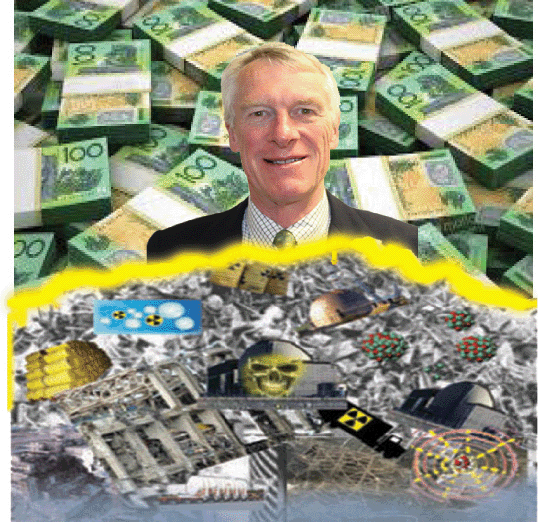
THE NEED TO DETERMINE BROAD COMMUNITY SUPPORT
In April 2016, a community sentiment survey was completed by DIIS through a company called ORIMA Research. This 205-page detailed report can be accessed on line. I attended another information gathering meeting at Quorn council chambers in April 2016, along with several other residents, to voice our concern. A member of our group voiced their concern at how the community survey was conducted and the methodology behind it. We all then heard a senior DIIS member tell us, yes, the community survey was flawed in some places, however we will still be going ahead with the next stage, into Phase 2, i.e. more information giving sessions to the public and looking at cultural and geological site compatibility.
[ “I understand there are a range of views within the community and the government encourages respect for all opinions. In my visit to the region and thru feedback from my department, I do not share your view that there is disunity in the area, or a need for assistance to support the community because of division.“ ] Mr Canavan could not possibly share my view because the people who were opposed to putting the waste dump in this area were told they could not have any time with him at all to discuss concerns face to face as he was too busy.?
TOURISM IN THE REGION
FUTURE EMPLOYMENT
We are informed by DIIS that there will be at least 15 full time job equivalents at the waste facility and yet when we look at every other industry, they are so tightly regulated, especially in areas of danger, it is only a matter of time before robotics also take over positions in this facility. This is the way of the future, so why would we trust people who are verbally telling us that we have nothing to worry about, the jobswill be there. I might add, that since January 2016, there have been at least five, possibly six key staff members from DIIS who have either left the Department or moved onto other positions. This does not allow continuity to the people they speak with and does not inspire confidence in what they are telling us. For example, I asked an employee of DIIS when they came to Quorn for the monthly gathering, what would DIIS do if the SA government citizens jury won the vote against having a HLW (high level waste) dump in South Australia. The employee told me DIIS would honour the SA Prohibition Act and walk away from it all. The next month I was told this would never happen and the Federal Government would overrule the Prohibition Act and carry straight on, as they have done. The employee who told me they would walk away, no longer works in that department.
ARPANSA have a guideline for prospective nuclear waste dump sites in Australia. The first three pre-requisites are 1. No seismic activity 2. Not flood prone and 3. Must have broad community support. Wallerberdina ticks all the boxes for where NOT to put it. I have stated before in writing that ANSTO are possibly the best people in the world to manage the waste storage at Lucas Heights.
OUTCOMES TO DATE AND RECOMMENDATIONS FOR FUTURE
It is for the above reasons that I believe DIIS need to scrap their prospective low-level waste dump locations and have a complete rethink in conjunction with other associations to try and rebuild a level of trust for what they are putting to the public before entering into public consultation.
Why is nuclear industry puppet – Matt Canavan not considering Leonora , Western Australia, as nuclear waste dump?
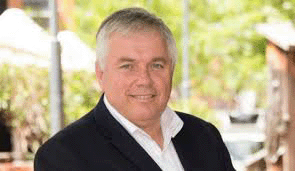 Nuclear site selection process questioned https://www.eyretribune.com.au/story/5467944/nuclear-site-selection-process-questioned/ Kathrine Catanzariti 14 June 18
Centre Alliance senator Rex Patrick (left) has called the site selection for the National Radioactive Waste Management Facility “an absolute sham”, claiming Minister for Resources and Northern Australia Matthew Canavan ignored a potential site at Leonora in Western Australia.
Mr Patrick, who introduced the senate inquiry into the site selection, made the claims on Wednesday following a visit to Leonora.

“Minister Canavan needs to more properly engage the proponents of the proposed site near the central WA mining township of Leonora or risk the whole selection process being confirmed as an absolute sham”, Mr Patrick said.
“I already hold enough concern in the selection process to have initiated a Senate Inquiry into it, but after visiting the Leonora site, I am convinced it is becoming a farce.”
Mr Patrick likened the lack of understanding of ‘broad community support’ to a running a race where participants are told they do not need to know where the finish line is.
The Leonora site was nominated in August last year, but Mr Canavan did not consider it due to the advancement of the sites in Kimba and Hawker.
Mr Patrick said that lead him to believe that a South Australian site was a “done deal”.
“It appears as though the new site is a ‘faster runner’ in the race, but won’t be allowed to participate because the Minister is determined to rush to select one of the South Australian sites despite there being a divided community.”
However, Mr Canavan said the government would not progress detailed assessment of other nominations until the results of the votes in the two South Australian communities were known. “We have well advanced proposals from three sites in South Australia, one near Hawker and two near Kimba,” he said. “These communities have been involved in extensive consultation and discussion about the site selection.
Next month each of the two communities will be given the opportunity to vote on whether they want to proceed with the nomination.
The government will not be progressing detailed assessment of other nominations until the results of the votes in the two South Australian communities are known.
No Radioactive Waste on Agricultural Land in Kimba or SA president Peter Woolford said it was important Mr Canavan made the right decision.
“…if there is a site on offer that meets all criteria, exhibits broad community support and is not on agricultural land, we believe he should be giving it serious consideration,” he said.
“We look forward to Minister Canavan’s explanation as to why he does not deem the Leonora proposal suitable for further investigation.”
The Kimba community will undertake the final vote on the facility in August.
Graham Readfern exposes the climate denial group “The Australian Environment Foundation”

The Australian Environment Foundation has secured a former prime minister to speak. But what does it actually do?
Securing a former prime minister to speak at your organisation is no doubt a coup for many groups.
Singapore’s Lee Kuan Yew School of Public Policy recently got Kevin Rudd. Australia’s Nelson Mandela Day committee has snaffled Julia Gillard for their next annual lecture.
What about our most recent former PM, Tony Abbott?
Next month, Abbott will deliver the “2018 Bob Carter Commemorative Lecture” to the Australian Environment Foundation (AEF), where the ticketing site says he’ll talk about “Climate Change and Restraining Greenhouse Gas Emissions”.
The AEF is an “environment charity” that promotes views that wind turbines make you sick, that human-caused climate change isn’t really a thing, and that environmentalists (the other sort) are killing farmers, fisheries and the economy.
Abbott’s lecture will no doubt pick up from his speech in London in December, where he delivered a suite of climate science denial talking pointsto the Global Warming Policy Foundation.
So who, or what, is the AEF? To look into its history, and the people involved with it, is to take a deep dive into Australia’s climate science denial network.
But first let’s look at the AEF right now because, as an “environmental charity”, Abbott’s next port of call doesn’t seem to do very much.
Latest figures available from the Australian Charities and Not-for-Profits Commission show that in 2016, the charity declared an annual income of just $1,175.
In May 2017, the AEF lent its logo to a letter to US President Donald Trump to offer “enthusiastic support” for his commitments to withdraw from the UN Paris climate agreement. But between July 2017 and February 2018, there was virtually nothing posted on its website.
Much of that website, including the “Climate News” section, is content from former Institute of Public Affairs fellow Alan Moran and postings that variously dismiss human-caused climate change and renewable energy, in particular wind power.
The charity has two other trading names listed with the Australian Securities and Investments Commission – the Australian Climate Science Coalition(ACSC) and ListenToUs – but both of these seem to be defunct. …….https://www.theguardian.com/environment/planet-oz/2018/jun/15/inside-the-aef-the-climate-denial-group-hosting-tony-abbott-as-guest-speaker
Event 27 June The Need for Leadership to Address White Supremacy in the NGO Sector
Pro Bono Australia Luke Michael, 14 June 18
 Charities and not for profits need to show leadership to address the issue of white supremacy in the NGO sector, a prominent Aboriginal writer and activist believes.
Nayuka Gorrie is a Kurnai/Gunai, Gunditjmara, Wiradjuri and Yorta Yorta writer and activist who spoke on a panel at the Victorian Council of Social Service (VCOSS) 2018 Summit on Wednesday.
She was joined by Victorian ombudsman Deborah Glass OAM, Will Stracke from the Victorian Trades Hall Council, Reason Party leader Fiona Patten, and Centre for Social Impact CEO Kristy Muir.
The panel discussed the “shifting nature of leadership and the role of citizens to shape their own prosperous and inclusive society”.
One of the topics discussed was the need for greater diversity in leadership, particularly around race and gender.
Stracke admitted during the panel discussion that leadership in the trade union movement was “too white”.
“One of our values that we say is ‘diversity is our strength and solidarity is our power’,” Stracke said.
“And that’s about the diversity of our movement and our movement is very diverse… but I think we as a union movement [still] need more voices.
“We’ve very white in terms of our leadership and we need to get better at that.”………
“Leadership needs to be much more representative of the people,” Glass said.
“It’s not just gender, it’s race, it’s disability, it’s everything we all stand for. We can’t have leaders speaking for us who don’t represent us, who don’t look like us or don’t speak like us.”………
Gorrie has organised an event to discuss “dismantling white supremacy in the NGO sector” at Victorian Trades Hall on 27 June.
She told Pro Bono News why she decided to create the event.
“I decided to put on that event after chatting to a number of different people that work in the not-for-profit sector,” she said.
“And [people of colour] are doing twice as much work just to survive I think.”
Gorrie said while white supremacy was found across all sections of society, it was especially disappointing to see it in the not-for-profit sector, considering the sector’s purpose to make the world a better place.
……..“I think a lot of not for profits make a lot of money and the Indigenous Advancement Strategy was a really good example of that. Most of the money in the strategy went to non-black organisations.“So there is a lot of money to be made in perceived black dysfunction and I don’t know if it’s possible for them to do the work they’ve set out to do if they haven’t examined and [removed] the white supremacy within themselves.”https://probonoaustralia.com.au/news/2018/06/need-leadership-address-white-supremacy-ngo-sector/
Centre Alliance Senator Rex Patrick exposes wider flaws in the Australian govt’s targeting of South Australia as nuclear waste dump

 Senator Rex Patrick has shown up the hypocrisy of the Federal Government in its expensive frenzy to foist a nuclear waste dump on rural South Australia. And in instigating the Senate Inquiry into this process, has set in motion the discrediting of the whole National Radioactive Waste Management Facility sham.
However, the propaganda by Western Australian private company Azark is not reliable, either. There is indigenous opposition to nuclear waste dumping in the Leonora region,Western Australia. Western Australia’s Labor government may not support Azark’s low level waste dump plan, may have its own plan for WA.s radioactive waste. This WA private offer is for low level waste disposal and is not for the Fed govt proposed above ground 100 year Store for 10,000 yr nuclear fuel wastes and long lived intermediate level wastes.
This exposes Federal govt’s plan to have two dumps in one, to “co-locate” a long lived waste Store’ along side a low level disposal site. It exposes their priority to dump Federal govt owned long lived nuclear wastes at an above ground “stranded wastes” dump in regional South Australia.
South Australian site selection for a national radioactive waste facility is a “sham”, as Western Australian private project is revealed

 South Australia nuclear waste site a “done deal: claims Senator Rex Patrick https://www.adelaidenow.com.au/business/sa-business-journal/sa-nuclear-waste-site-a-done-deal-senator-rex-patrick/news-story/08524bb4dc5004f467462b1591a55b1f, The Advertiser, Erin Jones, Regional Reporter, June 13, 2018
Centre Alliance senator Rex Patrick told The Advertiser the decision to establish a low-level facility at one of two sites in South Australia appeared to be a “done deal” following the revelation.
In August, Azark Project made a nomination to include the commercial operation of an underground storage facility, near the remote central mining town of Leonora, north of Kalgoorlie.
The South Australian senator, who visited Leonora, said the proposal appeared to have “considerable support” and unlike the two SA sites near Kimba and Hawker, did not need taxpayer funds to proceed.
“Resources Minister Matt Canavan needs to properly engage the proponents of the proposed site near Leonora or risk the whole selection process being confirmed as an absolute sham,” he said.
“It appears as though the new site is a ‘faster runner’ in the race, but won’t be allowed to participate because the Minister is determined to rush to select one of the South Australian sites despite there being a divided community.”
Azark Project chairman George Gear said the WA site had no environmental, land rights or water issues, and the proposal had support of the 2900 people in Leonora Shire.
Mr Gear said he had no confidence in the specially-formed government taskforce considering sites for the waste facility, given Leonora was not on the table.
“Apart from this being a superior site located in a mining area and in solid rock, this wouldn’t cost the taxpayer any money as it’s a private company that will build this,” Mr Gear, a former minister in the Keating government, said.
“The taskforce to date has either spent or committed $40 million and they haven’t finalised the project.
“Azark has completed all of its due diligence at its own cost and has offered to make it available to the taskforce — this invitation was not accepted.”
Mr Gear said Azark Project had decided to pursue the plan on its own, but was expected to meet Mr Canavan in Perth, today.
The Government is expected to decide in coming months whether to build the waste facility in SA, after a final ballot of Kimba and Hawker districts, on August 20.
Mr Canavan has previously said “broad community support” would be needed for the waste facility to go ahead — although no arbitrary figure has been provided.
The two-year site selection process has divided both communities — those in favour believe it would create economic opportunities, while those opposed say it will jeopardise industries.
The district where the waste facility is located would be rewarded by the government with a $10 million community fund to spend on local projects.
Both districts were already benefiting from a $4 million grants fund as a reward for being involved in the site selection process.
Senator Patrick this year successfully pushed for a Senate inquiry into the site selection process used for the national waste facility and an outcome is expected only days before the ballot, on August 14.
In a submission to the inquiry, Kimba’s mayor said more information on financial rewards and jobs was needed before the community voted in the ballot.
Mr Canavan did not respond to questions before deadline.

Medical Association for Prevention of War – an urgent need for an independent inquiry into the production and management of Australia’s nuclear waste.
The Medical Association for Prevention of War (Australia) Sue Wareham OAM MBBS Dr Margaret Beavis MBBS FRACGP MPH President Secretary Submission to Inquiry into the Selection Process for a national radioactive waste management facility in South Australia
The appropriateness and thoroughness of the site selection process for a national radioactive waste management facility at Kimba and Hawker in South Australia, noting the Government has stated that it will not impose such a facility on an unwilling community.
We will address the key issue of “Broad community support”, as we believe the information provided to communities has been misleading. It is not possible to have genuine community consent and a truly “willing community” based on inaccurate and incomplete information.
We will also raise concerns regarding “related matters”, addressing plans to massively increasing the future production of nuclear waste in Australia. There has been very poor process, information and community consultation about this issue also, and it will significantly impact on the community selected for the NRWMF due to markedly increased levels of long lived intermediate level waste being produced for the next 40 years.
The Medical Association for Prevention of War (Australia) works for the elimination of all weapons of mass destruction and the prevention of armed conflict. We promote peace through research, advocacy, peace education and partnerships. Our professional not-forprofit organisation has branches across Australia, and works globally through the International Physicians for the Prevention of Nuclear War.
Nuclear waste is toxic material that can last for millennia, and despite billions of dollars of research over many decades there are still no safe long term solutions. As an organisation we support the creation of a Federal facility, but the current process is unacceptably flawed.
In summary our concerns are:
REGARDING COMMUNITY SUPPORT
1) The NRWMF process as it stands is very divisive. Repeated, highly damaging processes imposed on previously cohesive communities are causing significant harms.
- Considerable amounts of persistently misleading information have been and continue to be presented to communities. Incorrect and incomplete information does not result in genuine consent or community support.
- In particular, despite many statements to the contrary, there is clear failure to observe international best practice standards for long lived intermediate level waste (ILW) management. There is no disposal plan whatsoever for ILW, which needs to be isolated from the ground water and the environment for 10,000-100,000 years, leaving the problem with many future generations of the affected community.
- RELATED MATTER: THE EXPANSION OF NUCLEAR MEDICINE PRODUCTION FOR EXPORT
- The expansion will create 40 years of significantly increased production of ILW.
- There is a lack of demonstrable “Net benefit” for the Australian community. The proposed expansion of medical isotope production needs genuine cost/benefit analysis to make sure this is not a heavily subsidised product being sold into the global market at the expense of the Australian community both now and in the future. Independent NEA/OECD economic modelling finds only 10-15% cost recovery of isotope manufacture when there is genuine inclusion of all costs.
- ANSTO has a narrative of global shortages, yet given falling demand and increasing global supply there is no shortage of Mo99 . The NEA/OECD predict a significant oversupply.
- 4) Again, there is no plan whatsoever for disposal of the additional long lived ILW generated. The current NRWMF process is just “kicking a highly radioactive can down the road”.
Both processes are unacceptably flawed.
MAPW urges
Recognition that currently the information provided to communities is riddled with so much misinformation it calls into question the underlying validity of any community consent process.
A halt to the current NRWMF process until such time as world’s best practice is followed. There is sufficient capacity at the Lucas Heights facility, once regulatory approvals are met, to store LLW and ILW well into the next decade.
Cessation of expansion of nuclear medicine for export, and a phase out of exports, until there is demonstrated, publicly available, clear analysis of cost/benefit and plans for appropriate disposal of the substantial amount of ILW this process will generate.
Transparent evaluation of “net benefit” to the Australian community. This as a whole must underpin the process, and be based on cradle to grave impacts of production.
In closing, it is clear there is an urgent need for an independent inquiry into the production and management of Australia’s nuclear waste.
Dr Beavis would be happy to appear before the committee if that would assist the inquiry. She is a GP with strong interest in public health issues, and teaches at the University of Melbourne in the areas of medicine, global health and nuclear waste.
Government assessment of proposed Kimba nuclear waste dump area is a farce
 Regina McKenzie Fight To Stop Nuclear Waste Dump In Flinders Ranges SA 12 June 18 The cultural assessment is a sham, just another token gesture by the Federal Government to tick a box, RPS failed to do a full cultural walk through and find the cultural significance of the area, they did not survey all Adnyamathanha people, to find the ones with the cultural knowledge of the area, they only did small pockets of area, also for the holes that were dug, no tests pits were done, only just standing watching a front end loader dig, no sieving whatsoever,
I suggested this but no, also hole for the water from drills was dug without a archaeologist present and a grader over a sandhill, no walk through no archaeologist in sight, they ran over marked heritage , a grindstone and dumped waste outside of work area , this assessment is a farce, no one listened , its just all tokenism, and all the underarm dealings behind closed door with the fanatical yes blacks , sounding a lot like insider trading to me. https://www.facebook.com/groups/344452605899556/
Australia not doing its fair share on carbon emissions
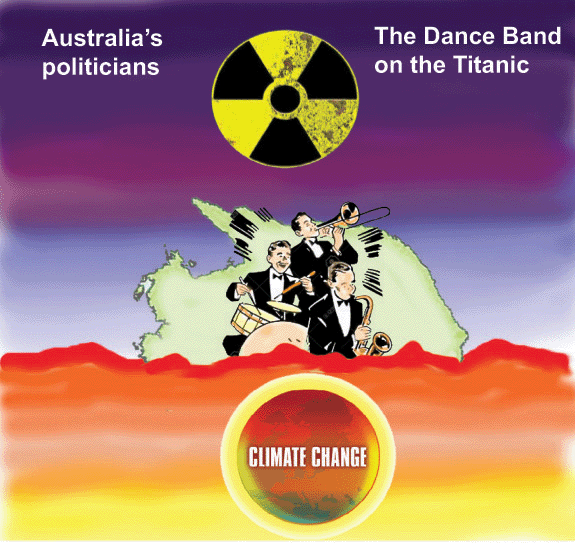 Australia’s emissions reduction target ‘unambitious, irresponsible’
New Australia Institute paper finds neither Coalition nor Labor’s pollution reduction targets would see us doing our fair share, Guardian, Katharine Murphy @murpharoo 12 Jun 2018
Pollution reduction targets for 2030 proposed by the Coalition and Labor will not see Australia contributing its fair share to cut greenhouse gas emissions under the Paris climate agreement, according to new research.
A paper from the progressive thinktank the Australia Institute finds the Turnbull government’s target of a 26-28% reduction on 2005 levels is “inadequate according to any recognised principle-based approach” and the Labor target of a 45% reduction is “the bare minimum necessary for Australia to be considered to be making an equitable contribution to the achievement of the Paris agreement’s two degree target”…..
The next round of international climate negotiations will be held in the Polish city of Katowice in December this year. The looming talks are critical to ensuring the signatories to the Paris deal maintain the momentum of their various emissions reduction pledges.
Unlike the United States, Australia remains in the Paris agreement, despite continued rumbling from conservatives about climate policy. However, the Turnbull government is still struggling to land its national energy guaranteewhich would impose emissions reductions in the electricity sector.
Because of internal pushback within the Coalition, and lobbying by some sectors, the government has not yet flagged a roadmap for emissions reductions across the economy, and there is widespread criticism of the lack of ambition in the target proposed for emissions reduction in electricity.
The latest official emissions data shows pollution increased by 1.5% in the year to December 2017. Australia’s emissions levels are now higher than they were in 2012 and have climbed by 3.6% since the carbon price was repealed in 2014.
Emissions are increasing in most sectors of the economy – in waste, agriculture and transport. Only one sector of the economy has recorded a decrease – the electricity sector – because aging coal-fired power plants have exited the system, and new renewables projects are coming on stream.
Merzian says Australia is continuing to “profit from high emissions rather than take up its fair share of reductions. We are unfairly shirking our global responsibilities onto others.”…….. https://www.theguardian.com/environment/2018/jun/12/australias-emissions-reduction-target-unambitious-irresponsible
Kimberley Land Council (KLC and agencies) wrong about Sovereignty
 Ghillar, Michael Anderson 7 June 2018 ‘While the Kimberley Land Council (KLC) and the
Australian Institute of Aboriginal and Torres Strait Islander Studies (AIATSIS)
convene the Native Title conference in Broome, hosted by the Yawuru People,
Anderson shines another light on the KLC and its agencies’ agenda.'”Since I’ve left Warmun the community has been bombarded by yet another Native Title meeting run by KLC agencies.
Again, Senior Elders were bullied to attend but they have reassured me proudly, ‘I didn’t sign anything.'”In their reliable report-back they joked about the way the KLC Legal advisor, Douglas D’Antione,
was telling them lies about sovereignty.
“He said that the only way to get sovereignty is by conquering and that you need
an army and navy to get sovereignty, like the English people did!!
“He then said that the second way to get sovereignty was for the owners just to say:
“OK, here. This is yours.”
At no time did he acknowledge that First Nations sovereignty is pre-existing
and continuing and is the basis of the continental common law.”
~ Ghillar, Michael Anderson
‘Having looked at the map of the Native Title applications’ areas and
then comparing those maps with the Kimberley tourist topographical map
being sold in stands in garages and newsagencies and information centres,
I realised that the KLC agencies are demanding the Peoples authority
to put a massive Native Title application over a vast area of land that
is already reserved under the WA State law as being set aside
exclusively for the use of Aborigines only.
‘I informed the people that they are about to, or have,
authorised a Native Title application to go over a massive area of land
that they already own through the Aboriginal Land Trust of Western Australia
and it is exclusively theirs, if their families came from these particular lands.
‘When I asked the people why they would authorise such a claim they all said
KLC agencies never informed them of this fact at all.
‘The KLC agencies fail to provide documents ahead of the meetings,
try to prevent independent legal advice and
do not give back copies of any papers the people may have signed,
or have been coerced to sign.
‘I am now informed that the people of Warmun and surrounding areas
have made a decision to dismiss the KLC, KRED Legal and ARMA, EHSIS
and other KLC agencies from having anything to do with their lands and waters.
‘They are understanding the KLC agencies plan to
take over negotiations to enable mining on their lands.
‘I am informed that the people are now gathering in significant numbers
and will inform the Federal Court that they no longer wish to
pursue the Native Title determinations, because as one of the
Senior Elders, Mr. Patrick Mung, has said with words to the effect:
“For too long we have been signing papers for KLC and its agencies
and there are a lot of things going on on our lands,
but look at us, we have nothing.
“When we ask for royalty money they tell us there is not enough in the bucket.
We don’t want these people any more.
We joined KLC because they said we were being ripped off.
But now we have just gone from one rip off to another.” … ‘
Read more of Ghillar’s comprehensive, well-researched, challenging media statement here:
nationalunitygovernment.org/content/kimberley-land-council-klc-agencies-wrong-about-sovereignty
Flinders Local Action Group’s detailed submission: Nuclear Waste Dump decision is a National matter – not just a local one
CONCLUSION: The current model to establish a NRWMF is wrong. This initiative has not come from any community. This is a National problem and it needs a National solution.
What is really wrong about this process is that radioactive waste, including the legacy material, is the Nation’s inheritance from an industry which, for its entire lifetime, has not included waste disposal as part of its production process. Filling and stacking drums was never going to be a solution. This is a National issue and a National problem. Small, remote communities, whether at Kimba, the Flinders Ranges or anywhere else, should never be expected to make the decision alone to accept the toxic by-products of one industry’s lifetime production.
The Flinders Ranges are promoted throughout the world as one of the last untouched landscapes that can be easily accessed. Tens of thousands visit the Flinders Ranges each year from all over the world.
A major point has been made of the need to clear our hospitals of low level waste comprised of used gloves, gowns, syringes and other items. This was contradicted, in October 2017, by a DIIS sponsored spokesman in Hawker who “advised that nuclear waste from nuclear medicine procedures in hospitals is virtually zero……the use of nuclear medicine will not contribute to radioactive waste in hospitals……this short lived product is stored for 10 half-lives……and disposed of as hospital waste.
Flinders Local Action Group , Greg Bannon, Roybn Wood, Leon Ashton, Bob Tulloch Submission toTo The Senate Economics References Committee. Inquiry into the process surrounding the Federal Government’s National Radioactive Waste Management Project (NRWMP).(Submission No. 73)
INTRODUCTION The Flinders Local Action Group is a regional group of volunteers based in the Flinders Ranges that have strong concerns about the project proceeding in our community.
The three sites currently under consideration for the facility are all in South Australia – one at Barndioota in the Flinders Ranges and two in Kimba on the Eyre Peninsula. Some of this nuclear waste is a hazard for hundreds of years and some for thousands of years.
The Flinders Local Action Group (FLAG) was formed to challenge the waste facility being built in our area and is made up of indigenous and non-indigenous members of the community. The site at Barndioota is of high cultural and archaeological significance to the Adnyamathanha Traditional Owners, is located in a flood zone, is subject to seismic activity and is located in the iconic Flinders Ranges. We do not believe this site is appropriate for the federal radioactive waste facility. The process of site selection is fundamentally flawed and has caused deep division and stress in our community.
Addressing the Terms of Reference Continue reading
Kay Fels’ strong submission against nuclear waste dump siting, – from a farmer’s point of view
Kaye Fels Submission to Senate Inquiry re the Nuclear Waste Repository Proposal at Barndioota South Australia (submission No. 63)
I am a life time resident of the Flinders Ranges region of South Australia. For the past 44 years I have lived and worked and now part own a sheep and cattle station within a 25 kilometre radius of the proposed waste repository.
I am deeply concerned at the way the land was volunteered for this purpose. The owner, who is an absentee landlord, saw an opportunity to capitalise on his sale. The irony is that he is an ex politician who was heavily involved in the nuclear debate in the 1990’s. The argument has been raised that you do not have to contact your neighbours if you wish to make changes but this is not a town block, nor is it something which does not come without stigma and or risks. I’m sure the equity of the neighbouring properties will be strongly affected by having a nuclear waste facility in the vicinity.
Another concern is that our stock (sheep and cattle) may also be stigmatised by the proximity of the waste dump and our organic status compromised. That is one source of income. We have been involved with tourism for over 50 years having established station stays, in purpose built cabins, and have continued to optimise this form of income with bush camping, 4WD tracks and providing services to the tourism industry since 1967. This will all now be jeopardised as the clean, green image of the Flinders Ranges is tarnished and why this area is even being considered is beyond me. The promises of a greater attraction, money for the community, jobs and security fade into insignificance when this highly productive region is being compromised by the effects of a nuclear waste facility.
Now for the risks, of which we are told will be minimal. The sites are located in an area where the underground water table is almost at surface level. This could lead to contamination of the underground water source, so vital to the region. The location is also on a piedmont plain and prone to flooding at intervals and intensities that most people would have no knowledge of. The floodwaters end up in Lake Torrens where the residues come to the surface and are blown to the four winds. There is also evidence where the flood systems have combined and resulted in flows into Spencer Gulf. Both scenarios are a recipe for environmental disaster.
Furthermore the site is located in a severe fault line as is the region of the Flinders. The land is constantly moving. We have evidence of huge cracks running for many kilometres on very similar soil types. This location is within 15km from the proposed site on very similar strata. Please see attached photos. If this disturbance was to occur where there is an above ground repository or even a sump, the results would be disastrous. Given that the proposal is to store low level waste in an above ground facility, and temporarily store intermediate waste in that same facility, it seems ludicrous that this is even considered given the geological and environmental features and risks involved. Why all the money has been spent on trying to convince the community what a great thing it would be when it clearly is unsuitable, beggars belief.
I am also very alarmed at how the original “66% of the people of the region were in favour” of the proposal going ahead was arrived at. When I questioned ANSTO regarding this I was told that it was an independent outsourced survey. People were supposedly telephoned and asked their opinion. When I inquired as to the survey base there was complete dismissal by ANSTO with them saying that they had every confidence in how the survey was conducted. I stated that I was not surveyed nor any of my family who also live and work here they tried to tell me that I was. Clearly this process is deeply flawed and there was a plot to choose a site and they chose here.
Apart from the physical disadvantages there is also the psychological damage caused by this proposal. The community has been split and in a small community such as ours which is renowned for its community spirit this is of huge concern. Family who have been friends for generations have been affected and it is ripping the heart out of the soul of the town. There is a lot of anguish and angst which you can’t walk away from although some have chosen to leave. One of the ANSTO representatives came out to speak to us in 2016 – which was the third or fourth visit in the “consultation”. My husband who had recently been through major heart operations was a little confrontational and asked why there was no continuity with the persons involved in the consultations. This person then proceeded to turn on his heel and leave. My son then informed him that he was here to hear our points of view, and was being employed to do so, and as such he was shirking his role. He then proceeded to accept an apology and contritely heard us out.
This is the problem. ANSTO will walk away from the conflict, problems and influences. We are left to deal with the trauma, the disadvantage, the psychological effects on family and relationships and the very real risks involved.
Whilst ANSTO have had representatives in Hawker and Quorn for the past 18 months their primary role has been to inform the public as to the benefits of the nuclear waste facility and sway the dissidents into coming in line with their way of thinking. All the hard questions are answered with “could”, “may”, “possibly won’t” or “shouldn’t” and there is a wealth of grey area to which there are no definite answers. E.g. will the waste repository have an effect on the organic status of our meat?” Answer: “No it shouldn’t impact on your organic status” Shouldn’t but it probably will! Even though there may be no physical impact again there is the stigma – and if there is any leakage into the water table or any contamination we will be left to bear the fallout literally!
Our family has been producing on the land for six generations and it is hoped this will continue into the future. My grandchildren are very concerned for their future here and do not want their future jeopardised by this intrusion. They have as much connection to the land as the aborigines and feel as protective.
The proposal has also caused a huge rift in the aboriginal community with some of the more vocal men in favour. However the women and the men who have lived here continuously are greatly opposed but are not given a voice and have become afraid of those who have assumed power.
We understand that the repository has to be sited somewhere but here is not the place. There are many more years where it could be housed at Lucas Heights so why make the move until necessary and why in an area which is so not suited for very many reasons. The intermediate waste will be temporarily housed in a facility not but for that purpose. Is this because they will build storage for this waste here too eventually? I am sure if the right reasons were quoted ANSTO were honest with us and the money was taken out of the equation there would be very few who would be in favour.
The $2m incentives to the community has already caused much angst as in their wisdom the Aus. Industry department decided to transfer some of their business grant applications into the $2m funding pool leaving community members aghast at the temerity of the businesses. One business owner has moved away because of the level of bitterness and the grant had “fallen through”. While this was happening Aus. Industry did not set the record straight. Not only has this now set a precedent which was advised against by members of the Barndioota Consultative Committee, it has also caused another deep divide in the community.
Many of the older residents of Hawker and district are confused, frightened and tormented by the proposal. One lady in her nineties whose family used to own the Wallerberdina Station blames herself for having sold the land to someone who would “put it up” for consideration as a nuclear waste facility. She has since developed dementia which I am sure has been hastened by the added stress.
Also of extreme concern is the amount of time, money and resources which has already been expended in convincing the community that this is a good idea. Why all this expenditure has occurred before feasibility studies have been conducted, clearance given by the aboriginals and other land holders and the state government (which I believe is bound by a nuclear waste management act) I cannot comprehend. As a taxpayer I am astounded at the waste of money over the past two plus years on this proposal which may not and I hope not come to fruition. I would like to know how much has already been spent on resources and all costs involved in this project. Independent studies should have been carried out. No, – more resources have been extended gagging people who are exponents of the negative. Some working for government departments have been told their jobs are on the line if they speak out further. Is this an honest and transparent process? – I think not!
The consultation phase was a tokenism with ANSTO telling us what will be happening, how safe it is and pushing the affirmative – not a true reflection of the community’s views and concerns. The consultative committee is a rubber stamp only with member’s views either “put down” or not taken seriously and an unworkable number with little effect. Even the meetings do not have minutes but are conveyed as courses of action with no recourse.
I hope the project will be abandoned and speak for many other persons in the community many of whom are afraid to speak out for fear of reprisal. There are no frank and open discussions and I fear that as already quoted, “the heart of the community has been ripped out”.
Let the Federal Government acquire land which is suitable and not in a pristine area which is free from atomic pollutants. Leave our small communities alone and don’t let one person make the decision that his land is available to the detriment of a whole region and community.
Thank you for taking the time to read my submission. For any further clarification or information I can be contacted at or Kaye Fels Please see photos below [on original] for indication of surface movement during 1990’s taken 3/8/2018
1 This month
25 October – Film –Britain’s Nuclear Bomb Scandal: Our Story – part of the Adelaide Film Festival,
Screening and Conversation
A screening of Britain’s Nuclear Bomb Scandal: Our Story (2024) followed by a talk with 2026 Bettison and James Awardee and Tradtional Owner Karina Lester in conversation with Simone Tur.
When: Sun 25 Oct, 12:00pm-Screening, 1:15pm-Talk
Where: The Mercury
Free admission, register below by clicking on BUY TICKETS and select free event tickets, at end of web page:
https://www.adelaidefilmfestival.org/program/2026/britains-nuclear-bomb-scandal-our-story
.

Australians deserve the truth
about
AUKUS – https://aukuspublicinquiry.com/

PETITION – To: Prime Minister Anthony Albanese and the Australian Labor Government

of the week – Australians for War Powers Reform (AWPR)
To see nuclear-related stories in greater depth and intensity

