Anti-Nuclear Coalition South Australia No Nuclear Waste Dump Anywhere in South Australia, 16 May 18 Richard Yeeles is the Policy Director of the Liberal Party of South Australia. In his 2016 submission to the Nuclear Fuel Cycle Royal Commission he recommended:
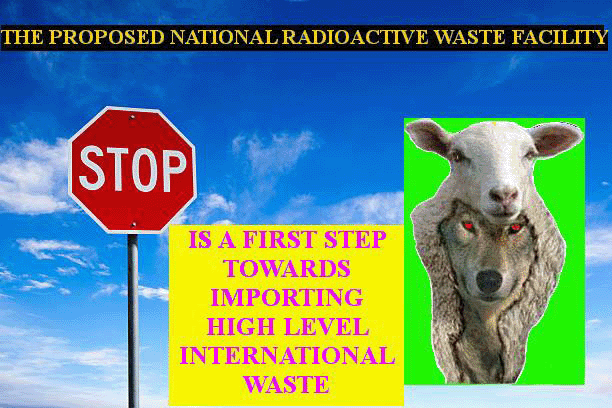
“That as a demonstration of its strong interest in, and commitment to the further development of a safe and sustainable Australian nuclear industry, and as a first step in such further development, the South Australian Government offers to host a national facility for storage and disposal of Australia’s own low and intermediate-level radioactive waste with the ultimate aim of securing Federal Government support for hosting an international radioactive waste management facility in South Australia”
Lib Senator Ramsay triggered KImba’s offer whilst Lib ex-Senator & absentee landlord Chapman dumped on the Flinders.
South Australians concerned about the prospect of a radioactive waste facility in the state protested outside of the Liberal Party headquarters in Adelaide this morning to oppose the proposal to both state and federal Liberals with a giant inflatable radioactive waste barrel drawing the attention of peak hour traffic.
The protesters were calling for Premier Steven Marshall and the Liberal government to oppose the federal government’s plan to establish a nuclear waste facility in Kimba or near Hawker.
Don’t Dump on SA member Tadhg Porter said the South Australian Liberal party brought in legislation that made the establishment of a waste dump illegal.
“We want Premier Marshall to defend our state against the prospect of the federal proposal, just like he defended South Australia against the proposal for an international high level radioactive waste facility,” Mr Porter said.
“We call on the federal government to stop this process, stop dividing communities and take a responsible approach to the management of Australia’s nuclear waste.”
Almost half of Australian big business moving to renewables
Climate Council says capacity of firms to generate solar power has doubled in less than two years, Guardian, Ben Smee, 15 May 18,
Almost half of Australia’s large businesses are actively transitioning to cheaper renewable energy, including many going off the grid by building their own generators and battery storage, as power bills threaten their bottom line.
A new report by the Climate Council details the increased speed of a business-led transition to renewables as power bills have increased.
The average household and small-business energy bill is more than 80% higher than a decade ago. Gas prices have increased threefold in five years.
Many businesses – including 46% of large operations – have responded by seeking green alternatives. The Climate Council report, released on Tuesday, said the capacity of Australian businesses to generate their own solar power had doubled in less than two years.
Business owners report making their investment back through cost savings in less than five years.
The general manager of AustChilli at Bundaberg, Ian Gaffel, said the decision to invest in solar panels was a “no-brainer”.
AustChilli employs more than 100 people in the agriculture and food manufacturing process. The business initially built a 100kW solar system and about 18 months ago added an additional 200kW.
Solar now accounts for about a quarter of the business’s power usage.
“We looked for many years at the idea before jumping in a few years ago,” Gaffel said. “We’re a growing business so as we’ve grown the energy we’re using goes up.”
“My role is on the financial side and from the numbers it was a very easy decision……..
Gaffel said the cost savings gave the business more confidence and certainty when deciding to expand and hire more employees. The next step for the business will likely be battery storage, which will further decrease its reliance on the energy grid.
Sue Tulloch A submission to Senate Standing Committees on Economics – The appropriateness and thoroughness of the site selection process for a national radioactive waste management facility (NRWMF) at Kimba and Hawker in South Australia, noting the Government has stated that it will not impose such a facility on an unwilling community. (Submission No. 32)
Terms of reference:
b) how the need for ‘broad community support’ has played and will continue to play a part in the process, in particular:
ii) how ‘broad community support’ has been or will be determined for each process advancement stage.
Untenable site nomination process
The legitimacy of the Governments’ Orima Survey
Lack of transparency from the Minister and DIIS Policy Officer
Shambolic role of the Bardioota Consultative Committee
whether wider (Eyre Peninsular of state‐wide) community views should be taken into consideration and, if so, how is this occurring or should be occurring
Introduction
I am Sue Tulloch, a resident of Quorn, a town within the Flinders Ranges Council district which includes the site, Barndioota nominated for a NRWMF, a section of the Wallerberdina Pastoral Lease in the northern Flinders Ranges near Hawker. Having with my partner, run the Copley Bakery (northern Flinders Ranges) for 20 years, I know why Australian and overseas visitors want to experience the Flinders Ranges. They perceive the area as having unique wilderness qualities. What would happen if we inserted a National Radioactive Waste Management Facility into this mindset?
Untenable site nomination process
The site was nominated by one individual, Grant Chapman, previously a Federal Government Senator, particularly interested in Australia’s search for a national nuclear waste site for over 20 years, these facts were not publicised.
Nobody either next door to the Barndioota site boundary, or in the surrounding areas were notified at the time.
Mr Chapman does not live on this property. He does not live in the designated area, whereas locals who live within the designated area ( Flinders Ranges Council district) have been suddenly lumped with the responsibility of deciding yes or no to ‘hosting’ the establishment of a NRWMF, the long and short term consequences, impacting all Australians.
If this site nomination process (Stage 1) is proven to be untenable, so would the ensuring community consultation process, and the ‘Community Sentiment Survey’.
The legitimacy of the Governments’ Orima Survey to access broad community consent to proceed to Stage 2.
The following observations were made after two days of personally studying the governments’ ‘Community Sentiment Survey – Report of Findings’, published by Orima Research in April 2016.
The survey was conducted on behalf of the Department of Industry, Innovation and Science to determine community sentiment for continuing to the next phase of a public consultation process, ( phase 2 technical assessment ) for the establishment of a National Radioactive Waste Management Facility (NRWMF) at six nominated sites. I focused on the nominated site of Barndioota and generally found the whole results conflicting and ambiguous from a layman’s point of view.
That the survey contains too many errors and unsubstantiated generalisations to be considered a formal, interpretive report, being inappropriate for public scrutiny, considering the questionable methodology and data obtained via the pilot and main general population surveys, especially as the future of the whole site selection process apparently seems to depend on it! (ref 1)
Lack of transparency from the Minister and the Policy Officer
I have been frustrated by the general absence of clear answers to my very specific questions sent to Minister Canavan (ref 2,3) and the Policy Officer, (ref 5, 6)
I had a battle (representing myself, no other group), to see the Minister when he visited Hawker (Fri 2/6/17), having followed all protocol including forwarding my questions well beforehand and communicating with the Ministers’ diary secretary, I was asked by the Policy Officer if I had permission to attend.
At the meeting, Minister Canavan did answer my question (ref 3 Q 2) saying, the government had no plans for future disposal of the Intermediate Level Waste proposed for the NRWMF.
Replies to my correspondence (ref 4, 6) were received, but disappointingly generic in nature.
At a meeting with the Dept of Industry, Innovation and Science (DIIS) on June 3 2017, my questions, despite of the Ministers’ assertion, (ref 4 4th para) were not addressed.
Shambolic role of the Barndioota Consultative Committee (BCC)
The BCC was established (Nov 2016) by the (DIIS) for ‘ensuring the community is fully engaged and is able to provide input on key aspects of the project throughout its’ next phase’ (NRWMF BCC Guidelines p.1 1.1 2nd para) However my experience as a public observer at the Dec 2017 BCC meeting, was anything but inclusive.
The discussion involved a presentation by consultant about the possibility of excluding Quorn in the next vote to go to Stage 2
Public observers (myself and another) not especially invited as speakers by the DIIS, were very obviously not welcomed. After being told the whole days’ business could not proceed if we stayed,( an invidious position to be put in), we were individually, forcibly escorted out by the DIIS representative (ref 7) What a farcical example of ‘ensuring the community is fully engaged!
ƒ The BCC ‘is not a decision‐making body and performs an advisory role only’, (BCC Guidelines p1 1.2), however ‘meetings may be open to the public at the discretion of the Committee….’ (BCC Guidelines p7 1.4.4 last para) Is this a decision making role?
ƒ The BCC is overwhelmingly dominated by ‘stakeholders’ wanting the NRWMF to go ahead, including the DIIS representatives. It therefore, appears to be a biased, controlled forum that does not practically encourage broad public consultation, being instead a marketing exercise to manufacture community consent.
ƒ The Deputy Convener of the BCC needs to be: ‘independent of the Department’ and to ‘act impartially with respect to any individual or representative in the community’ (BCC Guidelines pp3,4). His role as Chairperson at the Hawker BCC meeting with Minister Canavan (Fri 2/6/17), was blatantly in favor of the NRWMF going ahead, emphasising the considerable financial benefits for Hawker if the ‘project’ went ahead.
ƒ The Deputy Convener effectively evicted me from the Dec 2017 BCC meeting, (ref 7 para 2) contravening most of the ‘selection criteria for the Deputy Convener’, (BCC Guidelines p4) including;
ƒ An ability to facilitate and manage stakeholder committees in an independent manner ƒ Experience in community relations, facilitation, mediation or public advocacy: ƒ An ability to represent the concerns of a variety of interest groups and an understanding of local issues.
ƒ A willingness to share information with the local community
Meeting minutes (notes) are ‘drafted by the Department at the end of each Committee meeting, in collaboration with the Independent and Deputy Convener’ (BCC Guidelines p6). These notes are often, only, ‘publicly available on the Department’s website’ a week before the next bimonthly meeting if at all.(ref 7 para 3) A further example of the inappropriate, disingenuous role the BCC plays in the site selection process for a NRWMF.
e) whether wider (Eyre Peninsula or state‐wide) community views should be taken into consideration and, if so, how this is occurring or should be occurring.
Definitely, in a democracy such as Australia, wider community views regarding an issue with state and national relevance should be mandatory! Particularly in South Australia in light of the Citizens Jury voting no, to the proposal of deposing overseas high level radioactive waste in South Australia. (SA Nuclear Fuel Cycle Royal Commission Report May 2016). Albeit a separate issue to the NRWMF, it demonstrated the overall negative public attitude towards State and Federal Government radioactive waste proposals.
Most South Australians and Australians are unaware of the NRWMF proposal, believing that since the 2015‐2016 SA Royal Commission, any nuclear waste issues have been ‘done and dusted’. This has proved very handy for the Federal Government, effectively isolating the targeted community groups around Hawker and Kimba, fighting against having a NRWMF imposed on them.
Conclusion
Another resident of Quorn, in correspondence to Mr Bruce Wilson (DIIS advisor to the Minister), sums up my opinion about the appropriateness and thoroughness of the site selection process for a NRWMF at Hawker and Kimba, in SA, noting that the Government has stated that it will not impose such a facility on an unwilling community. ‘The search for a site to dispose of Australian generated LLW and ILW has .… so far, been unsuccessful….. If it is a National problem the answer needs to be found in a nationally collaborative way, with bi‐partisan support, and not palmed off onto remote, vulnerable communities, whose cohesion is split and disrupted by ideology, money and unsubstantiated raised expectations.’ re jobs, tourism opportunities and long term environmental stability.
I appreciate this valuable opportunity to voice my opinions at a Federal Government level and thank Senator Rex Patrick for the chance.
These people seem to have no grasp at all of the concerns of people worldwide about the effects of nuclear pollution on the environment and on future generations.
It is as if they have no understanding whatsoever of the risks to South Australia’s precious groundwater, to South Australia’s agricultural reputation, nor of the risks of transport accidents, terrorism, and the longterm situation of stranded radioactive trash.
Just consider these inane comments:
“the majority, we’re just so excited about the possibilities.
“it’s a way of ensuring a future for his young children.”
“I think it’s far safer than my own farming industry”
The small community of Kimba sits roughly halfway across the national highway stretching between South Australia’s east and west coasts. Wheat is the main crop grown here, but mayor Dean Johnson
says it’s marginal farming land. “We’re very reliant on rainfall in our area,” he tells SBS News.
The town’s uncertain future is the reason some residents have thrown their support behind a plan to store the nation’s nuclear waste. Local small business owner and farmer Michelle Raynr and her husband have offered to sell a small parcel of their land to the government for a future radioactive waste facility.
“You kind of just dread to think what the town will be like in another five, ten years if it doesn’t happen,” she says.
It would be a permanent facility for Australia’s low-level nuclear waste, and a temporary site for intermediate level disposal.
Ms Raynr says not everyone has been supportive of her decision. “It’s been a little bit disappointing, people’s reactions,” she says.“But the majority, we’re just so excited about the possibilities.”
Andrew Baldock is one who agrees. His parents have also offered to sell a piece of their land. He says it’s a way of ensuring a future for his young children.
“I’d really like to see something like this to help underpin the community, and perhaps, put us ahead of the other struggling towns in the region,” Mr Baldcock says.
“To me, it’s a lot less scary than the chemicals and the petrol, diesel and everything else that comes through our road here. I think it’s far safer than my own farming industry, to be honest.”
Radioactive waste is currently held across 100 different facilities. The federal government says it wants a central facility, housed in a community willing to support it.
Peter Woolford, Chairman of an anti-radioactive waste group in Kimba, wants the concerns of those who don’t support the project, to be heard.
“They’ve continually said they’re not going to impose it on a community, that it has to have broad community support, but I don’t think they have that in Kimba at all.”
The location for a national facility has been narrowed down to three sites, all in South Australia. Two are in Kimba, and the other is near Hawker, in the Flinders Ranges. The federal government says any facility would be constructed and managed under a strict regulatory framework.
Kimba local Graham Tiller believes any radioactive waste should be stored on existing government land.“There’s just no guarantees that land values won’t depreciate, or that grain won’t be devalued,” he says.
Tina Wakelin, another resident, says she agrees the site must go somewhere, but questions why it has to be in Kimba. “We must not be depicted as trying to stop nuclear medicine, that’s not the aim at all,” she says.“But a little town like ours should not feel responsible for all of Australia.”
Last month, the Resources Minister announced $4 million dollars in community funding grants for both Hawker and Kimba.
Mayor Dean Johnson says dozens of groups benefited from the cash injection.
“There’s the pony club… tennis courts, playgrounds, all sorts of things.”
Graham Tiller’s wife, Janet Tiller, says the money is not worth the impact of such a project. “No amount of money’s worth the health and livelihoods and friendships that have been lost in the town,” she says.
A postal ballot will be held on August 20 to measure community support.
The final decision as to where the waste site will go rests with the Resources Minister, who is expected to make his choice by the end of the year.
Geraldine GillenFight To Stop Nuclear Waste Dump In Flinders Ranges SA, 14 May 18 It is not just Kimba that needs to be consulted. I live at Whyalla, just up the road. At the very least all of Eyre Peninsula needs to be consulted, better still all South Australia. It will effect and affect us all. Especially the reputation of any agritculture or aquaculture. Unbelieveable that there are some people in Kimba who think this will “save” their town. I believe if it goes ahead, it will be the demise of the town.
Roni Skipworth Gov thinks that people can be bought – they did with the Shire of Kimba as it is a dying town like many rural towns n those who want this to happen decided $$$$ is what they need to boost it.
When the Mayor decided that the vote should only be for Kimba residents three quarters of the Shire didn’t want it, as everyone I have spoken to is against it. Somehow the Mayor and Ramsay had found a loophole and they ran with it. People are getting blinded by being healed by Nuclear Medicine saying it’s OK to av this dump but don’t realise that the Nuclear Waste is completely different than Nuclear Medicine.
Yes the gov is trying to cover up the negatives and saying it is harmless but it’s not as it was why then a worker last year when he got contaminated by a work accident is still not well. When the governments put out No Bullying ads why don’t they take action as at the moment that is what they are doing BULLYING US INTO SAYING YES FOR MANY NEGATIVE IDEAS THEY WANT TO DO ALL AROUND AUSTRALIA.
Brendan Harrington the tax payer as insurance companies hate nuclear, – USA has plenty about it on google and the tax payer pays not the nuclear corporation. I say NO Nuclear dump and people should research and see Medical isotopes have a half life of 3 days, This is not about medical isotopes. https://www.facebook.com/groups/344452605899556/
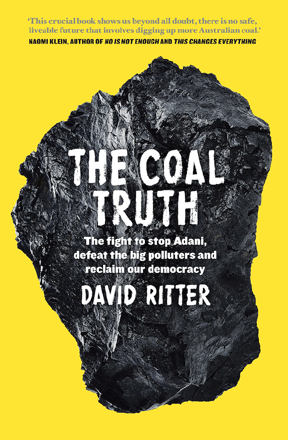
Just four citizens’: the Australians who confronted Adani in India, and made a difference Guardian, Geoff Cousins, 12 May 2018
In this book extract, Geoff Cousins describes how the farmer, the activist, the tourism operator and ‘an old bald man with hope in his heart’ travelled to India to protest against Adani……..
The campaign against the Adani mine is unique in my experience of major environmental battles. Most are “place-based” campaigns in one way or another: “don’t dam this river”; “don’t pollute this groundwater reserve”; “build this gas hub somewhere other than in a wilderness area”. The Adani proposal is different and touches on all the major environmental issues of our time, from climate change to global warming, from shifting from fossil fuels to renewables to the direct and indirect impacts on the Barrier Reef.
It has become a symbol of what is wrong with so much of the government policy in this country and elsewhere and that is why the campaign has attracted such widespread and passionate support. The central question that has focused the minds of all involved has become: if we can’t stop this mine at a time in history when urgent action is needed on all these issues, what can ever be achieved by the environment movement?…….
In discussions with traditional owners in Australia, it has been powerful to be able to describe first-hand the mistreatment Adani has meted out to Indigenous groups in India. The same promises are being made here, of employment and funding, and Indigenous groups are increasingly disbelieving of them – even those who may have signed agreements with Adani before they knew the truth.
A farmer in a wide hat and a bright green shirt with a white map of Australia on the back; an experienced and brave Great Barrier Reef activist; a woman who left her tourism business to join us at the last minute; and an old bald man with hope in his heart and fear in his belly – this was the great Aussie delegation. The Indians loved us. “You’re just four citizens?” they asked. “You don’t represent any organisation or government?” “No, just four people,” we answered.
There are thousands now, all over our country. More than 130 Stop Adani groups and thousands more people join the cause every month, with only one aim: to protect the planet, our reef, our natural world and our way of life against the environmental rape and pillage being carried out by Gautam Adani and his band of brothers.
Australia is one the world’s top 20 water-stressed nations but a shift to more renewable energy could lessen the nation’s water pressure.
A report by the World Resources Industry identified Australia as one country vulnerable to water stress where the potential for cheap renewable energy, solar and wind as opposed to fossil fuels, could reduce water consumption country-wide as these technologies use minimal – or zero – water.
‘Cheryl Axleby is a proud Narungga woman with family ties across South Australia. Cheryl is the co-chair of the National Aboriginal and Torres Strait Islander Legal Services (NATSILS).’
‘Yet again, our people have been let down with this year’s Federal Budget.
‘The investment in our communities is more eroded,
our quality of life more diminished,
our voices and needs more blatantly ignored.
‘While the Budget seeks to commemorate colonisation,
it fails to address its ongoing consequences and the oppression
that our people continue to experience.
‘The most alarming aspects of the Budget further stack the system
against our people and punish people living in poverty.
‘As a co-chair of NATSILS, I have been actively involved in trying to engage with governments
to provide insight and solutions into justice and social issues we face,
and the need for greater investment. It is disheartening that they are not listening,
and actively doing damage to our communities. …
Time for change
‘We remain unheard.
Our national Aboriginal and Torres Strait Islander representative bodies
are not invited to sit at the table with government.
Our communities are not meaningfully involved in the reform process.
And now the poorest amongst us will be punished for the ongoing effects of colonisation.
‘There are solutions.
Many of these were set out by our organisations in the 2016 Redfern Statement.
Now we continue to wait for the Government to act on their commitment to
“do things with us, not to us”.’
Submission To: Senate Standing Committees on Economics Regards “Selection process for a national radioactive waste management facility in South Australia”Ken and Carole Wetherby (Submission No. 12)
We live on a ‘hobby farm’ 10km east of Cleve which is outside the Kimba District Council.
Terms of Reference, our comments refer to items b, d and e. b)
“Broad community support”, the level of community support required for acceptance should be set at a 2/3 majority- then stick to this figure – don’t ‘waffle’.
d) Essentially the ‘community benefit program’ is a bribe and that is what it should be called.
e) This is the point which we have disagreed with from the outset. The establishment of a radioactive waste management facility at Kimba will have an effect on the whole of Eyre Peninsula, not just the Kimba Council area and we should all be allowed to have our say.
The ‘clean green’ reputation of the agricultural, fishing/aquaculture and tourism industries could be negatively affected. “Hobby farm’ values could also be affected – in our case we retired to our ‘hobby farm’ at Cleve because of Eyre Peninsula’s ‘clean green’ reputation. The agricultural zone on Eyre Peninsula is isolated from other farming areas by Spencers Gulf, the Nullarbor Plain and pastoral land to the north and as such it has a unique ability, as an entity, to claim and retain our “clean green’ reputation.
Of course you’d have to be pretty naive to think this isn’t step 1 to becoming the world’s nuclear waste dump?
Steven Marshall had previously said he would not support the facility and declared last year “a nuclear waste dump is now dead”.
Source: ABC News.
First posted 8 Jun 2017, 10:46am
Given deadlines are fast approaching and this seems as though its a foregone conclusion, it would seem our Premier Steven Marshall was unable to stay to his word and Malcolm Turnbull and Senator Matthew Canavan have been able to roll him. Embarrassing?
Then again when you’re offering 4 times property value to locals and offering other opposition segments houses and cars in exchange for their support, it’s hard to stop matters.
Hours before the doors swung open on the budget lock-up, the bright sparks on Twitter had already started a new meme. #KeepMyTenDollars was a reminder that Australians would gladly forgo an extra few bucks a week for to see the governments prioritise spending on health, education and renewables, not corporate and high-end tax cuts. It was certainly funnier than Scott Morrison’s bizarre attempt at humour.
“What have you achieved?” would have been an odd opening line to the government’s pre-election budget speech, were it not coming from the mouth of the man who famously waved a lump of coal around in Parliament to declare his love for the toxic fuel. The joke was lost on the rest of us, but it was the punch line that betrayed the confusion of the government.
The world’s leading economists have been warning for decades that the damage caused to the climate by burning coal, oil and gas poses one of the most serious threats to the global economy. The cost of destruction in agriculture, tourism, finance, insurance, property, and even mining caused by sweeping floods, droughts and bushfire caused by distorting the world’s life support systems is nearly unimaginable.
Indeed, it’s hard to imagine a sector that will not be severely impacted by climate change. But collapsing costs in renewables and a rising global movement against pollution is changing the headwinds – not that our Government seems to have noticed.
You would think that a Government that waxes lyrical about intergenerational equity would have at least a primary school grasp on climate change. Yet the forbidden words were nowhere to be seen in the budget speech, save for a small reference to the Government’s plans to walk away from innovation in the renewables sector (whatever happened to that dogged commitment to ‘jobs and innovation’). The devil, as always, was in the detail of the budget papers.
Budgets are a statement of values that mark the principles of legislators. In this year’s budget, the Government’s values were laid bare, with climate spending slashed by almost half, falling further to $1.2 billion by 2022. Analysis by the Australian Conservation Foundation found that the under-resourced Department of Environment and Energy will have an axe taken to its bottom line, with spending slated to plunge by 43 per cent on 2013 levels (when the Government took office) by 2022.
The Renewable Energy Target will be abolished by 2020. Taxpayer largesse will continue to flow to the Government’s friends in fossil fuel companies, with $30 billion in diesel tax subsidies pouring into private companies over the forecast period. No additional money for renewables or climate mitigation and adaptation will be forthcoming.
The opportunities that come from renewable energy, which are now cheaper as well as being cleaner and healthier, are being seized by the community of nations while Australia clings to a wheezing, out-dated economy.
On the same day the budget was delivered, the meter at Mauna Loa, Hawaii clocked 410 parts per million of carbon dioxide in the atmosphere – a level not seen in 800,000 years, well before humans developed agriculture, let alone donned suits and waved rocks around in Parliament.
The other critical budget, the carbon budget, is in obvious deficit.
The Government should keep my ten dollars, and use it to achieve real progress towards a coal-free, more liveable society. Most Australians would gladly chip in for wind and solar, and our vast weight of numbers will eventually prevail.
It’s clear after this budget that it will take concerted action from all Australians everywhere for the Government to regain its grip on reality.
NUCLEAR MONITOR – A PUBLICATION OF WORLD INFORMATION SERVICE ON ENERGY (WISE) AND THE NUCLEAR INFORMATION & RESOURCE SERVICE (NIRSAuthor: Ray Acheson ‒ Director, Reaching Critical Will, Women’s International League for Peace and Freedom) NM859.4719, May 2018
Looking at a map of South Australia’s nuclear landscape, the land is scarred. Uranium mines and weapon test sites, coupled with indications of where the government is currently proposing to site nuclear waste dumps, leave their marks across the desert. But amidst the devastation these poisonous activities have left on the land and its people, there is fierce resistance and boundless hope.
Friends of the Earth Australia has been running Radioactive Exposure Tours for the past thirty years.Designed to bring people from around Australia to meet local activists at various nuclear sites, the Rad Tour provides a unique opportunity to learn about the land, the people, and the nuclear industry in the most up-front and personal way.
This year’s tour featured visits to uranium mines, bomb test legacy sites, and proposed radioactive waste dumps on Arabunna, Adnyamathanha, and Kokatha land in South Australia, and introduced urban-based activists to those directly confronting the nuclear industry out in country. It brought together about 30 people including campaigners from the International Campaign to Abolish Nuclear Weapons and Reaching Critical Will, environmental activists with Friends of the Earth Australia and other organisations, and interested students and others looking to learn about the land, the people, and the industries operating out in the desert.
The journey of ten days takes us to many places and introduces us to many people, but can be loosely grouped into three tragic themes: bombing, mining, and dumping. Each of these aspects of the nuclear chain is stained with racism, militarism, and capitalism. Each represents a piece of a dirty, dangerous, but ultimately dying nuclear industry. And each has been and continues to be met with fierce resistance from local communities, including Traditional Owners of the land.
Testing the bomb The first two days of the trip are spent driving from Melbourne to Adelaide to Port Augusta. We pick up activists along the way, before finally heading out to the desert. Our first big stop on the Tour is a confrontation with the atomic bomb. Continue reading →
‘Mostly Indigenous remote jobseekers still need to work more than double hours of non-remote jobseekers for same income’
‘An overhaul of the remote work-for-the-dole scheme announced in the federal budget
has been criticised for maintaining racist and discriminatory requirements
on its majority Indigenous participants. …
‘Adrianne Walters, a senior lawyer at the Human Rights Law Centre, said
it was “mind-boggling” that the difference in requirements remained,
albeit slightly modified.
‘“Equal pay for equal work is a core tenet of Australian society.
The federal government must eliminate the blatantly discriminatory requirement,
which sees people in remote Aboriginal and Torres Strait Islander communities
forced to work more hours for the same basic Centrelink payment as people in cities,”
Walters said. … ‘
Eddie Hughes Submission to Senate Inquiry on Nuclear Waste Dump Sit Selection Process (Submission No. 57My name is Eddie Hughes and I am the State Member for Giles. Please accept the speech I gave in Parliament on the 31 May 2017 as my submission for the Senate Inquiry into “The selection process for a national radioactive waste management facility in South Australia”.
I believe that the selection process is deeply flawed as a result of being based on an individual site nomination process.
NUCLEAR WASTE
GRIEVANCE DEBATE – 31 MAY 2017
Mr HUGHES ( Giles ) ( 15:23 ): I rise today to talk about the process that is on the way to determine whether a facility to accommodate domestic nuclear waste is built in South Australia. It is very strange, given the vastness of the Australian continent and, indeed, the concentration of nuclear expertise at Lucas Heights, that the only three sites being considered are all in the electorate of Giles. The reason all the sites are in Giles does not reflect any particular set of comparative advantages.
What it does reflect is a fundamentally flawed site selection process. It is a site selection process that has little regard for the impact on the communities that have been put in the spotlight and a site selection process that has absolutely no regard for the division that has been created.
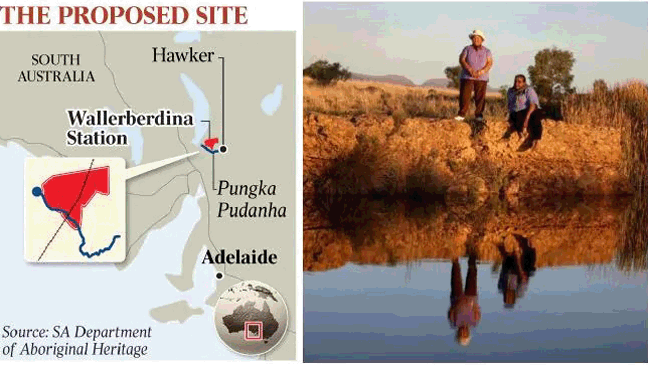
Let me be clear: we do need to manage our domestically-produced waste in a responsible fashion. The adoption of such a divisive process does not, however, represent a responsible approach. The trigger for the engagement process is at the heart of why this is a seriously flawed approach. If you look at Kimba and the surrounding district, and if you look at Hawker and its district, you will see the division that has been caused. The trigger for the Flinders Ranges site was totally centred on the action of one person. That person does not live in the region; he lives in Adelaide. He is an absentee landlord. This absentee landlord nominated Wallerberdina Station which is under a pastoral lease. The absentee landlord is Grant Chapman, a former Liberal Party Senator.
The process adopted by the Federal Government did not call for communities to nominate a site; it called for individuals with land tenure to nominate sites, a bizarre approach which then left communities to react. The absentee landlord did not consult with his neighbours prior to nominating his property. I understand that he did not discuss his intention with neighbouring pastoralists and he did not consult with the local Aboriginal people, some of whom live on the adjoining property at Yappala Station. I spent a night at Yappala, listening to the concerns expressed by the residents. They were shocked by the nomination and the arrogance of the absentee landlord. We now know that the presence of Aboriginal people in the Flinders Ranges dates back 40,000 years. They are not blow-ins, they are not absentee landlords, they have lived and walked the country for generations.
The nomination of Wallerberdina was marked and will always be marked by a complete lack of respect for the Adnyamathanha. The absentee landlord did not speak to his neighbours, neighbours whose connection to the land he obviously has no appreciation of. We are not all that far from terra nullius. His neighbours were invisible. The nomination and the ongoing process has generated division not just in the European community but also in the Aboriginal community. The nomination process in Kimba also centred on the actions of individuals and has also led to community division. In the lead-up to the Federal election, the people of Kimba were under the impression that the two sites nominated near Kimba had been taken off the table, only to magically reappear after the election.
Most of the waste generated comes from the Eastern States. Lucas Heights can easily accommodate the long-lived intermediate waste for decades to come. That is where the expertise is and that is where the more serious waste is generated. When it comes to that waste and other waste streams, we have ample time to get this right, and a starting point at a national level is to initiate a roundtable process involving all the various interests, including non-government environmental bodies. We have an obligation to do this properly and we can build a consensus about our long-term management of nuclear waste. What has happened to date should become a case study in how not to do it.
25 October – Film –Britain’s Nuclear Bomb Scandal: Our Story – part of the Adelaide Film Festival,
Screening and Conversation
A screening of Britain’s Nuclear Bomb Scandal: Our Story (2024) followed by a talk with 2026 Bettison and James Awardee and Tradtional Owner Karina Lester in conversation with Simone Tur.
When: Sun 25 Oct, 12:00pm-Screening, 1:15pm-Talk
Where: The Mercury
Free admission, register below by clicking on BUY TICKETS and select free event tickets, at end of web page: