South Australian Parliament debating law to protect whistleblowers
 SA parliament to debate whistleblower laws http://www.news.com.au/national/breaking-news/sa-whistleblower-laws-to-be-debated/news-story/8185705eee839b9c9b9277c456641777
A law shielding South Australian journalists from liability for refusing to reveal their sources will be tabled in state parliament.
Whistleblowers may soon have stronger protections under a bill introduced to parliament in South Australia.
The Liberal government on Thursday introduced legislation to shield journalists from criminal or civil liability if they do not disclose the identity of their sources when the information is in the public interest.
“This legislation enhances the public’s right to know by encouraging whistleblowers to come forward on the understanding that journalists will not be forced to disclose their identity in a court of law,” Attorney-General Vickie Chapman said.
The proposed legislation would make the default rule that journalists cannot be compelled to answer a question or produce a document that may disclose the identity of an informant.
“I anticipate it will be a very rare day that a court will deem revealing the identity of the informant is necessary to protect the public interest,” Ms Chapman said.
SA Law Society President Tim Mellor said the legislation was an important step in the protection of a free press.
“Like an independent judiciary, the fourth estate of a free press is an integral part of an open and transparent society,” Mr Mellor said
South Australian and Queensland are the only two states without shield laws.
Geophysicists say that North Korean nuclear blast ‘moved mountain’. Australia’s seismic station plays role in monitoring
While Dr Wang and his team used data from seismic monitoring systems in China and the surrounding area, Australia has one of the best in the world, Professor Tkalcic said: the Warramunga monitoring station in the Northern Territory, near Tennant Creek.
It’s almost smack bang in the centre of the continent, in an incredibly quiet part of the world, seismically speaking; far from tectonic plate edges, cities and the shoreline, where waves crashing on the coast create seismic noise.
There is also an infrasound detection system at Warramunga station, which detects waves that travel through the atmosphere produced by bomb blasts.
The data is transmitted by satellite to the Comprehensive Nuclear-Test-Ban Treaty Organisation in Vienna, where it is monitored round the clock.

North Korean nuclear test had energy of 10 Nagasaki bombs and moved mountain, geophysicists say http://www.abc.net.au/news/science/2018-05-11/north-korea-nuclear-test-satellites-seismic-monitoring/9746676 By science reporter Belinda Smith, 11 May 18,
An underground North Korean nuclear test in September last year exploded with 10 times the energy of the atomic bomb that exploded over Nagasaki in 1945.
It also caused the overlying mountain peak to sink by half a metre and shift about 3.5 metres south.
These are conclusions drawn by geophysicists, who used satellite radar and instruments that pick up waves travelling through the earth, to calculate the explosion’s depth and strength.
In the journal Science today, they also report signs that a subterranean tunnel system at the test site collapsed 8.5 minutes after the bomb detonated.
In the past, satellite technology — called synthetic radar aperture imagery — has mapped how the ground stretches and warps after earthquakes.
But this is the first time it has been used to examine a nuclear bomb test site, according to Teng Wang, study co-author and a geophysicist at Singapore’s Nanyang Technological University.
Since the United Nations General Assembly adopted the Comprehensive Nuclear-Test-Ban Treaty in 1996, nine nuclear tests have taken place.
Six of these were by North Korea, five of which were at its Mt Mantap facility in the country’s north.
The bombs were detonated in chambers tunnelled into the mountain itself — a granite peak that extends upwards just over 2,200 metres.
But this means the details of the tests, such as the energy produced by the bombs, have been largely unknown outside North Korea — until now.
Eye in the sky, ear to the ground
Dr Wang and his colleagues suspected they could deduce the strength and precise location of the bomb test on September 3 last year, which triggered a magnitude-6.3 earthquake.
Clandestine nuclear activities are tracked by a global monitoring system of sensors that pick up the faint shivers and shudders generated by distant underground blasts and earthquakes.
But while these instruments are capable of picking up the wave signature of a bomb blast thousands of kilometres away, more information is needed to pinpoint exactly where an explosion has taken place.
So in the weeks after the September North Korean bomb test, Dr Wang and his colleagues received images of the Mt Mantap terrain before and after the test, snapped by the German TerraSAR-X satellite.
To map the bumps and dips on the Earth’s entire surface, TerraSAR-X pings radar towards the ground and measures how long it before the signal is bounced back up again.
“As long as the ground is deformed, we can measure it from space using synthetic radar aperture,” Dr Wang said.
Combined with a bit of nifty mathematical modelling — the first time anyone’s modelled an underground nuclear test with radar data — he and his colleagues got a fix on the exact location of the detonation site.
This is a highlight of the work, said Hrvoje Tkalcic, a geophysicist at the Australian National University, who was not involved in the study.
“What’s always difficult is pinpointing an exact location [of a bomb test],” Professor Tkalcic said.
Dr Wang and his team calculated that the top of the mountain subsided about half a metre after the September test, and parts of it shuffled south.
To manage this deformation, the bomb released the energy equivalent to between 109,000 and 276,000 tonnes of TNT in a chamber 450 metres below Mt Mantap’s peak.
The “Fat Man” bomb that exploded over Nagasaki yielded an energy level equivalent to 20,000 tonnes.
Among the data, they found the seismic shivers of a second, smaller event — an aftershock that appeared 700 metres south of, and 8.5 minutes after, the explosion.
The waves produced by the aftershock weren’t consistent with an explosion; rather, it looked like the ground had imploded.
This, the geophysicists suggest, “likely indicates the collapse of the tunnel system of the test site”.
While Dr Wang and his team used data from seismic monitoring systems in China and the surrounding area, Australia has one of the best in the world, Professor Tkalcic said: the Warramunga monitoring station in the Northern Territory, near Tennant Creek.
It’s almost smack bang in the centre of the continent, in an incredibly quiet part of the world, seismically speaking; far from tectonic plate edges, cities and the shoreline, where waves crashing on the coast create seismic noise.
It uses an array of buried instruments to pick up waves that travel through the ground, acting as a giant antenna to amplify weak signals.
“They’re used in the same way as astronomers use arrays of antennas to look at deep space. It’s just that our antennas are pointed to the centre of the earth,” Professor Tkalcic said.
There is also an infrasound detection system at Warramunga station, which detects waves that travel through the atmosphere produced by bomb blasts.
The data is transmitted by satellite to the Comprehensive Nuclear-Test-Ban Treaty Organisation in Vienna, where it is monitored round the clock.
So how do geophysicists know if seismic waves are caused by bomb blasts and not, say, an earthquake or landslide?
In a subterranean explosion, the ground is pushed outwards and compressed, sending a particular type of wave through the ground, Professor Tkalcic said.
An earthquake’s seismic signature is different. If two plates collide, rub against each other or slip, they send out another type of wave.
“We can tell if the first motion was predominantly a compression or if it was a shear type of motion,” Professor Tkalcic said.
The melting of Antarctic ice is coming from warm waters underneath
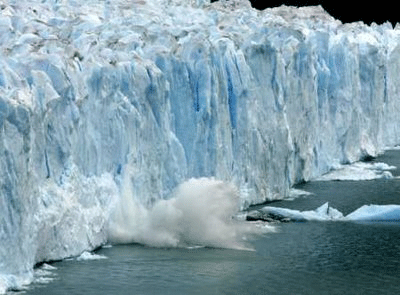 Global warming is melting Antarctic ice from below Warming oceans melting Antarctic ice shelves could accelerate sea level rise, Guardian, John Abraham, 9 May 18, “……With global warming, both of the poles are warming quite quickly, and this warming is causing ice to melt in both regions. When we think of ice melting, we may think of it melting from above, as the ice is heated from the air, from sunlight, or from infrared energy from the atmosphere. But in truth, a lot of the melting comes from below. For instance, in the Antarctic, the ice shelves extend from the land out over the water. The bottom of the ice shelf is exposed to the ocean. If the ocean warms up, it can melt the underside of the shelf and cause it to thin or break off into the ocean.
Around Antarctica, water at the ocean surface cools down and becomes saltier. These combined effects make the surface waters sink down to the sea floor. But as ice melt increases, fresh water flows into the ocean and interrupts this buoyancy effect. This “freshening” of the water can slow down or shut down the vertical mixing of the ocean. When this happens, the cold waters at the surface cannot sink. The deeper waters retain their heat and melt the ice from below.
The study incorporated measurements of both temperature and salinity (saltiness) at three locations near the Dalton Iceberg Tongue on the Sabrina Coast in East Antarctica. The measurements covered approximately an entire year and gave direct evidence of seasonal variations to the buoyancy of the waters. The researchers showed that a really important component to water-flow patterns were ‘polynyas.’ These are regions of open water that are surrounded by ice, typically by land ice on one side and sea ice on the other side.
When waters from the polynya are cold and salty, the waters sink downwards and form a cold curtain around the ice shelf. However, when the waters are not salty (because fresh water is flowing into the polynya), this protective curtain is disrupted and warm waters can intrude from outside, leading to more ice melt.
Based on this study, we may see increased ice loss in the future – sort of a feedback loop. That concerns us because it will mean more sea level rise (which is already accelerating), and more damage to coastal communities. I asked the lead author, Alesandro Silvano about this work:
We found that freshwater from melting ice shelves is already enough to stop formation of cold and salty waters in some locations around Antarctica. This process causes warming and freshening of Antarctic waters. Ocean warming increases melting of the Antarctic Ice Sheet, causing sea level to rise. Freshening of Antarctic waters weakens the currents that trap heat and carbon dioxide in the ocean, affecting the global climate. In this way local changes in Antarctica can have global implications. Multiple sources of evidence exist now to show that these changes are happening. However, what will happen in Antarctica in the next decades and centuries remains unclear and needs to be understood.
This is just another reason to take scientists seriously and act to slow down climate change before it is too late. https://www.theguardian.com/environment/climate-consensus-97-per-cent/2018/may/09/global-warming-is-melting-antarctic-ice-from-below
David Noonan: No sound reason for ANSTO’s nuclear reactor wastes to go to Kimba South Australia as STRANDED WASTES
 The proposed above ground Store in SA is primarily for ANSTO nuclear wastes
It is axiomatic that site selection at Kimba will require requisition of an Eyre Peninsula Port for decades of intended shipments of ANSTO nuclear fuel waste, first due from the UK in circa 2020-21.
The SA Nuclear Fuel Cycle Royal Commission (2016) concluded that terrorist attack scenarios are conceivable during the transport of nuclear fuel wastes & that if a cask was lost at sea and was irrecoverable the radioactivity that escapes is expected to affect thousands of cubic km of seawater.
ANSTO has produced irradiated nuclear fuel wastes & Intermediate Level Wastes at Lucas Heights for 60 years without any nuclear waste disposal capacity (or even a program to do so) and intends to continue this mal-practice for another 40 years under an OPAL reactor Operating License up to 2057.
It is an untenable fact that the proposed nuclear fuel waste Store in SA is intended to operate “above ground for approx. 100 years”, however responsible management of ANSTO irradiated nuclear fuel wastes requires isolation from the environment for 10,000 years.
A Store in SA is unnecessary given the safe option of Extended Storage at Lucas Heights
This Inquiry should find no manifest need for a nuclear waste Store in SA other than Federal agenda. There is no Safety, Licensing or technical reason to bring these nuclear wastes to SA.
the Federal Minister holds a draconian discretion under the National Radioactive Waste Management Act 2012 (NRWMA) to over-ride both Federal and State Aboriginal Heritage Acts.
Ending the process now is far preferable to “a final right of veto” which forces Aboriginal people through to the end of a divisive demanding site selection process that is harming their community.
An immediate adjoining property to the proposed NRWMF siting in the Flinders is an Indigenous Protected Area, a part of the National Reserve System that is supposed to be under Federal protection. AND the proposed sites and the broader area are part of a precedent registered Story
Line, values that must be respected, under the protection of the SA Aboriginal Heritage Act 1988
However: the Federal Minister holds a draconian discretion under the National Radioactive Waste Management Act 2012 (NRWMA) to over-ride both Federal and State Aboriginal Heritage Acts.
This ERC Inquiry should recognise that Aboriginal people’s ‘voice must be heard and their consent is essential’ as a core part of “broad community consent” and make a Finding that NRWMF siting on Adnyamathanha country in the iconic Flinders Ranges is inappropriate and must stop forthwith.
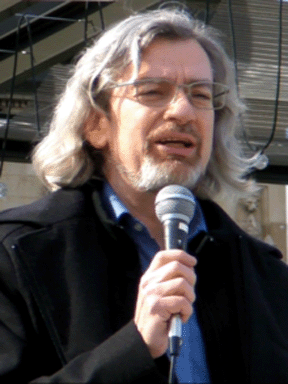 David J Noonan B.Sc., M.Env.St. Independent Environment Campaigner . Submission to Senate Economics References Committee Inquiry “Selection process for a national radioactive waste management facility in SA” (Submission No. 31)
RE: Flaws in site selection process, inappropriate indefinite storage floats best practice, failure to follow essential Nuclear Safety Committee advice, and serious threat to human & cultural rights.
Dear Secretary Please accept this public submission & consider my request to appear as a Witness at this Inquiry
This submission focuses on the “appropriateness and thoroughness of the site selection process” & associated matters for the proposed National Radioactive Waste Management Facility (NRWMF).
Specifically: on inappropriate Siting of a proposed indefinite above ground Store for primarily ANSTO irradiated nuclear fuel wastes & long lived Intermediate level reactor wastes in regional SA.
An Executive Summary and a few public interest & Safety Questions for this Inquiry to consider under your Terms of Reference are provided – along with an offer to expand on points raised.
Over the last two full years the Federal government has solely targeted regional communities in SA to site the nuclear waste Store & associated required nuclear Port and waste transport routes.
In doing so, the Federal process is unacceptably inadequate (rather than thorough) in failing to follow essential advice of the Nuclear Safety Committee to the regulator ARPANSA (NSC advice to the CEO, Nov 2016) on the NRWMF: for transparency in decisions and for “The ongoing requirement to clearly and effectively engage all stakeholders, including those along transport routes.”
My submission to the Minister (May 2017) on his decision under the National Radioactive Waste Management Act 2012 to assess two sites near Kimba as potential sites for the proposed NRWMF raised a range of issues that have not been thoroughly addressed since (see Attachment 1).
I request opportunity to appear as a Witness to provide evidence at a Hearing of this Inquiry, and was a Witness as an individual on nuclear waste issues at the SA Parliament Joint Committee Inquiry on the Findings of the Nuclear Royal Commission, held in 2016. Continue reading
Gary Cushway shows up the lack of indigenous support for nuclear waste dump
Gary Cushway
18 Feb 2018 Submission to Senate Inquiry on Selection Process for Nuclear Waste Dump Site. (submission no. 6) Cushway addresses these terms of reference:
b) how the need for ‘broad community support’ has played and will continue to play a part in the process
’Broad community support’ should reflect a large majority, both across the community and within stakeholder groups (including the indigenous community) in favour of moving to the next process advancement stage.
c) how any need for Indigenous support has played and will continue to play a part in the process, including how Indigenous support has been or will be determined for each process advancement stage;
It is not simply enough to say that consultation with indigenous stakeholders and neighbours has occurred, without elaborating on the results. The ‘Community sentiment survey’ conducted by DISI in April 2016 recorded 3% support from the indigenous community for the Barndioota site to proceed to the next stage. (p10 sec C)
source: http://www.radioactivewaste.gov.au/site-selection-process/key-documents-andfaqs -Community Sentiment Survey (3.05MB)
A copy of this report has been attached to this emailed submission.
Given the presumably low sample size I would suggest that this likely represents support of one or perhaps two individuals. It is vital that the sample size of this survey is published.
Additionally, the process behind the decision to disregard the significantly low support in the indigenous community from this survey and to progress the Barndioota site to the next stage should be discussed publicly as a matter of importance.
d) whether and/or how the Government’s ‘community benefit program’ payments affect broad community and Indigenous community sentiment
Although making funds available for ‘community benefit’ is clearly welcomed for any reason, the inclusion of offers of money as a part of the consultation process has created a few potential problems with regard to whether support from the community can be measured as broad support for the actual proposal or as support for the community benefit money being offered. This could also create a disparity when trying to effectively gauge ‘broad support’ in the community when some may be receiving significant amounts of money while others may not.
 There also could exist a perceived conflict of interest when bodies such as the Flinders Ranges Council are a recipient of this funding, when the Council may in future be required to make impartial planning decisions on, for example,
infrastructure or local environmental policy that is related to any future facility in the area.
There also could exist a perceived conflict of interest when bodies such as the Flinders Ranges Council are a recipient of this funding, when the Council may in future be required to make impartial planning decisions on, for example,
infrastructure or local environmental policy that is related to any future facility in the area.
Although local community support is vital, in a proposal such as a National Radioactive Waste Management Facility a broader consent should be sought from across the country.
As the NRWMF is a part of national plan of radioactive waste management any proposed site should require a ‘broad support’ nationally as well as locally.
The current proposal involves the storage of radioactive waste from sites across the country as well as the interim storage of waste returning to Australia from overseas. Federal, state and international governments have a responsibility to ensure that their involvement in the movement of radioactive waste complies with all national, state and international laws, regulations and best practice meaning that these governments and their constituents have a stake in ensuring that the site selection meets their own requirements in terms of legislation and broader social values. Limiting the consultation to a small local community area inhibits the ability of these stakeholders to have a voice in the process.
Carmichael mine in Queensland no longer a viable proposition
 Adani losses prompt mining company to shift away from imported coal, Guardian, Ben Smee , 7 May 18, Results show Carmichael mine in Queensland no longer a viable proposition, analysts say
Adani’s coal-fired power business has reported more heavy losses, prompting the Indian conglomerate to announce it would shift away from using expensive imported coal.
Analysts say the fourth-quarter financial results for Adani Power, a subsidiary of the Adani group, showed the proposed Carmichael mega-mine in Queensland was no longer a viable proposition.
Remarkably in the context of the Carmichael project, the billionaire Adani Groupboss, Gautam Adani, acknowledged in a statement that the cost of importing coal to India had contributed to Adani Power’s struggles.
“We expect to receive [domestic coal] for the Tiroda and Kawai plants in the near future, which will help reduce fuel costs and improve profitability of these projects,” he said.
“Under-recovery of fuel costs for Mundra project have impacted its financial viability, and we are in dialogue with key stakeholders for an early solution.”
When the Carmichael coal project was first proposed, Adani was pushing a “pit to plug” operational model under which it would mine coal to use at its own generators, making profits through efficiencies and cutting out middlemen.
The Mundra power plant, which operates on imported coal, was the planned destination for the spoils from the Carmichael project. After Mundra fell into financial trouble, Adani attempted unsuccessfully to sell the plant. It has not operated since February.
The Indian financial services company Edelweiss said Adani Power was “on thin ice” and doubted whether Mundra would reopen………https://www.theguardian.com/environment/2018/may/07/adani-coal-losses-prompt-mining-company-to-shift-from-imported-coal
Solar microgrid to launch in the heart of coal country
 SMH, By Cole Latimer, Dairy farmers in the heart of Victorian coal country will soon be able to trade solar power using blockchain processes.
A virtual microgrid will be created in the the Latrobe Valley, exchanging energy generated from 200 Gippsland dairy farmers, 20 businesses and 150 households, powered by a decentralised, peer-to-peer blockchain energy trading platform called Exergy.
Ivor Frischknecht, the Australian Renewable Energy Agency’s chief executive, said the trial was the first step in transitioning the agricultural region – near the state’s coal-fired power stations – to renewable power. It would be the first major trial of a blockchain-based virtual microgrid in Australia.
“The ‘virtual microgrid’ concept brings an alternative approach to energy where the control remains with the customers, rather than retailers, who can choose to opt in depending on the current prices and energy types, or their willingness to provide demand response,” Mr Frischknecht said.
The project will be built by LO3 Energy, a New York-based company that created the world’s first local energy marketplace, in Brooklyn, which allowed participants to trade energy using blockchain technology.
…….. The Victorian virtual microgrid will comprise solar installations, battery storage, and demand response and enabling technologies combined with LO3’s Exergy peer-to-peer trading mechanism, which uses blockchain processes to allow those within the market to buy and sell locally generated renewable energy.
With the energy-hungry farming industry still recovering from the 2016 milk crisis, it promises a cost-effective and resilient solution for farmers to create and manage their own energy and profit from trading their excess generation,” LO3 Energy founder Lawrence Orsini said.
“Engaging with farms is a key part of the project as they have the capacity to install large solar generation and storage. Exergy makes it possible for them to become mini-power plants and gain revenue for energy they don’t use.”
The farms will be given loans to build solar installations by the Sustainable Melbourne Fund, which will be repaid through council fees.
ARENA will also provide $370,000 in funding for the $775,000 project.
“The local Latrobe Valley marketplace would allow Gippsland farmers to take greater control of their energy use, providing the opportunity to sell their power back to the grid,” the Australian Renewable Energy Agency (ARENA) said, “consumers will also be paid for choosing to conserve energy at peak times.”
The study will run to the end of the year, with plans to roll out a pilot microgrid in Gippsland in 2019. https://www.smh.com.au/business/the-economy/solar-microgrid-to-launch-in-the-heart-of-coal-country-20180426-p4zbtf.html
Sisters of St Joseph finds the Terms of Reference for Senate Inquiry on Nuclear Waste Dumping to be ‘grossly inadequate”
 Others however do not consider that the financial risks are adequate. Their concerns have been articulated in community discussions:
• The loss of value to the spectacular tourist lands of the Flinders ranges
• The damage to farming country near Kimba
• The harm to below surface water tables
• The adverse effect on the prices of livestock and crops, caused by proximity to radioactive waste
• The adverse effect on the prices of land adjoining the site
• The fear that the Commission’s case for a nuclear making a profit is based on inflated estimates of the income and deflated estimates of the costs and risks
The question for all of us must be faced. What sort of planet will our children, grand children and great grand children inherit, if this land is used in the way proposed by the Government?

Josephite Justice Office, North Sydney NSW 2060, Submission to Senate Inquiry SELECTION PROCESS FOR A NATIONAL RADIOACTIVE WASTE MANAGEMENT FACILITY IN SOUTH AUSTRALIA Contact Jan Barnett rsj (Submission No. 68)
INTRODUCTION
This submission is presented on behalf of the Josephite Justice Office, a ministry of the Congregations of the Sisters of St Joseph. The Sisters of St Joseph and our Associates (numbering approximately three thousand women and men) were founded in the mid-nineteenth century by Mary MacKillop and Julian Tenison Woods to work with those suffering from poverty and social disadvantage. We educate, advocate and work for justice, for earth and people, especially those pushed to the margins.
We commend this Inquiry into the siting of national radioactive waste management facility (NRWMF) at Kimba and Hawker. It is particularly encouraging to note that the Government has stated unequivocally that it will not impose such a facility on an unwilling community. The controversy surrounding the siting of a NRWMF in any area of Australia over recent years indicates the strength of feeling and the contradictory evidence being argued. It is our belief that until these arguments can be resolved, then even the specific terms of reference nominated for the Inquiry will be grossly inadequate. Continue reading
Time for South Australians, ALL Australians, to rally against nuclear waste dumping in beautiful Flinders Ranges
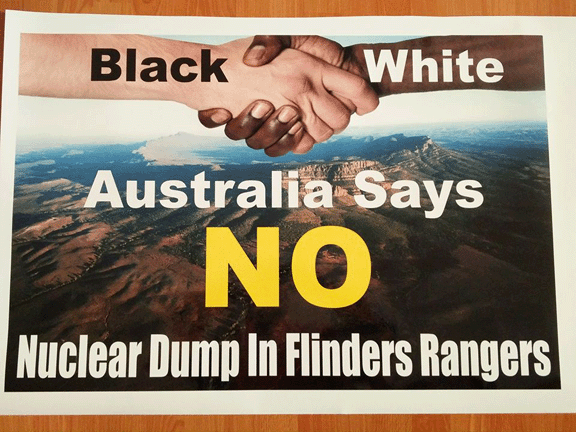
Anti-nuclear protesters increase fight against radioactive dump being established in SA
The Advertiser Erin Jones, Regional Reporter, Sunday Mail (SA) May 5, 2018
http://www.adelaidenow.com.au/news/south-australia/antinuclear-protesters-increase-fight-against-radioactive-dump-being-established-in-sa/news-story/55f7c369b17f03c747c1de824428b4df
ANTI-NUCLEAR campaigners will increase their fight to stop South Australia from becoming the nation’s radioactive waste ground, ahead of a final vote by the community.
Hundreds of postcards will be sent to Federal Resources Minister Matt Canavan demanding cultural heritage sites, agricultural land and the environment be protected from nuclear waste.
The Federal Government is expected to decide in the coming months whether to build a low-level and intermediate-level waste facility at Kimba or Barndioota, in the Flinders Ranges.
The two-year site selection process has divided both communities, those in favour believed it would create economic opportunities, while those opposed said it would jeopardise industries.
Conservation SA nuclear waste campaigner Mara Bonacci said the government needed to be more transparent about the facility ahead of an August 20 community ballot.
“There is division in both communities, whether it’s people who are pro-nuclear waste or anti-nuclear, they both want what’s best for the community,” Ms Bonacci said.
“But the pro-waste people are saying it will create lots of jobs, but we haven’t got any clarity around the numbers or if they’re full-time.
“We also want to know what number the Minister wants in a community vote to show ‘broad community support’ for the facility.”
Before the government decides on the successful site, residents from both communities will be given a final chance to accept or reject the proposal.
The ballot will be held less than a week after findings of a Senate Inquiry into the site-selection process are to be released, on August 14.
Mr Canavan told the Sunday Mail the government would provide more detailed information on the project’s design, job creation, cost, community benefits and safety, ahead of the ballot.
He said a nuclear waste facility would not be imposed on an unwilling community and it would need “broad community support” – although no arbitrary figure was provided.
“As we have always said, a range of factors will be used to determine broad community support, including the results of a public ballot, public and private submissions, and feedback from stakeholders during community discussions, including neighbours, councils and local groups,” Mr Canavan said. “The consultation process is engaging people on all sides of the discussion, and all views – supportive, neutral and opposed – are taken into account.”
The ballot will include residents of the Flinders Ranges Council and within a 50km radius of the Barnidoota site, and the Kimba District Council.
Disrespect by ANSTO toting NSW Aboriginal man across Australia to promote nuclear waste dumping
 Vivianne C McKenzie Shame on ANSTO and DIIS bringing yura to speak about waste dump in Wallerbidina. Who gave welcome to yartah? Did the Adnyamathana peoples give permission for them to have meeting on yartah?
Heather Mckenzie Stuart Disrespectable man shame on him!
Roni Skipworth So this guy from Darwahl tribe in NSW didnt ask permission to come on to your Ancestors Lands. That seems very disrespectful as having good Indigenous friends they used to explain to me the Indigenous Law was ‘Didnt matter where one wanted to travel in other parts of Australia,they needed to go the that destination’s Elders to ask permission to enter into their Lands’. Like those from Adnyamathanha Country who wanted to travel to Lucas Heights would out of respect go to the Elders of the Darwahl Tribe to ask permission to step onto their land. I feel that Indigenous Laws once very strong amongst Australia’s Indigenous are being lost in today’s world. Also I feel that is why some Indigenous Children run amuck as they are lost and living in a White Society under the White Laws have lost their way .
No Nuclear Waste Dump Anywhere in South Australia, 6 May 2018 https://www.facebook.com/groups/1314655315214929/
Adnyamathanha tribal elder, Ken McKenzie, rejects pressure to agree to nuclear waste dumping at Wallerberdina
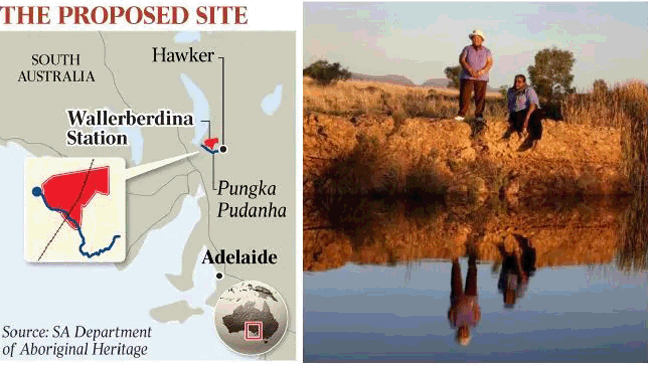 Enice Marsh, left, and Regina McKenzie at Yappala in the northern Flinders
I love Australia and I love the Flinders Ranges .
Even in my own room at Flinders House, at 2 o’clock in the morning, I have received phone calls telling me I’d better change my mind or else face tribal retribution. Because of my traditional ties to this land, these phone calls frightened me terribly. I am not a violent person. I’ve also had phone calls through the day saying huge benefits ie house, property could come my way if I was to say yes and encourage my people to also say yes to the dump.
Through all of this process over the last two years the government finally, in January of this year, 2018, employed a company who did a site cultural survey on Wallerberdina Station. This group of people desecrated one of our women’s traditional sites. Once again the terrible anguish that is being put on the people to see what has happened, is something that I never dreamed would be happening to my family and friends both black and white.
Local indigenous not impressed! ANSTO brought an indigenous nuclear spruiker from New South Wales to Flinders Ranges
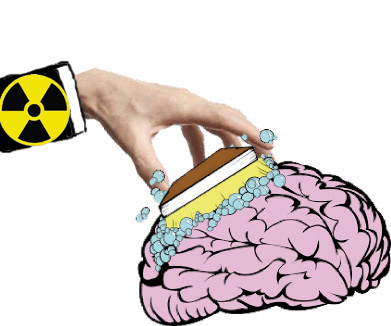 Heather Mckenzie Stuart Fight To Stop Nuclear Waste Dump In Flinders Ranges SA, 5 May Why is ANSTO and DIIS bringing a yaninjanha yura from Darwahl tribe in NSW to Hawker in the Flinders Ranges, making trouble saying urdnus are the only ones protesting against the proposed nuclear waste dump at Barndioota and are using yuras?
We go to protests and we will keep going to protests we will stand against the vartani. Anyway who gives that man the right to come here and talk in Adnyamathanha country, Wilyaru mirus and Adnyamathanha artuyani yarta. This is our ancestors lands, he has no shame we wouldnt go and talk in his yarta about his country. Dont come here pushing a nuclear waste dump on us, keep the poison in your country. You ANSTO and DIIS keep that yura in his country and let him dribble his rubbish over there in NSW. Hands off our sacred sites and stay in your yarta!! Ps his cultural consultancy means nothing to us, he want to stay at Lucas Heights.
Australia’s “Nuclear Archbishop” Dr Adi Paterson, graced Kimba with a visit

Dr Paterson visited Kimba on Friday with Carmelo Pesce, the mayor of the Sutherland Shire, which is home to the Lucas Heights reactor. According to the Eyre Tribune, the nuclear guru promised “45 jobs [that] will vary from full-time work, to shift work and on-call.
Dr Paterson said the announcement to the Kimba Economic Working Group and Consultative Committee and other members of the community received a positive reaction. ……..
If the proposed facility does go ahead in Kimba, Dr Paterson said it would receive a number of ongoing visits.
“There would be ongoing visits from independent regulators, visiting scientist and general visitors like tourists and school groups.”
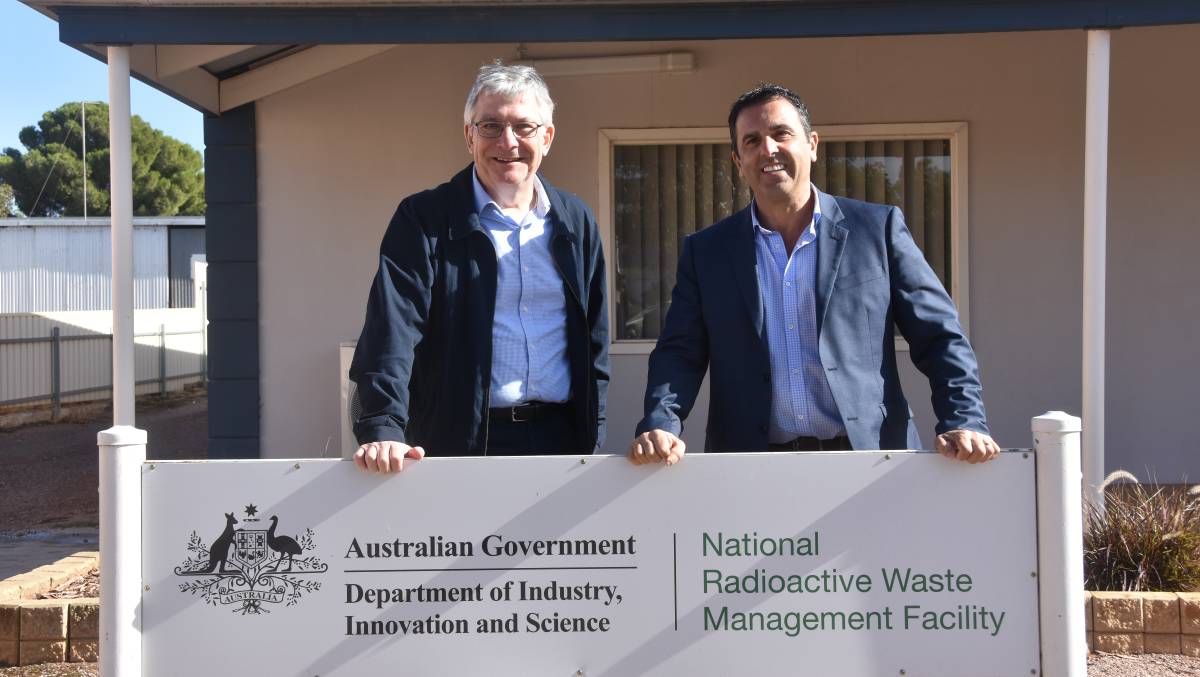
BHP, Heathgate, and Turnbull government keen to sell uranium to India
 Boost to nuclear-power: Two Australian firms in talks to export uranium to India, The Indian Express, by Anil Sasi | New Delhi May 2, 2018
Two Australian companies BHP Billiton, the world’s biggest mining company, and Heathgate Resources, an affiliate of US company General Atomics, are in discussions with the Department of Atomic Energy (DAE) for exporting uranium to India.
A sales contract for enabling the transfer, which is part of the ongoing commercial negotiations between Australian uranium vendors and India’s DAE on fuel contracts for civil nuclear-power generation, is currently under discussion, officials indicated…..
A steady supply of uranium is good news for the country’s nuclear power sector, something that is expected to boost the performance of Indian nuclear power plants, as well as of several fuel cycle facilities.
Former Australian Prime Minister Tony Abbott had signed an agreement with Prime Minister Narendra Modi for civil nuclear cooperation in September 2014, clearing the way for uranium sales. Australia’s current PM, Malcolm Turnbull, had said in April last year that he was looking forward to exporting uranium to India “as soon as possible” after holding talks with the Indian PM. Ongoing discussions with Melbourne-based BHP and Adelaide-based Heathgate Resources are aimed at formalising commercial contracts to enable uranium shipments to India. …….http://indianexpress.com/article/india/boost-to-nuclear-power-two-australian-firms-in-talks-to-export-uranium-to-india-5159318/
American climate denialist Scott Pruitt’s would have been c o-hosted by the climate denying IPA
 Climate sceptic group IPA suggested as co-host of Australian visit by Trump’s environment chief, Scott Pruitt’s cancelled trip would have promoted ‘innovation deregulation’, emails released under FoI show Guardian, Adam Morton.4 May 18The climate sceptic thinktank the Institute of Public Affairs was mooted as a co-host of an Australian visit by Donald Trump’s beleaguered Environment Protection Agency head, Scott Pruitt, which may have included discussion with local officials on whether environmental deals should be changed or cancelled.
Emails released to the US environment group the Sierra Club under freedom of information laws show that Matthew Freedman, a Washington consultant who describes himself as “a close personal friend” of the Australian environment minister, Josh Frydenberg, played a central role in organising Pruitt’s proposed August trip before it was cancelled when Hurricane Harvey hit the Texas gulf coast.
In the US, the emails are of interest as evidence that Pruitt relied on business figures and lobbyists to plan and justify his overseas travel. They were first published by the New York Times.
From an Australian perspective, they give insight into Pruitt’s proposed agenda and schedule. They discuss focusing on promoting “innovation deregulation”, federal-state relations and how to counter potential disagreements with Australian officials about climate change. The EPA administrator rejects mainstream climate science and worked closely with fossil fuel companies to reduce environmental regulation when he was Oklahoma’s attorney general.
Freedman suggested that Pruitt meet several members of the Australian government including the prime minister, Malcolm Turnbull (listed as “Malcomb”), the foreign minister, Julie Bishop, the trade minister, Steve Ciobo, and the then resources minister, Matt Canavan, along with Frydenberg …..
Roskam also recommended Pruitt meet Maurice Newman, a former chair of Tony Abbott’s business advisory council who has described global warming as “a delusion”, the former Productivity Commission head Gary Banks and the economist Henry Ergas …..
Roskam said Freedman, the US embassy in Canberra and the US consulate in Melbourne had approached the IPA about Pruitt’s potential visit. He said the organisation had welcomed the chance to “work closely with the world’s leading advocate for cutting environmental red tape” …….
Pruitt faces 11 federal investigations in the US, including into his spending on travel and his business relationships with lobbyists. Freedman worked on national security-related issues for Trump’s transition team but was removed after using a personal email address to conduct government business. https://www.theguardian.com/environment/2018/may/04/climate-sceptic-group-ipa-suggested-as-co-host-of-australian-visit-by-trumps-environment-chief
1 This month
25 October – Film –Britain’s Nuclear Bomb Scandal: Our Story – part of the Adelaide Film Festival,
Screening and Conversation
A screening of Britain’s Nuclear Bomb Scandal: Our Story (2024) followed by a talk with 2026 Bettison and James Awardee and Tradtional Owner Karina Lester in conversation with Simone Tur.
When: Sun 25 Oct, 12:00pm-Screening, 1:15pm-Talk
Where: The Mercury
Free admission, register below by clicking on BUY TICKETS and select free event tickets, at end of web page:
https://www.adelaidefilmfestival.org/program/2026/britains-nuclear-bomb-scandal-our-story
.

Australians deserve the truth
about
AUKUS – https://aukuspublicinquiry.com/

PETITION – To: Prime Minister Anthony Albanese and the Australian Labor Government

of the week – Australians for War Powers Reform (AWPR)
To see nuclear-related stories in greater depth and intensity

