Will Australia’s Prime Minister Turnbull cave in to USA pressure for Australia to join in USA efforts against Iran ?
US calls on Australia to pressure Iran out of nuclear weapons program, Perth Now, Peter MitchellAAP, US Secretary of State Mike Pompeo has called on Australia and other nations to help execute the Trump administration’s tough new campaign to ensure Iran “has no path to a nuclear weapon – not now, not ever”.
He said the US was ready impose the “strongest sanctions in history” against Iran and listed 12 demands the regime must follow, including providing the International Atomic Energy Agency with unqualified access to all sites throughout Iran.
“In the strategy we laid out today, we want the support of our most important allies and partners in the region and around the globe,” Pompeo said in his address to the Heritage Foundation in Washington DC.
“Certainly our European friends, but much more than that.
“I want the Australians, the Bahrainis, the Egyptians, the Indians, the Japanese, the Jordanians, the Kuwaitis, the Omanis, the Qataris, the Saudi Arabians, South Korea, the UAE, and many, many others worldwide to join in this effort against the Islamic Republic of Iran…….. Australian Prime Minister Malcolm Turnbull said on May 9 he regretted Mr Trump’s decision to pull out of the 2015 Iran nuclear deal between Iran and the US, Britain, Russia, France, China and Germany.https://www.perthnow.com.au/politics/donald-trump/us-calls-on-australia-to-pressure-iran-out-of-nuclear-weapons-program-ng-b88843974z
Australia’s Federal government process for nuclear waste dump siting disrespects indigenous community
It has been said that this dump will not go ahead if the community is opposed to it, therefore we don’t understand why this discussion is even still happening given that the clear majority of Traditional Owners are so opposed to it?
This area is currently under some protection from the Aboriginal Heritage Act of SA however, we are concerned that the Federal Government may attempt to override this state legislation. This concern is increased given that the government has suspended federal environmental and Aboriginal heritage protections during the siting period for the planned dump.
ATLA is in partnership with IBA in owning the Wilpena Pound Resort and we don’t want a waste dump to affect our tourism future.
It is NOT international best practice to go against the Traditional Owners and we call upon the federal government to stop this proposal immediately
How can you determine Indigenous support, for each process advancement stage, when ATLA was not approached until the project entered phase 2.
 Adnyamathanha Traditional Land Association RNTBC, Submission to the senate inquiry into the Selection process for a national radioactive waste management facility in South Australia. Introduction (Submission No.42)
The Adnyamathanha Traditional Lands Association RNTBC is the peak body for all matters relating to land, culture, heritage, language and native title for Adnyamathanha people. Adnyamathanha country includes the oldest mountain range in the world and we have the oldest living culture in the world.
Adnyamathanha people are important keepers of the knowledge of this country that is recognised worldwide. This is a very important role for each and every one of us to keep this culture strong and to protect this mountain range and surrounding country and ensure our knowledges are understood by future generations.
The Association has been set up on a culturally appropriate model that allows all Adnyamathanha people to have representation on this peak body. We have a governing committee of up to 24 members and each of these members represents a particular group of Adnyamathanha people. Our Board of Directors meet throughout the year to make the decisions in relation to the matters arising and where necessary decisions are brought back to the community for discussion and ratification.
This has been a very successful process for us all with our Consent Determination being handed down in 2009. We have been united in this process and by working together we have really achieved a great deal for our people and for the future generations. We have only achieved this because we work so hard to keep our culture strong and we were able to prove that we know our country and we know our story lines and our language is kept strong.
ATLA is in partnership with IBA to purchase the Wilpena Pound Resort.
Muda
Yura Muda is our term for our spiritual and cultural beliefs, it gives us our law, our rules for living and defines our spiritual beliefs and our boundaries. We believe our Muda in a way that is deeper than most other religions.
Some areas of our Muda have been disturbed or destroyed, by mining and other developments over the years and this causes a great deal of distress to our people. Once the land is destroyed the Muda is gone, we can no longer pass on that cultural and spiritual information to our younger generations and this of course effects our cultural survival.
The Waste Dump
The nuclear waste facility proposed for the Wallerberdina/Barndioota is in our country. We understand that this federal plan seeks to deal with the disposal of low level waste and the interim storage of intermediate level waste for a non-defined period at the facility site. In this submission we refer to the plan as a dump, please note that this refers to both the dump and store concepts. Our organisation has voted on several occasions stating we are totally opposed to the waste dump in that particular area.
We have been opposed to this dump from day one and we have made our views public where ever possible. Continue reading
Australian government increases pressure for nuclear waste dump – (will the Senate Inquiry be irrelevant?)
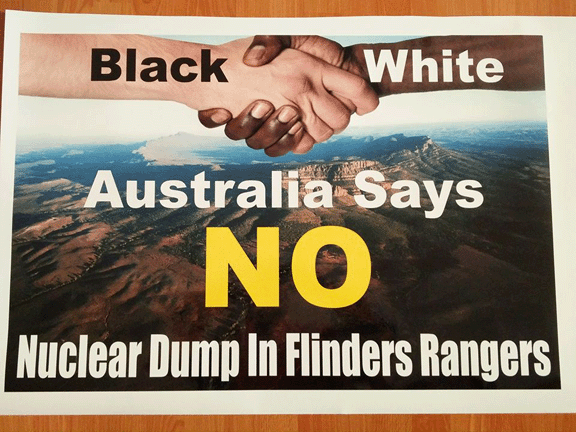
Make peace by defying SA nuclear dump https://www.eurekastreet.com.au/article.aspx?aeid=55371 Michele Madigan 17 May 2018
Sunday 29 April 2018 marked the second anniversary for many such South Australian peacemakers. It was on that date in 2016, at 2.30am, that Adnyamathanha Elder Aunty Enice Marsh heard the news that the federal government had ‘chosen’ the Flinders Ranges to be the ‘top of the list’ site of the proposed national nuclear dump.
Incredulous at hearing this on the 8am news, I rang Aunty Enice. ‘I’m sitting here trying to eat my weetbix and keep my thoughts calm,’ she said. ‘But do you know what I was thinking? Colonisation is again attacking the First Nations people and poisoning their land.’
For her colleague, Regina McKenzie, it was ‘like getting news of a death’: death to a 60,000-year cultural heritage.
Since then, South Australia’s international grain farming area of Kimba has again emerged as an alternative site. At last month’s first joint meeting in Port Augusta, both Kimba and Flinders Ranges peoples opposing the dump reported that after ‘a quiet last few months’, the pressure from the federal government is now back on with a vengeance.
The announcement of $2 million in ‘untied’ government grants to various local applicants in each region has been integral to this. What was surprising to the Kimba opponents, faced with the absence of five of their key colleagues, was the unannounced (at least to them) appearance of the Minister, National Party Senator Matt Canavan, at this announcement.
When challenged about this lack of notice, the senior public servant’s response was that he hadn’t been ‘really sure’ that the Minister was coming. Kimba opponents cite this as just another example of the government campaign strategy: ‘It’s all about stealth.’
The Minister also announced that the Australian Electoral Commission local voting for and against either region becoming Australia’s national nuclear dump would take place on 20 August. Currently there is a Senate Estimates Committee examining the process of site selection and related matters, with its recommendations due on 13 August — leaving hardly time for a dispersion, reading and respectful cognisance of its findings prior to the vote.
Political maneuvering is again evident in the insistence of the Minister to tightly restrict the voting area — as if the small numbers of local people will be the only ones affected. Kimba farmer opponents warn constantly of the danger to their international markets of other crops and produce (such as Port Lincoln’s seafood trade) on the whole of the Eyre Peninsula region.
The oft-repeated government saying: ‘We will not impose the federal nuclear dump on an unwilling community’ continues to fly in the face of the lately renewed state legislation, which actually forbids the transportation of such waste into South Australia.
On 28 April, some of us ‘southerners’ joined locals at the glorious Wilpena Pound (pictured) site to inform national and international tourists of the Australian government’s intention to make the region home to Australia’s highest level nuclear waste — if permitted.
Predictable reactions to the news (‘Incredible!’ ‘Why?‘) included inquiries about the distance from the Pound. Amazement followed the map sighting: that any government would deliberately jeopardise such an internationally recognised site by proposing, just 40km away, a dump site for nuclear waste. Measured by radioactivity, over 90 per cent of the waste would be intermediate long lived nuclear waste from the Lucas Heights nuclear reactor in Sydney — waste that will be hazardous for thousands of years.
Our dinner at the camping ground was accompanied by ring-necked parrots and, later, flocks of apostle birds. In the morning, my prayer companions included a mother kangaroo, who fossicked among the leaves while keeping herself discreetly behind the wire fence. Her joey however was a close encounter type, constantly circling within a metre of my chair.
The Flinders is an idyllic place. Kimba is important grain farming country. No wonder much of the emphasis in the government campaign, and by local proponents for both regions, continues to be on the low level nuclear waste component.
With the campaign stretching past its third year since the announcement of the respective leaseholders simply ‘offering’ their respective properties, both Aboriginal and non-Aboriginal opponents are rock solid in their constant efforts ‘to look after the country’. But it has come at huge personal and communal costs.
Barry Wakelin, the retired Coalition federal member, is one of the farmers fiercely opposing the plan. In the face of groundwater, transport and serious, hugely long-term safety risks, Wakelin insists, ‘This is a national issue, not something that a regional community should be left to deal with.’
A national response (in the form of a petition being circulated by Conservation South Australia) can be made in solidarity with the country and peoples who will be affected by the proposed site. Click here to sign the petition.
Response to ‘Burden of proof: A comprehensive review of the feasibility of 100% renewable-electricity systems’
Science Direct 18 May 18
- https://doi.org/10.1016/j.rser.2018.
Highlights
- •We respond to a recent article that is critical of the feasibility of 100% renewable-electricity systems.
- •Based on a literature review we show that none of the issues raised in the article are critical for feasibility or viability.
- •Each issue can be addressed at low economic cost, while not affecting the main conclusions of the reviewed studies.
- •We highlight methodological problems with the choice and evaluation of the feasibility criteria.
- •We provide further evidence for the feasibility and viability of renewables-based systems.
-
Abstract
A recent article ‘Burden of proof: A comprehensive review of the feasibility of 100% renewable-electricity systems’ claims that many studies of 100% renewable electricity systems do not demonstrate sufficient technical feasibility, according to the criteria of the article’s authors (henceforth ‘the authors’). Here we analyse the authors’ methodology and find it problematic. The feasibility criteria chosen by the authors are important, but are also easily addressed at low economic cost, while not affecting the main conclusions of the reviewed studies and certainly not affecting their technical feasibility. A more thorough review reveals that all of the issues have already been addressed in the engineering and modelling literature. Nuclear power, which the authors have evaluated positively elsewhere, faces other, genuine feasibility problems, such as the finiteness of uranium resources and a reliance on unproven technologies in the medium- to long-term. Energy systems based on renewables, on the other hand, are not only feasible, but already economically viable and decreasing in cost every year
-
1. Introduction
………..https://www.sciencedirect.com/science/article/pii/S1364032118303307
Scientists refute Ben Heard’s paper opposing reneweable energy
Can we get 100 percent of our energy from renewable sources? https://www.eurekalert.org/pub_releases/2018-05/luot-cwg051718.php New article gathers the evidence to address the sceptics LAPPEENRANTA UNIVERSITY OF TECHNOLOGY
Is there enough space for all the wind turbines and solar panels to provide all our energy needs? What happens when the sun doesn’t shine and the wind doesn’t blow? Won’t renewables destabilise the grid and cause blackouts?
 In a review paper last year in the high-ranking journal Renewable and Sustainable Energy Reviews, Master of Science Benjamin Heard (at left) and colleagues presented their case against 100% renewable electricity systems. They doubted the feasibility of many of the recent scenarios for high shares of renewable energy, questioning everything from whether renewables-based systems can survive extreme weather events with low sun and low wind, to the ability to keep the grid stable with so much variable generation.
Now scientists have hit back with their response to the points raised by Heard and colleagues.The researchers from the Karlsruhe Institute of Technology, the South African Council for Scientific and Industrial Research, Lappeenranta University of Technology, Delft University of Technology and Aalborg University have analysed hundreds of studies from across the scientific literature to answer each of the apparent issues. They demonstrate that there are no roadblocks on the way to a 100% renewable future. Continue reading
Busting the pro thorium nuclear spin
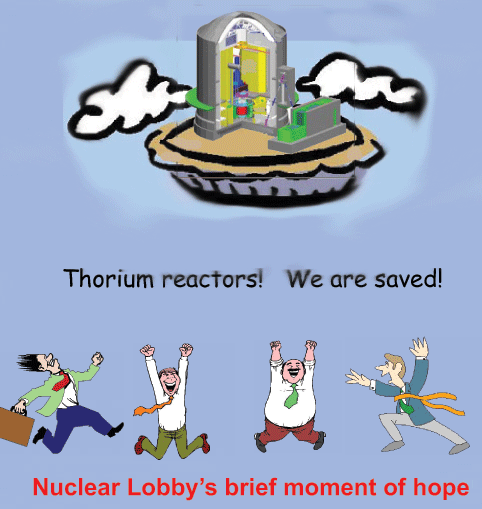 Should Australia consider thorium nuclear power? The Conversation
Not so different
While compelling at first glance, the details reveal a somewhat more murky picture. The molten salt architecture which gives certain thorium reactors high intrinsic safety equally applies to proposed fourth-generation designs using uranium. It is also true that nuclear physics technicalities make thorium much less attractive for weapons production, but it is by no means impossible; the USA and USSR each tested a thorium-based atomic bomb in 1955.
Other perceived advantages similarly diminish under scrutiny. There is plenty of uranium ore in the world and hence the fourfold abundance advantage of thorium is a moot point. Producing less long-lived radioactive waste is certainly beneficial, but the vexed question remains of how to deal with it.
Stating that thorium is more efficiently consumed is the most mischievous of the claimed benefits. Fast-breeder uranium reactors have much the same fuel efficiency as thorium reactors. However, they weren’t economic as the price of uranium turned out to rather low.
Senate climate report is a warning for Australia’s military
 Climate change warning for Australia’s military Former defence chief Admiral Chris Barrie, who led Australian forces until 2002, says a new Senate committee report on the security risks of climate change must be taken seriously. SBS World News, By James Elton-Pym , 18 May 18
Climate change is a clear and present danger to Australia’s security – Senate report
Senate report: climate change is a clear and present danger to Australia’s security, The Conversation, Associate Professor of International Relations, The University of Queensland,
The Senate Committee on Foreign Affairs, Defence and Trade yesterday presented its report on the national security implications of climate change.
The report makes several findings and recommendations, noting at the outset that climate change has a range of important security implications, both domestically and internationally.
Tellingly, none of the expert submissions questioned the rationale for this inquiry, nor the claim that climate change challenges Australian national security.
The report concludes that:
the consensus from the evidence (is) that climate change is exacerbating threats and risks to Australia’s national security.
Significantly, it also notes that climate change threatens both state and human security in the Australian context. Here are some of the key security implications.
Sea-level rises and natural disasters are key challenges
The report emphasises the risks posed by rising sea levels and an increase in the frequency and intensity of environmental stress (droughts and floods, for example) and natural disasters such as cyclones. In turn, it notes that these could trigger population movements, with people displaced by extreme weather events or rising seas.
This, the report argues, would have significant implications for the Australian Defence Force (ADF). Humanitarian assistance and disaster relief missions involving the ADF have increased significantly in Australia and our region in recent years. The report predicts that the ADF will face even more pressure to carry out this type of mission in the future.
In its submission, the Department of Defence pointed out that the ADF was not established to provide these roles. The report recommends the creation of a senior leadership position within Defence to plan and manage disaster relief missions both here and abroad.
Australia, and its backyard, are particularly vulnerable
The report notes that Australia and its region are particularly vulnerable to the impacts of climate change.
Australia’s population is largely clustered in coastal areas, and this is also true of the Asian region generally and the Pacific specifically. Pacific island nations – as low-lying and with limited resources for implementing adaptive measures – are acutely vulnerable to sea-level rises. In the Asian region 40 million people were displaced by natural disasters in 2010-11 alone.
The report argues that Australia’s obligation to its neighbours in the region, acknowledged in recent statements on the Pacific, will create significant pressure on Australia and its defence force to manage the implications of climate change. It recommends sending even more aid to the Pacific region to help build climate resilience.
Defence needs to plan ahead
While the report acknowledges Defence efforts, a key finding is the urgent need for Defence to plan for a climate-affected world………https://theconversation.com/senate-report-climate-change-is-a-clear-and-present-danger-to-australias-security-96797
Janette Thomas – on the biased “community consultation”on Barndioota nuclear dump plan, seismic and flooding dangers
Janette Thomas Senate Economics References Committee Inquiry into the selection process for a national radioactive waste management facility in South Australia (Submission No 36)
My name is Janette Thomas, resident of Quorn since 2003. My submission is written to explain the adverse effects of The Federal Government Nuclear Waste Dump siting selection process on my local community, my family and myself. I am deeply concerned that a nuclear waste facility is being considered for a site near Hawker on the Hookina flood plain.
Terms of Reference:
a) The financial compensation offered to applicants for the acquisition of land under the Nominations of Land Guidelines:
The Barndioota shortlisting site was publicly announced in November 2015. It was also mentioned in the November 2015 Community Newsletter of the Flinders Ranges Council by our Mayor in his “Mayors Message” stating “The first Council knew of this was calls seeking information from media outlets”.
Attachment 1 – FRC Community Newsletter, November 2015
In December 2015, The Department of Innovation, Industry and Science (DIIS) held information “drop-in” sessions in both Hawker and Quorn. It is not known how many residents availed themselves of this opportunity to learn more, however it is stated in the Mayor’s Message that “only a few residents visited them to find out more about the proposal”. I did take the opportunity to go and see what was being displayed, and spoke to the DIIS representatives. I voiced my concerns strongly, however it did not appear that there were any notes taken – just an attempt by the representatives to rebut any of the issues that I raised.
Attachment 2 – FRC Community Newsletter, December 2015
A presentation by the DIIS was held at the Quorn Town Hall on 15.2.16. The information given to the meeting was all positive and “talked up” the benefits to the community. For example:
- The $10 million dollars the host community would receive if the nuclear waste facility was to be sited in the area.
- 2. The 15 FTE jobs that would be available to operate the facility.
- 3. The annual $2M Community Benefit Package that would be available for local approved applications during the site selection process.
- 4. The tourist opportunities – it was suggested that tourists would come to the area to visit the facility.
- 5. Once the site is chosen the landowner is to receive 3 times the current value for the 100 hectares required.
- 6. The “temporary” storage of the Intermediate Level Waste (ILW) was barely mentioned, if at all, until question time when the panel was repeatedly asked about how it would be stored and for how long.
b) how the need for ‘broad community support’ has played and will continue to play a part in the process
A phone “survey” was undertaken by Orima over the period late February to early March 2016 to gauge the local community support to proceed to Stage 2, ie does the community want the various surveys to be undertaken to evaluate the area as suitable or not, for the storage of nuclear waste.
I answered a telephone call and was asked for the male occupant of the house between certain ages. My partner was over the age requested, and I was not eligible to do the survey, and so our household was not invited to participate. I heard of similar experiences later. I would like to have had the opportunity to make a statement at that time. How is it that a small number of phone calls about such a serious issue of “hosting” a national nuclear waste dump, can then be manipulated to gauge community support to proceed forward to the next stage. It has been suggested that the people who had no opinion were counted as being “in favour”.
Many people had not heard of the short listing of Barndioota, and had not had a chance to think about what they were saying yes, no, or don’t know to. There was publicity given through newsletters and DIIS mailouts, advising that there would be officers visiting from Australian Nuclear Science and Technology Organisation (ANSTO) on a regular basis, who could provide more information and answer any queries, however this all occurred after the decision was announced to proceed to stage 2. I did attend one of their visits voicing my concerns. Their answers were very biased – that there was nothing to be concerned about – refer below: ( f – any other related matters – A).
f) any other related matters
A. The people attending the town meeting 15.2.16 were given the opportunity to ask questions. Many were concerned about the Barndioota site location for many reasons. Some being:
- The Flinders Ranges is renown as being a very seismic active locality. Refer to attachment 3 – Independent Geological Report.
- 2. Barndioota is situated on a flood plain, notorious for extreme periodic flood events and massive historic mud flows. Refer to attachment 3 –
- Independent Geological Report. 3. Question time revealed that there would also be Intermediate level nuclear waste (ILW) stored “temporarily”. When queried how long is temporary – the reply was vague – different figures were quoted. 20, 30 – possibly up to 100 years. If this is the case, I see no reason to move the ILW from its current storage site until a suitable, safe, permanent site is established. Refer to attachment 4 –Quorn Mercury, (Community Meeting pp1-2)
B. The Barndioota site shortlisted, was part of a private leasehold property, and the landholder had not considered or consulted the neighbours or local community before making his application. He had full knowledge of the search for the nuclear waste site having served on three Senate Select Committees related to this industry: Dangers of Radioactive Waste, 23/3/95 to 24/04/96 (Chair from 30/03/95); Uranium Mining and Milling, 08/05/96 to 15/05/97 (Chair from 23/05/96); and Lucas Heights Reactor, 17/08/00 to 24/05/01, but the local community didn’t. This has been a major flaw in the process of a possible nuclear waste dump facility for many reasons.
- Neighbours and community should have been given the opportunity to discuss the ramifications of storing nuclear waste in their area as a matter of respect, similar to the building application process of local government.
- 2. To date there has been millions of dollars spent in “world best practice” obtaining a suitable site for the nuclear waste facility. For example:
a. The Orima Survey undertaken to proceed to the next stage.
b. Staff travel and accommodation costs for the many visits over the last 2 ½ years during the process period.
- Travel and accommodation costs for the numerous groups who have been taken to the Lucas Heights facility.
- d. The travel and accommodation costs of the French group who were asked to give account of the facility in their home country.
e. The $2million Community Benefits Programme made available for application as an incentive during the process to the next stage. Currently there is a second $2million application process underway for the Barndioota site. These processes are currently being replicated in Kimba and will be available for all other sites that proceed to the same stage.
f. The appointment of a full-time Liaison Officer (who appears to be in favour of the facility and not impartial).
g. There are various committees, with members receiving payment to cover their costs of time and travel.
h. There have recently been major costly site surveys undertaken
This will be the process for each of the shortlisted sites therefore multiplying the costly exercises manyfold. Continue reading
South Australia’s battles against nuclear waste dumping won, – and now fought again
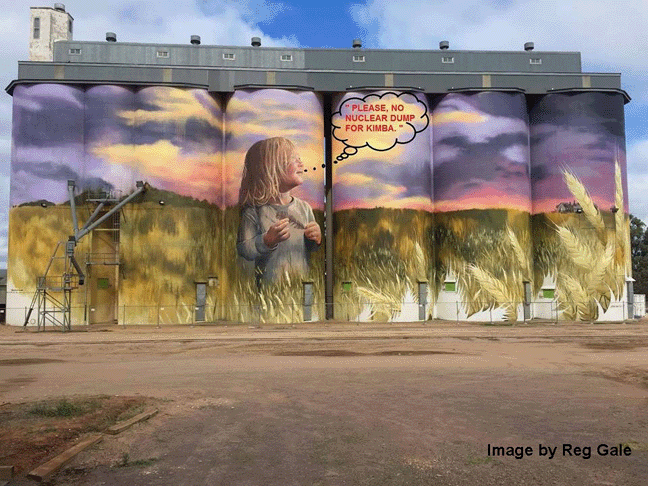
EXTRACT from: A journey to the heart of the anti-nuclear resistance in Australia: Radioactive Exposure Tour 2018, NUCLEAR MONITOR Author: Ray Acheson ‒ NM859.4719, May 2018 “……The federal government of Australia wants to build a facility to store and dispose of radioactive waste in South Australia, either at Wallerberdina Station near Hawker or on farming land in Kimba.
Wallerberdina Station is located in the Flinders Ranges, the largest mountain range in South Australia, 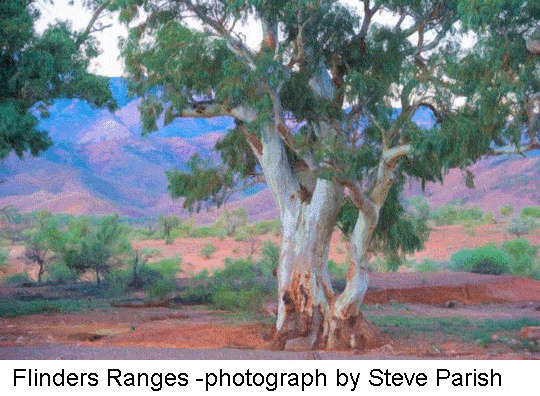 540 million years old. Approaching from the north on our drive down from Lake Eyre can only be described as breathtaking. The red dirt, the brown and green bush, and the ever-changing purples, blues, and reds of the mountains themselves are some of the most complex and stunning scenes one can likely see in the world.
Most people might find it shocking that the federal government would want to put a nuclear waste dump smack in the middle of this landscape. But after visiting other sites on the Rad Tour, it was only yet another disappointment ‒ and another point of resistance.
What is known is that the Wallerberdina site is of great cultural, historical, and spiritual significance to 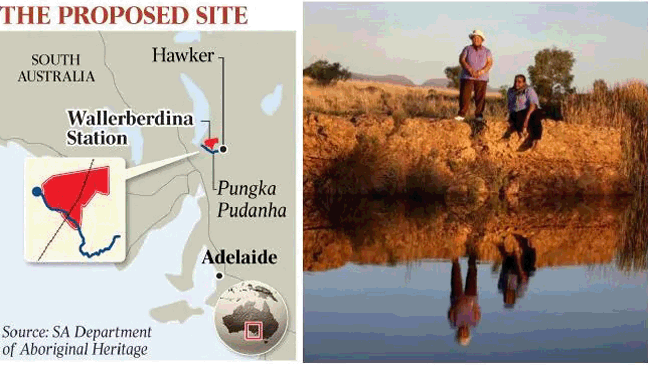 the Adnyamathanha people. It borders the Yappala Indigenous Protected Area, which is a crucial location for biodiversity in the Flinders Ranges. Its unique ecosystem provides a refuge for many native species of flora and fauna, contains many archaeological sites as well as the first registered Aboriginal Songline of its type in Australia, and is home to Pungka Pudanha, a natural spring and sacred woman’s site.
In case that isn’t enough, the area is a known floodplain. Our travels around the proposed site contained ample evidence of previous floods that sent massive trees rushing down the plain, smashing into each other and into various bridges and other built objects. The last big flood occurred in 2006.
The Adnyamathanha Traditional Owners were not consulted before their land was nominated for consideration by the government for the waste dump. “Through this area are registered cultural heritage sites and places of huge importance to our family, our history and our future,” wrote Adnyamathanha Traditional Owners in a 2015 statement. “We don’t want a nuclear waste dump here on our country and worry that if the waste comes here it will harm our environment and muda (our lore, our creation, our everything).”
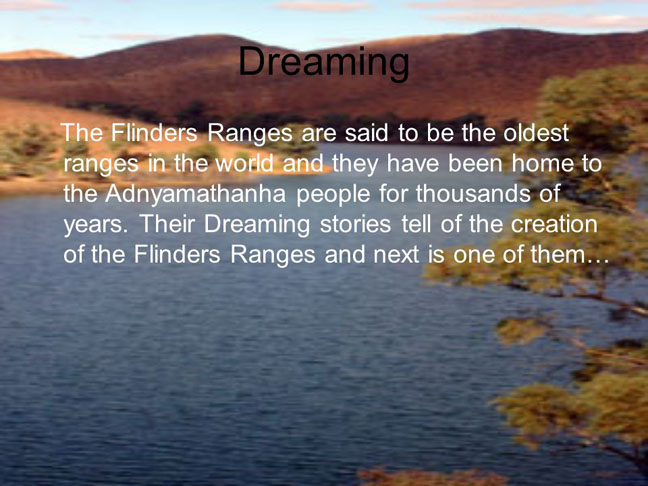
We met Adnyamathanha Traditional Owners Vivianne and Regina McKenzie, and Tony Clark, at the proposed site. They invited us into the Yappala Indigenous Protected Area to view the floodplains and swim in the beautiful Pungka Pudanha. We’d just been camping at Wilpena Pound in the Flinders Ranges National Park only a few kilometres away. It is impossible to understand the government’s rationale for wanting to build a toxic waste dump on this land so cherished by its Traditional Owners, local communities, and tourists alike.

The McKenzies have been working tirelessly to prevent the proposed dump from being established, as have other local activists. Fortunately, they have some serious recent successes to inspire them. In 2015, the federal government announced a plan to import 138,000 tonnes of high-level nuclear waste from around the world to South Australia as a commercial enterprise. But Traditional Owners began protesting immediately, arguing that the so-called consultations were not accessible and that misinformation was rife. In 2016, a Citizen’s Jury, established by then Premier Jay Weatherill and made up of 350 people, deliberated over evidence and information. In November that year, two-thirds of the Jury rejected “under any circumstances” the plan to import or store high-level waste.24 They cited lack of Aboriginal consent, unsubstantiated economic assumptions and projections, and lack of confidence in the governmental proposal’s validity.
Other battles against proposed nuclear waste dumps have been fought and won in South Australia. From 1998 to 2004, the Kupa Piti Kungka Tjuta, a council of senior Aboriginal women from northern South Australia, successfully campaigned against a proposed national nuclear waste dump near Woomera. In an open letter in 2004, the Kungkas wrote: “People said that you can’t win against the Government. Just a few women. We just kept talking and telling them to get their ears out of their pockets and listen. We never said we were going to give up. Government has big money to buy their way out but we never gave up.”
Connected communities
The attempts by the Australian government and the nuclear industry to impose a waste dump in the Flinders Ranges, just like their attempts to impose waste dumps and uranium mines elsewhere in the country, or their refusal to compensate victims and survivors of nuclear testing, are all mired with racism. They are rooted in a fundamental dismissal and devaluation of the lives and experiences of indigenous Australians, and of proximity to cities but more importantly, to power.The industry and government’s motivations for imposing nuclear violence on these people and this land are militarism and capitalism.
Profit over people. Weapons over wellbeing. Their capacity for compassion and duty of care has been constrained by chronic short-termism ‒ a total failure to protect future generations. The poison they pull out of the earth, process, sell, allow others to make bombs with, and bury back in the earth, wounds us all now and into the future.
But nuclear weapons are now prohibited under international law. New actors are challenging the possession of nuclear weapons in new ways, and nucleararmed states are facing a challenge like never before.
The nuclear energy industry ‒ and thus the demand for uranium ‒ is declining. Power plants are being shuttered; corporations are facing financial troubles. Dirty and dangerous, the nuclear industry is dying.
This is in no small part due to the relentless resistance against it. This resistance was fierce throughout all of the country we visited, from Woomera up to Lake Eyre, from Roxby Downs to the Flinders Ranges. We listened to stories of those living on this land, we heard their histories, witnessed their actions, and supported their plans…..
National Geographic now a stooge for the International Church of Nuclear
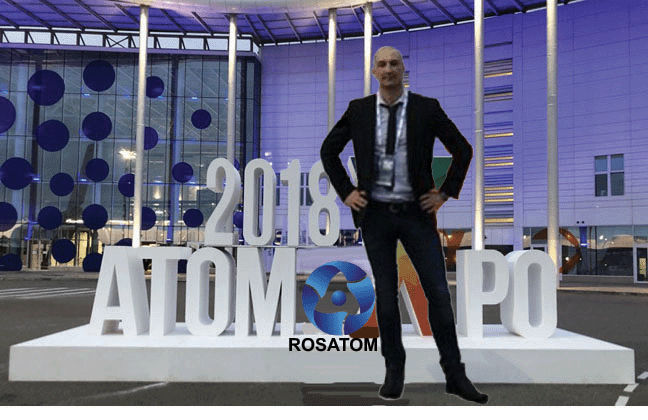
 Wild Edens” i s a new documentary series from National Geographic, initiated by Russia’s Rosatom State Atomic Energy Corporation
The first film in the series premiered at the X International Forum ATOMEXPO 2018, held on May 14-16 in Sochi (Russia). The documentary will be broadcast on the National Geographic channel in summer 2018.
The premiere was introduced by Ben Heard, from Australia. Pretty much unknown in Australia, Heard is very well known and revered by the global lobbyists for “new nuclear” – Small Modular Nuclear Reactors, – by Rosatom, by the South African nuclear lobby, and American companies like Terrestrial Energy.
Wild Edens promises to focus on climate change. Heard is happy to “ see a major corporation like Rosatom step boldly forward in this way and claim this issue on behalf of nuclear technologies“.
The series is filmed in the world’s most stunning untouched places and their inhabitants – wildlife and fauna alike, endangered by the effects of climate change” – blah blah
Like a few other recent documentaries ( “Pandora’s Promise”, “Twisting the Dragon’s Tail” and a Brian Cox documentary) – this will be a very soft sell for the nuclear industry.
It will surely be very beautiful, informative about wild places, and worth watching. Just be aware of the underlying religious propaganda about:
- nuclear power being the essential cure for climate change
- nuclear power being clean and green
- nuclear waste problem being solved now, or will be solved.
Labor prepared to strengthen environmental protections, as grass roots members demand
 Labor considers tougher environmental laws as branches call for new agency
Tony Burke says Labor isn’t afraid to strengthen laws as grassroots campaign calls for more proactive protections, Guardian, Katharine Murphy Political editor@murpharoo17 May 2018
Community Buying of solar power – a very good deal for Australia’s Non Profit organisations
 NFPs Encouraged to Make the Switch to Solar A new campaign has launched aiming to help the not-for-profit and community sector make the switch to renewable energy. Pro Bono, Luke Michael, Journalist, 15 May 18
Community Buying Group and Moreland Energy Foundation officially launched The Big Solar Switch campaign on Monday.
The campaign aims to facilitate Australia’s largest switch to solar power by actively reducing barriers of solar installation for the not-for-profit and community sector.
Developed exclusively for charities and community organisations, the initiative uses the strength of aggregated purchasing to reduce the cost and barriers of installing solar PV systems.
Packages contain a “best value” guarantee which includes negotiated rates for the sector, extended warranties, expert advice and links to funding.
Alison Rowe, the CEO of Moreland Energy Foundation, said unlike individual households and businesses, the charitable sector has not had the benefit of a dedicated program to assist them in the uptake of solar.
“Moreland Energy Foundation (MEFL) has a proud history of supporting communities to benefit from solar installations. We are excited by the opportunity to support the NFP and charitable sector to navigate the process of installing solar PV,” Rowe said.
“MEFL has a wealth of experience having facilitated the installation of over 10 MW (megawatts) of solar. Being an NFP ourselves we understand the resource challenges facing the sector and strive to make the process of investigating solar simple.”
Jill Riseley, the chair of Community Buying Group, told Pro Bono News electricity prices were causing a big headache for community organisations.
………Community Buying Group is hoping for around 10,000 organisations to make the switch to solar power during the campaign.The campaign’s roll-out will firstly focus on the housing sector, with the initial deadline for housing providers on 15 June.
This rollout for large NFPs will commence in late June.
Riseley encouraged the sector to buy-in to the campaign.
“The story we’re really trying to get out to the sector is that it’s a permanent reduction in one of their core operational expenses and it’s a real game changer for the bottom line of many NFPs,” she said. https://probonoaustralia.com.au/news/2018/05/nfps-encouraged-make-switch-solar/
Racist work-for-the-dole scheme survives another budget
ACTU.org.au 11 May 2018
‘The Abbott/Turnbull Government’s racially discriminatory remote work-for-the-dole scheme,
the Community Development Program, has survived another federal budget and
will continue to generate profit from the exploitation of Indigenous labour. …
‘Quotes attributable to
ACTU National Campaign Coordinator
Kara Keys:
‘“By standing by this program the Turnbull Government is declaring that they prefer
to create a system of indentured labour which exploits and
punishes Aboriginal and Torres Strait Islander people
over job creation and community development.’
‘“The fact that many workers in this program are working for organisations and
for-profit businesses in roles that would be paid anywhere else in the country
is an indication that Minister Scullion and the Turnbull government are once again
turning their back on Indigenous workers in favour of businesses and their profits
who are able to access a pool of free labour.’
‘“The Turnbull Government has monetised the exploitation of marginalised Indigenous communities
because it thinks there will be no political consequences. We are determined that there
will be severe consequences for this unconscionable conduct.’
‘“Minister Scullion needs to scrap this discriminatory program and
focus on the economic autonomy and the dignity of paid work in remote communities.
Anything other than the abolition of this program is unacceptable.”’
‘“We welcome the assurances of Minister Scullion’s office that under these changes there will be
‘significant protections to ensure penalties are only applied when they are warranted’ and
the implicit concession that many of the penalties handed out to date
have not met this lowest of all possible standards.’
Media contact: Peter Green
Read more:
www.actu.org.au/actu-media/media-releases/2018/racist-work-for-the-dole-scheme-survives-another-budget
Federal Nuclear Waste Dump the precursor to importing nuclear waste – South Australia’s Liberal Party plan
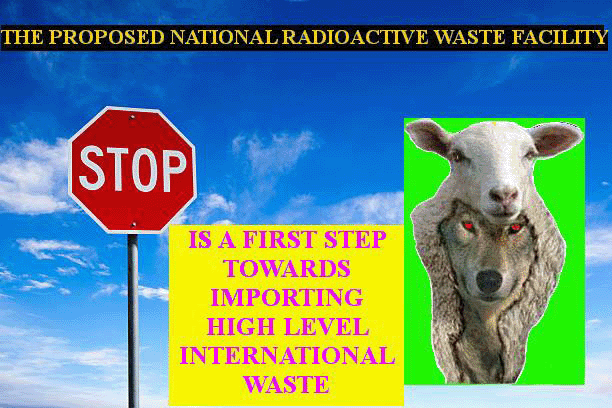
Lib Senator Ramsay triggered KImba’s offer whilst Lib ex-Senator & absentee landlord Chapman dumped on the Flinders.
Join the Dots peeps! https://www.facebook.com/groups/1314655315214929/
1 This month.
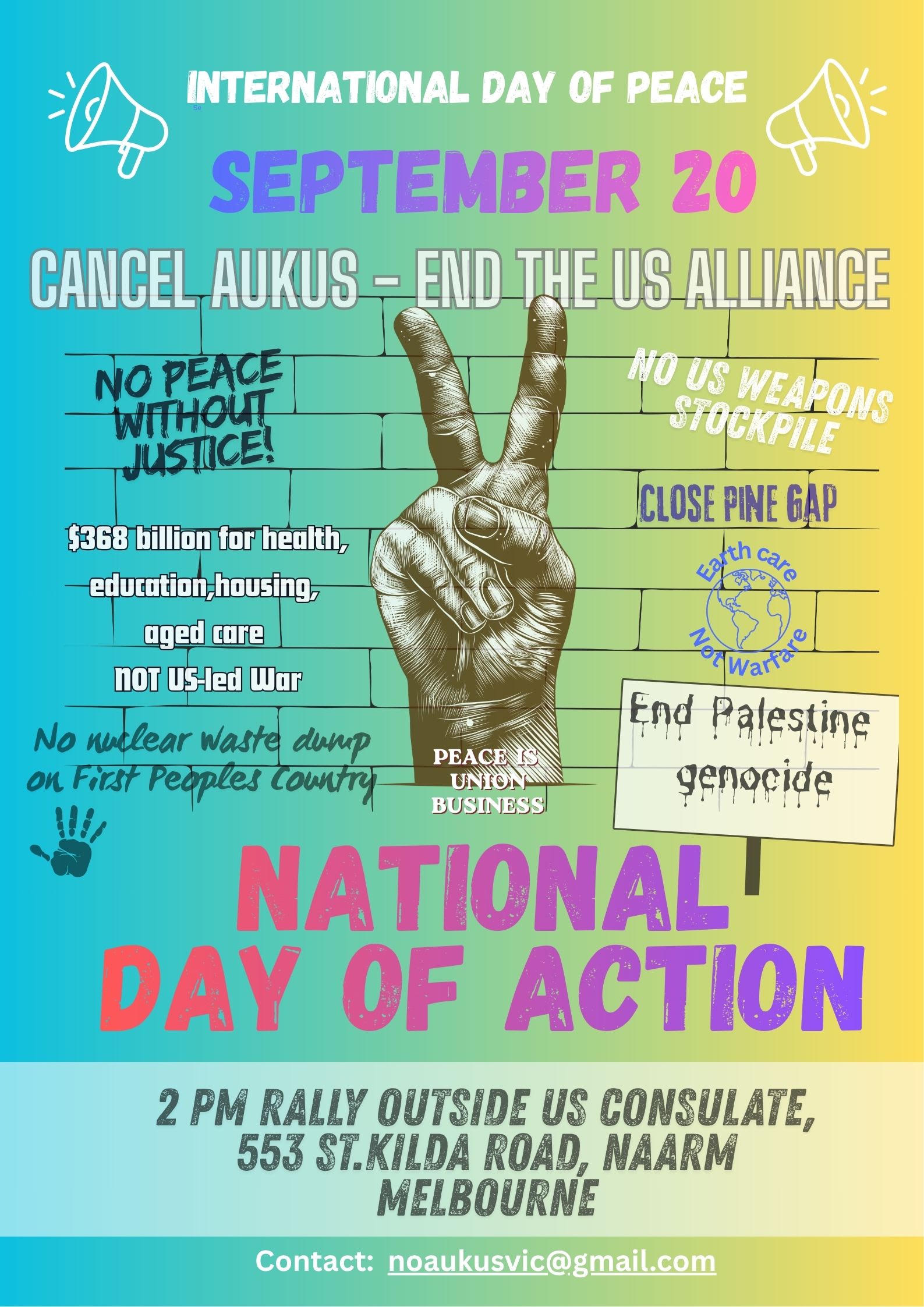
20 September –National Day of Action in Melbourne on the International Day of Peace

Help Aunty Sue Protect Her Land and Sacred Sites From Destructive Rocket Testing.
.

Australians deserve the truth
about
AUKUS – https://aukuspublicinquiry.com/
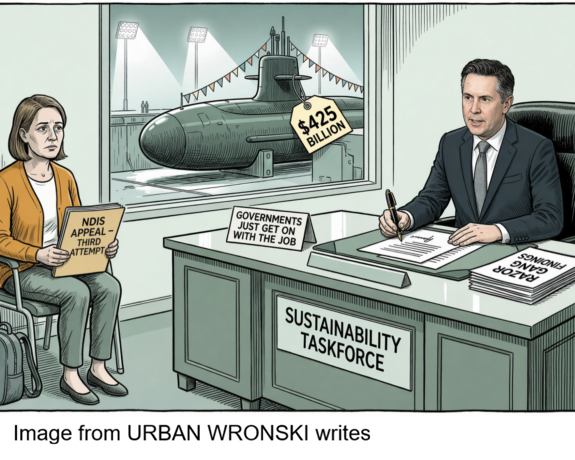

PETITION – To: Prime Minister Anthony Albanese and the Australian Labor Government

of the week – Australians for War Powers Reform (AWPR)
To see nuclear-related stories in greater depth and intensity
 Antinuclear