The North Shore Environmental Stewards – Liberals aim to unseat Tony Abbott, over his climate denialism
 Liberal activists target Tony Abbott’s seat over climate change policy
Sydneysiders urged to join party in former PM’s seat to ‘shift the politics’ and speak up for the environment,Guardian, Anne Davies, 3 May 18,
Tony Abbott’s political future could be under threat from a group of activists who have been organising environmentally conscious voters to join Liberal partybranches on Sydney’s north shore – a move that could unseat the former prime minister.
Billing themselves as “the counterweight” to the pro-coal power Monash Forum, the North Shore Environmental Stewards have held at least two recruitment functions at which attendees were urged to tap into their networks of environmentally conscious people to join the Liberal party branches in Abbott’s seat of Warringah and on the lower north shore.
The NSES has a Facebook page that says the group “supports clean energy and a healthy environment, and believes in traditional Liberal party values of environmental stewardship”………https://www.theguardian.com/australia-news/2018/may/03/environmentally-conscious-liberals-urged
What is electromagnetic radiation? and how safe is it?
 Why does this article not mention the difference in vulnerability between children and adults?
What is mobile phone radiation and how safe is it? ABC Science,By science reporter Belinda Smith
“…. What is electromagnetic radiation?
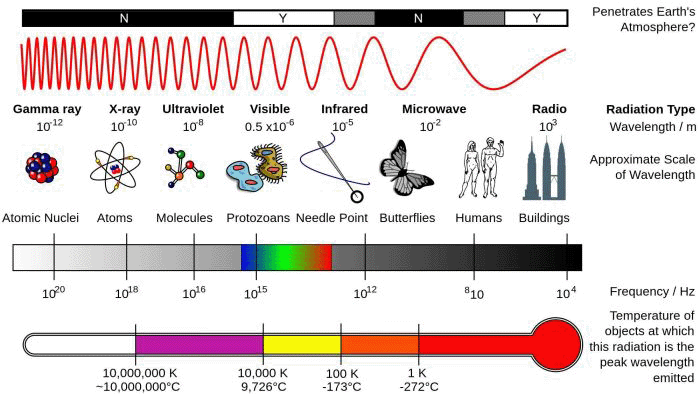
We are surrounded by all sorts of different types of electromagnetic radiation every day: your eyes pick up visible light, your bag is scanned by X-rays at airport security, microwaves heat your lunch and too much ultraviolet light gives you sunburn.
At its essence, electromagnetic radiation is energy comprising an electric field and magnetic field, which travel together, but perpendicularly, in waves.
Sometimes the length of these waves (or wavelength) is very short — a few nanometres for X-rays — while others are much longer — a few centimetres up to kilometres.
It’s these long wavelengths, called radio waves, that are the electromagnetic radiation of choice for mobile phones and base stations.
Unlike shorter wavelengths, such as visible light, radio waves can pass through walls. The longer the wavelength, the better it can penetrate solid stuff.
Another term you might see is frequency, which is the number of times a wave makes a full oscillation each second.
Frequency and wavelength are closely related. Wavelength is the speed of light divided by the frequency, so long wavelengths also have low frequency.
What are ionising and non-ionising radiation?

The radio frequency end of the electromagnetic spectrum is home to what’s known as “non-ionising radiation”, said Rodney Croft, from the University of Wollongong and director of the Australian Centre of Electromagnetic Bioeffects Research.
It’s the high-frequency, short wavelength radiation, such as X-rays, that can tinker with your DNA and are linked to cancer.
These waves are small enough and carry enough energy to knock electrons off atoms, ionising them.
Radio frequency used in mobile communications simply doesn’t have the energy to do that. But that’s not to say it doesn’t exert any effects on the matter it travels through.
“It’s an oscillating wave, which swings between positive and negative,” Professor Croft said
“If you have a bunch of molecules rotating, that causes friction, and energy is given off as heat. It’s how a microwave oven works.”
Does anyone regulate radio frequency limits?
In Australia, mobile phone and base station exposure limits are set by the Australian Radiation Protection and Nuclear Safety Agency (ARPANSA) and regulated by the Australian Communications and Media Authority.
The ARPANSA standard looks at how much energy a user absorbs from a mobile phone over time.
The maximum limit is currently 2 watts per kilogram of tissue. Phone manufacturers usually specify their maximum absorption rate in their manual.
You can find how much radio frequency is emitted by base stations at the Radio Frequency National Site Archive.
According to ARPANSA, it’s “typically hundreds of times below the [ARPANSA] limits”.
What are the effects of mobile radio frequency on tissues?
So are we microwaving our head whenever we answer the phone? A tiny bit, but not enough to be worried about, Professor Croft said.
He and his team found mobile phone radiation exposure increases the temperature of the outer grey, wrinkled layer of the brain called the cortex, but it’s only “maybe about 0.1 degree, which is very small compared to the temperature variation the body normally has to contend with”, he said.
“We do find that we get a slight change to thermoregulation, so the body, even with that small change, is sending a bit more blood out to the periphery to cool it, so your body doesn’t end up warming up.”
……...What about cancer in rodents?
Mobile phones are classed as “possibly carcinogenic” by the International Agency for Research on Cancer, putting them in the same category as aloe vera, bracken fern and Asian pickled vegetables.
And while radio frequency is non-ionising radiation — remember, it can’t knock electrons off atoms, fiddle with genetic material and trigger tumour growth like ionising radiation can — studies still investigate possible links.
Research published in February this year by the US National Toxicology Program found tumours grew in the nerves around the heart of male rats if they were bathed in extremely high levels of mobile radiation.
But, Professor Croft said, “there were so many difficulties with that study.
………Risks and benefits
Despite research showing no link between safe levels of radio frequency and cancer, telecommunications companies and other organisations do offer suggestions if you want to reduce exposure.
The obvious action, Dr Halgamuge said, is to limit mobile phone use: “You have no control over base stations, because that radiation is around you all the time, but you do have control over your mobile phone.”
The ARPANSA also recommends using hands-free or texting instead of calling, “but none of those things are actually based on any health effects”, Professor Croft said.
………So: does radio frequency have any effect on human tissue, apart from heating it a fraction of a degree?
That question is still open, Professor Wood said.
“Even though some of the evidence [that radio frequency causes damage] on the face of it looks quite compelling, there’s still a question of consistency…….http://www.abc.net.au/news/science/2018-04-30/mobile-phone-radiation-health-explainer-biophysics/9702630
Nuclear waste dump site decision an all-Australia matter , says Independent and Peaceful Australia Network South Australia
 Stephen Darley – Co-ordinator, Independent and Peaceful Australia Network IPAN (SA) SUBMISSION ON PROPOSED NUCLEAR WASTE MANAGEMENT FACILITIES IN South Australia We wish to respond to your Terms of Reference in relation to the appropriateness and thoroughness of the site selection process for a national radioactive waste management facility at Kimba and Hawke in South Australia, noting that the Government has stated that it will not impose such a facility on an unwilling community.
Our first response is to query whether your committee has given cognisance of the results of the recent Royal Commission into the Nuclear Fuel Cycle held in Adelaide in 2015, where the Citizens Jury (representing citizens selected at random and given comprehensive, expert information), overwhelming voted that they wanted NO part of the nuclear cycle developed here. This included nuclear waste management facilities.
The SA government agreed to abide by this decision. Consequently we would like to know under what legislation the Commonwealth can now override this decision and welcome your response to this query.
We make the following comments in response to your terms of reference :
a) The financial compensation offered to applicants for the acquisition of land under the Nominations of Land Guidelines:
This is a vexed issue as we would prefer that this proposal does not proceed, but should it do so, we believe that an independent panel should recommend the appropriate compensation where required and no land should be compulsorily acquired without the full consent of the owner and the surrounding community agreeing to any facility placement in their vicinity.
b) How the need for “broad community support” has played and will continue to play a part in the process, including:
i)The definition of ‘broad community support’ and
It is imperative that the broadest possible support be obtained before proceeding further as this is a national project that could affect other States where waste material is transported from. Transport, whether by sea, rail or road, will be a major hurdle for the proposed project as many communities have actively campaigned against waste material being trucked or shipped through their community (ie the sustained Port Adelaide and South Australians opposition to earlier proposed nuclear waste facilities). Not only is safe transport a major concern, but also the water table being contaminated if a spill occurs or the facility is not secured safely underground. We have no details of the type of facility proposed but all proposed waste management facilities, even low and intermediate level nuclear waste are recommended to be stored in very stable rock at considerable distance underground. How can people make a decision when they have no details of the actual storage being proposed ? To ask people to consent to transport and storage of toxic waste (which could conceivably increase to high level nuclear waste at some future date) is disingenuous.
Citizens must have all the proposed site facts put before them so that they can make a well informed decision on how this could/would impact on their State and/or community.
We recommend that both local, state and nationwide support be sought with all the above pertinent facts on the proposed structure, transport and guarantee, including exactly what level nuclear waste would be housed, with a firm guarantee that this would not be increased over time. A response level of 90% YES vote would be appropriate to ensure this proposal does have wide, genuine support – perhaps a postal vote would be the way forward. This process should also be carried out by an independent body.
- How broad community support has been or will be determined for each process advancement stage. Our response is incorporated in the above recommendation.
c) How any need for Indigenous support has played and will continue to play a part in the process including how indigenous support has been or will be determined for each process advancement stage;
We believe it is paramount that the Australian government fully outline and commit to whatever level of nuclear waste material would ever be stored at these sites. There is talk of intermediate level waste (and perhaps even high level). These levels require very stringent and specific storage sites which we doubt are available at the areas selected ie stored in stable geological rock for thousands of years with no possibility of leaching into any water table – mindful that the Artesian Basin is close by which stores most of Australia’s underground water. Your proposal needs to cover all the levels of waste and how they will be stored in full compliance with international standards.
It is paramount that indigenous peoples, especially around the proposed sites, should be in agreement first, before proceeding to canvass wider state and national support. Our local knowledge and experience, doubts that this will occur as we are mindful of the sustained and successful campaigns opposing any nuclear waste facilities in South Australia in the past, especially the Kunga Juta Aboriginal Women’s successful campaign to stop nuclear waste facilities on their land in the 1990s. They remember the consequences of the Maralinga Tests which adversely affected many of their communities, so there is a strong resistance to any nuclear waste facilities. Their combined support for such a facility would need to be evident through signatures and spokespeople standing up publicly to support any proposal, before canvassing this idea further.
- Whether and how the Government’s community benefit program payments affect broad community and indigenous community sentiment;
We are not cognisant of the community benefits program but suggest that they should be disentangled from this issue, as any monetary or community program inducement would be seen as a bribe to ensure support for a nuclear waste facility. Indigenous people should be provided with all the community services they require, without tying them to this proposal.
e) Whether wider Eyre Peninsular or state-wide community view should be taken into consideration and, if so, how this is occurring or should be occurring,
As mentioned above it is imperative that such an important and long lasting project gets overall support from first the local indigenous people, then the local communities, South Australians and lastly Australians overall. All the salient facts need to be published and people invited to vote. This information should the fact that waste is currently being stored successfully on-site where it is subject to regular scrutiny. People would need to have all transport routes identified and a guarantee that this project will not escalate into high level waste from overseas being shipped and stored here.
The project should only proceed if it has an overall majority vote of 90% in favour as what is proposed, once begun can not easily be undone.
f) Any other related matters. As seen above there is a lot more information and project management work to be drawn up before this proposal should be taken any further. At the moment it seems in the “wish list” category but serious information and planning needs to occur before this proposal cam be taken further. The first matter to be solved being the right of the Australian government to override the SA legislation which opposes any nuclear waste facility here. We would appreciate your response on this matter.
Australia, France, in support of Iran nuclear deal
Emmanuel Macron, Malcolm Turnbull fear looming demise of Iran nuclear deal Financial Review 1 May 18 by Andrew Tillett
Last-ditch efforts to prevent the Iran nuclear agreement from completely collapsing will feature in talks between Prime Minister Malcolm Turnbull and French President Emmanuel Macron on Wednesday, amid the growing likelihood Donald Trump will ditch the deal.
Australia has expressed its support for retaining the agreement, which requires Iran to curtail the development of nuclear weapons in return for economic and diplomatic sanctions being lifted, in a rare split with the White House.
During Mr Turnbull’s recent European visit, Germany Chancellor Angela Merkel and NATO Secretary-General Jens Stoltenberg both pressed upon him their concerns that Mr Trump will not certify the agreement by the May 12 deadline.
Both Ms Merkel and Mr Macron pushed Mr Trump not to abandon the agreement during their separate visits to Washington DC last week, with the French leader conceding he expected Mr Trump would cancel the deal because of US domestic politics.
A senior government source said Mr Turnbull would offer Mr Macron support for keeping the agreement alive when they meet in Sydney on Wednesday.
Mr Macron’s visit will be dominated by security and defence, including greater cooperation between Australia and France on development in the South Pacific to serve as a counterweight to China’s rise.
……Foreign Minister Julie Bishop said Australia’s position was that the agreement – formally known as the Joint Comprehensive Plan of Action (JCPOA) – should remain in place until such time as an alternative could be negotiated.
“I have made our views clear to the Trump administration and again during my recent discussion with US Secretary of State Mike Pompeo,” Ms Bishop told The Australian Financial Review.
“Our ongoing political support for the JCPOA is based on advice from the International Atomic Energy Agency that the deal is providing verifiable assurances on Iran’s nuclear program.
…..Lowy Institute non-resident fellow Anthony Bubalo said Australia was a peripheral player in the debate but Canberra would be “very conscious of any implications” a US withdrawal would have for negotiations with North Korea. Far from sending the “right message” to Kim Jong-un, it signalled to North Korea not to trust a deal struck with an US administration.
“It undermines efforts to strike a deal with North Korea,” he said. http://www.afr.com/news/emmanuel-macron-malcolm-turnbull-fear-looming-demise-of-iran-nuclear-deal-20180501-h0zh4t
Unanswered questions: what does ANSTO do with the high level nuclear waste canisters at Lucas Heights?
 Michael Skeet Kilowsky Fight To Stop Nuclear Waste Dump In Flinders Ranges SA
Gary See They’ve made an arbitrary date where waste has to leave Lucas Heights so they can argue for the first dump. The they’ll have intermediate level waste there that needs to move so that will be the argument for the next dump which will likely temporarily store high level waste so that makes the argument for the high level dump.
Once they have that they can go for new nuclear reactors and look at importing waste for money.
It’s just a low level waste dump though, they say
Now we are told the next shipment from England will be returned to Australia in 2020 -21 and shipped directly to the ‘new’ facility.
I agree, nuclear waste dumps are the trojan horse of the nuclear industry, pushing vunerable communities into believing it is for ‘the good of all’ with bribes and bullshit. A waste host town will just be that. A town that hosts deadly poison for hundreds and (probably) thousands of years. There’ll be no end to it.
Gary See There will be a proposal for an intermediate level facility and then a high level one after that.
At least that is the plan as far as I understand it.
https://www.facebook.com/groups/344452605899556/Australia can be the first 100 per cent renewables-powered continent
 ‘Captain Sunshine’ says Australia is not living up to its solar potential, https://www.smh.com.au/business/the-economy/captain-sunshine-says-australia-is-not-living-up-to-its-solar-potential-20180426-p4zbr0.html By Cole Latimer Australia can be the first 100 per cent renewables-powered continent, but it needs the political will to do so, a global solar expert says.
“Australia is not living up to its potential for power generation. It should be aiming for 100 per cent renewable energy, but Australia is up against the older, entrenched fossil fuel industry,” renewable energy entrepreneur and the chief executive of energy investor Energiya Global Capital, Yosef Abramowitz, said.
Dubbed “Captain Sunshine”, Mr Abramowitz is considered a global authority on the application and commercialisation of solar energy technology and has raised millions of dollars to build solar energy projects in Israel and East Africa.
Currently, solar energy accounts for just over 5 per cent of Australia’s total power generation despite it having the world’s highest average solar radiation – the potential for solar energy – of about 58 million petajoules of energy, or about 10,000 times the nation’s annual energy consumption. The size of a solar farm needed to power all of Australia would cover about 6270 square kilometres or approximately 0.1 per cent of the country.
“It’s a myth that the technology is not quite there yet. The time is now to scale towards 100 per cent given Australia’s amazing solar, wind and land resources,” Mr Abramowitz told Fairfax Media.
One of the major hurdles for the integration of more wind and solar power into Australia’s energy mix is the intermittency of the generation. For example, what to do when the wind isn’t blowing and the sun isn’t shining. Overcoming this requires more consistent generation, known as “reliability”, in the grid, which can be provided through gas- and coal-fired generation as well as pumped hydro storage. This need for reliability is one of the main pillars of the federal government’s National Energy Guarantee, which has limited the levels of wind and solar in the future energy mix to ensure a secure grid.
Mr Abramowitz said while the task of shifting to complete renewable generation seemed gargantuan, it was possible.
“In Israel, we wanted the whole southern tip of the country to be 100 per cent powered by solar energy during the day, from the Red Sea to the Dead Sea, – it seemed unlikely,” Mr Abramowitz said. “Today, that region is 70 per cent powered by solar energy during the day and can be 100 per cent by 2020.”
He said Australia lacked the political will to make the push for more renewable energy but added that it was a two-way street and the people needed to demand a shift in energy.
“Political leaders will follow the people’s will, we’d like to see more green audacity,” he said.
He said with more political support and policy frameworks solar markets could strengthen in Australia.
“Australia has had an on/off progress in solar – investors need to see a horizon,” he said.
“It’s difficult for the investment community to go ahead now, Australia needs to project a long-range horizon that investors can get excited about.
Australia needs to re-examine its coal-fired power plants and consider the costs of phasing them out; the timing is a political decision but the economic decision is simple.”
He added that Australia’s vast gas resources could also be utilised to aid this shift away from coal power.
Mr Abramowitz said solar power could provide a massive economic opportunity for the Northern Territory, particularly in remote communities. “When you have people living off the grid they tend to be poorer, as there is a real correlation between a lack of access to energy and a lack of economic development,” he said.
Renewable energy jobs up by a third – Australian Bureau of Statistics
 27 Apr 18, The number of jobs in Australia related to renewable energy production grew by one-third in 2016-17 to 14,820 full-time equivalent (FTE) positions, according to data released today by the Australian Bureau of Statistics.
ABS Director of Environment and Agriculture Statistics, Lauren Binns, said the 33 per cent increase on the previous year was mainly due to a number of major wind and solar energy projects starting their construction phase.
“The increase in employment in 2016-17 was driven primarily by three states, Queensland, New South Wales, and South Australia ” said Ms Binns.
Queensland had the largest increase in renewable energy employment, gaining an extra 1,220 FTE jobs, as a result of construction of large scale solar farms.
New South Wales and South Australia, on the other hand, realised most of their increases from new wind farm construction.
“In recent years, Australia has experienced growth in the amount of energy derived from renewable sources. While the proportion of energy from renewable sources remains relatively small there is considerable interest in renewable energy activities and associated employment,” said Ms Binns.
While roof top solar employment accounts for nearly half of the renewable energy jobs, the numbers have declined substantially over time, from a peak of 14,300 in 2011-12 to 6,430 in 2016-17.
The ABS publication, Employment in Renewable Energy Activities, Australia, provides experimental estimates of the levels of employment in renewable energy by state and territory, and by types of renewable energy activities.
The scope of employment estimates in this publication is employment in activities principally motivated by the production of renewable energy, and/or by the design, construction and/or operation and maintenance of renewable energy infrastructure.
Anica Niepraschk calls on the government to dismiss the Hawker and Kimba site nominations for nuclear dumping
I hereby call onto the Minister to dismiss the Hawker and Kimba site nominations and reconsider all options available, including co-hosting the radioactive waste management facility at an already existing nuclear site.
Submission : Anica Niepraschk Selection process for a national radioactive waste management facility in South Australia Submission 29 In this submission, I wish to point out the inappropriateness of the site selection process for a national radioactive waste management facility at Kimba and Hawker in South Australia.
In 2015, when the current voluntarist approach to the National Radioactive Waste Management Project (NRWMP) was in its early phase calling for land nominations to site Australia’s low and intermediate level radioactive waste management facility, I conducted a study on international best practices for such siting processes. Please thoroughly consider my research findings in the attached report. In my research, I found that a number of characteristics have internationally proven to be crucial for the success and integrity of a voluntarist approach. The NRWMP is lacking in most of these. Interestingly, in the cases I looked into, siting has only been successful in communities where a repository can be co-hosted with other nuclear facilities. These are communities with a nuclear history of some sort, such as hosting a nuclear reactor or intermediate storage facilities for radioactive waste.
Even when other communities had shown initial interest in hosting a radioactive waste facility, they ended their engagement in the siting process quite early on. This shows that it is much more likely for a repository to be hosted by a ‘nuclear community’, which partly roots in it already being familiar with the risks and benefits involved and thereby being much more comfortable to make an informed decision. An already existing positive relationship with the respective nuclear operator can furthermore contribute to a community showing interest.
Australia currently has a limited number of nuclear activities and stores its radioactive waste materials in numerous intermediate storage places, most of them very small. Only the site of the Australian Nuclear Science and Technology Organisation’s nuclear reactor and larger radioactive waste storage facility at Lucas Heights would reflect this experience. This is also where the majority of Australia’s radioactive waste is already stored. It would therefore provide the opportunity of simply improving on the current facilities and not having to transport the existing waste to a remote facility, thereby reducing risky and unnecessary transport of dangerous materials.
To be a truly voluntary process, community and public opinion has to be effectively taken into account by the respective decision making institutions and reflected in decisions. This means thatcommitments to not impose a repository on any community have to be observed. Showing respect towards informed decision-making necessitates providing local communities and the wider public with the necessary time and information. This is an essential factor to build trust towards the implementing agency.
Furthermore, a truly voluntary process acknowledges the role of the communities by engaging with them throughout the whole duration of the repository project. This should not be limited to the siting process but extend to the construction, operation and closure phases of the project. As the case of Belgium shows, communities can engage on issues such as the facility design and wider community implications e.g. facility monitoring and socio-economic projects. The early provision of information is essential, providing the community and wider public with the possibility to commission studies, reports and expert opinions. This encompasses an extensive assessment of environmental impacts and of alternative methods and siting options as major references to base a meaningful siting decision on for both the implementing agency and the community. These provisions enhance transparency and accountability and help build a more trusting relationship with the community. They raise the chance of a successful siting process as it is based on an informed decision and allows communities to feel more confident. Indigenous communities and Traditional Landowners play a central role in the siting process in some countries. Their consent and close engagement is critical in Australia where Traditional Owners are directly affected by the sites currently progressed. Furthermore, community engagement should also encompass neighbouring communities, which might be affected by the project.
A non-restrictive timeframe should be applied in siting processes, providing all stakeholders with sufficient time to make informed decisions. In the international case studies this has shown to require years. When the community feels comfortable to make a decision on the matter, a test of community support should be taken to establish its position. Similarly, the right-to-veto the government’s or operator’s siting decision should also provide the community with the final say on hosting a facility or not. In general, a community should be able to leave the siting process at any time if wished. As the UK example shows, this was one of the main factors communities wanted ensured when consulted on how to improve the siting process and has further proven to be a key feature of all the siting processes, making engagement really voluntary.
All the international examples enabled community engagement through providing funding to use according to their own needs to engage effectively on the issue. Additionally, some countries provide benefit packages for communities participating in the process and/or hosting the planned facility as a way to compensate for the efforts and risks associated and further drive local development, apart from the economic benefits already associated with the project such as employment, improved infrastructure and know-how. In case of any provisions in this respect, it is important that communication on funding or contributions is very clear from the beginning and that it does not compromise the position of the community on the issue and can be handled independently from nuclear operators or facility proponents.
In the case of Australia community engagement is completely carried out and funded by the National Radioactive Waste Management Project (NRWMP) and aimed at supporting the understanding of the project, instead of providing room for engaging on the issue. This transactional approach does not allow for the community to engage in ways it finds meaningful.
The main concern regarding the continuation of the site selection process, however, is the community opposition, which has been apparent for both the Barndioota site near Hawker as well as Kimba.
In the case of Barndioota, the local Adnyamathanha community at Yappala station, just kilometres away from the site, has been very vocal in its opposition to the siting from the beginning. With this site, the government chose, after pursuing Coober Pedy from 1998 to 2004 and Muckaty in the NT from 2005 to 2014, to not only once again target an Aboriginal community but also a culturally highly significant site. The proposed property is part of a songline and hosts many cultural sites, including the beautiful Hookina springs, a sacred women’s site for the Adnyamathanha. The local community remains actively connected to the maintenance and preservation of the land and is documenting and preserving their culture and history through recording traditional heritage sites and artefacts and mapping storylines in the area. The proposal is seen as an attack on their cultural beliefs, history and heritage.
The terms of reference of this inquiry clearly note the Government’s statement that it will not impose such a radioactive waste facility on an unwilling community. If the government is serious about its voluntary intentions and wants to be successful in the siting of the facility, it is paramount not to proceed with the shortlisted sites at Hawker and Kimba as they very clearly do not fulfill the essential criteria of community support. Attempts to ‘convince’ the local community of potential benefits of hosting the facility should be avoided under all circumstances, and the informed decision, which communities have taken, respected.
I hereby call onto the Minister to dismiss the Hawker and Kimba site nominations and reconsider all options available, including co-hosting the radioactive waste management facility at an already existing nuclear site. https://www.aph.gov.au/Parliamentary_Business/Committees/Senate/Economics/Wastemanagementfacility/Submissions
Australia’s radioactive trash, and the history of failed attempts to set up a nuclear waste dump
Submission Appendix Anna Niepraschk Wasting Time? International lessons for managing Australia’s radioactive waste, Anica Niepraschk Discussion Paper July 2015 from https://www.aph.gov.au/Parliamentary_Business/Committees/Senate/Economics/Wastemanagementfacility/Submissions
 In her paper Wasting time? International lessons for managing Australia’s radioactive waste, researcher Anica Niepraschk looks at how other countries have approached this challenge and what lessons might help Australia move away from a search for an ‘out of sight –out of mind’ dump site in favour of a responsible and effective management regime
Overview: For over two decades successive Australian governments have floundered when faced with how best to handle Australia’s radioactive waste. They consistently tried – and consistently failed to impose a!national dump site on unwilling communities in South Australia and the Northern Territory.
Now the federal government has a revised approached based on a foundation principle of volunteerism. Industry Minister Ian Macfarlane has called for nominations from around the country and is soon to release a short=list of possible sites where Australia’s low level waste can be buried and longer=lived material stored above ground.
1 Introduction
Finding technically, geologically and socially accepted sites for the storage or disposal of all forms of radioactive wastes has proven an international challenge for decades. Many countries have chosen to engage in various voluntary siting processes after having failed to site facilities on solely technical and/or political grounds due to community opposition and public contest. Australia is the most recent country to develop a voluntary approach after the failure of earlier approaches to realise a site.
For two decades Australia has been trying to find a solution to the disposal and storage of its low and intermediate-level radioactive waste (LILW). Attempts to impose a national repository on communities in South Australia (from 1998 to 2004) and subsequently the Northern Territory (2005 to 2014) have failed amid Federal Court trials, leaving the Australian government needing to engage in a different approach to the challenge of siting a repository. Continue reading
Doctors for the Environment Australia speak out on Australia’s disgraceful response to climate change
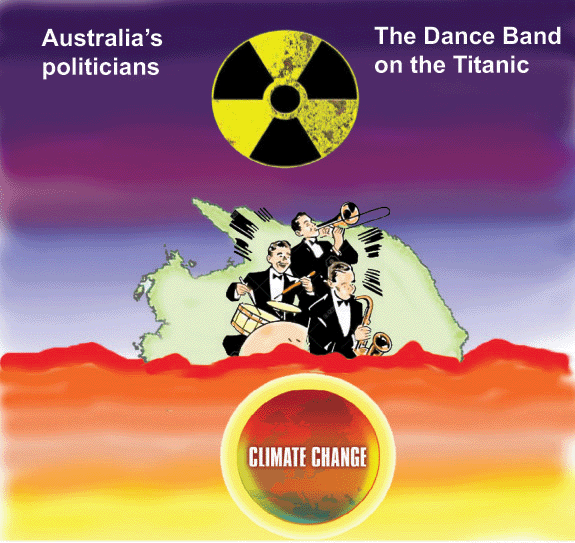 Climate change: Australia’s position is unconscionable for a wealthy country http://www.abc.net.au/news/2018-04-29/climate-change-health-impacts-who-adani-nt-fracking-australia/9702386 By David Shearman
Contradictions and problems in the National Radioactive Waste Management Facility Taskforce process
Selection process for a national radioactive waste management facility in South Australia, Submission 29 – Extract from Attachment 1 Anica Niepraschk
Arising challenges
Even though the current process is still in its early stages, it already either faces new challenges or has not yet dealt with older ones. Despite repeated calls by civil society organisations for an independent Inquiry into the full range of radioactive waste management options available, the government has instead continued its preferred option of a centralised radioactive waste facility. This leaves the current process vulnerable to criticism that the waste should remain at the sites where it is produced rather than being transported long distances through Australia, posing the risks of accidents on the way and the risk of an out of sight – out of mind approach in a remote area far away from expert oversight.
A continuing concern remains the federal government’s perception of urgency to solve the siting challenge, which is used as a justification for avoiding a more time consuming approach based on extensive consultation and consensus. Other countries have recognised that the provision of realistic timeframes is an essential condition in successful siting processes. The Australian government, despite the last 20 years of unsuccessful, rushed and pressured approaches, has again chosen to be bound by a rigid and self-imposed timeframe, trying to resolve the siting in around 18 months.
The current National Radioactive Waste Management Act (2012) is democratically compromised, as it provides for key legislation to safeguard cultural heritage and the environment as well as state legislation to be overridden in order to declare a site. SA, WA, Victoria and the NT all have state legislation in place prohibiting the storage or even transportation of radioactive waste from outside the state or territory. The federal government’s call for all Australian landowners to consider making a site nomination has failed to address this conflict of undermining existing laws and a ‘voluntary’ process. https://www.aph.gov.au/Parliamentary_Business/Committees/Senate/Economics/Wastemanagementfacility/Submissions
Colin Mitchell’s powerful submission to the Senate finds the national radioactive waste selection process to be deceitful
Colin Mitchell Submission to the Senate Standing Committee on Economics re the selection process for a national radioactive waste management facility from Colin Mitchell (independent campaigner)
I believe that the site selection process for a national radioactive waste management facility (NRWMF) is flawed because:
- The notion of ‘broad community support’ is considered far too narrowly as applying only to the local community.The NRWMF is a National project which could have environmental consequences extending far beyond the local community to encompass large areas of SA and beyond into other States of Australia, potentially effecting the whole nation. For example, leakage of radioactive material into the water table could spread over time causing disastrous effects on human and animal health, as well as agricultural crops. Also escape of radioactive material into the atmosphere could have similar negative consequences across wide areas of Australia and beyond. This is a decision which involves far more than the welfare of the immediate local community, rather the welfare of all the people of SA and all the people of Australia should be considered.
Recommendations: ‘Broad community support’ should extend to include the people of SA as a whole. Community opinion in other States of Australia should also be considered
Community support should be gauged by multiple methods including wide-ranging telephone and internet polling, acceptance of petitions and public meetings in Adelaide and all other major cities and towns in SA.
This process should be carried out by an independent body, not controlled by the government organisations involved in the establishment of a NRWMF. (ie not controlled by ANSTO or ARPANSA)
The consultation process should be thorough, be conducted over a long period (suggest a year) and incorporate the provision of full and open information about the project, including plans for both the low-level waste disposal facility and the above-ground store for intermediate level waste to be co-located at the same site.
The establishment of a NRWMF should not proceed without overwhelming support from the population of SA – at least 90% – (as well as 100% support from the local community), because the consequences of an unwise decision, flaws in the design of the facility, accidental releases of radioactive material, or an inability to properly maintain the facility over hundreds or even thousands of years, could be extremely serious to present or future generations.
- The site-selection process is also also flawed because insufficient information about the proposed NRWMF has been provided to the communities consulted. There has been a lack of transparency and bias in the presentation of information.1. Emphasis has been placed on medical isotope waste and there is insufficient information about the proposed co-location of intermediate level nuclear waste from Lucas Heights at the same site. The consultation process is deceitful because of the bias towards discussion of only the low-level waste and failure to properly inform the community about the colocation of Intermediate – level waste.
Recommendation: The co-location of Intermediate level nuclear waste should be mentioned every time the NRWMF is mentioned to avoid the false impression that this is only a low-level waste facility.
2. the communities have not been informed that the Intermediate-level waste to be colocated at the site is much more highly radioactive and has to be isolated for thousands of years compared with hundreds of years for low-level waste.
3. There are no plans presented for the “temporary” above-ground store to hold the intermediate-level waste.
4. The communities are not informed how the intermediate level waste is to be dealt with after “temporary” storage. There are no plans presented for long-term storage or final disposal of this waste.
5.The communities are not informed that the intermediate-level waste may be later disposed of in a deep geological disposal facility which may be built at the site of the NRWMF.
6. The communities are not informed that the construction of a deep geological disposal facility may lead to the importation of intermediate and high level nuclear waste from overseas in the future ie an international nuclear waste dump on the site (as advocated by government advisor Richard Yeeles in his submission to the recent Nuclear Fuel Cycle Royal Commission in SA “……it is open to your Royal Commission to recommend that the South Australian Government actively pursue the State’s further involvement in the nuclear industry with an initial focus on national and international radioactive waste management…….That as a demonstration of its strong interest in, and commitment to the further development of a safe and sustainable Australian nuclear industry, and as a first step in such further development, the South Australian Government offers to host a national facility for the storage and disposal of Australia’s own low and intermediate-level radioactive waste with the ultimate aim of securing Federal Government support for hosting an international radioactive waste management facility in South Australia.”
R.Yeeles, submission to Nuclear Fuel Cycle Royal Commission.)
- By failing to properly inform the communities about the co-location of the intermediate level waste the consultation process leaves itself open to the charge of deceit and thus undermines trust in the process and the agencies conducting the process as well as the government.
- Hazards of transporting nuclear waste over land/water are not being considered.
- Communities are not informed that intermediate-level waste can be securely stored at Lucas Heights itself. There is no advantage to moving this waste to another location and in fact moving the waste increases the risk of hazardous spills.
- Communities are not informed that there is not general agreement that a NRWMF is needed at all in Australia. They are not informed that there is a significant body of opinion that Australia’s nuclear waste should stay where it is and that, in particular, the intermediate-level waste at Lucas Heights is best stored at Lucas Heights where there are the resources and expertise to store this waste securely as it has been for many years. They are not informed that there is a significant body of opinion that there is nothing to be gained from moving this waste across country to another location because it is not presently known how to safely dispose of intermediate or high-level radioactive waste for the thousands of years it remains dangerously radioactive.Recommendation: the deficiencies in the information provided to communities mentioned above should be remedied. An independent community consultation body should be created which can provide full information on the proposed NRWMF in an open transparent manner including plans for the low-level facility and the intermediate-level above-ground store. This body should be independent from ANSTO or ARPANSA.
“Nuclear Medicine” – the fig leaf on the toxic nuclear industry – theme for May 2018
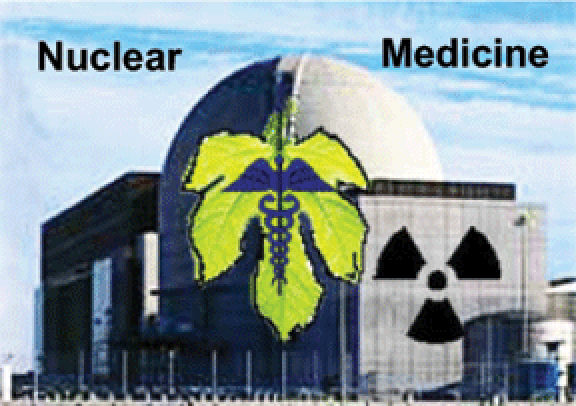
Small rural communities in South Australia are being told that it’s their patriotic duty to save Australia’s nuclear medicine – by allowing a nuclear waste dump in their area.
This is the patently lying propaganda of the Australian Government ‘s Department of Industry, Innovation and Science now busily involve spending tax-payers’ money on pro nuclear spin.
The real purpose of the radioactive trash dump is to host nuclear waste – euphemistically called “intermediate level” waste – currently stored in of 9,8000 leaking rusty barrels at Woomera, and also the wastes produced by the Lucas Heights nuclear reactor. These also so-called “intermediate ” wastes are the reprocessed wastes returned from France, with more to come in the future.
The Australian nation is being conned by the government and its well-funded nuclear promotion organisation Australian National Science and Technology Organisation (ANSTO), with the furphy that the whole purpose of the reactor is medical.
(a) the “medical isotope” function was tacked on – the original purpose was to lead to nuclear weapons. The current purpose is just a foot in the door for the whole nuclear fuel chain.
(b) Nuclear reactors are now going out of fashion, as the cheaper, more flexible, local, cyclotrons can produce medical isotopes safely – with no radioactive waste created.
The ecological knowledge of indigenous peoples
Land managers in Australia have adopted many of the fire-control practices of the aborigines and have partnered with native people.
While the skill of aborigines with fire had been noted before the giant brushfires – early settlers remarked on the “park-like” nature of the landscape – and studied before, it’s taken on new urgency. That’s why Australian land managers have adopted many of the ideas and partnered with native people as co-managers. The fire practices of the aborigines are also being taught and used in other countries.
Scientists have looked to Australian natives for other insights into the natural world. A team of researchers collaborated with natives based on their observations of kites and falcons that fly with flaming branches from a forest fire to start other fires. It’s well known that birds will hunt mice and lizards as they flee the flames of a wildfire. But stories among indigenous people in northern Australia held that some birds actually started fires by dropping a burning branch in unburned places. Based on this TEK, researchers watched and documented this behavior.
Aboriginal people “don’t see themselves as superior to or separated from animals. They are walking storehouses of knowledge”
 Native Knowledge: What Ecologists Are Learning from Indigenous People https://e360.yale.edu/features/native-knowledge-what-ecologists-are-learning-from-indigenous-people
From Alaska to Australia, scientists are turning to the knowledge of traditional people for a deeper understanding of the natural world. What they are learning is helping them discover more about everything from melting Arctic ice, to protecting fish stocks, to controlling wildfires. APRIL 26, 2018
While he was interviewing Inuit elders in Alaska to find out more about their knowledge of beluga whales and how the mammals might respond to the changing Arctic, researcher Henry Huntington lost track of the conversation as the hunters suddenly switched from the subject of belugas to beavers.
It turned out though, that the hunters were still really talking about whales. There had been an increase in beaver populations, they explained, which had reduced spawning habitat for salmon and other fish, which meant less prey for the belugas and so fewer whales.
“It was a more holistic view of the ecosystem,” said Huntington. And an important tip for whale researchers. “It would be pretty rare for someone studying belugas to be thinking about freshwater ecology.”
Around the globe, researchers are turning to what is known as Traditional Ecological Knowledge (TEK) to fill out an understanding of the natural world. TEK is deep knowledge of a place that has been painstakingly discovered by those who have adapted to it over thousands of years. “People have relied on this detailed knowledge for their survival,” Huntington and a colleague wrote in an article on the subject. “They have literally staked their lives on its accuracy and repeatability.”

Tapping into this traditional wisdom is playing an outsized role in the Arctic, where change is happening rapidly.
South Australia Health now dealing with infectious disease threats increased due to climate change
 Disease threat forces SA Health to prioritise adapting to climate change
HEALTH threats from extreme weather events and diseases spread by mosquitoes have prompted SA Health to prioritise adapting to climate change in a new blueprint. http://www.news.com.au/technology/environment/climate-change/disease-threat-forces-sa-health-to-prioritise-adapting-to-climate-change/news-story/fc734296a4580dda2c60320f8e8ac463#.ajdi8 Matt Smith
Chief medical officer Paddy Phillips has told The Advertiser the frequency and severity of heatwaves and bushfires, and the increased risk of the spread of disease by insects and bugs, meant climate change threatened the wellbeing of South Australians.
His warning comes as SA Health released its draft State Public Health Plan for the period from 2019-2024. Professor Phillips said multiple government agencies needed to consider the impact of climate change when developing policies and strategies to manage and prevent public health risks.It should also be front of mind when agencies assessed the suitability of health infrastructure and assets.
“Variations in our climate have increased the frequency and severity of weather events such as floods, droughts, bushfires, storms (and) periods of extreme heat, as well as the spread of vector-borne diseases,” Prof Phillips said.
“These events threaten the wellbeing of our communities, especially in vulnerable populations.”
Increases in diseases transmitted by mosquitoes, sandflies, triatomine bugs, blackflies, ticks, tsetse flies, mites, snails and lice have in recent years been linked to climate change on Australia’s east coast.
The draft report, that has been published for public consultation, lists four priorities:
CREATE healthier neighbourhoods and communities.
PROTECT against public and environmental health risks and adapt to climate change.
PREVENT chronic disease, communicable disease and injury.
FURTHER develop and maintain the statewide public health system.
Health and Wellbeing Minister Stephen Wade said he would review the plan, which was drawn up on the watch of the former Labor state government, to determine if any additional issues needed to be addressed. Mr Wade welcomed the inclusion of climate change as a priority. “It is prudent for public health plans to consider the impact of climate change,” he said.
SA Greens leader Mark Parnell said a suite of measures, including better town planning and the design of individual homes to be more resilient to changing climatic conditions, was needed.
That would help South Australia adapt to the challenge of climate change.
“We know that with a hotter climate comes more health problems including increased hospitalisations and premature deaths from increasing heatwaves,” he said.
1 This month
25 October – Film –Britain’s Nuclear Bomb Scandal: Our Story – part of the Adelaide Film Festival,
Screening and Conversation
A screening of Britain’s Nuclear Bomb Scandal: Our Story (2024) followed by a talk with 2026 Bettison and James Awardee and Tradtional Owner Karina Lester in conversation with Simone Tur.
When: Sun 25 Oct, 12:00pm-Screening, 1:15pm-Talk
Where: The Mercury
Free admission, register below by clicking on BUY TICKETS and select free event tickets, at end of web page:
https://www.adelaidefilmfestival.org/program/2026/britains-nuclear-bomb-scandal-our-story
.

Australians deserve the truth
about
AUKUS – https://aukuspublicinquiry.com/

PETITION – To: Prime Minister Anthony Albanese and the Australian Labor Government

of the week – Australians for War Powers Reform (AWPR)
To see nuclear-related stories in greater depth and intensity

