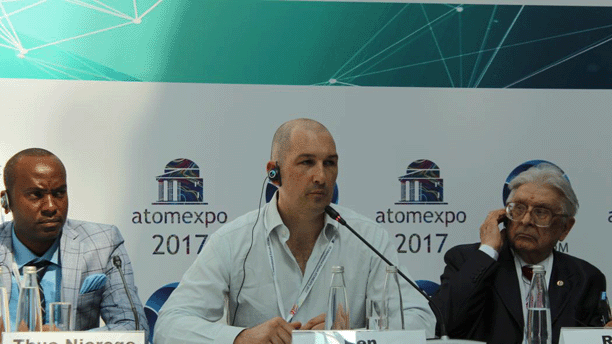
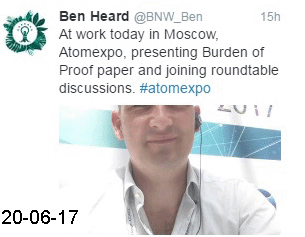
Jim Green shared a link. Nuclear Fuel Cycle Watch South , 4 Feb 18 AustraliaBen Heard – the paid nuclear lobbyist whose so-called environment group ‘Bright New World’ accepts secret corporate donations – claims that “Peace is furthered when a nation embraces nuclear power, because it makes that nation empirically less likely to embark on a nuclear weapons program. That is the finding of a 2017 study published in the peer-reviewed journal International Security.”
That’s false twice over. Firstly, it isn’t true. Secondly, Heard’s assertion isn’t supported by the International Security journal article, written by Nicholas Miller from Dartmouth College.
Miller’s article downplays the power/weapons connections but much of the information in his article undermines his own argument. In Miller’s own words, “more countries pursued nuclear weapons in the presence of a nuclear energy program than without one”, “the annual probability of starting a weapons program is more than twice as high in countries with nuclear energy programs, if one defines an energy program as having an operating power reactor or one under construction”, and countries that pursued nuclear weapons while they had a nuclear energy program were “marginally more likely” to acquire nuclear weapons (almost twice as likely if North Korea is considered to have had a nuclear energy program while it pursued weapons).
Nuclear power/weapons connections are multifaceted, repeatedly demonstrated, disturbing and dangerous:
• Nuclear power programs were involved in the successful pursuit of weapons in four countries (France, India, Pakistan, South Africa) according to Miller (and India and North Korea could be added to that list) and have provided many other countries with a latent weapons capability.
• Power programs have provided ongoing support for weapons programs to a greater or lesser degree in seven of the nine current weapons states (the exceptions being Israel and North Korea).
• The direct use of power reactors to produce plutonium for weapons in all or all-but-one of the declared weapons states (and possibly other countries, e.g. India and Pakistan).
• The use of power reactors to produce tritium for weapons in the US (and possibly other countries, e.g. India).
• Power programs (or real or feigned interest in nuclear power) legitimising enrichment and reprocessing programs that have fed proliferation.
• Power programs (or real or feigned interest in nuclear power) legitimising research (reactor) programs which can lead (and have led) to weapons proliferation.
• And last but not least, the training of experts for nuclear power programs whose expertise can be (and has been) used in weapons programs.
So why does Heard claim that “when a nation embraces nuclear power, because it makes that nation empirically less likely to embark on a nuclear weapons program”? He ignores most of Miller’s article (and Miller himself ignores much that is known about power/weapons connections) and focuses on these findings:
1. The annual probability of starting a weapons program is more than twice as high in countries with an operating power reactor or one under construction (a statistically-significant finding).
2. The annual probability of starting a weapons program is somewhat lower in countries with operating power reactors compared to countries without them (a statistically non-significant finding).
So why does Heard privilege the second of those findings when only the first is statistically significant? Why does Heard privilege the finding that excludes countries with power reactors under construction (but not in operation) when the inclusion of such countries provides a fuller, more accurate assessment of the power/weapons connections? Perhaps Heard’s selectivity is connected to his work as a paid nuclear lobbyist whose so-called environment group accepts secret corporate donations. https://www.facebook.com/groups/1021186047913052/
Connections between civil and military nuclear programs Detailed 2015 paper: The myth of the peaceful atom – debunking the misinformation peddled by the nuclear industry and its supporters Nuclear power and weapons – explaining the connections 2017 – nuclear industry body and lobbyists acknowl…
Cameron Scott, Submission to ARPANSA on draft Code for Radioactive Waste, 4 Mar 18 It needs to be stated in the Code for Disposal of radioactive Waste that the Federal Government can not override state legislation for building a national facility. The code needs to include a clause protecting farming land from becoming home to hazardous waste. Licensing should require communities to nominate land not individuals.
Colin Mitchell, Submission to ARPANSA on Radioactive Waste Code, 4 Mar 18 .I am against changing the Code to include other types of disposal facilities such as the above-ground storage for Intermediate Level nuclear waste from Lucas Heights that the Federal Govt wants to locate at their proposed National dump. This higher-level waste which remains dangerous for thousands of years should stay at Lucas Heights where it can be securely monitored. No deep-disposal facility should be permitted either. No National dump should be built – all waste should stay where it is.
Conservation Council SA Mara Bonacci, Nuclear Waste Campaigner, 1 Mar 18,
On 6 February 2018, the federal Senate referred an inquiry into the selection process for a national radioactive waste management facility in South Australia to the Senate Economics References Committee for inquiry and report by 14 August 2018.
This is welcome.
It is an important opportunity for you to have your say in Australia’s approach to radioactive waste management. The terms of reference can be found here and information about writing a submission is here. Submissions are due by 3rd April 2018. Please consider writing your own submission or alternatively, submit an online submission here.
Some points to consider including are:
A single individual or property owner should not be allowed to nominate a site for a nuclear waste dump.
The federal government have not made a clear or compelling case that we need a national nuclear waste dump in SA.
The consultation process has been deficient and has caused division in our communities.
The federal government plan lacks social licence or community consent. Traditional Owners have flagged concerns over cultural heritage issues.
The project has not considered the full range of options to best advance responsible radioactive waste management in Australia. Australia’s worst waste should be dealt with better.
It would be great to get as many submissions to the Senate Standing Committees on Economics as possible so collectively we can end this terrible process and get the federal government to finally take a responsible approach to radioactive waste management.
my personal prediction is that this will result in around 90 per cent renewables [in South Australia] by 2030. This is a prediction, not a target.
SA can lead the nation not just on energy generation, but all the manufacturing, construction and jobs that could go with this in areas such as PV panels, components, smart energy, CST mirrors, etc.
At a recent energy event in Adelaide where I presented for Nick Xenophon’s SA-BEST, it was encouraging that the Greens, SA-BEST, Labor and Liberal all stated that renewables was the future.
However, the Liberal Party is going to be hamstrung by Turnbull/Abbott and the National Energy Guarantee (a thought bubble to appease the Abbott ilk, masquerading as policy); inaction on climate; and offering a $1 billion loan to Adani. Continue reading →
Steve Dale Nuclear Fuel Cycle Watch South Australia, 3 Mar 18Oh dear… Ben Heard is off to the “Japan Atomic Industrial Forum” conference in April (according to twitter). It’s a wonder he is even welcome in Japan – the Japanese government is working hard and spending $billions trying to clean up some of the radioactive contamination.
Queensland’s premier has talked up gas and renewable energy when asked about the Adani coal mine, on her first day back from a trade mission to the United States.
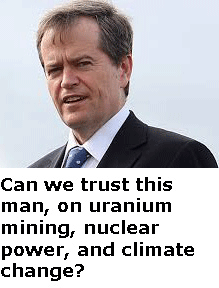
Federal Labor Leader Bill Shorten this week cast further doubt on Adani’s ability to raise funding for the project and whether a future Labor government would support the project.
Annastacia Palaszczuk on Friday said she hadn’t spoken to Mr Shorten since returning from the US, but reiterated the $16.5 billion mine had to stand up by itself without taxpayer money.
“There are other resource industries investing in Queensland, the gas industry is investing in Queensland, we have $20 billion worth of renewable energy on our books,” Ms Palaszczuk told reporters in Brisbane
“I hope a lot of resource company’s projects go ahead, but money talks, and the money is talking by investing in renewables.”
Ms Palaszczuk deflected questions about the proposed coal mine in Queensland’s Galilee Basin, instead pointing to interest from US investors in her government’s 50 per cent renewable energy target.
The premier said she had also met with the CEOs of a number of gas companies in the US as part of her government’s push to use gas as a transition fuel between coal and renewables.
The two leaders have held bilateral talks in Sydney.
Political editor Barry Soper told Larry Williams it was a charm offensive, and nothing substantial has come out of it.
He says the issues that were outstanding going into the talks remain outstanding, after them.
“It’s important, I guess, to keep a very good relationship with them but I don’t think we should allow ourselves to be bullied and to some degree, I think that’s what the Australians do to them.”
A Marshall Liberal Government will not support the building of a nuclear waste repository in South Australia.
South Australia and the Nuclear Industry
The Liberal Party has always been willing to fully and openly investigate the pros and cons of the nuclear fuel cycle to grow our economy and build our State. https://www.stevenmarshall.com.au/nuclear_industry
From ABC news
SA power cuts: Nuclear energy should be considered as solution, state Liberals say, By Daniel Keane,
today he said that did not mean he or his party were against the production of high-level nuclear waste in South Australia, via nuclear energy generation.
“We’ve never ruled out the nuclear opportunity for energy. We made it very clear that we were not in the slightest bit interested in continuing to pour money into the hopeless case which was a nuclear repository in South Australia,” he said.
“The royal commissioner ruled out nuclear energy in South Australia but there will be a time when it may become viable, and desperate times call for desperate solutions, and we are in a desperate situation.”
Nuclear waste returning to Australia this weekend by ship from France has been classified as high-level waste by French authorities, contradicting Australia’s claims over its radioactivity, a Greenpeace report has found.
Greenpeace’s investigation also found the waste still contains quantities of plutonium – highly toxic even in small quantities – despite reprocessing by French state-owned nuclear company, Areva.
“The Australian government is downplaying the danger of this shipment, saying it is intermediate-level waste that isn’t harmful unless mismanaged. But we know it contains plutonium and is classified as high-level waste by the French authorities,” said Emma Gibson, Greenpeace Australia Pacific’s Head of Programs.
“It’s clear on evidence the government is not being as straight as it can be about the nature of this shipment by insisting Australia only has intermediate-level waste. Australians have a right to know what is being stored in their backyard. The lack of transparency over this waste is highly problematic,” she said.
The nuclear waste was generated by the Australian Nuclear Science and Technology Organisation (ANSTO) and sent to France in 2001 to be reprocessed.
The French Nuclear Safety Authority (ASN) has revealed to Greenpeace that the waste has been classified as high-level (long-life) waste according to standards set by ANDRA, the French national radioactive waste management agency. High-level waste is ANDRA’s most severe nuclear waste classification.
Areva documents have also confirmed that the waste still contains low quantities of plutonium.
However ANSTO has classified the shipment as intermediate-level waste using an alternate classification system.
“The discrepancy is a significant concern as the French have much more experience of nuclear waste management than the Australians. We have written to Christopher Pyne, the Minister for Industry, Innovation and Science, asking him to clarify the exact nature of the waste,” said Ms Gibson.
She said the vessel carrying the waste – the BBC Shanghai – also has a worrying safety record and has been banned by a number of nations.
Official documents seen by Greenpeace show the BBC Shanghai has been detained by Australia, the United States and Spain in the past five years after failing safety inspections. The US has banned the ship from carrying government cargo, while 14 other nations have found deficiencies in the ship since 2002.
“The government is spending about $30 million to bring its nuclear waste back to Australia, but the management of this shipment has been a catalogue of mistakes and misinformation.
“American and Australian authorities have both detained this junkyard ship in the past two years after it failed inspections. While the US has banned it from carrying government cargo, the Australian government loaded it with tonnes of dangerous nuclear waste to transport around the world.
“The more you move radioactive waste around, the more you increase the likelihood of an accident which could spread radioactive contamination into the environment.
“The government is now saying Australia could be a nuclear waste dump for the rest of the world. Imagine the corners that could be cut when these dangerous shipments arrive regularly,” said Ms Gibson.
Endorsing Greenpeace’s report, Dr Helen Caldicott, veteran anti-nuclear advocate said:
“The fact France has classified this as high-level waste should send alarm bells ringing about what is actually coming back to Australia. The French have significantly more experience in handling nuclear waste than Australia does. That the two countries could have such different views on how dangerous this nuclear waste is should be a huge concern.
“There are enormously different safety regulations required for high-level nuclear waste compared with intermediate-level waste.
“Australia is conducting a dangerous radioactive exercise by transporting 10 tonnes of this high-level radioactive waste in a notoriously dangerous ship.”
The nuclear waste is due to be unloaded off the BBC Shanghai at Port Kembla in southern Sydney in the early hours of Sunday, 6 December. It will then be transported to Lucas Heights by road for interim storage.
David J Noonan B.Sc., M.Env.St. Independent Environment Campaigner, 2 March 2018
Summary for ARPANSA Website:
David Noonan: To be credible, a finalised ARPANSA Code must mandate the best practice Principal of Non-Imposition of nuclear waste disposal facilities on community.
It is untenable for this Code to countenance Disposal Facility Siting in an area of special cultural heritage significance to Aboriginal people. Proposed NRWMF siting in the iconic Flinders Ranges must stop. A finalised ARPANSA Code must respect Aboriginal people’s rights and interests.
ARPANSA needs to recognise the Storage and Disposal of nuclear wastes affects the rights, interests and safety of all South Australians and is prohibited in our State under the Nuclear Waste Storage (Prohibition) Act 2000.
Any imposition of Disposal Facility Siting in SA will be strongly resisted by community across SA.
Please feel free to contact regarding this submission (contacts provided in e-mail cover note).
To: ARPANSA Public Consultation on the Code for Disposal of Solid Radioactive WasteRadiation Protection Series C-3, RHC Draft – December 2017 StakeholderComment@arpansa.gov.au
Re: D.Noonan public submission on Required Protection of Cultural Heritage from impact by Disposal Facility Site selection AND on the Principal of Non-Imposition of Disposal Facilities 2nd March 2018Continue reading →
Nuclear weapon testing killed and blinded Aussies in our own backyard But Australia isn’t among the 122 countries that banned them. now to love, FEB 28, 2018 BY KATE WAGNER
When we hear about nuclear weapons, we think of the notorious and devastating Hiroshima and Nagasaki bombings, but what about Australia? For years, Indigenous communities in South Australia endured extreme nuclear weapon testing at the hands of the British government. It resulted in devastating, long-lasting health effects, if not death. But unlike the bombings in Japan, Australia’s history of atomic testing is rarely discussed.
The British and Australian governments said they chose barren, largely unpopulated areas to conduct the testing. But people were living there and, in the fallout, some suffered immediate health problems like rashes and skin infections while others were hit with autoimmune diseases later in life.
From 1947 until 1996, the Pacific underwent315 nuclear testsand it was Indigenous people who felt the brunt of the fallout.
In Australia specifically, the UK carried out 12 major nuclear tests, even dropping a 15-kilotonned atomic device in Maralinga – a weapon with the same explosive strength as the infamous Little Boy dropped on Hiroshima, although a completely different design.
Hundreds of nuclear tests were conducted in Australia
They also carried out a few hundred smaller scale tests at Emu Field and Maralinga in South Australia throughout the ’50s and ’60s. Although the testing was shrouded in secrecy for decades, through oral history the Yankunytjatjara, Anangu and Pitjantjatjara people remembered the day the ground shook and the suffocating black mist rolled in.
The devastating effects of nuclear testing in South Australia is something prominent anti-nuclear activist Karina Lester knows all too well. Her father, Yami Lester, was an Aboriginal elder blinded by nuclear fallout when he was a child and he spent his life raising awareness for the dangers of nuclear weapons.
“My dad spoke of that day a lot. People in the community had skin infections, rashes, people were violently vomiting. The nuclear tests would happen in the morning and by the evening, people were already sick,” Karina told Now To Love.
“The older generations really felt the brunt of that fallout, and the younger generation too. Our young that were there at the camp, infants and young children, were really exposed to that radiation fallout as well, so death – people passed on.
“My grandmother would tell her own story about digging the graves for her parents, my great-grandparents, and they are just horrific stories.”
Even 60 years later, the effects of the testing are far from a distant memory for Karina’s family. Her sister, and fellow anti-nuclear campaigner, Rose Lester, suffers from an autoimmune disease she says was caused by the nuclear tests, and the pair’s father Yami saw his life change irreversibly just years later.
“In 1953, they conducted their nuclear testing in Emu Field. By 1957, Dad’s world was in total darkness,” Karina explained.
But it was more than just physical wounds
“Many of my older generations were loaded on a truck and moved far from their traditional lands to Yalata and Ceduna communities, or even as far as Gerard on the River Murray and then up to Port Augusta and Coober Pedy,” Karina told Now To Love.
“They were relocated off their traditional lands, moved from their homes, and it had a devastating impact on their mental health and wellbeing.
“Those lands they tested on, they were lands we traditionally used for hunting and gathering; lands we were spiritually connected to, and that was proven by Royal Commission.”
The physical and emotional pain caused by the testing was only magnified by the Australian government’s refusal to accept any wrongdoing.
“My dad heard an interview with Ernest Titterton [a British nuclear physicist] on ABC Radio saying indigenous people were informed about the testing in advance. He said that Aboriginal people had been cared for and moved away,” Karina remembers.
“Mr Titterton may have gone and spoken to the white pastoralists, but no one ever spoke to the Aboriginal community. They couldn’t, they didn’t speak our language.
“It was after that interview Dad decided he had to do something – to hold someone responsible. He talked to our people and they decided it was finally time our story was shared.”
The Brewarrina community is stepping up the campaign against a proposed national nuclear waste dump, with two successful events held over the weekend.
A silent protest was held at the local Council meeting on Friday the 23rd February, with over 20 local protestors attending. Ngemba man Jason Ford presented the No Nuclear Bundabunda on Ngemba Land – Bad Poison petition to the councillors. The petition had 563 clear ‘no’ votes compared to 84 residents who voted in a Council survey that Council should ‘continue with the project.’
Ngemba woman and campaign coordinator Trish Frail said, “We did not win gold, but we won silver and we are happy with that at this stage of the campaign. No further action can be taken by Council until a Working Group is established and the many questions we put to them are answered.”
“We want to know the motivation and funding behind the delegation to Lucas Heights last November and details of the consultation arrangement for nuclear advocate Robert Parker. There is clearly no mandate for the Council to just push ahead and keep promoting the nuclear waste dump,” Ms Frail stated.
The ‘Keep Bre Nuclear Free’ rally the following day mobilised over 100 people, with young people proudly leading the march and chanting ‘No Bundabunda on Ngemba Land’ and ‘Keep Bre Nuclear Free’.
Many Elders also came out to support the campaign.
Aunty Doreen said, “As a Ngemba Elder and a custodian of the land it is important that I support the younger generation in preventing this atrocity from happening on our land, which came from the Dreaming. We struggle with the atrocities that have happened in the past; our future generations should not have to struggle with this danger.”
“It is nuclear genocide. The cotton industry has wrecked our water ways, we can’t let the nuclear industry wreck our land, water and environment,” Aunty Doreen concluded.
Supporters from Melbourne and Canberra travelled to participate in the rally, with messages of support sent from other areas currently under assessment to host the national nuclear dump.
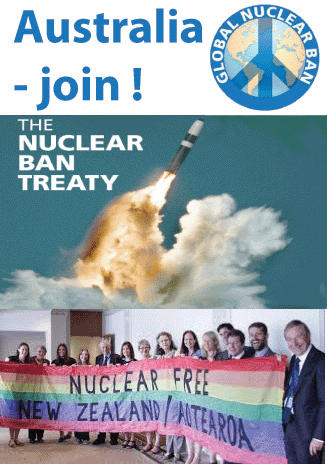
NZ may lobby Aust on nuclear weapons ban SBS News 27 Feb 18 “……….Australia could be in for a lecture from New Zealand on nuclear weapons disarmament.
NZ Prime Minister Jacinda Ardern will visit Australia for talks with Prime Minister Malcolm Turnbull at the end of the week.
She’ll be accompanied by Deputy Prime Minister Winston Peters, seven cabinet ministers and a business delegation.
Ms Ardern delivered a major foreign policy speech to the New Zealand Institute of Public Affairs on Tuesday and announced her government will reinstate the cabinet position of disarmament and arms control minister.
Last July, 122 countries voted in the United Nations to ban nuclear weapons.
Ms Ardern flagged in the speech her government was looking at an early ratification of the treaty. “In a modern context, the greatest challenge comes from North Korea, situated right here in our region,” she said.
“At a time when risks to global peace and security are growing and the rules-based system is under such pressure, we must recommit ourselves to the cause of non-proliferation and disarmament.”
Australia has refused to sign up to the treaty ban and did not take part in the negotiations.
The country relies on the deterrent protection from the US’s nuclear weapons arsenal.
New Zealand has long adopted a firm line in opposing development of nuclear capabilities, which at times puts the small Pacific nation at odds with some allies.
……… Asked if she’ll raise the issue with Mr Turnbull, Ms Ardern told reporters in Wellington: “I have no qualms having conversations about it.”……. NZ also has an ongoing offer to resettle 150 refugees from Nauru and Manus Island, which has previously been rejected……..https://www.sbs.com.au/news/nz-may-lobby-aust-on-nuclear-weapons-ban
25 October – Film –Britain’s Nuclear Bomb Scandal: Our Story – part of the Adelaide Film Festival,
Screening and Conversation
A screening of Britain’s Nuclear Bomb Scandal: Our Story (2024) followed by a talk with 2026 Bettison and James Awardee and Tradtional Owner Karina Lester in conversation with Simone Tur.
When: Sun 25 Oct, 12:00pm-Screening, 1:15pm-Talk
Where: The Mercury
Free admission, register below by clicking on BUY TICKETS and select free event tickets, at end of web page: