Nick Xenophon’s SA BEST party promises community electricity co-op.
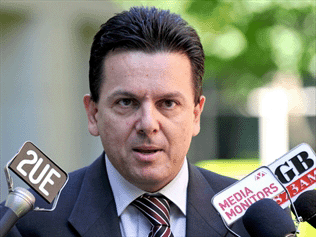
 Xenophon’s SA BEST unveils community electricity co-op plan http://reneweconomy.com.au/xenophons-sa-best-unveils-community-electricity-co-op-plan-11721/ By Sophie Vorrath on 27 February 2018
Nick Xenophon’s SA BEST party has waded into the South Australia energy war, with an election promise to cut power prices by as much as 20 per cent, by setting up a community electricity co-op.
Billed as an “exciting plan to lower power prices using the co-operative model of community electricity trusts,” the policy was unveiled on Tuesday ahead of the March 17 state election.
It follows a battery of energy policy promises from Jay Weatherill’s Labor Party, including plans to boost the state renewables target to 75 per cent, to introduce an energy storage target, and to adopt nation-leading electric vehicle incentives.
The SA Liberal Party has been less ambitious, but in October last year promised $100 million in grants to help homes to buy and install battery storage.
The SA BEST policy proposal gives form to one of Xenophon’s most favoured campaign slogans, which promised to give power back to the South Australian people.
To be named the Community Electricity Trust of SA (cETSA), the co-operative retailer would be made up of 50,000 lower-income households and up to 5000 small businesses, and power prices for those members would come down by 20 per cent.
The retailer would also be able to tender to develop 150MW of new renewable energy generation.
“The co-operative (energy) model has an internationally proven track record for delivering services,” said Business Council of Cooperatives and Mutuals CEO Melina Morrison.
“(It) is already being deployed in countries around the world, including the USA, Germany and Denmark,” she said.
“Nick Xenophon has been a long-time champion of co-operative and mutual enterprises – the Business Council of Co-operatives and Mutuals is confident this won’t be the last creative solution to SA’s problems using the co-op and mutual model from SA BEST.”
This article was originally published on RenewEconomy’s sister site, One Step Off The Grid, which focuses on customer experience with distributed generation. To sign up to One Step’s free weekly newsletter, please click here.
Vitrified nuclear waste due to be sent from UK to Lucas Heights, Australia by 2022
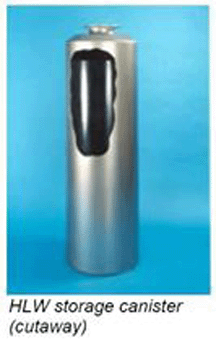 Radioactive Waste: Australia:Written question – 10476 http://www.parliament.uk/business/publications/written-questions-answers-statements/written-question/Commons/2017-09-13/10476/
In 1996 the Australia Nuclear Science and Technology Organisation (ANSTO) signed a contract with the United Kingdom Atomic Energy Authority (UKAEA) for the processing of spent nuclear fuel from the Australian research reactor at the Dounreay reprocessing facility. The contract contained an obligation to return uranium and an option to return waste which is supported by a MoU between the UK and Australian Governments in the form of an intergovernmental letter. The radioactive waste, which arose from the processing, comprises several tens of drums of cemented waste. The Nuclear Decommissioning Authority (NDA) assumed responsibility for the material when it became owners of Dounreay in 2005.
Cemented waste is challenging in terms of transport and volume, and for the ANSTO waste the return would require multiple moves or the provision of new flasks to ensure transport can be secured. The Scottish and UK Governments consulted on a proposed policy of radioactive waste substitution for the radioactive waste arising from historic fuel reprocessing contracts with overseas customers at Dounreay in 2010. Agreement was reached between the Scottish and UK Governments on 16 March 2012. Waste substitution is an internationally accepted practice where a radiological equivalent amount of waste is returned to the customer in a form that is acceptable. A contract was signed in 2014 with the NDA to enable waste substitution.
The substituted radioactive waste will be in the form of four vitrified residue containers holding waste which falls within the activity levels of Intermediate Level Waste. The vitrified residue (sealing of radioactive waste in molten glass poured into engineered stainless steel containers) comes from Sellafield. Waste in this form is immobilised. The cemented drums containing the Australian-origin radioactive waste from the processing of the spent nuclear fuel will be retained and managed at Dounreay pending final disposal, as the Dounreay Intermediate Level Waste stores are designed to accept it.
The vitrified residues are forecast to be returned to Australia by 2022 and are expected to be stored in an authorised storage facility located at Lucas Heights near Sydney, where the Australian research reactor is located. Following storage at Lucas Heights the vitrified residues will be co-located with a new disposal facility for Low Level Waste and will be temporary stored at that facility.
The Australian Government accepts that it has an international obligation to receive the vitrified residues. The Department of Industry, Innovation and Science (DIIS) is charged with identifying a site – National Radioactive Waste Management Facility – for its Low Level Waste currently stored in 100 different places around Australia. The NDA has been informed that following a public consultation process across Australia, DIIS is now actively engaged in dialogue with two communities in South Australia – Wallerberdina Station, near Hawker, and at Kimba. A decision on where the facility will be located has not yet been made.
Australians Mobilise to Stop Indian Coal Project
By Kalinga Seneviratne
‘A peoples’ movement is gathering steam across Australia
to stop a project by an Indian company to establish
Australia’s biggest ever coal mining project …
‘The protest movement … argues that
Australia needs to cut greenhouse gas creating coal exports
rather than opening more mines. …
‘The protest movement has formed alliances among conservation groups such as
the Australian Conservation Foundation,
Australian Marine Conservation Foundation,
Greenpeace and the Bob Brown Foundation …
‘There is even a ‘Sydney Knitting Nannies’ Group
– women in their 60s and 70s – supporting the campaign and
in Sydney along there are 500 active campaign groups, ….
‘traditional owners of the land – Wangan and Jagalingou Aboriginal people
– have taken their ‘native title’ claims to the Federal Court of Australia.
The hearing is scheduled for March 2018. … ‘
Read more of Kalinga’s comprehensive & informative article:
www.indepthnews.net/index.php/the-world/asia-pacific/1693-australians-mobilise-to-stop-indian-coal-project
Climate change denialists: is Australia’s new Deputy PM one of those?
Is Australia’s new Deputy PM another anti-wind climate denier? REneweconomy, By Sophie Vorrath on 27 February 2018
So Barnaby Joyce has gone; resigned from the position of Leader of the National Party and deputy prime minister of Australia, taking with him his climate scepticism, general dislike of renewables, and love of all things coal.
But is his replacement – Michael McCormack – any different? Quite possibly not. Here’s what we know, so far:
The Coalition’s minister for veterans affairs, and the newly installed minister for infrastructure and transport, McCormack joined parliament as a Nationals MP in 2010, after being elected to the House of Representatives for Riverina, in New South Wales.
He is the first Nationals leader since 1990 not to have worked as a farmer, although he is the son of a farmer.
McCormack started his working life in the media, rising from cadet journalist at the local Wagga paper the Daily Advertiser, to the position of editor.
He has some shady opinions on climate change.
In his first speech to parliament in 2010, McCormack he referred to climate science as “the nonsense we hear so often spoken by so many who base their views on mere assumptions of what might or might not happen.”
And he said: “When it does not rain for years on end, it does not mean it will not rain again. It does not mean we all need to listen to a government grant-seeking academic sprouting doom and gloom about climate changing irreversibly.”
He also referred repeatedly to that old Dorothea Mackellar poem – “I love a sunburnt country” – that some people seem to believe is a legitimate counter argument to decades of scientific research.
In 2012, he made an impassioned speech against the Labor government’s Carbon Pricing scheme:……..
is McCormack still a climate denier and wind farm hater? The answer is… we don’t know yet if he has evolved any.
Greens MP Adam Bandt tried to ask the new Deputy Prime Minister about his position on climate change during Parliament’s Question Time, but got shut down by the House Speaker:
“The member for Melbourne has been in the House long enough to know that he needs to ask ministers about issues for which they are responsible, not about first speeches, not about any other speeches. The member for Melbourne can resume his seat. The Deputy Prime Minister, as far as I am aware with the tabling of the new ministerial responsibilities, is still the Minister for Veterans Affairs and he is the Minister for Infrastructure and Transport, and that question in no way goes to his responsibilities. We will go to the next question.”
That’s a stunning statement – to suggest that ministries of infrastructure and transport “in no way” are linked to climate change.
RE has emailed and phoned McCormack’s office to ask if he still holds any or all of the above views. Or if he had changed them like he did on his strident attack on homosexuality that he later apologised for. We will keep you posted. http://reneweconomy.com.au/is-australias-new-deputy-pm-another-anti-wind-climate-denier-56686/
A Labor government could revoke Adani’s licence for coal mine expansion
Adani mine licence could be revoked under Labor government, Geoff Cousins says Bill Shorten told him, ABC News 27 Feb 8
Businessman and environmentalist Geoff Cousins says Opposition Leader Bill Shorten told him that if Labor wins government it could revoke the Adani mine licence.
Mr Cousins, former president of the Australian Conservation Foundation, told 7.30 that Mr Shorten made the statement to him privately last month.
“The key statement was that, ‘When we are in government, if the evidence is as compelling as we presently believe it to be regarding the approval of the Adani mine, we will revoke the licence, as allowed in the act. That’s a clear policy’,” Mr Cousins said.
“He told me he intended to speak to his colleagues.”
He said the conversation took place when Mr Shorten asked him for advice about the environmental impact of the Adani mine in Queensland’s Galilee Basin.
Mr Cousins said he spent two days in north Queensland with Mr Shorten — at the Labor leader’s request — to discuss the matter.
“He said he wanted to learn as much as he could first hand about the mine and the impacts on the reef and climate change issues and so on,” Mr Cousins said.
“He said the reason he wanted to get that first-hand knowledge was because he was planning a firmer policy position on Adani.”
According to Mr Cousins, at the end of the two days Mr Shorten told him he would discuss the policy with his colleagues.
Mr Cousins said he was speaking out publicly to “increase the pressure” on Labor to make a decision.
“It’s pretty clear there is some kind of resistance in his party to him leading on this issue,” he said………
The Adani mine has been a major headache for Mr Shorten and the Labor Party.
In rural Queensland the party faces a very real electoral threat from One Nation and wants to be seen as offering jobs and economic growth.
But at the same time it is trying to appeal to voters in the inner-Melbourne electorate of Batman, which could fall to the Greens in a by-election in just over a fortnight. http://www.abc.net.au/news/2018-02-27/geoff-cousins-accuses-bill-shorten-of-reneging-on-adani-deal/9490238
Jacinda Ardern’s ‘sexist, creepy’ 60 Minutes interview angers New Zealand
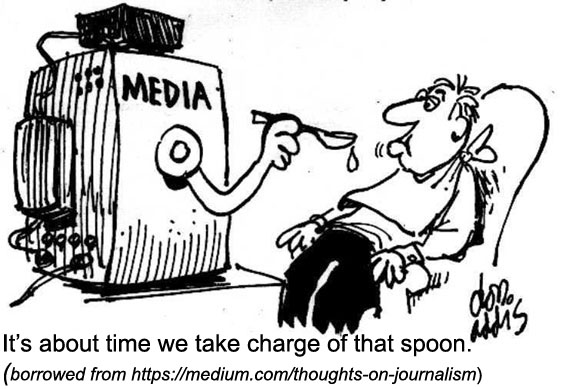 Guardian, Eleanor Ainge Roy in Dunedin 26 Feb 18
Australian journalist Charles Wooley criticised for calling PM ‘attractive’ and discussing the conception of her baby.
New Zealanders have criticised an interview with their prime minister, Jacinda Ardern, as “creepy” and “sexist”.
In the opening segment of the Australian current affairs show 60 Minutes , which aired on Sunday night, the veteran reporter Charles Wooley described the 37-year-old Ardern as “attractive”.–
“I’ve met a lot of prime ministers in my time,” says Wooley, filmed strolling the corridors of Parliament House with Ardern, the camera pulling in for a close-up on Ardern’s smiling face. “But none so young, not too many so smart, and never one so attractive.”
Wooley goes on to say that like the rest of New Zealand, he is “smitten” with their prime minister, with Channel Nine describing the interview in promos as a behind-the-scenes special with a world leader “like no other”, who is “young, honest and pregnant”.
“Admittedly, although somewhat smitten just like the rest of her country, I do know, that what’s really important in politics has to be what you leave behind,” Wooley says.
The interview was immediately met with derision from many New Zealanders on social media, who leapt to the defence of Ardern at having to endure the overly personal line of questioning, and dismissed Wooley as misogynistic and inappropriate. Other viewers said the interview was “repugnant”, “creepy” and “painful”.
“How did a nice person like you get into the sordid world of politics?” Wooley asked Ardern
“Nice people go into politics,” replied Ardern, smiling.
Wooley’s questions about her pregnancy appeared to make her and her partner, Clarke Gayford, rather uncomfortable.
“One really important political question that I want to ask you,” Wooley said. “And that is, what exactly is the date that the baby’s due?”
Ardern replied that her baby was due on 17 June, to which Wooley replied: “It’s interesting how many people have been counting back to the conception … as it were,” which made Gayford blush and laugh uncomfortably, responding: “Really?”
Wooley continued: “Having produced six children it doesn’t amaze me that people can have children; why shouldn’t a child be conceived during an election campaign?”
At this, Ardern appeared to roll her eyes, responding: “The election was done. Not that we need to get into those details.”
Wooley’s interviewing style obviously irked Gayford, who later alluded to the program when he tweeted about great places in New Zealand where you could “escape for 60 Minutes or longer”……..
In her weekly media standup Ardern said she did not find the interview offensive though she was initially taken aback by the question concerning the conception date of her child. https://www.theguardian.com/world/2018/feb/26/sexist-creepy-jacinda-ardern-60-minutes-interview-angers-new-zealand
Australia’s Department of Home Affairs – too much power to Peter Dutton?
 Politicising Intelligence: Dutton, Pezzullo and the Department of Home Affairs, Independent Australia , Dr Binoy Kampmark discusses the “unsettling” power overreach of the newly devised super ministry, the Department of Home Affairs, overseen by Peter Dutton and Michael Pezzullo.
BE WARY of the police state operative, the desk job authoritarian — be especially wary of the political figures endorsing such characters, those supposed saviours from inflated threats and cardboard demons.
This is the dilemma Australian bureaucrats face across a range of departments in Canberra, notably those cannibalised in the creation of the Department of Home Affairs, the remodelled variant of the Immigration and Border Protection portfolio. Those affected by the process hail from the Attorney-General’s Department, Infrastructure and Regional Development and Prime Minister and Cabinet.
The Saturday Paper‘s Karen Middleton revealed something that was as surprising as the next sunrise. ASIO officials are said to have been tetchy about the whole business of centralised power — a point that seemed to eek its way in a secret speech delivered by the former Australian Attorney-General, George Brandis. Brandis, according to Middleton, claimed the creation of the department to be “unsettling” for the agency, though expressed confidence that the changes would be implemented without too much fuss……..
Pezzullo and Dutton harbour a confused view about the protection of liberty. To ensure its strength, a degree of state confusion and muddling is necessary. But security assumes the force of a sledgehammer, centralised and directed against citizen and enemy alike. ……..https://independentaustralia.net/politics/politics-display/politicising-intelligence-dutton-pezzullo-and-the-department-of-home-affairs,11243
Australia signed up to keep nuclear waste as close as possible to the point of production
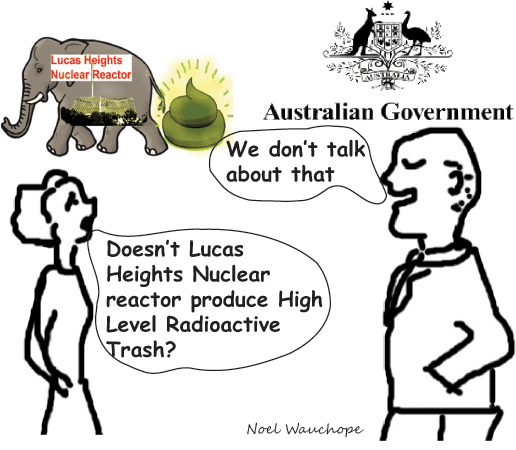
Paul Waldon Fight To Stop Nuclear Waste Dump In Flinders Ranges 26 Feb 18, SA We the people of South Australia, and the people of ANSTO, ARPANSA, and the DIIS, all have one common denominator, and that is “We don’t want nuclear waste in our backyards.”
Australia agreed to keep the waste as close as possible to the point of production, the day the Basel Convention was signed. However the DIIS are trying to sell this waste to all South Australians using our tax money, but can the SA taxpayer entice the residents of Barden Ridge to keep the waste by offering a few extra dollars. Yes, this is the deadly radioactive waste that they declared they were more than happy to reside alongside of when they purchased, built, moved into, or worked near Lucas heights. more https://www.facebook.com/groups/344452605899556/
Senator Cory Bernardi promises $445 billion for South Australia, if it hosts international nuclear waste dump
Cory Bernardi says a nuclear power dump could make us the ‘Saudi Arabia of the south’, news.com.au 26 Feb 18 CORY Bernardi is pushing to reignite a controversial development in South Australia, saying it could make the state the “Saudi Arabia of the south”.
LEADER of the Australian Conservatives party Cori Bernardi is pushing for a nuclear waste dump in South Australia, which he says will transform the state into the economic “Saudi Arabia of the south”.
Speaking at the party’s election launch in South Australia on Sunday, founder and federal Senator Cory Bernardi said he wanted to reopen the debate on an outback nuclear dump.
He called for changes to the law to allow for “all forms of energy production”, including nuclear power, urging authorities to “complete a full rigorous analysis” of the idea.
According to The Advertiser, he claimed the dump would generate up to $6.7 billion in gross state product, allow for $3 billion in annual taxes to be scrapped, and see the state reaping in $445 billion over the next century.
“Imagine that legacy for our children … to draw on in developing this state,” he said. “We would be an economic powerhouse. We would be the strongest state in the Commonwealth.”
Upper House candidate Robert Brokenshire said the party is “committed to looking at all types of energy production including nuclear energy to find the cheapest and most reliable form of energy”.
Labor Premier Jay Weatherill was quick to rule out the suggestion.
“That’s dead,” he said on Sunday. “Labor Party policy has been opposed to a nuclear waste facility in the past and there’s no prospect of changing that in the future.”
Mr Weatherill did not rule out pursuing a High Court case against the Turnbull government if a national nuclear waste dump was to be approved in South Australia, The Australian reported last month.
……..Earlier this month, the Australian Conservatives announced it will field 33 Lower House and two Upper House candidates at the state election on March 17. http://www.news.com.au/technology/environment/cory-bernardi-says-a-nuclear-power-dump-could-make-us-the-saudi-arabia-of-the-south/news-story/eb3f1ada5ed978646f53a2911f0e1c3d
South Australia: Senator Cory Bernardi ridicules Elon Musk, as he launches Australian Conservatives pro nuclear election Campaign
 SA election: Australian Conservatives launch nuclear dump idea and ridicule Elon Musk, By Daniel Keane , ABC News 25 Feb 18
Labor wavers back and forth on the Adani coal mine question.
Labor’s fence-sitting on Adani has become a double backflip, Guardian, 24 Feb 18
The backflip is standard operating procedure in professional politics, we all know that, but the double backflip is a somewhat rarer event.
Yet under the cover of yet another seismic convulsion inside the Turnbull government, Bill Shorten looks to be lining up for the dubious double on the controversial Adani coal mine. After signalling quite clearly in late January that Labor would toughen its position on the project, the Labor leader has cooled off noticeably on that notion over the past week or so.
Just before David Feeney announced he would resign from parliament because he couldn’t prove he was eligible to sit in the lower house, triggering a byelection in his lower house seat of Batman, Shorten used an appearance at the National Press Club to telegraph a shift on the mine.
Climate groups had been active with Shorten over the summer break, trying to persuade him to adopt a legal option of stopping the mine. The Labor leader changed the working formulation on the project in late January, and backed in the putative shift in the weeks immediately following, suddenly revving up the negative environmental impacts of the project.
a few things will matter to Labor at the next federal election. One will be having a climate policy that appeals to progressive as well as traditional voters. Another will be having a leader who isn’t perceived by voters as a flip-flopper, or a climate warrior of convenience.
While Labor can’t and shouldn’t forget blue collar workers and succumb entirely to the post materialist sensibilities of its inner urban constituency, toughening its line on Adani represented an opportunity for Labor to try to unify the progressive left, which has engaged in poisonous recriminations as a consequence of the toxic climate wars which have divided Australian politics for more than a decade……..https://www.theguardian.com/australia-news/2018/feb/24/labors-fence-sitting-on-adani-has-become-a-double-backflip
Submission to ARPANSA on the draft Code for Disposal of Solid Radioactive Waste
 Submission 1 to Code for Disposal of Solid Radioactive Waste (RPS C-3) By Noel Wauchope, 24 Feb 18
Regarding the type of radioactive wastes discussed
The big change in this Code is that it now applies to all types of disposal facility – meaning that higher level nuclear wastes are planned for. The draft Code states on page 9:
– “Australia has no high level waste (HLW) and is unlikely to possess any in the foreseeable 108 future”
But the plan is obviously to include reprocessed nuclear wastes returned to Lucas Heights, from France, where they are classified as High Level Wastes, not Intermediate Level Wastes (ILW) The vitrified waste we received back from France has a radioactivity over one Billion Becquerels per gram (one GigaBq/gr). France considers this High Level Waste http://inventaire.andra.fr/…/2006_summar…/files/docs/all.pdf
Many people are aware of the approx 10 cubic metres reprocessed spent fuel classed as ILW & returned from France in 2015. Not more generally known is the fact that there is much much more ILW destined for ‘temporary storage’ above ground (contrary to IAEA best practice) in the proposed repository
Currently there is no official determination about what is actually to be accumulated there – hence the delay in remediating the leaking drums at Woomera and failure to properly inform the local communities, also thereby wrongfully expecting them to sign off on an unknown quality/quantity.
Regarding the containers for transport and interim storage of radioactove wastes
CASKS. No detail is given in the draft Code, which calls for
“appropriate selection of waste forms and packaging”.
There are problems both in transport and in storage above ground for hundreds of years
For example – accidents, includng fires. The Mont Blac Tunnel was one fire in 1999 that had temperatures of 1000 degrees celsius, while dry cask tests only reach 760 degrees for no more than 20 minutes http://www.mace.manchester.ac.uk/…/Infrastructural…/mont.htm
There is no detail on the containers for radioactive waste. This is becoming an issue overseas. The Swedish Environmental Court has ruled against their planned radioactive waste repository because of concerns about the copper canisters planned. http://www.dianuke.org/landmark-swedish-court-judgment-nuc…/
USA’s The Nuclear Regulatory Commission (NRC) allows U.S. nuclear plants to store or transport spent fuel waste in thin walled welded stainless steel canisters designed to withstand a crash at 30 miles per hour https://www.newtimesslo.com/…/a-pact-with-the-devil/Content…
Britain has similar concerns. https://cumbriatrust.wordpress.com/…/swedens-problem-is-al…/ February 21, 2018by cumbriatrust
Regarding the transport and interim storage of radioactive wastes
TRANSPORT. In all its 65 pages has just the bare 2 lines, which refer the reader to another document. The dangers in transporting nuclearwastes for over 2000 km across the continent are glossed over. But it is well known that such transport over very long distances is risky. Washington, D.C. Mayor Carolyn Goodman – “Anywhere it’s transported is at risk because of the tunnels, the bridges, the railroads, the roads,” she said. “An accident … puts millions and millions of people around the country at risk for loss of life, cancer and everything else.” , https://lasvegassun.com/…/in-dc-goodman-highlights-dangers…/
INTERIM STORAGE. This is a nice phrase for what is likely to turn out to be STRANDED WASTES. Page 43 of the draft Code – “Near surface disposal facilities are generally designed on the assumption that 1295 institutional control has to remain in force for a period of time. For short lived waste, 1296 the period will have to be several tens to hundreds of years following closure.”
This Code will approve and give the go-ahead for the plan to have this temporary above-ground storage set up BEFORE there is any building of a permanent deep disposal repository.
Regarding the discussion of COMMUNITY
COMMUNITY . Page 17 of the draft Code defines “Community” In this Code the term ‘community’ is used to define the level of spatial and social organisation at which the issue of demographics must be addressed by the license applicant in terms of ‘the impact of the facility on the community in which the facility is, or is to be situated’. In general usage ‘community’ refers to a geographical area defined for the purpose of consultation.”
The Code thus eliminates the interest of the broader community – in rural South Australia, in the State of Sout hAustralia, and in the whole country.
Even while considering just the immediate local community, the Code states, on page 23, that one criterion for the location is that it must be a site “which has little or no potential for agriculture or outdoor recreational use”. I wonder what the farming community in the Kimba area think of this?
Department of Industry, Innovation and Science appoints giant American corporation AECOM to assess nuclear waste dump sites
AECOM (formerly known as AECOM Technology Corporation) is an American multinational engineering firm…AECOM traces its origins to Kentucky-based Ashland Oil & Refining Company,
 Successful Tenderer To Conduct Site Characterisation 2 February 2018
Successful tenderer to conduct site studies.
THE Department of Industry, Innovation and Science today announced AECOM is the successful tenderer to assess technical suitability of sites being considered for a National Radioactive Waste Management Facility.
The “site characterisation” works that they undertake under the contract will be conducted on all three of the nominated sites, currently being considered: two in Kimba and one at Wallerberdina Station……..
AECOM was the successful tenderer of five applicants, based on factors including its engineering and radioactive waste management experience, combined with specific experience operating in South Australia.
Radioactive waste is currently stored in more than 100 locations around Australia, and the Site Characterisation is part of Phase 2 of a process to establish a single, safe facility to consolidate the waste.
The facility will be the permanent repository for Australia’s low level radioactive waste, and it will also temporarily store our intermediate level radioactive waste………
“While these assessments are underway, our extensive community consultation will continue.
“Additionally, within the next week we will see the closing of applications for the Community Benefit Program for both communities, on Monday 5th February 2018.
“We have the right experts and the right staff in place to advance this project through various decision points this year,” McCleary said.
Department of Industry, Innovation and Science to set up another pro nuclear ‘Economic Working Group’ (EWG)
Kimba residents to be involved with nuclear economic investigation https://www.eyretribune.com.au/story/5241635/kimba-residents-to-be-involved-with-nuclear-economic-investigation/
Kimba residents have the chance to be directly involved in investigating economic opportunities and issues relating to the proposed National Radioactive Waste Management Facility.
As part of the Department of Industry, Innovation and Science’s ongoing consultation, an Economic Working Group (EWG) consisting of local community members will be established to consider the proposal.
Working group members will consider how economic benefits could be realised, or issues addressed, if Kimba is selected as the location for the national facility.
Opportunities that could come from the facility may include contracting works in construction, ongoing work during operation, and flow on roles in everything from the service industry to tourism.
Head of the National Radioactive Waste Management Facility Taskforce Bruce McCleary said the project had economic potential.
“This project has potential to generate significant local economic opportunities and this committee will give locals the chance to directly explore that,” he said.
“We know that local community members are best placed to highlight where there are local opportunities, and where more opportunities need to be created.
“Members of the Economic Working Group will work with the Kimba Consultative Committee and the department’s project team to discuss the ways the proposed facility could enhance the local community.
“The committee members will also be tasked with identifying any economic activities that could be impacted by the facility.”
The group will be based on the model already implemented in Barnidoota.
“I encourage all interested local community members – those for, against or undecided on the proposal, to put in an Expression of Interest in joining the Kimba Economic Working Group,” Mr McCleary said.
The Kimba Economic Working Group will consist of a maximum of 10 members, including a Chairperson.
Expressions of interest are now open and close at 5pm EDT on March 13 2018.
For more information on the selection criteria and how to apply to be a member of the Economic Working Group, go to www.radioactivewaste.gov.au.
REGARDING THE NATIONAL RADIOACTIVE WASTE MANAGEMENT FACILITY – summary of letter to Industry Minister Matt Canavan
 Medical Association for the Prevention of War (MAPW), 23 Feb 18 REGARDING THE NATIONAL RADIOACTIVE WASTE MANAGEMENT FACILITY (NRWMF )
1) The process is very divisive. Repeated, highly damaging processes imposed on previously cohesive communities are causing significant harms.
2) Considerable amounts of persistently misleading information have been and continue to be presented to communities. Incorrect and incomplete information does not result in genuine consent.
3) There is a failure to observe international best practice standards for the highly radioactive long lived intermediate level waste (ILW) management. There is no disposal plan whatsoever for ILW, leaving the problem for many future generations.
REGARDING THE EXPANSION OF NUCLEAR MEDICINE PRODUCTION FOR EXPORT
1) There is a lack of demonstrable “Net benefit”. The proposed 40 year-long expansion of medical isotope production needs genuine cost/benefit analysis to make sure this is not a heavily subsidised product being sold into the global market at the expense of the Australian community both now and in the future. Independent NEA/OECD economic modelling finds only 10-15% cost recovery of isotope manufacture when there is genuine inclusion of all costs.
2) The expansion will create 40 years of significantly increased production of ILW.
3) ANSTO has a narrative of global shortages, yet given falling demand and increasing global supply there is no shortage of Mo99. The NEA/OECD predict a significant oversupply.
4) Again, there is no plan whatsoever for disposal of the additional ILW generated.
Both processes are unacceptably flawed.
Medical Association for the Prevention of War (MAPW) urges
* A halt to the current NRWMF process until such time as world’s best practice is followed. There is sufficient capacity at the Lucas Heights facility, once regulatory approvals are met, to store Low Level Waste (LLW) and Intermediate Level Waste (ILW) well into the next decade.
* Cessation of expansion of nuclear medicine for export, and a phase out of exports, until there is demonstrated, publicly available, clear analysis of cost/benefit and plans for appropriate disposal of the substantial amount of ILW this process will generate.
* Transparent evaluation of “net benefit” to the Australian community. This as a whole must underpin the process, and be based on cradle to grave impacts of production.
* Recognition that currently the information provided to communities is riddled with so much misinformation it calls into question the underlying validity of any community consent process.
In closing, it is clear there is an urgent need for an independent inquiry into the production and management of Australia’s nuclear waste.
1 This month
25 October – Film –Britain’s Nuclear Bomb Scandal: Our Story – part of the Adelaide Film Festival,
Screening and Conversation
A screening of Britain’s Nuclear Bomb Scandal: Our Story (2024) followed by a talk with 2026 Bettison and James Awardee and Tradtional Owner Karina Lester in conversation with Simone Tur.
When: Sun 25 Oct, 12:00pm-Screening, 1:15pm-Talk
Where: The Mercury
Free admission, register below by clicking on BUY TICKETS and select free event tickets, at end of web page:
https://www.adelaidefilmfestival.org/program/2026/britains-nuclear-bomb-scandal-our-story
.

Australians deserve the truth
about
AUKUS – https://aukuspublicinquiry.com/

PETITION – To: Prime Minister Anthony Albanese and the Australian Labor Government

of the week – Australians for War Powers Reform (AWPR)
To see nuclear-related stories in greater depth and intensity

