Confusion about what types of nuclear waste are at Woomera, and planned for Kimba area
 Steve Dale “The mixture of water and concentrated radioactive material inside some of the drums also had the potential to produce explosive hydrogen gas, inspectors found.” There is now great risk to workers having to deal with this stuff. The nuclear lobbyists and pronuclear politicians won’t be the ones putting their life span at risk cleaning this radioactive mess up.
Paul Waldon Fight To Stop Nuclear Waste Dump In Flinders Ranges SA It would be a grave risk to endure a banquet blindfolded, with a food allergy. Yet the promotion of a deadly radioactive waste dump which the DIIS has “failed” to defined the different qualities, grade, and product sources of radiation would be a fatuous advance. Thus, the risk is “Paramount.” https://www.facebook.com/groups/344452605899556/
A renewable energy jobs boom is sweeping across regional Australia
 Renewable energy: powering Australia in more ways than one http://www.examiner.com.au/story/5229330/renewable-energy-is-powering-jobs-in-the-regions/?cs=97 James Wright 18 Feb 18 A jobs boom is sweeping across regional Australia and there’s one industry to thank – the renewable energy sector. From places like Gordon in southern Tasmania to Pindari in north-east NSW, new solar installations, windfarms, battery arrays, solar towers and pumped hydro facilities are springing life into regional towns. How are they doing this? By injecting desperately needed investment and job opportunities into remote locations.
In Far North Queensland, the Kidston solar array and pumped-hydro project will create 588 jobs this year. At the other end of the country in Port Augusta, Sundrop Farm’s first-of-its-kind solar tower for Australia creates another 200 jobs. Meanwhile over the border, Stawell in western Victoria is preparing for an influx of 1300 jobs from Nectar Farms combined windfarm, battery storage and 10-hectare hothouse facility.
This is great news! But despite the steady stream of new developments in regional areas, we’re actually being short-changed. Policy uncertainty due to ongoing internal squabbles in the Federal Government is strangling the growth of this sector and costing regional Australia the true jobs boom it deserves.
Australia has the richest renewable energy resources in the world. We have enough to power the nation 500 times over, yet we have some of the least ambitious renewable energy targets in the developed world.
If politicians could simply commit to a modest and achievable 50 per cent renewable energy target, this would create 28,000 new jobs. The vast majority would be in regional Australia where they are greatly needed to breathe new life into struggling local economies.
A renewable energy investment boom is a light on the horizon for many regional towns, we can’t let backwards politics spoil this once in a generation opportunity. James Wright is chief executive officer of the Future Business Council.
New schemes may help renters get solar panels on their roof – Australia’s solar energy boom
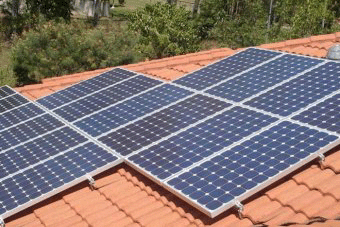 Solar boom: New schemes may help renters get solar panels on their roof, ABC Science, By Anna Salleh, 18 Feb 18,
Despite local opposition, Australian government still planning for nuclear waste dump in rural South Australia
 Planning is continuing for a nuclear waste disposal site in the South Australian outback, despite opposition from local residents. http://www.abc.net.au/news/2018-02-17/barndioota-nuclear-waste-site-planning-outrages-locals/9456052
 ABC North and West By Gary-Jon Lysaght 17 Feb 18 The Federal Government has shortlisted two sitesat Kimba on the Eyre Peninsula and one at Barndioota, south of Lake Torrens, near Hawker. The site that is chosen will become a permanent facility for low-level nuclear waste, and will temporarily hold intermediate-level waste.
The intermediate-level waste is currently being held at Lucas Heights, in Sydney’s south.
Barndioota is a gazetted area, and was a town between 1883 and 1929. Locals from Quorn and Hawker, the two communities closest to the Barndioota site, have been vocally opposing the site since planning began in 2015.
“We can see no reason why you’d bring stuff that’s temporarily stored somewhere else … to a completely new site that hasn’t even been built,” resident Greg Bannon said.
Mr Bannon is chairman of the Flinders Local Action Group, a community based organisation aimed at highlighting the problems with a nuclear waste storage facility in the Flinders Ranges.
He said the facility would have a significant impact on tourism, which was a chief economic driver for the Flinders Ranges.
“It’ll create a perception from tourists that they don’t want to go there,” Mr Bannon said.
“We think this facility is totally at odds with anything that’s promoted for the Flinders Ranges.”
Sacred women’s site in area The Adnyamathanha are the traditional owners of Barndioota, and have a sacred Aboriginal women’s site in the region. Enise March is the site’s custodian and said she had been astonished to hear the region was being considered for a nuclear waste disposal facility. “I received that message at 2 o’clock in the morning and I was shocked, extremely shocked,” she said.
“I felt as though I’d been hit in the back of the head with an axe.”
Region seismically active, ‘worst place’ for facility
The Barndioota site, and the entire Flinders Ranges, is considered seismically active.
Flinders University emeritus professor in geology Chris Vonderborch said because of this, it was the worst place to put a nuclear waste facility. “It seems to tick all the wrong boxes for a safe disposal site,” he said. “If you look at past earthquakes around Australia, they’ll line up and down the front of the Flinders Ranges. “It’s an area that can have earthquakes.”
Professor Vonderborch said if the facility was built, the nuclides from it could form a surface sediment on Lake Torrens. “Anything that goes in there comes to the surface, or gets washed in to the surface, and then it’s got a very good chance of blowing who knows where, towards Port Augusta or whatever,” he said.
What nuclear waste will be stored?
Low-level waste Emits radiation at levels that generally require minimal shielding during handling, transport and storage
Examples include paper, plastic, gloves, cloths and filters which contain small amounts of radioactivity
Could include items, such as test tubes, that have come into contact with nuclear medicine
Intermediate Waste Emits a higher level of radiation and requires additional shielding
Generated from radiopharmaceutical production and reactor operations
For example, steel rods that come from the reactors Source: ANSTO
Update on Submissions to the Australian Senate Inquiry on Nuclear Waste Dump Site Selection

The National Radioactive Waste Management Facility Project seems hellbent on keeping this matter “in the family” – the family being itself and a small group of local supporters in the sites already volunteering.
So, it could be a bit of a spanner in the works, for the Australian Senate to be having a Committee of Inquiry into the process. That seems to be inviting outsiders to have a say on the subject of transporting radioactive trash, particularly spent nuclear fuel rod trash 2000 km across Australia, to sit in above ground canisters “temporarily” near Kimba, South Australia.
Who are the Committee members? We don’t know. When will it report back? That’s on August 14th, which might be too late – the site selection might have been made by then.
Anyway, people can send in Submissions by April 3rd, and I urge you to do so.
Four pro nuclear submissions are already published on the Senate Committee site.
These submissions come from:
- Denise Carpenter – member of the Barndioota Consultative Committee. This Committee’s role is to help determine which is the best site for a National Radioactive Waste Dump.
- Ian Carpenter is an enthusiastic member of the Hawker Economic Working Group – “set up t0 investigate how local people at Barndioota, near Hawker and Quorn, 330km north of Adelaide could benefit if radioactive waste is stored there.”
- Chelsea Haywood
- Janice Alex McInnis
I have skimmed through the 4 submissions already published, and they are pretty crummy, repetitive pro nuclear stuff – all emphasising that the writer thinks that the Federal Nuclear Waste Dump is really a matter for the local, not the wider, community.
For example, Chelsea Haywood writes:
broad community support should be kept to those that will be affected should this proposal move forward. By this I mean that there is no need to involve the entire state as it will not impact on them either way should the project go ahead or not.
So far, 4 pro nuclear Submissions to Senate Committee on nuclear waste dump selection.
M y advice to those writing submissions is to take your time, and do it properly.
I have skimmed through the 4 submissions already published, and they are pretty crummy, repetitive pro nuclear stuff – all emphasising that the writer thinks that the Federal Nuclear Waste Dump is really a matter for the local, not the wider, community
The writers are: Denise Carpenter, Ian Carpenter, Chelsea Haywood and Janice Alex McInnis
Nuclear waste dump? A new abuse for Brewarrina’s Aboriginal people?

Brewarrina, or “Bre” as it is known, is an historic and fascinating town on the Barwon-Darling River. New South Wales.With 68% of the local population identifying as indigenous it is essentially an Aboriginal town. ….
It is hard to underestimate the importance of the Aboriginal stone fish traps which, at 40,000 years old, may be the oldest man-made structures on the planet.
Brewarrina was the scene of a huge massacre of Aboriginals. “They rounded them up like cattle, old and young, on the Quantambone plain, and shot them. It is said that there were about 400 and that was how Hospital Creek got its name”
 No Nuclear Bundabunda at Brewarrina – bad poison [SIGN THE PETITION] https://www.thepetitionsite.com/513/682/502/no-nuclear-bundabunda-at-brewarrina-bad-poison/?taf_id=51207201&cid=fb_na#bbfb=750086702
If Nuclear waste was so safe why is it taken over 35years to find a site, why are they seeking to build in isolated communities with the majority off the population being Aboriginal?
Brewarrina is known worldwide for the oldest man-made structure in the world with Baiame’s Ngunnhu Fish Traps and we want to keep it that way, not to be known as a nuclear waste facility.
The local Council approached the Federal Government for this proposal without consultation with the community and without negotiation with the Local Land Council or the Ngemba Community Working Party or other local councils.
We believe the health of the community will be at risk. We are being promised 15 jobs, what is 15 jobs compared to the health of the community and the land and water.
There are other options available to boost the economy of the town such as solar power, tourism and the abattoirs.
No Nuclear Bundabunda at Brewarrina – bad poison
(please note; 7 out of 9 Councillors have supported this proposal)
The Greens will table our petition in Federal Parliament.
South Australia a global leader in clean energy: Institute for Energy Economics and Financial Analysis (IEEFA)
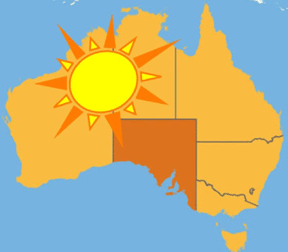 IEEFA: South Aust among world leaders in transition to wind, solar, ECO News, By David Twomey -February 14, 2018
National Radioactive Waste Management Project is deceiving local communities
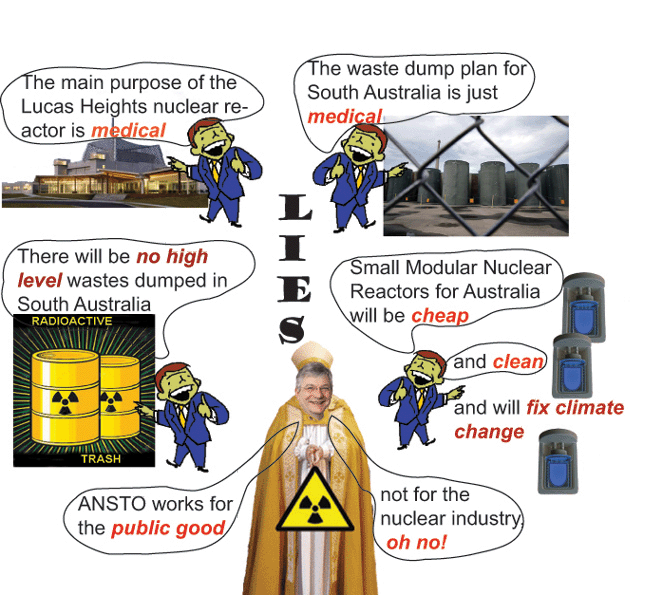
EnuFF[SA https://www.facebook.com/sanuclearfree/, 14 Feb 18, Many people are aware of the approx 10 cubic metres reprocessed spent fuel classed as ILW & returned from France in 2015. Not more generally known is the fact that there is much much more ILW destined for ‘temporary storage’ above ground (contrary to IAEA best practice) in the proposed suppository.
Trying to get current figures is nigh on impossible. If anyone has access to such then please share that knowledge with us….
One abject failure of the National Radioactive Waste Management Project to fully inform local communities, the State Parliament, or even their own Federal Minister, are facts about the so-called Intermediate Level Waste (ILW). Even those who are following the issue may only be aware of the approx 10 cubic metres of reprocessed fuel returned from France in 2015. However, there is much much more ILW. Below is an extract table of Australia’s ILW inventory from 1999 (now 2018 & there could be more):
Waste forms to be accepted at a long-lived intermediate level waste store
ANSTO Radioisotope Production solid waste
ANSTO-HIFAR spent fuel reprocessing waste COGEMA glass matrix DOUNREY cemented Yet to be returned
ANSTO-HIFAR decommissioning waste Care & maintenance
ANSTO-OPAL Operational waste Prior to OPAL start Spent fuel reprocessing Yet to eventuate Eventual decommissioning Yet to eventuate
Over 600 cubic metres of ILW initially placed in a ‘temporary’ above ground store & each year another 7 added with an open-ended time frame – could be for decades to come. 1 Primary source: “National Radioactive Waste Repository Site Selection Study – A Report on Public Comment”, Department of Industry, Science and Resources, June 1999, page 48 https://industry.gov.au/resource/Documents/radioactive_waste/report_on_public_comment_phase_3.pdf viewed 13/02/18
The machinations of Australia’s military-industrial-nuclear complex macho men
 Claudio Pompili Nuclear Fuel Cycle Watch South Australia, 14
  Feb 18,
The most articulate and informed assessment of the machinations by and aspirations of Australia’s military-industrial machine to align our foreign ‘defence’ policy with that of the US and, insidiously, surreptitiously create an environment for the potential acquisition of tactical nuclear weapons, either in our own right or by proxy. The new proposed ‘state secrets’ legislation by the LNP government is a necessary step in this direction.
This explains the persistent campaigns in Australia over recent decades to develop nuclear power generation programs that are acknowledged, critical enablers of military nuclear programs. The nuclear aspirations of the Menzies LNP governments of the 50s to own ‘the bomb’ are alive and well in Canberra.
The recent purchase of French-design nuclear submarines converted to diesel-powered drives is an obvious contender for such initiatives. Inexorably, the pro-nuclear cheer squad and its strategists, both in military-intelligence, such as the Australia Strategic Policy Institute, or in civil society, such as Ben Heard’s ‘nuclear will save the environment’ astro-turfing initiatives, will be clamouring to have the ‘real deal’ nuclear-powered subs.
SA’s NFCRC, led by former Rear Admiral Kevin Scarce, was an active promoter of nuclear military weaponry. His NFCRC demurred on outright recommending nuclear power generation, for now, but instead pushed for the world’s first international high-level nuclear waste dump in SA, based on a single, spurious economic cost-benefit analysis coupled with an illegal, publicly-funded propaganda juggernaut stemming directly from Premier Jay Weatherill’s department. This push was supported by powerful sectors of the Adelaide business establishment including Big Miners, such as BHP and Santos, and promoted by Murdoch’s The Adelaide Advertiser tabloid. A temporary reprieve in the nuclear industry campaign was effected by the majority report of the Second Citizen’s Jury that recommended ‘no expansion of the nuclear fuel cycle under any circumstances’.
Premier Weatherill has declared the nuclear dump initiative “dead” but Blind Freddy would add “for now”.
UK’s Cumbria Trust point to serious concerns about nuclear dump plans and “Working with communities”
 “Working with communities” – we have serious concerns https://cumbriatrust.wordpress.com/2018/02/14/working-with-communities-we-have-serious-concerns/ February 14, 2018
Kimba or Wallerberdina Station could be stuck with Stranded Radioactive Trash
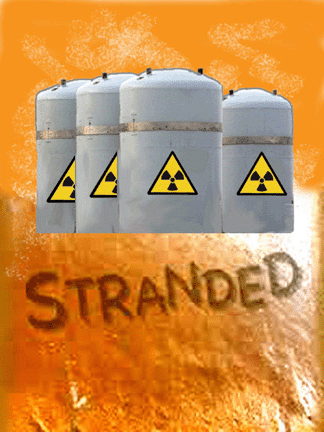 Noel Wauchope, https://cooberpedytimes.com/news-paper/ , 8 Feb 18 I am feeling quite uneasy about the over-confident tone of the latest statement about the National Radioactive Waste Management Facility.The General Manager of the National Radioactive Waste Management Taskforce Bruce McCleary says:
“We have the right experts and the right staff in place to advance this project through various decision points this year.”
Just who are these “right experts”, and what is their agenda?
We, the public, have been given to understand that this radioactive waste facility is all about promoting medicine, by storing “medical” wastes. Medical radioactive wastes are almost entirely are classified as “low level” – especially as, for the vast majority, their radioactive half-lives are so short – a matter of hours or a few days. It stands to reason that these wastes don’t need to be transported about 3200 Km across the continent.
Now we learn that the South Australian dump site will “temporarily store our intermediate level radioactive waste”. This sounds awfully like the reprocessed nuclear wastes that are returning to the Lucas Heights nuclear reactor site from France, and England. The vitrified waste we received back from France has a radioactivity over one Billion Becquerels per gram (one GigaBq/gr). France considers this High Level Waste http://inventaire.andra.fr/…/2006_summar…/files/docs/all.pdf
The fact that this facility, planned for Kimba or other sites in the region is to be stored “temporarily”, means that the plan is to send it to Kimba or Wallaerberdina Station BEFORE there is any plan for its permanent disposal.
Kimba or Wallerberdin a Station, or whoever is the “successful” applicant is likely to be stuck with that problem already hitting American communities – having “stranded n clear wastes”. This would be a very bad outcome for an area that has previously been known as agricultural, clean and green
Julian Assange loses bid to have UK arrest warrant withdrawn
Why is the Australian government giving no help to this Australian citizen?
ABC News 14 Feb 18, A British judge has upheld an arrest warrant for Julian  Assange, saying the WikiLeaks founder should have the courage to come to court and face justice after more than five years inside Ecuador’s London embassy.
Key points:
- Mr Assange can seek to appeal, though his lawyers did not say whether he would
- He faces arrest if he leaves Ecuador’s London embassy
- His attorney argues that arresting him was no longer proportionate or in the public interest
Judge Emma Arbuthnot rejected arguments by Mr Assange’s lawyers that it is no longer in the public interest to arrest him for jumping bail in 2012 and seeking shelter in the embassy to avoid extradition to Sweden.
Prosecutors there were investigating allegations of sexual assault and rape made by two women, which Mr Assange has denied.
Judge Arbuthnot did not mince words in her ruling at Westminster Magistrates’ Court, saying that by jumping bail, Mr Assange had made “a determined attempt to avoid the order of the court”.
She said Mr Assange appeared to be “a man who wants to impose his terms on the course of justice”.
Mr Assange can seek to appeal, though his lawyers did not immediately say whether he would.
Swedish prosecutors dropped their investigation last year, saying there was no prospect of bringing Mr Assange to Sweden in the foreseeable future.
But the British warrant for violating bail conditions still stands, and Mr Assange faces arrest if he leaves the embassy.
Mr Assange’s lawyers had asked for the warrant to be withdrawn since Sweden no longer wants him extradited, but the judge rejected their request last week.
His attorney had gone on to argue that arresting him was no longer proportionate or in the public interest.
Lawyer Mark Summers argued the Australian was justified in seeking refuge in the embassy because he had a legitimate fear that US authorities want to arrest him for WikiLeaks’ publication of secret documents.
Judge Arbuthnot dismissed another plank of Mr Assange’s case — a report from a UN working group which said the 46-year-old was being arbitrarily detained.
“I give little weight to the views of the working group,” the judge said, noting that Mr Assange had “restricted his own freedom for a number of years”.
Julian Assange’s bid for freedom
While court hearings for Julian Assange’s bid for freedom are interesting steps in a long running saga, the end game is far more complicated, writes Lisa Millar.
Mr Assange’s lawyer had argued that the five-plus years Mr Assange had spent inside the embassy were “adequate, if not severe” punishment for his actions, noting that he had health problems including a frozen shoulder and depression….
..The ruling leaves the long legal impasse intact. Apart from the bail-jumping charge — for which the maximum sentence is one year in prison — Mr Assange suspects there is a secret US grand jury indictment against him for WikiLeaks’ publication of classified documents, and that American authorities will seek his extradition.
Mr Assange’s lawyers say he is willing to face legal proceedings in Britain, but only if he receives a guarantee that he will not be sent to the US to face prosecution. That is not an assurance Britain is likely to give. ……http://www.abc.net.au/news/2018-02-14/julian-assange-loses-bid-to-have-uk-arrest-warrant-withdrawn/9444540
Wangan Jagalingou oppose Adani coal mine expansion – NO EXTINGUISHMENT OF NATIVE TITLE
Letter to the QLD Premier – there should be no extinguishment of Native Title, by Wangan Jagalingou wanganjagalingou.com.au/author/wj/
There should be no extinguishment of Native Title without our consent
‘The W&J Council received its most recent mandate at a meeting of the W&J claim group on 2 December 2017.
The letter informed the Government that the W&J claim group opposes the Adani Mining Pty Ltd project because of the damage that it will cause to the culture, and the lands and waters,
of the Wangan and Jagalingou People.
‘W&J council also oppose the registered Indigenous Land Use Agreement (ILUA) with Adani Mining Pty Ltd
purported to be authorised by the Wangan and Jagalingou People
in controversial circumstances (“the Adani ILUA”).
‘W&J council uphold the decisions of the claim group who,
on four separate occasions (the last being at the authorisation meeting of 2 December 2017),
have rejected the Adani ILUA. …wanganjagalingou.com.au/letter-to-the-qld-premier-there-should-be-no-extinguishment-of-native-title/
Close the Gap and Apology are band-aid measures – a far cry from treaties & decolonisation
 Sovereign Union of First Nations and Peoples in Australia, Asserting Australia’s First Nations Sovereignty into Governance, www.sovereignunion.mobi, 12 February 2018,
Ghillar, Michael Anderson, Convenor of the Sovereign Union, last surviving member of the founding four of the Aboriginal Embassy and Leader of the Euahlayi Nation said from Goodooga today:
“I don’t believe a modern treaty process will get any further than the National Aboriginal Conference (NAC) did, unless Sovereign First Nations declare sovereign independence through UDIs and force decolonisation through a united front. Understandably, First Nations’ assertions of sovereignty have been honed in the intervening 30 plus years. I constantly remind our people that our reality is we hold the continental Common Law, but are occupied by a foreign power ruling in right of the British Crown. Until this changes through decolonisation, Close the Gap, Apology and other government policies remain as band aid measures.”
Statement in full:
“So long as a Rhodes Scholar is running this country the vested interests of the British Crown are paramount and remain in line with mining magnate Cecil Rhodes’ legacy of educating scholars to run and exploit a country for Britain’s benefit. PM Malcolm Turnbull, a Rhodes Scholar with a Bachelor of Civil Law from Brasenose College, Oxford is the latest agent of the coloniser to ensure First Nations’ inherent sovereign rights to lands, waters and natural resources are quashed.
This is consistent with Turnbull’s continuing fiasco of the Closing the Gap agenda, which has clearly failed, despite minor improvements announced today. In reality, the Turnbull government wants to either abandon the Close the Gap program, or water down the targets, despite recent recommendations from the UN Committee for the Elimination of Racial Discrimination (CERD), to do otherwise and properly engage with ‘Indigenous people’. [ http://www.abc.net.au/news/2018-02-08/closing-the-gap-review-finds-policy-effectively-abandoned-by-gov/9405100 ] & [https://www.theguardian.com/australia-news/2018/feb/08/closing-the-gap-turnbull-rejects-claims-government-has-abandoned-strategy ]
Turnbull may talk about ‘refreshing’ Close the Gap to appear in line with the CERD recommendations of 2017, but fails to provide the requested ‘disaggregated data’ for a proper evaluation. In fact, the Turnbull government is belligerently ignoring the CERD’s 2017 findings, which were strategically released on Boxing Day, 26 December 2017. CERD was highly critical of Australia’s treatment of First Nations and Peoples and failure to address remedies.
At para 19 the CERD states:
- … despite statements by the State Party that it rejects the principle ofterra nulliusgrounded in the “discovery discourse”, the State party continues to conduct its relations with indigenous peoples, in a manner that is not reconcilable with their rights to self-determination and to own and control their lands and natural resources.
Once again the CERD recommends Australia ‘enter into good faith treaty negotiations’ [para20]. This is, in fact, a recognition of First Nations’ pre-existing and continuing sovereignty because the only meaning of treaty in modern international law is an agreement between sovereign Nations.
The CERD also recommends ‘that the State party move urgently to effectively protect the land rights of indigenous peoples, including by amending the Native Title Act 1993, with a view to lowering the standard of proof required and simplifying the applicable procedures. It also urges the State party to ensure that the principle of free, prior and informed consent is incorporated into the Native Title Act 1993 and into other legislation, as appropriate, and fully implemented in practice.’ [ CERD/C/AUS/CO/18-20 ] (emphasis added)
Read more of this Statement by Ghillar when it becomes available at:www.sovereignunion.mobi
1 This month
25 October – Film –Britain’s Nuclear Bomb Scandal: Our Story – part of the Adelaide Film Festival,
Screening and Conversation
A screening of Britain’s Nuclear Bomb Scandal: Our Story (2024) followed by a talk with 2026 Bettison and James Awardee and Tradtional Owner Karina Lester in conversation with Simone Tur.
When: Sun 25 Oct, 12:00pm-Screening, 1:15pm-Talk
Where: The Mercury
Free admission, register below by clicking on BUY TICKETS and select free event tickets, at end of web page:
https://www.adelaidefilmfestival.org/program/2026/britains-nuclear-bomb-scandal-our-story
.

Australians deserve the truth
about
AUKUS – https://aukuspublicinquiry.com/
PETITION – To: Prime Minister Anthony Albanese and the Australian Labor Government

of the week – Australians for War Powers Reform (AWPR)
To see nuclear-related stories in greater depth and intensity

