Longterm slump in uranium industry looks like being permanent
Very few mines could operate at a profit at current prices. Some mines are profitable because earlier contracts stipulated higher prices, while many mines are operating at a loss.
And with the cost of a single power reactor climbing to as much as $20 billion, proposals to introduce nuclear power to Australia seem more and more quixotic and are now largely limited to the far right ‒ in particular, Australians Conservatives’ luminary Senator Cory Bernardi and the Minerals Council of Australia.
BHP marketing vice-president Vicky Binns said in December 2017 that uranium markets would remain oversupplied for close to a decade, with downward pressure remaining on uranium prices
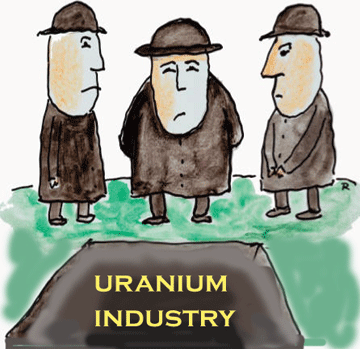 Uranium industry slumps, nuclear power dead in the water Jim Green, Online Opinion, 23 F
……….These days, the market exhibits multiple levels of weirdness, all stemming from the growing acknowledgment that nuclear power and the uranium industry face a bleak future.
The uranium market has a “subdued outlook” and Cameco’s uranium is now “more valuable in the ground” according to Warwick Grigor from Far East Capital, because the cost of production is higher than the prices currently being offered. Cameco CEO Tim Gitzel agrees, saying in January 2018 that at current prices “our supply is better left in the ground.” So uranium industry executives and market analysts are finally coming around to rallying cry of the anti-uranium movement: Leave it in the ground!
We’ve also had the odd situation over the past year of nuclear lobbyists arguing repeatedly that the nuclear power industry is in “crisis” and wondering what if anything can be salvaged from “the ashes of today’s dying industry“. Usually such claims come from the anti-nuclear movement ‒ sometimes more in hope that expectation.
And we’ve had the odd situation of industry bodies (such as the US Nuclear Energy Institute) and supporters (such as former US energy secretary Ernest Moniz) openly acknowledging the connections between nuclear power and weapons ‒ connections they have strenuously denied for decades.
Such arguments are now being used in an effort to secure preferential treatment for uranium mining companies in the US. Ur-Energy and Energy Fuels have lodged a petition with the Department of Commerce seeking a mandated requirement for US power utilities purchase a minimum 25% of their requirements from US mines. Uranium is “the backbone of the U.S. nuclear deterrent and fuels ships and submarines in the U.S. Navy”, the companies state………
Another miserable year for the uranium industry Nuclear power has been stagnant for the past 20 years. Although power reactors account for an overwhelming majority of uranium demand, uranium production ‒ and prices ‒ have been up and down and all over the place.
Uranium mine production increased by 50% from 2007 to 2016. The increase was driven, initially at least, by expectations of the nuclear renaissance that didn’t eventuate. Mine production plus secondary sources (e.g. stockpiles and ex-military material) have consistently exceeded demand ‒ 2017 was the eleventh consecutive year of surplus according to the CEO of uranium company Bannerman Resources.
Stockpiles (inventories) have grown steadily over the past decade to reach enormous levels ‒ enough to keep the entire global reactor fleet operating for around eight years. Supply from mines and secondary sources in recent years has exceeded demand by about 18%.
Those dynamics have put downward pressure on prices. After six years of steady decline, uranium prices were flat in 2017. The spot price as of 1 December 2017 was less than one-third of the pre-Fukushima price and the long-term contract price less than half the pre-Fukushima price.
Countless would-be uranium mining companies have given up, some trying their luck in other areas such as property development or growing dope. Some mines have closed, others have been put into care-and-maintenance, and others have reduced output. But supply has continued to exceed demand ‒ and to exert downward pressure on prices.
Very few mines could operate at a profit at current prices. Some mines are profitable because earlier contracts stipulated higher prices, while many mines are operating at a loss. Many companies have been loathe to close operating mines, or to put them into care-and-maintenance, even if the only other option is operating at a loss. They have been playing chicken, hoping that other companies and mines will fold first and that the resultant loss of production will drive up prices. “We have to recognise that we over-produce, and we are responsible for this fall in the price,” said Areva executive Jacques Peythieu in April 2017.
Current prices would need to more than double to encourage new mines ‒ a long-term contract price of about US$70–$80 is typically cited as being required to encourage the development of new mines.
The patterns outlined above were repeated in 2017. It was another miserable year for the uranium industry. A great year for those of us living in uranium producing countries who don’t want to see new mines open and who look forward to the closure of existing mines. And a great year for the nuclear power industry ‒ in the narrow sense that the plentiful availability of cheap uranium allows the industry to focus on other problems.
Cut-backs announced
The patterns that have prevailed over the past five years or so might be changed by decisions taken by Cameco and Kazatomprom (Kazakhstan) in late 2017 to significantly reduce production. Continue reading
Brewarrina residents step up campaign against proposed nuclear dump.
 22 Feb 18 Brewarrina residents, including Ngemba people with local cultural responsibilities, are stepping up their campaign against the proposal for national nuclear waste dump in the region.
A silent vigil will be held during the Council meeting at 8:30am this Friday February 23, followed with a rally on Saturday morning at 9:30am.
In November 2017 the Brewarrina Council revealed that a delegation had traveled to Lucas Heights nuclear reactor in Sydney and subsequently engaged pro-nuclear consultant Robert Parker.
Trish Frail, a Ngemba woman who is coordinating the local campaign to oppose the dump, said the community was shocked by the proposal.
“This nuclear facility will not benefit our town, the community or the environment,” Ms Frail said.
“Ngemba people are custodians for the Ngunnhu Fish Traps. The site is claimed to be over sixty thousand years old and is heritage listed, being the oldest man-made structure in the world.”

“The Biami Traps were once a great gathering site for all clans to trap fish and to host corroborees, initiation ceremonies, and meetings for trade and barter.”
“A lot of our younger generation are talking about moving away if a nuclear dump is built on our land, they will lose our culture and our lore, this must not happen. The young people have been helping.”
“Brewarrina will not become a nuclear dumping ground for the Australian Government. We say No Nuclear Bundabunda (poison) on Ngemba Land – Bad Poison,” Ms Frail concluded.
Facebook events
Friday vigil: https://www.facebook.com/events/1222018404595401/?ti=icl
Saturday rally: https://www.facebook.com/events/186908808568897/?ti=icl
Premier Jay Weatherill says that South Australia’s election will be a referendum on renewables
 Weatherill: Why state election will be
  referendum on renewables, REneweconomy, By Giles Parkinson on 22 February 2018
South Australia Premier Jay Weatherill might not be able to see much daylight between his Labor Party and the rival Liberals and SA Best, but he’s certainly making sure there is a big difference between his energy policy and those of the Opposition and the upstart party of Nick Xenophon.
Over the past few weeks, before and since the start of the official election campaign, Weatherill has been trotting out almost daily announcements about significant new investments and new targets for renewable energy and energy storage in the state.
It was capped this week with his world-leading 75 per cent renewables target by 2025, the Australia-first “renewable storage” target of 750MW, Australia’s first battery manufacturing plant, to be built by Germany’s sonnen, and any number of individual renewable and storage projects.
There is good reason for this. Renewable energy, according to the polls, is a lot more popular than the Labor government, struggling under the burden of 16 years in power and about an even bet with the Liberals, with Xenophon the wild-card.
…….Weatherill insists the pursuit of renewable energy has been a success. The Australian Energy Market Operator, having “dropped the ball” is now managing the system properly (new CEO Audrey Zibelman has been a “breath of fresh air”, he says), and renewables have not been the cause of any outages.
“What we have demonstrated is that despite having 48.9 per cent renewable energy, we haven’t had any reliability issues that caused outages because of the size of our renewable energy,” Weatherill says
The blackouts in September 2016, and in February last year, were caused by major weather events and failures in the National Energy Market, the latter when “perfectly good supply” (a major unit at the Pelican Point gas generator) was not switched on because of “the way the market works.”
That prompted the SA government to intervene, building its own emergency back-up, and launching a series of initiatives that has seen the world’s biggest lithium-ion battery built by Tesla, and the world’s biggest solar tower with molten salt storage due in 2020.
This has been accompanied by a series of investments and studies in battery storage, pumped hydro and hydrogen energy projects, along with virtual power plants and micro-grids.
And the Tesla big battery, next to the Hornsdale wind farm, is already having an impact, particularly in markets that provide network services known as FCAS (Frequency Control and Ancillary Services).
“The Tesla big battery is already smashing the FCAS market, and we will get fantastic benefits from not being ripped of by the existing generators for those FCAS services,” Weatherill says.
………Labor’s 75 per cent renewable energy target compares to the Liberals pledge to can any state-based initiative, even though both have programs to encourage battery storage in households.
Xenophon’s SA Best is only now starting to roll out its policy proposals, which include creating a new “not-for-profit” retailer, and a tender for 150MW of “dispatchable” renewables.
Weatherill is hopeful Labor can continue without having to strike a deal with Xenophon’s SA Best, but says he is confident, if he must, in being able to convince Xenophon to come on board with Labor’s energy policy, notwithstanding Xenophon’s support of anti-wind campaigns in the past.
“I think I can persuade Nick that this is an appropriate future for South Australia,” he says. “I hope to get there on my lonesome without a coalition. If we do (need to strike a deal), I won’t be compromised on this, because it is critical for the future of the state.”…….http://reneweconomy.com.au/weatherill-why-state-election-will-be-referendum-on-renewables-47132/
Labor’s doublespeak about Adani coal mine plan
Greens use Labor’s Adani indecision to ramp up Batman campaign
Activists seize upon Labor’s contradictory messages on Queensland coalmine in battle for inner-city Melbourne, Guardian, Katharine Murphy Political editor@murpharoo 21 Feb 2018 18.
Townsville City Council censors documentary about Adani coal megamine plan
 Anti-Adani documentary screening axed for safety reasons, not politics, council says, ABC News, 21 Feb 18 By Josh Robertson Public safety concerns, not politics, were behind the axing of the screening of a documentary on the Stop Adani protest movement, a north Queensland council says.
The latest comments on ARPANSA’s site about Code for Radioactive Wastes
James & Cindy Shepherdson We feel very strongly that there should be no consideration at all of having any type of radioactive waste stored on agricultural land. ARPANSA also needs to take into consideration the social ramifications of any proposed site on any populated, productive land.
Janet Tiller Nuclear waste and food producing districts do not mix. I say no.
The whole process is flawed and one sided. The guidelines keep changing when the outcomes don’t suit what the government are seeking.
Graham Tiller BROAD community support. Set figure 70% and dont change it.
Completely transparent and fair process a must.Not the present pathetic process. Not to be on any agriculture aquaculture and horticulture areas of food producing land. Food and nuclear waste do not mix . Clean and Green
The yes / no vote should be the whole state not just one town.
Local vote to be 100km radius of nominated sites. Neighboring councils should be notified and have input .
GrahamTiller Continuous lies, change of guide lines, half truths proper gander misleading information have been a issue through the whole process period in kimba. And of course the 2 mill. bribe and the 10mill. bigger bribe . Not much for the destruction of a ounce perfect safe and prosperous community . Greed sums it up, it’s all about the money. https://www.arpansa.gov.au/code-disposal-solid-radioactive-waste-rps-c-3
Hunters Hill residents still waiting on government to clean up uranium contaminated land
 Hunters Hill residents wary of latest announcement on uranium contamination, ABC News, 20 Feb 18, By Jade Macmillan
Residents on Sydney’s lower north shore have dismissed the Government’s latest plans to clean up land contaminated by a uranium smelter more than hundred years ago as “a hollow promise”.
Property Minister Victor Dominello announced $30 million to remediate the waterfront land on Nelson Parade in Hunters Hill, the former site of the Radium Hill refinery, which closed in 1915.
The area was also occupied by a carbolic acid plant until the early 1900s and a tin smelter until the 1960s.
Residents have spent decades urging the Government to remove the affected soil, which the NSW Environment Protection Authority found it was contaminated with petroleum hydrocarbons, coal tar pitch, arsenic and lead.
“Having this funding should give the community confidence that we are determined to remediate the site,” Mr Dominello said, ahead of a public meeting of more than 200 residents on Tuesday night.
“The Government is currently considering suitable disposal locations for the waste, and is in discussions with the Federal Government on the possibility of using the proposed National Radioactive Waste Management Facility earmarked for development in South Australia.”
The minister did not provide a timeframe for the works and a site for the radioactive facility has not yet been selected.
Rosemary Manusu, 80, who has lived on Nelson Parade for more than 50 years, said she had little faith in the announcement after years of inaction from successive governments.
“It’s been promised and promised about three or four times. So until they actually start moving it, I don’t believe a word they say,” she said……http://www.abc.net.au/news/2018-02-21/hunters-hill-uranium-contamination-residents-wary/9468272
Mark Parnell outlines The Greens environment policy for the coming South Australian election
 At the South Australian State Election Leaders’ Forum on the environment “South Australia: Our Future”, I outlined the Greens vision for an environment that is clean, healthy and resilient.
Protecting South Australia’s environment means:
• 100% renewable energy by 2025
• A healthy River Murray
• Valuing our wildlife and biodiversity
• Protecting the Great Australian Bight
• Opposing destructive and polluting industries
• Marine sanctuaries
• Investing in our National Parks and Reserves
• No nuclear waste dump
• Enhancing urban open spaces and landscapes
Nuclear waste canisters will themselves eventually become toxic radioactive trash
 Paul Richards No Nuclear Waste Dump Anywhere in South Australia, 20 Feb 18, Even if they were the to last not 4, 40, or world’s best practice type with the limited liability guarantee of a 100 years;
The canisters after any time period, create yet more nuclear waste, along with their toxic radioactive contents, that all have to be repackaged creating more nuclear material to be stored.
This process, of repackaging, whether it’s 4, 40, or a 100 years, goes on indefinitely.
To add another layer of complexity to this utterly illogical process, this waste grows exponentially over this indefinite timeline of essential care.
As nothing but steady decay into volatile, life-damaging radionuclides occurs, phasing from one type to the next. A process that literally is indefinite, unimaginable in human governance terms. Even ‘if’ no nuclear waste and unspent fuel are created by the nuclear cycle, of mining, milling, rod construction and the reactor outcomes, including decommissioning reactors.
The pretense that Lucas Heights nuclear spent fuel rods are an “asset”. No, they are wastes
Steve Dale Nuclear Fuel Cycle Watch South Australia If France and others stop reprocessing our spent nuclear reactor fuel, some organisations will no longer be able to call it “an asset”.
“‘The spent fuel rods at Lucas Heights can only sensibly be treated as high level waste. The pretence that spent fuel rods constitute an asset must stop” from the Research Reactor Review, Future Reactions: Report of the Research Reactor Review, 1993
Australia’s shocking cruelty to Aboriginal people with disabilities: Solitary confinement
‘The abuse of Aboriginal prisoners with disabilities in Australian jails is confronting, and ongoing.
‘In Part 3 of this special series for New Matilda, Michael Brull looks at the use of
solitary confinement against disabled Aboriginal prisoners,
exposed in a report written by Human Rights Watch‘
‘Human Rights Watch (HRW) observes that under international law, solitary confinement means
confining a prisoner for 22 hours or more per day “without meaningful human contact”.
Prolonged solitary confinement occurs when solitary confinement is extended past 15 consecutive days.
‘HRW documents in its report that various specialists on international law
from various United Nations human rights organisations have found that under international law,
it is unacceptable to impose solitary confinement on people with disabilities
under any circumstances. … ‘
Read Part 3 of MichaelBrull‘s interesting, thought-provoking, comprehensive, compassionate & concerned article
focusing on the SolitaryConfinement of AboriginalPeopleWithDisabilities:
newmatilda.com/2018/02/19/behind-bars-part-3-australias-shocking-cruelty-aboriginal-people-disabilities-solitary-confinement/
Eleven members of the Turnbull Government openly support nuclear power for Australia
 In March 2017, eleven members of the Turnbull Government were listed as openly supporting the prospect of nuclear power in Australia. Listed politicians were: Andrew Broad, James Paterson, Tony Pasin, Tim Wilson, Chris Back, Craig Kelly, Eric Abetz, Andrew Hastie, Warren Entsch, Bridget McKenzie and Rowan Ramsey.[34] http://everything.explained.today/Nuclear_industry_in_South_Australia/
To Feb 19 these are all the published comments on ARPANSA’s site about Code for Radioactive Wastes
Amy Koch I am from Kimba and I say NO!!
If there is no issue with this effecting our business then there is no reason that we can’t get a guaranteed from our industry representatives that our profitable farming business will not be effected by the proposed sight?
A clear indication of “Broad community support” is a must. Minister Canavan stated support of 65% was needed to go forward into phase two and yet he put kimba through with Only 57% there is a huge difference there. Clear guidelines needed!
Brett Burnard Stokes I denounce the covert administration of radioactive poisons to pregnant Australian women and their children.
I demand that production of radioactive poisons cease and that the perpetrators of these poisonings be brought to justice.
I challenge the perpetrators to actually measure the effects of their covert administration of radioactive poisons to pregnant Australian women and their children.
I denounce the current use of junk science to justify these covert poisonings.
Anonymous I am strongly against this and this whole process. It has made my Community divided, my family stressed and finally my decision to leave this town.
Anonymous ATLA Adnymathana Traditional Lands Association voted unamiously against the Radioactive Waste Dump proposal at Wallerbedina in the Flinders Ranges.ANSTO ignored the Media release by ATLA in 2016
Anonymous Particle accelerators are providing a cleaner (no highly radioactive, long lived waste) alternative to nuclear reactors for producing medical isotopes.Download PDF
Justine Major There is no mention of the impact of this facility upon existing industries when undertaking site selection. I feel there needs to be an inclusion of a clause (perhaps at 3.1.29 of the Code) along the lines of “sufficient evidence is provided that the cohabitation of this facility with existing industries will have minimal negative impact on existing industries”. This evidence needs to be relevant to Australia, not international equivalents.
Denise Carpenter ( member of the Barndioota Consultative Committee. This Committee’s role is to help determine which is the best site for a National Radioactive Waste Dump.) I am confident, after a lot or research on the subject, that ARPANSA is a regulatory body that will ensure that world best practice procedures will be stringently followed and adhered to and I am happy for a repository to go ahead in our area.
ARPANSA’s stringent regulations will ensure safety is paramount both for nuclear storage and the wellbeing of everyone working or living in the vicinity.
ARPANSA draft Code for Disposal of Solid Radioactive Waste – Comments deadline postponed to 2nd March
 This process is about determining the nature of the material to be dumped in the proposed x3 SAust radioactive suppositories.
Currently there is no official determination about what is actually to be accumulated there – hence the delay in remediating the leaking drums @ Woomera & failure to properly inform the local communities.
Also thereby wrongfully expecting them to sign off on an unknown quality/quantity.
ARPANSA is engaging in public consultation on the draft Code for Disposal of Solid Radioactive Waste (Radioactive Waste Disposal Code).
to – Senate Standing Committee -Stop nuclear waste threats in South Australia
 Stop nuclear waste threats in South Australia https://www.facebook.com/StopNuclearWasteThreatsInSouthAustralia/posts/398850867208130to – Senate Standing Committees on Economics
via email economics.sen@aph.gov.au
Subject – Selection process for a national radioactive waste management facility in South Australia
Terms of Reference addressed:
e) whether wider (Eyre Peninsular or state-wide) community views should be taken into consideration and, if so, how this is occurring or should be occurring;
======================================
Dear Committee Members
I am one of hundreds of South Australians who have signed the following Online Open Letter calling for police action against illegal threats to import nuclear waste and to establish nuclear waste dump(s).
Please take note of this community rejection of nuclear waste importation into South Australia.
Please take note of this community support for the laws which prohibit nuclear waste importation into South Australia.
Please cease this process which threatens present and future South Australians and shows contempt towards South Australian law.
Best wishes
from Brett Stokes
Dear Commissioner of Police,
We are citizens of Australia who want action taken to enforce the law, including the South Australian Nuclear Waste Storage Facility (Prohibition) Act 2000 (abbreviated herein as the NWSF(P) Act 2000).
We are sick and tired of being threatened with illegal importation of nuclear waste.
We are sick and tired of public money being spent illegally to plan and promote illegal importation of nuclear waste.
We want action now to stop current threats of illegal importation of nuclear waste. We want action now to deter future threats of illegal importation of nuclear waste.
It is clear that the NWSF(P) Act 2000 has been breached.
During 2015 and 2016, s13 has been breached by spending of public money on many promotional and planning aspects of illegal nuclear waste importation, as briefly described in Appendix A.
Since early 2016, there has been an open conspiracy to breach s8 and s9, with planning and promotion of importation and storage of nuclear waste into South Australia, as briefly described in Appendix B.
There are ten year imprisonment penalties and multi million dollar fines for offences – these are very serious penalties, in accord with the gravity of the threat.
As well as these offences against the NWSF(P) Act 2000, there are also other offences, including fraud, which may become more apparent as your investigation proceeds.
Please act now to enforce the law.
Please act now to end this illegal threat.
Please act now to “protect the health, safety and welfare of the people of South Australia and to protect the environment in which they live”. (Quote from s3 Objects of Act of the NWSF(P) Act 2000)
Thank you for your attention to this important matter.
Signed (Name and Postcode)
1 Tim Baker 5081 signed on 2016-11-24 at 20:30 (ACDT)
2 Brett Stokes 5118 signed on 2016-11-24 at 21:15 (ACDT)
3 John Mcgovern 5472 signed on 2016-11-24 at 22:35 (ACDT)
4 Zac Eagle 5159 signed on 2016-11-24 at 23:29 (ACDT)
5 James DeAth 5155 signed on 2016-11-25 at 00:13 (ACDT)
6 Paigen Hunter 5433 signed on 2016-11-25 at 01:04 (ACDT)
7 Daryl Gibson 2430 signed on 2016-11-25 at 06:19 (ACDT)
8 Greg Waldon 5481
signed on 2016-11-25 at 06:27 (ACDT)
9 Tanya Hunter 5000 signed on 2016-11-25 at 06:38 (ACDT)
10 Paul Levai 5433 signed on 2016-11-25 at 07:31 (ACDT)
11 Fernando M. Gonçalves 5022 signed on 2016-11-25 at 07:54 (ACDT)
12 Edi Carlos de Oliveira 5085 signed on 2016-11-25 at 08:06 (ACDT)
13 Patsy Laver 2573 signed on 2016-11-25 at 09:30 (ACDT)
14 Ty Haddrick 5230 signed on 2016-11-25 at 09:37 (ACDT)
15 Mark Wallman 5013 signed on 2016-11-25 at 10:38 (ACDT)
16 Louise McCauley 5166 signed on 2016-11-25 at 10:42 (ACDT)
17 Brett Derschow 6722 signed on 2016-11-25 at 11:08 (ACDT)
18 Paddy Tobin 2663 signed on 2016-11-25 at 11:11 (ACDT)
19 Susan Thiselton 5690 signed on 2016-11-25 at 11:20 (ACDT)
20 Letitia Kemister 2777 signed on 2016-11-25 at 11:21 (ACDT)
,,, continued ,,, >https://www.aph.gov.au/Parliamentary_Business/Committees/Senate/Economics/Wastemanagementfacility
1 This month
25 October – Film –Britain’s Nuclear Bomb Scandal: Our Story – part of the Adelaide Film Festival,
Screening and Conversation
A screening of Britain’s Nuclear Bomb Scandal: Our Story (2024) followed by a talk with 2026 Bettison and James Awardee and Tradtional Owner Karina Lester in conversation with Simone Tur.
When: Sun 25 Oct, 12:00pm-Screening, 1:15pm-Talk
Where: The Mercury
Free admission, register below by clicking on BUY TICKETS and select free event tickets, at end of web page:
https://www.adelaidefilmfestival.org/program/2026/britains-nuclear-bomb-scandal-our-story
.

Australians deserve the truth
about
AUKUS – https://aukuspublicinquiry.com/

PETITION – To: Prime Minister Anthony Albanese and the Australian Labor Government

of the week – Australians for War Powers Reform (AWPR)
To see nuclear-related stories in greater depth and intensity

